Ultrapar Participacoes Porter's Five Forces Analysis

Elevate Your Analysis with the Complete Porter's Five Forces Analysis
Ultrapar Participacoes navigates a complex landscape shaped by intense rivalry and significant buyer power, particularly within its fuel distribution segment. The threat of new entrants, while present, is somewhat mitigated by high capital requirements and established brand loyalty.
The complete report reveals the real forces shaping Ultrapar Participacoes’s industry—from supplier influence to threat of new entrants. Gain actionable insights to drive smarter decision-making.
Suppliers Bargaining Power

Supplier Concentration and Importance of Inputs
Ultrapar's fuel distribution business, Ipiranga, relies heavily on refined petroleum products, with Petrobras being the primary domestic supplier in Brazil. Petrobras's significant control over upstream and refining operations grants it considerable leverage. In 2023, Petrobras accounted for a substantial portion of Brazil's total oil production, underscoring its critical role in the supply chain.
Switching Costs for Ultrapar
Ultrapar's bargaining power with its suppliers is significantly influenced by switching costs. For refined fuels and liquefied petroleum gas (LPG), changing major suppliers involves substantial investments in adapting existing logistics, storage facilities, and distribution channels. This makes it challenging and costly to shift away from established partners.
Securing new, long-term supply contracts with alternative producers or international importers is a complicated and lengthy undertaking. This process often requires extensive due diligence, negotiation, and regulatory approvals, further solidifying the position of existing suppliers. In 2023, Ultrapar's revenue was R$133.8 billion, highlighting the scale of operations impacted by these supplier relationships.

Threat of Forward Integration by Suppliers
Major upstream players, such as Petrobras, hold the potential to expand their direct distribution operations. This could directly impact Ultrapar by reducing the volume of products available for Ultrapar to distribute, thereby diminishing its market share and profitability.
While such a strategic shift would necessitate substantial capital investment from suppliers, the mere possibility of forward integration serves as a significant source of leverage. This latent threat grants suppliers considerable bargaining power in their dealings with downstream companies like Ultrapar.
For instance, in 2024, Petrobras's significant market share in fuel production and its existing distribution infrastructure position it as a formidable potential competitor if it chooses to integrate forward. This capability inherently limits Ultrapar's negotiating power on pricing and supply terms, as suppliers can credibly threaten to bypass intermediaries.

Availability of Substitute Inputs
While fossil fuels continue to be the primary inputs for Ultrapar's energy businesses, the landscape is gradually shifting. Brazil's growing emphasis on biofuels, such as ethanol, and alternative sources like natural gas and biomethane presents new avenues for sourcing. This diversification, though still developing, has the potential to lessen the leverage of traditional suppliers in the long term.
Ultragaz, a key subsidiary, is actively exploring the distribution of biomethane. This strategic move could, over time, broaden its supply chain for liquefied petroleum gas (LPG), offering a counterbalance to established suppliers.
- **Diversification of Energy Inputs:** Brazil's energy sector is seeing increased adoption of biofuels and natural gas, offering alternative input streams for companies like Ultrapar.
- **Ultragaz's Biomethane Initiative:** The company's exploration of biomethane distribution aims to diversify its LPG supply chain, potentially reducing reliance on traditional sources.
- **Long-Term Impact on Supplier Power:** This gradual diversification, while currently nascent, is expected to incrementally decrease the bargaining power of suppliers in the future.
Supplier's Contribution to Ultrapar's Cost Structure
The cost of fuel and LPG from suppliers forms a significant chunk of Ultrapar's operating expenses. For instance, in 2023, the cost of goods sold for Ultrapar's fuel distribution segment was R$56.3 billion, highlighting the direct impact of supplier pricing on its bottom line. These raw material costs are highly sensitive to global energy markets.
Given that fluctuations in international oil and gas prices directly influence these input costs, suppliers wield considerable power. If Ultrapar cannot fully pass these price increases onto its customers, its profitability is directly impacted. This cost sensitivity clearly demonstrates the inherent bargaining power held by Ultrapar's raw material suppliers.
- Fuel and LPG Costs: A major component of Ultrapar's expenditures.
- Global Price Sensitivity: Input costs are directly tied to international oil and gas markets.
- Profitability Impact: Inability to pass on cost increases erodes profit margins.
- Supplier Leverage: Raw material providers possess significant influence over Ultrapar's costs.
Supplier Power Shapes Ultrapar's Fuel Distribution Future
Ultrapar's primary suppliers, particularly for refined fuels and LPG, possess considerable bargaining power. This stems from Petrobras's dominant position in Brazil's oil production and refining, with the company accounting for a significant share of the nation's output. The high switching costs associated with changing major fuel suppliers, requiring extensive logistical and infrastructure adaptations, further solidify the leverage of existing partners.
The potential for suppliers like Petrobras to integrate forward into distribution presents a significant threat, limiting Ultrapar's negotiating leverage. For instance, Petrobras's substantial market share and existing infrastructure in 2024 underscore its capability to bypass intermediaries. While Ultrapar is exploring diversification into biofuels and biomethane, these alternatives are still developing and have yet to significantly diminish the power of traditional fossil fuel suppliers.
| Metric | 2023 Value (R$ billions) | Significance |
| Ultrapar Revenue | 133.8 | Indicates scale of operations affected by supplier relationships |
| Cost of Goods Sold (Fuel Distribution) | 56.3 | Highlights direct impact of supplier pricing on profitability |
What is included in the product
 Detailed Word Document
This analysis tailors Porter's Five Forces to Ultrapar Participacoes, revealing the intensity of rivalry, buyer and supplier power, threat of new entrants, and the impact of substitutes on its diverse business segments.

 Customizable Excel Spreadsheet
Instantly assess Ultrapar's competitive landscape with a clear, actionable visualization of Porter's Five Forces, enabling swift identification of strategic opportunities and threats.
Customers Bargaining Power

Customer Fragmentation in Retail Fuel and LPG
For Ultrapar's Ipiranga and Ultragaz businesses, the customer base is incredibly spread out, encompassing millions of individual drivers and small businesses. This wide distribution means that no single customer holds much sway. In 2023, for instance, Ultrapar's fuel distribution segment served a vast network, and the sheer volume of individual transactions underscores this fragmentation.
While individual customers have limited power due to their small scale, their collective price sensitivity is a significant consideration. Consumers of fuel and LPG are often looking for the best deals, and even small price differences can influence purchasing decisions. This sensitivity means that maintaining competitive pricing is crucial for Ultrapar to retain its broad customer base.
Price Sensitivity and Homogeneous Products
In Brazil's fuel and LPG markets, products from major players like Ultrapar (Ipiranga), Vibra Energia, and Raízen are largely the same. This lack of differentiation means customers, both individuals and businesses, are highly sensitive to price differences. They can easily switch suppliers if another offers a better deal or greater convenience.
This ease of switching significantly boosts customer bargaining power. For instance, in 2023, fuel prices saw considerable fluctuations, with retail gasoline prices in São Paulo averaging around R$5.80 per liter, creating an environment where even small price advantages could sway customer loyalty. This intense price competition, particularly in densely populated urban areas, forces distributors to compete aggressively on cost.

Low Switching Costs for Customers
For individual consumers, switching fuel stations or LPG providers involves minimal cost or effort, further empowering them to choose the most favorable option. This ease of switching intensifies competition and forces distributors like Ultrapar to maintain competitive pricing and service levels to retain market share.

Customer Concentration in Logistics (Ultracargo)
Ultracargo, a key player in Brazil's logistics sector, faces significant customer concentration, particularly with large industrial clients like petrochemical and agribusiness firms. These major customers, due to the substantial volumes of liquid storage they require, possess considerable bargaining power. This allows them to negotiate terms and pricing, potentially squeezing Ultracargo's profit margins.
For instance, in 2023, Ultrapar, Ultracargo's parent company, reported that its revenue from fuel distribution, a segment often involving large clients, was R$115.1 billion. While this figure isn't solely attributable to Ultracargo's logistics services, it highlights the scale of operations with large industrial customers within the group. The ability of these clients to switch providers or threaten to do so gives them leverage.
- Customer Concentration: Ultracargo serves large industrial clients in sectors like petrochemicals and agribusiness, who require significant bulk liquid storage.
- Bargaining Power: These large clients wield substantial bargaining power due to the volume of services they procure and their ability to negotiate favorable terms.
- Margin Impact: The leverage held by these key customers can directly impact Ultracargo's profitability by putting downward pressure on service prices.
Threat of Backward Integration by Customers
The threat of backward integration by customers, while not a significant concern for Ultrapar's retail fuel segment, could be a consideration for its industrial clients. Large commercial entities in sectors like logistics or energy might explore developing their own storage and distribution infrastructure.
However, the substantial capital outlay and the need for specialized technical know-how present considerable barriers. For instance, building a fuel terminal requires hundreds of millions of dollars in investment and extensive regulatory approvals, making it economically unfeasible for most of Ultrapar's B2B customers. This high barrier significantly diminishes the likelihood of widespread backward integration across Ultrapar's customer base.
- High Capital Investment: Building fuel storage and distribution facilities can cost upwards of $100 million, a prohibitive sum for most potential integrators.
- Specialized Expertise Required: Operating such infrastructure demands significant technical and logistical expertise, which many companies may lack.
- Regulatory Hurdles: Obtaining permits and complying with environmental and safety regulations for fuel handling is a complex and lengthy process.
- Focus on Core Competencies: Most industrial customers prefer to concentrate on their primary business operations rather than investing in ancillary infrastructure.
Customer Power: Fragmented vs. Concentrated Influence
For Ultrapar's fuel and LPG businesses, the bargaining power of customers is generally low due to a highly fragmented customer base, particularly among individual consumers. While millions of drivers and small businesses purchase fuel, no single entity commands significant influence. This widespread distribution, exemplified by Ultrapar's extensive network in 2023, means individual customer impact is minimal.
However, the collective price sensitivity of these numerous customers is a key factor. Consumers actively seek competitive pricing, making product differentiation difficult in the largely commoditized fuel and LPG markets. This forces Ultrapar to maintain aggressive pricing strategies to retain its broad customer base, especially given the ease with which customers can switch providers.
In contrast, Ultracargo, Ultrapar's logistics arm, faces higher customer bargaining power from its large industrial clients in sectors like petrochemicals and agribusiness. These major customers, requiring substantial volumes of liquid storage, can negotiate favorable terms and pricing, impacting Ultracargo's profit margins. For instance, in 2023, Ultrapar's fuel distribution revenue reached R$115.1 billion, indicating the scale of operations with large B2B clients.
| Customer Type | Bargaining Power Factor | Impact on Ultrapar | Example Data (2023) |
|---|---|---|---|
| Individual Consumers (Fuel/LPG) | Low (fragmented, low volume per customer) | Limited direct impact; high collective price sensitivity | Millions of transactions; average retail gasoline price ~R$5.80/liter (SP) |
| Industrial Clients (Ultracargo) | High (concentrated, high volume) | Potential for price negotiation, margin pressure | R$115.1 billion fuel distribution revenue (group level) |
Preview the Actual Deliverable
Ultrapar Participacoes Porter's Five Forces Analysis
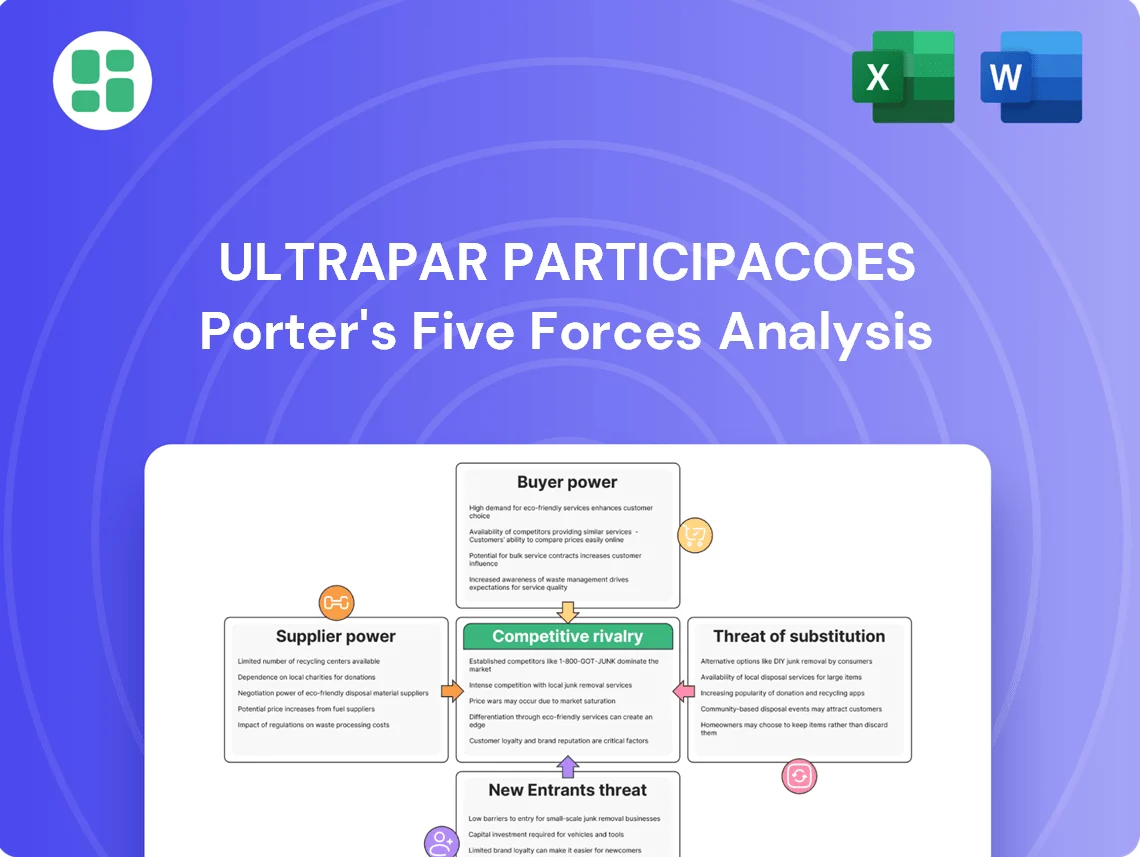
This preview shows the exact document you'll receive immediately after purchase—no surprises, no placeholders. The comprehensive Porter's Five Forces analysis of Ultrapar Participacoes details the competitive landscape, including the bargaining power of buyers and suppliers, the threat of new entrants and substitutes, and the intensity of rivalry within its diverse business segments like fuel distribution, LPG, and specialty chemicals.

Product Information
Product Information
Shipping & Returns
Shipping & Returns
Ultrapar Participacoes Porter's Five Forces Analysis
Ultrapar Participacoes Porter's Five Forces Analysis
Elevate Your Analysis with the Complete Porter's Five Forces Analysis
Ultrapar Participacoes navigates a complex landscape shaped by intense rivalry and significant buyer power, particularly within its fuel distribution segment. The threat of new entrants, while present, is somewhat mitigated by high capital requirements and established brand loyalty.
The complete report reveals the real forces shaping Ultrapar Participacoes’s industry—from supplier influence to threat of new entrants. Gain actionable insights to drive smarter decision-making.
Suppliers Bargaining Power
Supplier Concentration and Importance of Inputs
Ultrapar's fuel distribution business, Ipiranga, relies heavily on refined petroleum products, with Petrobras being the primary domestic supplier in Brazil. Petrobras's significant control over upstream and refining operations grants it considerable leverage. In 2023, Petrobras accounted for a substantial portion of Brazil's total oil production, underscoring its critical role in the supply chain.
Switching Costs for Ultrapar
Ultrapar's bargaining power with its suppliers is significantly influenced by switching costs. For refined fuels and liquefied petroleum gas (LPG), changing major suppliers involves substantial investments in adapting existing logistics, storage facilities, and distribution channels. This makes it challenging and costly to shift away from established partners.
Securing new, long-term supply contracts with alternative producers or international importers is a complicated and lengthy undertaking. This process often requires extensive due diligence, negotiation, and regulatory approvals, further solidifying the position of existing suppliers. In 2023, Ultrapar's revenue was R$133.8 billion, highlighting the scale of operations impacted by these supplier relationships.
Threat of Forward Integration by Suppliers
Major upstream players, such as Petrobras, hold the potential to expand their direct distribution operations. This could directly impact Ultrapar by reducing the volume of products available for Ultrapar to distribute, thereby diminishing its market share and profitability.
While such a strategic shift would necessitate substantial capital investment from suppliers, the mere possibility of forward integration serves as a significant source of leverage. This latent threat grants suppliers considerable bargaining power in their dealings with downstream companies like Ultrapar.
For instance, in 2024, Petrobras's significant market share in fuel production and its existing distribution infrastructure position it as a formidable potential competitor if it chooses to integrate forward. This capability inherently limits Ultrapar's negotiating power on pricing and supply terms, as suppliers can credibly threaten to bypass intermediaries.
Availability of Substitute Inputs
While fossil fuels continue to be the primary inputs for Ultrapar's energy businesses, the landscape is gradually shifting. Brazil's growing emphasis on biofuels, such as ethanol, and alternative sources like natural gas and biomethane presents new avenues for sourcing. This diversification, though still developing, has the potential to lessen the leverage of traditional suppliers in the long term.
Ultragaz, a key subsidiary, is actively exploring the distribution of biomethane. This strategic move could, over time, broaden its supply chain for liquefied petroleum gas (LPG), offering a counterbalance to established suppliers.
- **Diversification of Energy Inputs:** Brazil's energy sector is seeing increased adoption of biofuels and natural gas, offering alternative input streams for companies like Ultrapar.
- **Ultragaz's Biomethane Initiative:** The company's exploration of biomethane distribution aims to diversify its LPG supply chain, potentially reducing reliance on traditional sources.
- **Long-Term Impact on Supplier Power:** This gradual diversification, while currently nascent, is expected to incrementally decrease the bargaining power of suppliers in the future.
Supplier's Contribution to Ultrapar's Cost Structure
The cost of fuel and LPG from suppliers forms a significant chunk of Ultrapar's operating expenses. For instance, in 2023, the cost of goods sold for Ultrapar's fuel distribution segment was R$56.3 billion, highlighting the direct impact of supplier pricing on its bottom line. These raw material costs are highly sensitive to global energy markets.
Given that fluctuations in international oil and gas prices directly influence these input costs, suppliers wield considerable power. If Ultrapar cannot fully pass these price increases onto its customers, its profitability is directly impacted. This cost sensitivity clearly demonstrates the inherent bargaining power held by Ultrapar's raw material suppliers.
- Fuel and LPG Costs: A major component of Ultrapar's expenditures.
- Global Price Sensitivity: Input costs are directly tied to international oil and gas markets.
- Profitability Impact: Inability to pass on cost increases erodes profit margins.
- Supplier Leverage: Raw material providers possess significant influence over Ultrapar's costs.
Supplier Power Shapes Ultrapar's Fuel Distribution Future
Ultrapar's primary suppliers, particularly for refined fuels and LPG, possess considerable bargaining power. This stems from Petrobras's dominant position in Brazil's oil production and refining, with the company accounting for a significant share of the nation's output. The high switching costs associated with changing major fuel suppliers, requiring extensive logistical and infrastructure adaptations, further solidify the leverage of existing partners.
The potential for suppliers like Petrobras to integrate forward into distribution presents a significant threat, limiting Ultrapar's negotiating leverage. For instance, Petrobras's substantial market share and existing infrastructure in 2024 underscore its capability to bypass intermediaries. While Ultrapar is exploring diversification into biofuels and biomethane, these alternatives are still developing and have yet to significantly diminish the power of traditional fossil fuel suppliers.
| Metric | 2023 Value (R$ billions) | Significance |
| Ultrapar Revenue | 133.8 | Indicates scale of operations affected by supplier relationships |
| Cost of Goods Sold (Fuel Distribution) | 56.3 | Highlights direct impact of supplier pricing on profitability |
What is included in the product
Detailed Word Document
This analysis tailors Porter's Five Forces to Ultrapar Participacoes, revealing the intensity of rivalry, buyer and supplier power, threat of new entrants, and the impact of substitutes on its diverse business segments.
Customizable Excel Spreadsheet
Instantly assess Ultrapar's competitive landscape with a clear, actionable visualization of Porter's Five Forces, enabling swift identification of strategic opportunities and threats.
Customers Bargaining Power
Customer Fragmentation in Retail Fuel and LPG
For Ultrapar's Ipiranga and Ultragaz businesses, the customer base is incredibly spread out, encompassing millions of individual drivers and small businesses. This wide distribution means that no single customer holds much sway. In 2023, for instance, Ultrapar's fuel distribution segment served a vast network, and the sheer volume of individual transactions underscores this fragmentation.
While individual customers have limited power due to their small scale, their collective price sensitivity is a significant consideration. Consumers of fuel and LPG are often looking for the best deals, and even small price differences can influence purchasing decisions. This sensitivity means that maintaining competitive pricing is crucial for Ultrapar to retain its broad customer base.
Price Sensitivity and Homogeneous Products
In Brazil's fuel and LPG markets, products from major players like Ultrapar (Ipiranga), Vibra Energia, and Raízen are largely the same. This lack of differentiation means customers, both individuals and businesses, are highly sensitive to price differences. They can easily switch suppliers if another offers a better deal or greater convenience.
This ease of switching significantly boosts customer bargaining power. For instance, in 2023, fuel prices saw considerable fluctuations, with retail gasoline prices in São Paulo averaging around R$5.80 per liter, creating an environment where even small price advantages could sway customer loyalty. This intense price competition, particularly in densely populated urban areas, forces distributors to compete aggressively on cost.
Low Switching Costs for Customers
For individual consumers, switching fuel stations or LPG providers involves minimal cost or effort, further empowering them to choose the most favorable option. This ease of switching intensifies competition and forces distributors like Ultrapar to maintain competitive pricing and service levels to retain market share.
Customer Concentration in Logistics (Ultracargo)
Ultracargo, a key player in Brazil's logistics sector, faces significant customer concentration, particularly with large industrial clients like petrochemical and agribusiness firms. These major customers, due to the substantial volumes of liquid storage they require, possess considerable bargaining power. This allows them to negotiate terms and pricing, potentially squeezing Ultracargo's profit margins.
For instance, in 2023, Ultrapar, Ultracargo's parent company, reported that its revenue from fuel distribution, a segment often involving large clients, was R$115.1 billion. While this figure isn't solely attributable to Ultracargo's logistics services, it highlights the scale of operations with large industrial customers within the group. The ability of these clients to switch providers or threaten to do so gives them leverage.
- Customer Concentration: Ultracargo serves large industrial clients in sectors like petrochemicals and agribusiness, who require significant bulk liquid storage.
- Bargaining Power: These large clients wield substantial bargaining power due to the volume of services they procure and their ability to negotiate favorable terms.
- Margin Impact: The leverage held by these key customers can directly impact Ultracargo's profitability by putting downward pressure on service prices.
Threat of Backward Integration by Customers
The threat of backward integration by customers, while not a significant concern for Ultrapar's retail fuel segment, could be a consideration for its industrial clients. Large commercial entities in sectors like logistics or energy might explore developing their own storage and distribution infrastructure.
However, the substantial capital outlay and the need for specialized technical know-how present considerable barriers. For instance, building a fuel terminal requires hundreds of millions of dollars in investment and extensive regulatory approvals, making it economically unfeasible for most of Ultrapar's B2B customers. This high barrier significantly diminishes the likelihood of widespread backward integration across Ultrapar's customer base.
- High Capital Investment: Building fuel storage and distribution facilities can cost upwards of $100 million, a prohibitive sum for most potential integrators.
- Specialized Expertise Required: Operating such infrastructure demands significant technical and logistical expertise, which many companies may lack.
- Regulatory Hurdles: Obtaining permits and complying with environmental and safety regulations for fuel handling is a complex and lengthy process.
- Focus on Core Competencies: Most industrial customers prefer to concentrate on their primary business operations rather than investing in ancillary infrastructure.
Customer Power: Fragmented vs. Concentrated Influence
For Ultrapar's fuel and LPG businesses, the bargaining power of customers is generally low due to a highly fragmented customer base, particularly among individual consumers. While millions of drivers and small businesses purchase fuel, no single entity commands significant influence. This widespread distribution, exemplified by Ultrapar's extensive network in 2023, means individual customer impact is minimal.
However, the collective price sensitivity of these numerous customers is a key factor. Consumers actively seek competitive pricing, making product differentiation difficult in the largely commoditized fuel and LPG markets. This forces Ultrapar to maintain aggressive pricing strategies to retain its broad customer base, especially given the ease with which customers can switch providers.
In contrast, Ultracargo, Ultrapar's logistics arm, faces higher customer bargaining power from its large industrial clients in sectors like petrochemicals and agribusiness. These major customers, requiring substantial volumes of liquid storage, can negotiate favorable terms and pricing, impacting Ultracargo's profit margins. For instance, in 2023, Ultrapar's fuel distribution revenue reached R$115.1 billion, indicating the scale of operations with large B2B clients.
| Customer Type | Bargaining Power Factor | Impact on Ultrapar | Example Data (2023) |
|---|---|---|---|
| Individual Consumers (Fuel/LPG) | Low (fragmented, low volume per customer) | Limited direct impact; high collective price sensitivity | Millions of transactions; average retail gasoline price ~R$5.80/liter (SP) |
| Industrial Clients (Ultracargo) | High (concentrated, high volume) | Potential for price negotiation, margin pressure | R$115.1 billion fuel distribution revenue (group level) |
Preview the Actual Deliverable
Ultrapar Participacoes Porter's Five Forces Analysis
This preview shows the exact document you'll receive immediately after purchase—no surprises, no placeholders. The comprehensive Porter's Five Forces analysis of Ultrapar Participacoes details the competitive landscape, including the bargaining power of buyers and suppliers, the threat of new entrants and substitutes, and the intensity of rivalry within its diverse business segments like fuel distribution, LPG, and specialty chemicals.
Product Information
Product Information
Shipping & Returns
Shipping & Returns
Description
Elevate Your Analysis with the Complete Porter's Five Forces Analysis
Ultrapar Participacoes navigates a complex landscape shaped by intense rivalry and significant buyer power, particularly within its fuel distribution segment. The threat of new entrants, while present, is somewhat mitigated by high capital requirements and established brand loyalty.
The complete report reveals the real forces shaping Ultrapar Participacoes’s industry—from supplier influence to threat of new entrants. Gain actionable insights to drive smarter decision-making.
Suppliers Bargaining Power
Supplier Concentration and Importance of Inputs
Ultrapar's fuel distribution business, Ipiranga, relies heavily on refined petroleum products, with Petrobras being the primary domestic supplier in Brazil. Petrobras's significant control over upstream and refining operations grants it considerable leverage. In 2023, Petrobras accounted for a substantial portion of Brazil's total oil production, underscoring its critical role in the supply chain.
Switching Costs for Ultrapar
Ultrapar's bargaining power with its suppliers is significantly influenced by switching costs. For refined fuels and liquefied petroleum gas (LPG), changing major suppliers involves substantial investments in adapting existing logistics, storage facilities, and distribution channels. This makes it challenging and costly to shift away from established partners.
Securing new, long-term supply contracts with alternative producers or international importers is a complicated and lengthy undertaking. This process often requires extensive due diligence, negotiation, and regulatory approvals, further solidifying the position of existing suppliers. In 2023, Ultrapar's revenue was R$133.8 billion, highlighting the scale of operations impacted by these supplier relationships.
Threat of Forward Integration by Suppliers
Major upstream players, such as Petrobras, hold the potential to expand their direct distribution operations. This could directly impact Ultrapar by reducing the volume of products available for Ultrapar to distribute, thereby diminishing its market share and profitability.
While such a strategic shift would necessitate substantial capital investment from suppliers, the mere possibility of forward integration serves as a significant source of leverage. This latent threat grants suppliers considerable bargaining power in their dealings with downstream companies like Ultrapar.
For instance, in 2024, Petrobras's significant market share in fuel production and its existing distribution infrastructure position it as a formidable potential competitor if it chooses to integrate forward. This capability inherently limits Ultrapar's negotiating power on pricing and supply terms, as suppliers can credibly threaten to bypass intermediaries.
Availability of Substitute Inputs
While fossil fuels continue to be the primary inputs for Ultrapar's energy businesses, the landscape is gradually shifting. Brazil's growing emphasis on biofuels, such as ethanol, and alternative sources like natural gas and biomethane presents new avenues for sourcing. This diversification, though still developing, has the potential to lessen the leverage of traditional suppliers in the long term.
Ultragaz, a key subsidiary, is actively exploring the distribution of biomethane. This strategic move could, over time, broaden its supply chain for liquefied petroleum gas (LPG), offering a counterbalance to established suppliers.
- **Diversification of Energy Inputs:** Brazil's energy sector is seeing increased adoption of biofuels and natural gas, offering alternative input streams for companies like Ultrapar.
- **Ultragaz's Biomethane Initiative:** The company's exploration of biomethane distribution aims to diversify its LPG supply chain, potentially reducing reliance on traditional sources.
- **Long-Term Impact on Supplier Power:** This gradual diversification, while currently nascent, is expected to incrementally decrease the bargaining power of suppliers in the future.
Supplier's Contribution to Ultrapar's Cost Structure
The cost of fuel and LPG from suppliers forms a significant chunk of Ultrapar's operating expenses. For instance, in 2023, the cost of goods sold for Ultrapar's fuel distribution segment was R$56.3 billion, highlighting the direct impact of supplier pricing on its bottom line. These raw material costs are highly sensitive to global energy markets.
Given that fluctuations in international oil and gas prices directly influence these input costs, suppliers wield considerable power. If Ultrapar cannot fully pass these price increases onto its customers, its profitability is directly impacted. This cost sensitivity clearly demonstrates the inherent bargaining power held by Ultrapar's raw material suppliers.
- Fuel and LPG Costs: A major component of Ultrapar's expenditures.
- Global Price Sensitivity: Input costs are directly tied to international oil and gas markets.
- Profitability Impact: Inability to pass on cost increases erodes profit margins.
- Supplier Leverage: Raw material providers possess significant influence over Ultrapar's costs.
Supplier Power Shapes Ultrapar's Fuel Distribution Future
Ultrapar's primary suppliers, particularly for refined fuels and LPG, possess considerable bargaining power. This stems from Petrobras's dominant position in Brazil's oil production and refining, with the company accounting for a significant share of the nation's output. The high switching costs associated with changing major fuel suppliers, requiring extensive logistical and infrastructure adaptations, further solidify the leverage of existing partners.
The potential for suppliers like Petrobras to integrate forward into distribution presents a significant threat, limiting Ultrapar's negotiating leverage. For instance, Petrobras's substantial market share and existing infrastructure in 2024 underscore its capability to bypass intermediaries. While Ultrapar is exploring diversification into biofuels and biomethane, these alternatives are still developing and have yet to significantly diminish the power of traditional fossil fuel suppliers.
| Metric | 2023 Value (R$ billions) | Significance |
| Ultrapar Revenue | 133.8 | Indicates scale of operations affected by supplier relationships |
| Cost of Goods Sold (Fuel Distribution) | 56.3 | Highlights direct impact of supplier pricing on profitability |
What is included in the product
Detailed Word Document
This analysis tailors Porter's Five Forces to Ultrapar Participacoes, revealing the intensity of rivalry, buyer and supplier power, threat of new entrants, and the impact of substitutes on its diverse business segments.
Customizable Excel Spreadsheet
Instantly assess Ultrapar's competitive landscape with a clear, actionable visualization of Porter's Five Forces, enabling swift identification of strategic opportunities and threats.
Customers Bargaining Power
Customer Fragmentation in Retail Fuel and LPG
For Ultrapar's Ipiranga and Ultragaz businesses, the customer base is incredibly spread out, encompassing millions of individual drivers and small businesses. This wide distribution means that no single customer holds much sway. In 2023, for instance, Ultrapar's fuel distribution segment served a vast network, and the sheer volume of individual transactions underscores this fragmentation.
While individual customers have limited power due to their small scale, their collective price sensitivity is a significant consideration. Consumers of fuel and LPG are often looking for the best deals, and even small price differences can influence purchasing decisions. This sensitivity means that maintaining competitive pricing is crucial for Ultrapar to retain its broad customer base.
Price Sensitivity and Homogeneous Products
In Brazil's fuel and LPG markets, products from major players like Ultrapar (Ipiranga), Vibra Energia, and Raízen are largely the same. This lack of differentiation means customers, both individuals and businesses, are highly sensitive to price differences. They can easily switch suppliers if another offers a better deal or greater convenience.
This ease of switching significantly boosts customer bargaining power. For instance, in 2023, fuel prices saw considerable fluctuations, with retail gasoline prices in São Paulo averaging around R$5.80 per liter, creating an environment where even small price advantages could sway customer loyalty. This intense price competition, particularly in densely populated urban areas, forces distributors to compete aggressively on cost.
Low Switching Costs for Customers
For individual consumers, switching fuel stations or LPG providers involves minimal cost or effort, further empowering them to choose the most favorable option. This ease of switching intensifies competition and forces distributors like Ultrapar to maintain competitive pricing and service levels to retain market share.
Customer Concentration in Logistics (Ultracargo)
Ultracargo, a key player in Brazil's logistics sector, faces significant customer concentration, particularly with large industrial clients like petrochemical and agribusiness firms. These major customers, due to the substantial volumes of liquid storage they require, possess considerable bargaining power. This allows them to negotiate terms and pricing, potentially squeezing Ultracargo's profit margins.
For instance, in 2023, Ultrapar, Ultracargo's parent company, reported that its revenue from fuel distribution, a segment often involving large clients, was R$115.1 billion. While this figure isn't solely attributable to Ultracargo's logistics services, it highlights the scale of operations with large industrial customers within the group. The ability of these clients to switch providers or threaten to do so gives them leverage.
- Customer Concentration: Ultracargo serves large industrial clients in sectors like petrochemicals and agribusiness, who require significant bulk liquid storage.
- Bargaining Power: These large clients wield substantial bargaining power due to the volume of services they procure and their ability to negotiate favorable terms.
- Margin Impact: The leverage held by these key customers can directly impact Ultracargo's profitability by putting downward pressure on service prices.
Threat of Backward Integration by Customers
The threat of backward integration by customers, while not a significant concern for Ultrapar's retail fuel segment, could be a consideration for its industrial clients. Large commercial entities in sectors like logistics or energy might explore developing their own storage and distribution infrastructure.
However, the substantial capital outlay and the need for specialized technical know-how present considerable barriers. For instance, building a fuel terminal requires hundreds of millions of dollars in investment and extensive regulatory approvals, making it economically unfeasible for most of Ultrapar's B2B customers. This high barrier significantly diminishes the likelihood of widespread backward integration across Ultrapar's customer base.
- High Capital Investment: Building fuel storage and distribution facilities can cost upwards of $100 million, a prohibitive sum for most potential integrators.
- Specialized Expertise Required: Operating such infrastructure demands significant technical and logistical expertise, which many companies may lack.
- Regulatory Hurdles: Obtaining permits and complying with environmental and safety regulations for fuel handling is a complex and lengthy process.
- Focus on Core Competencies: Most industrial customers prefer to concentrate on their primary business operations rather than investing in ancillary infrastructure.
Customer Power: Fragmented vs. Concentrated Influence
For Ultrapar's fuel and LPG businesses, the bargaining power of customers is generally low due to a highly fragmented customer base, particularly among individual consumers. While millions of drivers and small businesses purchase fuel, no single entity commands significant influence. This widespread distribution, exemplified by Ultrapar's extensive network in 2023, means individual customer impact is minimal.
However, the collective price sensitivity of these numerous customers is a key factor. Consumers actively seek competitive pricing, making product differentiation difficult in the largely commoditized fuel and LPG markets. This forces Ultrapar to maintain aggressive pricing strategies to retain its broad customer base, especially given the ease with which customers can switch providers.
In contrast, Ultracargo, Ultrapar's logistics arm, faces higher customer bargaining power from its large industrial clients in sectors like petrochemicals and agribusiness. These major customers, requiring substantial volumes of liquid storage, can negotiate favorable terms and pricing, impacting Ultracargo's profit margins. For instance, in 2023, Ultrapar's fuel distribution revenue reached R$115.1 billion, indicating the scale of operations with large B2B clients.
| Customer Type | Bargaining Power Factor | Impact on Ultrapar | Example Data (2023) |
|---|---|---|---|
| Individual Consumers (Fuel/LPG) | Low (fragmented, low volume per customer) | Limited direct impact; high collective price sensitivity | Millions of transactions; average retail gasoline price ~R$5.80/liter (SP) |
| Industrial Clients (Ultracargo) | High (concentrated, high volume) | Potential for price negotiation, margin pressure | R$115.1 billion fuel distribution revenue (group level) |
Preview the Actual Deliverable
Ultrapar Participacoes Porter's Five Forces Analysis
This preview shows the exact document you'll receive immediately after purchase—no surprises, no placeholders. The comprehensive Porter's Five Forces analysis of Ultrapar Participacoes details the competitive landscape, including the bargaining power of buyers and suppliers, the threat of new entrants and substitutes, and the intensity of rivalry within its diverse business segments like fuel distribution, LPG, and specialty chemicals.