First Financial Holding Porter's Five Forces Analysis

Go Beyond the Preview—Access the Full Strategic Report
First Financial Holding operates within a dynamic financial services landscape, where understanding the interplay of competitive forces is paramount. Our analysis reveals the significant influence of buyer power and the constant threat of substitutes, shaping the company's strategic landscape.
The complete report reveals the real forces shaping First Financial Holding’s industry—from supplier influence to threat of new entrants. Gain actionable insights to drive smarter decision-making.
Suppliers Bargaining Power

Concentrated Technology Providers
First Financial Holding Company's reliance on specialized technology, from digital banking to cybersecurity, means a few key fintech providers hold considerable sway. These concentrated technology providers can exert significant bargaining power because switching to a new system is often costly and complex, disrupting critical operations. For instance, the global fintech market was valued at over $1.1 trillion in 2023, with a significant portion driven by core banking and digital transformation solutions, underscoring the dependence on a select group of innovators.
Skilled Labor and Talent Pool
The financial services sector, particularly with advancements in fintech and AI, heavily relies on specialized skills. This includes expertise in data science, cybersecurity, and financial product development.
In 2024, Taiwan's tech talent market, crucial for these areas, faced ongoing competition. For instance, demand for AI specialists outstripped supply, pushing average salaries for experienced AI engineers upwards by an estimated 15-20% year-on-year, significantly impacting recruitment costs for firms like First Financial Holding.
When a limited pool of highly sought-after talent exists, whether in Taiwan or globally, the bargaining power of these skilled employees intensifies. This translates directly into increased wage expectations and higher expenses associated with attracting and retaining top performers in critical roles.

Capital and Funding Sources
First Financial Holding, like other financial institutions, taps into a diverse range of capital and funding sources. While personal and corporate deposits in Taiwan offer a stable bedrock, the company also accesses broader financial markets. This reliance on external funding means that large institutional investors and international lenders can exert influence, potentially dictating terms, especially during periods of economic uncertainty or when evaluating First Financial's risk. For instance, in early 2024, global interest rate hikes influenced the cost of wholesale funding for many financial firms.

Information and Data Service Providers
Information and Data Service Providers wield considerable influence over First Financial Holding. Access to real-time market data, credit ratings, and financial intelligence is absolutely vital for First Financial's core businesses, including asset management, securities brokerage, and risk management.
These providers, often large global corporations, possess significant bargaining power. This strength stems from the unique, proprietary nature of their comprehensive databases and the substantial expense involved in duplicating such extensive information resources. For instance, Bloomberg terminals, a common tool in financial services, represent a significant recurring cost for firms.
- High Switching Costs: Migrating to alternative data providers can be complex and costly due to integration challenges and retraining needs.
- Proprietary Data: Many providers offer unique datasets or analytical tools that are difficult to replicate.
- Concentration: The market for financial data is often concentrated among a few dominant players, reducing competitive pressure.
- Essential Inputs: Reliable and timely data is not a luxury but a fundamental requirement for First Financial's operations and decision-making.
Regulatory Compliance and Legal Services
The financial sector in Taiwan is heavily regulated, requiring First Financial Holding to consistently allocate resources to legal and compliance professionals. This is crucial for navigating changes in regulations, like those concerning anti-money laundering (AML) or virtual asset service providers (VASPs). For instance, in 2024, the Financial Supervisory Commission (FSC) continued to refine AML regulations, impacting operational procedures.
Specialized legal firms and compliance software providers hold significant bargaining power. Their niche expertise is indispensable, and the financial penalties for non-compliance are substantial. In 2023, fines for regulatory breaches in Taiwan's financial sector reached hundreds of millions of New Taiwan Dollars, underscoring the importance of robust compliance.
- Regulatory Landscape: Taiwan's financial industry is subject to stringent oversight from bodies like the FSC, necessitating continuous adaptation to new rules.
- Compliance Costs: Investments in legal counsel and compliance technology are significant, driven by the need to avoid penalties and maintain operational integrity.
- Supplier Power: Specialized legal and compliance service providers leverage their expertise and the high cost of errors to command strong pricing power.
- Risk Mitigation: Effective navigation of regulations, supported by expert external services, is critical for First Financial Holding to mitigate operational and reputational risks.
Supplier Power: Driving Costs and Shaping Financial Services
Suppliers of specialized technology, critical talent, and essential data services can significantly impact First Financial Holding's costs and operational flexibility. The concentration of providers in areas like fintech solutions and financial data analytics, coupled with high switching costs, grants these suppliers considerable leverage. For instance, global fintech market growth, exceeding $1.1 trillion in 2023, highlights the dependence on a few key innovators.
The bargaining power of suppliers is amplified by the essential nature of their products or services and the difficulty in finding viable alternatives. In 2024, Taiwan's competitive tech talent market saw AI specialist salaries rise by an estimated 15-20%, directly increasing recruitment expenses for firms like First Financial Holding.
Furthermore, regulatory compliance necessitates reliance on specialized legal and compliance firms, whose expertise is indispensable. The substantial fines for non-compliance, which reached hundreds of millions of New Taiwan Dollars in 2023 for the sector, underscore the significant power these service providers hold.
| Supplier Category | Key Dependencies for First Financial | Supplier Bargaining Power Factors | 2024 Impact Example |
|---|---|---|---|
| Fintech & Technology Providers | Digital banking platforms, cybersecurity solutions | High switching costs, proprietary technology, market concentration | Increased costs for upgrading core banking systems |
| Specialized Talent | Data scientists, AI engineers, cybersecurity experts | Scarcity of skills, high demand, competitive salary environment | Wage inflation impacting recruitment and retention budgets |
| Financial Data & Information Services | Real-time market data, credit ratings, financial intelligence | Unique datasets, high cost of data replication, essential for operations | Recurring subscription fees for market data terminals |
| Legal & Compliance Services | Regulatory advice, AML/VASP expertise, compliance software | Niche expertise, high cost of non-compliance, regulatory complexity | Increased spending on legal counsel to navigate evolving regulations |
What is included in the product
 Detailed Word Document
This analysis dissects the competitive landscape for First Financial Holding, examining the intensity of rivalry, the power of buyers and suppliers, the threat of new entrants and substitutes, and the overall industry attractiveness.

 Customizable Excel Spreadsheet
Instantly identify and address competitive threats with a visual breakdown of First Financial Holding's market position, allowing for proactive strategy adjustments.
Customers Bargaining Power

Diverse Customer Segments
First Financial Holding's customer base is incredibly varied, encompassing individuals saving in banks, companies trading securities, individuals insured, and institutions managing assets. This wide array of client types means no single group can easily dictate terms.
While the sheer number of retail customers dilutes individual power, significant clients like major corporations or very wealthy individuals can exert more influence. For instance, a large corporate client depositing billions or utilizing extensive financial services might negotiate more favorable rates or terms due to the substantial business they represent.
Low Switching Costs for Basic Services
For basic banking products like deposits and standard loans in Taiwan, customers generally face low switching costs. This is particularly true as digital banking platforms simplify account opening and management. For instance, in 2023, the average time to open a new bank account digitally in Taiwan was reported to be under 10 minutes for many institutions, significantly reducing the friction for customers to move their funds.

Price Sensitivity and Transparency
In Taiwan's crowded financial services landscape, customers are keenly aware of prices, especially for straightforward products like basic savings accounts or standard loans. This heightened price sensitivity means they're more likely to switch providers for even small differences in fees or interest rates.
The rise of online platforms and comparison websites has significantly boosted transparency. For instance, by mid-2024, numerous financial comparison sites in Taiwan allowed consumers to easily see and contrast interest rates, fees, and product features across multiple banks and financial institutions. This accessibility empowers customers to negotiate better terms and makes it harder for First Financial Holding to maintain higher prices without justification.

Availability of Alternatives
Customers today have an expansive range of financial service providers available, far beyond just traditional banks. This includes numerous other financial holding companies, specialized standalone banks, member-owned credit unions, and a rapidly expanding ecosystem of fintech companies offering everything from digital payments to investment platforms.
The sheer volume of these alternatives, both within domestic markets and increasingly from international players, directly amplifies customer bargaining power. When a financial institution’s offerings are not competitive on price, service, or innovation, customers can readily switch to a substitute provider, making it easier for them to secure better terms or find solutions that better meet their specific needs.
For instance, in 2024, the global fintech market was projected to reach over $2.1 trillion, highlighting the significant growth and accessibility of alternative financial solutions. This robust competitive landscape means customers are less reliant on any single institution.
- Broad Choice: Customers can select from traditional banks, credit unions, and a growing number of fintech providers.
- Ease of Switching: Lower switching costs and readily available digital platforms facilitate easy movement between providers.
- Market Competition: The proliferation of financial technology and challenger banks intensifies competition, giving customers more leverage.
- Price Sensitivity: With many options, customers are more likely to compare fees, interest rates, and service charges, driving down margins for institutions.
Influence of Digital Platforms and Aggregators
The rise of digital platforms and financial aggregators significantly amplifies customer bargaining power. These tools offer unprecedented transparency, allowing consumers to easily compare pricing, features, and customer reviews across various financial institutions. For instance, in 2024, a significant portion of consumers actively used comparison websites before making financial decisions, driving down the cost of customer acquisition for banks and financial service providers.
This increased access to information directly combats information asymmetry, a traditional barrier that favored financial firms. Customers can now readily identify the best deals and switch providers with minimal friction, forcing companies to compete more aggressively on price and service quality. This shift means that First Financial Holding, like its peers, must continuously innovate and offer competitive terms to retain its customer base in a digitally-enabled marketplace.
- Digital Comparison Tools: Websites and apps allow easy comparison of financial products, increasing customer knowledge.
- Reduced Switching Costs: Online processes simplify moving between providers, enhancing customer leverage.
- Information Transparency: Digital platforms diminish information gaps, empowering informed customer choices.
- Competitive Pressure: Easy comparison forces companies to offer better value to attract and keep customers.
Customer Power: A Force in Financial Services
First Financial Holding faces moderate bargaining power from its customers. While individual retail customers have limited influence due to the sheer volume of clients, larger corporate or high-net-worth individuals can negotiate better terms. The ease of switching, especially with digital banking, and the increasing price sensitivity of Taiwanese consumers, driven by readily available comparison tools, further empower customers.
| Factor | Impact on First Financial Holding | Evidence/Data (2023-2024) |
|---|---|---|
| Customer Concentration | Low for retail, Moderate for large clients | Taiwan's banking sector has millions of retail customers, diluting individual power. However, large corporate deposits can represent significant portions of a bank's balance sheet. |
| Switching Costs | Low to Moderate | Digital account opening in Taiwan averaged under 10 minutes in 2023, reducing friction. |
| Price Sensitivity | High | Consumers actively use comparison sites for financial products, seeking better rates and lower fees. |
| Availability of Substitutes | High | The global fintech market, projected to exceed $2.1 trillion in 2024, offers numerous alternatives to traditional banking services. |
Preview the Actual Deliverable
First Financial Holding Porter's Five Forces Analysis
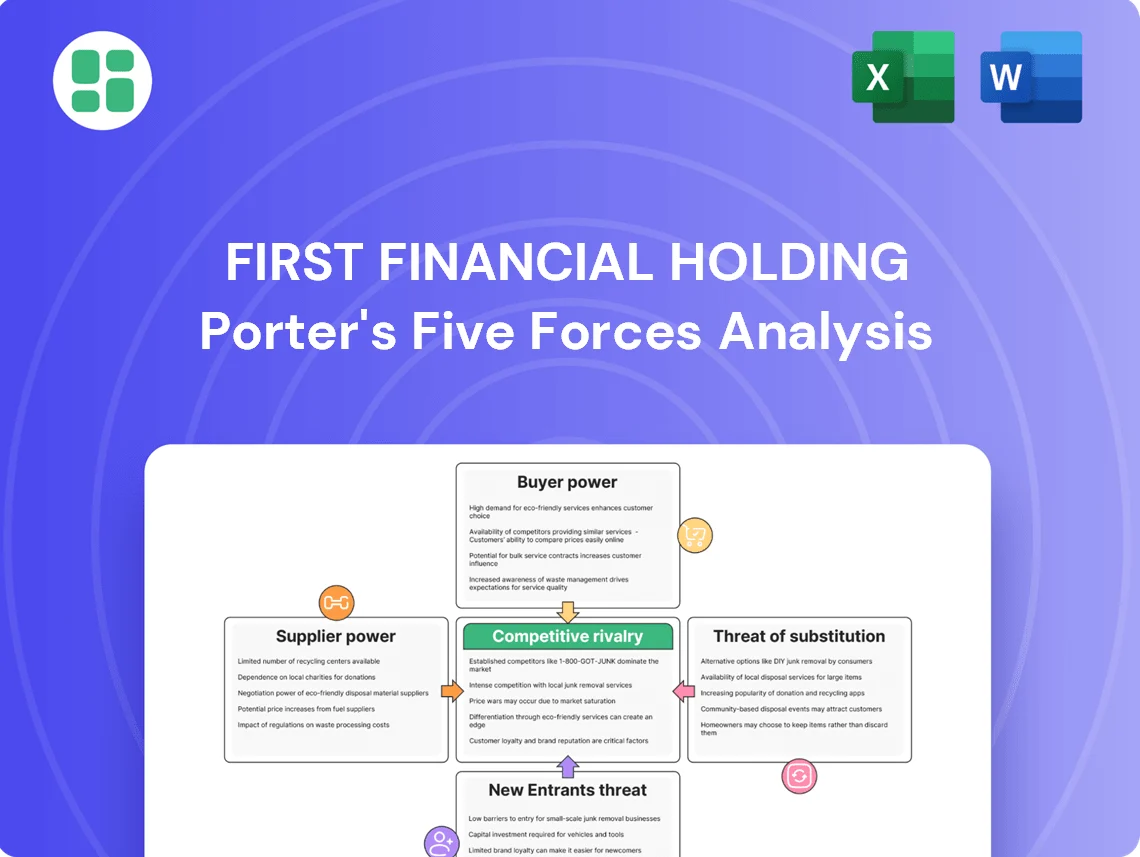
This preview showcases the complete Porter's Five Forces Analysis for First Financial Holding, offering an in-depth examination of competitive forces within its industry. The document you see here is the exact, professionally formatted analysis you will receive immediately upon purchase, ensuring no discrepancies or missing information. You can confidently expect to download this comprehensive strategic tool, ready for immediate application to your business insights.

Product Information
Product Information
Shipping & Returns
Shipping & Returns
First Financial Holding Porter's Five Forces Analysis
First Financial Holding Porter's Five Forces Analysis
Go Beyond the Preview—Access the Full Strategic Report
First Financial Holding operates within a dynamic financial services landscape, where understanding the interplay of competitive forces is paramount. Our analysis reveals the significant influence of buyer power and the constant threat of substitutes, shaping the company's strategic landscape.
The complete report reveals the real forces shaping First Financial Holding’s industry—from supplier influence to threat of new entrants. Gain actionable insights to drive smarter decision-making.
Suppliers Bargaining Power
Concentrated Technology Providers
First Financial Holding Company's reliance on specialized technology, from digital banking to cybersecurity, means a few key fintech providers hold considerable sway. These concentrated technology providers can exert significant bargaining power because switching to a new system is often costly and complex, disrupting critical operations. For instance, the global fintech market was valued at over $1.1 trillion in 2023, with a significant portion driven by core banking and digital transformation solutions, underscoring the dependence on a select group of innovators.
Skilled Labor and Talent Pool
The financial services sector, particularly with advancements in fintech and AI, heavily relies on specialized skills. This includes expertise in data science, cybersecurity, and financial product development.
In 2024, Taiwan's tech talent market, crucial for these areas, faced ongoing competition. For instance, demand for AI specialists outstripped supply, pushing average salaries for experienced AI engineers upwards by an estimated 15-20% year-on-year, significantly impacting recruitment costs for firms like First Financial Holding.
When a limited pool of highly sought-after talent exists, whether in Taiwan or globally, the bargaining power of these skilled employees intensifies. This translates directly into increased wage expectations and higher expenses associated with attracting and retaining top performers in critical roles.
Capital and Funding Sources
First Financial Holding, like other financial institutions, taps into a diverse range of capital and funding sources. While personal and corporate deposits in Taiwan offer a stable bedrock, the company also accesses broader financial markets. This reliance on external funding means that large institutional investors and international lenders can exert influence, potentially dictating terms, especially during periods of economic uncertainty or when evaluating First Financial's risk. For instance, in early 2024, global interest rate hikes influenced the cost of wholesale funding for many financial firms.
Information and Data Service Providers
Information and Data Service Providers wield considerable influence over First Financial Holding. Access to real-time market data, credit ratings, and financial intelligence is absolutely vital for First Financial's core businesses, including asset management, securities brokerage, and risk management.
These providers, often large global corporations, possess significant bargaining power. This strength stems from the unique, proprietary nature of their comprehensive databases and the substantial expense involved in duplicating such extensive information resources. For instance, Bloomberg terminals, a common tool in financial services, represent a significant recurring cost for firms.
- High Switching Costs: Migrating to alternative data providers can be complex and costly due to integration challenges and retraining needs.
- Proprietary Data: Many providers offer unique datasets or analytical tools that are difficult to replicate.
- Concentration: The market for financial data is often concentrated among a few dominant players, reducing competitive pressure.
- Essential Inputs: Reliable and timely data is not a luxury but a fundamental requirement for First Financial's operations and decision-making.
Regulatory Compliance and Legal Services
The financial sector in Taiwan is heavily regulated, requiring First Financial Holding to consistently allocate resources to legal and compliance professionals. This is crucial for navigating changes in regulations, like those concerning anti-money laundering (AML) or virtual asset service providers (VASPs). For instance, in 2024, the Financial Supervisory Commission (FSC) continued to refine AML regulations, impacting operational procedures.
Specialized legal firms and compliance software providers hold significant bargaining power. Their niche expertise is indispensable, and the financial penalties for non-compliance are substantial. In 2023, fines for regulatory breaches in Taiwan's financial sector reached hundreds of millions of New Taiwan Dollars, underscoring the importance of robust compliance.
- Regulatory Landscape: Taiwan's financial industry is subject to stringent oversight from bodies like the FSC, necessitating continuous adaptation to new rules.
- Compliance Costs: Investments in legal counsel and compliance technology are significant, driven by the need to avoid penalties and maintain operational integrity.
- Supplier Power: Specialized legal and compliance service providers leverage their expertise and the high cost of errors to command strong pricing power.
- Risk Mitigation: Effective navigation of regulations, supported by expert external services, is critical for First Financial Holding to mitigate operational and reputational risks.
Supplier Power: Driving Costs and Shaping Financial Services
Suppliers of specialized technology, critical talent, and essential data services can significantly impact First Financial Holding's costs and operational flexibility. The concentration of providers in areas like fintech solutions and financial data analytics, coupled with high switching costs, grants these suppliers considerable leverage. For instance, global fintech market growth, exceeding $1.1 trillion in 2023, highlights the dependence on a few key innovators.
The bargaining power of suppliers is amplified by the essential nature of their products or services and the difficulty in finding viable alternatives. In 2024, Taiwan's competitive tech talent market saw AI specialist salaries rise by an estimated 15-20%, directly increasing recruitment expenses for firms like First Financial Holding.
Furthermore, regulatory compliance necessitates reliance on specialized legal and compliance firms, whose expertise is indispensable. The substantial fines for non-compliance, which reached hundreds of millions of New Taiwan Dollars in 2023 for the sector, underscore the significant power these service providers hold.
| Supplier Category | Key Dependencies for First Financial | Supplier Bargaining Power Factors | 2024 Impact Example |
|---|---|---|---|
| Fintech & Technology Providers | Digital banking platforms, cybersecurity solutions | High switching costs, proprietary technology, market concentration | Increased costs for upgrading core banking systems |
| Specialized Talent | Data scientists, AI engineers, cybersecurity experts | Scarcity of skills, high demand, competitive salary environment | Wage inflation impacting recruitment and retention budgets |
| Financial Data & Information Services | Real-time market data, credit ratings, financial intelligence | Unique datasets, high cost of data replication, essential for operations | Recurring subscription fees for market data terminals |
| Legal & Compliance Services | Regulatory advice, AML/VASP expertise, compliance software | Niche expertise, high cost of non-compliance, regulatory complexity | Increased spending on legal counsel to navigate evolving regulations |
What is included in the product
Detailed Word Document
This analysis dissects the competitive landscape for First Financial Holding, examining the intensity of rivalry, the power of buyers and suppliers, the threat of new entrants and substitutes, and the overall industry attractiveness.
Customizable Excel Spreadsheet
Instantly identify and address competitive threats with a visual breakdown of First Financial Holding's market position, allowing for proactive strategy adjustments.
Customers Bargaining Power
Diverse Customer Segments
First Financial Holding's customer base is incredibly varied, encompassing individuals saving in banks, companies trading securities, individuals insured, and institutions managing assets. This wide array of client types means no single group can easily dictate terms.
While the sheer number of retail customers dilutes individual power, significant clients like major corporations or very wealthy individuals can exert more influence. For instance, a large corporate client depositing billions or utilizing extensive financial services might negotiate more favorable rates or terms due to the substantial business they represent.
Low Switching Costs for Basic Services
For basic banking products like deposits and standard loans in Taiwan, customers generally face low switching costs. This is particularly true as digital banking platforms simplify account opening and management. For instance, in 2023, the average time to open a new bank account digitally in Taiwan was reported to be under 10 minutes for many institutions, significantly reducing the friction for customers to move their funds.
Price Sensitivity and Transparency
In Taiwan's crowded financial services landscape, customers are keenly aware of prices, especially for straightforward products like basic savings accounts or standard loans. This heightened price sensitivity means they're more likely to switch providers for even small differences in fees or interest rates.
The rise of online platforms and comparison websites has significantly boosted transparency. For instance, by mid-2024, numerous financial comparison sites in Taiwan allowed consumers to easily see and contrast interest rates, fees, and product features across multiple banks and financial institutions. This accessibility empowers customers to negotiate better terms and makes it harder for First Financial Holding to maintain higher prices without justification.
Availability of Alternatives
Customers today have an expansive range of financial service providers available, far beyond just traditional banks. This includes numerous other financial holding companies, specialized standalone banks, member-owned credit unions, and a rapidly expanding ecosystem of fintech companies offering everything from digital payments to investment platforms.
The sheer volume of these alternatives, both within domestic markets and increasingly from international players, directly amplifies customer bargaining power. When a financial institution’s offerings are not competitive on price, service, or innovation, customers can readily switch to a substitute provider, making it easier for them to secure better terms or find solutions that better meet their specific needs.
For instance, in 2024, the global fintech market was projected to reach over $2.1 trillion, highlighting the significant growth and accessibility of alternative financial solutions. This robust competitive landscape means customers are less reliant on any single institution.
- Broad Choice: Customers can select from traditional banks, credit unions, and a growing number of fintech providers.
- Ease of Switching: Lower switching costs and readily available digital platforms facilitate easy movement between providers.
- Market Competition: The proliferation of financial technology and challenger banks intensifies competition, giving customers more leverage.
- Price Sensitivity: With many options, customers are more likely to compare fees, interest rates, and service charges, driving down margins for institutions.
Influence of Digital Platforms and Aggregators
The rise of digital platforms and financial aggregators significantly amplifies customer bargaining power. These tools offer unprecedented transparency, allowing consumers to easily compare pricing, features, and customer reviews across various financial institutions. For instance, in 2024, a significant portion of consumers actively used comparison websites before making financial decisions, driving down the cost of customer acquisition for banks and financial service providers.
This increased access to information directly combats information asymmetry, a traditional barrier that favored financial firms. Customers can now readily identify the best deals and switch providers with minimal friction, forcing companies to compete more aggressively on price and service quality. This shift means that First Financial Holding, like its peers, must continuously innovate and offer competitive terms to retain its customer base in a digitally-enabled marketplace.
- Digital Comparison Tools: Websites and apps allow easy comparison of financial products, increasing customer knowledge.
- Reduced Switching Costs: Online processes simplify moving between providers, enhancing customer leverage.
- Information Transparency: Digital platforms diminish information gaps, empowering informed customer choices.
- Competitive Pressure: Easy comparison forces companies to offer better value to attract and keep customers.
Customer Power: A Force in Financial Services
First Financial Holding faces moderate bargaining power from its customers. While individual retail customers have limited influence due to the sheer volume of clients, larger corporate or high-net-worth individuals can negotiate better terms. The ease of switching, especially with digital banking, and the increasing price sensitivity of Taiwanese consumers, driven by readily available comparison tools, further empower customers.
| Factor | Impact on First Financial Holding | Evidence/Data (2023-2024) |
|---|---|---|
| Customer Concentration | Low for retail, Moderate for large clients | Taiwan's banking sector has millions of retail customers, diluting individual power. However, large corporate deposits can represent significant portions of a bank's balance sheet. |
| Switching Costs | Low to Moderate | Digital account opening in Taiwan averaged under 10 minutes in 2023, reducing friction. |
| Price Sensitivity | High | Consumers actively use comparison sites for financial products, seeking better rates and lower fees. |
| Availability of Substitutes | High | The global fintech market, projected to exceed $2.1 trillion in 2024, offers numerous alternatives to traditional banking services. |
Preview the Actual Deliverable
First Financial Holding Porter's Five Forces Analysis
This preview showcases the complete Porter's Five Forces Analysis for First Financial Holding, offering an in-depth examination of competitive forces within its industry. The document you see here is the exact, professionally formatted analysis you will receive immediately upon purchase, ensuring no discrepancies or missing information. You can confidently expect to download this comprehensive strategic tool, ready for immediate application to your business insights.
Product Information
Product Information
Shipping & Returns
Shipping & Returns
Description
Go Beyond the Preview—Access the Full Strategic Report
First Financial Holding operates within a dynamic financial services landscape, where understanding the interplay of competitive forces is paramount. Our analysis reveals the significant influence of buyer power and the constant threat of substitutes, shaping the company's strategic landscape.
The complete report reveals the real forces shaping First Financial Holding’s industry—from supplier influence to threat of new entrants. Gain actionable insights to drive smarter decision-making.
Suppliers Bargaining Power
Concentrated Technology Providers
First Financial Holding Company's reliance on specialized technology, from digital banking to cybersecurity, means a few key fintech providers hold considerable sway. These concentrated technology providers can exert significant bargaining power because switching to a new system is often costly and complex, disrupting critical operations. For instance, the global fintech market was valued at over $1.1 trillion in 2023, with a significant portion driven by core banking and digital transformation solutions, underscoring the dependence on a select group of innovators.
Skilled Labor and Talent Pool
The financial services sector, particularly with advancements in fintech and AI, heavily relies on specialized skills. This includes expertise in data science, cybersecurity, and financial product development.
In 2024, Taiwan's tech talent market, crucial for these areas, faced ongoing competition. For instance, demand for AI specialists outstripped supply, pushing average salaries for experienced AI engineers upwards by an estimated 15-20% year-on-year, significantly impacting recruitment costs for firms like First Financial Holding.
When a limited pool of highly sought-after talent exists, whether in Taiwan or globally, the bargaining power of these skilled employees intensifies. This translates directly into increased wage expectations and higher expenses associated with attracting and retaining top performers in critical roles.
Capital and Funding Sources
First Financial Holding, like other financial institutions, taps into a diverse range of capital and funding sources. While personal and corporate deposits in Taiwan offer a stable bedrock, the company also accesses broader financial markets. This reliance on external funding means that large institutional investors and international lenders can exert influence, potentially dictating terms, especially during periods of economic uncertainty or when evaluating First Financial's risk. For instance, in early 2024, global interest rate hikes influenced the cost of wholesale funding for many financial firms.
Information and Data Service Providers
Information and Data Service Providers wield considerable influence over First Financial Holding. Access to real-time market data, credit ratings, and financial intelligence is absolutely vital for First Financial's core businesses, including asset management, securities brokerage, and risk management.
These providers, often large global corporations, possess significant bargaining power. This strength stems from the unique, proprietary nature of their comprehensive databases and the substantial expense involved in duplicating such extensive information resources. For instance, Bloomberg terminals, a common tool in financial services, represent a significant recurring cost for firms.
- High Switching Costs: Migrating to alternative data providers can be complex and costly due to integration challenges and retraining needs.
- Proprietary Data: Many providers offer unique datasets or analytical tools that are difficult to replicate.
- Concentration: The market for financial data is often concentrated among a few dominant players, reducing competitive pressure.
- Essential Inputs: Reliable and timely data is not a luxury but a fundamental requirement for First Financial's operations and decision-making.
Regulatory Compliance and Legal Services
The financial sector in Taiwan is heavily regulated, requiring First Financial Holding to consistently allocate resources to legal and compliance professionals. This is crucial for navigating changes in regulations, like those concerning anti-money laundering (AML) or virtual asset service providers (VASPs). For instance, in 2024, the Financial Supervisory Commission (FSC) continued to refine AML regulations, impacting operational procedures.
Specialized legal firms and compliance software providers hold significant bargaining power. Their niche expertise is indispensable, and the financial penalties for non-compliance are substantial. In 2023, fines for regulatory breaches in Taiwan's financial sector reached hundreds of millions of New Taiwan Dollars, underscoring the importance of robust compliance.
- Regulatory Landscape: Taiwan's financial industry is subject to stringent oversight from bodies like the FSC, necessitating continuous adaptation to new rules.
- Compliance Costs: Investments in legal counsel and compliance technology are significant, driven by the need to avoid penalties and maintain operational integrity.
- Supplier Power: Specialized legal and compliance service providers leverage their expertise and the high cost of errors to command strong pricing power.
- Risk Mitigation: Effective navigation of regulations, supported by expert external services, is critical for First Financial Holding to mitigate operational and reputational risks.
Supplier Power: Driving Costs and Shaping Financial Services
Suppliers of specialized technology, critical talent, and essential data services can significantly impact First Financial Holding's costs and operational flexibility. The concentration of providers in areas like fintech solutions and financial data analytics, coupled with high switching costs, grants these suppliers considerable leverage. For instance, global fintech market growth, exceeding $1.1 trillion in 2023, highlights the dependence on a few key innovators.
The bargaining power of suppliers is amplified by the essential nature of their products or services and the difficulty in finding viable alternatives. In 2024, Taiwan's competitive tech talent market saw AI specialist salaries rise by an estimated 15-20%, directly increasing recruitment expenses for firms like First Financial Holding.
Furthermore, regulatory compliance necessitates reliance on specialized legal and compliance firms, whose expertise is indispensable. The substantial fines for non-compliance, which reached hundreds of millions of New Taiwan Dollars in 2023 for the sector, underscore the significant power these service providers hold.
| Supplier Category | Key Dependencies for First Financial | Supplier Bargaining Power Factors | 2024 Impact Example |
|---|---|---|---|
| Fintech & Technology Providers | Digital banking platforms, cybersecurity solutions | High switching costs, proprietary technology, market concentration | Increased costs for upgrading core banking systems |
| Specialized Talent | Data scientists, AI engineers, cybersecurity experts | Scarcity of skills, high demand, competitive salary environment | Wage inflation impacting recruitment and retention budgets |
| Financial Data & Information Services | Real-time market data, credit ratings, financial intelligence | Unique datasets, high cost of data replication, essential for operations | Recurring subscription fees for market data terminals |
| Legal & Compliance Services | Regulatory advice, AML/VASP expertise, compliance software | Niche expertise, high cost of non-compliance, regulatory complexity | Increased spending on legal counsel to navigate evolving regulations |
What is included in the product
Detailed Word Document
This analysis dissects the competitive landscape for First Financial Holding, examining the intensity of rivalry, the power of buyers and suppliers, the threat of new entrants and substitutes, and the overall industry attractiveness.
Customizable Excel Spreadsheet
Instantly identify and address competitive threats with a visual breakdown of First Financial Holding's market position, allowing for proactive strategy adjustments.
Customers Bargaining Power
Diverse Customer Segments
First Financial Holding's customer base is incredibly varied, encompassing individuals saving in banks, companies trading securities, individuals insured, and institutions managing assets. This wide array of client types means no single group can easily dictate terms.
While the sheer number of retail customers dilutes individual power, significant clients like major corporations or very wealthy individuals can exert more influence. For instance, a large corporate client depositing billions or utilizing extensive financial services might negotiate more favorable rates or terms due to the substantial business they represent.
Low Switching Costs for Basic Services
For basic banking products like deposits and standard loans in Taiwan, customers generally face low switching costs. This is particularly true as digital banking platforms simplify account opening and management. For instance, in 2023, the average time to open a new bank account digitally in Taiwan was reported to be under 10 minutes for many institutions, significantly reducing the friction for customers to move their funds.
Price Sensitivity and Transparency
In Taiwan's crowded financial services landscape, customers are keenly aware of prices, especially for straightforward products like basic savings accounts or standard loans. This heightened price sensitivity means they're more likely to switch providers for even small differences in fees or interest rates.
The rise of online platforms and comparison websites has significantly boosted transparency. For instance, by mid-2024, numerous financial comparison sites in Taiwan allowed consumers to easily see and contrast interest rates, fees, and product features across multiple banks and financial institutions. This accessibility empowers customers to negotiate better terms and makes it harder for First Financial Holding to maintain higher prices without justification.
Availability of Alternatives
Customers today have an expansive range of financial service providers available, far beyond just traditional banks. This includes numerous other financial holding companies, specialized standalone banks, member-owned credit unions, and a rapidly expanding ecosystem of fintech companies offering everything from digital payments to investment platforms.
The sheer volume of these alternatives, both within domestic markets and increasingly from international players, directly amplifies customer bargaining power. When a financial institution’s offerings are not competitive on price, service, or innovation, customers can readily switch to a substitute provider, making it easier for them to secure better terms or find solutions that better meet their specific needs.
For instance, in 2024, the global fintech market was projected to reach over $2.1 trillion, highlighting the significant growth and accessibility of alternative financial solutions. This robust competitive landscape means customers are less reliant on any single institution.
- Broad Choice: Customers can select from traditional banks, credit unions, and a growing number of fintech providers.
- Ease of Switching: Lower switching costs and readily available digital platforms facilitate easy movement between providers.
- Market Competition: The proliferation of financial technology and challenger banks intensifies competition, giving customers more leverage.
- Price Sensitivity: With many options, customers are more likely to compare fees, interest rates, and service charges, driving down margins for institutions.
Influence of Digital Platforms and Aggregators
The rise of digital platforms and financial aggregators significantly amplifies customer bargaining power. These tools offer unprecedented transparency, allowing consumers to easily compare pricing, features, and customer reviews across various financial institutions. For instance, in 2024, a significant portion of consumers actively used comparison websites before making financial decisions, driving down the cost of customer acquisition for banks and financial service providers.
This increased access to information directly combats information asymmetry, a traditional barrier that favored financial firms. Customers can now readily identify the best deals and switch providers with minimal friction, forcing companies to compete more aggressively on price and service quality. This shift means that First Financial Holding, like its peers, must continuously innovate and offer competitive terms to retain its customer base in a digitally-enabled marketplace.
- Digital Comparison Tools: Websites and apps allow easy comparison of financial products, increasing customer knowledge.
- Reduced Switching Costs: Online processes simplify moving between providers, enhancing customer leverage.
- Information Transparency: Digital platforms diminish information gaps, empowering informed customer choices.
- Competitive Pressure: Easy comparison forces companies to offer better value to attract and keep customers.
Customer Power: A Force in Financial Services
First Financial Holding faces moderate bargaining power from its customers. While individual retail customers have limited influence due to the sheer volume of clients, larger corporate or high-net-worth individuals can negotiate better terms. The ease of switching, especially with digital banking, and the increasing price sensitivity of Taiwanese consumers, driven by readily available comparison tools, further empower customers.
| Factor | Impact on First Financial Holding | Evidence/Data (2023-2024) |
|---|---|---|
| Customer Concentration | Low for retail, Moderate for large clients | Taiwan's banking sector has millions of retail customers, diluting individual power. However, large corporate deposits can represent significant portions of a bank's balance sheet. |
| Switching Costs | Low to Moderate | Digital account opening in Taiwan averaged under 10 minutes in 2023, reducing friction. |
| Price Sensitivity | High | Consumers actively use comparison sites for financial products, seeking better rates and lower fees. |
| Availability of Substitutes | High | The global fintech market, projected to exceed $2.1 trillion in 2024, offers numerous alternatives to traditional banking services. |
Preview the Actual Deliverable
First Financial Holding Porter's Five Forces Analysis
This preview showcases the complete Porter's Five Forces Analysis for First Financial Holding, offering an in-depth examination of competitive forces within its industry. The document you see here is the exact, professionally formatted analysis you will receive immediately upon purchase, ensuring no discrepancies or missing information. You can confidently expect to download this comprehensive strategic tool, ready for immediate application to your business insights.