Enstar Group Porter's Five Forces Analysis

Go Beyond the Preview—Access the Full Strategic Report
Enstar Group operates in an industry shaped by moderate bargaining power of buyers and suppliers, with a manageable threat from new entrants and substitutes. The competitive rivalry within the insurance sector presents a significant force, demanding strategic agility.
The complete report reveals the real forces shaping Enstar Group’s industry—from supplier influence to threat of new entrants. Gain actionable insights to drive smarter decision-making.
Suppliers Bargaining Power

Capital Providers and Reinsurance Capacity
Enstar's business model is inherently capital-intensive, necessitating substantial financial resources for both acquiring new portfolios and managing ongoing claims. The availability and cost of this capital directly impact Enstar's strategic flexibility. For instance, in 2023, global insurance-linked securities (ILS) market capacity, a key source of reinsurance, experienced growth, but pricing remained elevated due to prior year losses, demonstrating supplier leverage.
The bargaining power of capital providers, whether through debt financing from banks or equity from investors, can significantly shape Enstar's cost of capital. This power is amplified when large-scale acquisitions are contemplated, requiring substantial upfront investment. Similarly, access to competitive reinsurance capacity, which Enstar utilizes to transfer specific risks and manage its own capital, acts as a critical supplier relationship.
Insurance Companies Divesting Run-Off Portfolios
The primary suppliers to Enstar Group are insurance and reinsurance companies looking to offload non-core or legacy business. Their bargaining power hinges on how many other buyers are available for these run-off portfolios, how complicated and appealing the liabilities are, and how quickly they need to exit. For instance, in 2023, the global run-off market saw significant activity, with major insurers like Allianz and Zurich actively managing their legacy portfolios, indicating a strong supply of potential deals.

Specialized Professional Services
Enstar Group's reliance on specialized professional services like actuarial consultants, legal advisors, and claims management experts for its complex run-off operations grants these providers a degree of bargaining power. The highly niche expertise required for managing legacy insurance portfolios means fewer firms possess the necessary skills, potentially increasing supplier leverage.
However, Enstar's substantial scale within the run-off market and its emphasis on building long-term partnerships with service providers likely serve to temper this supplier power. For instance, as of early 2024, Enstar continued to secure significant run-off transactions, demonstrating its ability to attract and retain top-tier professional service firms, suggesting a balanced negotiation dynamic.

Technology and Data Providers
Technology and data providers wield significant influence over Enstar Group, particularly given the company's focus on managing extensive legacy portfolios. Efficiently handling vast amounts of historical data for claims processing, financial reporting, and analytics necessitates sophisticated technology platforms. Suppliers offering unique or critical software, data management, and cybersecurity solutions can command higher prices or dictate terms if their services are essential for Enstar's operational continuity and competitive edge.
Enstar's reliance on specialized vendors for core infrastructure, such as claims administration systems or actuarial modeling software, can amplify supplier power. For instance, a significant portion of the insurance technology market, estimated to be worth billions globally, is characterized by niche providers with deep expertise. If Enstar’s operational efficiency is heavily dependent on a particular vendor’s proprietary system, that vendor’s bargaining power increases substantially.
- Criticality of Technology: Enstar's ability to manage legacy insurance portfolios efficiently hinges on advanced data analytics and claims processing technology.
- Supplier Uniqueness: Providers of specialized software, data solutions, and cybersecurity services gain power if their offerings are unique and vital for Enstar's operations.
- Vendor Dependence: Reliance on specific vendors for essential infrastructure, such as claims management systems, can strengthen their bargaining position.
- Market Dynamics: The specialized nature of insurance technology solutions means that a limited number of providers may cater to Enstar's specific needs, enhancing their leverage.
Talent and Human Capital
The bargaining power of suppliers in the context of talent and human capital for Enstar Group's run-off business is significant due to the highly specialized nature of the work. This includes expertise in actuarial science, claims management, legal, and investment, all critical for managing legacy insurance liabilities effectively.
The availability of skilled professionals, especially those with deep experience in handling complex, long-tail insurance portfolios, directly impacts Enstar's operational costs and its ability to expand. A scarcity of such qualified individuals would naturally amplify their leverage.
- Specialized Skill Demand: Enstar requires professionals with niche skills in actuarial analysis, complex claims resolution, and specialized legal expertise relevant to legacy insurance.
- Talent Scarcity Impact: A limited pool of experienced professionals in legacy insurance can drive up recruitment and retention costs, increasing supplier power.
- Industry Experience Premium: Professionals with proven track records in the run-off sector often command higher compensation, reflecting their valuable, hard-to-replicate experience.
Supplier Power in Legacy Insurance: A Moderate Influence
The bargaining power of suppliers for Enstar Group is moderate, primarily influenced by the specialized nature of the services and capital required for its run-off business. Key suppliers include capital providers, professional service firms, and technology vendors.
In 2024, the global reinsurance market continued to see robust demand for legacy solutions, with companies actively seeking to divest non-core portfolios. This increased deal flow can empower sellers, but Enstar's established market position and capital strength often allow it to negotiate favorable terms.
For instance, Enstar's access to diverse funding sources, including debt and equity, provides some leverage against individual capital providers. Similarly, while specialized actuarial and legal expertise is crucial, Enstar's scale and reputation can attract top-tier firms, mitigating excessive supplier power.
| Supplier Type | Key Considerations | Impact on Enstar |
| Capital Providers | Availability of ILS, debt financing, equity markets | Cost of capital, ability to fund acquisitions |
| Professional Services | Actuarial, legal, claims management expertise | Operational efficiency, transaction complexity |
| Technology & Data | Claims processing software, data analytics, cybersecurity | Operational continuity, competitive edge |
| Talent/Human Capital | Specialized skills in legacy insurance | Operational costs, expansion capabilities |
What is included in the product
 Detailed Word Document
This analysis of Enstar Group's competitive landscape reveals the intensity of rivalry, the power of buyers and suppliers, the threat of new entrants and substitutes, and the overall attractiveness of the insurance market.

 Customizable Excel Spreadsheet
Effortlessly identify and mitigate competitive threats by visualizing the intensity of each of Porter's Five Forces, providing a clear roadmap for strategic advantage.
Customers Bargaining Power

Original Insurers/Cedants (as indirect customers)
Original insurers, or cedants, act as indirect customers for Enstar Group. Their bargaining power stems from the availability of alternative solutions for managing legacy liabilities, including internal run-off management or engaging with other acquisition specialists. The competitive intensity among run-off acquirers directly influences the cedants' leverage.
Policyholders and Claimants
Policyholders and claimants, though not direct customers in the typical sense, hold significant influence over Enstar Group. Their collective power stems from their ability to engage regulatory bodies and pursue legal action if claims are mishandled, impacting Enstar's operational stability and public image. For instance, in 2023, the insurance industry faced increased scrutiny regarding claim processing times and fairness, highlighting the importance of robust claimant relations.
Enstar's success is intrinsically linked to its capacity for efficient and equitable claim resolution. A strong track record in this area not only fosters trust but also mitigates the risk of costly litigation and reputational damage. The company's financial health and market standing are directly influenced by how effectively it manages these critical stakeholder interactions, ensuring fair outcomes for all parties involved.

Regulatory Bodies and Governments
Regulatory bodies and governments wield considerable influence over Enstar Group's operations across its various jurisdictions. These entities dictate business practices, capital requirements, and claims management, essentially setting the rules of engagement. For instance, in 2024, the Bermuda Monetary Authority (BMA) continued to enforce robust solvency requirements for insurers operating on the island, a key location for Enstar’s legacy business. Failure to comply can result in severe penalties, including fines and operational restrictions, underscoring the significant bargaining power regulators hold.
The power of these regulatory bodies stems from their authority to impose sanctions. Enstar must navigate a complex web of compliance, ensuring adherence to capital adequacy ratios, consumer protection laws, and reporting standards. This continuous need for regulatory compliance means Enstar is inherently subject to the demands of these governmental agencies, which can significantly impact its cost of doing business and strategic flexibility. For example, evolving data privacy regulations in Europe, like those influenced by GDPR, require ongoing investment in compliance measures, demonstrating the direct impact of government mandates on Enstar's operational framework.

Rating Agencies
Credit rating agencies hold considerable influence over Enstar Group by evaluating its financial health and capacity to fulfill its commitments. These assessments directly impact Enstar's ability to access capital markets and shape its reputation among original insurers, regulatory bodies, and policyholders.
A lower credit rating can escalate borrowing expenses and impede Enstar's pursuit of new acquisitions. This leverage grants rating agencies significant indirect power over Enstar's financial maneuverability and overall market position.
- Impact on Capital Access: A strong rating from agencies like S&P or Moody's can lower Enstar's cost of debt, making it easier to raise funds for growth. Conversely, a downgrade can make borrowing more expensive or even inaccessible.
- Influence on Insurer Confidence: For Enstar's core business of acquiring and managing run-off insurance portfolios, the confidence of original insurers is paramount. Favorable ratings signal financial stability, encouraging more attractive acquisition opportunities.
- Regulatory Scrutiny: Regulators often monitor the creditworthiness of insurance companies. A downgrade could trigger increased regulatory oversight, potentially impacting operational flexibility.
- Market Perception: Publicly available credit ratings significantly influence how investors, partners, and the broader market perceive Enstar's financial stability and long-term viability.
Investment Partners and Co-investors
Enstar's reliance on investment partners and co-investors grants these entities a degree of bargaining power. These partners can influence deal terms, profit splits, and the strategic direction of shared ventures, especially when Enstar seeks external capital for specific transactions or portfolio management. Enstar's ability to attract and retain these partners is significantly influenced by its established reputation and performance history in investment management.
For instance, in 2024, Enstar continued its strategy of leveraging partnerships for growth. While specific co-investment figures are often private, the broader insurance-linked securities market, a key area for such partnerships, saw significant capital inflows. The ILS market, which Enstar actively participates in, is projected to grow, indicating continued demand for Enstar's expertise from capital providers.
- Influence on Deal Terms: Co-investors can negotiate for more favorable economic terms or governance rights in joint ventures.
- Profit Sharing Negotiations: The allocation of profits from managed portfolios can be a point of contention, giving partners leverage.
- Strategic Alignment: Partners may exert influence to ensure the strategic direction of co-invested assets aligns with their own objectives.
- Reputation as a Counterbalance: Enstar's strong track record and market position serve as a crucial factor in mitigating the bargaining power of its partners.
Insurers' Leverage: Alternatives Shape Run-Off Deals
The bargaining power of customers for Enstar Group is primarily exerted by original insurers seeking to offload legacy liabilities. These cedants possess leverage due to the availability of alternative solutions, including internal run-off management or engaging with other specialist acquirers. The competitive landscape among run-off acquirers directly impacts the cedants' negotiating position.
Full Version Awaits
Enstar Group Porter's Five Forces Analysis
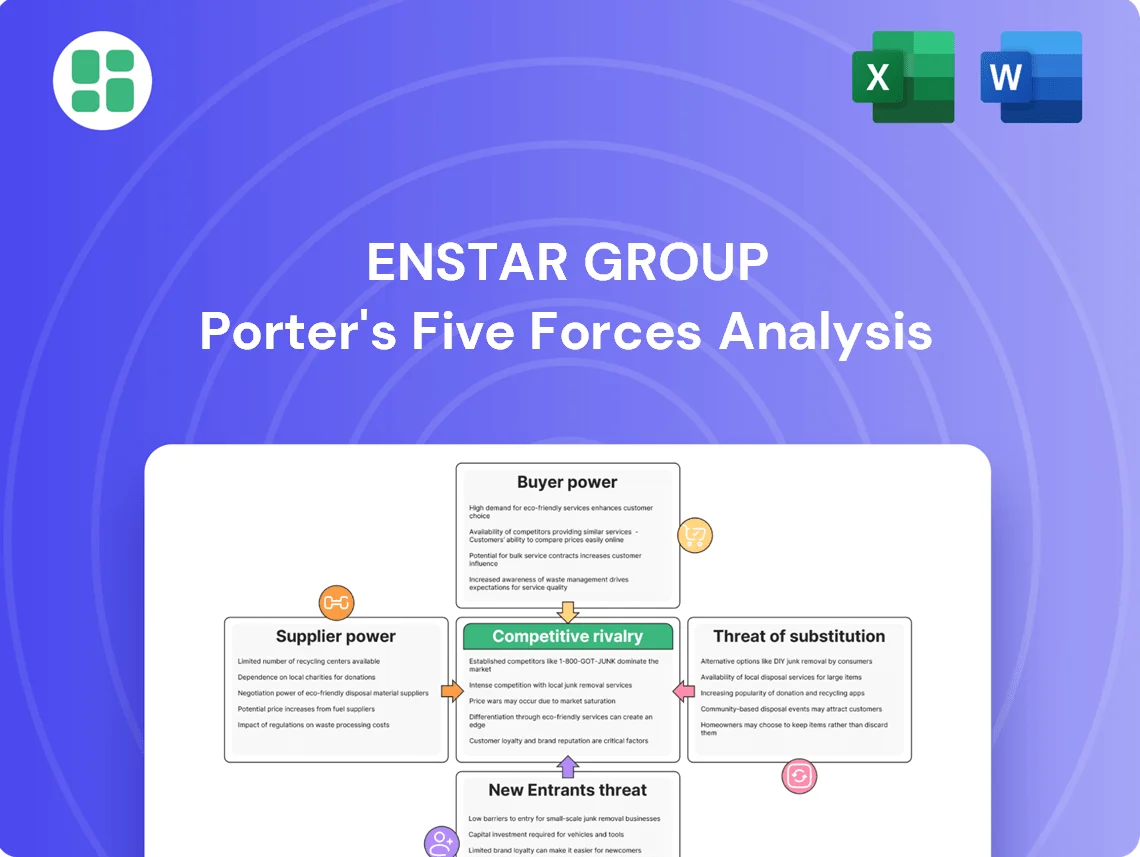
This preview showcases the comprehensive Porter's Five Forces analysis of Enstar Group, detailing the competitive landscape and strategic implications for the company. The document you see here is the exact, fully formatted report you'll receive immediately after purchase, providing actionable insights without any placeholders or surprises. You can trust that the in-depth analysis of threat of new entrants, bargaining power of buyers and suppliers, threat of substitute products, and intensity of rivalry presented here is precisely what you will download and utilize.

Product Information
Product Information
Shipping & Returns
Shipping & Returns
Enstar Group Porter's Five Forces Analysis
Enstar Group Porter's Five Forces Analysis
Go Beyond the Preview—Access the Full Strategic Report
Enstar Group operates in an industry shaped by moderate bargaining power of buyers and suppliers, with a manageable threat from new entrants and substitutes. The competitive rivalry within the insurance sector presents a significant force, demanding strategic agility.
The complete report reveals the real forces shaping Enstar Group’s industry—from supplier influence to threat of new entrants. Gain actionable insights to drive smarter decision-making.
Suppliers Bargaining Power
Capital Providers and Reinsurance Capacity
Enstar's business model is inherently capital-intensive, necessitating substantial financial resources for both acquiring new portfolios and managing ongoing claims. The availability and cost of this capital directly impact Enstar's strategic flexibility. For instance, in 2023, global insurance-linked securities (ILS) market capacity, a key source of reinsurance, experienced growth, but pricing remained elevated due to prior year losses, demonstrating supplier leverage.
The bargaining power of capital providers, whether through debt financing from banks or equity from investors, can significantly shape Enstar's cost of capital. This power is amplified when large-scale acquisitions are contemplated, requiring substantial upfront investment. Similarly, access to competitive reinsurance capacity, which Enstar utilizes to transfer specific risks and manage its own capital, acts as a critical supplier relationship.
Insurance Companies Divesting Run-Off Portfolios
The primary suppliers to Enstar Group are insurance and reinsurance companies looking to offload non-core or legacy business. Their bargaining power hinges on how many other buyers are available for these run-off portfolios, how complicated and appealing the liabilities are, and how quickly they need to exit. For instance, in 2023, the global run-off market saw significant activity, with major insurers like Allianz and Zurich actively managing their legacy portfolios, indicating a strong supply of potential deals.
Specialized Professional Services
Enstar Group's reliance on specialized professional services like actuarial consultants, legal advisors, and claims management experts for its complex run-off operations grants these providers a degree of bargaining power. The highly niche expertise required for managing legacy insurance portfolios means fewer firms possess the necessary skills, potentially increasing supplier leverage.
However, Enstar's substantial scale within the run-off market and its emphasis on building long-term partnerships with service providers likely serve to temper this supplier power. For instance, as of early 2024, Enstar continued to secure significant run-off transactions, demonstrating its ability to attract and retain top-tier professional service firms, suggesting a balanced negotiation dynamic.
Technology and Data Providers
Technology and data providers wield significant influence over Enstar Group, particularly given the company's focus on managing extensive legacy portfolios. Efficiently handling vast amounts of historical data for claims processing, financial reporting, and analytics necessitates sophisticated technology platforms. Suppliers offering unique or critical software, data management, and cybersecurity solutions can command higher prices or dictate terms if their services are essential for Enstar's operational continuity and competitive edge.
Enstar's reliance on specialized vendors for core infrastructure, such as claims administration systems or actuarial modeling software, can amplify supplier power. For instance, a significant portion of the insurance technology market, estimated to be worth billions globally, is characterized by niche providers with deep expertise. If Enstar’s operational efficiency is heavily dependent on a particular vendor’s proprietary system, that vendor’s bargaining power increases substantially.
- Criticality of Technology: Enstar's ability to manage legacy insurance portfolios efficiently hinges on advanced data analytics and claims processing technology.
- Supplier Uniqueness: Providers of specialized software, data solutions, and cybersecurity services gain power if their offerings are unique and vital for Enstar's operations.
- Vendor Dependence: Reliance on specific vendors for essential infrastructure, such as claims management systems, can strengthen their bargaining position.
- Market Dynamics: The specialized nature of insurance technology solutions means that a limited number of providers may cater to Enstar's specific needs, enhancing their leverage.
Talent and Human Capital
The bargaining power of suppliers in the context of talent and human capital for Enstar Group's run-off business is significant due to the highly specialized nature of the work. This includes expertise in actuarial science, claims management, legal, and investment, all critical for managing legacy insurance liabilities effectively.
The availability of skilled professionals, especially those with deep experience in handling complex, long-tail insurance portfolios, directly impacts Enstar's operational costs and its ability to expand. A scarcity of such qualified individuals would naturally amplify their leverage.
- Specialized Skill Demand: Enstar requires professionals with niche skills in actuarial analysis, complex claims resolution, and specialized legal expertise relevant to legacy insurance.
- Talent Scarcity Impact: A limited pool of experienced professionals in legacy insurance can drive up recruitment and retention costs, increasing supplier power.
- Industry Experience Premium: Professionals with proven track records in the run-off sector often command higher compensation, reflecting their valuable, hard-to-replicate experience.
Supplier Power in Legacy Insurance: A Moderate Influence
The bargaining power of suppliers for Enstar Group is moderate, primarily influenced by the specialized nature of the services and capital required for its run-off business. Key suppliers include capital providers, professional service firms, and technology vendors.
In 2024, the global reinsurance market continued to see robust demand for legacy solutions, with companies actively seeking to divest non-core portfolios. This increased deal flow can empower sellers, but Enstar's established market position and capital strength often allow it to negotiate favorable terms.
For instance, Enstar's access to diverse funding sources, including debt and equity, provides some leverage against individual capital providers. Similarly, while specialized actuarial and legal expertise is crucial, Enstar's scale and reputation can attract top-tier firms, mitigating excessive supplier power.
| Supplier Type | Key Considerations | Impact on Enstar |
| Capital Providers | Availability of ILS, debt financing, equity markets | Cost of capital, ability to fund acquisitions |
| Professional Services | Actuarial, legal, claims management expertise | Operational efficiency, transaction complexity |
| Technology & Data | Claims processing software, data analytics, cybersecurity | Operational continuity, competitive edge |
| Talent/Human Capital | Specialized skills in legacy insurance | Operational costs, expansion capabilities |
What is included in the product
Detailed Word Document
This analysis of Enstar Group's competitive landscape reveals the intensity of rivalry, the power of buyers and suppliers, the threat of new entrants and substitutes, and the overall attractiveness of the insurance market.
Customizable Excel Spreadsheet
Effortlessly identify and mitigate competitive threats by visualizing the intensity of each of Porter's Five Forces, providing a clear roadmap for strategic advantage.
Customers Bargaining Power
Original Insurers/Cedants (as indirect customers)
Original insurers, or cedants, act as indirect customers for Enstar Group. Their bargaining power stems from the availability of alternative solutions for managing legacy liabilities, including internal run-off management or engaging with other acquisition specialists. The competitive intensity among run-off acquirers directly influences the cedants' leverage.
Policyholders and Claimants
Policyholders and claimants, though not direct customers in the typical sense, hold significant influence over Enstar Group. Their collective power stems from their ability to engage regulatory bodies and pursue legal action if claims are mishandled, impacting Enstar's operational stability and public image. For instance, in 2023, the insurance industry faced increased scrutiny regarding claim processing times and fairness, highlighting the importance of robust claimant relations.
Enstar's success is intrinsically linked to its capacity for efficient and equitable claim resolution. A strong track record in this area not only fosters trust but also mitigates the risk of costly litigation and reputational damage. The company's financial health and market standing are directly influenced by how effectively it manages these critical stakeholder interactions, ensuring fair outcomes for all parties involved.
Regulatory Bodies and Governments
Regulatory bodies and governments wield considerable influence over Enstar Group's operations across its various jurisdictions. These entities dictate business practices, capital requirements, and claims management, essentially setting the rules of engagement. For instance, in 2024, the Bermuda Monetary Authority (BMA) continued to enforce robust solvency requirements for insurers operating on the island, a key location for Enstar’s legacy business. Failure to comply can result in severe penalties, including fines and operational restrictions, underscoring the significant bargaining power regulators hold.
The power of these regulatory bodies stems from their authority to impose sanctions. Enstar must navigate a complex web of compliance, ensuring adherence to capital adequacy ratios, consumer protection laws, and reporting standards. This continuous need for regulatory compliance means Enstar is inherently subject to the demands of these governmental agencies, which can significantly impact its cost of doing business and strategic flexibility. For example, evolving data privacy regulations in Europe, like those influenced by GDPR, require ongoing investment in compliance measures, demonstrating the direct impact of government mandates on Enstar's operational framework.
Rating Agencies
Credit rating agencies hold considerable influence over Enstar Group by evaluating its financial health and capacity to fulfill its commitments. These assessments directly impact Enstar's ability to access capital markets and shape its reputation among original insurers, regulatory bodies, and policyholders.
A lower credit rating can escalate borrowing expenses and impede Enstar's pursuit of new acquisitions. This leverage grants rating agencies significant indirect power over Enstar's financial maneuverability and overall market position.
- Impact on Capital Access: A strong rating from agencies like S&P or Moody's can lower Enstar's cost of debt, making it easier to raise funds for growth. Conversely, a downgrade can make borrowing more expensive or even inaccessible.
- Influence on Insurer Confidence: For Enstar's core business of acquiring and managing run-off insurance portfolios, the confidence of original insurers is paramount. Favorable ratings signal financial stability, encouraging more attractive acquisition opportunities.
- Regulatory Scrutiny: Regulators often monitor the creditworthiness of insurance companies. A downgrade could trigger increased regulatory oversight, potentially impacting operational flexibility.
- Market Perception: Publicly available credit ratings significantly influence how investors, partners, and the broader market perceive Enstar's financial stability and long-term viability.
Investment Partners and Co-investors
Enstar's reliance on investment partners and co-investors grants these entities a degree of bargaining power. These partners can influence deal terms, profit splits, and the strategic direction of shared ventures, especially when Enstar seeks external capital for specific transactions or portfolio management. Enstar's ability to attract and retain these partners is significantly influenced by its established reputation and performance history in investment management.
For instance, in 2024, Enstar continued its strategy of leveraging partnerships for growth. While specific co-investment figures are often private, the broader insurance-linked securities market, a key area for such partnerships, saw significant capital inflows. The ILS market, which Enstar actively participates in, is projected to grow, indicating continued demand for Enstar's expertise from capital providers.
- Influence on Deal Terms: Co-investors can negotiate for more favorable economic terms or governance rights in joint ventures.
- Profit Sharing Negotiations: The allocation of profits from managed portfolios can be a point of contention, giving partners leverage.
- Strategic Alignment: Partners may exert influence to ensure the strategic direction of co-invested assets aligns with their own objectives.
- Reputation as a Counterbalance: Enstar's strong track record and market position serve as a crucial factor in mitigating the bargaining power of its partners.
Insurers' Leverage: Alternatives Shape Run-Off Deals
The bargaining power of customers for Enstar Group is primarily exerted by original insurers seeking to offload legacy liabilities. These cedants possess leverage due to the availability of alternative solutions, including internal run-off management or engaging with other specialist acquirers. The competitive landscape among run-off acquirers directly impacts the cedants' negotiating position.
Full Version Awaits
Enstar Group Porter's Five Forces Analysis
This preview showcases the comprehensive Porter's Five Forces analysis of Enstar Group, detailing the competitive landscape and strategic implications for the company. The document you see here is the exact, fully formatted report you'll receive immediately after purchase, providing actionable insights without any placeholders or surprises. You can trust that the in-depth analysis of threat of new entrants, bargaining power of buyers and suppliers, threat of substitute products, and intensity of rivalry presented here is precisely what you will download and utilize.
Product Information
Product Information
Shipping & Returns
Shipping & Returns
Description
Go Beyond the Preview—Access the Full Strategic Report
Enstar Group operates in an industry shaped by moderate bargaining power of buyers and suppliers, with a manageable threat from new entrants and substitutes. The competitive rivalry within the insurance sector presents a significant force, demanding strategic agility.
The complete report reveals the real forces shaping Enstar Group’s industry—from supplier influence to threat of new entrants. Gain actionable insights to drive smarter decision-making.
Suppliers Bargaining Power
Capital Providers and Reinsurance Capacity
Enstar's business model is inherently capital-intensive, necessitating substantial financial resources for both acquiring new portfolios and managing ongoing claims. The availability and cost of this capital directly impact Enstar's strategic flexibility. For instance, in 2023, global insurance-linked securities (ILS) market capacity, a key source of reinsurance, experienced growth, but pricing remained elevated due to prior year losses, demonstrating supplier leverage.
The bargaining power of capital providers, whether through debt financing from banks or equity from investors, can significantly shape Enstar's cost of capital. This power is amplified when large-scale acquisitions are contemplated, requiring substantial upfront investment. Similarly, access to competitive reinsurance capacity, which Enstar utilizes to transfer specific risks and manage its own capital, acts as a critical supplier relationship.
Insurance Companies Divesting Run-Off Portfolios
The primary suppliers to Enstar Group are insurance and reinsurance companies looking to offload non-core or legacy business. Their bargaining power hinges on how many other buyers are available for these run-off portfolios, how complicated and appealing the liabilities are, and how quickly they need to exit. For instance, in 2023, the global run-off market saw significant activity, with major insurers like Allianz and Zurich actively managing their legacy portfolios, indicating a strong supply of potential deals.
Specialized Professional Services
Enstar Group's reliance on specialized professional services like actuarial consultants, legal advisors, and claims management experts for its complex run-off operations grants these providers a degree of bargaining power. The highly niche expertise required for managing legacy insurance portfolios means fewer firms possess the necessary skills, potentially increasing supplier leverage.
However, Enstar's substantial scale within the run-off market and its emphasis on building long-term partnerships with service providers likely serve to temper this supplier power. For instance, as of early 2024, Enstar continued to secure significant run-off transactions, demonstrating its ability to attract and retain top-tier professional service firms, suggesting a balanced negotiation dynamic.
Technology and Data Providers
Technology and data providers wield significant influence over Enstar Group, particularly given the company's focus on managing extensive legacy portfolios. Efficiently handling vast amounts of historical data for claims processing, financial reporting, and analytics necessitates sophisticated technology platforms. Suppliers offering unique or critical software, data management, and cybersecurity solutions can command higher prices or dictate terms if their services are essential for Enstar's operational continuity and competitive edge.
Enstar's reliance on specialized vendors for core infrastructure, such as claims administration systems or actuarial modeling software, can amplify supplier power. For instance, a significant portion of the insurance technology market, estimated to be worth billions globally, is characterized by niche providers with deep expertise. If Enstar’s operational efficiency is heavily dependent on a particular vendor’s proprietary system, that vendor’s bargaining power increases substantially.
- Criticality of Technology: Enstar's ability to manage legacy insurance portfolios efficiently hinges on advanced data analytics and claims processing technology.
- Supplier Uniqueness: Providers of specialized software, data solutions, and cybersecurity services gain power if their offerings are unique and vital for Enstar's operations.
- Vendor Dependence: Reliance on specific vendors for essential infrastructure, such as claims management systems, can strengthen their bargaining position.
- Market Dynamics: The specialized nature of insurance technology solutions means that a limited number of providers may cater to Enstar's specific needs, enhancing their leverage.
Talent and Human Capital
The bargaining power of suppliers in the context of talent and human capital for Enstar Group's run-off business is significant due to the highly specialized nature of the work. This includes expertise in actuarial science, claims management, legal, and investment, all critical for managing legacy insurance liabilities effectively.
The availability of skilled professionals, especially those with deep experience in handling complex, long-tail insurance portfolios, directly impacts Enstar's operational costs and its ability to expand. A scarcity of such qualified individuals would naturally amplify their leverage.
- Specialized Skill Demand: Enstar requires professionals with niche skills in actuarial analysis, complex claims resolution, and specialized legal expertise relevant to legacy insurance.
- Talent Scarcity Impact: A limited pool of experienced professionals in legacy insurance can drive up recruitment and retention costs, increasing supplier power.
- Industry Experience Premium: Professionals with proven track records in the run-off sector often command higher compensation, reflecting their valuable, hard-to-replicate experience.
Supplier Power in Legacy Insurance: A Moderate Influence
The bargaining power of suppliers for Enstar Group is moderate, primarily influenced by the specialized nature of the services and capital required for its run-off business. Key suppliers include capital providers, professional service firms, and technology vendors.
In 2024, the global reinsurance market continued to see robust demand for legacy solutions, with companies actively seeking to divest non-core portfolios. This increased deal flow can empower sellers, but Enstar's established market position and capital strength often allow it to negotiate favorable terms.
For instance, Enstar's access to diverse funding sources, including debt and equity, provides some leverage against individual capital providers. Similarly, while specialized actuarial and legal expertise is crucial, Enstar's scale and reputation can attract top-tier firms, mitigating excessive supplier power.
| Supplier Type | Key Considerations | Impact on Enstar |
| Capital Providers | Availability of ILS, debt financing, equity markets | Cost of capital, ability to fund acquisitions |
| Professional Services | Actuarial, legal, claims management expertise | Operational efficiency, transaction complexity |
| Technology & Data | Claims processing software, data analytics, cybersecurity | Operational continuity, competitive edge |
| Talent/Human Capital | Specialized skills in legacy insurance | Operational costs, expansion capabilities |
What is included in the product
Detailed Word Document
This analysis of Enstar Group's competitive landscape reveals the intensity of rivalry, the power of buyers and suppliers, the threat of new entrants and substitutes, and the overall attractiveness of the insurance market.
Customizable Excel Spreadsheet
Effortlessly identify and mitigate competitive threats by visualizing the intensity of each of Porter's Five Forces, providing a clear roadmap for strategic advantage.
Customers Bargaining Power
Original Insurers/Cedants (as indirect customers)
Original insurers, or cedants, act as indirect customers for Enstar Group. Their bargaining power stems from the availability of alternative solutions for managing legacy liabilities, including internal run-off management or engaging with other acquisition specialists. The competitive intensity among run-off acquirers directly influences the cedants' leverage.
Policyholders and Claimants
Policyholders and claimants, though not direct customers in the typical sense, hold significant influence over Enstar Group. Their collective power stems from their ability to engage regulatory bodies and pursue legal action if claims are mishandled, impacting Enstar's operational stability and public image. For instance, in 2023, the insurance industry faced increased scrutiny regarding claim processing times and fairness, highlighting the importance of robust claimant relations.
Enstar's success is intrinsically linked to its capacity for efficient and equitable claim resolution. A strong track record in this area not only fosters trust but also mitigates the risk of costly litigation and reputational damage. The company's financial health and market standing are directly influenced by how effectively it manages these critical stakeholder interactions, ensuring fair outcomes for all parties involved.
Regulatory Bodies and Governments
Regulatory bodies and governments wield considerable influence over Enstar Group's operations across its various jurisdictions. These entities dictate business practices, capital requirements, and claims management, essentially setting the rules of engagement. For instance, in 2024, the Bermuda Monetary Authority (BMA) continued to enforce robust solvency requirements for insurers operating on the island, a key location for Enstar’s legacy business. Failure to comply can result in severe penalties, including fines and operational restrictions, underscoring the significant bargaining power regulators hold.
The power of these regulatory bodies stems from their authority to impose sanctions. Enstar must navigate a complex web of compliance, ensuring adherence to capital adequacy ratios, consumer protection laws, and reporting standards. This continuous need for regulatory compliance means Enstar is inherently subject to the demands of these governmental agencies, which can significantly impact its cost of doing business and strategic flexibility. For example, evolving data privacy regulations in Europe, like those influenced by GDPR, require ongoing investment in compliance measures, demonstrating the direct impact of government mandates on Enstar's operational framework.
Rating Agencies
Credit rating agencies hold considerable influence over Enstar Group by evaluating its financial health and capacity to fulfill its commitments. These assessments directly impact Enstar's ability to access capital markets and shape its reputation among original insurers, regulatory bodies, and policyholders.
A lower credit rating can escalate borrowing expenses and impede Enstar's pursuit of new acquisitions. This leverage grants rating agencies significant indirect power over Enstar's financial maneuverability and overall market position.
- Impact on Capital Access: A strong rating from agencies like S&P or Moody's can lower Enstar's cost of debt, making it easier to raise funds for growth. Conversely, a downgrade can make borrowing more expensive or even inaccessible.
- Influence on Insurer Confidence: For Enstar's core business of acquiring and managing run-off insurance portfolios, the confidence of original insurers is paramount. Favorable ratings signal financial stability, encouraging more attractive acquisition opportunities.
- Regulatory Scrutiny: Regulators often monitor the creditworthiness of insurance companies. A downgrade could trigger increased regulatory oversight, potentially impacting operational flexibility.
- Market Perception: Publicly available credit ratings significantly influence how investors, partners, and the broader market perceive Enstar's financial stability and long-term viability.
Investment Partners and Co-investors
Enstar's reliance on investment partners and co-investors grants these entities a degree of bargaining power. These partners can influence deal terms, profit splits, and the strategic direction of shared ventures, especially when Enstar seeks external capital for specific transactions or portfolio management. Enstar's ability to attract and retain these partners is significantly influenced by its established reputation and performance history in investment management.
For instance, in 2024, Enstar continued its strategy of leveraging partnerships for growth. While specific co-investment figures are often private, the broader insurance-linked securities market, a key area for such partnerships, saw significant capital inflows. The ILS market, which Enstar actively participates in, is projected to grow, indicating continued demand for Enstar's expertise from capital providers.
- Influence on Deal Terms: Co-investors can negotiate for more favorable economic terms or governance rights in joint ventures.
- Profit Sharing Negotiations: The allocation of profits from managed portfolios can be a point of contention, giving partners leverage.
- Strategic Alignment: Partners may exert influence to ensure the strategic direction of co-invested assets aligns with their own objectives.
- Reputation as a Counterbalance: Enstar's strong track record and market position serve as a crucial factor in mitigating the bargaining power of its partners.
Insurers' Leverage: Alternatives Shape Run-Off Deals
The bargaining power of customers for Enstar Group is primarily exerted by original insurers seeking to offload legacy liabilities. These cedants possess leverage due to the availability of alternative solutions, including internal run-off management or engaging with other specialist acquirers. The competitive landscape among run-off acquirers directly impacts the cedants' negotiating position.
Full Version Awaits
Enstar Group Porter's Five Forces Analysis
This preview showcases the comprehensive Porter's Five Forces analysis of Enstar Group, detailing the competitive landscape and strategic implications for the company. The document you see here is the exact, fully formatted report you'll receive immediately after purchase, providing actionable insights without any placeholders or surprises. You can trust that the in-depth analysis of threat of new entrants, bargaining power of buyers and suppliers, threat of substitute products, and intensity of rivalry presented here is precisely what you will download and utilize.