F.P.E.E. Industries Porter's Five Forces Analysis

Elevate Your Analysis with the Complete Porter's Five Forces Analysis
Our Porter's Five Forces analysis for F.P.E.E. Industries reveals a dynamic competitive landscape, highlighting significant pressures from rivals and the constant threat of new entrants. Understanding these forces is crucial for navigating the market effectively.
The complete report provides a detailed, force-by-force breakdown of F.P.E.E. Industries’s industry, including supplier and buyer power, and the intensity of substitute products. Gain actionable insights to drive smarter decision-making.
Suppliers Bargaining Power

Supplier Concentration and Uniqueness
The bargaining power of suppliers in the precast concrete industry is influenced by the concentration and uniqueness of key material providers. Major inputs like cement, aggregates (sand and gravel), and steel reinforcement are critical. In 2024, cement prices saw fluctuations, with some regions experiencing increases due to energy costs and demand, impacting the power of cement suppliers.
The industry's reliance on these fundamental materials means suppliers of cement and steel, in particular, can wield significant influence, especially when supply chains face disruptions or demand surges. For instance, global steel prices can directly affect the cost of reinforcement bars, a vital component in precast concrete, giving steel suppliers considerable leverage.
Furthermore, suppliers offering specialized molds or advanced concrete additives possess enhanced bargaining power. Their unique products, often protected by intellectual property or requiring specific manufacturing expertise, create a less competitive supplier landscape, allowing them to command higher prices or more favorable terms.
Switching Costs for F.P.E.E. Industries
Switching suppliers for essential materials like cement and steel presents F.P.E.E. Industries with moderate to high costs. These expenses stem from the need to recalibrate production machinery, implement new quality assurance protocols, and manage potential interruptions to their manufacturing timelines. In 2024, the global average cost for retooling a production line for a new material input was estimated to be around $50,000 to $150,000, depending on the complexity of the process.
Beyond the technical adjustments, F.P.E.E. Industries also faces the financial and time investment required to build relationships with new vendors and negotiate new supply agreements. This process can involve extensive due diligence, site visits, and contract reviews, all of which add to the overall cost of supplier switching.

Availability of Substitutes for Inputs
The availability of substitutes for a company's core inputs significantly impacts supplier bargaining power. For F.P.E.E. Industries, the primary inputs for precast concrete—cement, aggregates, and steel—have limited direct substitutes that can match their structural integrity and cost-effectiveness at the scale required for construction projects. While advancements in cementitious materials and the use of recycled aggregates are emerging, they do not yet offer a complete replacement for traditional components across all applications.
This limited substitutability means that suppliers of these essential materials hold considerable sway. For instance, the global cement market, a key input for F.P.E.E. Industries, saw production reach approximately 4.2 billion metric tons in 2023, with major producers often dictating terms due to the high capital investment and established infrastructure required for their operations. This scarcity of viable alternatives strengthens the negotiating position of existing cement, aggregate, and steel suppliers.

Threat of Forward Integration by Suppliers
The threat of suppliers forward integrating into precast concrete manufacturing for F.P.E.E. Industries is generally considered low. This is primarily because raw material suppliers typically operate with business models focused on material extraction and processing, which are fundamentally different from the complex, capital-intensive nature of precast concrete production. The significant investments in specialized machinery, design capabilities, and installation expertise required in the precast sector present a substantial barrier to entry for these suppliers.
For instance, the precast concrete industry demands advanced engineering and logistical planning, areas where raw material providers often lack the necessary competencies. In 2024, the global precast concrete market was valued at approximately $200 billion, highlighting the specialized nature of this industry that requires more than just raw material supply. Suppliers focusing on cement, aggregate, or steel reinforcement have distinct operational focuses and profit drivers that do not naturally align with the intricate manufacturing and project-specific demands of precast concrete solutions.
- Low Barrier to Entry: Suppliers typically lack the capital, specialized equipment, and technical expertise needed for complex precast manufacturing.
- Distinct Business Models: Raw material suppliers' core competencies are in extraction and processing, not in the design, engineering, and installation of precast concrete products.
- Industry Specialization: The precast concrete sector, valued at around $200 billion globally in 2024, requires specialized knowledge and infrastructure that raw material providers generally do not possess.
- High Capital Investment: Forward integration into precast production involves significant upfront costs for manufacturing facilities and advanced technology.
Impact of Input Costs on F.P.E.E.'s Profitability
Fluctuations in the prices of crucial raw materials like cement and steel directly affect F.P.E.E. Industries' production expenses and, consequently, its profit margins. For instance, in early 2024, global steel prices saw an upward trend, averaging around $750 per metric ton, a significant increase from the previous year, which would have directly pressured F.P.E.E.'s cost of goods sold.
The extent to which F.P.E.E. can absorb or pass on these escalating input costs hinges on its own leverage with customers and the overall competitive landscape. If F.P.E.E. faces strong competition, its ability to increase prices to offset higher material expenses is limited, thereby squeezing profitability.
- Raw Material Price Volatility: Cement and steel prices are subject to global supply and demand dynamics, impacting F.P.E.E.'s cost structure.
- Cost Pass-Through Ability: F.P.E.E.'s capacity to transfer increased input costs to its clients is a critical determinant of its profitability.
- Market Competition: A highly competitive market restricts F.P.E.E.'s pricing power, making it harder to maintain margins when faced with rising supplier costs.
- Supplier Concentration: A concentrated supplier base for key inputs can amplify supplier bargaining power, forcing F.P.E.E. to accept less favorable terms.
Supplier Power: A Key Factor for F.P.E.E.
The bargaining power of suppliers for F.P.E.E. Industries is significant, primarily due to the concentrated nature of essential raw material providers and the limited availability of direct substitutes. In 2024, the global cement market, a critical input, continued to be dominated by a few large players, granting them considerable leverage. This concentration, coupled with the high switching costs for F.P.E.E., such as retooling and establishing new supplier relationships, reinforces the suppliers' strong negotiating position.
| Factor | Impact on F.P.E.E. Industries | 2024 Data/Context |
|---|---|---|
| Supplier Concentration | High for cement and steel; moderate for aggregates | Major cement producers control significant market share. |
| Switching Costs | Moderate to high (retooling, new supplier relationships) | Estimated $50,000-$150,000 for production line recalibration. |
| Availability of Substitutes | Low for core inputs (cement, steel) | Emerging materials do not yet fully replace traditional components. |
| Threat of Forward Integration | Low | Raw material suppliers lack precast manufacturing expertise. |
What is included in the product
 Detailed Word Document
This analysis dissects the competitive landscape for F.P.E.E. Industries by examining the intensity of rivalry, the bargaining power of buyers and suppliers, the threat of new entrants, and the threat of substitute products.

 Customizable Excel Spreadsheet
Instantly diagnose competitive pressures with a visually intuitive F.P.E.E. Industries Porter's Five Forces analysis, transforming complex market dynamics into actionable insights.
Customers Bargaining Power

Customer Concentration and Volume
F.P.E.E. Industries operates within the building and civil engineering sectors, where key clients are often large entities like major contractors, developers, or government bodies. These significant customers, particularly those involved in substantial infrastructure projects, possess considerable bargaining power. This strength stems from the sheer volume of their purchases and their capacity to negotiate favorable bulk pricing, directly impacting F.P.E.E.'s pricing flexibility.
Price Sensitivity of Customers
Customers in the construction sector, especially those involved in major projects, exhibit significant price sensitivity. This is largely driven by the stringent budget constraints and the highly competitive nature of project bidding. For instance, in 2024, the average bid win rate for large construction projects globally often hinges on achieving cost efficiencies, with price being a primary differentiator.
This intense focus on cost means clients will actively search for the most economical options that still fulfill their technical requirements. Consequently, F.P.E.E. Industries faces considerable pressure to ensure its pricing remains competitive to secure these valuable contracts.

Availability of Substitute Products/Services for Customers
The bargaining power of customers for F.P.E.E. Industries is significantly influenced by the availability of substitute products. While precast concrete offers advantages like faster construction times and consistent quality, customers can opt for traditional cast-in-place concrete, steel framing, or even timber structures. This array of alternatives allows customers to exert considerable pressure on F.P.E.E. if its pricing, delivery schedules, or product specifications are not perceived as competitive.

Threat of Backward Integration by Customers
The threat of customers integrating backward into F.P.E.E. Industries' operations, such as precast concrete manufacturing, is typically low. This is primarily due to the substantial capital outlay and specialized technical knowledge needed to establish and efficiently run such facilities. For instance, the cost of setting up a modern precast concrete plant can easily run into millions of dollars, requiring significant upfront investment in land, machinery, and skilled labor.
While a few exceptionally large and vertically integrated construction firms might possess the resources and strategic imperative to consider backward integration, it remains an infrequent strategy for the majority of F.P.E.E. Industries' clientele. These behemoths might aim to control supply chains for massive, ongoing projects, but the operational complexities and the need to maintain focus on core construction competencies often outweigh the benefits.
The economies of scale enjoyed by established precast manufacturers like F.P.E.E. Industries also present a formidable barrier. These companies can produce at a lower per-unit cost due to high-volume production, making it economically challenging for individual customers to compete. For example, in 2024, the average cost per cubic meter for precast concrete can vary significantly, but large-scale producers often achieve cost efficiencies that smaller, captive operations cannot match.
- High Capital Investment: Establishing a precast concrete facility requires millions in upfront costs for equipment and infrastructure.
- Specialized Expertise: Operating such plants demands specific engineering and production knowledge.
- Economies of Scale: Established players benefit from lower per-unit costs due to high-volume production.
- Strategic Focus: Most customers prioritize their core construction business over manufacturing.
Customer's Access to Information
Customers in the building and civil engineering sectors, including those engaging with F.P.E.E. Industries, are generally quite knowledgeable. They often have access to detailed market pricing, precise product specifications, and a clear understanding of alternative suppliers. This is largely due to the nature of project tenders and the shared industry knowledge that circulates.
This readily available information significantly bolsters their bargaining power. It empowers them to effectively compare various offers, identify the most competitive options, and consequently, demand more favorable terms from F.P.E.E. Industries. For instance, in 2024, a significant portion of major construction bids saw multiple suppliers offering comparable materials, forcing companies to compete on price and service.
- Informed Bidding Processes: Project tenders commonly reveal pricing benchmarks and supplier capabilities, enabling customers to gauge fair market value.
- Product Specification Clarity: Detailed technical specifications for building materials and engineering services allow customers to compare offerings apples-to-apples.
- Supplier Comparison: The existence of numerous suppliers in the construction ecosystem allows customers to easily identify and switch between alternatives, increasing their leverage.
Customer Power Shapes Precast Industry Dynamics
The bargaining power of customers for F.P.E.E. Industries is substantial, primarily due to the concentrated nature of its client base and the competitive landscape of the building and civil engineering sectors. Large clients, such as major contractors and government bodies, wield significant influence through their purchasing volume and ability to negotiate bulk discounts. This pricing sensitivity is amplified by the constant pressure to manage project budgets, a key factor in winning bids, especially in 2024 where cost efficiency often dictated contract awards.
Customers can readily switch to alternative materials like steel or timber, or even traditional cast-in-place concrete, if F.P.E.E. Industries' offerings are not perceived as competitive in terms of price, delivery, or specifications. The threat of backward integration by customers is minimal due to the high capital investment and specialized knowledge required for precast manufacturing, with new plant setups often costing millions of dollars. Furthermore, F.P.E.E.'s own economies of scale in production create a cost advantage that makes it difficult for customers to replicate internally.
Customers are typically well-informed, possessing detailed market pricing data and product specifications, which strengthens their negotiating position. This transparency, evident in the competitive bidding processes common in 2024, allows them to easily compare offers and demand favorable terms.
| Factor | Impact on F.P.E.E. Industries | Example/Data Point (2024) |
|---|---|---|
| Customer Concentration | High | Large infrastructure projects often involve a few dominant contractors. |
| Price Sensitivity | High | Bid win rates in 2024 heavily influenced by cost competitiveness. |
| Availability of Substitutes | Moderate to High | Steel, timber, and traditional concrete offer viable alternatives. |
| Threat of Backward Integration | Low | Setting up a precast plant can require millions in capital investment. |
| Customer Information | High | Tender processes and industry knowledge provide pricing benchmarks. |
Preview Before You Purchase
F.P.E.E. Industries Porter's Five Forces Analysis
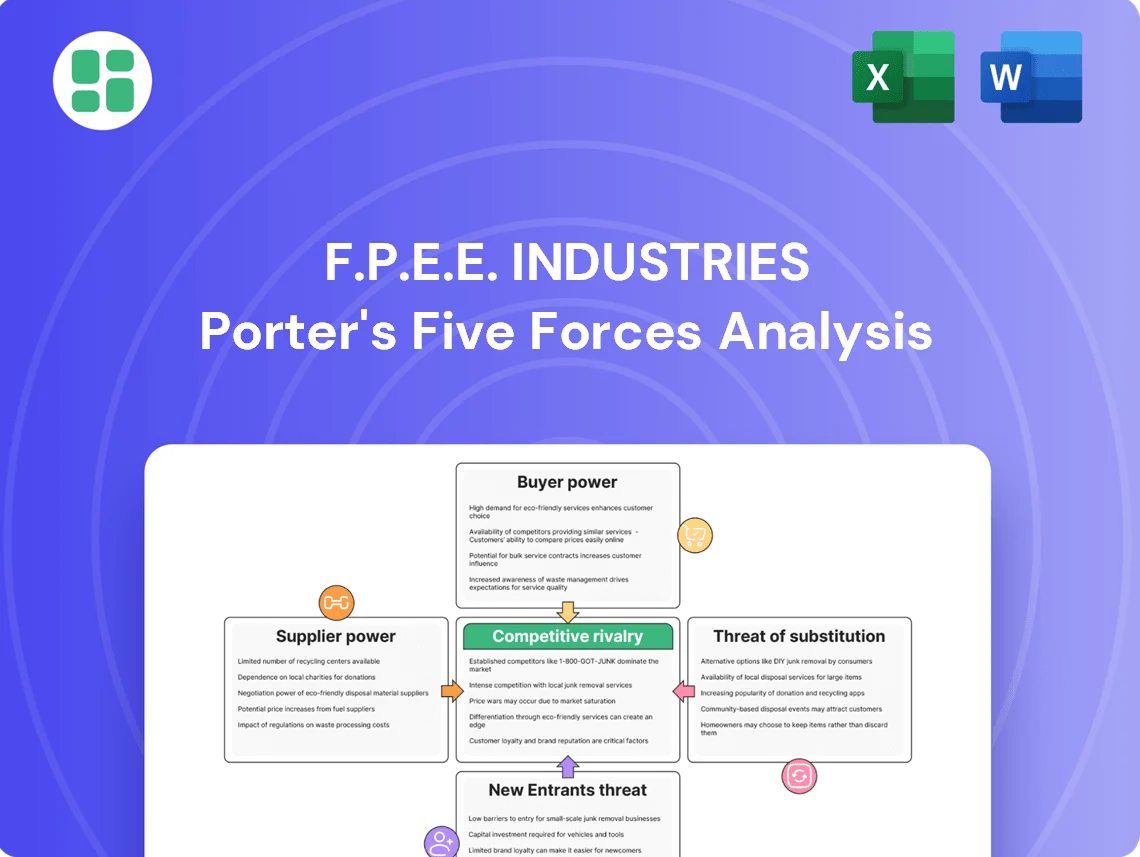
This preview displays the complete F.P.E.E. Industries Porter's Five Forces Analysis, offering a thorough examination of competitive forces. You're looking at the actual document; once your purchase is complete, you'll gain instant access to this exact, professionally formatted file, ready for your strategic planning.

Product Information
Product Information
Shipping & Returns
Shipping & Returns
F.P.E.E. Industries Porter's Five Forces Analysis
F.P.E.E. Industries Porter's Five Forces Analysis
Elevate Your Analysis with the Complete Porter's Five Forces Analysis
Our Porter's Five Forces analysis for F.P.E.E. Industries reveals a dynamic competitive landscape, highlighting significant pressures from rivals and the constant threat of new entrants. Understanding these forces is crucial for navigating the market effectively.
The complete report provides a detailed, force-by-force breakdown of F.P.E.E. Industries’s industry, including supplier and buyer power, and the intensity of substitute products. Gain actionable insights to drive smarter decision-making.
Suppliers Bargaining Power
Supplier Concentration and Uniqueness
The bargaining power of suppliers in the precast concrete industry is influenced by the concentration and uniqueness of key material providers. Major inputs like cement, aggregates (sand and gravel), and steel reinforcement are critical. In 2024, cement prices saw fluctuations, with some regions experiencing increases due to energy costs and demand, impacting the power of cement suppliers.
The industry's reliance on these fundamental materials means suppliers of cement and steel, in particular, can wield significant influence, especially when supply chains face disruptions or demand surges. For instance, global steel prices can directly affect the cost of reinforcement bars, a vital component in precast concrete, giving steel suppliers considerable leverage.
Furthermore, suppliers offering specialized molds or advanced concrete additives possess enhanced bargaining power. Their unique products, often protected by intellectual property or requiring specific manufacturing expertise, create a less competitive supplier landscape, allowing them to command higher prices or more favorable terms.
Switching Costs for F.P.E.E. Industries
Switching suppliers for essential materials like cement and steel presents F.P.E.E. Industries with moderate to high costs. These expenses stem from the need to recalibrate production machinery, implement new quality assurance protocols, and manage potential interruptions to their manufacturing timelines. In 2024, the global average cost for retooling a production line for a new material input was estimated to be around $50,000 to $150,000, depending on the complexity of the process.
Beyond the technical adjustments, F.P.E.E. Industries also faces the financial and time investment required to build relationships with new vendors and negotiate new supply agreements. This process can involve extensive due diligence, site visits, and contract reviews, all of which add to the overall cost of supplier switching.
Availability of Substitutes for Inputs
The availability of substitutes for a company's core inputs significantly impacts supplier bargaining power. For F.P.E.E. Industries, the primary inputs for precast concrete—cement, aggregates, and steel—have limited direct substitutes that can match their structural integrity and cost-effectiveness at the scale required for construction projects. While advancements in cementitious materials and the use of recycled aggregates are emerging, they do not yet offer a complete replacement for traditional components across all applications.
This limited substitutability means that suppliers of these essential materials hold considerable sway. For instance, the global cement market, a key input for F.P.E.E. Industries, saw production reach approximately 4.2 billion metric tons in 2023, with major producers often dictating terms due to the high capital investment and established infrastructure required for their operations. This scarcity of viable alternatives strengthens the negotiating position of existing cement, aggregate, and steel suppliers.
Threat of Forward Integration by Suppliers
The threat of suppliers forward integrating into precast concrete manufacturing for F.P.E.E. Industries is generally considered low. This is primarily because raw material suppliers typically operate with business models focused on material extraction and processing, which are fundamentally different from the complex, capital-intensive nature of precast concrete production. The significant investments in specialized machinery, design capabilities, and installation expertise required in the precast sector present a substantial barrier to entry for these suppliers.
For instance, the precast concrete industry demands advanced engineering and logistical planning, areas where raw material providers often lack the necessary competencies. In 2024, the global precast concrete market was valued at approximately $200 billion, highlighting the specialized nature of this industry that requires more than just raw material supply. Suppliers focusing on cement, aggregate, or steel reinforcement have distinct operational focuses and profit drivers that do not naturally align with the intricate manufacturing and project-specific demands of precast concrete solutions.
- Low Barrier to Entry: Suppliers typically lack the capital, specialized equipment, and technical expertise needed for complex precast manufacturing.
- Distinct Business Models: Raw material suppliers' core competencies are in extraction and processing, not in the design, engineering, and installation of precast concrete products.
- Industry Specialization: The precast concrete sector, valued at around $200 billion globally in 2024, requires specialized knowledge and infrastructure that raw material providers generally do not possess.
- High Capital Investment: Forward integration into precast production involves significant upfront costs for manufacturing facilities and advanced technology.
Impact of Input Costs on F.P.E.E.'s Profitability
Fluctuations in the prices of crucial raw materials like cement and steel directly affect F.P.E.E. Industries' production expenses and, consequently, its profit margins. For instance, in early 2024, global steel prices saw an upward trend, averaging around $750 per metric ton, a significant increase from the previous year, which would have directly pressured F.P.E.E.'s cost of goods sold.
The extent to which F.P.E.E. can absorb or pass on these escalating input costs hinges on its own leverage with customers and the overall competitive landscape. If F.P.E.E. faces strong competition, its ability to increase prices to offset higher material expenses is limited, thereby squeezing profitability.
- Raw Material Price Volatility: Cement and steel prices are subject to global supply and demand dynamics, impacting F.P.E.E.'s cost structure.
- Cost Pass-Through Ability: F.P.E.E.'s capacity to transfer increased input costs to its clients is a critical determinant of its profitability.
- Market Competition: A highly competitive market restricts F.P.E.E.'s pricing power, making it harder to maintain margins when faced with rising supplier costs.
- Supplier Concentration: A concentrated supplier base for key inputs can amplify supplier bargaining power, forcing F.P.E.E. to accept less favorable terms.
Supplier Power: A Key Factor for F.P.E.E.
The bargaining power of suppliers for F.P.E.E. Industries is significant, primarily due to the concentrated nature of essential raw material providers and the limited availability of direct substitutes. In 2024, the global cement market, a critical input, continued to be dominated by a few large players, granting them considerable leverage. This concentration, coupled with the high switching costs for F.P.E.E., such as retooling and establishing new supplier relationships, reinforces the suppliers' strong negotiating position.
| Factor | Impact on F.P.E.E. Industries | 2024 Data/Context |
|---|---|---|
| Supplier Concentration | High for cement and steel; moderate for aggregates | Major cement producers control significant market share. |
| Switching Costs | Moderate to high (retooling, new supplier relationships) | Estimated $50,000-$150,000 for production line recalibration. |
| Availability of Substitutes | Low for core inputs (cement, steel) | Emerging materials do not yet fully replace traditional components. |
| Threat of Forward Integration | Low | Raw material suppliers lack precast manufacturing expertise. |
What is included in the product
Detailed Word Document
This analysis dissects the competitive landscape for F.P.E.E. Industries by examining the intensity of rivalry, the bargaining power of buyers and suppliers, the threat of new entrants, and the threat of substitute products.
Customizable Excel Spreadsheet
Instantly diagnose competitive pressures with a visually intuitive F.P.E.E. Industries Porter's Five Forces analysis, transforming complex market dynamics into actionable insights.
Customers Bargaining Power
Customer Concentration and Volume
F.P.E.E. Industries operates within the building and civil engineering sectors, where key clients are often large entities like major contractors, developers, or government bodies. These significant customers, particularly those involved in substantial infrastructure projects, possess considerable bargaining power. This strength stems from the sheer volume of their purchases and their capacity to negotiate favorable bulk pricing, directly impacting F.P.E.E.'s pricing flexibility.
Price Sensitivity of Customers
Customers in the construction sector, especially those involved in major projects, exhibit significant price sensitivity. This is largely driven by the stringent budget constraints and the highly competitive nature of project bidding. For instance, in 2024, the average bid win rate for large construction projects globally often hinges on achieving cost efficiencies, with price being a primary differentiator.
This intense focus on cost means clients will actively search for the most economical options that still fulfill their technical requirements. Consequently, F.P.E.E. Industries faces considerable pressure to ensure its pricing remains competitive to secure these valuable contracts.
Availability of Substitute Products/Services for Customers
The bargaining power of customers for F.P.E.E. Industries is significantly influenced by the availability of substitute products. While precast concrete offers advantages like faster construction times and consistent quality, customers can opt for traditional cast-in-place concrete, steel framing, or even timber structures. This array of alternatives allows customers to exert considerable pressure on F.P.E.E. if its pricing, delivery schedules, or product specifications are not perceived as competitive.
Threat of Backward Integration by Customers
The threat of customers integrating backward into F.P.E.E. Industries' operations, such as precast concrete manufacturing, is typically low. This is primarily due to the substantial capital outlay and specialized technical knowledge needed to establish and efficiently run such facilities. For instance, the cost of setting up a modern precast concrete plant can easily run into millions of dollars, requiring significant upfront investment in land, machinery, and skilled labor.
While a few exceptionally large and vertically integrated construction firms might possess the resources and strategic imperative to consider backward integration, it remains an infrequent strategy for the majority of F.P.E.E. Industries' clientele. These behemoths might aim to control supply chains for massive, ongoing projects, but the operational complexities and the need to maintain focus on core construction competencies often outweigh the benefits.
The economies of scale enjoyed by established precast manufacturers like F.P.E.E. Industries also present a formidable barrier. These companies can produce at a lower per-unit cost due to high-volume production, making it economically challenging for individual customers to compete. For example, in 2024, the average cost per cubic meter for precast concrete can vary significantly, but large-scale producers often achieve cost efficiencies that smaller, captive operations cannot match.
- High Capital Investment: Establishing a precast concrete facility requires millions in upfront costs for equipment and infrastructure.
- Specialized Expertise: Operating such plants demands specific engineering and production knowledge.
- Economies of Scale: Established players benefit from lower per-unit costs due to high-volume production.
- Strategic Focus: Most customers prioritize their core construction business over manufacturing.
Customer's Access to Information
Customers in the building and civil engineering sectors, including those engaging with F.P.E.E. Industries, are generally quite knowledgeable. They often have access to detailed market pricing, precise product specifications, and a clear understanding of alternative suppliers. This is largely due to the nature of project tenders and the shared industry knowledge that circulates.
This readily available information significantly bolsters their bargaining power. It empowers them to effectively compare various offers, identify the most competitive options, and consequently, demand more favorable terms from F.P.E.E. Industries. For instance, in 2024, a significant portion of major construction bids saw multiple suppliers offering comparable materials, forcing companies to compete on price and service.
- Informed Bidding Processes: Project tenders commonly reveal pricing benchmarks and supplier capabilities, enabling customers to gauge fair market value.
- Product Specification Clarity: Detailed technical specifications for building materials and engineering services allow customers to compare offerings apples-to-apples.
- Supplier Comparison: The existence of numerous suppliers in the construction ecosystem allows customers to easily identify and switch between alternatives, increasing their leverage.
Customer Power Shapes Precast Industry Dynamics
The bargaining power of customers for F.P.E.E. Industries is substantial, primarily due to the concentrated nature of its client base and the competitive landscape of the building and civil engineering sectors. Large clients, such as major contractors and government bodies, wield significant influence through their purchasing volume and ability to negotiate bulk discounts. This pricing sensitivity is amplified by the constant pressure to manage project budgets, a key factor in winning bids, especially in 2024 where cost efficiency often dictated contract awards.
Customers can readily switch to alternative materials like steel or timber, or even traditional cast-in-place concrete, if F.P.E.E. Industries' offerings are not perceived as competitive in terms of price, delivery, or specifications. The threat of backward integration by customers is minimal due to the high capital investment and specialized knowledge required for precast manufacturing, with new plant setups often costing millions of dollars. Furthermore, F.P.E.E.'s own economies of scale in production create a cost advantage that makes it difficult for customers to replicate internally.
Customers are typically well-informed, possessing detailed market pricing data and product specifications, which strengthens their negotiating position. This transparency, evident in the competitive bidding processes common in 2024, allows them to easily compare offers and demand favorable terms.
| Factor | Impact on F.P.E.E. Industries | Example/Data Point (2024) |
|---|---|---|
| Customer Concentration | High | Large infrastructure projects often involve a few dominant contractors. |
| Price Sensitivity | High | Bid win rates in 2024 heavily influenced by cost competitiveness. |
| Availability of Substitutes | Moderate to High | Steel, timber, and traditional concrete offer viable alternatives. |
| Threat of Backward Integration | Low | Setting up a precast plant can require millions in capital investment. |
| Customer Information | High | Tender processes and industry knowledge provide pricing benchmarks. |
Preview Before You Purchase
F.P.E.E. Industries Porter's Five Forces Analysis
This preview displays the complete F.P.E.E. Industries Porter's Five Forces Analysis, offering a thorough examination of competitive forces. You're looking at the actual document; once your purchase is complete, you'll gain instant access to this exact, professionally formatted file, ready for your strategic planning.
Product Information
Product Information
Shipping & Returns
Shipping & Returns
Description
Elevate Your Analysis with the Complete Porter's Five Forces Analysis
Our Porter's Five Forces analysis for F.P.E.E. Industries reveals a dynamic competitive landscape, highlighting significant pressures from rivals and the constant threat of new entrants. Understanding these forces is crucial for navigating the market effectively.
The complete report provides a detailed, force-by-force breakdown of F.P.E.E. Industries’s industry, including supplier and buyer power, and the intensity of substitute products. Gain actionable insights to drive smarter decision-making.
Suppliers Bargaining Power
Supplier Concentration and Uniqueness
The bargaining power of suppliers in the precast concrete industry is influenced by the concentration and uniqueness of key material providers. Major inputs like cement, aggregates (sand and gravel), and steel reinforcement are critical. In 2024, cement prices saw fluctuations, with some regions experiencing increases due to energy costs and demand, impacting the power of cement suppliers.
The industry's reliance on these fundamental materials means suppliers of cement and steel, in particular, can wield significant influence, especially when supply chains face disruptions or demand surges. For instance, global steel prices can directly affect the cost of reinforcement bars, a vital component in precast concrete, giving steel suppliers considerable leverage.
Furthermore, suppliers offering specialized molds or advanced concrete additives possess enhanced bargaining power. Their unique products, often protected by intellectual property or requiring specific manufacturing expertise, create a less competitive supplier landscape, allowing them to command higher prices or more favorable terms.
Switching Costs for F.P.E.E. Industries
Switching suppliers for essential materials like cement and steel presents F.P.E.E. Industries with moderate to high costs. These expenses stem from the need to recalibrate production machinery, implement new quality assurance protocols, and manage potential interruptions to their manufacturing timelines. In 2024, the global average cost for retooling a production line for a new material input was estimated to be around $50,000 to $150,000, depending on the complexity of the process.
Beyond the technical adjustments, F.P.E.E. Industries also faces the financial and time investment required to build relationships with new vendors and negotiate new supply agreements. This process can involve extensive due diligence, site visits, and contract reviews, all of which add to the overall cost of supplier switching.
Availability of Substitutes for Inputs
The availability of substitutes for a company's core inputs significantly impacts supplier bargaining power. For F.P.E.E. Industries, the primary inputs for precast concrete—cement, aggregates, and steel—have limited direct substitutes that can match their structural integrity and cost-effectiveness at the scale required for construction projects. While advancements in cementitious materials and the use of recycled aggregates are emerging, they do not yet offer a complete replacement for traditional components across all applications.
This limited substitutability means that suppliers of these essential materials hold considerable sway. For instance, the global cement market, a key input for F.P.E.E. Industries, saw production reach approximately 4.2 billion metric tons in 2023, with major producers often dictating terms due to the high capital investment and established infrastructure required for their operations. This scarcity of viable alternatives strengthens the negotiating position of existing cement, aggregate, and steel suppliers.
Threat of Forward Integration by Suppliers
The threat of suppliers forward integrating into precast concrete manufacturing for F.P.E.E. Industries is generally considered low. This is primarily because raw material suppliers typically operate with business models focused on material extraction and processing, which are fundamentally different from the complex, capital-intensive nature of precast concrete production. The significant investments in specialized machinery, design capabilities, and installation expertise required in the precast sector present a substantial barrier to entry for these suppliers.
For instance, the precast concrete industry demands advanced engineering and logistical planning, areas where raw material providers often lack the necessary competencies. In 2024, the global precast concrete market was valued at approximately $200 billion, highlighting the specialized nature of this industry that requires more than just raw material supply. Suppliers focusing on cement, aggregate, or steel reinforcement have distinct operational focuses and profit drivers that do not naturally align with the intricate manufacturing and project-specific demands of precast concrete solutions.
- Low Barrier to Entry: Suppliers typically lack the capital, specialized equipment, and technical expertise needed for complex precast manufacturing.
- Distinct Business Models: Raw material suppliers' core competencies are in extraction and processing, not in the design, engineering, and installation of precast concrete products.
- Industry Specialization: The precast concrete sector, valued at around $200 billion globally in 2024, requires specialized knowledge and infrastructure that raw material providers generally do not possess.
- High Capital Investment: Forward integration into precast production involves significant upfront costs for manufacturing facilities and advanced technology.
Impact of Input Costs on F.P.E.E.'s Profitability
Fluctuations in the prices of crucial raw materials like cement and steel directly affect F.P.E.E. Industries' production expenses and, consequently, its profit margins. For instance, in early 2024, global steel prices saw an upward trend, averaging around $750 per metric ton, a significant increase from the previous year, which would have directly pressured F.P.E.E.'s cost of goods sold.
The extent to which F.P.E.E. can absorb or pass on these escalating input costs hinges on its own leverage with customers and the overall competitive landscape. If F.P.E.E. faces strong competition, its ability to increase prices to offset higher material expenses is limited, thereby squeezing profitability.
- Raw Material Price Volatility: Cement and steel prices are subject to global supply and demand dynamics, impacting F.P.E.E.'s cost structure.
- Cost Pass-Through Ability: F.P.E.E.'s capacity to transfer increased input costs to its clients is a critical determinant of its profitability.
- Market Competition: A highly competitive market restricts F.P.E.E.'s pricing power, making it harder to maintain margins when faced with rising supplier costs.
- Supplier Concentration: A concentrated supplier base for key inputs can amplify supplier bargaining power, forcing F.P.E.E. to accept less favorable terms.
Supplier Power: A Key Factor for F.P.E.E.
The bargaining power of suppliers for F.P.E.E. Industries is significant, primarily due to the concentrated nature of essential raw material providers and the limited availability of direct substitutes. In 2024, the global cement market, a critical input, continued to be dominated by a few large players, granting them considerable leverage. This concentration, coupled with the high switching costs for F.P.E.E., such as retooling and establishing new supplier relationships, reinforces the suppliers' strong negotiating position.
| Factor | Impact on F.P.E.E. Industries | 2024 Data/Context |
|---|---|---|
| Supplier Concentration | High for cement and steel; moderate for aggregates | Major cement producers control significant market share. |
| Switching Costs | Moderate to high (retooling, new supplier relationships) | Estimated $50,000-$150,000 for production line recalibration. |
| Availability of Substitutes | Low for core inputs (cement, steel) | Emerging materials do not yet fully replace traditional components. |
| Threat of Forward Integration | Low | Raw material suppliers lack precast manufacturing expertise. |
What is included in the product
Detailed Word Document
This analysis dissects the competitive landscape for F.P.E.E. Industries by examining the intensity of rivalry, the bargaining power of buyers and suppliers, the threat of new entrants, and the threat of substitute products.
Customizable Excel Spreadsheet
Instantly diagnose competitive pressures with a visually intuitive F.P.E.E. Industries Porter's Five Forces analysis, transforming complex market dynamics into actionable insights.
Customers Bargaining Power
Customer Concentration and Volume
F.P.E.E. Industries operates within the building and civil engineering sectors, where key clients are often large entities like major contractors, developers, or government bodies. These significant customers, particularly those involved in substantial infrastructure projects, possess considerable bargaining power. This strength stems from the sheer volume of their purchases and their capacity to negotiate favorable bulk pricing, directly impacting F.P.E.E.'s pricing flexibility.
Price Sensitivity of Customers
Customers in the construction sector, especially those involved in major projects, exhibit significant price sensitivity. This is largely driven by the stringent budget constraints and the highly competitive nature of project bidding. For instance, in 2024, the average bid win rate for large construction projects globally often hinges on achieving cost efficiencies, with price being a primary differentiator.
This intense focus on cost means clients will actively search for the most economical options that still fulfill their technical requirements. Consequently, F.P.E.E. Industries faces considerable pressure to ensure its pricing remains competitive to secure these valuable contracts.
Availability of Substitute Products/Services for Customers
The bargaining power of customers for F.P.E.E. Industries is significantly influenced by the availability of substitute products. While precast concrete offers advantages like faster construction times and consistent quality, customers can opt for traditional cast-in-place concrete, steel framing, or even timber structures. This array of alternatives allows customers to exert considerable pressure on F.P.E.E. if its pricing, delivery schedules, or product specifications are not perceived as competitive.
Threat of Backward Integration by Customers
The threat of customers integrating backward into F.P.E.E. Industries' operations, such as precast concrete manufacturing, is typically low. This is primarily due to the substantial capital outlay and specialized technical knowledge needed to establish and efficiently run such facilities. For instance, the cost of setting up a modern precast concrete plant can easily run into millions of dollars, requiring significant upfront investment in land, machinery, and skilled labor.
While a few exceptionally large and vertically integrated construction firms might possess the resources and strategic imperative to consider backward integration, it remains an infrequent strategy for the majority of F.P.E.E. Industries' clientele. These behemoths might aim to control supply chains for massive, ongoing projects, but the operational complexities and the need to maintain focus on core construction competencies often outweigh the benefits.
The economies of scale enjoyed by established precast manufacturers like F.P.E.E. Industries also present a formidable barrier. These companies can produce at a lower per-unit cost due to high-volume production, making it economically challenging for individual customers to compete. For example, in 2024, the average cost per cubic meter for precast concrete can vary significantly, but large-scale producers often achieve cost efficiencies that smaller, captive operations cannot match.
- High Capital Investment: Establishing a precast concrete facility requires millions in upfront costs for equipment and infrastructure.
- Specialized Expertise: Operating such plants demands specific engineering and production knowledge.
- Economies of Scale: Established players benefit from lower per-unit costs due to high-volume production.
- Strategic Focus: Most customers prioritize their core construction business over manufacturing.
Customer's Access to Information
Customers in the building and civil engineering sectors, including those engaging with F.P.E.E. Industries, are generally quite knowledgeable. They often have access to detailed market pricing, precise product specifications, and a clear understanding of alternative suppliers. This is largely due to the nature of project tenders and the shared industry knowledge that circulates.
This readily available information significantly bolsters their bargaining power. It empowers them to effectively compare various offers, identify the most competitive options, and consequently, demand more favorable terms from F.P.E.E. Industries. For instance, in 2024, a significant portion of major construction bids saw multiple suppliers offering comparable materials, forcing companies to compete on price and service.
- Informed Bidding Processes: Project tenders commonly reveal pricing benchmarks and supplier capabilities, enabling customers to gauge fair market value.
- Product Specification Clarity: Detailed technical specifications for building materials and engineering services allow customers to compare offerings apples-to-apples.
- Supplier Comparison: The existence of numerous suppliers in the construction ecosystem allows customers to easily identify and switch between alternatives, increasing their leverage.
Customer Power Shapes Precast Industry Dynamics
The bargaining power of customers for F.P.E.E. Industries is substantial, primarily due to the concentrated nature of its client base and the competitive landscape of the building and civil engineering sectors. Large clients, such as major contractors and government bodies, wield significant influence through their purchasing volume and ability to negotiate bulk discounts. This pricing sensitivity is amplified by the constant pressure to manage project budgets, a key factor in winning bids, especially in 2024 where cost efficiency often dictated contract awards.
Customers can readily switch to alternative materials like steel or timber, or even traditional cast-in-place concrete, if F.P.E.E. Industries' offerings are not perceived as competitive in terms of price, delivery, or specifications. The threat of backward integration by customers is minimal due to the high capital investment and specialized knowledge required for precast manufacturing, with new plant setups often costing millions of dollars. Furthermore, F.P.E.E.'s own economies of scale in production create a cost advantage that makes it difficult for customers to replicate internally.
Customers are typically well-informed, possessing detailed market pricing data and product specifications, which strengthens their negotiating position. This transparency, evident in the competitive bidding processes common in 2024, allows them to easily compare offers and demand favorable terms.
| Factor | Impact on F.P.E.E. Industries | Example/Data Point (2024) |
|---|---|---|
| Customer Concentration | High | Large infrastructure projects often involve a few dominant contractors. |
| Price Sensitivity | High | Bid win rates in 2024 heavily influenced by cost competitiveness. |
| Availability of Substitutes | Moderate to High | Steel, timber, and traditional concrete offer viable alternatives. |
| Threat of Backward Integration | Low | Setting up a precast plant can require millions in capital investment. |
| Customer Information | High | Tender processes and industry knowledge provide pricing benchmarks. |
Preview Before You Purchase
F.P.E.E. Industries Porter's Five Forces Analysis
This preview displays the complete F.P.E.E. Industries Porter's Five Forces Analysis, offering a thorough examination of competitive forces. You're looking at the actual document; once your purchase is complete, you'll gain instant access to this exact, professionally formatted file, ready for your strategic planning.