Sumitomo Chemical Porter's Five Forces Analysis

Go Beyond the Preview—Access the Full Strategic Report
Sumitomo Chemical navigates a complex landscape shaped by powerful industry forces, from the bargaining power of its diverse customer base to the ever-present threat of substitute products. Understanding these dynamics is crucial for any stakeholder looking to grasp their competitive positioning.
The complete report reveals the real forces shaping Sumitomo Chemical’s industry—from supplier influence to threat of new entrants. Gain actionable insights to drive smarter decision-making.
Suppliers Bargaining Power

Concentration of raw material suppliers
The chemical industry, including companies like Sumitomo Chemical, often depends on a limited number of suppliers for critical raw materials such as crude oil, natural gas, and specific minerals. For instance, in 2024, the global petrochemical market, a key input for many chemical processes, continued to be influenced by the pricing of crude oil, which fluctuated significantly, averaging around $80 per barrel for Brent crude in the first half of the year. If these raw material sources are highly concentrated among a few providers, those suppliers gain substantial leverage to dictate prices. This can directly increase Sumitomo Chemical's production expenses and squeeze its profit margins.
Sumitomo Chemical's strategy of maintaining a diversified product portfolio can offer a degree of resilience against this supplier power. By operating across various chemical segments, the company spreads its reliance on different raw material streams. This diversification means that a price shock in one particular raw material may not cripple the entire operation, as other business units might be less affected or even benefit from different market conditions.
Availability of substitute inputs
The ease with which Sumitomo Chemical can switch between different raw materials or sources significantly impacts supplier power. For instance, if Sumitomo relies heavily on a single, specialized chemical that has few alternatives, suppliers of that chemical hold considerable leverage. However, if multiple suppliers offer comparable inputs, or if Sumitomo can readily substitute one raw material for another, its bargaining power increases.
In 2024, the chemical industry experienced fluctuations in raw material availability, particularly for petrochemical derivatives, due to geopolitical events and supply chain disruptions. Companies like Sumitomo Chemical that had diversified their supplier base and invested in R&D for alternative materials were better positioned to mitigate price increases and supply shortages, thereby reducing the bargaining power of any single supplier.

Switching costs for Sumitomo Chemical
Sumitomo Chemical faces significant supplier bargaining power due to high switching costs. These costs can include the need for specialized equipment modifications or lengthy re-qualification processes for new materials, making it difficult and expensive for Sumitomo Chemical to change suppliers. For instance, in the agrochemical sector, where Sumitomo Chemical operates, the development and approval of new active ingredients can take years and involve substantial investment, creating strong ties to existing suppliers of intermediate chemicals.

Uniqueness of supplier offerings (specialized chemicals, technology)
Sumitomo Chemical's reliance on suppliers offering specialized chemicals and proprietary technologies significantly enhances supplier bargaining power. When these unique inputs are critical for Sumitomo's innovative product lines, finding suitable alternatives becomes challenging, potentially impacting product quality and development timelines.
For instance, in the advanced materials sector, where Sumitomo Chemical operates, a supplier holding patents for a key component in high-performance polymers can command higher prices. In 2024, the global specialty chemicals market, a key area for Sumitomo, was valued at approximately $650 billion, with a significant portion driven by proprietary formulations and advanced manufacturing processes.
- Proprietary Technologies: Suppliers with exclusive rights to essential manufacturing technologies or chemical synthesis methods gain leverage.
- Critical Inputs: The more indispensable a supplier's specialized chemical or component is to Sumitomo's final product, the stronger the supplier's position.
- Limited Alternatives: A scarcity of alternative suppliers for these unique offerings forces Sumitomo to accept supplier terms.
Threat of forward integration by suppliers
The threat of suppliers integrating forward into Sumitomo Chemical's manufacturing operations significantly bolsters their bargaining power. If suppliers possess the capability and intent to produce the same chemicals or materials Sumitomo currently makes, they can dictate terms more aggressively. This leverage can compel Sumitomo to accept less favorable pricing or supply agreements to preempt direct competition from its own feedstock providers.
For instance, if a key raw material supplier for Sumitomo's agrochemicals division were to develop the capacity to produce finished pesticide formulations, this would create a substantial competitive threat. Such a move would not only disrupt Sumitomo's market position but also give the supplier immense leverage in negotiations over raw material costs. As of early 2024, the specialty chemicals sector, where Sumitomo Chemical operates, has seen some consolidation, potentially increasing the risk of such forward integration by larger, well-capitalized suppliers.
- Increased Supplier Leverage: Suppliers capable of forward integration gain significant power to influence pricing and terms.
- Competitive Threat: Direct competition from suppliers can erode Sumitomo Chemical's market share and profitability.
- Negotiation Pressure: Sumitomo may be forced into less advantageous agreements to avoid this competitive risk.
- Industry Trend: Consolidation in related chemical sectors can amplify the potential for forward integration by suppliers.
Suppliers Dictate Terms in Chemical Manufacturing
Sumitomo Chemical faces substantial bargaining power from its suppliers, particularly those providing specialized chemicals or proprietary technologies. High switching costs, such as the need for equipment modifications or lengthy material re-qualification processes, further solidify supplier leverage. For example, in Sumitomo's agrochemical business, developing and approving new active ingredients can take years, creating strong dependencies on existing intermediate chemical suppliers.
The concentration of suppliers for critical raw materials, like those for petrochemicals, also grants significant power. In 2024, crude oil prices, a key input, averaged around $80 per barrel for Brent crude in the first half, impacting production expenses. Furthermore, the threat of suppliers integrating forward into Sumitomo's manufacturing operations, as seen with some consolidation in the specialty chemicals sector by early 2024, increases their ability to dictate terms and poses a competitive threat.
| Factor | Impact on Sumitomo Chemical | 2024 Relevance/Example |
|---|---|---|
| Supplier Concentration | High leverage for few suppliers | Petrochemical inputs influenced by crude oil prices (avg. ~$80/bbl Brent H1 2024) |
| Switching Costs | Difficulty and expense in changing suppliers | Agrochemicals: long development cycles for new active ingredients |
| Proprietary Inputs | Supplier control over unique materials | Specialty chemicals: patents on key components in high-performance polymers |
| Forward Integration Threat | Suppliers becoming competitors | Specialty chemicals sector consolidation (early 2024) increases risk |
What is included in the product
 Detailed Word Document
This analysis unpacks the competitive landscape for Sumitomo Chemical, detailing the intensity of rivalry, buyer and supplier power, threat of new entrants, and the impact of substitutes on its diverse chemical businesses.

 Customizable Excel Spreadsheet
Gain immediate clarity on competitive pressures with a visual breakdown of each force, enabling faster, more informed strategic adjustments.
Customers Bargaining Power

Diversity and concentration of customer base
Sumitomo Chemical's customer base spans diverse sectors like petrochemicals, IT, health, and agriculture. This broad reach typically dilutes the power of individual customers, as no single entity holds overwhelming sway.
However, within specific market segments, the concentration of a few large industrial clients can significantly amplify their bargaining power. For instance, in the IT-related chemicals division, if a handful of major electronics manufacturers represent a substantial percentage of sales, they can exert considerable pressure on pricing and terms.
Customer's ability to switch to competitors
The bargaining power of Sumitomo Chemical's customers is significantly influenced by how easily and cheaply they can switch to other chemical suppliers. For commodity chemicals, where differentiation is minimal, customers can readily shift to competitors, often based purely on price. This puts considerable pressure on Sumitomo to maintain competitive pricing. For example, in the agricultural chemicals sector, where many generic products exist, a farmer might easily switch if a competitor offers a similar product at a lower cost.
Conversely, when Sumitomo Chemical provides highly specialized chemicals or integrated solutions that are crucial to a customer's manufacturing process, the cost and complexity of switching increase. This reduces the customer's leverage. In 2024, the specialty chemicals market, which often involves tailored formulations and technical support, generally sees lower customer switching power compared to bulk chemicals. For instance, a pharmaceutical company relying on a specific, high-purity intermediate from Sumitomo would face significant R&D and regulatory hurdles to change suppliers, thereby limiting their bargaining power.

Price sensitivity of customers
Customers in commodity chemical markets often exhibit high price sensitivity. This is because the products are largely undifferentiated, leading buyers to seek the most competitive prices. For instance, in the bulk petrochemicals segment, even small price variations can significantly influence purchasing decisions.
However, Sumitomo Chemical's position shifts with its specialized offerings. For its IT-related chemicals, which are crucial for semiconductor manufacturing, customers are typically less price-sensitive. This is due to the unique, high-performance nature of these materials and their critical role in advanced electronics production, where reliability and specific functionalities often outweigh minor cost differences.

Availability of substitute products for customers
The availability of substitute products significantly strengthens the bargaining power of Sumitomo Chemical's customers. When customers can easily switch to alternative solutions that meet their needs, they have more leverage to demand lower prices or better terms. This is particularly true in markets where Sumitomo Chemical faces competition from companies offering similar chemical compounds or materials.
For instance, in the agricultural chemicals sector, the development of new generic pesticides or bio-based alternatives can directly challenge Sumitomo Chemical's market position. Customers, such as farmers, can opt for these substitutes if Sumitomo Chemical's offerings become too expensive or less effective. In 2023, the global agrochemical market saw continued growth in generic product sales, putting pressure on established players to innovate and maintain competitive pricing.
- Increased Customer Leverage: A wide array of substitutes empowers customers to negotiate more favorable pricing and product specifications.
- Competitive Pressure: Sumitomo Chemical must continuously innovate and optimize costs to retain customers who have readily available alternatives.
- Impact on Profitability: The threat of substitution can compress profit margins, especially in segments with high price sensitivity and numerous competitors.
- Market Dynamics: In 2024, the chemical industry is observing a trend where customers are increasingly scrutinizing the total cost of ownership, including performance and environmental impact, when evaluating substitutes.
Threat of backward integration by customers
The bargaining power of customers is a significant factor for Sumitomo Chemical. Large clients, particularly those in industries like automotive or electronics, possess the capability to integrate backward, meaning they could produce chemicals or materials in-house that they currently source from Sumitomo. This potential for captive production grants these customers substantial leverage in negotiations.
For instance, a major automotive manufacturer might consider producing certain specialty chemicals used in their vehicle components if the cost and complexity are manageable. This threat can pressure Sumitomo Chemical to offer more competitive pricing or more favorable contract terms to retain these key accounts and prevent market share erosion due to customers opting for self-sufficiency.
- Backward Integration Threat: Large customers can leverage their scale to produce chemicals internally, reducing reliance on suppliers like Sumitomo Chemical.
- Customer Leverage: The potential for in-house production empowers customers to demand lower prices and better terms.
- Market Share Risk: Sumitomo Chemical faces the risk of losing business if customers find captive production more economical or strategically advantageous.
- Pricing Pressure: This customer power can directly impact Sumitomo Chemical's profitability by forcing price concessions.
Customer Power Shapes Chemical Industry Dynamics
Sumitomo Chemical's customers possess considerable bargaining power, particularly when they purchase commodity chemicals where switching costs are low and price is the primary driver. This is evident in segments like petrochemicals, where a few large buyers can significantly influence pricing. For specialized products, however, this power is diminished due to higher switching costs and the critical nature of the materials.
The threat of backward integration by large customers, such as automotive or electronics manufacturers, also elevates their leverage. If these clients can economically produce certain chemicals in-house, they can pressure Sumitomo Chemical for better terms to avoid losing business. Furthermore, the availability of numerous substitute products across various sectors allows customers to readily shift suppliers, intensifying competitive pressure and potentially impacting Sumitomo's profit margins.
| Customer Segment | Switching Costs | Price Sensitivity | Bargaining Power |
| Commodity Petrochemicals | Low | High | High |
| IT-Related Chemicals (e.g., semiconductor materials) | High | Low | Low to Moderate |
| Agricultural Chemicals (generic) | Low | High | High |
| Specialty Chemicals (e.g., pharmaceutical intermediates) | High | Low to Moderate | Low |
Same Document Delivered
Sumitomo Chemical Porter's Five Forces Analysis
This preview showcases the complete Sumitomo Chemical Porter's Five Forces Analysis, offering a comprehensive examination of the competitive landscape. The document you see here is precisely what you will receive, fully formatted and ready for immediate use upon purchase, ensuring no surprises and instant access to valuable strategic insights.

Product Information
Product Information
Shipping & Returns
Shipping & Returns
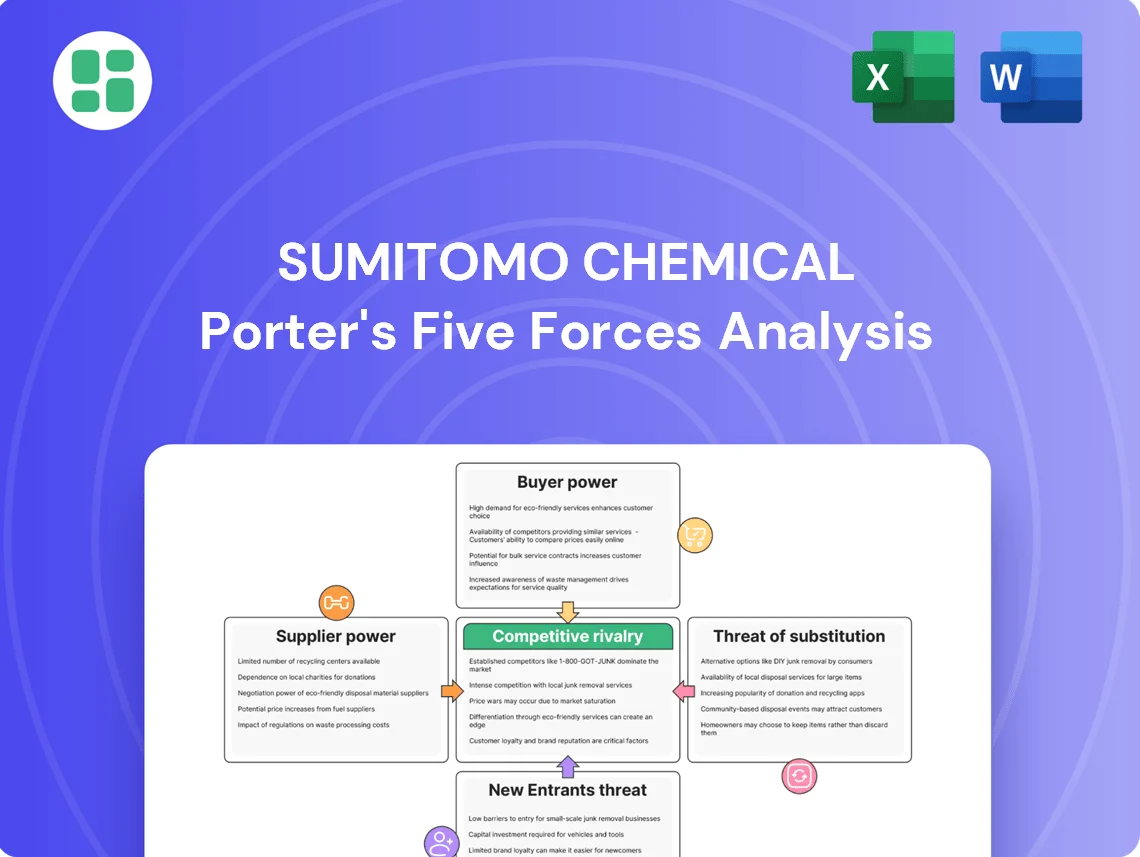
Sumitomo Chemical Porter's Five Forces Analysis
Sumitomo Chemical Porter's Five Forces Analysis
Go Beyond the Preview—Access the Full Strategic Report
Sumitomo Chemical navigates a complex landscape shaped by powerful industry forces, from the bargaining power of its diverse customer base to the ever-present threat of substitute products. Understanding these dynamics is crucial for any stakeholder looking to grasp their competitive positioning.
The complete report reveals the real forces shaping Sumitomo Chemical’s industry—from supplier influence to threat of new entrants. Gain actionable insights to drive smarter decision-making.
Suppliers Bargaining Power
Concentration of raw material suppliers
The chemical industry, including companies like Sumitomo Chemical, often depends on a limited number of suppliers for critical raw materials such as crude oil, natural gas, and specific minerals. For instance, in 2024, the global petrochemical market, a key input for many chemical processes, continued to be influenced by the pricing of crude oil, which fluctuated significantly, averaging around $80 per barrel for Brent crude in the first half of the year. If these raw material sources are highly concentrated among a few providers, those suppliers gain substantial leverage to dictate prices. This can directly increase Sumitomo Chemical's production expenses and squeeze its profit margins.
Sumitomo Chemical's strategy of maintaining a diversified product portfolio can offer a degree of resilience against this supplier power. By operating across various chemical segments, the company spreads its reliance on different raw material streams. This diversification means that a price shock in one particular raw material may not cripple the entire operation, as other business units might be less affected or even benefit from different market conditions.
Availability of substitute inputs
The ease with which Sumitomo Chemical can switch between different raw materials or sources significantly impacts supplier power. For instance, if Sumitomo relies heavily on a single, specialized chemical that has few alternatives, suppliers of that chemical hold considerable leverage. However, if multiple suppliers offer comparable inputs, or if Sumitomo can readily substitute one raw material for another, its bargaining power increases.
In 2024, the chemical industry experienced fluctuations in raw material availability, particularly for petrochemical derivatives, due to geopolitical events and supply chain disruptions. Companies like Sumitomo Chemical that had diversified their supplier base and invested in R&D for alternative materials were better positioned to mitigate price increases and supply shortages, thereby reducing the bargaining power of any single supplier.
Switching costs for Sumitomo Chemical
Sumitomo Chemical faces significant supplier bargaining power due to high switching costs. These costs can include the need for specialized equipment modifications or lengthy re-qualification processes for new materials, making it difficult and expensive for Sumitomo Chemical to change suppliers. For instance, in the agrochemical sector, where Sumitomo Chemical operates, the development and approval of new active ingredients can take years and involve substantial investment, creating strong ties to existing suppliers of intermediate chemicals.
Uniqueness of supplier offerings (specialized chemicals, technology)
Sumitomo Chemical's reliance on suppliers offering specialized chemicals and proprietary technologies significantly enhances supplier bargaining power. When these unique inputs are critical for Sumitomo's innovative product lines, finding suitable alternatives becomes challenging, potentially impacting product quality and development timelines.
For instance, in the advanced materials sector, where Sumitomo Chemical operates, a supplier holding patents for a key component in high-performance polymers can command higher prices. In 2024, the global specialty chemicals market, a key area for Sumitomo, was valued at approximately $650 billion, with a significant portion driven by proprietary formulations and advanced manufacturing processes.
- Proprietary Technologies: Suppliers with exclusive rights to essential manufacturing technologies or chemical synthesis methods gain leverage.
- Critical Inputs: The more indispensable a supplier's specialized chemical or component is to Sumitomo's final product, the stronger the supplier's position.
- Limited Alternatives: A scarcity of alternative suppliers for these unique offerings forces Sumitomo to accept supplier terms.
Threat of forward integration by suppliers
The threat of suppliers integrating forward into Sumitomo Chemical's manufacturing operations significantly bolsters their bargaining power. If suppliers possess the capability and intent to produce the same chemicals or materials Sumitomo currently makes, they can dictate terms more aggressively. This leverage can compel Sumitomo to accept less favorable pricing or supply agreements to preempt direct competition from its own feedstock providers.
For instance, if a key raw material supplier for Sumitomo's agrochemicals division were to develop the capacity to produce finished pesticide formulations, this would create a substantial competitive threat. Such a move would not only disrupt Sumitomo's market position but also give the supplier immense leverage in negotiations over raw material costs. As of early 2024, the specialty chemicals sector, where Sumitomo Chemical operates, has seen some consolidation, potentially increasing the risk of such forward integration by larger, well-capitalized suppliers.
- Increased Supplier Leverage: Suppliers capable of forward integration gain significant power to influence pricing and terms.
- Competitive Threat: Direct competition from suppliers can erode Sumitomo Chemical's market share and profitability.
- Negotiation Pressure: Sumitomo may be forced into less advantageous agreements to avoid this competitive risk.
- Industry Trend: Consolidation in related chemical sectors can amplify the potential for forward integration by suppliers.
Suppliers Dictate Terms in Chemical Manufacturing
Sumitomo Chemical faces substantial bargaining power from its suppliers, particularly those providing specialized chemicals or proprietary technologies. High switching costs, such as the need for equipment modifications or lengthy material re-qualification processes, further solidify supplier leverage. For example, in Sumitomo's agrochemical business, developing and approving new active ingredients can take years, creating strong dependencies on existing intermediate chemical suppliers.
The concentration of suppliers for critical raw materials, like those for petrochemicals, also grants significant power. In 2024, crude oil prices, a key input, averaged around $80 per barrel for Brent crude in the first half, impacting production expenses. Furthermore, the threat of suppliers integrating forward into Sumitomo's manufacturing operations, as seen with some consolidation in the specialty chemicals sector by early 2024, increases their ability to dictate terms and poses a competitive threat.
| Factor | Impact on Sumitomo Chemical | 2024 Relevance/Example |
|---|---|---|
| Supplier Concentration | High leverage for few suppliers | Petrochemical inputs influenced by crude oil prices (avg. ~$80/bbl Brent H1 2024) |
| Switching Costs | Difficulty and expense in changing suppliers | Agrochemicals: long development cycles for new active ingredients |
| Proprietary Inputs | Supplier control over unique materials | Specialty chemicals: patents on key components in high-performance polymers |
| Forward Integration Threat | Suppliers becoming competitors | Specialty chemicals sector consolidation (early 2024) increases risk |
What is included in the product
Detailed Word Document
This analysis unpacks the competitive landscape for Sumitomo Chemical, detailing the intensity of rivalry, buyer and supplier power, threat of new entrants, and the impact of substitutes on its diverse chemical businesses.
Customizable Excel Spreadsheet
Gain immediate clarity on competitive pressures with a visual breakdown of each force, enabling faster, more informed strategic adjustments.
Customers Bargaining Power
Diversity and concentration of customer base
Sumitomo Chemical's customer base spans diverse sectors like petrochemicals, IT, health, and agriculture. This broad reach typically dilutes the power of individual customers, as no single entity holds overwhelming sway.
However, within specific market segments, the concentration of a few large industrial clients can significantly amplify their bargaining power. For instance, in the IT-related chemicals division, if a handful of major electronics manufacturers represent a substantial percentage of sales, they can exert considerable pressure on pricing and terms.
Customer's ability to switch to competitors
The bargaining power of Sumitomo Chemical's customers is significantly influenced by how easily and cheaply they can switch to other chemical suppliers. For commodity chemicals, where differentiation is minimal, customers can readily shift to competitors, often based purely on price. This puts considerable pressure on Sumitomo to maintain competitive pricing. For example, in the agricultural chemicals sector, where many generic products exist, a farmer might easily switch if a competitor offers a similar product at a lower cost.
Conversely, when Sumitomo Chemical provides highly specialized chemicals or integrated solutions that are crucial to a customer's manufacturing process, the cost and complexity of switching increase. This reduces the customer's leverage. In 2024, the specialty chemicals market, which often involves tailored formulations and technical support, generally sees lower customer switching power compared to bulk chemicals. For instance, a pharmaceutical company relying on a specific, high-purity intermediate from Sumitomo would face significant R&D and regulatory hurdles to change suppliers, thereby limiting their bargaining power.
Price sensitivity of customers
Customers in commodity chemical markets often exhibit high price sensitivity. This is because the products are largely undifferentiated, leading buyers to seek the most competitive prices. For instance, in the bulk petrochemicals segment, even small price variations can significantly influence purchasing decisions.
However, Sumitomo Chemical's position shifts with its specialized offerings. For its IT-related chemicals, which are crucial for semiconductor manufacturing, customers are typically less price-sensitive. This is due to the unique, high-performance nature of these materials and their critical role in advanced electronics production, where reliability and specific functionalities often outweigh minor cost differences.
Availability of substitute products for customers
The availability of substitute products significantly strengthens the bargaining power of Sumitomo Chemical's customers. When customers can easily switch to alternative solutions that meet their needs, they have more leverage to demand lower prices or better terms. This is particularly true in markets where Sumitomo Chemical faces competition from companies offering similar chemical compounds or materials.
For instance, in the agricultural chemicals sector, the development of new generic pesticides or bio-based alternatives can directly challenge Sumitomo Chemical's market position. Customers, such as farmers, can opt for these substitutes if Sumitomo Chemical's offerings become too expensive or less effective. In 2023, the global agrochemical market saw continued growth in generic product sales, putting pressure on established players to innovate and maintain competitive pricing.
- Increased Customer Leverage: A wide array of substitutes empowers customers to negotiate more favorable pricing and product specifications.
- Competitive Pressure: Sumitomo Chemical must continuously innovate and optimize costs to retain customers who have readily available alternatives.
- Impact on Profitability: The threat of substitution can compress profit margins, especially in segments with high price sensitivity and numerous competitors.
- Market Dynamics: In 2024, the chemical industry is observing a trend where customers are increasingly scrutinizing the total cost of ownership, including performance and environmental impact, when evaluating substitutes.
Threat of backward integration by customers
The bargaining power of customers is a significant factor for Sumitomo Chemical. Large clients, particularly those in industries like automotive or electronics, possess the capability to integrate backward, meaning they could produce chemicals or materials in-house that they currently source from Sumitomo. This potential for captive production grants these customers substantial leverage in negotiations.
For instance, a major automotive manufacturer might consider producing certain specialty chemicals used in their vehicle components if the cost and complexity are manageable. This threat can pressure Sumitomo Chemical to offer more competitive pricing or more favorable contract terms to retain these key accounts and prevent market share erosion due to customers opting for self-sufficiency.
- Backward Integration Threat: Large customers can leverage their scale to produce chemicals internally, reducing reliance on suppliers like Sumitomo Chemical.
- Customer Leverage: The potential for in-house production empowers customers to demand lower prices and better terms.
- Market Share Risk: Sumitomo Chemical faces the risk of losing business if customers find captive production more economical or strategically advantageous.
- Pricing Pressure: This customer power can directly impact Sumitomo Chemical's profitability by forcing price concessions.
Customer Power Shapes Chemical Industry Dynamics
Sumitomo Chemical's customers possess considerable bargaining power, particularly when they purchase commodity chemicals where switching costs are low and price is the primary driver. This is evident in segments like petrochemicals, where a few large buyers can significantly influence pricing. For specialized products, however, this power is diminished due to higher switching costs and the critical nature of the materials.
The threat of backward integration by large customers, such as automotive or electronics manufacturers, also elevates their leverage. If these clients can economically produce certain chemicals in-house, they can pressure Sumitomo Chemical for better terms to avoid losing business. Furthermore, the availability of numerous substitute products across various sectors allows customers to readily shift suppliers, intensifying competitive pressure and potentially impacting Sumitomo's profit margins.
| Customer Segment | Switching Costs | Price Sensitivity | Bargaining Power |
| Commodity Petrochemicals | Low | High | High |
| IT-Related Chemicals (e.g., semiconductor materials) | High | Low | Low to Moderate |
| Agricultural Chemicals (generic) | Low | High | High |
| Specialty Chemicals (e.g., pharmaceutical intermediates) | High | Low to Moderate | Low |
Same Document Delivered
Sumitomo Chemical Porter's Five Forces Analysis
This preview showcases the complete Sumitomo Chemical Porter's Five Forces Analysis, offering a comprehensive examination of the competitive landscape. The document you see here is precisely what you will receive, fully formatted and ready for immediate use upon purchase, ensuring no surprises and instant access to valuable strategic insights.
Product Information
Product Information
Shipping & Returns
Shipping & Returns
Description
Go Beyond the Preview—Access the Full Strategic Report
Sumitomo Chemical navigates a complex landscape shaped by powerful industry forces, from the bargaining power of its diverse customer base to the ever-present threat of substitute products. Understanding these dynamics is crucial for any stakeholder looking to grasp their competitive positioning.
The complete report reveals the real forces shaping Sumitomo Chemical’s industry—from supplier influence to threat of new entrants. Gain actionable insights to drive smarter decision-making.
Suppliers Bargaining Power
Concentration of raw material suppliers
The chemical industry, including companies like Sumitomo Chemical, often depends on a limited number of suppliers for critical raw materials such as crude oil, natural gas, and specific minerals. For instance, in 2024, the global petrochemical market, a key input for many chemical processes, continued to be influenced by the pricing of crude oil, which fluctuated significantly, averaging around $80 per barrel for Brent crude in the first half of the year. If these raw material sources are highly concentrated among a few providers, those suppliers gain substantial leverage to dictate prices. This can directly increase Sumitomo Chemical's production expenses and squeeze its profit margins.
Sumitomo Chemical's strategy of maintaining a diversified product portfolio can offer a degree of resilience against this supplier power. By operating across various chemical segments, the company spreads its reliance on different raw material streams. This diversification means that a price shock in one particular raw material may not cripple the entire operation, as other business units might be less affected or even benefit from different market conditions.
Availability of substitute inputs
The ease with which Sumitomo Chemical can switch between different raw materials or sources significantly impacts supplier power. For instance, if Sumitomo relies heavily on a single, specialized chemical that has few alternatives, suppliers of that chemical hold considerable leverage. However, if multiple suppliers offer comparable inputs, or if Sumitomo can readily substitute one raw material for another, its bargaining power increases.
In 2024, the chemical industry experienced fluctuations in raw material availability, particularly for petrochemical derivatives, due to geopolitical events and supply chain disruptions. Companies like Sumitomo Chemical that had diversified their supplier base and invested in R&D for alternative materials were better positioned to mitigate price increases and supply shortages, thereby reducing the bargaining power of any single supplier.
Switching costs for Sumitomo Chemical
Sumitomo Chemical faces significant supplier bargaining power due to high switching costs. These costs can include the need for specialized equipment modifications or lengthy re-qualification processes for new materials, making it difficult and expensive for Sumitomo Chemical to change suppliers. For instance, in the agrochemical sector, where Sumitomo Chemical operates, the development and approval of new active ingredients can take years and involve substantial investment, creating strong ties to existing suppliers of intermediate chemicals.
Uniqueness of supplier offerings (specialized chemicals, technology)
Sumitomo Chemical's reliance on suppliers offering specialized chemicals and proprietary technologies significantly enhances supplier bargaining power. When these unique inputs are critical for Sumitomo's innovative product lines, finding suitable alternatives becomes challenging, potentially impacting product quality and development timelines.
For instance, in the advanced materials sector, where Sumitomo Chemical operates, a supplier holding patents for a key component in high-performance polymers can command higher prices. In 2024, the global specialty chemicals market, a key area for Sumitomo, was valued at approximately $650 billion, with a significant portion driven by proprietary formulations and advanced manufacturing processes.
- Proprietary Technologies: Suppliers with exclusive rights to essential manufacturing technologies or chemical synthesis methods gain leverage.
- Critical Inputs: The more indispensable a supplier's specialized chemical or component is to Sumitomo's final product, the stronger the supplier's position.
- Limited Alternatives: A scarcity of alternative suppliers for these unique offerings forces Sumitomo to accept supplier terms.
Threat of forward integration by suppliers
The threat of suppliers integrating forward into Sumitomo Chemical's manufacturing operations significantly bolsters their bargaining power. If suppliers possess the capability and intent to produce the same chemicals or materials Sumitomo currently makes, they can dictate terms more aggressively. This leverage can compel Sumitomo to accept less favorable pricing or supply agreements to preempt direct competition from its own feedstock providers.
For instance, if a key raw material supplier for Sumitomo's agrochemicals division were to develop the capacity to produce finished pesticide formulations, this would create a substantial competitive threat. Such a move would not only disrupt Sumitomo's market position but also give the supplier immense leverage in negotiations over raw material costs. As of early 2024, the specialty chemicals sector, where Sumitomo Chemical operates, has seen some consolidation, potentially increasing the risk of such forward integration by larger, well-capitalized suppliers.
- Increased Supplier Leverage: Suppliers capable of forward integration gain significant power to influence pricing and terms.
- Competitive Threat: Direct competition from suppliers can erode Sumitomo Chemical's market share and profitability.
- Negotiation Pressure: Sumitomo may be forced into less advantageous agreements to avoid this competitive risk.
- Industry Trend: Consolidation in related chemical sectors can amplify the potential for forward integration by suppliers.
Suppliers Dictate Terms in Chemical Manufacturing
Sumitomo Chemical faces substantial bargaining power from its suppliers, particularly those providing specialized chemicals or proprietary technologies. High switching costs, such as the need for equipment modifications or lengthy material re-qualification processes, further solidify supplier leverage. For example, in Sumitomo's agrochemical business, developing and approving new active ingredients can take years, creating strong dependencies on existing intermediate chemical suppliers.
The concentration of suppliers for critical raw materials, like those for petrochemicals, also grants significant power. In 2024, crude oil prices, a key input, averaged around $80 per barrel for Brent crude in the first half, impacting production expenses. Furthermore, the threat of suppliers integrating forward into Sumitomo's manufacturing operations, as seen with some consolidation in the specialty chemicals sector by early 2024, increases their ability to dictate terms and poses a competitive threat.
| Factor | Impact on Sumitomo Chemical | 2024 Relevance/Example |
|---|---|---|
| Supplier Concentration | High leverage for few suppliers | Petrochemical inputs influenced by crude oil prices (avg. ~$80/bbl Brent H1 2024) |
| Switching Costs | Difficulty and expense in changing suppliers | Agrochemicals: long development cycles for new active ingredients |
| Proprietary Inputs | Supplier control over unique materials | Specialty chemicals: patents on key components in high-performance polymers |
| Forward Integration Threat | Suppliers becoming competitors | Specialty chemicals sector consolidation (early 2024) increases risk |
What is included in the product
Detailed Word Document
This analysis unpacks the competitive landscape for Sumitomo Chemical, detailing the intensity of rivalry, buyer and supplier power, threat of new entrants, and the impact of substitutes on its diverse chemical businesses.
Customizable Excel Spreadsheet
Gain immediate clarity on competitive pressures with a visual breakdown of each force, enabling faster, more informed strategic adjustments.
Customers Bargaining Power
Diversity and concentration of customer base
Sumitomo Chemical's customer base spans diverse sectors like petrochemicals, IT, health, and agriculture. This broad reach typically dilutes the power of individual customers, as no single entity holds overwhelming sway.
However, within specific market segments, the concentration of a few large industrial clients can significantly amplify their bargaining power. For instance, in the IT-related chemicals division, if a handful of major electronics manufacturers represent a substantial percentage of sales, they can exert considerable pressure on pricing and terms.
Customer's ability to switch to competitors
The bargaining power of Sumitomo Chemical's customers is significantly influenced by how easily and cheaply they can switch to other chemical suppliers. For commodity chemicals, where differentiation is minimal, customers can readily shift to competitors, often based purely on price. This puts considerable pressure on Sumitomo to maintain competitive pricing. For example, in the agricultural chemicals sector, where many generic products exist, a farmer might easily switch if a competitor offers a similar product at a lower cost.
Conversely, when Sumitomo Chemical provides highly specialized chemicals or integrated solutions that are crucial to a customer's manufacturing process, the cost and complexity of switching increase. This reduces the customer's leverage. In 2024, the specialty chemicals market, which often involves tailored formulations and technical support, generally sees lower customer switching power compared to bulk chemicals. For instance, a pharmaceutical company relying on a specific, high-purity intermediate from Sumitomo would face significant R&D and regulatory hurdles to change suppliers, thereby limiting their bargaining power.
Price sensitivity of customers
Customers in commodity chemical markets often exhibit high price sensitivity. This is because the products are largely undifferentiated, leading buyers to seek the most competitive prices. For instance, in the bulk petrochemicals segment, even small price variations can significantly influence purchasing decisions.
However, Sumitomo Chemical's position shifts with its specialized offerings. For its IT-related chemicals, which are crucial for semiconductor manufacturing, customers are typically less price-sensitive. This is due to the unique, high-performance nature of these materials and their critical role in advanced electronics production, where reliability and specific functionalities often outweigh minor cost differences.
Availability of substitute products for customers
The availability of substitute products significantly strengthens the bargaining power of Sumitomo Chemical's customers. When customers can easily switch to alternative solutions that meet their needs, they have more leverage to demand lower prices or better terms. This is particularly true in markets where Sumitomo Chemical faces competition from companies offering similar chemical compounds or materials.
For instance, in the agricultural chemicals sector, the development of new generic pesticides or bio-based alternatives can directly challenge Sumitomo Chemical's market position. Customers, such as farmers, can opt for these substitutes if Sumitomo Chemical's offerings become too expensive or less effective. In 2023, the global agrochemical market saw continued growth in generic product sales, putting pressure on established players to innovate and maintain competitive pricing.
- Increased Customer Leverage: A wide array of substitutes empowers customers to negotiate more favorable pricing and product specifications.
- Competitive Pressure: Sumitomo Chemical must continuously innovate and optimize costs to retain customers who have readily available alternatives.
- Impact on Profitability: The threat of substitution can compress profit margins, especially in segments with high price sensitivity and numerous competitors.
- Market Dynamics: In 2024, the chemical industry is observing a trend where customers are increasingly scrutinizing the total cost of ownership, including performance and environmental impact, when evaluating substitutes.
Threat of backward integration by customers
The bargaining power of customers is a significant factor for Sumitomo Chemical. Large clients, particularly those in industries like automotive or electronics, possess the capability to integrate backward, meaning they could produce chemicals or materials in-house that they currently source from Sumitomo. This potential for captive production grants these customers substantial leverage in negotiations.
For instance, a major automotive manufacturer might consider producing certain specialty chemicals used in their vehicle components if the cost and complexity are manageable. This threat can pressure Sumitomo Chemical to offer more competitive pricing or more favorable contract terms to retain these key accounts and prevent market share erosion due to customers opting for self-sufficiency.
- Backward Integration Threat: Large customers can leverage their scale to produce chemicals internally, reducing reliance on suppliers like Sumitomo Chemical.
- Customer Leverage: The potential for in-house production empowers customers to demand lower prices and better terms.
- Market Share Risk: Sumitomo Chemical faces the risk of losing business if customers find captive production more economical or strategically advantageous.
- Pricing Pressure: This customer power can directly impact Sumitomo Chemical's profitability by forcing price concessions.
Customer Power Shapes Chemical Industry Dynamics
Sumitomo Chemical's customers possess considerable bargaining power, particularly when they purchase commodity chemicals where switching costs are low and price is the primary driver. This is evident in segments like petrochemicals, where a few large buyers can significantly influence pricing. For specialized products, however, this power is diminished due to higher switching costs and the critical nature of the materials.
The threat of backward integration by large customers, such as automotive or electronics manufacturers, also elevates their leverage. If these clients can economically produce certain chemicals in-house, they can pressure Sumitomo Chemical for better terms to avoid losing business. Furthermore, the availability of numerous substitute products across various sectors allows customers to readily shift suppliers, intensifying competitive pressure and potentially impacting Sumitomo's profit margins.
| Customer Segment | Switching Costs | Price Sensitivity | Bargaining Power |
| Commodity Petrochemicals | Low | High | High |
| IT-Related Chemicals (e.g., semiconductor materials) | High | Low | Low to Moderate |
| Agricultural Chemicals (generic) | Low | High | High |
| Specialty Chemicals (e.g., pharmaceutical intermediates) | High | Low to Moderate | Low |
Same Document Delivered
Sumitomo Chemical Porter's Five Forces Analysis
This preview showcases the complete Sumitomo Chemical Porter's Five Forces Analysis, offering a comprehensive examination of the competitive landscape. The document you see here is precisely what you will receive, fully formatted and ready for immediate use upon purchase, ensuring no surprises and instant access to valuable strategic insights.