Subaru Corporation Porter's Five Forces Analysis

Elevate Your Analysis with the Complete Porter's Five Forces Analysis
Subaru Corporation faces significant competitive pressures, from the intense rivalry among established automakers to the growing threat of new entrants with innovative technologies. Understanding the bargaining power of both suppliers and buyers is crucial for navigating this dynamic automotive landscape. The presence of substitute products also necessitates continuous adaptation and differentiation for Subaru to maintain its market position.
The complete report reveals the real forces shaping Subaru Corporation’s industry—from supplier influence to threat of new entrants. Gain actionable insights to drive smarter decision-making.
Suppliers Bargaining Power

Concentration and Uniqueness of Inputs
The automotive sector, including Subaru, depends on a worldwide supply chain for everything from basic materials to complex electronics. When a small number of suppliers control essential, specialized parts like advanced semiconductors or unique engine components, their leverage over Subaru grows considerably. This is especially true if these parts are proprietary or require deep integration, making it expensive and difficult for Subaru to change suppliers.
Switching Costs for Subaru
Subaru's ability to switch between suppliers significantly impacts the bargaining power of its suppliers. If changing suppliers requires substantial investment in specialized tooling, design adaptations, or lengthy supplier qualification procedures, then current suppliers gain considerable leverage. For instance, the development of Subaru's unique Boxer engine and its integrated drivetrain components often necessitates bespoke parts, increasing the switching costs for any new supplier to enter the market.
Conversely, when components are commoditized and easily sourced from numerous vendors, Subaru's switching costs are minimal, thereby diminishing supplier power. However, the automotive industry, particularly for specialized manufacturers like Subaru, often deals with proprietary technologies and integrated systems. This means that many of Subaru's key components are not easily interchangeable.
Recent global supply chain challenges, such as the persistent semiconductor shortages affecting the automotive sector throughout 2022 and into 2023, starkly illustrate the elevated switching costs and limited alternatives for critical components. For example, the shortage of microcontrollers, essential for modern vehicle electronics, forced many automakers, including Subaru, to prioritize production and sometimes even reduce vehicle features, demonstrating the significant power these component suppliers wielded due to high switching barriers.

Threat of Forward Integration by Suppliers
The risk of component suppliers moving into Subaru's manufacturing or assembly operations is typically minimal due to the significant investment and intricate processes involved in car production. However, for suppliers of highly specialized technologies, such as advanced battery systems or autonomous driving software, this threat is more plausible.
This possibility might encourage Subaru to form strategic alliances or joint ventures to guarantee consistent supply and foster technological advancement. For instance, in 2024, the automotive industry saw increased collaboration in areas like electric vehicle battery development, with companies like Toyota, Mazda, and Subaru investing in joint ventures for battery production.

Importance of Subaru to Suppliers
Subaru Corporation's importance as a customer significantly influences its suppliers' bargaining power. If a supplier relies heavily on Subaru for a large portion of its revenue, Subaru gains leverage in negotiations regarding pricing, delivery schedules, and product specifications. For instance, if a key component supplier like Denso, a major automotive supplier, derives a substantial percentage of its sales from Subaru, Denso would be more inclined to accommodate Subaru's demands to maintain that business relationship.
Conversely, if Subaru represents a minor client to a large, diversified supplier, the supplier's dependence on Subaru is minimal. This scenario empowers the supplier, allowing them greater flexibility in setting terms and potentially commanding higher prices. Understanding this dynamic is vital for Subaru to manage its procurement costs effectively and ensure a stable supply chain. For example, if Subaru sources specialized electronic components from a global leader like Bosch, and Subaru's orders constitute a small fraction of Bosch's overall sales, Bosch would have considerably more bargaining power.
The balance of this relationship directly impacts Subaru's ability to secure favorable terms and maintain supply chain resilience. In 2023, Subaru's total revenue was approximately $35.2 billion. The proportion of this revenue contributed by individual suppliers would determine the power dynamic in each specific relationship. For example, if a tire manufacturer like Bridgestone, which supplies tires to Subaru, generates 10% of its global revenue from Subaru, Bridgestone would likely possess more bargaining power than if Subaru accounted for only 1% of its revenue.
Key considerations for Subaru include:
- Supplier Dependence: Assessing the percentage of a supplier's total revenue derived from Subaru.
- Supplier Diversification: Evaluating how many other major automotive manufacturers a supplier serves.
- Component Criticality: Understanding the uniqueness and availability of the components supplied.
- Contractual Agreements: Reviewing the terms and conditions that define the buyer-supplier relationship.
Impact of Supply Chain Disruptions
Global supply chain disruptions, including the ongoing semiconductor shortage and escalating raw material prices, have significantly bolstered the bargaining power of suppliers within the automotive industry. These persistent challenges, projected to extend through 2025, have resulted in production slowdowns and higher input expenses for manufacturers like Subaru Corporation.
The automotive sector experienced a notable increase in component costs throughout 2023 and into early 2024. For instance, the average price of key semiconductor components saw an increase of up to 15% year-over-year, directly impacting vehicle manufacturing costs. This situation forces automakers to accept less favorable terms or face further production halts.
- Semiconductor Shortage Impact: Continued scarcity of chips, critical for modern vehicle functions, gives chip manufacturers considerable leverage.
- Raw Material Price Volatility: Fluctuations in prices for steel, aluminum, and rare earth minerals, essential for vehicle production, empower their respective suppliers.
- Increased Supplier Leverage: Automakers are compelled to secure supply agreements, often at higher prices, to maintain production continuity.
- Strategic Response: Subaru and its peers are investing in supply chain diversification and long-term supplier partnerships to build resilience against these pressures.
Critical Components & Disruptions Elevate Supplier Power
The bargaining power of Subaru's suppliers is elevated when they provide unique or critical components, making it costly and time-consuming for Subaru to switch. This is particularly evident with specialized parts like advanced semiconductors or proprietary engine systems, where switching costs can be substantial. For example, the development of Subaru's unique Boxer engine often requires highly specific components, limiting supplier alternatives and increasing their leverage.
Global supply chain disruptions, such as the persistent semiconductor shortages seen through 2023 and into 2024, have significantly amplified supplier power. These shortages forced automakers, including Subaru, to accept less favorable terms or risk production halts, demonstrating the immense leverage held by suppliers of essential, scarce parts. The automotive sector saw component costs rise notably in 2023, with semiconductor prices increasing by up to 15% year-over-year.
| Factor | Impact on Subaru | Example/Data (2023-2024) |
|---|---|---|
| Component Uniqueness | Increases supplier power | Subaru's Boxer engine requires specialized parts, limiting alternatives. |
| Switching Costs | Increases supplier power | High investment in tooling and design for new suppliers. |
| Supply Chain Disruptions | Significantly increases supplier power | Semiconductor shortages led to up to 15% price hikes for critical components in 2023. |
| Supplier Dependence on Subaru | Decreases supplier power | If Subaru represents a small portion of a supplier's revenue, Subaru has less leverage. |
What is included in the product
 Detailed Word Document
This analysis unpacks the competitive forces impacting Subaru Corporation, revealing the intensity of rivalry, buyer and supplier power, threat of new entrants, and the impact of substitutes on its market position.

 Customizable Excel Spreadsheet
Instantly identify and strategize against competitive threats with a clear, actionable breakdown of Subaru's Porter's Five Forces.
Customers Bargaining Power

Price Sensitivity and Availability of Alternatives
Subaru's individual customers often show a notable sensitivity to price, a common trait in the automotive sector where a vast selection of alternatives exists. Consumers can readily research and compare pricing, features, and overall value across many different manufacturers, making price a significant factor in their purchasing decisions.
The availability of numerous competing brands means that if Subaru's pricing is perceived as too high without a corresponding increase in perceived value, customers may easily switch to other options. For instance, in 2023, the average transaction price for a new vehicle in the US hovered around $47,000, a figure Subaru must remain competitive within, especially when considering its core offerings.
While Subaru's distinctive all-wheel-drive system and boxer engines offer unique selling propositions, substantial price differences without clear justification can push buyers towards rivals. This dynamic necessitates that Subaru consistently offers competitive pricing and attractive incentives to retain its customer base.
Customer Information and Transparency
The internet and widespread review platforms have dramatically increased customer knowledge in the automotive sector. Buyers can now easily access detailed information on safety, reliability, owner satisfaction, and resale values for vehicles like those from Subaru. This heightened transparency means Subaru faces greater pressure to maintain high quality and customer service to ensure positive brand perception and competitive pricing.

Switching Costs for Customers
Switching costs for most car buyers are quite low, typically just requiring time for research and test drives. This low barrier means customers can easily move to a competitor if they find a better deal or a more appealing vehicle, directly enhancing their bargaining power. Subaru works to counter this by building strong brand loyalty, leveraging its reputation for safety and reliability, which helps retain customers.

Volume of Purchases (Fleet vs. Individual)
The bargaining power of Subaru's customers isn't uniform; it shifts dramatically based on the volume of their purchases. Individual buyers, while important, have relatively low direct leverage, typically negotiating at the dealership for better pricing or added options.
However, Subaru's power dynamic changes considerably when dealing with large fleet operators. Companies that purchase vehicles in bulk, such as rental car agencies or corporate entities, possess significant clout. Their substantial order volumes allow them to negotiate for considerable discounts, specialized vehicle configurations, and preferential service contracts, directly influencing Subaru's profitability on these large-scale transactions.
For instance, in 2024, the automotive industry saw continued pressure on fleet sales pricing. Major fleet buyers often represent a significant portion of a manufacturer's total sales volume. Subaru, like its competitors, must balance the revenue generated from these large orders against the potential erosion of profit margins due to aggressive price negotiations.
- Individual Buyers: Limited direct bargaining power, primarily at the dealership level.
- Fleet Buyers: Significant power due to high purchase volumes, leading to demands for discounts and customized terms.
- Impact on Subaru: Large fleet deals can affect profit margins, requiring careful negotiation and strategic pricing.
- Industry Trend (2024): Continued pricing pressure on fleet sales across the automotive sector.
Economic Conditions and Affordability
Broader economic conditions significantly influence how much power customers have. For example, during periods of high interest rates and increasing vehicle prices, consumers naturally become more hesitant to spend. This heightened price sensitivity means customers are more likely to seek out deals or postpone buying a new car, directly boosting their bargaining power against manufacturers like Subaru.
In 2024, the automotive industry has navigated a complex economic landscape. Rising inflation and elevated interest rates have made vehicle financing more expensive for consumers. This economic pressure forces automakers to consider more aggressive incentives and competitive financing options to attract buyers. For instance, reports from early 2024 indicated a noticeable uptick in manufacturer-offered discounts and special financing deals across various brands as they aimed to maintain sales volume amidst softening demand.
- Economic Headwinds: High interest rates and escalating vehicle prices in 2024 have made car purchases less affordable for many consumers.
- Increased Price Sensitivity: When economic conditions are challenging, customers become more focused on value and are less willing to pay premium prices.
- Demand for Incentives: This increased caution compels automakers, including Subaru, to offer more promotions, discounts, and favorable financing to stimulate sales.
- Market Responsiveness: Subaru, like its competitors, must adapt its pricing and sales strategies to reflect the prevailing economic climate and consumer affordability in 2024 and looking into 2025.
Buyer Leverage in the 2024 Auto Industry
Subaru's customers, particularly individual buyers, possess significant bargaining power due to the wide availability of competing automotive brands and readily accessible pricing information. This allows consumers to easily compare options and switch if Subaru's offerings are not perceived as offering sufficient value for the price. The ease of information access means customers are well-informed about safety, reliability, and resale values, further amplifying their ability to negotiate or choose alternatives.
While individual buyers have leverage through comparison shopping, large fleet buyers wield considerably more power due to their substantial purchase volumes. These entities can negotiate for significant discounts, customized vehicle specifications, and preferential service terms, directly impacting Subaru's profit margins on these transactions. The automotive industry in 2024 continued to see fleet sales as a key volume driver, with pricing pressures from these large clients remaining a significant factor.
Broader economic conditions in 2024, such as higher interest rates and elevated vehicle prices, have increased consumer price sensitivity. This economic pressure compels automakers like Subaru to offer more aggressive incentives and financing options to maintain sales volume, thereby enhancing the bargaining power of the average car buyer. For instance, reports from early 2024 indicated a noticeable increase in manufacturer discounts across the sector as companies responded to softening demand.
| Customer Segment | Bargaining Power Level | Key Drivers | Impact on Subaru |
|---|---|---|---|
| Individual Buyers | Moderate to High | Price sensitivity, availability of alternatives, access to information, low switching costs. | Necessitates competitive pricing and strong value proposition. |
| Fleet Buyers (e.g., rental agencies, corporations) | High | High purchase volumes, ability to negotiate bulk discounts, demand for customization. | Can significantly impact profit margins; requires strategic negotiation and pricing. |
| Overall Market (2024 Economic Context) | Elevated | High interest rates, rising vehicle prices, increased consumer price sensitivity, demand for incentives. | Requires automakers to offer more promotions and favorable financing to stimulate sales. |
Same Document Delivered
Subaru Corporation Porter's Five Forces Analysis
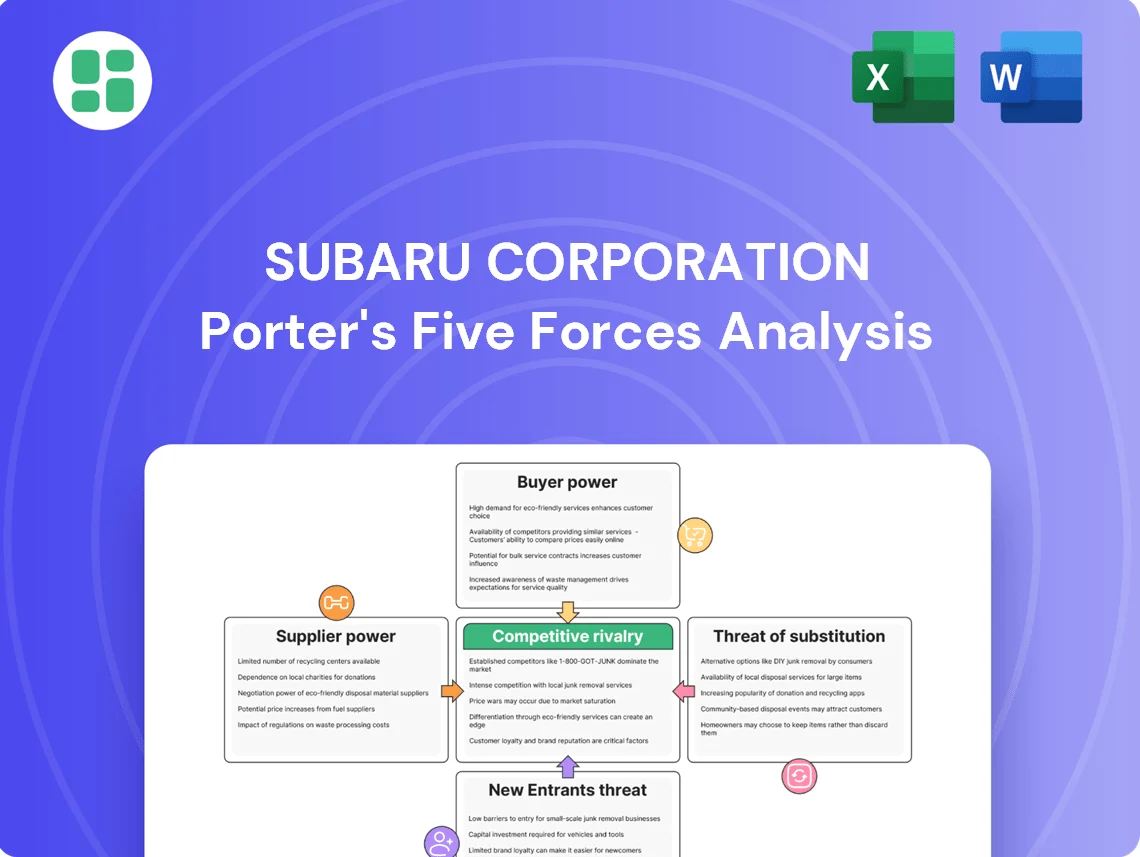
This preview showcases the complete Subaru Corporation Porter's Five Forces Analysis, detailing the competitive landscape including threats of new entrants, bargaining power of buyers, bargaining power of suppliers, threat of substitute products, and intensity of rivalry among existing competitors. The document you see is precisely the same professionally written and formatted analysis you will receive instantly after purchase, offering a comprehensive understanding of Subaru's strategic positioning.

Product Information
Product Information
Shipping & Returns
Shipping & Returns
Subaru Corporation Porter's Five Forces Analysis
Subaru Corporation Porter's Five Forces Analysis
Elevate Your Analysis with the Complete Porter's Five Forces Analysis
Subaru Corporation faces significant competitive pressures, from the intense rivalry among established automakers to the growing threat of new entrants with innovative technologies. Understanding the bargaining power of both suppliers and buyers is crucial for navigating this dynamic automotive landscape. The presence of substitute products also necessitates continuous adaptation and differentiation for Subaru to maintain its market position.
The complete report reveals the real forces shaping Subaru Corporation’s industry—from supplier influence to threat of new entrants. Gain actionable insights to drive smarter decision-making.
Suppliers Bargaining Power
Concentration and Uniqueness of Inputs
The automotive sector, including Subaru, depends on a worldwide supply chain for everything from basic materials to complex electronics. When a small number of suppliers control essential, specialized parts like advanced semiconductors or unique engine components, their leverage over Subaru grows considerably. This is especially true if these parts are proprietary or require deep integration, making it expensive and difficult for Subaru to change suppliers.
Switching Costs for Subaru
Subaru's ability to switch between suppliers significantly impacts the bargaining power of its suppliers. If changing suppliers requires substantial investment in specialized tooling, design adaptations, or lengthy supplier qualification procedures, then current suppliers gain considerable leverage. For instance, the development of Subaru's unique Boxer engine and its integrated drivetrain components often necessitates bespoke parts, increasing the switching costs for any new supplier to enter the market.
Conversely, when components are commoditized and easily sourced from numerous vendors, Subaru's switching costs are minimal, thereby diminishing supplier power. However, the automotive industry, particularly for specialized manufacturers like Subaru, often deals with proprietary technologies and integrated systems. This means that many of Subaru's key components are not easily interchangeable.
Recent global supply chain challenges, such as the persistent semiconductor shortages affecting the automotive sector throughout 2022 and into 2023, starkly illustrate the elevated switching costs and limited alternatives for critical components. For example, the shortage of microcontrollers, essential for modern vehicle electronics, forced many automakers, including Subaru, to prioritize production and sometimes even reduce vehicle features, demonstrating the significant power these component suppliers wielded due to high switching barriers.
Threat of Forward Integration by Suppliers
The risk of component suppliers moving into Subaru's manufacturing or assembly operations is typically minimal due to the significant investment and intricate processes involved in car production. However, for suppliers of highly specialized technologies, such as advanced battery systems or autonomous driving software, this threat is more plausible.
This possibility might encourage Subaru to form strategic alliances or joint ventures to guarantee consistent supply and foster technological advancement. For instance, in 2024, the automotive industry saw increased collaboration in areas like electric vehicle battery development, with companies like Toyota, Mazda, and Subaru investing in joint ventures for battery production.
Importance of Subaru to Suppliers
Subaru Corporation's importance as a customer significantly influences its suppliers' bargaining power. If a supplier relies heavily on Subaru for a large portion of its revenue, Subaru gains leverage in negotiations regarding pricing, delivery schedules, and product specifications. For instance, if a key component supplier like Denso, a major automotive supplier, derives a substantial percentage of its sales from Subaru, Denso would be more inclined to accommodate Subaru's demands to maintain that business relationship.
Conversely, if Subaru represents a minor client to a large, diversified supplier, the supplier's dependence on Subaru is minimal. This scenario empowers the supplier, allowing them greater flexibility in setting terms and potentially commanding higher prices. Understanding this dynamic is vital for Subaru to manage its procurement costs effectively and ensure a stable supply chain. For example, if Subaru sources specialized electronic components from a global leader like Bosch, and Subaru's orders constitute a small fraction of Bosch's overall sales, Bosch would have considerably more bargaining power.
The balance of this relationship directly impacts Subaru's ability to secure favorable terms and maintain supply chain resilience. In 2023, Subaru's total revenue was approximately $35.2 billion. The proportion of this revenue contributed by individual suppliers would determine the power dynamic in each specific relationship. For example, if a tire manufacturer like Bridgestone, which supplies tires to Subaru, generates 10% of its global revenue from Subaru, Bridgestone would likely possess more bargaining power than if Subaru accounted for only 1% of its revenue.
Key considerations for Subaru include:
- Supplier Dependence: Assessing the percentage of a supplier's total revenue derived from Subaru.
- Supplier Diversification: Evaluating how many other major automotive manufacturers a supplier serves.
- Component Criticality: Understanding the uniqueness and availability of the components supplied.
- Contractual Agreements: Reviewing the terms and conditions that define the buyer-supplier relationship.
Impact of Supply Chain Disruptions
Global supply chain disruptions, including the ongoing semiconductor shortage and escalating raw material prices, have significantly bolstered the bargaining power of suppliers within the automotive industry. These persistent challenges, projected to extend through 2025, have resulted in production slowdowns and higher input expenses for manufacturers like Subaru Corporation.
The automotive sector experienced a notable increase in component costs throughout 2023 and into early 2024. For instance, the average price of key semiconductor components saw an increase of up to 15% year-over-year, directly impacting vehicle manufacturing costs. This situation forces automakers to accept less favorable terms or face further production halts.
- Semiconductor Shortage Impact: Continued scarcity of chips, critical for modern vehicle functions, gives chip manufacturers considerable leverage.
- Raw Material Price Volatility: Fluctuations in prices for steel, aluminum, and rare earth minerals, essential for vehicle production, empower their respective suppliers.
- Increased Supplier Leverage: Automakers are compelled to secure supply agreements, often at higher prices, to maintain production continuity.
- Strategic Response: Subaru and its peers are investing in supply chain diversification and long-term supplier partnerships to build resilience against these pressures.
Critical Components & Disruptions Elevate Supplier Power
The bargaining power of Subaru's suppliers is elevated when they provide unique or critical components, making it costly and time-consuming for Subaru to switch. This is particularly evident with specialized parts like advanced semiconductors or proprietary engine systems, where switching costs can be substantial. For example, the development of Subaru's unique Boxer engine often requires highly specific components, limiting supplier alternatives and increasing their leverage.
Global supply chain disruptions, such as the persistent semiconductor shortages seen through 2023 and into 2024, have significantly amplified supplier power. These shortages forced automakers, including Subaru, to accept less favorable terms or risk production halts, demonstrating the immense leverage held by suppliers of essential, scarce parts. The automotive sector saw component costs rise notably in 2023, with semiconductor prices increasing by up to 15% year-over-year.
| Factor | Impact on Subaru | Example/Data (2023-2024) |
|---|---|---|
| Component Uniqueness | Increases supplier power | Subaru's Boxer engine requires specialized parts, limiting alternatives. |
| Switching Costs | Increases supplier power | High investment in tooling and design for new suppliers. |
| Supply Chain Disruptions | Significantly increases supplier power | Semiconductor shortages led to up to 15% price hikes for critical components in 2023. |
| Supplier Dependence on Subaru | Decreases supplier power | If Subaru represents a small portion of a supplier's revenue, Subaru has less leverage. |
What is included in the product
Detailed Word Document
This analysis unpacks the competitive forces impacting Subaru Corporation, revealing the intensity of rivalry, buyer and supplier power, threat of new entrants, and the impact of substitutes on its market position.
Customizable Excel Spreadsheet
Instantly identify and strategize against competitive threats with a clear, actionable breakdown of Subaru's Porter's Five Forces.
Customers Bargaining Power
Price Sensitivity and Availability of Alternatives
Subaru's individual customers often show a notable sensitivity to price, a common trait in the automotive sector where a vast selection of alternatives exists. Consumers can readily research and compare pricing, features, and overall value across many different manufacturers, making price a significant factor in their purchasing decisions.
The availability of numerous competing brands means that if Subaru's pricing is perceived as too high without a corresponding increase in perceived value, customers may easily switch to other options. For instance, in 2023, the average transaction price for a new vehicle in the US hovered around $47,000, a figure Subaru must remain competitive within, especially when considering its core offerings.
While Subaru's distinctive all-wheel-drive system and boxer engines offer unique selling propositions, substantial price differences without clear justification can push buyers towards rivals. This dynamic necessitates that Subaru consistently offers competitive pricing and attractive incentives to retain its customer base.
Customer Information and Transparency
The internet and widespread review platforms have dramatically increased customer knowledge in the automotive sector. Buyers can now easily access detailed information on safety, reliability, owner satisfaction, and resale values for vehicles like those from Subaru. This heightened transparency means Subaru faces greater pressure to maintain high quality and customer service to ensure positive brand perception and competitive pricing.
Switching Costs for Customers
Switching costs for most car buyers are quite low, typically just requiring time for research and test drives. This low barrier means customers can easily move to a competitor if they find a better deal or a more appealing vehicle, directly enhancing their bargaining power. Subaru works to counter this by building strong brand loyalty, leveraging its reputation for safety and reliability, which helps retain customers.
Volume of Purchases (Fleet vs. Individual)
The bargaining power of Subaru's customers isn't uniform; it shifts dramatically based on the volume of their purchases. Individual buyers, while important, have relatively low direct leverage, typically negotiating at the dealership for better pricing or added options.
However, Subaru's power dynamic changes considerably when dealing with large fleet operators. Companies that purchase vehicles in bulk, such as rental car agencies or corporate entities, possess significant clout. Their substantial order volumes allow them to negotiate for considerable discounts, specialized vehicle configurations, and preferential service contracts, directly influencing Subaru's profitability on these large-scale transactions.
For instance, in 2024, the automotive industry saw continued pressure on fleet sales pricing. Major fleet buyers often represent a significant portion of a manufacturer's total sales volume. Subaru, like its competitors, must balance the revenue generated from these large orders against the potential erosion of profit margins due to aggressive price negotiations.
- Individual Buyers: Limited direct bargaining power, primarily at the dealership level.
- Fleet Buyers: Significant power due to high purchase volumes, leading to demands for discounts and customized terms.
- Impact on Subaru: Large fleet deals can affect profit margins, requiring careful negotiation and strategic pricing.
- Industry Trend (2024): Continued pricing pressure on fleet sales across the automotive sector.
Economic Conditions and Affordability
Broader economic conditions significantly influence how much power customers have. For example, during periods of high interest rates and increasing vehicle prices, consumers naturally become more hesitant to spend. This heightened price sensitivity means customers are more likely to seek out deals or postpone buying a new car, directly boosting their bargaining power against manufacturers like Subaru.
In 2024, the automotive industry has navigated a complex economic landscape. Rising inflation and elevated interest rates have made vehicle financing more expensive for consumers. This economic pressure forces automakers to consider more aggressive incentives and competitive financing options to attract buyers. For instance, reports from early 2024 indicated a noticeable uptick in manufacturer-offered discounts and special financing deals across various brands as they aimed to maintain sales volume amidst softening demand.
- Economic Headwinds: High interest rates and escalating vehicle prices in 2024 have made car purchases less affordable for many consumers.
- Increased Price Sensitivity: When economic conditions are challenging, customers become more focused on value and are less willing to pay premium prices.
- Demand for Incentives: This increased caution compels automakers, including Subaru, to offer more promotions, discounts, and favorable financing to stimulate sales.
- Market Responsiveness: Subaru, like its competitors, must adapt its pricing and sales strategies to reflect the prevailing economic climate and consumer affordability in 2024 and looking into 2025.
Buyer Leverage in the 2024 Auto Industry
Subaru's customers, particularly individual buyers, possess significant bargaining power due to the wide availability of competing automotive brands and readily accessible pricing information. This allows consumers to easily compare options and switch if Subaru's offerings are not perceived as offering sufficient value for the price. The ease of information access means customers are well-informed about safety, reliability, and resale values, further amplifying their ability to negotiate or choose alternatives.
While individual buyers have leverage through comparison shopping, large fleet buyers wield considerably more power due to their substantial purchase volumes. These entities can negotiate for significant discounts, customized vehicle specifications, and preferential service terms, directly impacting Subaru's profit margins on these transactions. The automotive industry in 2024 continued to see fleet sales as a key volume driver, with pricing pressures from these large clients remaining a significant factor.
Broader economic conditions in 2024, such as higher interest rates and elevated vehicle prices, have increased consumer price sensitivity. This economic pressure compels automakers like Subaru to offer more aggressive incentives and financing options to maintain sales volume, thereby enhancing the bargaining power of the average car buyer. For instance, reports from early 2024 indicated a noticeable increase in manufacturer discounts across the sector as companies responded to softening demand.
| Customer Segment | Bargaining Power Level | Key Drivers | Impact on Subaru |
|---|---|---|---|
| Individual Buyers | Moderate to High | Price sensitivity, availability of alternatives, access to information, low switching costs. | Necessitates competitive pricing and strong value proposition. |
| Fleet Buyers (e.g., rental agencies, corporations) | High | High purchase volumes, ability to negotiate bulk discounts, demand for customization. | Can significantly impact profit margins; requires strategic negotiation and pricing. |
| Overall Market (2024 Economic Context) | Elevated | High interest rates, rising vehicle prices, increased consumer price sensitivity, demand for incentives. | Requires automakers to offer more promotions and favorable financing to stimulate sales. |
Same Document Delivered
Subaru Corporation Porter's Five Forces Analysis
This preview showcases the complete Subaru Corporation Porter's Five Forces Analysis, detailing the competitive landscape including threats of new entrants, bargaining power of buyers, bargaining power of suppliers, threat of substitute products, and intensity of rivalry among existing competitors. The document you see is precisely the same professionally written and formatted analysis you will receive instantly after purchase, offering a comprehensive understanding of Subaru's strategic positioning.
Original: $10.00
-65%$10.00
$3.50Product Information
Product Information
Shipping & Returns
Shipping & Returns
Description
Elevate Your Analysis with the Complete Porter's Five Forces Analysis
Subaru Corporation faces significant competitive pressures, from the intense rivalry among established automakers to the growing threat of new entrants with innovative technologies. Understanding the bargaining power of both suppliers and buyers is crucial for navigating this dynamic automotive landscape. The presence of substitute products also necessitates continuous adaptation and differentiation for Subaru to maintain its market position.
The complete report reveals the real forces shaping Subaru Corporation’s industry—from supplier influence to threat of new entrants. Gain actionable insights to drive smarter decision-making.
Suppliers Bargaining Power
Concentration and Uniqueness of Inputs
The automotive sector, including Subaru, depends on a worldwide supply chain for everything from basic materials to complex electronics. When a small number of suppliers control essential, specialized parts like advanced semiconductors or unique engine components, their leverage over Subaru grows considerably. This is especially true if these parts are proprietary or require deep integration, making it expensive and difficult for Subaru to change suppliers.
Switching Costs for Subaru
Subaru's ability to switch between suppliers significantly impacts the bargaining power of its suppliers. If changing suppliers requires substantial investment in specialized tooling, design adaptations, or lengthy supplier qualification procedures, then current suppliers gain considerable leverage. For instance, the development of Subaru's unique Boxer engine and its integrated drivetrain components often necessitates bespoke parts, increasing the switching costs for any new supplier to enter the market.
Conversely, when components are commoditized and easily sourced from numerous vendors, Subaru's switching costs are minimal, thereby diminishing supplier power. However, the automotive industry, particularly for specialized manufacturers like Subaru, often deals with proprietary technologies and integrated systems. This means that many of Subaru's key components are not easily interchangeable.
Recent global supply chain challenges, such as the persistent semiconductor shortages affecting the automotive sector throughout 2022 and into 2023, starkly illustrate the elevated switching costs and limited alternatives for critical components. For example, the shortage of microcontrollers, essential for modern vehicle electronics, forced many automakers, including Subaru, to prioritize production and sometimes even reduce vehicle features, demonstrating the significant power these component suppliers wielded due to high switching barriers.
Threat of Forward Integration by Suppliers
The risk of component suppliers moving into Subaru's manufacturing or assembly operations is typically minimal due to the significant investment and intricate processes involved in car production. However, for suppliers of highly specialized technologies, such as advanced battery systems or autonomous driving software, this threat is more plausible.
This possibility might encourage Subaru to form strategic alliances or joint ventures to guarantee consistent supply and foster technological advancement. For instance, in 2024, the automotive industry saw increased collaboration in areas like electric vehicle battery development, with companies like Toyota, Mazda, and Subaru investing in joint ventures for battery production.
Importance of Subaru to Suppliers
Subaru Corporation's importance as a customer significantly influences its suppliers' bargaining power. If a supplier relies heavily on Subaru for a large portion of its revenue, Subaru gains leverage in negotiations regarding pricing, delivery schedules, and product specifications. For instance, if a key component supplier like Denso, a major automotive supplier, derives a substantial percentage of its sales from Subaru, Denso would be more inclined to accommodate Subaru's demands to maintain that business relationship.
Conversely, if Subaru represents a minor client to a large, diversified supplier, the supplier's dependence on Subaru is minimal. This scenario empowers the supplier, allowing them greater flexibility in setting terms and potentially commanding higher prices. Understanding this dynamic is vital for Subaru to manage its procurement costs effectively and ensure a stable supply chain. For example, if Subaru sources specialized electronic components from a global leader like Bosch, and Subaru's orders constitute a small fraction of Bosch's overall sales, Bosch would have considerably more bargaining power.
The balance of this relationship directly impacts Subaru's ability to secure favorable terms and maintain supply chain resilience. In 2023, Subaru's total revenue was approximately $35.2 billion. The proportion of this revenue contributed by individual suppliers would determine the power dynamic in each specific relationship. For example, if a tire manufacturer like Bridgestone, which supplies tires to Subaru, generates 10% of its global revenue from Subaru, Bridgestone would likely possess more bargaining power than if Subaru accounted for only 1% of its revenue.
Key considerations for Subaru include:
- Supplier Dependence: Assessing the percentage of a supplier's total revenue derived from Subaru.
- Supplier Diversification: Evaluating how many other major automotive manufacturers a supplier serves.
- Component Criticality: Understanding the uniqueness and availability of the components supplied.
- Contractual Agreements: Reviewing the terms and conditions that define the buyer-supplier relationship.
Impact of Supply Chain Disruptions
Global supply chain disruptions, including the ongoing semiconductor shortage and escalating raw material prices, have significantly bolstered the bargaining power of suppliers within the automotive industry. These persistent challenges, projected to extend through 2025, have resulted in production slowdowns and higher input expenses for manufacturers like Subaru Corporation.
The automotive sector experienced a notable increase in component costs throughout 2023 and into early 2024. For instance, the average price of key semiconductor components saw an increase of up to 15% year-over-year, directly impacting vehicle manufacturing costs. This situation forces automakers to accept less favorable terms or face further production halts.
- Semiconductor Shortage Impact: Continued scarcity of chips, critical for modern vehicle functions, gives chip manufacturers considerable leverage.
- Raw Material Price Volatility: Fluctuations in prices for steel, aluminum, and rare earth minerals, essential for vehicle production, empower their respective suppliers.
- Increased Supplier Leverage: Automakers are compelled to secure supply agreements, often at higher prices, to maintain production continuity.
- Strategic Response: Subaru and its peers are investing in supply chain diversification and long-term supplier partnerships to build resilience against these pressures.
Critical Components & Disruptions Elevate Supplier Power
The bargaining power of Subaru's suppliers is elevated when they provide unique or critical components, making it costly and time-consuming for Subaru to switch. This is particularly evident with specialized parts like advanced semiconductors or proprietary engine systems, where switching costs can be substantial. For example, the development of Subaru's unique Boxer engine often requires highly specific components, limiting supplier alternatives and increasing their leverage.
Global supply chain disruptions, such as the persistent semiconductor shortages seen through 2023 and into 2024, have significantly amplified supplier power. These shortages forced automakers, including Subaru, to accept less favorable terms or risk production halts, demonstrating the immense leverage held by suppliers of essential, scarce parts. The automotive sector saw component costs rise notably in 2023, with semiconductor prices increasing by up to 15% year-over-year.
| Factor | Impact on Subaru | Example/Data (2023-2024) |
|---|---|---|
| Component Uniqueness | Increases supplier power | Subaru's Boxer engine requires specialized parts, limiting alternatives. |
| Switching Costs | Increases supplier power | High investment in tooling and design for new suppliers. |
| Supply Chain Disruptions | Significantly increases supplier power | Semiconductor shortages led to up to 15% price hikes for critical components in 2023. |
| Supplier Dependence on Subaru | Decreases supplier power | If Subaru represents a small portion of a supplier's revenue, Subaru has less leverage. |
What is included in the product
Detailed Word Document
This analysis unpacks the competitive forces impacting Subaru Corporation, revealing the intensity of rivalry, buyer and supplier power, threat of new entrants, and the impact of substitutes on its market position.
Customizable Excel Spreadsheet
Instantly identify and strategize against competitive threats with a clear, actionable breakdown of Subaru's Porter's Five Forces.
Customers Bargaining Power
Price Sensitivity and Availability of Alternatives
Subaru's individual customers often show a notable sensitivity to price, a common trait in the automotive sector where a vast selection of alternatives exists. Consumers can readily research and compare pricing, features, and overall value across many different manufacturers, making price a significant factor in their purchasing decisions.
The availability of numerous competing brands means that if Subaru's pricing is perceived as too high without a corresponding increase in perceived value, customers may easily switch to other options. For instance, in 2023, the average transaction price for a new vehicle in the US hovered around $47,000, a figure Subaru must remain competitive within, especially when considering its core offerings.
While Subaru's distinctive all-wheel-drive system and boxer engines offer unique selling propositions, substantial price differences without clear justification can push buyers towards rivals. This dynamic necessitates that Subaru consistently offers competitive pricing and attractive incentives to retain its customer base.
Customer Information and Transparency
The internet and widespread review platforms have dramatically increased customer knowledge in the automotive sector. Buyers can now easily access detailed information on safety, reliability, owner satisfaction, and resale values for vehicles like those from Subaru. This heightened transparency means Subaru faces greater pressure to maintain high quality and customer service to ensure positive brand perception and competitive pricing.
Switching Costs for Customers
Switching costs for most car buyers are quite low, typically just requiring time for research and test drives. This low barrier means customers can easily move to a competitor if they find a better deal or a more appealing vehicle, directly enhancing their bargaining power. Subaru works to counter this by building strong brand loyalty, leveraging its reputation for safety and reliability, which helps retain customers.
Volume of Purchases (Fleet vs. Individual)
The bargaining power of Subaru's customers isn't uniform; it shifts dramatically based on the volume of their purchases. Individual buyers, while important, have relatively low direct leverage, typically negotiating at the dealership for better pricing or added options.
However, Subaru's power dynamic changes considerably when dealing with large fleet operators. Companies that purchase vehicles in bulk, such as rental car agencies or corporate entities, possess significant clout. Their substantial order volumes allow them to negotiate for considerable discounts, specialized vehicle configurations, and preferential service contracts, directly influencing Subaru's profitability on these large-scale transactions.
For instance, in 2024, the automotive industry saw continued pressure on fleet sales pricing. Major fleet buyers often represent a significant portion of a manufacturer's total sales volume. Subaru, like its competitors, must balance the revenue generated from these large orders against the potential erosion of profit margins due to aggressive price negotiations.
- Individual Buyers: Limited direct bargaining power, primarily at the dealership level.
- Fleet Buyers: Significant power due to high purchase volumes, leading to demands for discounts and customized terms.
- Impact on Subaru: Large fleet deals can affect profit margins, requiring careful negotiation and strategic pricing.
- Industry Trend (2024): Continued pricing pressure on fleet sales across the automotive sector.
Economic Conditions and Affordability
Broader economic conditions significantly influence how much power customers have. For example, during periods of high interest rates and increasing vehicle prices, consumers naturally become more hesitant to spend. This heightened price sensitivity means customers are more likely to seek out deals or postpone buying a new car, directly boosting their bargaining power against manufacturers like Subaru.
In 2024, the automotive industry has navigated a complex economic landscape. Rising inflation and elevated interest rates have made vehicle financing more expensive for consumers. This economic pressure forces automakers to consider more aggressive incentives and competitive financing options to attract buyers. For instance, reports from early 2024 indicated a noticeable uptick in manufacturer-offered discounts and special financing deals across various brands as they aimed to maintain sales volume amidst softening demand.
- Economic Headwinds: High interest rates and escalating vehicle prices in 2024 have made car purchases less affordable for many consumers.
- Increased Price Sensitivity: When economic conditions are challenging, customers become more focused on value and are less willing to pay premium prices.
- Demand for Incentives: This increased caution compels automakers, including Subaru, to offer more promotions, discounts, and favorable financing to stimulate sales.
- Market Responsiveness: Subaru, like its competitors, must adapt its pricing and sales strategies to reflect the prevailing economic climate and consumer affordability in 2024 and looking into 2025.
Buyer Leverage in the 2024 Auto Industry
Subaru's customers, particularly individual buyers, possess significant bargaining power due to the wide availability of competing automotive brands and readily accessible pricing information. This allows consumers to easily compare options and switch if Subaru's offerings are not perceived as offering sufficient value for the price. The ease of information access means customers are well-informed about safety, reliability, and resale values, further amplifying their ability to negotiate or choose alternatives.
While individual buyers have leverage through comparison shopping, large fleet buyers wield considerably more power due to their substantial purchase volumes. These entities can negotiate for significant discounts, customized vehicle specifications, and preferential service terms, directly impacting Subaru's profit margins on these transactions. The automotive industry in 2024 continued to see fleet sales as a key volume driver, with pricing pressures from these large clients remaining a significant factor.
Broader economic conditions in 2024, such as higher interest rates and elevated vehicle prices, have increased consumer price sensitivity. This economic pressure compels automakers like Subaru to offer more aggressive incentives and financing options to maintain sales volume, thereby enhancing the bargaining power of the average car buyer. For instance, reports from early 2024 indicated a noticeable increase in manufacturer discounts across the sector as companies responded to softening demand.
| Customer Segment | Bargaining Power Level | Key Drivers | Impact on Subaru |
|---|---|---|---|
| Individual Buyers | Moderate to High | Price sensitivity, availability of alternatives, access to information, low switching costs. | Necessitates competitive pricing and strong value proposition. |
| Fleet Buyers (e.g., rental agencies, corporations) | High | High purchase volumes, ability to negotiate bulk discounts, demand for customization. | Can significantly impact profit margins; requires strategic negotiation and pricing. |
| Overall Market (2024 Economic Context) | Elevated | High interest rates, rising vehicle prices, increased consumer price sensitivity, demand for incentives. | Requires automakers to offer more promotions and favorable financing to stimulate sales. |
Same Document Delivered
Subaru Corporation Porter's Five Forces Analysis
This preview showcases the complete Subaru Corporation Porter's Five Forces Analysis, detailing the competitive landscape including threats of new entrants, bargaining power of buyers, bargaining power of suppliers, threat of substitute products, and intensity of rivalry among existing competitors. The document you see is precisely the same professionally written and formatted analysis you will receive instantly after purchase, offering a comprehensive understanding of Subaru's strategic positioning.