Selective Insurance Group Porter's Five Forces Analysis

From Overview to Strategy Blueprint
Selective Insurance Group operates within a dynamic insurance landscape, where bargaining power of buyers and the threat of substitutes significantly shape its competitive environment. Understanding these forces is crucial for any strategic evaluation of the company's market position.
The complete report reveals the real forces shaping Selective Insurance Group’s industry—from supplier influence to threat of new entrants. Gain actionable insights to drive smarter decision-making.
Suppliers Bargaining Power

Concentration of Reinsurance Market
The concentration within the reinsurance market significantly influences the bargaining power of suppliers for companies like Selective Insurance Group. Reinsurers, who essentially insure insurance companies, hold considerable sway, particularly in specific insurance categories. While property reinsurance rates are showing signs of softening, the outlook for casualty reinsurance in 2025 points to substantial price hikes, potentially in the double-digit percentage range. This is driven by ongoing concerns surrounding social inflation and increasing legal costs.
This upward pressure on casualty reinsurance pricing means Selective, along with other property and casualty insurers, faces a challenging environment. Reinsurers are focused on safeguarding their own profitability, which can translate into stricter terms and conditions for primary insurers. These terms can directly affect Selective's underwriting margins, making it crucial for them to manage these supplier relationships effectively.
Reliance on Independent Agents
Selective Insurance Group's reliance on independent agents significantly influences supplier bargaining power. These agents are crucial as they are the exclusive channel for distributing Selective's products. In 2024, independent agencies were responsible for a substantial 61.5% of all property/casualty insurance written in the U.S., highlighting their market leverage.
The bargaining power of these independent agents is amplified because they represent multiple insurance carriers. This allows them to direct business to whichever insurer offers the most favorable terms or products. For agencies, securing carriers that are committed to their business is a primary concern, further strengthening their position when negotiating with insurers like Selective.

Technology and Data Providers
Technology and data analytics providers are becoming crucial partners for insurers like Selective Insurance Group. These suppliers offer advanced solutions powered by AI, machine learning, and blockchain to improve underwriting, claims, and risk assessment. In 2024, the insurance industry’s investment in insurtech, which includes these technologies, continued to grow significantly, with a projected 15% increase in spending on data analytics and AI platforms compared to 2023, indicating a rising reliance on these specialized vendors.
The highly specialized and rapidly evolving nature of these technological offerings grants suppliers considerable bargaining power. Insurers are increasingly dependent on these cutting-edge solutions to maintain competitiveness and enhance operational efficiency. For instance, the development and implementation of sophisticated AI-driven fraud detection systems can be a complex undertaking, making it difficult for insurers to switch providers easily, thus strengthening the suppliers' position.

Claims and Legal Service Providers
Claims adjustment services and legal expertise providers wield significant influence over insurers like Selective Insurance Group. This is especially true with the escalating trend of jury awards and legal expenses, which directly inflate claims costs and impact the profitability of property and casualty (P&C) insurers. The efficiency and cost-effectiveness of these suppliers in handling claims processing are critical determinants of an insurer's financial health.
The bargaining power of these suppliers is amplified by several factors:
- Specialized Expertise: Claims adjusters and legal professionals possess niche skills and knowledge that are not easily replicated, making insurers reliant on their services.
- Rising Legal Costs: In 2024, legal defense costs continue to be a major concern for P&C insurers, with some reports indicating an average increase of 5-7% year-over-year for complex litigation.
- Impact on Profitability: The ability of these service providers to manage claims costs efficiently directly translates into improved loss ratios and overall profitability for Selective Insurance Group.
Human Capital and Talent
The availability of skilled human capital, such as actuaries, underwriters, and IT specialists, acts as a critical supplier to Selective Insurance Group. The insurance sector, in general, is experiencing difficulties in attracting and keeping talent, especially for positions involving emerging technologies like artificial intelligence.
This scarcity of qualified professionals can significantly boost the bargaining power of experienced individuals. Consequently, insurers like Selective may face escalating labor costs as they compete for this specialized expertise. For instance, in 2024, the demand for AI-savvy insurance professionals outstripped supply, driving up salaries for these roles by an estimated 15-20% compared to the previous year.
- Talent Scarcity: The insurance industry continues to grapple with a shortage of skilled professionals, particularly in areas like data analytics and cybersecurity.
- Rising Labor Costs: Increased competition for specialized talent is leading to higher compensation packages, impacting operational expenses for insurers.
- Impact on Innovation: Difficulty in acquiring talent with expertise in new technologies can slow down the adoption and integration of innovative solutions within insurance operations.
Insurance Faces Strong Supplier Bargaining Power
Selective Insurance Group faces significant supplier bargaining power from reinsurers, particularly in casualty lines where anticipated double-digit price hikes for 2025, driven by social inflation, will impact underwriting margins. Independent agents, representing 61.5% of U.S. property/casualty insurance written in 2024, also hold strong leverage due to their ability to place business with multiple carriers, prioritizing those committed to their agencies. Furthermore, the growing reliance on specialized insurtech providers, with industry spending on data analytics and AI projected to rise 15% in 2024, grants these vendors considerable power due to the complexity and rapid evolution of their offerings.
| Supplier Type | Bargaining Power Factors | 2024/2025 Data/Impact |
|---|---|---|
| Reinsurers | Market concentration, specialty lines demand | Casualty reinsurance prices expected to rise significantly (double-digit %) in 2025 due to social inflation and legal costs. |
| Independent Agents | Distribution channel exclusivity, multi-carrier representation | Accounted for 61.5% of U.S. P&C insurance written in 2024; agents prioritize carrier commitment. |
| Insurtech/Tech Providers | Specialized, evolving technology (AI, ML, blockchain) | Industry investment in data analytics/AI platforms up ~15% in 2024; complex solutions reduce insurer switching ability. |
What is included in the product
 Detailed Word Document
This analysis dissects the competitive forces impacting Selective Insurance Group, revealing the intensity of rivalry, buyer and supplier power, and the threat of new entrants and substitutes within the insurance sector.

 Customizable Excel Spreadsheet
Quickly identify and mitigate competitive threats with a visual, interactive model of the five forces impacting Selective Insurance Group.
Customers Bargaining Power

Price Sensitivity and Comparison
Customers, both individuals and businesses, are showing heightened price sensitivity, particularly as insurance premiums continue their upward trend in 2024. This economic pressure encourages them to actively seek out more competitive pricing and compare offerings from various insurers. For instance, a 2024 survey indicated that 65% of consumers switched insurance providers due to price alone.
The availability of independent agents who can efficiently compare quotes from multiple insurance companies amplifies this customer power. These agents act as a crucial intermediary, providing consumers with readily accessible information on pricing and coverage options, thereby increasing the ease with which customers can switch providers if a better deal is found.
Availability of Information and Digital Tools
The digital revolution in insurance has significantly boosted customer bargaining power. In 2024, readily available online comparison tools and mobile applications empower consumers to effortlessly research and contrast policy offerings from various providers. This increased transparency, coupled with lower switching costs facilitated by digital platforms, means customers can more easily find better deals and switch providers, putting pressure on Selective Insurance Group to remain competitive.

Low Switching Costs for Standard Products
Customers for standard insurance products often face minimal costs when switching providers. This ease of transition means they can readily move to a competitor offering more favorable terms or lower premiums, directly impacting Selective Insurance Group.
The low switching costs for common insurance policies underscore the importance of customer retention for Selective. Insurers must therefore prioritize delivering exceptional customer experiences and fostering loyalty to combat customer churn and maintain market share.

Demand for Personalized and Flexible Products
Modern consumers increasingly seek insurance policies that are not one-size-fits-all but are customized to their unique circumstances and changing life stages. This trend significantly enhances customer bargaining power, as they can gravitate towards insurers offering greater flexibility and personalization.
Selective Insurance Group, like its peers, faces this evolving demand. For instance, in 2024, the demand for usage-based insurance (UBI) continued to grow, with telematics data being leveraged to offer more tailored auto insurance premiums. This allows customers to potentially lower costs by demonstrating safe driving habits.
- Demand for Personalization: Customers expect insurance products that reflect their individual risk profiles and lifestyle needs.
- Flexibility in Offerings: Insurers are pressured to provide adaptable policies that can be modified as customer circumstances change.
- Customer Choice Amplified: The ability to find tailored solutions empowers customers to switch providers if their needs aren't met, increasing competitive pressure on insurers.
- Impact on Pricing: Personalized pricing models, driven by data analytics, give customers more leverage to negotiate better rates based on their demonstrated behavior.
Influence of Independent Agents on Customer Choice
Selective Insurance Group's reliance on independent agents, who also represent customer interests, significantly influences customer bargaining power. These agents actively compare policies from various insurers to secure the best rates and coverage for their clients.
This dynamic means customers, through their agents, gain access to a wider array of choices and more competitive pricing. For instance, in 2024, the independent agent channel continued to be a dominant force in property and casualty insurance distribution, with agents often prioritizing client satisfaction and value, which inherently benefits the end customer.
- Independent agents act as client advocates, comparing multiple insurance options.
- This comparison process drives competitive pricing and enhances product coverage for customers.
- The independent agent model amplifies customer bargaining power by providing informed choices.
Customer Power Reshapes Insurance: Price & Personalization Drive Choices
Customers' bargaining power remains significant, fueled by increasing price sensitivity and the ease of comparing options. In 2024, a notable 65% of consumers switched insurance providers primarily due to better pricing, highlighting the direct impact of cost on customer loyalty.
The proliferation of digital comparison tools and the continued strength of independent agents empower consumers to readily access and evaluate multiple insurance offerings. This accessibility, coupled with minimal switching costs for standard policies, allows customers to exert considerable pressure on insurers like Selective to offer competitive rates and superior value.
Furthermore, the growing demand for personalized insurance solutions, such as usage-based auto insurance, gives customers more leverage. By demonstrating safe driving habits, individuals can negotiate lower premiums, directly influencing insurer pricing strategies and reinforcing customer influence in the market.
| Factor | Impact on Customer Bargaining Power | 2024 Data/Trend |
|---|---|---|
| Price Sensitivity | High | 65% of consumers switched for price alone. |
| Availability of Information | High | Widespread use of online comparison tools and independent agents. |
| Switching Costs | Low | Minimal costs for standard insurance policies. |
| Demand for Personalization | Increasing | Growth in usage-based insurance (UBI). |
What You See Is What You Get
Selective Insurance Group Porter's Five Forces Analysis
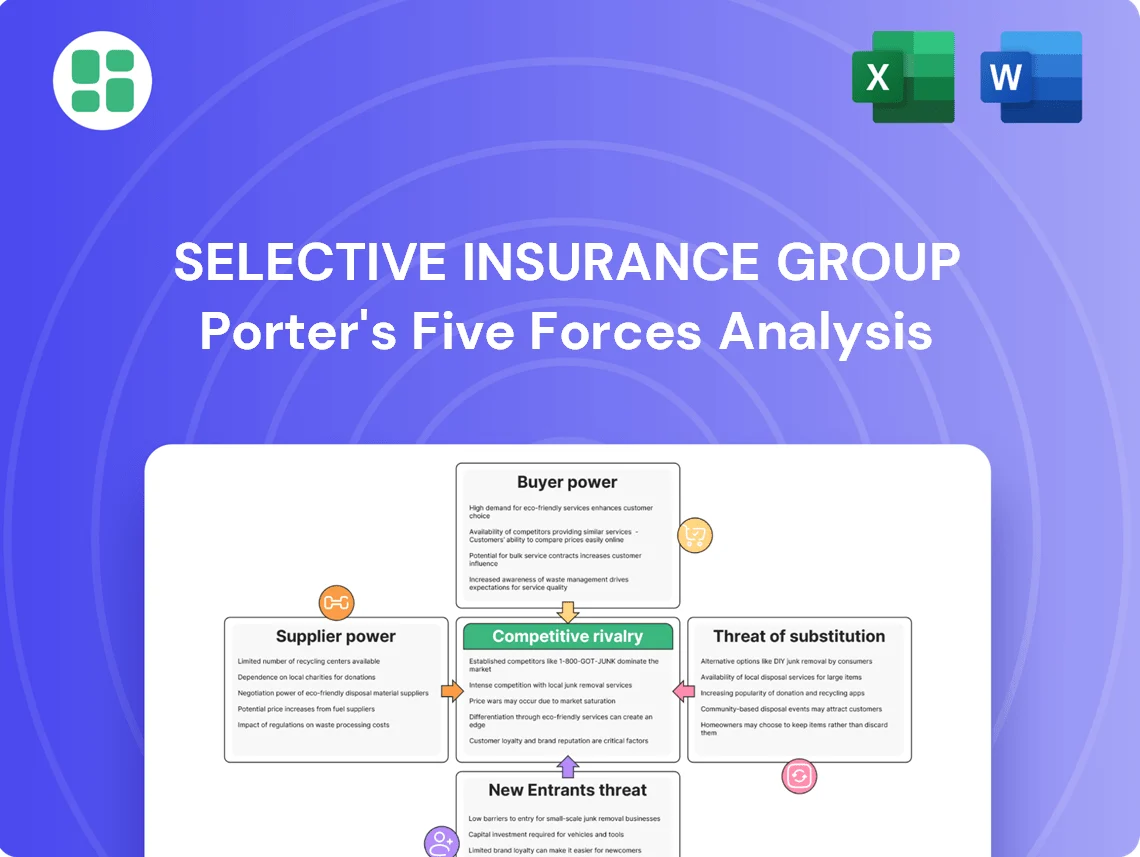
This preview shows the exact document you'll receive immediately after purchase—no surprises, no placeholders. It details Selective Insurance Group's competitive landscape through Porter's Five Forces, analyzing the threat of new entrants, the bargaining power of buyers, the bargaining power of suppliers, the threat of substitute products or services, and the intensity of rivalry among existing competitors.

Product Information
Product Information
Shipping & Returns
Shipping & Returns
Selective Insurance Group Porter's Five Forces Analysis
Selective Insurance Group Porter's Five Forces Analysis
From Overview to Strategy Blueprint
Selective Insurance Group operates within a dynamic insurance landscape, where bargaining power of buyers and the threat of substitutes significantly shape its competitive environment. Understanding these forces is crucial for any strategic evaluation of the company's market position.
The complete report reveals the real forces shaping Selective Insurance Group’s industry—from supplier influence to threat of new entrants. Gain actionable insights to drive smarter decision-making.
Suppliers Bargaining Power
Concentration of Reinsurance Market
The concentration within the reinsurance market significantly influences the bargaining power of suppliers for companies like Selective Insurance Group. Reinsurers, who essentially insure insurance companies, hold considerable sway, particularly in specific insurance categories. While property reinsurance rates are showing signs of softening, the outlook for casualty reinsurance in 2025 points to substantial price hikes, potentially in the double-digit percentage range. This is driven by ongoing concerns surrounding social inflation and increasing legal costs.
This upward pressure on casualty reinsurance pricing means Selective, along with other property and casualty insurers, faces a challenging environment. Reinsurers are focused on safeguarding their own profitability, which can translate into stricter terms and conditions for primary insurers. These terms can directly affect Selective's underwriting margins, making it crucial for them to manage these supplier relationships effectively.
Reliance on Independent Agents
Selective Insurance Group's reliance on independent agents significantly influences supplier bargaining power. These agents are crucial as they are the exclusive channel for distributing Selective's products. In 2024, independent agencies were responsible for a substantial 61.5% of all property/casualty insurance written in the U.S., highlighting their market leverage.
The bargaining power of these independent agents is amplified because they represent multiple insurance carriers. This allows them to direct business to whichever insurer offers the most favorable terms or products. For agencies, securing carriers that are committed to their business is a primary concern, further strengthening their position when negotiating with insurers like Selective.
Technology and Data Providers
Technology and data analytics providers are becoming crucial partners for insurers like Selective Insurance Group. These suppliers offer advanced solutions powered by AI, machine learning, and blockchain to improve underwriting, claims, and risk assessment. In 2024, the insurance industry’s investment in insurtech, which includes these technologies, continued to grow significantly, with a projected 15% increase in spending on data analytics and AI platforms compared to 2023, indicating a rising reliance on these specialized vendors.
The highly specialized and rapidly evolving nature of these technological offerings grants suppliers considerable bargaining power. Insurers are increasingly dependent on these cutting-edge solutions to maintain competitiveness and enhance operational efficiency. For instance, the development and implementation of sophisticated AI-driven fraud detection systems can be a complex undertaking, making it difficult for insurers to switch providers easily, thus strengthening the suppliers' position.
Claims and Legal Service Providers
Claims adjustment services and legal expertise providers wield significant influence over insurers like Selective Insurance Group. This is especially true with the escalating trend of jury awards and legal expenses, which directly inflate claims costs and impact the profitability of property and casualty (P&C) insurers. The efficiency and cost-effectiveness of these suppliers in handling claims processing are critical determinants of an insurer's financial health.
The bargaining power of these suppliers is amplified by several factors:
- Specialized Expertise: Claims adjusters and legal professionals possess niche skills and knowledge that are not easily replicated, making insurers reliant on their services.
- Rising Legal Costs: In 2024, legal defense costs continue to be a major concern for P&C insurers, with some reports indicating an average increase of 5-7% year-over-year for complex litigation.
- Impact on Profitability: The ability of these service providers to manage claims costs efficiently directly translates into improved loss ratios and overall profitability for Selective Insurance Group.
Human Capital and Talent
The availability of skilled human capital, such as actuaries, underwriters, and IT specialists, acts as a critical supplier to Selective Insurance Group. The insurance sector, in general, is experiencing difficulties in attracting and keeping talent, especially for positions involving emerging technologies like artificial intelligence.
This scarcity of qualified professionals can significantly boost the bargaining power of experienced individuals. Consequently, insurers like Selective may face escalating labor costs as they compete for this specialized expertise. For instance, in 2024, the demand for AI-savvy insurance professionals outstripped supply, driving up salaries for these roles by an estimated 15-20% compared to the previous year.
- Talent Scarcity: The insurance industry continues to grapple with a shortage of skilled professionals, particularly in areas like data analytics and cybersecurity.
- Rising Labor Costs: Increased competition for specialized talent is leading to higher compensation packages, impacting operational expenses for insurers.
- Impact on Innovation: Difficulty in acquiring talent with expertise in new technologies can slow down the adoption and integration of innovative solutions within insurance operations.
Insurance Faces Strong Supplier Bargaining Power
Selective Insurance Group faces significant supplier bargaining power from reinsurers, particularly in casualty lines where anticipated double-digit price hikes for 2025, driven by social inflation, will impact underwriting margins. Independent agents, representing 61.5% of U.S. property/casualty insurance written in 2024, also hold strong leverage due to their ability to place business with multiple carriers, prioritizing those committed to their agencies. Furthermore, the growing reliance on specialized insurtech providers, with industry spending on data analytics and AI projected to rise 15% in 2024, grants these vendors considerable power due to the complexity and rapid evolution of their offerings.
| Supplier Type | Bargaining Power Factors | 2024/2025 Data/Impact |
|---|---|---|
| Reinsurers | Market concentration, specialty lines demand | Casualty reinsurance prices expected to rise significantly (double-digit %) in 2025 due to social inflation and legal costs. |
| Independent Agents | Distribution channel exclusivity, multi-carrier representation | Accounted for 61.5% of U.S. P&C insurance written in 2024; agents prioritize carrier commitment. |
| Insurtech/Tech Providers | Specialized, evolving technology (AI, ML, blockchain) | Industry investment in data analytics/AI platforms up ~15% in 2024; complex solutions reduce insurer switching ability. |
What is included in the product
Detailed Word Document
This analysis dissects the competitive forces impacting Selective Insurance Group, revealing the intensity of rivalry, buyer and supplier power, and the threat of new entrants and substitutes within the insurance sector.
Customizable Excel Spreadsheet
Quickly identify and mitigate competitive threats with a visual, interactive model of the five forces impacting Selective Insurance Group.
Customers Bargaining Power
Price Sensitivity and Comparison
Customers, both individuals and businesses, are showing heightened price sensitivity, particularly as insurance premiums continue their upward trend in 2024. This economic pressure encourages them to actively seek out more competitive pricing and compare offerings from various insurers. For instance, a 2024 survey indicated that 65% of consumers switched insurance providers due to price alone.
The availability of independent agents who can efficiently compare quotes from multiple insurance companies amplifies this customer power. These agents act as a crucial intermediary, providing consumers with readily accessible information on pricing and coverage options, thereby increasing the ease with which customers can switch providers if a better deal is found.
Availability of Information and Digital Tools
The digital revolution in insurance has significantly boosted customer bargaining power. In 2024, readily available online comparison tools and mobile applications empower consumers to effortlessly research and contrast policy offerings from various providers. This increased transparency, coupled with lower switching costs facilitated by digital platforms, means customers can more easily find better deals and switch providers, putting pressure on Selective Insurance Group to remain competitive.
Low Switching Costs for Standard Products
Customers for standard insurance products often face minimal costs when switching providers. This ease of transition means they can readily move to a competitor offering more favorable terms or lower premiums, directly impacting Selective Insurance Group.
The low switching costs for common insurance policies underscore the importance of customer retention for Selective. Insurers must therefore prioritize delivering exceptional customer experiences and fostering loyalty to combat customer churn and maintain market share.
Demand for Personalized and Flexible Products
Modern consumers increasingly seek insurance policies that are not one-size-fits-all but are customized to their unique circumstances and changing life stages. This trend significantly enhances customer bargaining power, as they can gravitate towards insurers offering greater flexibility and personalization.
Selective Insurance Group, like its peers, faces this evolving demand. For instance, in 2024, the demand for usage-based insurance (UBI) continued to grow, with telematics data being leveraged to offer more tailored auto insurance premiums. This allows customers to potentially lower costs by demonstrating safe driving habits.
- Demand for Personalization: Customers expect insurance products that reflect their individual risk profiles and lifestyle needs.
- Flexibility in Offerings: Insurers are pressured to provide adaptable policies that can be modified as customer circumstances change.
- Customer Choice Amplified: The ability to find tailored solutions empowers customers to switch providers if their needs aren't met, increasing competitive pressure on insurers.
- Impact on Pricing: Personalized pricing models, driven by data analytics, give customers more leverage to negotiate better rates based on their demonstrated behavior.
Influence of Independent Agents on Customer Choice
Selective Insurance Group's reliance on independent agents, who also represent customer interests, significantly influences customer bargaining power. These agents actively compare policies from various insurers to secure the best rates and coverage for their clients.
This dynamic means customers, through their agents, gain access to a wider array of choices and more competitive pricing. For instance, in 2024, the independent agent channel continued to be a dominant force in property and casualty insurance distribution, with agents often prioritizing client satisfaction and value, which inherently benefits the end customer.
- Independent agents act as client advocates, comparing multiple insurance options.
- This comparison process drives competitive pricing and enhances product coverage for customers.
- The independent agent model amplifies customer bargaining power by providing informed choices.
Customer Power Reshapes Insurance: Price & Personalization Drive Choices
Customers' bargaining power remains significant, fueled by increasing price sensitivity and the ease of comparing options. In 2024, a notable 65% of consumers switched insurance providers primarily due to better pricing, highlighting the direct impact of cost on customer loyalty.
The proliferation of digital comparison tools and the continued strength of independent agents empower consumers to readily access and evaluate multiple insurance offerings. This accessibility, coupled with minimal switching costs for standard policies, allows customers to exert considerable pressure on insurers like Selective to offer competitive rates and superior value.
Furthermore, the growing demand for personalized insurance solutions, such as usage-based auto insurance, gives customers more leverage. By demonstrating safe driving habits, individuals can negotiate lower premiums, directly influencing insurer pricing strategies and reinforcing customer influence in the market.
| Factor | Impact on Customer Bargaining Power | 2024 Data/Trend |
|---|---|---|
| Price Sensitivity | High | 65% of consumers switched for price alone. |
| Availability of Information | High | Widespread use of online comparison tools and independent agents. |
| Switching Costs | Low | Minimal costs for standard insurance policies. |
| Demand for Personalization | Increasing | Growth in usage-based insurance (UBI). |
What You See Is What You Get
Selective Insurance Group Porter's Five Forces Analysis
This preview shows the exact document you'll receive immediately after purchase—no surprises, no placeholders. It details Selective Insurance Group's competitive landscape through Porter's Five Forces, analyzing the threat of new entrants, the bargaining power of buyers, the bargaining power of suppliers, the threat of substitute products or services, and the intensity of rivalry among existing competitors.
Product Information
Product Information
Shipping & Returns
Shipping & Returns
Description
From Overview to Strategy Blueprint
Selective Insurance Group operates within a dynamic insurance landscape, where bargaining power of buyers and the threat of substitutes significantly shape its competitive environment. Understanding these forces is crucial for any strategic evaluation of the company's market position.
The complete report reveals the real forces shaping Selective Insurance Group’s industry—from supplier influence to threat of new entrants. Gain actionable insights to drive smarter decision-making.
Suppliers Bargaining Power
Concentration of Reinsurance Market
The concentration within the reinsurance market significantly influences the bargaining power of suppliers for companies like Selective Insurance Group. Reinsurers, who essentially insure insurance companies, hold considerable sway, particularly in specific insurance categories. While property reinsurance rates are showing signs of softening, the outlook for casualty reinsurance in 2025 points to substantial price hikes, potentially in the double-digit percentage range. This is driven by ongoing concerns surrounding social inflation and increasing legal costs.
This upward pressure on casualty reinsurance pricing means Selective, along with other property and casualty insurers, faces a challenging environment. Reinsurers are focused on safeguarding their own profitability, which can translate into stricter terms and conditions for primary insurers. These terms can directly affect Selective's underwriting margins, making it crucial for them to manage these supplier relationships effectively.
Reliance on Independent Agents
Selective Insurance Group's reliance on independent agents significantly influences supplier bargaining power. These agents are crucial as they are the exclusive channel for distributing Selective's products. In 2024, independent agencies were responsible for a substantial 61.5% of all property/casualty insurance written in the U.S., highlighting their market leverage.
The bargaining power of these independent agents is amplified because they represent multiple insurance carriers. This allows them to direct business to whichever insurer offers the most favorable terms or products. For agencies, securing carriers that are committed to their business is a primary concern, further strengthening their position when negotiating with insurers like Selective.
Technology and Data Providers
Technology and data analytics providers are becoming crucial partners for insurers like Selective Insurance Group. These suppliers offer advanced solutions powered by AI, machine learning, and blockchain to improve underwriting, claims, and risk assessment. In 2024, the insurance industry’s investment in insurtech, which includes these technologies, continued to grow significantly, with a projected 15% increase in spending on data analytics and AI platforms compared to 2023, indicating a rising reliance on these specialized vendors.
The highly specialized and rapidly evolving nature of these technological offerings grants suppliers considerable bargaining power. Insurers are increasingly dependent on these cutting-edge solutions to maintain competitiveness and enhance operational efficiency. For instance, the development and implementation of sophisticated AI-driven fraud detection systems can be a complex undertaking, making it difficult for insurers to switch providers easily, thus strengthening the suppliers' position.
Claims and Legal Service Providers
Claims adjustment services and legal expertise providers wield significant influence over insurers like Selective Insurance Group. This is especially true with the escalating trend of jury awards and legal expenses, which directly inflate claims costs and impact the profitability of property and casualty (P&C) insurers. The efficiency and cost-effectiveness of these suppliers in handling claims processing are critical determinants of an insurer's financial health.
The bargaining power of these suppliers is amplified by several factors:
- Specialized Expertise: Claims adjusters and legal professionals possess niche skills and knowledge that are not easily replicated, making insurers reliant on their services.
- Rising Legal Costs: In 2024, legal defense costs continue to be a major concern for P&C insurers, with some reports indicating an average increase of 5-7% year-over-year for complex litigation.
- Impact on Profitability: The ability of these service providers to manage claims costs efficiently directly translates into improved loss ratios and overall profitability for Selective Insurance Group.
Human Capital and Talent
The availability of skilled human capital, such as actuaries, underwriters, and IT specialists, acts as a critical supplier to Selective Insurance Group. The insurance sector, in general, is experiencing difficulties in attracting and keeping talent, especially for positions involving emerging technologies like artificial intelligence.
This scarcity of qualified professionals can significantly boost the bargaining power of experienced individuals. Consequently, insurers like Selective may face escalating labor costs as they compete for this specialized expertise. For instance, in 2024, the demand for AI-savvy insurance professionals outstripped supply, driving up salaries for these roles by an estimated 15-20% compared to the previous year.
- Talent Scarcity: The insurance industry continues to grapple with a shortage of skilled professionals, particularly in areas like data analytics and cybersecurity.
- Rising Labor Costs: Increased competition for specialized talent is leading to higher compensation packages, impacting operational expenses for insurers.
- Impact on Innovation: Difficulty in acquiring talent with expertise in new technologies can slow down the adoption and integration of innovative solutions within insurance operations.
Insurance Faces Strong Supplier Bargaining Power
Selective Insurance Group faces significant supplier bargaining power from reinsurers, particularly in casualty lines where anticipated double-digit price hikes for 2025, driven by social inflation, will impact underwriting margins. Independent agents, representing 61.5% of U.S. property/casualty insurance written in 2024, also hold strong leverage due to their ability to place business with multiple carriers, prioritizing those committed to their agencies. Furthermore, the growing reliance on specialized insurtech providers, with industry spending on data analytics and AI projected to rise 15% in 2024, grants these vendors considerable power due to the complexity and rapid evolution of their offerings.
| Supplier Type | Bargaining Power Factors | 2024/2025 Data/Impact |
|---|---|---|
| Reinsurers | Market concentration, specialty lines demand | Casualty reinsurance prices expected to rise significantly (double-digit %) in 2025 due to social inflation and legal costs. |
| Independent Agents | Distribution channel exclusivity, multi-carrier representation | Accounted for 61.5% of U.S. P&C insurance written in 2024; agents prioritize carrier commitment. |
| Insurtech/Tech Providers | Specialized, evolving technology (AI, ML, blockchain) | Industry investment in data analytics/AI platforms up ~15% in 2024; complex solutions reduce insurer switching ability. |
What is included in the product
Detailed Word Document
This analysis dissects the competitive forces impacting Selective Insurance Group, revealing the intensity of rivalry, buyer and supplier power, and the threat of new entrants and substitutes within the insurance sector.
Customizable Excel Spreadsheet
Quickly identify and mitigate competitive threats with a visual, interactive model of the five forces impacting Selective Insurance Group.
Customers Bargaining Power
Price Sensitivity and Comparison
Customers, both individuals and businesses, are showing heightened price sensitivity, particularly as insurance premiums continue their upward trend in 2024. This economic pressure encourages them to actively seek out more competitive pricing and compare offerings from various insurers. For instance, a 2024 survey indicated that 65% of consumers switched insurance providers due to price alone.
The availability of independent agents who can efficiently compare quotes from multiple insurance companies amplifies this customer power. These agents act as a crucial intermediary, providing consumers with readily accessible information on pricing and coverage options, thereby increasing the ease with which customers can switch providers if a better deal is found.
Availability of Information and Digital Tools
The digital revolution in insurance has significantly boosted customer bargaining power. In 2024, readily available online comparison tools and mobile applications empower consumers to effortlessly research and contrast policy offerings from various providers. This increased transparency, coupled with lower switching costs facilitated by digital platforms, means customers can more easily find better deals and switch providers, putting pressure on Selective Insurance Group to remain competitive.
Low Switching Costs for Standard Products
Customers for standard insurance products often face minimal costs when switching providers. This ease of transition means they can readily move to a competitor offering more favorable terms or lower premiums, directly impacting Selective Insurance Group.
The low switching costs for common insurance policies underscore the importance of customer retention for Selective. Insurers must therefore prioritize delivering exceptional customer experiences and fostering loyalty to combat customer churn and maintain market share.
Demand for Personalized and Flexible Products
Modern consumers increasingly seek insurance policies that are not one-size-fits-all but are customized to their unique circumstances and changing life stages. This trend significantly enhances customer bargaining power, as they can gravitate towards insurers offering greater flexibility and personalization.
Selective Insurance Group, like its peers, faces this evolving demand. For instance, in 2024, the demand for usage-based insurance (UBI) continued to grow, with telematics data being leveraged to offer more tailored auto insurance premiums. This allows customers to potentially lower costs by demonstrating safe driving habits.
- Demand for Personalization: Customers expect insurance products that reflect their individual risk profiles and lifestyle needs.
- Flexibility in Offerings: Insurers are pressured to provide adaptable policies that can be modified as customer circumstances change.
- Customer Choice Amplified: The ability to find tailored solutions empowers customers to switch providers if their needs aren't met, increasing competitive pressure on insurers.
- Impact on Pricing: Personalized pricing models, driven by data analytics, give customers more leverage to negotiate better rates based on their demonstrated behavior.
Influence of Independent Agents on Customer Choice
Selective Insurance Group's reliance on independent agents, who also represent customer interests, significantly influences customer bargaining power. These agents actively compare policies from various insurers to secure the best rates and coverage for their clients.
This dynamic means customers, through their agents, gain access to a wider array of choices and more competitive pricing. For instance, in 2024, the independent agent channel continued to be a dominant force in property and casualty insurance distribution, with agents often prioritizing client satisfaction and value, which inherently benefits the end customer.
- Independent agents act as client advocates, comparing multiple insurance options.
- This comparison process drives competitive pricing and enhances product coverage for customers.
- The independent agent model amplifies customer bargaining power by providing informed choices.
Customer Power Reshapes Insurance: Price & Personalization Drive Choices
Customers' bargaining power remains significant, fueled by increasing price sensitivity and the ease of comparing options. In 2024, a notable 65% of consumers switched insurance providers primarily due to better pricing, highlighting the direct impact of cost on customer loyalty.
The proliferation of digital comparison tools and the continued strength of independent agents empower consumers to readily access and evaluate multiple insurance offerings. This accessibility, coupled with minimal switching costs for standard policies, allows customers to exert considerable pressure on insurers like Selective to offer competitive rates and superior value.
Furthermore, the growing demand for personalized insurance solutions, such as usage-based auto insurance, gives customers more leverage. By demonstrating safe driving habits, individuals can negotiate lower premiums, directly influencing insurer pricing strategies and reinforcing customer influence in the market.
| Factor | Impact on Customer Bargaining Power | 2024 Data/Trend |
|---|---|---|
| Price Sensitivity | High | 65% of consumers switched for price alone. |
| Availability of Information | High | Widespread use of online comparison tools and independent agents. |
| Switching Costs | Low | Minimal costs for standard insurance policies. |
| Demand for Personalization | Increasing | Growth in usage-based insurance (UBI). |
What You See Is What You Get
Selective Insurance Group Porter's Five Forces Analysis
This preview shows the exact document you'll receive immediately after purchase—no surprises, no placeholders. It details Selective Insurance Group's competitive landscape through Porter's Five Forces, analyzing the threat of new entrants, the bargaining power of buyers, the bargaining power of suppliers, the threat of substitute products or services, and the intensity of rivalry among existing competitors.