Razor Energy Porter's Five Forces Analysis

Don't Miss the Bigger Picture
Razor Energy faces moderate buyer power due to a fragmented customer base, but the threat of substitutes remains a significant concern in the energy sector. Understanding these dynamics is crucial for any stakeholder.
The full report reveals the real forces shaping Razor Energy’s industry—from supplier influence to threat of new entrants. Gain actionable insights to drive smarter decision-making.
Suppliers Bargaining Power

Specialized Oilfield Services and Equipment
Suppliers of specialized oilfield services and advanced equipment wield considerable bargaining power. This is due to the high technical expertise and substantial capital investment needed for their operations, making it difficult for companies like Razor Energy to switch providers easily. For instance, companies providing hydraulic fracturing or directional drilling services often have proprietary technology and skilled personnel that are in high demand.
The oilfield services sector is poised for robust expansion, with projections indicating strong growth from 2025 through 2029. This anticipated surge is fueled by persistent global energy demand and a renewed focus on exploration and production activities worldwide. In 2024, the oilfield services market was valued at approximately $250 billion, and it's expected to see a compound annual growth rate (CAGR) of around 5% in the coming years, further solidifying supplier leverage.
Availability of Skilled Labor
The availability of skilled labor, such as engineers, geologists, and field technicians, directly impacts the bargaining power of suppliers in the energy sector. While the Canadian oil and gas drilling industry anticipates job growth in 2025, a shortage of highly specialized skills can still grant labor suppliers significant leverage, particularly for intricate projects like enhanced oil recovery.

Regulatory Compliance and Environmental Services
With new environmental regulations, like the federal emissions cap aiming for reductions between 2030 and 2032, suppliers offering environmental compliance, carbon capture, and decarbonization solutions are gaining significant leverage. Razor Energy's commitment to sustainability, particularly through its subsidiary FutEra Power Corp., makes it dependent on these specialized providers.

Infrastructure and Transportation Providers
Infrastructure and transportation providers, particularly pipeline operators, hold significant bargaining power over energy producers like Razor Energy. The reliance on established pipeline networks for transporting crude oil and natural gas creates a dependency that allows these providers to influence terms and pricing. For instance, in 2023, Canadian crude oil exports reached approximately 4.8 million barrels per day, highlighting the sheer volume dependent on these transport systems.
While the expansion of the Trans Mountain Pipeline in 2024 has increased export capacity, potentially offering more alternative routes and slightly diluting the power of any single provider, the overall dependence on pipeline infrastructure remains. This continued reliance means that transportation costs and service availability can still exert considerable influence on Razor Energy's operational efficiency and profitability.
- High Dependence: Energy producers are heavily reliant on pipelines for efficient and cost-effective transportation of their products.
- Limited Alternatives: In many regions, the number of viable transportation options for crude oil and natural gas is limited, concentrating power with existing providers.
- Infrastructure Investment: The substantial capital investment required to build and maintain pipelines creates high barriers to entry for potential competitors, reinforcing the power of incumbent providers.
Technology and Digital Solutions Providers
The bargaining power of technology and digital solutions providers in the oil and gas sector, including companies like Razor Energy, is significant. The industry's push for digital transformation, leveraging AI and big data analytics for operational optimization, creates strong demand for specialized tech suppliers. These providers can leverage the substantial value they deliver through enhanced efficiency and cost savings, often commanding premium pricing.
For instance, the global oil and gas analytics market was valued at approximately $3.5 billion in 2023 and is projected to grow substantially. Suppliers offering cutting-edge solutions that demonstrably improve production efficiency or reduce downtime are in a strong position. This allows them to negotiate favorable terms, as companies like Razor Energy seek to modernize and extract more value from existing assets.
- Increased Demand for Digitalization: The oil and gas industry's investment in digital solutions, including AI and data analytics, is a key driver of supplier power.
- Value-Added Services: Suppliers offering demonstrable efficiency gains and cost reductions through their technologies can justify higher prices.
- Impact on Asset Enhancement: Companies like Razor Energy rely on these providers to improve the performance of their existing oil and gas assets, giving suppliers leverage.
Critical Suppliers Command Power in Oilfield Operations
Suppliers of specialized oilfield services and advanced equipment hold significant bargaining power due to high technical expertise and capital investment, making it difficult for companies like Razor Energy to switch providers. The oilfield services market, valued at approximately $250 billion in 2024 with an expected 5% CAGR, is expanding, further solidifying supplier leverage. Moreover, providers of environmental compliance and decarbonization solutions are gaining influence as new regulations take effect, impacting Razor Energy's strategic dependencies.
| Factor | Impact on Razor Energy | Supporting Data/Observation |
| Specialized Services & Technology | High Bargaining Power | Proprietary technology in hydraulic fracturing and directional drilling |
| Skilled Labor Availability | Moderate to High Bargaining Power | Shortage of specialized skills for intricate projects |
| Environmental Solutions | Increasing Bargaining Power | Demand for carbon capture and decarbonization services |
| Transportation Infrastructure | High Bargaining Power | Reliance on pipelines for 4.8 million bpd Canadian crude oil exports (2023) |
| Digitalization & Analytics | High Bargaining Power | Global oil and gas analytics market valued at $3.5 billion (2023) |
What is included in the product
 Detailed Word Document
Razor Energy's Porter's Five Forces Analysis offers a comprehensive examination of the competitive forces shaping its industry, detailing the intensity of rivalry, buyer and supplier power, threat of new entrants, and the impact of substitutes.

 Customizable Excel Spreadsheet
Instantly identify competitive pressures with a clear, visual breakdown of Porter's Five Forces—streamlining strategic planning and market understanding.
Customers Bargaining Power

Concentration of Refineries and Pipeline Operators
The bargaining power of customers for Razor Energy is significantly influenced by the concentrated nature of refineries and pipeline operators, especially those involved in exporting crude oil and natural gas to the United States. This consolidation means a smaller number of entities are making purchasing decisions, giving them more sway.
A substantial portion of Canadian crude oil is destined for the U.S., where refineries are specifically equipped to process heavy oil. In 2024, the U.S. remained the primary export market for Canadian crude, with volumes fluctuating based on global supply and demand dynamics. This reliance on a single, concentrated market amplifies the leverage of U.S. refiners in price negotiations with Canadian producers like Razor Energy.
Increased Export Capacity and Market Diversification
The expansion of the Trans Mountain Pipeline, completed in May 2024, has opened up new export routes for Canadian crude oil to Asian markets. This development offers producers like Razor Energy more options for selling their product, potentially lessening their reliance on any single buyer. For instance, by reaching new international customers, Razor Energy can leverage this broader market access to negotiate more favorable terms.

Emerging LNG Export Markets
The emergence of new liquefied natural gas (LNG) export markets, particularly with Canada's first major facility slated for British Columbia in late 2025, is poised to significantly alter the bargaining power of customers for natural gas producers like Razor Energy. This facility will unlock access to global demand, potentially reducing reliance on domestic buyers.
By offering an alternative outlet for production, these emerging export markets can diminish the leverage domestic customers hold over natural gas prices. For instance, the increased global demand anticipated from such projects could lead to higher realized prices for producers, thereby weakening the price-setting power of any single large domestic buyer.

Commodity Nature of Products
The commodity nature of crude oil and natural gas significantly erodes the bargaining power of customers. Because these resources are largely undifferentiated, buyers can readily switch between suppliers based on the most favorable price, provided quality and delivery standards are met. This makes it challenging for individual producers like Razor Energy to command premium pricing.
In 2024, the global oil market experienced considerable price volatility, with Brent crude averaging around $83 per barrel for the year. This price sensitivity directly impacts producers, as customers are less inclined to pay more when identical or very similar products are available elsewhere at a lower cost.
- Commodity Products: Crude oil and natural gas are treated as interchangeable goods.
- Price Sensitivity: Customers prioritize cost when selecting a supplier.
- Limited Pricing Power: Producers struggle to differentiate and charge higher prices.
- Supplier Switching: Buyers can easily move to competitors offering better deals.
Integration of Green Energy Initiatives
For FutEra Power Corp., a subsidiary of Razor Energy focused on green energy, its customers are primarily grid operators and large industrial users purchasing co-generated electricity. These buyers often wield significant bargaining power. This is partly due to the regulated environment of the electricity market, which can create price ceilings and standard contract terms, and also because there are often multiple alternative power generation sources available to them.
In 2024, the increasing decentralization of energy production and the growth of distributed energy resources (DERs) further amplify customer power. For instance, industrial clients might have the option to invest in their own on-site solar or battery storage, reducing their reliance on external suppliers like FutEra. This trend means that FutEra must offer competitive pricing and reliable service to retain these crucial customers.
- Customer Concentration: The number of large industrial consumers and grid operators purchasing co-generated electricity can be limited, giving them more leverage.
- Availability of Substitutes: Customers can often switch to other power sources, including renewable energy from different providers or even conventional fossil fuel generation, if prices are not competitive.
- Switching Costs: While switching costs can sometimes be high, advancements in energy technology are making it easier and more cost-effective for large consumers to change suppliers or generate their own power.
- Price Sensitivity: Industrial customers, in particular, are often highly sensitive to electricity costs, as it directly impacts their operational expenses and profitability.
Customer Bargaining Power in Energy: A Dual Perspective
The bargaining power of customers for Razor Energy is influenced by market concentration and the commodity nature of its products. For its green energy subsidiary, FutEra Power Corp., customer power is amplified by market regulation and the availability of alternative energy sources.
The concentrated nature of U.S. refineries, which are the primary buyers of Canadian crude oil, grants them significant leverage. This was evident in 2024, where the U.S. remained the dominant export market for Canadian oil, with refiners equipped for heavy oil processing holding considerable sway in price negotiations.
However, the expansion of the Trans Mountain Pipeline in May 2024 and the development of new LNG export markets are creating alternative outlets for Razor Energy's production. This increased market access for both crude oil and natural gas offers producers more options, potentially diminishing the bargaining power of any single domestic buyer.
The commodity nature of crude oil and natural gas means customers can easily switch suppliers based on price, limiting Razor Energy's pricing power. For instance, the price volatility in 2024, with Brent crude averaging around $83 per barrel, underscored customer price sensitivity.
| Factor | Impact on Razor Energy | 2024 Data/Context |
|---|---|---|
| Customer Concentration (Crude Oil) | High bargaining power for U.S. refiners | U.S. remains primary export market for Canadian crude |
| Market Access (Crude Oil) | Potential to reduce reliance on single buyers | Trans Mountain Pipeline expansion completed May 2024 |
| Emerging Markets (Natural Gas) | Weakens domestic customer leverage | First major Canadian LNG facility slated for late 2025 |
| Commodity Nature | Limited pricing power for producers | Brent crude averaged ~$83/barrel in 2024, indicating price sensitivity |
| Customer Power (FutEra Power) | Significant due to regulation and alternatives | Growth of DERs increases options for industrial clients |
Full Version Awaits
Razor Energy Porter's Five Forces Analysis
This preview showcases the comprehensive Razor Energy Porter's Five Forces Analysis you will receive immediately after purchase. What you see is the exact, professionally formatted document, detailing the competitive landscape and strategic implications for Razor Energy. You can be confident that the insights and analysis presented here are precisely what you'll gain access to, enabling informed strategic decision-making.

Product Information
Product Information
Shipping & Returns
Shipping & Returns
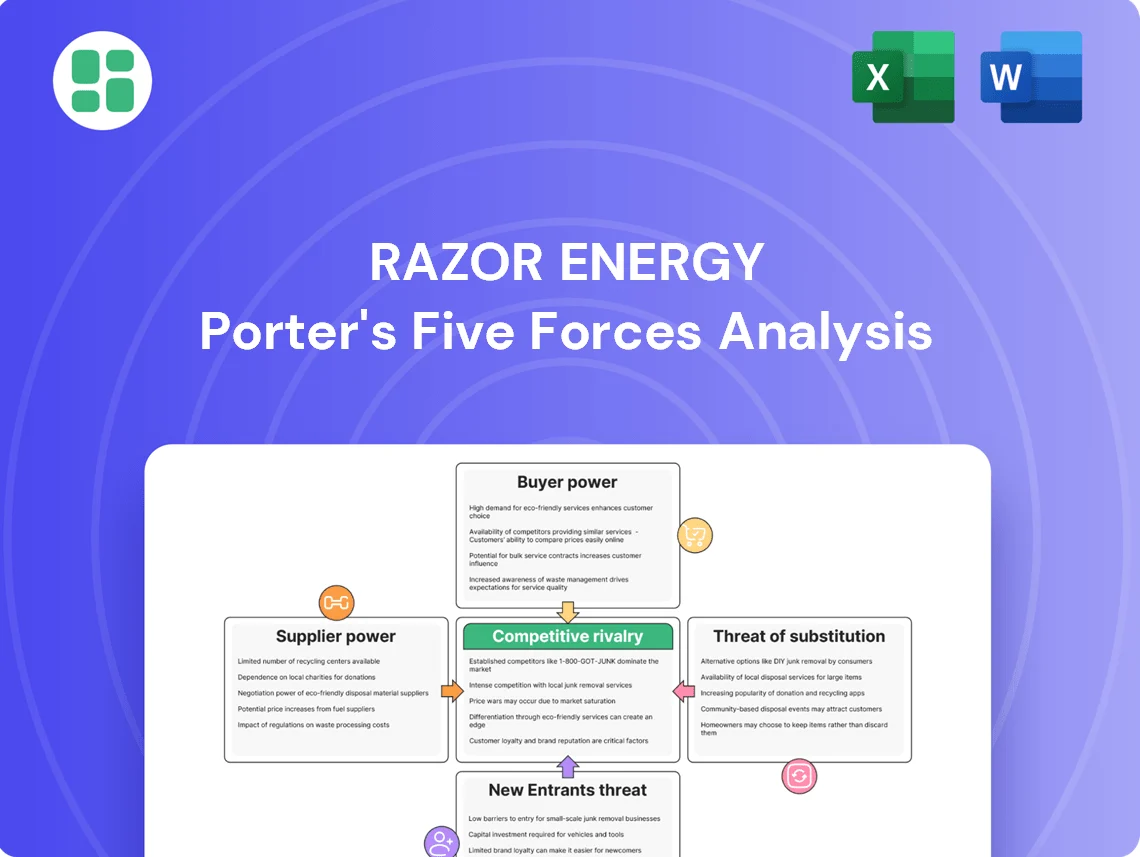
Razor Energy Porter's Five Forces Analysis
Razor Energy Porter's Five Forces Analysis
Don't Miss the Bigger Picture
Razor Energy faces moderate buyer power due to a fragmented customer base, but the threat of substitutes remains a significant concern in the energy sector. Understanding these dynamics is crucial for any stakeholder.
The full report reveals the real forces shaping Razor Energy’s industry—from supplier influence to threat of new entrants. Gain actionable insights to drive smarter decision-making.
Suppliers Bargaining Power
Specialized Oilfield Services and Equipment
Suppliers of specialized oilfield services and advanced equipment wield considerable bargaining power. This is due to the high technical expertise and substantial capital investment needed for their operations, making it difficult for companies like Razor Energy to switch providers easily. For instance, companies providing hydraulic fracturing or directional drilling services often have proprietary technology and skilled personnel that are in high demand.
The oilfield services sector is poised for robust expansion, with projections indicating strong growth from 2025 through 2029. This anticipated surge is fueled by persistent global energy demand and a renewed focus on exploration and production activities worldwide. In 2024, the oilfield services market was valued at approximately $250 billion, and it's expected to see a compound annual growth rate (CAGR) of around 5% in the coming years, further solidifying supplier leverage.
Availability of Skilled Labor
The availability of skilled labor, such as engineers, geologists, and field technicians, directly impacts the bargaining power of suppliers in the energy sector. While the Canadian oil and gas drilling industry anticipates job growth in 2025, a shortage of highly specialized skills can still grant labor suppliers significant leverage, particularly for intricate projects like enhanced oil recovery.
Regulatory Compliance and Environmental Services
With new environmental regulations, like the federal emissions cap aiming for reductions between 2030 and 2032, suppliers offering environmental compliance, carbon capture, and decarbonization solutions are gaining significant leverage. Razor Energy's commitment to sustainability, particularly through its subsidiary FutEra Power Corp., makes it dependent on these specialized providers.
Infrastructure and Transportation Providers
Infrastructure and transportation providers, particularly pipeline operators, hold significant bargaining power over energy producers like Razor Energy. The reliance on established pipeline networks for transporting crude oil and natural gas creates a dependency that allows these providers to influence terms and pricing. For instance, in 2023, Canadian crude oil exports reached approximately 4.8 million barrels per day, highlighting the sheer volume dependent on these transport systems.
While the expansion of the Trans Mountain Pipeline in 2024 has increased export capacity, potentially offering more alternative routes and slightly diluting the power of any single provider, the overall dependence on pipeline infrastructure remains. This continued reliance means that transportation costs and service availability can still exert considerable influence on Razor Energy's operational efficiency and profitability.
- High Dependence: Energy producers are heavily reliant on pipelines for efficient and cost-effective transportation of their products.
- Limited Alternatives: In many regions, the number of viable transportation options for crude oil and natural gas is limited, concentrating power with existing providers.
- Infrastructure Investment: The substantial capital investment required to build and maintain pipelines creates high barriers to entry for potential competitors, reinforcing the power of incumbent providers.
Technology and Digital Solutions Providers
The bargaining power of technology and digital solutions providers in the oil and gas sector, including companies like Razor Energy, is significant. The industry's push for digital transformation, leveraging AI and big data analytics for operational optimization, creates strong demand for specialized tech suppliers. These providers can leverage the substantial value they deliver through enhanced efficiency and cost savings, often commanding premium pricing.
For instance, the global oil and gas analytics market was valued at approximately $3.5 billion in 2023 and is projected to grow substantially. Suppliers offering cutting-edge solutions that demonstrably improve production efficiency or reduce downtime are in a strong position. This allows them to negotiate favorable terms, as companies like Razor Energy seek to modernize and extract more value from existing assets.
- Increased Demand for Digitalization: The oil and gas industry's investment in digital solutions, including AI and data analytics, is a key driver of supplier power.
- Value-Added Services: Suppliers offering demonstrable efficiency gains and cost reductions through their technologies can justify higher prices.
- Impact on Asset Enhancement: Companies like Razor Energy rely on these providers to improve the performance of their existing oil and gas assets, giving suppliers leverage.
Critical Suppliers Command Power in Oilfield Operations
Suppliers of specialized oilfield services and advanced equipment hold significant bargaining power due to high technical expertise and capital investment, making it difficult for companies like Razor Energy to switch providers. The oilfield services market, valued at approximately $250 billion in 2024 with an expected 5% CAGR, is expanding, further solidifying supplier leverage. Moreover, providers of environmental compliance and decarbonization solutions are gaining influence as new regulations take effect, impacting Razor Energy's strategic dependencies.
| Factor | Impact on Razor Energy | Supporting Data/Observation |
| Specialized Services & Technology | High Bargaining Power | Proprietary technology in hydraulic fracturing and directional drilling |
| Skilled Labor Availability | Moderate to High Bargaining Power | Shortage of specialized skills for intricate projects |
| Environmental Solutions | Increasing Bargaining Power | Demand for carbon capture and decarbonization services |
| Transportation Infrastructure | High Bargaining Power | Reliance on pipelines for 4.8 million bpd Canadian crude oil exports (2023) |
| Digitalization & Analytics | High Bargaining Power | Global oil and gas analytics market valued at $3.5 billion (2023) |
What is included in the product
Detailed Word Document
Razor Energy's Porter's Five Forces Analysis offers a comprehensive examination of the competitive forces shaping its industry, detailing the intensity of rivalry, buyer and supplier power, threat of new entrants, and the impact of substitutes.
Customizable Excel Spreadsheet
Instantly identify competitive pressures with a clear, visual breakdown of Porter's Five Forces—streamlining strategic planning and market understanding.
Customers Bargaining Power
Concentration of Refineries and Pipeline Operators
The bargaining power of customers for Razor Energy is significantly influenced by the concentrated nature of refineries and pipeline operators, especially those involved in exporting crude oil and natural gas to the United States. This consolidation means a smaller number of entities are making purchasing decisions, giving them more sway.
A substantial portion of Canadian crude oil is destined for the U.S., where refineries are specifically equipped to process heavy oil. In 2024, the U.S. remained the primary export market for Canadian crude, with volumes fluctuating based on global supply and demand dynamics. This reliance on a single, concentrated market amplifies the leverage of U.S. refiners in price negotiations with Canadian producers like Razor Energy.
Increased Export Capacity and Market Diversification
The expansion of the Trans Mountain Pipeline, completed in May 2024, has opened up new export routes for Canadian crude oil to Asian markets. This development offers producers like Razor Energy more options for selling their product, potentially lessening their reliance on any single buyer. For instance, by reaching new international customers, Razor Energy can leverage this broader market access to negotiate more favorable terms.
Emerging LNG Export Markets
The emergence of new liquefied natural gas (LNG) export markets, particularly with Canada's first major facility slated for British Columbia in late 2025, is poised to significantly alter the bargaining power of customers for natural gas producers like Razor Energy. This facility will unlock access to global demand, potentially reducing reliance on domestic buyers.
By offering an alternative outlet for production, these emerging export markets can diminish the leverage domestic customers hold over natural gas prices. For instance, the increased global demand anticipated from such projects could lead to higher realized prices for producers, thereby weakening the price-setting power of any single large domestic buyer.
Commodity Nature of Products
The commodity nature of crude oil and natural gas significantly erodes the bargaining power of customers. Because these resources are largely undifferentiated, buyers can readily switch between suppliers based on the most favorable price, provided quality and delivery standards are met. This makes it challenging for individual producers like Razor Energy to command premium pricing.
In 2024, the global oil market experienced considerable price volatility, with Brent crude averaging around $83 per barrel for the year. This price sensitivity directly impacts producers, as customers are less inclined to pay more when identical or very similar products are available elsewhere at a lower cost.
- Commodity Products: Crude oil and natural gas are treated as interchangeable goods.
- Price Sensitivity: Customers prioritize cost when selecting a supplier.
- Limited Pricing Power: Producers struggle to differentiate and charge higher prices.
- Supplier Switching: Buyers can easily move to competitors offering better deals.
Integration of Green Energy Initiatives
For FutEra Power Corp., a subsidiary of Razor Energy focused on green energy, its customers are primarily grid operators and large industrial users purchasing co-generated electricity. These buyers often wield significant bargaining power. This is partly due to the regulated environment of the electricity market, which can create price ceilings and standard contract terms, and also because there are often multiple alternative power generation sources available to them.
In 2024, the increasing decentralization of energy production and the growth of distributed energy resources (DERs) further amplify customer power. For instance, industrial clients might have the option to invest in their own on-site solar or battery storage, reducing their reliance on external suppliers like FutEra. This trend means that FutEra must offer competitive pricing and reliable service to retain these crucial customers.
- Customer Concentration: The number of large industrial consumers and grid operators purchasing co-generated electricity can be limited, giving them more leverage.
- Availability of Substitutes: Customers can often switch to other power sources, including renewable energy from different providers or even conventional fossil fuel generation, if prices are not competitive.
- Switching Costs: While switching costs can sometimes be high, advancements in energy technology are making it easier and more cost-effective for large consumers to change suppliers or generate their own power.
- Price Sensitivity: Industrial customers, in particular, are often highly sensitive to electricity costs, as it directly impacts their operational expenses and profitability.
Customer Bargaining Power in Energy: A Dual Perspective
The bargaining power of customers for Razor Energy is influenced by market concentration and the commodity nature of its products. For its green energy subsidiary, FutEra Power Corp., customer power is amplified by market regulation and the availability of alternative energy sources.
The concentrated nature of U.S. refineries, which are the primary buyers of Canadian crude oil, grants them significant leverage. This was evident in 2024, where the U.S. remained the dominant export market for Canadian oil, with refiners equipped for heavy oil processing holding considerable sway in price negotiations.
However, the expansion of the Trans Mountain Pipeline in May 2024 and the development of new LNG export markets are creating alternative outlets for Razor Energy's production. This increased market access for both crude oil and natural gas offers producers more options, potentially diminishing the bargaining power of any single domestic buyer.
The commodity nature of crude oil and natural gas means customers can easily switch suppliers based on price, limiting Razor Energy's pricing power. For instance, the price volatility in 2024, with Brent crude averaging around $83 per barrel, underscored customer price sensitivity.
| Factor | Impact on Razor Energy | 2024 Data/Context |
|---|---|---|
| Customer Concentration (Crude Oil) | High bargaining power for U.S. refiners | U.S. remains primary export market for Canadian crude |
| Market Access (Crude Oil) | Potential to reduce reliance on single buyers | Trans Mountain Pipeline expansion completed May 2024 |
| Emerging Markets (Natural Gas) | Weakens domestic customer leverage | First major Canadian LNG facility slated for late 2025 |
| Commodity Nature | Limited pricing power for producers | Brent crude averaged ~$83/barrel in 2024, indicating price sensitivity |
| Customer Power (FutEra Power) | Significant due to regulation and alternatives | Growth of DERs increases options for industrial clients |
Full Version Awaits
Razor Energy Porter's Five Forces Analysis
This preview showcases the comprehensive Razor Energy Porter's Five Forces Analysis you will receive immediately after purchase. What you see is the exact, professionally formatted document, detailing the competitive landscape and strategic implications for Razor Energy. You can be confident that the insights and analysis presented here are precisely what you'll gain access to, enabling informed strategic decision-making.
Product Information
Product Information
Shipping & Returns
Shipping & Returns
Description
Don't Miss the Bigger Picture
Razor Energy faces moderate buyer power due to a fragmented customer base, but the threat of substitutes remains a significant concern in the energy sector. Understanding these dynamics is crucial for any stakeholder.
The full report reveals the real forces shaping Razor Energy’s industry—from supplier influence to threat of new entrants. Gain actionable insights to drive smarter decision-making.
Suppliers Bargaining Power
Specialized Oilfield Services and Equipment
Suppliers of specialized oilfield services and advanced equipment wield considerable bargaining power. This is due to the high technical expertise and substantial capital investment needed for their operations, making it difficult for companies like Razor Energy to switch providers easily. For instance, companies providing hydraulic fracturing or directional drilling services often have proprietary technology and skilled personnel that are in high demand.
The oilfield services sector is poised for robust expansion, with projections indicating strong growth from 2025 through 2029. This anticipated surge is fueled by persistent global energy demand and a renewed focus on exploration and production activities worldwide. In 2024, the oilfield services market was valued at approximately $250 billion, and it's expected to see a compound annual growth rate (CAGR) of around 5% in the coming years, further solidifying supplier leverage.
Availability of Skilled Labor
The availability of skilled labor, such as engineers, geologists, and field technicians, directly impacts the bargaining power of suppliers in the energy sector. While the Canadian oil and gas drilling industry anticipates job growth in 2025, a shortage of highly specialized skills can still grant labor suppliers significant leverage, particularly for intricate projects like enhanced oil recovery.
Regulatory Compliance and Environmental Services
With new environmental regulations, like the federal emissions cap aiming for reductions between 2030 and 2032, suppliers offering environmental compliance, carbon capture, and decarbonization solutions are gaining significant leverage. Razor Energy's commitment to sustainability, particularly through its subsidiary FutEra Power Corp., makes it dependent on these specialized providers.
Infrastructure and Transportation Providers
Infrastructure and transportation providers, particularly pipeline operators, hold significant bargaining power over energy producers like Razor Energy. The reliance on established pipeline networks for transporting crude oil and natural gas creates a dependency that allows these providers to influence terms and pricing. For instance, in 2023, Canadian crude oil exports reached approximately 4.8 million barrels per day, highlighting the sheer volume dependent on these transport systems.
While the expansion of the Trans Mountain Pipeline in 2024 has increased export capacity, potentially offering more alternative routes and slightly diluting the power of any single provider, the overall dependence on pipeline infrastructure remains. This continued reliance means that transportation costs and service availability can still exert considerable influence on Razor Energy's operational efficiency and profitability.
- High Dependence: Energy producers are heavily reliant on pipelines for efficient and cost-effective transportation of their products.
- Limited Alternatives: In many regions, the number of viable transportation options for crude oil and natural gas is limited, concentrating power with existing providers.
- Infrastructure Investment: The substantial capital investment required to build and maintain pipelines creates high barriers to entry for potential competitors, reinforcing the power of incumbent providers.
Technology and Digital Solutions Providers
The bargaining power of technology and digital solutions providers in the oil and gas sector, including companies like Razor Energy, is significant. The industry's push for digital transformation, leveraging AI and big data analytics for operational optimization, creates strong demand for specialized tech suppliers. These providers can leverage the substantial value they deliver through enhanced efficiency and cost savings, often commanding premium pricing.
For instance, the global oil and gas analytics market was valued at approximately $3.5 billion in 2023 and is projected to grow substantially. Suppliers offering cutting-edge solutions that demonstrably improve production efficiency or reduce downtime are in a strong position. This allows them to negotiate favorable terms, as companies like Razor Energy seek to modernize and extract more value from existing assets.
- Increased Demand for Digitalization: The oil and gas industry's investment in digital solutions, including AI and data analytics, is a key driver of supplier power.
- Value-Added Services: Suppliers offering demonstrable efficiency gains and cost reductions through their technologies can justify higher prices.
- Impact on Asset Enhancement: Companies like Razor Energy rely on these providers to improve the performance of their existing oil and gas assets, giving suppliers leverage.
Critical Suppliers Command Power in Oilfield Operations
Suppliers of specialized oilfield services and advanced equipment hold significant bargaining power due to high technical expertise and capital investment, making it difficult for companies like Razor Energy to switch providers. The oilfield services market, valued at approximately $250 billion in 2024 with an expected 5% CAGR, is expanding, further solidifying supplier leverage. Moreover, providers of environmental compliance and decarbonization solutions are gaining influence as new regulations take effect, impacting Razor Energy's strategic dependencies.
| Factor | Impact on Razor Energy | Supporting Data/Observation |
| Specialized Services & Technology | High Bargaining Power | Proprietary technology in hydraulic fracturing and directional drilling |
| Skilled Labor Availability | Moderate to High Bargaining Power | Shortage of specialized skills for intricate projects |
| Environmental Solutions | Increasing Bargaining Power | Demand for carbon capture and decarbonization services |
| Transportation Infrastructure | High Bargaining Power | Reliance on pipelines for 4.8 million bpd Canadian crude oil exports (2023) |
| Digitalization & Analytics | High Bargaining Power | Global oil and gas analytics market valued at $3.5 billion (2023) |
What is included in the product
Detailed Word Document
Razor Energy's Porter's Five Forces Analysis offers a comprehensive examination of the competitive forces shaping its industry, detailing the intensity of rivalry, buyer and supplier power, threat of new entrants, and the impact of substitutes.
Customizable Excel Spreadsheet
Instantly identify competitive pressures with a clear, visual breakdown of Porter's Five Forces—streamlining strategic planning and market understanding.
Customers Bargaining Power
Concentration of Refineries and Pipeline Operators
The bargaining power of customers for Razor Energy is significantly influenced by the concentrated nature of refineries and pipeline operators, especially those involved in exporting crude oil and natural gas to the United States. This consolidation means a smaller number of entities are making purchasing decisions, giving them more sway.
A substantial portion of Canadian crude oil is destined for the U.S., where refineries are specifically equipped to process heavy oil. In 2024, the U.S. remained the primary export market for Canadian crude, with volumes fluctuating based on global supply and demand dynamics. This reliance on a single, concentrated market amplifies the leverage of U.S. refiners in price negotiations with Canadian producers like Razor Energy.
Increased Export Capacity and Market Diversification
The expansion of the Trans Mountain Pipeline, completed in May 2024, has opened up new export routes for Canadian crude oil to Asian markets. This development offers producers like Razor Energy more options for selling their product, potentially lessening their reliance on any single buyer. For instance, by reaching new international customers, Razor Energy can leverage this broader market access to negotiate more favorable terms.
Emerging LNG Export Markets
The emergence of new liquefied natural gas (LNG) export markets, particularly with Canada's first major facility slated for British Columbia in late 2025, is poised to significantly alter the bargaining power of customers for natural gas producers like Razor Energy. This facility will unlock access to global demand, potentially reducing reliance on domestic buyers.
By offering an alternative outlet for production, these emerging export markets can diminish the leverage domestic customers hold over natural gas prices. For instance, the increased global demand anticipated from such projects could lead to higher realized prices for producers, thereby weakening the price-setting power of any single large domestic buyer.
Commodity Nature of Products
The commodity nature of crude oil and natural gas significantly erodes the bargaining power of customers. Because these resources are largely undifferentiated, buyers can readily switch between suppliers based on the most favorable price, provided quality and delivery standards are met. This makes it challenging for individual producers like Razor Energy to command premium pricing.
In 2024, the global oil market experienced considerable price volatility, with Brent crude averaging around $83 per barrel for the year. This price sensitivity directly impacts producers, as customers are less inclined to pay more when identical or very similar products are available elsewhere at a lower cost.
- Commodity Products: Crude oil and natural gas are treated as interchangeable goods.
- Price Sensitivity: Customers prioritize cost when selecting a supplier.
- Limited Pricing Power: Producers struggle to differentiate and charge higher prices.
- Supplier Switching: Buyers can easily move to competitors offering better deals.
Integration of Green Energy Initiatives
For FutEra Power Corp., a subsidiary of Razor Energy focused on green energy, its customers are primarily grid operators and large industrial users purchasing co-generated electricity. These buyers often wield significant bargaining power. This is partly due to the regulated environment of the electricity market, which can create price ceilings and standard contract terms, and also because there are often multiple alternative power generation sources available to them.
In 2024, the increasing decentralization of energy production and the growth of distributed energy resources (DERs) further amplify customer power. For instance, industrial clients might have the option to invest in their own on-site solar or battery storage, reducing their reliance on external suppliers like FutEra. This trend means that FutEra must offer competitive pricing and reliable service to retain these crucial customers.
- Customer Concentration: The number of large industrial consumers and grid operators purchasing co-generated electricity can be limited, giving them more leverage.
- Availability of Substitutes: Customers can often switch to other power sources, including renewable energy from different providers or even conventional fossil fuel generation, if prices are not competitive.
- Switching Costs: While switching costs can sometimes be high, advancements in energy technology are making it easier and more cost-effective for large consumers to change suppliers or generate their own power.
- Price Sensitivity: Industrial customers, in particular, are often highly sensitive to electricity costs, as it directly impacts their operational expenses and profitability.
Customer Bargaining Power in Energy: A Dual Perspective
The bargaining power of customers for Razor Energy is influenced by market concentration and the commodity nature of its products. For its green energy subsidiary, FutEra Power Corp., customer power is amplified by market regulation and the availability of alternative energy sources.
The concentrated nature of U.S. refineries, which are the primary buyers of Canadian crude oil, grants them significant leverage. This was evident in 2024, where the U.S. remained the dominant export market for Canadian oil, with refiners equipped for heavy oil processing holding considerable sway in price negotiations.
However, the expansion of the Trans Mountain Pipeline in May 2024 and the development of new LNG export markets are creating alternative outlets for Razor Energy's production. This increased market access for both crude oil and natural gas offers producers more options, potentially diminishing the bargaining power of any single domestic buyer.
The commodity nature of crude oil and natural gas means customers can easily switch suppliers based on price, limiting Razor Energy's pricing power. For instance, the price volatility in 2024, with Brent crude averaging around $83 per barrel, underscored customer price sensitivity.
| Factor | Impact on Razor Energy | 2024 Data/Context |
|---|---|---|
| Customer Concentration (Crude Oil) | High bargaining power for U.S. refiners | U.S. remains primary export market for Canadian crude |
| Market Access (Crude Oil) | Potential to reduce reliance on single buyers | Trans Mountain Pipeline expansion completed May 2024 |
| Emerging Markets (Natural Gas) | Weakens domestic customer leverage | First major Canadian LNG facility slated for late 2025 |
| Commodity Nature | Limited pricing power for producers | Brent crude averaged ~$83/barrel in 2024, indicating price sensitivity |
| Customer Power (FutEra Power) | Significant due to regulation and alternatives | Growth of DERs increases options for industrial clients |
Full Version Awaits
Razor Energy Porter's Five Forces Analysis
This preview showcases the comprehensive Razor Energy Porter's Five Forces Analysis you will receive immediately after purchase. What you see is the exact, professionally formatted document, detailing the competitive landscape and strategic implications for Razor Energy. You can be confident that the insights and analysis presented here are precisely what you'll gain access to, enabling informed strategic decision-making.