Marks & Spencer Group Porter's Five Forces Analysis

Don't Miss the Bigger Picture
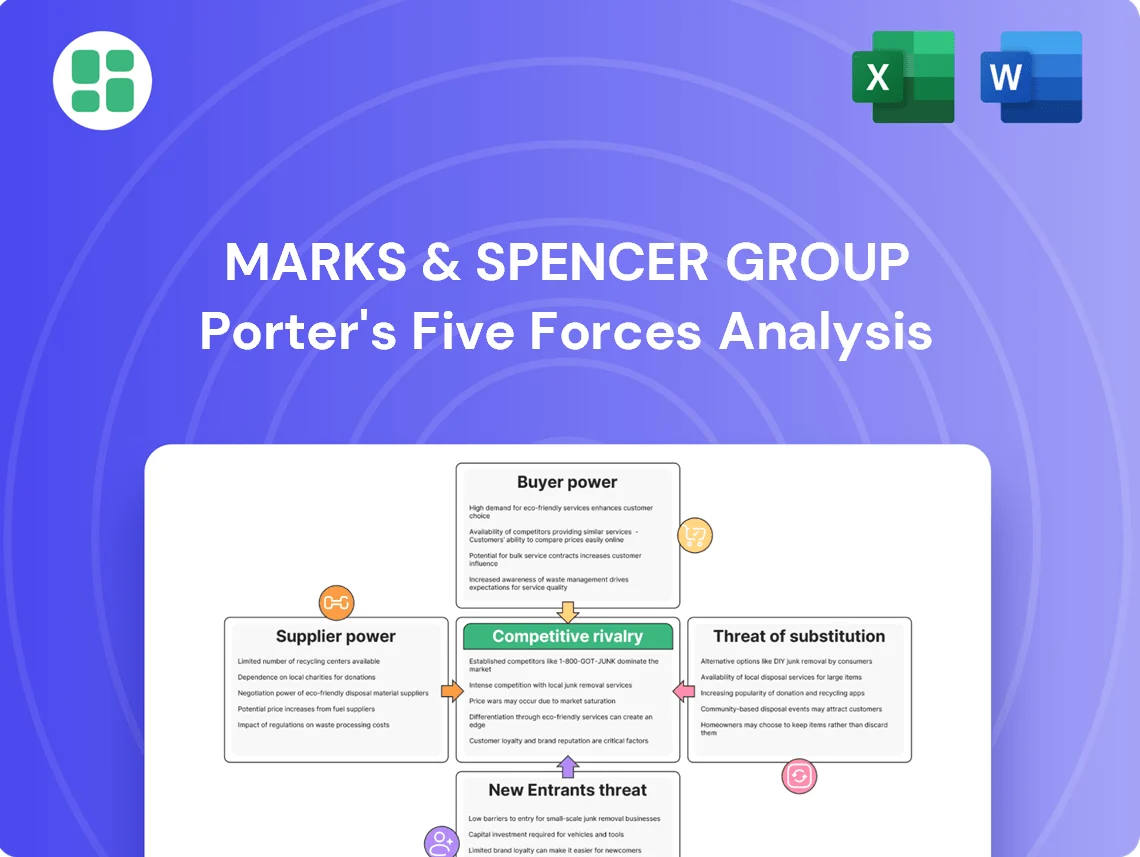
Marks & Spencer Group navigates a complex retail landscape, facing moderate buyer power due to brand loyalty and a wide product range, while the threat of new entrants is somewhat mitigated by established brand recognition and capital requirements. The bargaining power of suppliers presents a significant factor, particularly for specialized food and clothing lines. Substitutes, ranging from online retailers to discount chains, exert considerable pressure on M&S's pricing and product innovation.
This brief snapshot only scratches the surface. Unlock the full Porter's Five Forces Analysis to explore Marks & Spencer Group’s competitive dynamics, market pressures, and strategic advantages in detail.
Suppliers Bargaining Power

Supplier Concentration and Specialisation
Marks & Spencer's (M&S) reliance on a broad network of suppliers for its predominantly own-brand products generally limits the bargaining power of individual suppliers. This diversification allows M&S flexibility to switch between providers for many standard items, thus mitigating supplier leverage.
However, the situation shifts for highly specialized inputs. For instance, unique food ingredients or proprietary fabric technologies can concentrate power in the hands of a few suppliers, potentially increasing M&S's cost or dependency. In 2023, M&S reported that approximately 70% of its clothing was own-brand, highlighting the scale of its supplier relationships.
Switching Costs for M&S
For many of its common goods, Marks & Spencer faces low switching costs when changing suppliers. This is largely due to the company sourcing from a diverse range of providers, which enhances its negotiation leverage and limits any single supplier's power. For instance, in 2023, M&S continued its strategy of diversifying its food supply chain, reducing reliance on any one producer.
However, the situation shifts for more specialized or integrated supplier relationships. When M&S engages in long-term collaborations, such as joint product development for its premium food lines, the costs and complexities associated with switching suppliers can increase substantially. This strategic integration means that the investment in unique formulations or supply chain adjustments can create higher barriers to entry for new suppliers.

Importance of M&S to Suppliers
Marks & Spencer's considerable size and well-established brand name make it a highly sought-after customer for many suppliers. This desirability translates into significant order volumes and a boost in prestige for those who partner with M&S, thereby diminishing the bargaining power of individual suppliers.
In 2023, M&S reported a revenue of £12.2 billion, underscoring the substantial business opportunities available to its suppliers. This scale means that M&S often represents a major portion of a supplier's revenue, making them more reliant on the retailer.
Furthermore, M&S places a strong emphasis on ethical sourcing and sustainability. This commitment means suppliers must adhere to specific standards and practices, which can also influence the dynamics of their relationship with M&S and potentially limit their leverage.

Threat of Forward Integration by Suppliers
The threat of suppliers moving into direct retail, known as forward integration, is generally low for Marks & Spencer Group. Most of M&S's suppliers, particularly those providing raw materials or components, lack the substantial retail infrastructure, established brand equity, and direct-to-consumer (DTC) sales capabilities needed to successfully compete with M&S. For instance, a fabric supplier would need to invest heavily in store leases, marketing, and e-commerce platforms to replicate M&S's market presence.
M&S's robust and widespread retail network, encompassing hundreds of stores and a significant online presence, acts as a formidable barrier to entry for potential supplier competitors. This established physical and digital footprint makes it exceedingly difficult for suppliers to replicate the customer reach and brand loyalty M&S commands. In 2024, M&S continued to leverage its omnichannel strategy, with its online sales contributing a substantial portion to its overall revenue, further solidifying this barrier.
- Low Forward Integration Threat: Suppliers typically lack M&S's retail infrastructure and brand recognition.
- Barrier to Entry: M&S's extensive store network and online presence deter supplier competition.
- Reduced Supplier Power: This lack of competitive threat limits suppliers' ability to dictate terms.
- Omnichannel Strength: M&S's 2024 performance highlighted the strength of its integrated retail approach.
Input Differentiation and Availability
For Marks & Spencer Group, the bargaining power of suppliers is significantly influenced by input differentiation and availability. In many of its core product lines, particularly clothing and staple food items, the inputs M&S relies on are often not highly differentiated. This means that numerous suppliers can offer similar materials or ingredients, which inherently limits the power any single supplier holds.
This situation benefits M&S as it can readily source from a wide pool of providers, fostering competition among them. This competitive landscape allows M&S to negotiate favorable terms, maintain competitive pricing, and ensure consistent quality across its offerings. For instance, in 2023, M&S reported that its cost of goods sold was approximately £7.7 billion, a figure that benefits from efficient sourcing across diverse supplier bases.
- Input Commoditization: Many of M&S's clothing fabrics and standard food ingredients are commodities, meaning they are widely available from multiple suppliers.
- Supplier Competition: The availability of alternative suppliers for these undifferentiated inputs intensifies competition, driving down prices and reducing individual supplier leverage.
- Impact on Sourcing Costs: In fiscal year 2024, M&S focused on strengthening its supply chain relationships, aiming to mitigate inflationary pressures on raw materials, which is easier when inputs are not highly specialized.
- Potential for Supplier Power: However, for specialized or exclusive items, such as unique food ingredients or innovative textile technologies, differentiation can shift power towards those specific suppliers.
M&S: Strong Hand in Supplier Negotiations
The bargaining power of suppliers for Marks & Spencer Group is generally low due to the availability of numerous suppliers for many of its core products, especially in clothing and staple foods. This abundance of choice allows M&S to negotiate favorable terms and prices, as inputs are often not highly differentiated. In fiscal year 2024, M&S continued efforts to optimize its supply chain, a task made more manageable by the commoditized nature of many of its sourcing needs, helping to mitigate inflationary pressures.
| Factor | Impact on M&S | Supporting Data (FY23/24) |
|---|---|---|
| Input Differentiation | Low for many core products (e.g., staple foods, common fabrics) | M&S sources from a diverse supplier base, limiting individual supplier leverage. |
| Supplier Concentration | Generally low for undifferentiated inputs | In 2023, M&S reported ~70% of clothing was own-brand, indicating broad supplier relationships. |
| Switching Costs | Low for standard inputs | M&S's strategy of diversifying its food supply chain in 2023 reduced reliance on single producers. |
| Supplier Dependence on M&S | High for many suppliers | M&S's FY23 revenue of £12.2 billion signifies substantial business for its partners. |
What is included in the product
 Detailed Word Document
This analysis unpacks the competitive forces shaping Marks & Spencer Group's retail environment, examining threats from rivals, buyer power, supplier leverage, new entrants, and substitutes.

 Customizable Excel Spreadsheet
Instantly identify and mitigate competitive threats with a dynamic, interactive dashboard visualizing M&S's Porter's Five Forces.
Gain actionable insights into market pressures by easily adjusting variables for buyer power, supplier power, and new entrants.
Customers Bargaining Power

Customer Price Sensitivity
Customer price sensitivity is a significant factor for retailers like Marks & Spencer. In 2024, with ongoing economic uncertainties, consumers are increasingly scrutinizing their spending, particularly in categories like food and basic apparel where competition is fierce. M&S has actively worked to address this, notably by investing in its food pricing strategy to enhance its value proposition and remain competitive.
Availability of Substitutes and Alternatives
Customers at Marks & Spencer Group face a significant number of substitutes for their clothing, home goods, and food products. This wide choice, ranging from budget-friendly discounters to other established premium brands, directly amplifies customer bargaining power.
The ease with which customers can switch between retailers, due to minimal switching costs, puts pressure on M&S. For instance, in the competitive UK grocery market, where M&S Food operates, discounters like Aldi and Lidl have continued to gain market share, with Aldi reporting a 13.3% market share in the 12 weeks ending March 24, 2024, according to Kantar. This highlights the readily available alternatives.
M&S actively works to counter this by focusing on its unique selling propositions. The emphasis on product quality, perceived value for money, and the distinctiveness of its own-brand ranges are key strategies to retain customer loyalty and mitigate the impact of substitutes.

Customer Information and Transparency
Customers today have unprecedented access to information, thanks to the internet and readily available comparison tools. This means they can easily research product quality, features, and pricing from various retailers, including M&S. For instance, in 2023, the UK online retail market was valued at over £80 billion, indicating a significant shift in consumer behavior towards digital channels where price transparency is paramount.
This increased transparency directly impacts M&S's bargaining power by allowing customers to readily benchmark its offerings against competitors. If M&S's prices or perceived value don't align with market expectations, customers have the power to easily switch. This is particularly relevant as M&S invests in its digital transformation, aiming to improve customer experience and personalization, which in turn can influence their perception of value.

Loyalty Programs and Brand Equity
Marks & Spencer Group's Sparks loyalty program, boasting over 17 million members, is a key tool in managing customer bargaining power. By offering personalized rewards and tailored promotions, M&S enhances customer retention and makes switching less appealing. This program directly combats the threat of customers seeking lower prices elsewhere by increasing their perceived value and connection to the brand.
The strong brand equity that M&S has cultivated over decades also plays a significant role. This equity, built on a reputation for quality and trustworthiness, fosters a sense of loyalty that transcends price sensitivity. Customers who trust the M&S brand are less likely to be swayed by competitors' offers, thereby reducing their individual bargaining power.
- Sparks Program Reach: Over 17 million members as of early 2024.
- Personalization Impact: Drives customer retention and reduces price-based switching.
- Brand Equity: Built on quality and trust, fostering deep customer loyalty.
Volume of Purchases by Individual Customers
The volume of purchases by individual customers at Marks & Spencer (M&S) is generally low. This means that no single shopper can exert significant leverage over the company's pricing or terms. For instance, the average transaction value at M&S, while varying across departments like food and clothing, typically represents a tiny fraction of the group's overall revenue.
While individual customer power is limited, the collective buying power of millions of M&S shoppers is substantial. A widespread shift in consumer preference or a broad decline in demand for specific product categories can significantly impact M&S's sales and profitability. This underscores the importance of M&S maintaining broad customer appeal and ensuring satisfaction across its diverse product offerings to manage overall demand effectively.
- Low Individual Purchase Volume: Individual customer transactions at M&S are typically small relative to the company's total sales volume.
- Limited Individual Bargaining Power: This low purchase volume prevents any single customer from dictating terms or prices to M&S.
- Collective Demand Impact: Shifts in demand from the aggregate customer base can significantly influence M&S's performance.
- Focus on Broad Appeal: M&S must cater to a wide range of customer needs to maintain consistent demand and mitigate the impact of individual customer preferences.
Customer Bargaining Power: Retailer Strategies for Retention
Marks & Spencer's customers possess considerable bargaining power due to the wide availability of substitutes across its product lines, from clothing to groceries. This is amplified by the ease of switching between retailers, a trend evident in the UK grocery sector where discounters like Aldi and Lidl are gaining market share, with Aldi holding 13.3% in early 2024. Customers are also empowered by readily accessible online information and price comparison tools, making price transparency a critical factor. M&S counters this by leveraging its Sparks loyalty program, which boasts over 17 million members, and its strong brand equity built on quality and trust to foster customer retention and mitigate price-based switching.
| Factor | Impact on M&S | Mitigation Strategies |
|---|---|---|
| Availability of Substitutes | High; customers can easily find alternatives for clothing, home, and food. | Focus on unique product quality, perceived value, and own-brand distinctiveness. |
| Switching Costs | Low; minimal barriers to changing retailers. | Sparks loyalty program offering personalized rewards and promotions. |
| Information Availability | High; customers can easily compare prices and quality online. | Enhancing digital experience and personalization to influence perceived value. |
| Price Sensitivity | Increasing, especially in competitive categories like food. | Investment in food pricing strategy to improve value proposition. |
| Individual Purchase Volume | Low; no single customer can exert significant influence. | Focus on maintaining broad customer appeal and satisfaction. |
Full Version Awaits
Marks & Spencer Group Porter's Five Forces Analysis
This preview displays the complete Marks & Spencer Group Porter's Five Forces Analysis, offering a thorough examination of competitive forces within their industry. The document you see here is precisely what you will receive immediately after purchase, ensuring full transparency and immediate access to this professionally crafted strategic tool.

Product Information
Product Information
Shipping & Returns
Shipping & Returns
Marks & Spencer Group Porter's Five Forces Analysis
Marks & Spencer Group Porter's Five Forces Analysis
Don't Miss the Bigger Picture
Marks & Spencer Group navigates a complex retail landscape, facing moderate buyer power due to brand loyalty and a wide product range, while the threat of new entrants is somewhat mitigated by established brand recognition and capital requirements. The bargaining power of suppliers presents a significant factor, particularly for specialized food and clothing lines. Substitutes, ranging from online retailers to discount chains, exert considerable pressure on M&S's pricing and product innovation.
This brief snapshot only scratches the surface. Unlock the full Porter's Five Forces Analysis to explore Marks & Spencer Group’s competitive dynamics, market pressures, and strategic advantages in detail.
Suppliers Bargaining Power
Supplier Concentration and Specialisation
Marks & Spencer's (M&S) reliance on a broad network of suppliers for its predominantly own-brand products generally limits the bargaining power of individual suppliers. This diversification allows M&S flexibility to switch between providers for many standard items, thus mitigating supplier leverage.
However, the situation shifts for highly specialized inputs. For instance, unique food ingredients or proprietary fabric technologies can concentrate power in the hands of a few suppliers, potentially increasing M&S's cost or dependency. In 2023, M&S reported that approximately 70% of its clothing was own-brand, highlighting the scale of its supplier relationships.
Switching Costs for M&S
For many of its common goods, Marks & Spencer faces low switching costs when changing suppliers. This is largely due to the company sourcing from a diverse range of providers, which enhances its negotiation leverage and limits any single supplier's power. For instance, in 2023, M&S continued its strategy of diversifying its food supply chain, reducing reliance on any one producer.
However, the situation shifts for more specialized or integrated supplier relationships. When M&S engages in long-term collaborations, such as joint product development for its premium food lines, the costs and complexities associated with switching suppliers can increase substantially. This strategic integration means that the investment in unique formulations or supply chain adjustments can create higher barriers to entry for new suppliers.
Importance of M&S to Suppliers
Marks & Spencer's considerable size and well-established brand name make it a highly sought-after customer for many suppliers. This desirability translates into significant order volumes and a boost in prestige for those who partner with M&S, thereby diminishing the bargaining power of individual suppliers.
In 2023, M&S reported a revenue of £12.2 billion, underscoring the substantial business opportunities available to its suppliers. This scale means that M&S often represents a major portion of a supplier's revenue, making them more reliant on the retailer.
Furthermore, M&S places a strong emphasis on ethical sourcing and sustainability. This commitment means suppliers must adhere to specific standards and practices, which can also influence the dynamics of their relationship with M&S and potentially limit their leverage.
Threat of Forward Integration by Suppliers
The threat of suppliers moving into direct retail, known as forward integration, is generally low for Marks & Spencer Group. Most of M&S's suppliers, particularly those providing raw materials or components, lack the substantial retail infrastructure, established brand equity, and direct-to-consumer (DTC) sales capabilities needed to successfully compete with M&S. For instance, a fabric supplier would need to invest heavily in store leases, marketing, and e-commerce platforms to replicate M&S's market presence.
M&S's robust and widespread retail network, encompassing hundreds of stores and a significant online presence, acts as a formidable barrier to entry for potential supplier competitors. This established physical and digital footprint makes it exceedingly difficult for suppliers to replicate the customer reach and brand loyalty M&S commands. In 2024, M&S continued to leverage its omnichannel strategy, with its online sales contributing a substantial portion to its overall revenue, further solidifying this barrier.
- Low Forward Integration Threat: Suppliers typically lack M&S's retail infrastructure and brand recognition.
- Barrier to Entry: M&S's extensive store network and online presence deter supplier competition.
- Reduced Supplier Power: This lack of competitive threat limits suppliers' ability to dictate terms.
- Omnichannel Strength: M&S's 2024 performance highlighted the strength of its integrated retail approach.
Input Differentiation and Availability
For Marks & Spencer Group, the bargaining power of suppliers is significantly influenced by input differentiation and availability. In many of its core product lines, particularly clothing and staple food items, the inputs M&S relies on are often not highly differentiated. This means that numerous suppliers can offer similar materials or ingredients, which inherently limits the power any single supplier holds.
This situation benefits M&S as it can readily source from a wide pool of providers, fostering competition among them. This competitive landscape allows M&S to negotiate favorable terms, maintain competitive pricing, and ensure consistent quality across its offerings. For instance, in 2023, M&S reported that its cost of goods sold was approximately £7.7 billion, a figure that benefits from efficient sourcing across diverse supplier bases.
- Input Commoditization: Many of M&S's clothing fabrics and standard food ingredients are commodities, meaning they are widely available from multiple suppliers.
- Supplier Competition: The availability of alternative suppliers for these undifferentiated inputs intensifies competition, driving down prices and reducing individual supplier leverage.
- Impact on Sourcing Costs: In fiscal year 2024, M&S focused on strengthening its supply chain relationships, aiming to mitigate inflationary pressures on raw materials, which is easier when inputs are not highly specialized.
- Potential for Supplier Power: However, for specialized or exclusive items, such as unique food ingredients or innovative textile technologies, differentiation can shift power towards those specific suppliers.
M&S: Strong Hand in Supplier Negotiations
The bargaining power of suppliers for Marks & Spencer Group is generally low due to the availability of numerous suppliers for many of its core products, especially in clothing and staple foods. This abundance of choice allows M&S to negotiate favorable terms and prices, as inputs are often not highly differentiated. In fiscal year 2024, M&S continued efforts to optimize its supply chain, a task made more manageable by the commoditized nature of many of its sourcing needs, helping to mitigate inflationary pressures.
| Factor | Impact on M&S | Supporting Data (FY23/24) |
|---|---|---|
| Input Differentiation | Low for many core products (e.g., staple foods, common fabrics) | M&S sources from a diverse supplier base, limiting individual supplier leverage. |
| Supplier Concentration | Generally low for undifferentiated inputs | In 2023, M&S reported ~70% of clothing was own-brand, indicating broad supplier relationships. |
| Switching Costs | Low for standard inputs | M&S's strategy of diversifying its food supply chain in 2023 reduced reliance on single producers. |
| Supplier Dependence on M&S | High for many suppliers | M&S's FY23 revenue of £12.2 billion signifies substantial business for its partners. |
What is included in the product
Detailed Word Document
This analysis unpacks the competitive forces shaping Marks & Spencer Group's retail environment, examining threats from rivals, buyer power, supplier leverage, new entrants, and substitutes.
Customizable Excel Spreadsheet
Instantly identify and mitigate competitive threats with a dynamic, interactive dashboard visualizing M&S's Porter's Five Forces.
Gain actionable insights into market pressures by easily adjusting variables for buyer power, supplier power, and new entrants.
Customers Bargaining Power
Customer Price Sensitivity
Customer price sensitivity is a significant factor for retailers like Marks & Spencer. In 2024, with ongoing economic uncertainties, consumers are increasingly scrutinizing their spending, particularly in categories like food and basic apparel where competition is fierce. M&S has actively worked to address this, notably by investing in its food pricing strategy to enhance its value proposition and remain competitive.
Availability of Substitutes and Alternatives
Customers at Marks & Spencer Group face a significant number of substitutes for their clothing, home goods, and food products. This wide choice, ranging from budget-friendly discounters to other established premium brands, directly amplifies customer bargaining power.
The ease with which customers can switch between retailers, due to minimal switching costs, puts pressure on M&S. For instance, in the competitive UK grocery market, where M&S Food operates, discounters like Aldi and Lidl have continued to gain market share, with Aldi reporting a 13.3% market share in the 12 weeks ending March 24, 2024, according to Kantar. This highlights the readily available alternatives.
M&S actively works to counter this by focusing on its unique selling propositions. The emphasis on product quality, perceived value for money, and the distinctiveness of its own-brand ranges are key strategies to retain customer loyalty and mitigate the impact of substitutes.
Customer Information and Transparency
Customers today have unprecedented access to information, thanks to the internet and readily available comparison tools. This means they can easily research product quality, features, and pricing from various retailers, including M&S. For instance, in 2023, the UK online retail market was valued at over £80 billion, indicating a significant shift in consumer behavior towards digital channels where price transparency is paramount.
This increased transparency directly impacts M&S's bargaining power by allowing customers to readily benchmark its offerings against competitors. If M&S's prices or perceived value don't align with market expectations, customers have the power to easily switch. This is particularly relevant as M&S invests in its digital transformation, aiming to improve customer experience and personalization, which in turn can influence their perception of value.
Loyalty Programs and Brand Equity
Marks & Spencer Group's Sparks loyalty program, boasting over 17 million members, is a key tool in managing customer bargaining power. By offering personalized rewards and tailored promotions, M&S enhances customer retention and makes switching less appealing. This program directly combats the threat of customers seeking lower prices elsewhere by increasing their perceived value and connection to the brand.
The strong brand equity that M&S has cultivated over decades also plays a significant role. This equity, built on a reputation for quality and trustworthiness, fosters a sense of loyalty that transcends price sensitivity. Customers who trust the M&S brand are less likely to be swayed by competitors' offers, thereby reducing their individual bargaining power.
- Sparks Program Reach: Over 17 million members as of early 2024.
- Personalization Impact: Drives customer retention and reduces price-based switching.
- Brand Equity: Built on quality and trust, fostering deep customer loyalty.
Volume of Purchases by Individual Customers
The volume of purchases by individual customers at Marks & Spencer (M&S) is generally low. This means that no single shopper can exert significant leverage over the company's pricing or terms. For instance, the average transaction value at M&S, while varying across departments like food and clothing, typically represents a tiny fraction of the group's overall revenue.
While individual customer power is limited, the collective buying power of millions of M&S shoppers is substantial. A widespread shift in consumer preference or a broad decline in demand for specific product categories can significantly impact M&S's sales and profitability. This underscores the importance of M&S maintaining broad customer appeal and ensuring satisfaction across its diverse product offerings to manage overall demand effectively.
- Low Individual Purchase Volume: Individual customer transactions at M&S are typically small relative to the company's total sales volume.
- Limited Individual Bargaining Power: This low purchase volume prevents any single customer from dictating terms or prices to M&S.
- Collective Demand Impact: Shifts in demand from the aggregate customer base can significantly influence M&S's performance.
- Focus on Broad Appeal: M&S must cater to a wide range of customer needs to maintain consistent demand and mitigate the impact of individual customer preferences.
Customer Bargaining Power: Retailer Strategies for Retention
Marks & Spencer's customers possess considerable bargaining power due to the wide availability of substitutes across its product lines, from clothing to groceries. This is amplified by the ease of switching between retailers, a trend evident in the UK grocery sector where discounters like Aldi and Lidl are gaining market share, with Aldi holding 13.3% in early 2024. Customers are also empowered by readily accessible online information and price comparison tools, making price transparency a critical factor. M&S counters this by leveraging its Sparks loyalty program, which boasts over 17 million members, and its strong brand equity built on quality and trust to foster customer retention and mitigate price-based switching.
| Factor | Impact on M&S | Mitigation Strategies |
|---|---|---|
| Availability of Substitutes | High; customers can easily find alternatives for clothing, home, and food. | Focus on unique product quality, perceived value, and own-brand distinctiveness. |
| Switching Costs | Low; minimal barriers to changing retailers. | Sparks loyalty program offering personalized rewards and promotions. |
| Information Availability | High; customers can easily compare prices and quality online. | Enhancing digital experience and personalization to influence perceived value. |
| Price Sensitivity | Increasing, especially in competitive categories like food. | Investment in food pricing strategy to improve value proposition. |
| Individual Purchase Volume | Low; no single customer can exert significant influence. | Focus on maintaining broad customer appeal and satisfaction. |
Full Version Awaits
Marks & Spencer Group Porter's Five Forces Analysis
This preview displays the complete Marks & Spencer Group Porter's Five Forces Analysis, offering a thorough examination of competitive forces within their industry. The document you see here is precisely what you will receive immediately after purchase, ensuring full transparency and immediate access to this professionally crafted strategic tool.
Original: $10.00
-65%$10.00
$3.50Product Information
Product Information
Shipping & Returns
Shipping & Returns
Description
Don't Miss the Bigger Picture
Marks & Spencer Group navigates a complex retail landscape, facing moderate buyer power due to brand loyalty and a wide product range, while the threat of new entrants is somewhat mitigated by established brand recognition and capital requirements. The bargaining power of suppliers presents a significant factor, particularly for specialized food and clothing lines. Substitutes, ranging from online retailers to discount chains, exert considerable pressure on M&S's pricing and product innovation.
This brief snapshot only scratches the surface. Unlock the full Porter's Five Forces Analysis to explore Marks & Spencer Group’s competitive dynamics, market pressures, and strategic advantages in detail.
Suppliers Bargaining Power
Supplier Concentration and Specialisation
Marks & Spencer's (M&S) reliance on a broad network of suppliers for its predominantly own-brand products generally limits the bargaining power of individual suppliers. This diversification allows M&S flexibility to switch between providers for many standard items, thus mitigating supplier leverage.
However, the situation shifts for highly specialized inputs. For instance, unique food ingredients or proprietary fabric technologies can concentrate power in the hands of a few suppliers, potentially increasing M&S's cost or dependency. In 2023, M&S reported that approximately 70% of its clothing was own-brand, highlighting the scale of its supplier relationships.
Switching Costs for M&S
For many of its common goods, Marks & Spencer faces low switching costs when changing suppliers. This is largely due to the company sourcing from a diverse range of providers, which enhances its negotiation leverage and limits any single supplier's power. For instance, in 2023, M&S continued its strategy of diversifying its food supply chain, reducing reliance on any one producer.
However, the situation shifts for more specialized or integrated supplier relationships. When M&S engages in long-term collaborations, such as joint product development for its premium food lines, the costs and complexities associated with switching suppliers can increase substantially. This strategic integration means that the investment in unique formulations or supply chain adjustments can create higher barriers to entry for new suppliers.
Importance of M&S to Suppliers
Marks & Spencer's considerable size and well-established brand name make it a highly sought-after customer for many suppliers. This desirability translates into significant order volumes and a boost in prestige for those who partner with M&S, thereby diminishing the bargaining power of individual suppliers.
In 2023, M&S reported a revenue of £12.2 billion, underscoring the substantial business opportunities available to its suppliers. This scale means that M&S often represents a major portion of a supplier's revenue, making them more reliant on the retailer.
Furthermore, M&S places a strong emphasis on ethical sourcing and sustainability. This commitment means suppliers must adhere to specific standards and practices, which can also influence the dynamics of their relationship with M&S and potentially limit their leverage.
Threat of Forward Integration by Suppliers
The threat of suppliers moving into direct retail, known as forward integration, is generally low for Marks & Spencer Group. Most of M&S's suppliers, particularly those providing raw materials or components, lack the substantial retail infrastructure, established brand equity, and direct-to-consumer (DTC) sales capabilities needed to successfully compete with M&S. For instance, a fabric supplier would need to invest heavily in store leases, marketing, and e-commerce platforms to replicate M&S's market presence.
M&S's robust and widespread retail network, encompassing hundreds of stores and a significant online presence, acts as a formidable barrier to entry for potential supplier competitors. This established physical and digital footprint makes it exceedingly difficult for suppliers to replicate the customer reach and brand loyalty M&S commands. In 2024, M&S continued to leverage its omnichannel strategy, with its online sales contributing a substantial portion to its overall revenue, further solidifying this barrier.
- Low Forward Integration Threat: Suppliers typically lack M&S's retail infrastructure and brand recognition.
- Barrier to Entry: M&S's extensive store network and online presence deter supplier competition.
- Reduced Supplier Power: This lack of competitive threat limits suppliers' ability to dictate terms.
- Omnichannel Strength: M&S's 2024 performance highlighted the strength of its integrated retail approach.
Input Differentiation and Availability
For Marks & Spencer Group, the bargaining power of suppliers is significantly influenced by input differentiation and availability. In many of its core product lines, particularly clothing and staple food items, the inputs M&S relies on are often not highly differentiated. This means that numerous suppliers can offer similar materials or ingredients, which inherently limits the power any single supplier holds.
This situation benefits M&S as it can readily source from a wide pool of providers, fostering competition among them. This competitive landscape allows M&S to negotiate favorable terms, maintain competitive pricing, and ensure consistent quality across its offerings. For instance, in 2023, M&S reported that its cost of goods sold was approximately £7.7 billion, a figure that benefits from efficient sourcing across diverse supplier bases.
- Input Commoditization: Many of M&S's clothing fabrics and standard food ingredients are commodities, meaning they are widely available from multiple suppliers.
- Supplier Competition: The availability of alternative suppliers for these undifferentiated inputs intensifies competition, driving down prices and reducing individual supplier leverage.
- Impact on Sourcing Costs: In fiscal year 2024, M&S focused on strengthening its supply chain relationships, aiming to mitigate inflationary pressures on raw materials, which is easier when inputs are not highly specialized.
- Potential for Supplier Power: However, for specialized or exclusive items, such as unique food ingredients or innovative textile technologies, differentiation can shift power towards those specific suppliers.
M&S: Strong Hand in Supplier Negotiations
The bargaining power of suppliers for Marks & Spencer Group is generally low due to the availability of numerous suppliers for many of its core products, especially in clothing and staple foods. This abundance of choice allows M&S to negotiate favorable terms and prices, as inputs are often not highly differentiated. In fiscal year 2024, M&S continued efforts to optimize its supply chain, a task made more manageable by the commoditized nature of many of its sourcing needs, helping to mitigate inflationary pressures.
| Factor | Impact on M&S | Supporting Data (FY23/24) |
|---|---|---|
| Input Differentiation | Low for many core products (e.g., staple foods, common fabrics) | M&S sources from a diverse supplier base, limiting individual supplier leverage. |
| Supplier Concentration | Generally low for undifferentiated inputs | In 2023, M&S reported ~70% of clothing was own-brand, indicating broad supplier relationships. |
| Switching Costs | Low for standard inputs | M&S's strategy of diversifying its food supply chain in 2023 reduced reliance on single producers. |
| Supplier Dependence on M&S | High for many suppliers | M&S's FY23 revenue of £12.2 billion signifies substantial business for its partners. |
What is included in the product
Detailed Word Document
This analysis unpacks the competitive forces shaping Marks & Spencer Group's retail environment, examining threats from rivals, buyer power, supplier leverage, new entrants, and substitutes.
Customizable Excel Spreadsheet
Instantly identify and mitigate competitive threats with a dynamic, interactive dashboard visualizing M&S's Porter's Five Forces.
Gain actionable insights into market pressures by easily adjusting variables for buyer power, supplier power, and new entrants.
Customers Bargaining Power
Customer Price Sensitivity
Customer price sensitivity is a significant factor for retailers like Marks & Spencer. In 2024, with ongoing economic uncertainties, consumers are increasingly scrutinizing their spending, particularly in categories like food and basic apparel where competition is fierce. M&S has actively worked to address this, notably by investing in its food pricing strategy to enhance its value proposition and remain competitive.
Availability of Substitutes and Alternatives
Customers at Marks & Spencer Group face a significant number of substitutes for their clothing, home goods, and food products. This wide choice, ranging from budget-friendly discounters to other established premium brands, directly amplifies customer bargaining power.
The ease with which customers can switch between retailers, due to minimal switching costs, puts pressure on M&S. For instance, in the competitive UK grocery market, where M&S Food operates, discounters like Aldi and Lidl have continued to gain market share, with Aldi reporting a 13.3% market share in the 12 weeks ending March 24, 2024, according to Kantar. This highlights the readily available alternatives.
M&S actively works to counter this by focusing on its unique selling propositions. The emphasis on product quality, perceived value for money, and the distinctiveness of its own-brand ranges are key strategies to retain customer loyalty and mitigate the impact of substitutes.
Customer Information and Transparency
Customers today have unprecedented access to information, thanks to the internet and readily available comparison tools. This means they can easily research product quality, features, and pricing from various retailers, including M&S. For instance, in 2023, the UK online retail market was valued at over £80 billion, indicating a significant shift in consumer behavior towards digital channels where price transparency is paramount.
This increased transparency directly impacts M&S's bargaining power by allowing customers to readily benchmark its offerings against competitors. If M&S's prices or perceived value don't align with market expectations, customers have the power to easily switch. This is particularly relevant as M&S invests in its digital transformation, aiming to improve customer experience and personalization, which in turn can influence their perception of value.
Loyalty Programs and Brand Equity
Marks & Spencer Group's Sparks loyalty program, boasting over 17 million members, is a key tool in managing customer bargaining power. By offering personalized rewards and tailored promotions, M&S enhances customer retention and makes switching less appealing. This program directly combats the threat of customers seeking lower prices elsewhere by increasing their perceived value and connection to the brand.
The strong brand equity that M&S has cultivated over decades also plays a significant role. This equity, built on a reputation for quality and trustworthiness, fosters a sense of loyalty that transcends price sensitivity. Customers who trust the M&S brand are less likely to be swayed by competitors' offers, thereby reducing their individual bargaining power.
- Sparks Program Reach: Over 17 million members as of early 2024.
- Personalization Impact: Drives customer retention and reduces price-based switching.
- Brand Equity: Built on quality and trust, fostering deep customer loyalty.
Volume of Purchases by Individual Customers
The volume of purchases by individual customers at Marks & Spencer (M&S) is generally low. This means that no single shopper can exert significant leverage over the company's pricing or terms. For instance, the average transaction value at M&S, while varying across departments like food and clothing, typically represents a tiny fraction of the group's overall revenue.
While individual customer power is limited, the collective buying power of millions of M&S shoppers is substantial. A widespread shift in consumer preference or a broad decline in demand for specific product categories can significantly impact M&S's sales and profitability. This underscores the importance of M&S maintaining broad customer appeal and ensuring satisfaction across its diverse product offerings to manage overall demand effectively.
- Low Individual Purchase Volume: Individual customer transactions at M&S are typically small relative to the company's total sales volume.
- Limited Individual Bargaining Power: This low purchase volume prevents any single customer from dictating terms or prices to M&S.
- Collective Demand Impact: Shifts in demand from the aggregate customer base can significantly influence M&S's performance.
- Focus on Broad Appeal: M&S must cater to a wide range of customer needs to maintain consistent demand and mitigate the impact of individual customer preferences.
Customer Bargaining Power: Retailer Strategies for Retention
Marks & Spencer's customers possess considerable bargaining power due to the wide availability of substitutes across its product lines, from clothing to groceries. This is amplified by the ease of switching between retailers, a trend evident in the UK grocery sector where discounters like Aldi and Lidl are gaining market share, with Aldi holding 13.3% in early 2024. Customers are also empowered by readily accessible online information and price comparison tools, making price transparency a critical factor. M&S counters this by leveraging its Sparks loyalty program, which boasts over 17 million members, and its strong brand equity built on quality and trust to foster customer retention and mitigate price-based switching.
| Factor | Impact on M&S | Mitigation Strategies |
|---|---|---|
| Availability of Substitutes | High; customers can easily find alternatives for clothing, home, and food. | Focus on unique product quality, perceived value, and own-brand distinctiveness. |
| Switching Costs | Low; minimal barriers to changing retailers. | Sparks loyalty program offering personalized rewards and promotions. |
| Information Availability | High; customers can easily compare prices and quality online. | Enhancing digital experience and personalization to influence perceived value. |
| Price Sensitivity | Increasing, especially in competitive categories like food. | Investment in food pricing strategy to improve value proposition. |
| Individual Purchase Volume | Low; no single customer can exert significant influence. | Focus on maintaining broad customer appeal and satisfaction. |
Full Version Awaits
Marks & Spencer Group Porter's Five Forces Analysis
This preview displays the complete Marks & Spencer Group Porter's Five Forces Analysis, offering a thorough examination of competitive forces within their industry. The document you see here is precisely what you will receive immediately after purchase, ensuring full transparency and immediate access to this professionally crafted strategic tool.