Manila Water Porter's Five Forces Analysis

Elevate Your Analysis with the Complete Porter's Five Forces Analysis
Manila Water faces significant bargaining power from its customers, who have limited alternatives for essential water services. The threat of new entrants, while regulated, is present, and the availability of substitutes, though indirect, can emerge. Understanding these dynamics is crucial for strategic planning.
The complete report reveals the real forces shaping Manila Water’s industry—from supplier influence to threat of new entrants. Gain actionable insights to drive smarter decision-making.
Suppliers Bargaining Power

Concentration of Key Suppliers
Manila Water's reliance on a concentrated number of key suppliers significantly shapes its bargaining power. The company's primary source of raw water, essential for its operations, is largely controlled by government entities such as the Metropolitan Waterworks and Sewerage System (MWSS). This monopolistic supply structure inherently grants the MWSS substantial leverage in negotiations.
This concentration extends to specialized inputs like water treatment chemicals and large-scale infrastructure materials, where a limited pool of vendors can dictate terms. For instance, in 2023, infrastructure development projects for water supply expansion often faced price escalations from major construction material suppliers, impacting capital expenditure budgets.
Importance of Inputs to Manila Water
Manila Water's operations are fundamentally reliant on its suppliers for critical inputs like raw water and essential treatment chemicals. These resources are not just important; they are the very lifeblood of the company's ability to deliver clean and safe water to its customers.
This deep dependence means suppliers hold significant leverage. For instance, securing a stable and cost-effective supply of coagulants and disinfectants, crucial for water purification, directly impacts Manila Water's operational efficiency and profitability. In 2023, the cost of chemicals represented a notable portion of their operating expenses, highlighting the sensitivity of their margins to supplier pricing.

Switching Costs for Manila Water
Manila Water faces considerable supplier power due to high switching costs for specialized equipment and large infrastructure projects. These costs can include significant expenses for re-engineering, retraining staff, and managing potential operational downtime during a transition. For instance, securing a new provider for advanced water treatment technology could necessitate extensive system modifications and new employee training programs, making a switch economically burdensome.

Availability of Substitute Inputs
For critical inputs like raw water from established sources or highly specialized water treatment chemicals, Manila Water often faces limited or no viable substitutes at the scale it requires. This scarcity directly translates to reduced bargaining power for Manila Water.
The lack of readily available alternatives for essential components means suppliers can dictate terms and prices with considerable influence. This situation significantly enhances the bargaining power of these suppliers, impacting Manila Water's cost structure and operational flexibility.
- Limited Substitutes for Raw Water: Manila Water relies heavily on specific watersheds and water sources, with few scalable alternatives available. For instance, the Angat-Ipo-La Mesa water system is the primary source for Metro Manila, providing over 90% of the water supply.
- Specialized Treatment Chemicals: Certain advanced water treatment chemicals are proprietary or require specific manufacturing processes, limiting the number of potential suppliers.
- Supplier Leverage: The absence of strong substitute inputs grants suppliers greater leverage in price negotiations and contract terms, as Manila Water has fewer options to switch to.
Supplier's Ability to Forward Integrate
The capacity of suppliers to forward integrate, meaning they could potentially move into the customer's business, is a significant factor in the bargaining power of suppliers. For Manila Water, the primary 'supplier' of raw water is essentially the government, which controls the water sources and the regulatory environment.
While it's highly improbable for typical suppliers to enter the water utility sector due to massive capital requirements and stringent regulations, the government's existing position as the ultimate authority over raw water supply and its role as regulator fundamentally alters this dynamic. This inherent governmental control over the resource and the concession agreements significantly diminishes Manila Water's bargaining power with its most critical 'supplier'.
- Governmental Control: The Philippine government, through agencies like the National Water Resources Board (NWRB), dictates water allocation and tariffs, effectively acting as the primary 'supplier' and regulator.
- Regulatory Barriers: The immense capital investment and complex regulatory approvals needed to operate a water utility make forward integration by private raw water suppliers practically impossible.
- Concession Framework: Manila Water operates under concession agreements granted by the government, which inherently places the government in a dominant supplier position.
- Limited Leverage: This structure means Manila Water has limited leverage in negotiating terms with the government for raw water supply, as the government holds the ultimate power over the resource.
Government Control & Specialized Inputs Limit Water Firm's Leverage
Manila Water's bargaining power with its suppliers is significantly constrained by the concentrated nature of its critical input sources. The company's primary reliance on government-controlled water sources, such as the Angat-Ipo-La Mesa system which supplies over 90% of Metro Manila's water, places immense leverage with these entities. This dependence is further amplified by the limited availability of viable, large-scale substitutes for raw water, a situation that was starkly evident in 2023 as water security remained a paramount concern.
Furthermore, the specialized nature of water treatment chemicals and advanced infrastructure components means a restricted pool of vendors can dictate terms. For instance, in the first half of 2024, the global supply chain disruptions continued to affect the availability and pricing of certain essential chemicals, leading to increased procurement costs for Manila Water. The high switching costs associated with specialized equipment also solidify supplier power, making it economically prohibitive to change providers frequently.
The Philippine government, acting as the ultimate authority over raw water allocation and regulatory frameworks, holds a dominant position. This governmental control, coupled with the immense capital and regulatory hurdles for potential competitors, makes forward integration by private suppliers into the water utility sector practically impossible. Consequently, Manila Water's leverage in negotiating terms for its most vital resource remains minimal.
| Input Type | Key Suppliers | Supplier Bargaining Power Factors | Impact on Manila Water (2023-2024) |
|---|---|---|---|
| Raw Water | Metropolitan Waterworks and Sewerage System (MWSS), National Water Resources Board (NWRB) | Monopolistic control of sources, government regulation, high switching costs for Manila Water | Limited negotiation leverage, dependence on government allocation and pricing; continued focus on water source diversification projects. |
| Water Treatment Chemicals | Limited specialized chemical manufacturers | Proprietary nature of chemicals, limited substitutes, supply chain volatility | Increased procurement costs due to global price fluctuations and supply constraints; 2023 operating expenses saw a notable percentage increase in chemical costs. |
| Infrastructure Materials & Equipment | Select large construction material suppliers, specialized technology providers | Concentrated supplier base, high switching costs for specialized equipment, project-specific requirements | Potential for price escalations in large capital expenditure projects; need for long-term contracts to secure stable pricing and supply. |
What is included in the product
 Detailed Word Document
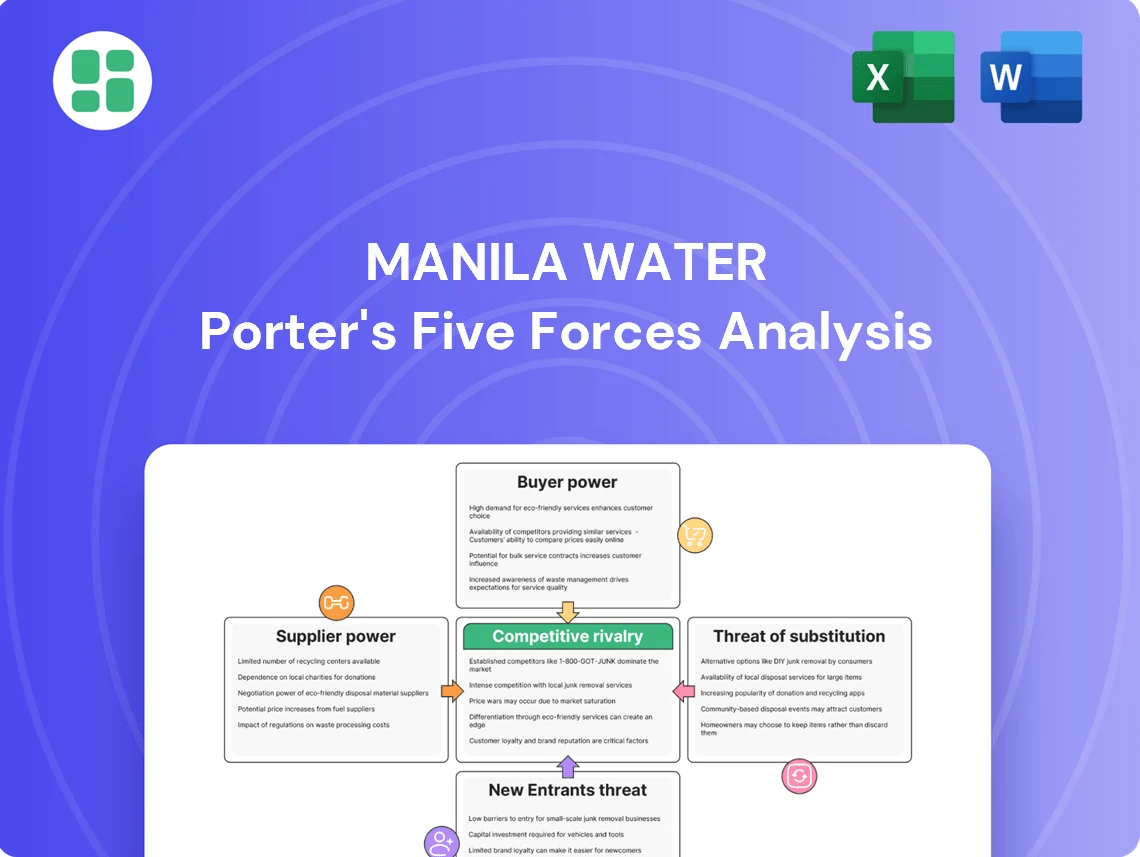
This Porter's Five Forces analysis for Manila Water dissects the competitive intensity within the Philippine water utility sector, examining the bargaining power of buyers and suppliers, the threat of new entrants and substitutes, and the rivalry among existing players.

 Customizable Excel Spreadsheet
Effortlessly identify and mitigate competitive threats by visualizing the intensity of each Porter's Five Force, allowing for targeted strategic adjustments.
Customers Bargaining Power

Customer Price Sensitivity
Residential customers of Manila Water, while needing an essential service, do exhibit sensitivity to price hikes, particularly in light of prevailing economic conditions. For instance, in 2024, inflation remained a concern for many households, making any increase in utility bills a point of contention.
However, the direct bargaining power of these customers is significantly tempered by the regulatory framework. The Metropolitan Waterworks and Sewerage System Regulatory Office (MWSS RO) plays a crucial role, setting and approving water tariffs. This body acts as the primary point of negotiation, effectively channeling customer price sensitivity through a formal, regulated process rather than direct company interaction.
This regulatory oversight means that while customer sentiment regarding price is important, it doesn't translate into immediate, unmitigated pressure on Manila Water's profitability. The MWSS RO's decisions, based on factors like operational costs and service standards, mediate the extent to which customer price sensitivity can influence actual rates charged.
Availability of Alternatives for Customers
Within Manila Water's exclusive concession area in the East Zone of Metro Manila and Rizal Province, customers face a significant limitation: the virtual absence of alternative piped water service providers. This means they cannot easily switch to a different utility for their essential water and sewerage needs, a situation that directly impacts their leverage.
The lack of readily available direct substitutes for the comprehensive water and sewerage services provided by Manila Water substantially reduces the bargaining power of individual customers. This exclusivity grants Manila Water a strong position, as customers are largely dependent on their services for a fundamental necessity.

Switching Costs for Customers
For customers of Manila Water, switching costs for its core piped water service are virtually nonexistent. Disconnecting from the established piped network and attempting to rely on alternatives like bottled water or private deep wells is not a feasible or sustainable option for the vast majority of households and businesses.
The practicalities and immense costs associated with establishing and maintaining alternative water sources create a near-total lock-in for customers. This lack of viable alternatives significantly strengthens Manila Water's bargaining power against its customer base.

Customer Information and Transparency
Customers of Manila Water typically possess limited insight into the company's detailed cost structures, operational efficiencies, or precise profit margins. This information asymmetry inherently weakens their ability to effectively bargain or challenge pricing beyond the established regulatory channels.
While regulatory bodies like the Metropolitan Waterworks and Sewerage System (MWSS) mandate certain levels of transparency, particularly concerning tariff adjustments, this oversight doesn't equip individual consumers with the granular data needed for direct negotiation. For instance, in 2023, Manila Water reported a net income of PHP 8.3 billion, but the specific cost breakdowns influencing tariff calculations remain largely inaccessible to the average customer.
- Limited Information Access: Customers lack detailed knowledge of Manila Water's cost drivers and profit margins, hindering their ability to negotiate pricing effectively.
- Regulatory Oversight vs. Direct Negotiation: While regulators provide transparency on tariffs, this does not translate into direct bargaining power for individual customers.
- Asymmetrical Information: The utility's complex operational and financial data is not readily available to consumers, creating a significant information gap.
- Impact on Bargaining Power: This lack of information significantly reduces the bargaining power of customers, leaving them reliant on the existing regulatory framework for price considerations.
Customer Concentration and Organization
Manila Water's customer base is incredibly diverse, encompassing millions of residential, commercial, and industrial accounts. This vast fragmentation means no single customer or small group of customers holds significant sway to negotiate better terms. In 2023, Manila Water reported serving over 7.8 million direct customers, highlighting this broad reach.
While consumer advocacy groups do exist and play a role in ensuring service quality and fair pricing, their power is channeled through regulatory bodies. They influence policy and standards rather than engaging in direct commercial bargaining with Manila Water. This indirect approach further limits the direct bargaining power of individual customers.
- Customer Fragmentation: Millions of diverse accounts prevent concentrated purchasing power.
- Regulatory Influence: Advocacy groups impact through policy, not direct negotiation.
- Limited Leverage: Individual customers have minimal ability to dictate terms.
Customers' Limited Leverage: A Look at the Captive Water Market
The bargaining power of Manila Water's customers is generally low. While customers are sensitive to price increases, particularly with inflation concerns in 2024, their ability to directly negotiate with the company is minimal due to the regulatory framework. The Metropolitan Waterworks and Sewerage System Regulatory Office (MWSS RO) sets tariffs, acting as the primary intermediary for price discussions.
Furthermore, the lack of alternative piped water providers in Manila Water's concession area creates a captive customer base. Switching costs are effectively prohibitive, meaning customers cannot easily opt for another service. This dependency, coupled with limited customer access to detailed cost structures and the sheer fragmentation of its millions of customers, significantly curtails their direct bargaining leverage.
| Factor | Assessment | Impact on Manila Water |
| Price Sensitivity | Moderate to High (especially in 2024 due to inflation) | Requires justification for tariff adjustments through MWSS RO |
| Availability of Substitutes | Virtually None (for piped water) | Very Low customer bargaining power |
| Switching Costs | Extremely High (impractical alternatives) | Very Low customer bargaining power |
| Information Asymmetry | High (limited customer insight into costs) | Low customer bargaining power |
| Customer Fragmentation | Extremely High (millions of diverse accounts) | Very Low individual and collective bargaining power |
Full Version Awaits
Manila Water Porter's Five Forces Analysis
This preview showcases the complete Manila Water Porter's Five Forces Analysis, offering a detailed examination of the competitive landscape within the Philippine water utility sector. The document you see here is precisely what you will receive immediately after purchase, ensuring full transparency and immediate access to this professionally crafted strategic tool.

Product Information
Product Information
Shipping & Returns
Shipping & Returns
Manila Water Porter's Five Forces Analysis
Manila Water Porter's Five Forces Analysis
Elevate Your Analysis with the Complete Porter's Five Forces Analysis
Manila Water faces significant bargaining power from its customers, who have limited alternatives for essential water services. The threat of new entrants, while regulated, is present, and the availability of substitutes, though indirect, can emerge. Understanding these dynamics is crucial for strategic planning.
The complete report reveals the real forces shaping Manila Water’s industry—from supplier influence to threat of new entrants. Gain actionable insights to drive smarter decision-making.
Suppliers Bargaining Power
Concentration of Key Suppliers
Manila Water's reliance on a concentrated number of key suppliers significantly shapes its bargaining power. The company's primary source of raw water, essential for its operations, is largely controlled by government entities such as the Metropolitan Waterworks and Sewerage System (MWSS). This monopolistic supply structure inherently grants the MWSS substantial leverage in negotiations.
This concentration extends to specialized inputs like water treatment chemicals and large-scale infrastructure materials, where a limited pool of vendors can dictate terms. For instance, in 2023, infrastructure development projects for water supply expansion often faced price escalations from major construction material suppliers, impacting capital expenditure budgets.
Importance of Inputs to Manila Water
Manila Water's operations are fundamentally reliant on its suppliers for critical inputs like raw water and essential treatment chemicals. These resources are not just important; they are the very lifeblood of the company's ability to deliver clean and safe water to its customers.
This deep dependence means suppliers hold significant leverage. For instance, securing a stable and cost-effective supply of coagulants and disinfectants, crucial for water purification, directly impacts Manila Water's operational efficiency and profitability. In 2023, the cost of chemicals represented a notable portion of their operating expenses, highlighting the sensitivity of their margins to supplier pricing.
Switching Costs for Manila Water
Manila Water faces considerable supplier power due to high switching costs for specialized equipment and large infrastructure projects. These costs can include significant expenses for re-engineering, retraining staff, and managing potential operational downtime during a transition. For instance, securing a new provider for advanced water treatment technology could necessitate extensive system modifications and new employee training programs, making a switch economically burdensome.
Availability of Substitute Inputs
For critical inputs like raw water from established sources or highly specialized water treatment chemicals, Manila Water often faces limited or no viable substitutes at the scale it requires. This scarcity directly translates to reduced bargaining power for Manila Water.
The lack of readily available alternatives for essential components means suppliers can dictate terms and prices with considerable influence. This situation significantly enhances the bargaining power of these suppliers, impacting Manila Water's cost structure and operational flexibility.
- Limited Substitutes for Raw Water: Manila Water relies heavily on specific watersheds and water sources, with few scalable alternatives available. For instance, the Angat-Ipo-La Mesa water system is the primary source for Metro Manila, providing over 90% of the water supply.
- Specialized Treatment Chemicals: Certain advanced water treatment chemicals are proprietary or require specific manufacturing processes, limiting the number of potential suppliers.
- Supplier Leverage: The absence of strong substitute inputs grants suppliers greater leverage in price negotiations and contract terms, as Manila Water has fewer options to switch to.
Supplier's Ability to Forward Integrate
The capacity of suppliers to forward integrate, meaning they could potentially move into the customer's business, is a significant factor in the bargaining power of suppliers. For Manila Water, the primary 'supplier' of raw water is essentially the government, which controls the water sources and the regulatory environment.
While it's highly improbable for typical suppliers to enter the water utility sector due to massive capital requirements and stringent regulations, the government's existing position as the ultimate authority over raw water supply and its role as regulator fundamentally alters this dynamic. This inherent governmental control over the resource and the concession agreements significantly diminishes Manila Water's bargaining power with its most critical 'supplier'.
- Governmental Control: The Philippine government, through agencies like the National Water Resources Board (NWRB), dictates water allocation and tariffs, effectively acting as the primary 'supplier' and regulator.
- Regulatory Barriers: The immense capital investment and complex regulatory approvals needed to operate a water utility make forward integration by private raw water suppliers practically impossible.
- Concession Framework: Manila Water operates under concession agreements granted by the government, which inherently places the government in a dominant supplier position.
- Limited Leverage: This structure means Manila Water has limited leverage in negotiating terms with the government for raw water supply, as the government holds the ultimate power over the resource.
Government Control & Specialized Inputs Limit Water Firm's Leverage
Manila Water's bargaining power with its suppliers is significantly constrained by the concentrated nature of its critical input sources. The company's primary reliance on government-controlled water sources, such as the Angat-Ipo-La Mesa system which supplies over 90% of Metro Manila's water, places immense leverage with these entities. This dependence is further amplified by the limited availability of viable, large-scale substitutes for raw water, a situation that was starkly evident in 2023 as water security remained a paramount concern.
Furthermore, the specialized nature of water treatment chemicals and advanced infrastructure components means a restricted pool of vendors can dictate terms. For instance, in the first half of 2024, the global supply chain disruptions continued to affect the availability and pricing of certain essential chemicals, leading to increased procurement costs for Manila Water. The high switching costs associated with specialized equipment also solidify supplier power, making it economically prohibitive to change providers frequently.
The Philippine government, acting as the ultimate authority over raw water allocation and regulatory frameworks, holds a dominant position. This governmental control, coupled with the immense capital and regulatory hurdles for potential competitors, makes forward integration by private suppliers into the water utility sector practically impossible. Consequently, Manila Water's leverage in negotiating terms for its most vital resource remains minimal.
| Input Type | Key Suppliers | Supplier Bargaining Power Factors | Impact on Manila Water (2023-2024) |
|---|---|---|---|
| Raw Water | Metropolitan Waterworks and Sewerage System (MWSS), National Water Resources Board (NWRB) | Monopolistic control of sources, government regulation, high switching costs for Manila Water | Limited negotiation leverage, dependence on government allocation and pricing; continued focus on water source diversification projects. |
| Water Treatment Chemicals | Limited specialized chemical manufacturers | Proprietary nature of chemicals, limited substitutes, supply chain volatility | Increased procurement costs due to global price fluctuations and supply constraints; 2023 operating expenses saw a notable percentage increase in chemical costs. |
| Infrastructure Materials & Equipment | Select large construction material suppliers, specialized technology providers | Concentrated supplier base, high switching costs for specialized equipment, project-specific requirements | Potential for price escalations in large capital expenditure projects; need for long-term contracts to secure stable pricing and supply. |
What is included in the product
Detailed Word Document
This Porter's Five Forces analysis for Manila Water dissects the competitive intensity within the Philippine water utility sector, examining the bargaining power of buyers and suppliers, the threat of new entrants and substitutes, and the rivalry among existing players.
Customizable Excel Spreadsheet
Effortlessly identify and mitigate competitive threats by visualizing the intensity of each Porter's Five Force, allowing for targeted strategic adjustments.
Customers Bargaining Power
Customer Price Sensitivity
Residential customers of Manila Water, while needing an essential service, do exhibit sensitivity to price hikes, particularly in light of prevailing economic conditions. For instance, in 2024, inflation remained a concern for many households, making any increase in utility bills a point of contention.
However, the direct bargaining power of these customers is significantly tempered by the regulatory framework. The Metropolitan Waterworks and Sewerage System Regulatory Office (MWSS RO) plays a crucial role, setting and approving water tariffs. This body acts as the primary point of negotiation, effectively channeling customer price sensitivity through a formal, regulated process rather than direct company interaction.
This regulatory oversight means that while customer sentiment regarding price is important, it doesn't translate into immediate, unmitigated pressure on Manila Water's profitability. The MWSS RO's decisions, based on factors like operational costs and service standards, mediate the extent to which customer price sensitivity can influence actual rates charged.
Availability of Alternatives for Customers
Within Manila Water's exclusive concession area in the East Zone of Metro Manila and Rizal Province, customers face a significant limitation: the virtual absence of alternative piped water service providers. This means they cannot easily switch to a different utility for their essential water and sewerage needs, a situation that directly impacts their leverage.
The lack of readily available direct substitutes for the comprehensive water and sewerage services provided by Manila Water substantially reduces the bargaining power of individual customers. This exclusivity grants Manila Water a strong position, as customers are largely dependent on their services for a fundamental necessity.
Switching Costs for Customers
For customers of Manila Water, switching costs for its core piped water service are virtually nonexistent. Disconnecting from the established piped network and attempting to rely on alternatives like bottled water or private deep wells is not a feasible or sustainable option for the vast majority of households and businesses.
The practicalities and immense costs associated with establishing and maintaining alternative water sources create a near-total lock-in for customers. This lack of viable alternatives significantly strengthens Manila Water's bargaining power against its customer base.
Customer Information and Transparency
Customers of Manila Water typically possess limited insight into the company's detailed cost structures, operational efficiencies, or precise profit margins. This information asymmetry inherently weakens their ability to effectively bargain or challenge pricing beyond the established regulatory channels.
While regulatory bodies like the Metropolitan Waterworks and Sewerage System (MWSS) mandate certain levels of transparency, particularly concerning tariff adjustments, this oversight doesn't equip individual consumers with the granular data needed for direct negotiation. For instance, in 2023, Manila Water reported a net income of PHP 8.3 billion, but the specific cost breakdowns influencing tariff calculations remain largely inaccessible to the average customer.
- Limited Information Access: Customers lack detailed knowledge of Manila Water's cost drivers and profit margins, hindering their ability to negotiate pricing effectively.
- Regulatory Oversight vs. Direct Negotiation: While regulators provide transparency on tariffs, this does not translate into direct bargaining power for individual customers.
- Asymmetrical Information: The utility's complex operational and financial data is not readily available to consumers, creating a significant information gap.
- Impact on Bargaining Power: This lack of information significantly reduces the bargaining power of customers, leaving them reliant on the existing regulatory framework for price considerations.
Customer Concentration and Organization
Manila Water's customer base is incredibly diverse, encompassing millions of residential, commercial, and industrial accounts. This vast fragmentation means no single customer or small group of customers holds significant sway to negotiate better terms. In 2023, Manila Water reported serving over 7.8 million direct customers, highlighting this broad reach.
While consumer advocacy groups do exist and play a role in ensuring service quality and fair pricing, their power is channeled through regulatory bodies. They influence policy and standards rather than engaging in direct commercial bargaining with Manila Water. This indirect approach further limits the direct bargaining power of individual customers.
- Customer Fragmentation: Millions of diverse accounts prevent concentrated purchasing power.
- Regulatory Influence: Advocacy groups impact through policy, not direct negotiation.
- Limited Leverage: Individual customers have minimal ability to dictate terms.
Customers' Limited Leverage: A Look at the Captive Water Market
The bargaining power of Manila Water's customers is generally low. While customers are sensitive to price increases, particularly with inflation concerns in 2024, their ability to directly negotiate with the company is minimal due to the regulatory framework. The Metropolitan Waterworks and Sewerage System Regulatory Office (MWSS RO) sets tariffs, acting as the primary intermediary for price discussions.
Furthermore, the lack of alternative piped water providers in Manila Water's concession area creates a captive customer base. Switching costs are effectively prohibitive, meaning customers cannot easily opt for another service. This dependency, coupled with limited customer access to detailed cost structures and the sheer fragmentation of its millions of customers, significantly curtails their direct bargaining leverage.
| Factor | Assessment | Impact on Manila Water |
| Price Sensitivity | Moderate to High (especially in 2024 due to inflation) | Requires justification for tariff adjustments through MWSS RO |
| Availability of Substitutes | Virtually None (for piped water) | Very Low customer bargaining power |
| Switching Costs | Extremely High (impractical alternatives) | Very Low customer bargaining power |
| Information Asymmetry | High (limited customer insight into costs) | Low customer bargaining power |
| Customer Fragmentation | Extremely High (millions of diverse accounts) | Very Low individual and collective bargaining power |
Full Version Awaits
Manila Water Porter's Five Forces Analysis
This preview showcases the complete Manila Water Porter's Five Forces Analysis, offering a detailed examination of the competitive landscape within the Philippine water utility sector. The document you see here is precisely what you will receive immediately after purchase, ensuring full transparency and immediate access to this professionally crafted strategic tool.
Original: $10.00
-65%$10.00
$3.50Product Information
Product Information
Shipping & Returns
Shipping & Returns
Description
Elevate Your Analysis with the Complete Porter's Five Forces Analysis
Manila Water faces significant bargaining power from its customers, who have limited alternatives for essential water services. The threat of new entrants, while regulated, is present, and the availability of substitutes, though indirect, can emerge. Understanding these dynamics is crucial for strategic planning.
The complete report reveals the real forces shaping Manila Water’s industry—from supplier influence to threat of new entrants. Gain actionable insights to drive smarter decision-making.
Suppliers Bargaining Power
Concentration of Key Suppliers
Manila Water's reliance on a concentrated number of key suppliers significantly shapes its bargaining power. The company's primary source of raw water, essential for its operations, is largely controlled by government entities such as the Metropolitan Waterworks and Sewerage System (MWSS). This monopolistic supply structure inherently grants the MWSS substantial leverage in negotiations.
This concentration extends to specialized inputs like water treatment chemicals and large-scale infrastructure materials, where a limited pool of vendors can dictate terms. For instance, in 2023, infrastructure development projects for water supply expansion often faced price escalations from major construction material suppliers, impacting capital expenditure budgets.
Importance of Inputs to Manila Water
Manila Water's operations are fundamentally reliant on its suppliers for critical inputs like raw water and essential treatment chemicals. These resources are not just important; they are the very lifeblood of the company's ability to deliver clean and safe water to its customers.
This deep dependence means suppliers hold significant leverage. For instance, securing a stable and cost-effective supply of coagulants and disinfectants, crucial for water purification, directly impacts Manila Water's operational efficiency and profitability. In 2023, the cost of chemicals represented a notable portion of their operating expenses, highlighting the sensitivity of their margins to supplier pricing.
Switching Costs for Manila Water
Manila Water faces considerable supplier power due to high switching costs for specialized equipment and large infrastructure projects. These costs can include significant expenses for re-engineering, retraining staff, and managing potential operational downtime during a transition. For instance, securing a new provider for advanced water treatment technology could necessitate extensive system modifications and new employee training programs, making a switch economically burdensome.
Availability of Substitute Inputs
For critical inputs like raw water from established sources or highly specialized water treatment chemicals, Manila Water often faces limited or no viable substitutes at the scale it requires. This scarcity directly translates to reduced bargaining power for Manila Water.
The lack of readily available alternatives for essential components means suppliers can dictate terms and prices with considerable influence. This situation significantly enhances the bargaining power of these suppliers, impacting Manila Water's cost structure and operational flexibility.
- Limited Substitutes for Raw Water: Manila Water relies heavily on specific watersheds and water sources, with few scalable alternatives available. For instance, the Angat-Ipo-La Mesa water system is the primary source for Metro Manila, providing over 90% of the water supply.
- Specialized Treatment Chemicals: Certain advanced water treatment chemicals are proprietary or require specific manufacturing processes, limiting the number of potential suppliers.
- Supplier Leverage: The absence of strong substitute inputs grants suppliers greater leverage in price negotiations and contract terms, as Manila Water has fewer options to switch to.
Supplier's Ability to Forward Integrate
The capacity of suppliers to forward integrate, meaning they could potentially move into the customer's business, is a significant factor in the bargaining power of suppliers. For Manila Water, the primary 'supplier' of raw water is essentially the government, which controls the water sources and the regulatory environment.
While it's highly improbable for typical suppliers to enter the water utility sector due to massive capital requirements and stringent regulations, the government's existing position as the ultimate authority over raw water supply and its role as regulator fundamentally alters this dynamic. This inherent governmental control over the resource and the concession agreements significantly diminishes Manila Water's bargaining power with its most critical 'supplier'.
- Governmental Control: The Philippine government, through agencies like the National Water Resources Board (NWRB), dictates water allocation and tariffs, effectively acting as the primary 'supplier' and regulator.
- Regulatory Barriers: The immense capital investment and complex regulatory approvals needed to operate a water utility make forward integration by private raw water suppliers practically impossible.
- Concession Framework: Manila Water operates under concession agreements granted by the government, which inherently places the government in a dominant supplier position.
- Limited Leverage: This structure means Manila Water has limited leverage in negotiating terms with the government for raw water supply, as the government holds the ultimate power over the resource.
Government Control & Specialized Inputs Limit Water Firm's Leverage
Manila Water's bargaining power with its suppliers is significantly constrained by the concentrated nature of its critical input sources. The company's primary reliance on government-controlled water sources, such as the Angat-Ipo-La Mesa system which supplies over 90% of Metro Manila's water, places immense leverage with these entities. This dependence is further amplified by the limited availability of viable, large-scale substitutes for raw water, a situation that was starkly evident in 2023 as water security remained a paramount concern.
Furthermore, the specialized nature of water treatment chemicals and advanced infrastructure components means a restricted pool of vendors can dictate terms. For instance, in the first half of 2024, the global supply chain disruptions continued to affect the availability and pricing of certain essential chemicals, leading to increased procurement costs for Manila Water. The high switching costs associated with specialized equipment also solidify supplier power, making it economically prohibitive to change providers frequently.
The Philippine government, acting as the ultimate authority over raw water allocation and regulatory frameworks, holds a dominant position. This governmental control, coupled with the immense capital and regulatory hurdles for potential competitors, makes forward integration by private suppliers into the water utility sector practically impossible. Consequently, Manila Water's leverage in negotiating terms for its most vital resource remains minimal.
| Input Type | Key Suppliers | Supplier Bargaining Power Factors | Impact on Manila Water (2023-2024) |
|---|---|---|---|
| Raw Water | Metropolitan Waterworks and Sewerage System (MWSS), National Water Resources Board (NWRB) | Monopolistic control of sources, government regulation, high switching costs for Manila Water | Limited negotiation leverage, dependence on government allocation and pricing; continued focus on water source diversification projects. |
| Water Treatment Chemicals | Limited specialized chemical manufacturers | Proprietary nature of chemicals, limited substitutes, supply chain volatility | Increased procurement costs due to global price fluctuations and supply constraints; 2023 operating expenses saw a notable percentage increase in chemical costs. |
| Infrastructure Materials & Equipment | Select large construction material suppliers, specialized technology providers | Concentrated supplier base, high switching costs for specialized equipment, project-specific requirements | Potential for price escalations in large capital expenditure projects; need for long-term contracts to secure stable pricing and supply. |
What is included in the product
Detailed Word Document
This Porter's Five Forces analysis for Manila Water dissects the competitive intensity within the Philippine water utility sector, examining the bargaining power of buyers and suppliers, the threat of new entrants and substitutes, and the rivalry among existing players.
Customizable Excel Spreadsheet
Effortlessly identify and mitigate competitive threats by visualizing the intensity of each Porter's Five Force, allowing for targeted strategic adjustments.
Customers Bargaining Power
Customer Price Sensitivity
Residential customers of Manila Water, while needing an essential service, do exhibit sensitivity to price hikes, particularly in light of prevailing economic conditions. For instance, in 2024, inflation remained a concern for many households, making any increase in utility bills a point of contention.
However, the direct bargaining power of these customers is significantly tempered by the regulatory framework. The Metropolitan Waterworks and Sewerage System Regulatory Office (MWSS RO) plays a crucial role, setting and approving water tariffs. This body acts as the primary point of negotiation, effectively channeling customer price sensitivity through a formal, regulated process rather than direct company interaction.
This regulatory oversight means that while customer sentiment regarding price is important, it doesn't translate into immediate, unmitigated pressure on Manila Water's profitability. The MWSS RO's decisions, based on factors like operational costs and service standards, mediate the extent to which customer price sensitivity can influence actual rates charged.
Availability of Alternatives for Customers
Within Manila Water's exclusive concession area in the East Zone of Metro Manila and Rizal Province, customers face a significant limitation: the virtual absence of alternative piped water service providers. This means they cannot easily switch to a different utility for their essential water and sewerage needs, a situation that directly impacts their leverage.
The lack of readily available direct substitutes for the comprehensive water and sewerage services provided by Manila Water substantially reduces the bargaining power of individual customers. This exclusivity grants Manila Water a strong position, as customers are largely dependent on their services for a fundamental necessity.
Switching Costs for Customers
For customers of Manila Water, switching costs for its core piped water service are virtually nonexistent. Disconnecting from the established piped network and attempting to rely on alternatives like bottled water or private deep wells is not a feasible or sustainable option for the vast majority of households and businesses.
The practicalities and immense costs associated with establishing and maintaining alternative water sources create a near-total lock-in for customers. This lack of viable alternatives significantly strengthens Manila Water's bargaining power against its customer base.
Customer Information and Transparency
Customers of Manila Water typically possess limited insight into the company's detailed cost structures, operational efficiencies, or precise profit margins. This information asymmetry inherently weakens their ability to effectively bargain or challenge pricing beyond the established regulatory channels.
While regulatory bodies like the Metropolitan Waterworks and Sewerage System (MWSS) mandate certain levels of transparency, particularly concerning tariff adjustments, this oversight doesn't equip individual consumers with the granular data needed for direct negotiation. For instance, in 2023, Manila Water reported a net income of PHP 8.3 billion, but the specific cost breakdowns influencing tariff calculations remain largely inaccessible to the average customer.
- Limited Information Access: Customers lack detailed knowledge of Manila Water's cost drivers and profit margins, hindering their ability to negotiate pricing effectively.
- Regulatory Oversight vs. Direct Negotiation: While regulators provide transparency on tariffs, this does not translate into direct bargaining power for individual customers.
- Asymmetrical Information: The utility's complex operational and financial data is not readily available to consumers, creating a significant information gap.
- Impact on Bargaining Power: This lack of information significantly reduces the bargaining power of customers, leaving them reliant on the existing regulatory framework for price considerations.
Customer Concentration and Organization
Manila Water's customer base is incredibly diverse, encompassing millions of residential, commercial, and industrial accounts. This vast fragmentation means no single customer or small group of customers holds significant sway to negotiate better terms. In 2023, Manila Water reported serving over 7.8 million direct customers, highlighting this broad reach.
While consumer advocacy groups do exist and play a role in ensuring service quality and fair pricing, their power is channeled through regulatory bodies. They influence policy and standards rather than engaging in direct commercial bargaining with Manila Water. This indirect approach further limits the direct bargaining power of individual customers.
- Customer Fragmentation: Millions of diverse accounts prevent concentrated purchasing power.
- Regulatory Influence: Advocacy groups impact through policy, not direct negotiation.
- Limited Leverage: Individual customers have minimal ability to dictate terms.
Customers' Limited Leverage: A Look at the Captive Water Market
The bargaining power of Manila Water's customers is generally low. While customers are sensitive to price increases, particularly with inflation concerns in 2024, their ability to directly negotiate with the company is minimal due to the regulatory framework. The Metropolitan Waterworks and Sewerage System Regulatory Office (MWSS RO) sets tariffs, acting as the primary intermediary for price discussions.
Furthermore, the lack of alternative piped water providers in Manila Water's concession area creates a captive customer base. Switching costs are effectively prohibitive, meaning customers cannot easily opt for another service. This dependency, coupled with limited customer access to detailed cost structures and the sheer fragmentation of its millions of customers, significantly curtails their direct bargaining leverage.
| Factor | Assessment | Impact on Manila Water |
| Price Sensitivity | Moderate to High (especially in 2024 due to inflation) | Requires justification for tariff adjustments through MWSS RO |
| Availability of Substitutes | Virtually None (for piped water) | Very Low customer bargaining power |
| Switching Costs | Extremely High (impractical alternatives) | Very Low customer bargaining power |
| Information Asymmetry | High (limited customer insight into costs) | Low customer bargaining power |
| Customer Fragmentation | Extremely High (millions of diverse accounts) | Very Low individual and collective bargaining power |
Full Version Awaits
Manila Water Porter's Five Forces Analysis
This preview showcases the complete Manila Water Porter's Five Forces Analysis, offering a detailed examination of the competitive landscape within the Philippine water utility sector. The document you see here is precisely what you will receive immediately after purchase, ensuring full transparency and immediate access to this professionally crafted strategic tool.