Leonardo Porter's Five Forces Analysis

Go Beyond the Preview—Access the Full Strategic Report
Leonardo's competitive landscape is shaped by powerful forces, from intense rivalry to the ever-present threat of substitutes. Understanding these dynamics is crucial for any strategic decision.
This brief snapshot only scratches the surface. Unlock the full Porter's Five Forces Analysis to explore Leonardo’s competitive dynamics, market pressures, and strategic advantages in detail.
Suppliers Bargaining Power

Highly Specialized Inputs
Leonardo's reliance on a select group of suppliers for highly specialized components, such as advanced avionics and unique propulsion systems, significantly bolsters supplier bargaining power. The proprietary nature of these critical inputs means Leonardo faces substantial redesign and requalification expenses if it attempts to switch suppliers, effectively locking it into existing relationships.
Long-Term Supplier Relationships
In the aerospace and defense sector, long-term contracts and deep supplier integration are the norm, driven by rigorous certification, complex manufacturing, and critical reliability needs. These established ties create significant switching costs for companies like Leonardo, as replacing a supplier necessitates comprehensive testing, regulatory sign-offs, and can disrupt production timelines. This situation inherently amplifies the bargaining leverage held by these essential suppliers.

Supplier Concentration
For Leonardo, the bargaining power of suppliers is a key consideration, particularly when looking at supplier concentration. If a critical component or raw material has only a few major suppliers, Leonardo’s ability to negotiate favorable terms is significantly weakened. This limited supplier base allows those dominant players to exert considerable influence over pricing and delivery.
In 2024, the aerospace and defense sector, where Leonardo operates, has seen continued consolidation among key component manufacturers. For instance, the market for advanced avionics systems or specialized composite materials often features a handful of global leaders. This concentration means these suppliers can command higher prices and dictate delivery schedules, impacting Leonardo's cost structure and production timelines.
This situation presents a direct challenge to Leonardo's efforts in cost management and ensuring a robust supply chain. When suppliers are highly concentrated, they have less incentive to compete on price or offer flexible terms, potentially increasing Leonardo's operational expenses and vulnerability to supply disruptions.

Proprietary Technology of Suppliers
Many suppliers hold unique intellectual property and advanced technological expertise that are crucial for Leonardo's sophisticated products. This proprietary technology often presents a significant hurdle for Leonardo to replicate internally or source from alternative providers, thereby amplifying the suppliers' bargaining leverage. For instance, in the aerospace sector, specialized component manufacturers with patented materials or advanced manufacturing processes can command higher prices and more favorable terms.
This dependence on specialized innovation means Leonardo frequently finds itself in situations requiring close collaboration with these key suppliers. Such partnerships, while essential for accessing cutting-edge capabilities, can inherently restrict Leonardo's operational flexibility and foster a heightened reliance on the specific innovations and production schedules of these external entities. This dynamic was evident in 2024 when Leonardo faced extended lead times for certain advanced avionics systems due to a single supplier's exclusive control over a critical semiconductor fabrication process.
- Supplier Dependence: Proprietary technology limits Leonardo's ability to insource or find substitutes, increasing supplier power.
- Collaboration Constraints: Close partnerships with tech-focused suppliers can reduce Leonardo's flexibility and increase reliance.
- Market Impact: In 2024, reliance on a sole supplier for advanced avionics components led to significant production delays, highlighting the impact of proprietary technology on Leonardo's operations.
Impact of Supplier's Financial Health
The financial stability of Leonardo's suppliers is a critical factor influencing their bargaining power. Suppliers demonstrating robust financial health and consistent operational capacity are better positioned to weather supply chain disruptions, such as those seen in 2024 with factory fires and labor disputes impacting various industries. This resilience translates into a stronger negotiating position for these suppliers.
Leonardo's emphasis on reliability and continuity in its production schedules and project deliveries means that financially sound suppliers inherently hold an advantage. For instance, a supplier with strong cash flow can absorb unexpected cost increases or invest in maintaining production levels, making them a more dependable partner and thus increasing their leverage.
- Supplier Financial Health: Financially stable suppliers can absorb cost increases, bolstering their bargaining power.
- Operational Capacity: Consistent performance and operational resilience, especially during 2024's disruptions, enhance supplier leverage.
- Reliability Priority: Leonardo's need for continuity favors suppliers with proven financial and operational stability.
- Market Conditions: A challenging supply chain environment in 2024 amplified the bargaining power of well-capitalized and reliable suppliers.
The Cost of Supplier Leverage
The bargaining power of suppliers significantly impacts Leonardo's operational costs and strategic flexibility. When suppliers control critical, specialized inputs, or possess unique intellectual property, their leverage increases substantially. This is particularly true in the aerospace sector, where high switching costs and the need for certified components amplify supplier influence. In 2024, supply chain volatility, including shortages of specialized semiconductors, further empowered key suppliers, allowing them to dictate terms and pricing.
| Factor | Impact on Leonardo | 2024 Relevance |
|---|---|---|
| Supplier Concentration | Weakens Leonardo's negotiation position, leading to higher costs. | Continued consolidation in avionics and materials markets in 2024 concentrated power among fewer suppliers. |
| Proprietary Technology | Increases dependence and switching costs, enhancing supplier leverage. | Patented materials and advanced manufacturing processes in 2024 allowed suppliers to command premium pricing. |
| Switching Costs | High costs for requalification and redesign limit Leonardo's alternatives. | Rigorous certification requirements in 2024 made supplier changes prohibitively expensive and time-consuming. |
| Supplier Financial Health | Financially stable suppliers have greater resilience and negotiating power. | In 2024, reliable suppliers with strong balance sheets were better able to manage disruptions, increasing their leverage. |
What is included in the product
 Detailed Word Document
This analysis dissects the competitive landscape for Leonardo by examining the intensity of rivalry, the bargaining power of buyers and suppliers, the threat of new entrants and substitutes.

 Customizable Excel Spreadsheet
Quickly identify and address competitive threats with a visual breakdown of each of Porter's Five Forces, enabling faster strategic adjustments.
Customers Bargaining Power

Consolidated Customer Base
Leonardo's primary customers are governments and national armed forces, which are often large, consolidated entities. This concentration of demand means these customers possess significant purchasing power. For instance, in 2024, defense spending globally reached an estimated $2.4 trillion, with major nations like the United States, China, and Saudi Arabia being significant buyers of advanced defense systems.
These entities procure large volumes of high-value products and services, enabling them to negotiate favorable pricing and demand extensive support. This leverage directly influences Leonardo's profitability and the terms of its contracts, as these customers can often dictate specifications and payment schedules.
Long-Term Contracts and Strategic Partnerships
Long-term contracts and strategic partnerships in defense procurement significantly bolster customer bargaining power. These multi-year agreements, often spanning decades for complex platforms, grant customers substantial leverage over a product's entire lifecycle, influencing everything from initial design to ongoing maintenance and future upgrades. For instance, a major fighter jet program might involve a 20-year support contract, giving the procuring nation considerable sway over service pricing and technological advancements.
This customer control directly impacts a company like Leonardo by allowing them to dictate terms for maintenance, upgrades, and even technology transfer. Such stipulations can reshape Leonardo's long-term revenue streams and limit its operational flexibility. The substantial investment and integration required by these long-term commitments inherently reduce customer switching costs, thereby amplifying their influence and bargaining position throughout the partnership.

High Stakes and National Security Interests
When customers are governments procuring defense systems, their bargaining power is amplified by national security imperatives. Leonardo's clients, primarily national defense ministries, demand unwavering reliability and cutting-edge performance for mission-critical applications. This high-stakes environment means customers have significant leverage in dictating product specifications and ensuring strategic technological independence.
Governments often leverage their position by imposing stringent contractual obligations, including requirements for industrial offsets and local content, which can influence Leonardo's operational decisions and profitability. For instance, a major defense contract in 2024 might include clauses mandating a certain percentage of components be sourced domestically, directly impacting Leonardo's supply chain and cost structure.

Budgetary Constraints of Governments
Governments, as significant customers for defense contractors like Leonardo, often operate under strict budgetary constraints. These constraints are not static; they fluctuate with political shifts and economic conditions. For instance, while global defense spending saw an increase, with the Stockholm International Peace Research Institute (SIPRI) reporting a 6.8% rise in real terms in 2023 to reach $2.4 trillion, individual nations' fiscal situations can still lead to periods of austerity.
These budgetary pressures empower customers to negotiate more aggressively on pricing or to postpone crucial procurement decisions. This directly influences Leonardo's revenue streams and makes forecasting sales volumes a more complex undertaking. The ability of governments to delay or reduce spending creates an unpredictable sales environment.
- Government Defense Budgets: Subject to political and economic cycles, leading to variability in spending.
- Customer Leverage: Budgetary constraints enable customers to push for lower prices or delayed procurements.
- Impact on Leonardo: Affects order book stability and revenue predictability, creating a challenging sales landscape.
Customer's Ability to Demand Customization
Customers, especially significant entities like government agencies, often require highly tailored solutions to meet their unique operational and strategic demands. This need for custom-built products and services grants these buyers considerable power to negotiate specifics, intellectual property ownership, and performance benchmarks. For instance, in 2024, Leonardo's defense contracts frequently involved extensive customization, impacting production timelines and cost structures.
The imperative for bespoke solutions allows customers to exert leverage in negotiations, influencing everything from product specifications to intellectual property rights and performance guarantees. While these custom orders represent significant revenue streams, they can also hinder Leonardo's capacity to standardize its offerings and capitalize on economies of scale. This dynamic was evident in 2024, where several large, customized orders for Leonardo's aerospace components led to increased manufacturing complexity and higher per-unit costs compared to standard production runs.
- Customer Customization Demands: Large governmental and defense clients frequently require highly customized products, impacting Leonardo's standardization efforts.
- Negotiating Power: The need for bespoke solutions empowers customers to negotiate detailed specifications, IP rights, and performance guarantees.
- Impact on Economies of Scale: Extensive customization can limit Leonardo's ability to achieve economies of scale, potentially increasing production costs.
- 2024 Contract Examples: In 2024, Leonardo observed that custom defense system orders, while lucrative, required significant adaptation, leading to an estimated 15% increase in production complexity for those specific projects.
Customer Leverage: Shaping Defense Contracts and Pricing
The bargaining power of Leonardo's customers is substantial, primarily due to the consolidated nature of the defense sector and the significant volume of their purchases. Governments, as the main clientele, are large entities that can negotiate favorable terms, impacting Leonardo's pricing and contract conditions. This is underscored by the global defense spending, which reached an estimated $2.4 trillion in 2024, with major nations being key buyers of advanced systems.
Long-term contracts in defense procurement, often spanning decades, give customers considerable leverage over the entire product lifecycle, from design to maintenance. This deep integration and investment reduce switching costs for these clients, amplifying their influence. For instance, a multi-year support contract for a major platform allows customers to dictate service pricing and technological advancements, directly affecting Leonardo's revenue streams and operational flexibility.
Customers' demands for highly tailored solutions also boost their bargaining power. The need for bespoke products and services allows buyers to negotiate specifics like intellectual property rights and performance benchmarks. While these custom orders are lucrative, they can hinder Leonardo's ability to standardize and achieve economies of scale, as seen in 2024 with complex aerospace component orders increasing production complexity.
| Customer Characteristic | Impact on Leonardo | Supporting Data (2024 Estimates) |
|---|---|---|
| Consolidated Demand (Governments) | Increased Negotiating Power, Favorable Pricing | Global Defense Spending: $2.4 Trillion |
| Large Order Volumes | Leverage on Price and Support Terms | Major Nations as Key Buyers |
| Long-Term Contracts & Integration | Customer Control over Lifecycle, Reduced Switching Costs | Decades-long contracts for complex platforms |
| Customization Requirements | Negotiating Power on Specs & IP, Hindered Economies of Scale | Increased production complexity for bespoke orders |
Same Document Delivered
Leonardo Porter's Five Forces Analysis
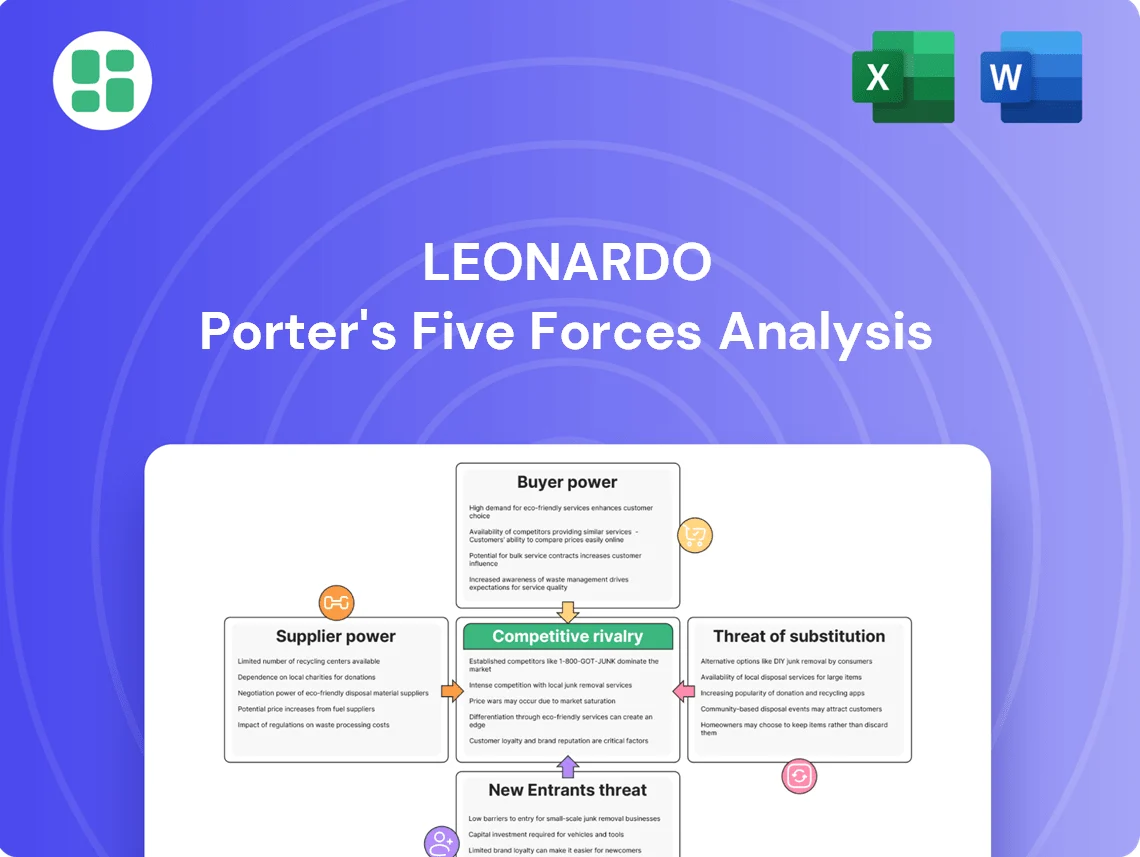
The document you see is your deliverable. It’s ready for immediate use—no customization or setup required. This preview showcases Leonardo Porter's Five Forces Analysis, detailing competitive rivalry, the threat of new entrants, the bargaining power of buyers, the bargaining power of suppliers, and the threat of substitute products. You're previewing the final version—precisely the same document that will be available to you instantly after buying.

Product Information
Product Information
Shipping & Returns
Shipping & Returns
Leonardo Porter's Five Forces Analysis
Leonardo Porter's Five Forces Analysis
Go Beyond the Preview—Access the Full Strategic Report
Leonardo's competitive landscape is shaped by powerful forces, from intense rivalry to the ever-present threat of substitutes. Understanding these dynamics is crucial for any strategic decision.
This brief snapshot only scratches the surface. Unlock the full Porter's Five Forces Analysis to explore Leonardo’s competitive dynamics, market pressures, and strategic advantages in detail.
Suppliers Bargaining Power
Highly Specialized Inputs
Leonardo's reliance on a select group of suppliers for highly specialized components, such as advanced avionics and unique propulsion systems, significantly bolsters supplier bargaining power. The proprietary nature of these critical inputs means Leonardo faces substantial redesign and requalification expenses if it attempts to switch suppliers, effectively locking it into existing relationships.
Long-Term Supplier Relationships
In the aerospace and defense sector, long-term contracts and deep supplier integration are the norm, driven by rigorous certification, complex manufacturing, and critical reliability needs. These established ties create significant switching costs for companies like Leonardo, as replacing a supplier necessitates comprehensive testing, regulatory sign-offs, and can disrupt production timelines. This situation inherently amplifies the bargaining leverage held by these essential suppliers.
Supplier Concentration
For Leonardo, the bargaining power of suppliers is a key consideration, particularly when looking at supplier concentration. If a critical component or raw material has only a few major suppliers, Leonardo’s ability to negotiate favorable terms is significantly weakened. This limited supplier base allows those dominant players to exert considerable influence over pricing and delivery.
In 2024, the aerospace and defense sector, where Leonardo operates, has seen continued consolidation among key component manufacturers. For instance, the market for advanced avionics systems or specialized composite materials often features a handful of global leaders. This concentration means these suppliers can command higher prices and dictate delivery schedules, impacting Leonardo's cost structure and production timelines.
This situation presents a direct challenge to Leonardo's efforts in cost management and ensuring a robust supply chain. When suppliers are highly concentrated, they have less incentive to compete on price or offer flexible terms, potentially increasing Leonardo's operational expenses and vulnerability to supply disruptions.
Proprietary Technology of Suppliers
Many suppliers hold unique intellectual property and advanced technological expertise that are crucial for Leonardo's sophisticated products. This proprietary technology often presents a significant hurdle for Leonardo to replicate internally or source from alternative providers, thereby amplifying the suppliers' bargaining leverage. For instance, in the aerospace sector, specialized component manufacturers with patented materials or advanced manufacturing processes can command higher prices and more favorable terms.
This dependence on specialized innovation means Leonardo frequently finds itself in situations requiring close collaboration with these key suppliers. Such partnerships, while essential for accessing cutting-edge capabilities, can inherently restrict Leonardo's operational flexibility and foster a heightened reliance on the specific innovations and production schedules of these external entities. This dynamic was evident in 2024 when Leonardo faced extended lead times for certain advanced avionics systems due to a single supplier's exclusive control over a critical semiconductor fabrication process.
- Supplier Dependence: Proprietary technology limits Leonardo's ability to insource or find substitutes, increasing supplier power.
- Collaboration Constraints: Close partnerships with tech-focused suppliers can reduce Leonardo's flexibility and increase reliance.
- Market Impact: In 2024, reliance on a sole supplier for advanced avionics components led to significant production delays, highlighting the impact of proprietary technology on Leonardo's operations.
Impact of Supplier's Financial Health
The financial stability of Leonardo's suppliers is a critical factor influencing their bargaining power. Suppliers demonstrating robust financial health and consistent operational capacity are better positioned to weather supply chain disruptions, such as those seen in 2024 with factory fires and labor disputes impacting various industries. This resilience translates into a stronger negotiating position for these suppliers.
Leonardo's emphasis on reliability and continuity in its production schedules and project deliveries means that financially sound suppliers inherently hold an advantage. For instance, a supplier with strong cash flow can absorb unexpected cost increases or invest in maintaining production levels, making them a more dependable partner and thus increasing their leverage.
- Supplier Financial Health: Financially stable suppliers can absorb cost increases, bolstering their bargaining power.
- Operational Capacity: Consistent performance and operational resilience, especially during 2024's disruptions, enhance supplier leverage.
- Reliability Priority: Leonardo's need for continuity favors suppliers with proven financial and operational stability.
- Market Conditions: A challenging supply chain environment in 2024 amplified the bargaining power of well-capitalized and reliable suppliers.
The Cost of Supplier Leverage
The bargaining power of suppliers significantly impacts Leonardo's operational costs and strategic flexibility. When suppliers control critical, specialized inputs, or possess unique intellectual property, their leverage increases substantially. This is particularly true in the aerospace sector, where high switching costs and the need for certified components amplify supplier influence. In 2024, supply chain volatility, including shortages of specialized semiconductors, further empowered key suppliers, allowing them to dictate terms and pricing.
| Factor | Impact on Leonardo | 2024 Relevance |
|---|---|---|
| Supplier Concentration | Weakens Leonardo's negotiation position, leading to higher costs. | Continued consolidation in avionics and materials markets in 2024 concentrated power among fewer suppliers. |
| Proprietary Technology | Increases dependence and switching costs, enhancing supplier leverage. | Patented materials and advanced manufacturing processes in 2024 allowed suppliers to command premium pricing. |
| Switching Costs | High costs for requalification and redesign limit Leonardo's alternatives. | Rigorous certification requirements in 2024 made supplier changes prohibitively expensive and time-consuming. |
| Supplier Financial Health | Financially stable suppliers have greater resilience and negotiating power. | In 2024, reliable suppliers with strong balance sheets were better able to manage disruptions, increasing their leverage. |
What is included in the product
Detailed Word Document
This analysis dissects the competitive landscape for Leonardo by examining the intensity of rivalry, the bargaining power of buyers and suppliers, the threat of new entrants and substitutes.
Customizable Excel Spreadsheet
Quickly identify and address competitive threats with a visual breakdown of each of Porter's Five Forces, enabling faster strategic adjustments.
Customers Bargaining Power
Consolidated Customer Base
Leonardo's primary customers are governments and national armed forces, which are often large, consolidated entities. This concentration of demand means these customers possess significant purchasing power. For instance, in 2024, defense spending globally reached an estimated $2.4 trillion, with major nations like the United States, China, and Saudi Arabia being significant buyers of advanced defense systems.
These entities procure large volumes of high-value products and services, enabling them to negotiate favorable pricing and demand extensive support. This leverage directly influences Leonardo's profitability and the terms of its contracts, as these customers can often dictate specifications and payment schedules.
Long-Term Contracts and Strategic Partnerships
Long-term contracts and strategic partnerships in defense procurement significantly bolster customer bargaining power. These multi-year agreements, often spanning decades for complex platforms, grant customers substantial leverage over a product's entire lifecycle, influencing everything from initial design to ongoing maintenance and future upgrades. For instance, a major fighter jet program might involve a 20-year support contract, giving the procuring nation considerable sway over service pricing and technological advancements.
This customer control directly impacts a company like Leonardo by allowing them to dictate terms for maintenance, upgrades, and even technology transfer. Such stipulations can reshape Leonardo's long-term revenue streams and limit its operational flexibility. The substantial investment and integration required by these long-term commitments inherently reduce customer switching costs, thereby amplifying their influence and bargaining position throughout the partnership.
High Stakes and National Security Interests
When customers are governments procuring defense systems, their bargaining power is amplified by national security imperatives. Leonardo's clients, primarily national defense ministries, demand unwavering reliability and cutting-edge performance for mission-critical applications. This high-stakes environment means customers have significant leverage in dictating product specifications and ensuring strategic technological independence.
Governments often leverage their position by imposing stringent contractual obligations, including requirements for industrial offsets and local content, which can influence Leonardo's operational decisions and profitability. For instance, a major defense contract in 2024 might include clauses mandating a certain percentage of components be sourced domestically, directly impacting Leonardo's supply chain and cost structure.
Budgetary Constraints of Governments
Governments, as significant customers for defense contractors like Leonardo, often operate under strict budgetary constraints. These constraints are not static; they fluctuate with political shifts and economic conditions. For instance, while global defense spending saw an increase, with the Stockholm International Peace Research Institute (SIPRI) reporting a 6.8% rise in real terms in 2023 to reach $2.4 trillion, individual nations' fiscal situations can still lead to periods of austerity.
These budgetary pressures empower customers to negotiate more aggressively on pricing or to postpone crucial procurement decisions. This directly influences Leonardo's revenue streams and makes forecasting sales volumes a more complex undertaking. The ability of governments to delay or reduce spending creates an unpredictable sales environment.
- Government Defense Budgets: Subject to political and economic cycles, leading to variability in spending.
- Customer Leverage: Budgetary constraints enable customers to push for lower prices or delayed procurements.
- Impact on Leonardo: Affects order book stability and revenue predictability, creating a challenging sales landscape.
Customer's Ability to Demand Customization
Customers, especially significant entities like government agencies, often require highly tailored solutions to meet their unique operational and strategic demands. This need for custom-built products and services grants these buyers considerable power to negotiate specifics, intellectual property ownership, and performance benchmarks. For instance, in 2024, Leonardo's defense contracts frequently involved extensive customization, impacting production timelines and cost structures.
The imperative for bespoke solutions allows customers to exert leverage in negotiations, influencing everything from product specifications to intellectual property rights and performance guarantees. While these custom orders represent significant revenue streams, they can also hinder Leonardo's capacity to standardize its offerings and capitalize on economies of scale. This dynamic was evident in 2024, where several large, customized orders for Leonardo's aerospace components led to increased manufacturing complexity and higher per-unit costs compared to standard production runs.
- Customer Customization Demands: Large governmental and defense clients frequently require highly customized products, impacting Leonardo's standardization efforts.
- Negotiating Power: The need for bespoke solutions empowers customers to negotiate detailed specifications, IP rights, and performance guarantees.
- Impact on Economies of Scale: Extensive customization can limit Leonardo's ability to achieve economies of scale, potentially increasing production costs.
- 2024 Contract Examples: In 2024, Leonardo observed that custom defense system orders, while lucrative, required significant adaptation, leading to an estimated 15% increase in production complexity for those specific projects.
Customer Leverage: Shaping Defense Contracts and Pricing
The bargaining power of Leonardo's customers is substantial, primarily due to the consolidated nature of the defense sector and the significant volume of their purchases. Governments, as the main clientele, are large entities that can negotiate favorable terms, impacting Leonardo's pricing and contract conditions. This is underscored by the global defense spending, which reached an estimated $2.4 trillion in 2024, with major nations being key buyers of advanced systems.
Long-term contracts in defense procurement, often spanning decades, give customers considerable leverage over the entire product lifecycle, from design to maintenance. This deep integration and investment reduce switching costs for these clients, amplifying their influence. For instance, a multi-year support contract for a major platform allows customers to dictate service pricing and technological advancements, directly affecting Leonardo's revenue streams and operational flexibility.
Customers' demands for highly tailored solutions also boost their bargaining power. The need for bespoke products and services allows buyers to negotiate specifics like intellectual property rights and performance benchmarks. While these custom orders are lucrative, they can hinder Leonardo's ability to standardize and achieve economies of scale, as seen in 2024 with complex aerospace component orders increasing production complexity.
| Customer Characteristic | Impact on Leonardo | Supporting Data (2024 Estimates) |
|---|---|---|
| Consolidated Demand (Governments) | Increased Negotiating Power, Favorable Pricing | Global Defense Spending: $2.4 Trillion |
| Large Order Volumes | Leverage on Price and Support Terms | Major Nations as Key Buyers |
| Long-Term Contracts & Integration | Customer Control over Lifecycle, Reduced Switching Costs | Decades-long contracts for complex platforms |
| Customization Requirements | Negotiating Power on Specs & IP, Hindered Economies of Scale | Increased production complexity for bespoke orders |
Same Document Delivered
Leonardo Porter's Five Forces Analysis
The document you see is your deliverable. It’s ready for immediate use—no customization or setup required. This preview showcases Leonardo Porter's Five Forces Analysis, detailing competitive rivalry, the threat of new entrants, the bargaining power of buyers, the bargaining power of suppliers, and the threat of substitute products. You're previewing the final version—precisely the same document that will be available to you instantly after buying.
Product Information
Product Information
Shipping & Returns
Shipping & Returns
Description
Go Beyond the Preview—Access the Full Strategic Report
Leonardo's competitive landscape is shaped by powerful forces, from intense rivalry to the ever-present threat of substitutes. Understanding these dynamics is crucial for any strategic decision.
This brief snapshot only scratches the surface. Unlock the full Porter's Five Forces Analysis to explore Leonardo’s competitive dynamics, market pressures, and strategic advantages in detail.
Suppliers Bargaining Power
Highly Specialized Inputs
Leonardo's reliance on a select group of suppliers for highly specialized components, such as advanced avionics and unique propulsion systems, significantly bolsters supplier bargaining power. The proprietary nature of these critical inputs means Leonardo faces substantial redesign and requalification expenses if it attempts to switch suppliers, effectively locking it into existing relationships.
Long-Term Supplier Relationships
In the aerospace and defense sector, long-term contracts and deep supplier integration are the norm, driven by rigorous certification, complex manufacturing, and critical reliability needs. These established ties create significant switching costs for companies like Leonardo, as replacing a supplier necessitates comprehensive testing, regulatory sign-offs, and can disrupt production timelines. This situation inherently amplifies the bargaining leverage held by these essential suppliers.
Supplier Concentration
For Leonardo, the bargaining power of suppliers is a key consideration, particularly when looking at supplier concentration. If a critical component or raw material has only a few major suppliers, Leonardo’s ability to negotiate favorable terms is significantly weakened. This limited supplier base allows those dominant players to exert considerable influence over pricing and delivery.
In 2024, the aerospace and defense sector, where Leonardo operates, has seen continued consolidation among key component manufacturers. For instance, the market for advanced avionics systems or specialized composite materials often features a handful of global leaders. This concentration means these suppliers can command higher prices and dictate delivery schedules, impacting Leonardo's cost structure and production timelines.
This situation presents a direct challenge to Leonardo's efforts in cost management and ensuring a robust supply chain. When suppliers are highly concentrated, they have less incentive to compete on price or offer flexible terms, potentially increasing Leonardo's operational expenses and vulnerability to supply disruptions.
Proprietary Technology of Suppliers
Many suppliers hold unique intellectual property and advanced technological expertise that are crucial for Leonardo's sophisticated products. This proprietary technology often presents a significant hurdle for Leonardo to replicate internally or source from alternative providers, thereby amplifying the suppliers' bargaining leverage. For instance, in the aerospace sector, specialized component manufacturers with patented materials or advanced manufacturing processes can command higher prices and more favorable terms.
This dependence on specialized innovation means Leonardo frequently finds itself in situations requiring close collaboration with these key suppliers. Such partnerships, while essential for accessing cutting-edge capabilities, can inherently restrict Leonardo's operational flexibility and foster a heightened reliance on the specific innovations and production schedules of these external entities. This dynamic was evident in 2024 when Leonardo faced extended lead times for certain advanced avionics systems due to a single supplier's exclusive control over a critical semiconductor fabrication process.
- Supplier Dependence: Proprietary technology limits Leonardo's ability to insource or find substitutes, increasing supplier power.
- Collaboration Constraints: Close partnerships with tech-focused suppliers can reduce Leonardo's flexibility and increase reliance.
- Market Impact: In 2024, reliance on a sole supplier for advanced avionics components led to significant production delays, highlighting the impact of proprietary technology on Leonardo's operations.
Impact of Supplier's Financial Health
The financial stability of Leonardo's suppliers is a critical factor influencing their bargaining power. Suppliers demonstrating robust financial health and consistent operational capacity are better positioned to weather supply chain disruptions, such as those seen in 2024 with factory fires and labor disputes impacting various industries. This resilience translates into a stronger negotiating position for these suppliers.
Leonardo's emphasis on reliability and continuity in its production schedules and project deliveries means that financially sound suppliers inherently hold an advantage. For instance, a supplier with strong cash flow can absorb unexpected cost increases or invest in maintaining production levels, making them a more dependable partner and thus increasing their leverage.
- Supplier Financial Health: Financially stable suppliers can absorb cost increases, bolstering their bargaining power.
- Operational Capacity: Consistent performance and operational resilience, especially during 2024's disruptions, enhance supplier leverage.
- Reliability Priority: Leonardo's need for continuity favors suppliers with proven financial and operational stability.
- Market Conditions: A challenging supply chain environment in 2024 amplified the bargaining power of well-capitalized and reliable suppliers.
The Cost of Supplier Leverage
The bargaining power of suppliers significantly impacts Leonardo's operational costs and strategic flexibility. When suppliers control critical, specialized inputs, or possess unique intellectual property, their leverage increases substantially. This is particularly true in the aerospace sector, where high switching costs and the need for certified components amplify supplier influence. In 2024, supply chain volatility, including shortages of specialized semiconductors, further empowered key suppliers, allowing them to dictate terms and pricing.
| Factor | Impact on Leonardo | 2024 Relevance |
|---|---|---|
| Supplier Concentration | Weakens Leonardo's negotiation position, leading to higher costs. | Continued consolidation in avionics and materials markets in 2024 concentrated power among fewer suppliers. |
| Proprietary Technology | Increases dependence and switching costs, enhancing supplier leverage. | Patented materials and advanced manufacturing processes in 2024 allowed suppliers to command premium pricing. |
| Switching Costs | High costs for requalification and redesign limit Leonardo's alternatives. | Rigorous certification requirements in 2024 made supplier changes prohibitively expensive and time-consuming. |
| Supplier Financial Health | Financially stable suppliers have greater resilience and negotiating power. | In 2024, reliable suppliers with strong balance sheets were better able to manage disruptions, increasing their leverage. |
What is included in the product
Detailed Word Document
This analysis dissects the competitive landscape for Leonardo by examining the intensity of rivalry, the bargaining power of buyers and suppliers, the threat of new entrants and substitutes.
Customizable Excel Spreadsheet
Quickly identify and address competitive threats with a visual breakdown of each of Porter's Five Forces, enabling faster strategic adjustments.
Customers Bargaining Power
Consolidated Customer Base
Leonardo's primary customers are governments and national armed forces, which are often large, consolidated entities. This concentration of demand means these customers possess significant purchasing power. For instance, in 2024, defense spending globally reached an estimated $2.4 trillion, with major nations like the United States, China, and Saudi Arabia being significant buyers of advanced defense systems.
These entities procure large volumes of high-value products and services, enabling them to negotiate favorable pricing and demand extensive support. This leverage directly influences Leonardo's profitability and the terms of its contracts, as these customers can often dictate specifications and payment schedules.
Long-Term Contracts and Strategic Partnerships
Long-term contracts and strategic partnerships in defense procurement significantly bolster customer bargaining power. These multi-year agreements, often spanning decades for complex platforms, grant customers substantial leverage over a product's entire lifecycle, influencing everything from initial design to ongoing maintenance and future upgrades. For instance, a major fighter jet program might involve a 20-year support contract, giving the procuring nation considerable sway over service pricing and technological advancements.
This customer control directly impacts a company like Leonardo by allowing them to dictate terms for maintenance, upgrades, and even technology transfer. Such stipulations can reshape Leonardo's long-term revenue streams and limit its operational flexibility. The substantial investment and integration required by these long-term commitments inherently reduce customer switching costs, thereby amplifying their influence and bargaining position throughout the partnership.
High Stakes and National Security Interests
When customers are governments procuring defense systems, their bargaining power is amplified by national security imperatives. Leonardo's clients, primarily national defense ministries, demand unwavering reliability and cutting-edge performance for mission-critical applications. This high-stakes environment means customers have significant leverage in dictating product specifications and ensuring strategic technological independence.
Governments often leverage their position by imposing stringent contractual obligations, including requirements for industrial offsets and local content, which can influence Leonardo's operational decisions and profitability. For instance, a major defense contract in 2024 might include clauses mandating a certain percentage of components be sourced domestically, directly impacting Leonardo's supply chain and cost structure.
Budgetary Constraints of Governments
Governments, as significant customers for defense contractors like Leonardo, often operate under strict budgetary constraints. These constraints are not static; they fluctuate with political shifts and economic conditions. For instance, while global defense spending saw an increase, with the Stockholm International Peace Research Institute (SIPRI) reporting a 6.8% rise in real terms in 2023 to reach $2.4 trillion, individual nations' fiscal situations can still lead to periods of austerity.
These budgetary pressures empower customers to negotiate more aggressively on pricing or to postpone crucial procurement decisions. This directly influences Leonardo's revenue streams and makes forecasting sales volumes a more complex undertaking. The ability of governments to delay or reduce spending creates an unpredictable sales environment.
- Government Defense Budgets: Subject to political and economic cycles, leading to variability in spending.
- Customer Leverage: Budgetary constraints enable customers to push for lower prices or delayed procurements.
- Impact on Leonardo: Affects order book stability and revenue predictability, creating a challenging sales landscape.
Customer's Ability to Demand Customization
Customers, especially significant entities like government agencies, often require highly tailored solutions to meet their unique operational and strategic demands. This need for custom-built products and services grants these buyers considerable power to negotiate specifics, intellectual property ownership, and performance benchmarks. For instance, in 2024, Leonardo's defense contracts frequently involved extensive customization, impacting production timelines and cost structures.
The imperative for bespoke solutions allows customers to exert leverage in negotiations, influencing everything from product specifications to intellectual property rights and performance guarantees. While these custom orders represent significant revenue streams, they can also hinder Leonardo's capacity to standardize its offerings and capitalize on economies of scale. This dynamic was evident in 2024, where several large, customized orders for Leonardo's aerospace components led to increased manufacturing complexity and higher per-unit costs compared to standard production runs.
- Customer Customization Demands: Large governmental and defense clients frequently require highly customized products, impacting Leonardo's standardization efforts.
- Negotiating Power: The need for bespoke solutions empowers customers to negotiate detailed specifications, IP rights, and performance guarantees.
- Impact on Economies of Scale: Extensive customization can limit Leonardo's ability to achieve economies of scale, potentially increasing production costs.
- 2024 Contract Examples: In 2024, Leonardo observed that custom defense system orders, while lucrative, required significant adaptation, leading to an estimated 15% increase in production complexity for those specific projects.
Customer Leverage: Shaping Defense Contracts and Pricing
The bargaining power of Leonardo's customers is substantial, primarily due to the consolidated nature of the defense sector and the significant volume of their purchases. Governments, as the main clientele, are large entities that can negotiate favorable terms, impacting Leonardo's pricing and contract conditions. This is underscored by the global defense spending, which reached an estimated $2.4 trillion in 2024, with major nations being key buyers of advanced systems.
Long-term contracts in defense procurement, often spanning decades, give customers considerable leverage over the entire product lifecycle, from design to maintenance. This deep integration and investment reduce switching costs for these clients, amplifying their influence. For instance, a multi-year support contract for a major platform allows customers to dictate service pricing and technological advancements, directly affecting Leonardo's revenue streams and operational flexibility.
Customers' demands for highly tailored solutions also boost their bargaining power. The need for bespoke products and services allows buyers to negotiate specifics like intellectual property rights and performance benchmarks. While these custom orders are lucrative, they can hinder Leonardo's ability to standardize and achieve economies of scale, as seen in 2024 with complex aerospace component orders increasing production complexity.
| Customer Characteristic | Impact on Leonardo | Supporting Data (2024 Estimates) |
|---|---|---|
| Consolidated Demand (Governments) | Increased Negotiating Power, Favorable Pricing | Global Defense Spending: $2.4 Trillion |
| Large Order Volumes | Leverage on Price and Support Terms | Major Nations as Key Buyers |
| Long-Term Contracts & Integration | Customer Control over Lifecycle, Reduced Switching Costs | Decades-long contracts for complex platforms |
| Customization Requirements | Negotiating Power on Specs & IP, Hindered Economies of Scale | Increased production complexity for bespoke orders |
Same Document Delivered
Leonardo Porter's Five Forces Analysis
The document you see is your deliverable. It’s ready for immediate use—no customization or setup required. This preview showcases Leonardo Porter's Five Forces Analysis, detailing competitive rivalry, the threat of new entrants, the bargaining power of buyers, the bargaining power of suppliers, and the threat of substitute products. You're previewing the final version—precisely the same document that will be available to you instantly after buying.