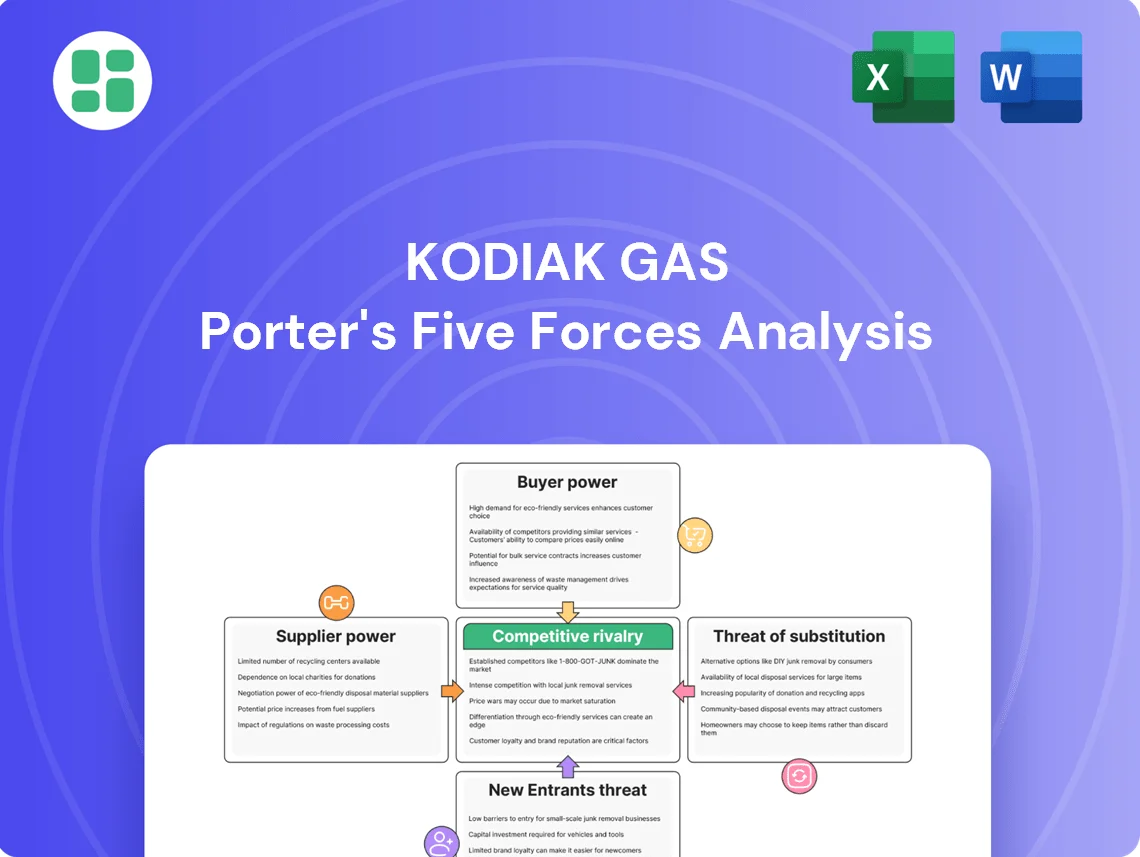
Kodiak Gas Porter's Five Forces Analysis

Go Beyond the Preview—Access the Full Strategic Report
Kodiak Gas faces significant competitive pressures, particularly from established rivals and the threat of new entrants in the energy sector. Understanding the bargaining power of their suppliers and the intensity of rivalry is crucial for their strategic positioning.
This brief snapshot only scratches the surface. Unlock the full Porter's Five Forces Analysis to explore Kodiak Gas’s competitive dynamics, market pressures, and strategic advantages in detail.
Suppliers Bargaining Power

Concentration of Suppliers
The contract compression industry's reliance on specialized, high-horsepower natural gas compressors and engines means a limited number of manufacturers control the supply chain. Companies like Ariel Corporation are major players, holding significant market share in producing these essential pieces of equipment.
This concentration of suppliers grants them considerable bargaining power. For service providers such as Kodiak Gas Services, this can translate into less favorable pricing and terms, particularly when acquiring critical components or replacement parts, as there are few viable alternatives.
Switching Costs for Kodiak
Switching major equipment suppliers presents significant hurdles for Kodiak. These include substantial costs associated with retooling existing facilities, comprehensive employee training on new systems, and the potential for unforeseen compatibility issues with their current operational infrastructure. These upfront investments act as a strong deterrent to changing vendors.
Furthermore, Kodiak has cultivated long-standing relationships with its current suppliers, fostering established and efficient supply chains. This deep integration creates considerable inertia, making the process of switching suppliers not only complex but also financially burdensome, reinforcing the bargaining power of these existing partners.

Uniqueness of Inputs
The components and parts for natural gas compressors, particularly those used by Kodiak Gas, are frequently proprietary or demand highly specialized manufacturing processes. This inherent uniqueness significantly restricts the availability of readily accessible, generic alternatives, thereby concentrating power with the original equipment manufacturers (OEMs) and their certified parts suppliers.

Threat of Forward Integration by Suppliers
While less common, major equipment manufacturers, like those supplying compressors to Kodiak Gas, could theoretically move into contract compression services themselves. This would represent forward integration, leveraging their existing product knowledge. However, it demands substantial operational expertise beyond just manufacturing, a significant hurdle.
Despite the operational challenges, these suppliers wield considerable influence. Their control over critical components, such as specialized compressor parts, grants them indirect leverage over the service market. This means even without direct service provision, they can impact the availability and cost of essential equipment for service providers.
- Supplier Forward Integration Risk: While direct forward integration by equipment manufacturers into compression services is rare due to operational complexity, it remains a theoretical threat.
- Component Control: Suppliers' dominance over key compressor parts provides indirect leverage, influencing service market dynamics and potentially affecting costs for companies like Kodiak Gas.
- Industry Example: For instance, a major player in the gas compression equipment market might possess the financial muscle to acquire or build out service capabilities, though the operational integration is complex.
Importance of Supplier Inputs to Kodiak's Business
Kodiak's reliance on specialized compression equipment suppliers is significant. The availability and cost of these critical components directly influence Kodiak's operational capacity and its ability to meet customer demand. For instance, maintaining high fleet utilization, which reached 97% in Q4 2024, hinges on having access to reliable and high-performance machinery.
The bargaining power of these suppliers is amplified by the specialized nature of the equipment and the stringent performance requirements in the oil and gas industry. Any increase in supplier prices or delays in delivery can directly translate into higher operating costs and reduced profitability for Kodiak, impacting its competitive position.
- Supplier Dependence: Kodiak depends on a limited number of suppliers for specialized compression equipment, which is essential for its service delivery.
- Operational Impact: Disruptions from suppliers can directly affect Kodiak's fleet utilization rates, a key performance indicator.
- Cost Sensitivity: Increases in equipment costs from suppliers can squeeze Kodiak's profit margins.
- Market Dynamics: The specialized nature of the equipment and the industry's demands can give suppliers leverage.
Specialized Equipment Drives Supplier Bargaining Power
The bargaining power of suppliers in the contract compression industry, particularly for companies like Kodiak Gas Services, is substantial due to the specialized nature of the equipment. Major manufacturers, such as Ariel Corporation, dominate the market for high-horsepower natural gas compressors, limiting alternatives for buyers.
This supplier concentration means Kodiak faces potential price increases and less favorable terms, impacting operational costs. For example, the cost of essential components can directly affect Kodiak's ability to maintain competitive pricing for its services, especially given that fleet utilization, a key metric, aims for high levels like 97% achieved in Q4 2024.
| Supplier Characteristic | Impact on Kodiak Gas | Example/Data Point |
|---|---|---|
| Limited Number of Suppliers | Reduced choice, higher prices possible | Ariel Corporation's significant market share in compressors |
| Proprietary Components | Dependency on OEMs for parts | Specialized manufacturing processes for compressor parts |
| High Switching Costs | Deters changing vendors | Costs of retooling, training, and compatibility issues |
| Long-Standing Relationships | Inertia in supply chain | Established and efficient current supply chains |
What is included in the product
 Detailed Word Document
This Five Forces analysis provides a comprehensive examination of the competitive landscape for Kodiak Gas, detailing the intensity of rivalry, the bargaining power of buyers and suppliers, the threat of new entrants, and the impact of substitutes.

 Customizable Excel Spreadsheet
Effortlessly visualize competitive intensity with a dynamic Porter's Five Forces dashboard, transforming complex analysis into actionable insights.
Customers Bargaining Power

Concentration of Customers
Kodiak Gas's customer base is largely concentrated within the oil and gas production and midstream sectors. Major basins, such as the Permian, represent key operational areas where numerous producers require Kodiak's services.
While the sheer number of potential clients might seem high, a smaller group of very large producers or midstream companies can wield significant bargaining power. These major clients, due to the substantial volume of services they contract, can negotiate more favorable terms, impacting Kodiak's pricing and profitability.
Switching Costs for Customers
Customers face switching costs when moving from one contract compression provider to another. These costs can involve logistical hurdles, potential operational interruptions, and the effort required to adopt new equipment or service personnel. For instance, a customer might need to reconfigure their facilities or retrain staff, adding to the overall expense and inconvenience of a switch.
Kodiak Gas aims to mitigate this by offering fixed-revenue contracts. These agreements are designed to foster enduring customer partnerships, thereby enhancing customer loyalty and reducing the likelihood of them seeking alternative providers. This strategy leverages the inertia created by established relationships and the perceived benefits of consistent service and pricing.

Customer Price Sensitivity
In the dynamic oil and gas sector, customer price sensitivity is a significant factor. When commodity prices swing wildly, buyers become acutely focused on cost. Kodiak Gas's efforts to streamline production and minimize flaring are valuable, but the ultimate price point remains a key determinant in customer purchasing decisions.

Availability of Alternative Service Providers
The contract compression market is characterized by a significant number of major players, such as Archrock and USA Compression. This robust competition means customers aren't limited to a single provider, giving them more leverage to negotiate terms and pricing.
The presence of multiple established companies offering similar services directly enhances customer bargaining power. Customers can readily compare offerings, service levels, and pricing structures, making it easier to switch if they aren't satisfied or find a better deal elsewhere.
- Archrock's 2023 revenue was $2.1 billion, indicating its substantial presence and the competitive nature of the market.
- USA Compression's 2023 revenue reached $1.1 billion, further underscoring the availability of significant alternatives for customers.
- The ability to choose between these large, well-capitalized providers allows customers to demand more favorable contract terms.
Threat of Backward Integration by Customers
Customers, particularly large oil and gas producers or midstream companies, possess the potential threat of backward integration. This means they could decide to own and operate their own compression fleets instead of relying on third-party service providers like Kodiak Gas. For instance, a major producer might evaluate the cost-effectiveness of building its own fleet versus the ongoing service fees.
However, several factors often mitigate this threat. The specialized expertise required for operating and maintaining complex compression equipment is significant. Furthermore, the substantial capital investment needed to acquire and upkeep such fleets, coupled with the ongoing maintenance burden, frequently makes outsourcing to specialized companies like Kodiak a more financially prudent and operationally efficient choice for many customers.
- High Capital Outlay: Acquiring a fleet of compression units can cost millions of dollars, a significant barrier for many potential integrators.
- Specialized Technical Expertise: Operating and maintaining compression equipment requires skilled technicians and engineers, which can be challenging to recruit and retain.
- Operational Complexity: Managing a fleet involves logistics, scheduling, and ensuring uptime, adding layers of operational complexity for non-specialized companies.
Customer Clout and Competition Define Gas Compression Landscape
Kodiak Gas faces significant customer bargaining power due to a concentrated customer base and the presence of large, influential clients. These major players can leverage their volume to negotiate better pricing and terms. The availability of numerous competitors, such as Archrock and USA Compression, further amplifies this power, as customers can easily switch providers if unsatisfied.
Customers also consider the costs associated with switching providers, which can include logistical challenges and operational disruptions. Kodiak mitigates this by offering fixed-revenue contracts to foster loyalty. However, price sensitivity remains high, especially when oil and gas commodity prices fluctuate, making cost a critical factor in purchasing decisions.
| Competitor | 2023 Revenue | Market Position |
|---|---|---|
| Archrock | $2.1 billion | Major player with extensive fleet |
| USA Compression | $1.1 billion | Significant competitor with broad service offerings |
Preview the Actual Deliverable
Kodiak Gas Porter's Five Forces Analysis
This preview showcases the comprehensive Five Forces Analysis of Kodiak Gas Porter, detailing the competitive landscape and strategic implications for the company. The document you see here is the exact, fully formatted analysis that will be delivered to you immediately upon purchase, ensuring you receive precisely what you need without any alterations.

Product Information
Product Information
Shipping & Returns
Shipping & Returns
Kodiak Gas Porter's Five Forces Analysis
Kodiak Gas Porter's Five Forces Analysis
Go Beyond the Preview—Access the Full Strategic Report
Kodiak Gas faces significant competitive pressures, particularly from established rivals and the threat of new entrants in the energy sector. Understanding the bargaining power of their suppliers and the intensity of rivalry is crucial for their strategic positioning.
This brief snapshot only scratches the surface. Unlock the full Porter's Five Forces Analysis to explore Kodiak Gas’s competitive dynamics, market pressures, and strategic advantages in detail.
Suppliers Bargaining Power
Concentration of Suppliers
The contract compression industry's reliance on specialized, high-horsepower natural gas compressors and engines means a limited number of manufacturers control the supply chain. Companies like Ariel Corporation are major players, holding significant market share in producing these essential pieces of equipment.
This concentration of suppliers grants them considerable bargaining power. For service providers such as Kodiak Gas Services, this can translate into less favorable pricing and terms, particularly when acquiring critical components or replacement parts, as there are few viable alternatives.
Switching Costs for Kodiak
Switching major equipment suppliers presents significant hurdles for Kodiak. These include substantial costs associated with retooling existing facilities, comprehensive employee training on new systems, and the potential for unforeseen compatibility issues with their current operational infrastructure. These upfront investments act as a strong deterrent to changing vendors.
Furthermore, Kodiak has cultivated long-standing relationships with its current suppliers, fostering established and efficient supply chains. This deep integration creates considerable inertia, making the process of switching suppliers not only complex but also financially burdensome, reinforcing the bargaining power of these existing partners.
Uniqueness of Inputs
The components and parts for natural gas compressors, particularly those used by Kodiak Gas, are frequently proprietary or demand highly specialized manufacturing processes. This inherent uniqueness significantly restricts the availability of readily accessible, generic alternatives, thereby concentrating power with the original equipment manufacturers (OEMs) and their certified parts suppliers.
Threat of Forward Integration by Suppliers
While less common, major equipment manufacturers, like those supplying compressors to Kodiak Gas, could theoretically move into contract compression services themselves. This would represent forward integration, leveraging their existing product knowledge. However, it demands substantial operational expertise beyond just manufacturing, a significant hurdle.
Despite the operational challenges, these suppliers wield considerable influence. Their control over critical components, such as specialized compressor parts, grants them indirect leverage over the service market. This means even without direct service provision, they can impact the availability and cost of essential equipment for service providers.
- Supplier Forward Integration Risk: While direct forward integration by equipment manufacturers into compression services is rare due to operational complexity, it remains a theoretical threat.
- Component Control: Suppliers' dominance over key compressor parts provides indirect leverage, influencing service market dynamics and potentially affecting costs for companies like Kodiak Gas.
- Industry Example: For instance, a major player in the gas compression equipment market might possess the financial muscle to acquire or build out service capabilities, though the operational integration is complex.
Importance of Supplier Inputs to Kodiak's Business
Kodiak's reliance on specialized compression equipment suppliers is significant. The availability and cost of these critical components directly influence Kodiak's operational capacity and its ability to meet customer demand. For instance, maintaining high fleet utilization, which reached 97% in Q4 2024, hinges on having access to reliable and high-performance machinery.
The bargaining power of these suppliers is amplified by the specialized nature of the equipment and the stringent performance requirements in the oil and gas industry. Any increase in supplier prices or delays in delivery can directly translate into higher operating costs and reduced profitability for Kodiak, impacting its competitive position.
- Supplier Dependence: Kodiak depends on a limited number of suppliers for specialized compression equipment, which is essential for its service delivery.
- Operational Impact: Disruptions from suppliers can directly affect Kodiak's fleet utilization rates, a key performance indicator.
- Cost Sensitivity: Increases in equipment costs from suppliers can squeeze Kodiak's profit margins.
- Market Dynamics: The specialized nature of the equipment and the industry's demands can give suppliers leverage.
Specialized Equipment Drives Supplier Bargaining Power
The bargaining power of suppliers in the contract compression industry, particularly for companies like Kodiak Gas Services, is substantial due to the specialized nature of the equipment. Major manufacturers, such as Ariel Corporation, dominate the market for high-horsepower natural gas compressors, limiting alternatives for buyers.
This supplier concentration means Kodiak faces potential price increases and less favorable terms, impacting operational costs. For example, the cost of essential components can directly affect Kodiak's ability to maintain competitive pricing for its services, especially given that fleet utilization, a key metric, aims for high levels like 97% achieved in Q4 2024.
| Supplier Characteristic | Impact on Kodiak Gas | Example/Data Point |
|---|---|---|
| Limited Number of Suppliers | Reduced choice, higher prices possible | Ariel Corporation's significant market share in compressors |
| Proprietary Components | Dependency on OEMs for parts | Specialized manufacturing processes for compressor parts |
| High Switching Costs | Deters changing vendors | Costs of retooling, training, and compatibility issues |
| Long-Standing Relationships | Inertia in supply chain | Established and efficient current supply chains |
What is included in the product
Detailed Word Document
This Five Forces analysis provides a comprehensive examination of the competitive landscape for Kodiak Gas, detailing the intensity of rivalry, the bargaining power of buyers and suppliers, the threat of new entrants, and the impact of substitutes.
Customizable Excel Spreadsheet
Effortlessly visualize competitive intensity with a dynamic Porter's Five Forces dashboard, transforming complex analysis into actionable insights.
Customers Bargaining Power
Concentration of Customers
Kodiak Gas's customer base is largely concentrated within the oil and gas production and midstream sectors. Major basins, such as the Permian, represent key operational areas where numerous producers require Kodiak's services.
While the sheer number of potential clients might seem high, a smaller group of very large producers or midstream companies can wield significant bargaining power. These major clients, due to the substantial volume of services they contract, can negotiate more favorable terms, impacting Kodiak's pricing and profitability.
Switching Costs for Customers
Customers face switching costs when moving from one contract compression provider to another. These costs can involve logistical hurdles, potential operational interruptions, and the effort required to adopt new equipment or service personnel. For instance, a customer might need to reconfigure their facilities or retrain staff, adding to the overall expense and inconvenience of a switch.
Kodiak Gas aims to mitigate this by offering fixed-revenue contracts. These agreements are designed to foster enduring customer partnerships, thereby enhancing customer loyalty and reducing the likelihood of them seeking alternative providers. This strategy leverages the inertia created by established relationships and the perceived benefits of consistent service and pricing.
Customer Price Sensitivity
In the dynamic oil and gas sector, customer price sensitivity is a significant factor. When commodity prices swing wildly, buyers become acutely focused on cost. Kodiak Gas's efforts to streamline production and minimize flaring are valuable, but the ultimate price point remains a key determinant in customer purchasing decisions.
Availability of Alternative Service Providers
The contract compression market is characterized by a significant number of major players, such as Archrock and USA Compression. This robust competition means customers aren't limited to a single provider, giving them more leverage to negotiate terms and pricing.
The presence of multiple established companies offering similar services directly enhances customer bargaining power. Customers can readily compare offerings, service levels, and pricing structures, making it easier to switch if they aren't satisfied or find a better deal elsewhere.
- Archrock's 2023 revenue was $2.1 billion, indicating its substantial presence and the competitive nature of the market.
- USA Compression's 2023 revenue reached $1.1 billion, further underscoring the availability of significant alternatives for customers.
- The ability to choose between these large, well-capitalized providers allows customers to demand more favorable contract terms.
Threat of Backward Integration by Customers
Customers, particularly large oil and gas producers or midstream companies, possess the potential threat of backward integration. This means they could decide to own and operate their own compression fleets instead of relying on third-party service providers like Kodiak Gas. For instance, a major producer might evaluate the cost-effectiveness of building its own fleet versus the ongoing service fees.
However, several factors often mitigate this threat. The specialized expertise required for operating and maintaining complex compression equipment is significant. Furthermore, the substantial capital investment needed to acquire and upkeep such fleets, coupled with the ongoing maintenance burden, frequently makes outsourcing to specialized companies like Kodiak a more financially prudent and operationally efficient choice for many customers.
- High Capital Outlay: Acquiring a fleet of compression units can cost millions of dollars, a significant barrier for many potential integrators.
- Specialized Technical Expertise: Operating and maintaining compression equipment requires skilled technicians and engineers, which can be challenging to recruit and retain.
- Operational Complexity: Managing a fleet involves logistics, scheduling, and ensuring uptime, adding layers of operational complexity for non-specialized companies.
Customer Clout and Competition Define Gas Compression Landscape
Kodiak Gas faces significant customer bargaining power due to a concentrated customer base and the presence of large, influential clients. These major players can leverage their volume to negotiate better pricing and terms. The availability of numerous competitors, such as Archrock and USA Compression, further amplifies this power, as customers can easily switch providers if unsatisfied.
Customers also consider the costs associated with switching providers, which can include logistical challenges and operational disruptions. Kodiak mitigates this by offering fixed-revenue contracts to foster loyalty. However, price sensitivity remains high, especially when oil and gas commodity prices fluctuate, making cost a critical factor in purchasing decisions.
| Competitor | 2023 Revenue | Market Position |
|---|---|---|
| Archrock | $2.1 billion | Major player with extensive fleet |
| USA Compression | $1.1 billion | Significant competitor with broad service offerings |
Preview the Actual Deliverable
Kodiak Gas Porter's Five Forces Analysis
This preview showcases the comprehensive Five Forces Analysis of Kodiak Gas Porter, detailing the competitive landscape and strategic implications for the company. The document you see here is the exact, fully formatted analysis that will be delivered to you immediately upon purchase, ensuring you receive precisely what you need without any alterations.
Original: $10.00
-65%$10.00
$3.50Product Information
Product Information
Shipping & Returns
Shipping & Returns
Description
Go Beyond the Preview—Access the Full Strategic Report
Kodiak Gas faces significant competitive pressures, particularly from established rivals and the threat of new entrants in the energy sector. Understanding the bargaining power of their suppliers and the intensity of rivalry is crucial for their strategic positioning.
This brief snapshot only scratches the surface. Unlock the full Porter's Five Forces Analysis to explore Kodiak Gas’s competitive dynamics, market pressures, and strategic advantages in detail.
Suppliers Bargaining Power
Concentration of Suppliers
The contract compression industry's reliance on specialized, high-horsepower natural gas compressors and engines means a limited number of manufacturers control the supply chain. Companies like Ariel Corporation are major players, holding significant market share in producing these essential pieces of equipment.
This concentration of suppliers grants them considerable bargaining power. For service providers such as Kodiak Gas Services, this can translate into less favorable pricing and terms, particularly when acquiring critical components or replacement parts, as there are few viable alternatives.
Switching Costs for Kodiak
Switching major equipment suppliers presents significant hurdles for Kodiak. These include substantial costs associated with retooling existing facilities, comprehensive employee training on new systems, and the potential for unforeseen compatibility issues with their current operational infrastructure. These upfront investments act as a strong deterrent to changing vendors.
Furthermore, Kodiak has cultivated long-standing relationships with its current suppliers, fostering established and efficient supply chains. This deep integration creates considerable inertia, making the process of switching suppliers not only complex but also financially burdensome, reinforcing the bargaining power of these existing partners.
Uniqueness of Inputs
The components and parts for natural gas compressors, particularly those used by Kodiak Gas, are frequently proprietary or demand highly specialized manufacturing processes. This inherent uniqueness significantly restricts the availability of readily accessible, generic alternatives, thereby concentrating power with the original equipment manufacturers (OEMs) and their certified parts suppliers.
Threat of Forward Integration by Suppliers
While less common, major equipment manufacturers, like those supplying compressors to Kodiak Gas, could theoretically move into contract compression services themselves. This would represent forward integration, leveraging their existing product knowledge. However, it demands substantial operational expertise beyond just manufacturing, a significant hurdle.
Despite the operational challenges, these suppliers wield considerable influence. Their control over critical components, such as specialized compressor parts, grants them indirect leverage over the service market. This means even without direct service provision, they can impact the availability and cost of essential equipment for service providers.
- Supplier Forward Integration Risk: While direct forward integration by equipment manufacturers into compression services is rare due to operational complexity, it remains a theoretical threat.
- Component Control: Suppliers' dominance over key compressor parts provides indirect leverage, influencing service market dynamics and potentially affecting costs for companies like Kodiak Gas.
- Industry Example: For instance, a major player in the gas compression equipment market might possess the financial muscle to acquire or build out service capabilities, though the operational integration is complex.
Importance of Supplier Inputs to Kodiak's Business
Kodiak's reliance on specialized compression equipment suppliers is significant. The availability and cost of these critical components directly influence Kodiak's operational capacity and its ability to meet customer demand. For instance, maintaining high fleet utilization, which reached 97% in Q4 2024, hinges on having access to reliable and high-performance machinery.
The bargaining power of these suppliers is amplified by the specialized nature of the equipment and the stringent performance requirements in the oil and gas industry. Any increase in supplier prices or delays in delivery can directly translate into higher operating costs and reduced profitability for Kodiak, impacting its competitive position.
- Supplier Dependence: Kodiak depends on a limited number of suppliers for specialized compression equipment, which is essential for its service delivery.
- Operational Impact: Disruptions from suppliers can directly affect Kodiak's fleet utilization rates, a key performance indicator.
- Cost Sensitivity: Increases in equipment costs from suppliers can squeeze Kodiak's profit margins.
- Market Dynamics: The specialized nature of the equipment and the industry's demands can give suppliers leverage.
Specialized Equipment Drives Supplier Bargaining Power
The bargaining power of suppliers in the contract compression industry, particularly for companies like Kodiak Gas Services, is substantial due to the specialized nature of the equipment. Major manufacturers, such as Ariel Corporation, dominate the market for high-horsepower natural gas compressors, limiting alternatives for buyers.
This supplier concentration means Kodiak faces potential price increases and less favorable terms, impacting operational costs. For example, the cost of essential components can directly affect Kodiak's ability to maintain competitive pricing for its services, especially given that fleet utilization, a key metric, aims for high levels like 97% achieved in Q4 2024.
| Supplier Characteristic | Impact on Kodiak Gas | Example/Data Point |
|---|---|---|
| Limited Number of Suppliers | Reduced choice, higher prices possible | Ariel Corporation's significant market share in compressors |
| Proprietary Components | Dependency on OEMs for parts | Specialized manufacturing processes for compressor parts |
| High Switching Costs | Deters changing vendors | Costs of retooling, training, and compatibility issues |
| Long-Standing Relationships | Inertia in supply chain | Established and efficient current supply chains |
What is included in the product
Detailed Word Document
This Five Forces analysis provides a comprehensive examination of the competitive landscape for Kodiak Gas, detailing the intensity of rivalry, the bargaining power of buyers and suppliers, the threat of new entrants, and the impact of substitutes.
Customizable Excel Spreadsheet
Effortlessly visualize competitive intensity with a dynamic Porter's Five Forces dashboard, transforming complex analysis into actionable insights.
Customers Bargaining Power
Concentration of Customers
Kodiak Gas's customer base is largely concentrated within the oil and gas production and midstream sectors. Major basins, such as the Permian, represent key operational areas where numerous producers require Kodiak's services.
While the sheer number of potential clients might seem high, a smaller group of very large producers or midstream companies can wield significant bargaining power. These major clients, due to the substantial volume of services they contract, can negotiate more favorable terms, impacting Kodiak's pricing and profitability.
Switching Costs for Customers
Customers face switching costs when moving from one contract compression provider to another. These costs can involve logistical hurdles, potential operational interruptions, and the effort required to adopt new equipment or service personnel. For instance, a customer might need to reconfigure their facilities or retrain staff, adding to the overall expense and inconvenience of a switch.
Kodiak Gas aims to mitigate this by offering fixed-revenue contracts. These agreements are designed to foster enduring customer partnerships, thereby enhancing customer loyalty and reducing the likelihood of them seeking alternative providers. This strategy leverages the inertia created by established relationships and the perceived benefits of consistent service and pricing.
Customer Price Sensitivity
In the dynamic oil and gas sector, customer price sensitivity is a significant factor. When commodity prices swing wildly, buyers become acutely focused on cost. Kodiak Gas's efforts to streamline production and minimize flaring are valuable, but the ultimate price point remains a key determinant in customer purchasing decisions.
Availability of Alternative Service Providers
The contract compression market is characterized by a significant number of major players, such as Archrock and USA Compression. This robust competition means customers aren't limited to a single provider, giving them more leverage to negotiate terms and pricing.
The presence of multiple established companies offering similar services directly enhances customer bargaining power. Customers can readily compare offerings, service levels, and pricing structures, making it easier to switch if they aren't satisfied or find a better deal elsewhere.
- Archrock's 2023 revenue was $2.1 billion, indicating its substantial presence and the competitive nature of the market.
- USA Compression's 2023 revenue reached $1.1 billion, further underscoring the availability of significant alternatives for customers.
- The ability to choose between these large, well-capitalized providers allows customers to demand more favorable contract terms.
Threat of Backward Integration by Customers
Customers, particularly large oil and gas producers or midstream companies, possess the potential threat of backward integration. This means they could decide to own and operate their own compression fleets instead of relying on third-party service providers like Kodiak Gas. For instance, a major producer might evaluate the cost-effectiveness of building its own fleet versus the ongoing service fees.
However, several factors often mitigate this threat. The specialized expertise required for operating and maintaining complex compression equipment is significant. Furthermore, the substantial capital investment needed to acquire and upkeep such fleets, coupled with the ongoing maintenance burden, frequently makes outsourcing to specialized companies like Kodiak a more financially prudent and operationally efficient choice for many customers.
- High Capital Outlay: Acquiring a fleet of compression units can cost millions of dollars, a significant barrier for many potential integrators.
- Specialized Technical Expertise: Operating and maintaining compression equipment requires skilled technicians and engineers, which can be challenging to recruit and retain.
- Operational Complexity: Managing a fleet involves logistics, scheduling, and ensuring uptime, adding layers of operational complexity for non-specialized companies.
Customer Clout and Competition Define Gas Compression Landscape
Kodiak Gas faces significant customer bargaining power due to a concentrated customer base and the presence of large, influential clients. These major players can leverage their volume to negotiate better pricing and terms. The availability of numerous competitors, such as Archrock and USA Compression, further amplifies this power, as customers can easily switch providers if unsatisfied.
Customers also consider the costs associated with switching providers, which can include logistical challenges and operational disruptions. Kodiak mitigates this by offering fixed-revenue contracts to foster loyalty. However, price sensitivity remains high, especially when oil and gas commodity prices fluctuate, making cost a critical factor in purchasing decisions.
| Competitor | 2023 Revenue | Market Position |
|---|---|---|
| Archrock | $2.1 billion | Major player with extensive fleet |
| USA Compression | $1.1 billion | Significant competitor with broad service offerings |
Preview the Actual Deliverable
Kodiak Gas Porter's Five Forces Analysis
This preview showcases the comprehensive Five Forces Analysis of Kodiak Gas Porter, detailing the competitive landscape and strategic implications for the company. The document you see here is the exact, fully formatted analysis that will be delivered to you immediately upon purchase, ensuring you receive precisely what you need without any alterations.