Kingsoft Porter's Five Forces Analysis

From Overview to Strategy Blueprint
Kingsoft operates within a dynamic software landscape, facing intense competition and evolving customer demands. Understanding the interplay of these forces is crucial for strategic planning.
The complete report reveals the real forces shaping Kingsoft’s industry—from supplier influence to threat of new entrants. Gain actionable insights to drive smarter decision-making.
Suppliers Bargaining Power

Supplier Concentration and Uniqueness
Kingsoft's bargaining power of suppliers is influenced by the concentration and uniqueness of its input providers. If Kingsoft heavily relies on a few suppliers for critical components like advanced chips for its AI initiatives or specialized game development engines, these suppliers gain significant leverage. For instance, the increasing demand for high-performance AI chips in 2024, with companies like NVIDIA dominating the market, means Kingsoft could face higher costs or supply constraints if it depends heavily on such specialized suppliers.
The uniqueness of these inputs is a key factor; cutting-edge AI technologies or proprietary game engines often have few, if any, substitutes. This lack of alternatives amplifies the supplier's power, potentially forcing Kingsoft into less favorable terms. Conversely, for more standard software development tools or general IT infrastructure, where numerous suppliers exist, Kingsoft's bargaining power would be considerably stronger, as it can easily switch to alternative providers.
Switching Costs for Kingsoft
Kingsoft's reliance on specific supplier technologies or platforms significantly influences its switching costs. If substantial investments have been made in proprietary software or hardware from a particular supplier, Kingsoft faces considerable expenses when considering a change. These costs can include re-training personnel on new systems, migrating vast amounts of data, and the potential for operational disruptions during the transition period.
These high switching costs effectively bolster the bargaining power of Kingsoft's existing suppliers. Suppliers understand that Kingsoft would likely absorb these transition expenses rather than endure the hassle and financial impact of switching. This dynamic makes it more challenging for Kingsoft to negotiate favorable terms or switch to potentially cheaper alternatives.
For instance, if Kingsoft's cloud infrastructure is deeply integrated with a single provider's proprietary services, moving to a different cloud provider could involve significant re-architecting and data transfer fees. While specific figures for Kingsoft's current supplier integrations aren't publicly detailed, the general principle holds true: the deeper the integration, the higher the switching cost and, consequently, the greater the supplier's leverage.

Threat of Forward Integration by Suppliers
Suppliers possessing robust technological expertise or a dominant market standing could potentially engage in forward integration, directly entering the software or internet services arena and competing with Kingsoft. This scenario is especially pertinent if these suppliers furnish essential components that can be readily packaged as a finished product, diminishing Kingsoft's influence over its operational pipeline.

Importance of Kingsoft to Suppliers
Kingsoft's position as a customer significantly shapes its suppliers' bargaining power. If Kingsoft is a major client, representing a substantial portion of a supplier's sales, that supplier may be more amenable to favorable pricing and terms for Kingsoft. Conversely, if Kingsoft is a smaller customer for a supplier, its ability to influence pricing or terms is diminished.
The relative importance of Kingsoft to its suppliers influences their bargaining power. If Kingsoft represents a significant portion of a supplier's revenue, the supplier might be more willing to negotiate favorable terms. However, if Kingsoft is one among many customers, its individual leverage decreases.
- Customer Dependence: If a supplier relies heavily on Kingsoft for its revenue, Kingsoft gains leverage to negotiate better prices or terms. For instance, if a key software component supplier derives over 20% of its income from Kingsoft, its willingness to concede on pricing increases.
- Supplier Concentration: The bargaining power of suppliers is also affected by the concentration within their own industries. If Kingsoft sources from a few specialized providers, those suppliers have more power. However, if the market for Kingsoft's required inputs is highly fragmented with many potential suppliers, Kingsoft's purchasing power is amplified.
- Switching Costs for Kingsoft: The ease or difficulty Kingsoft faces in switching suppliers also plays a role. High switching costs, such as the need for extensive re-integration or retraining, can give existing suppliers more leverage.
Availability of Substitute Inputs
The availability of substitute inputs significantly curtails supplier bargaining power. When Kingsoft can easily switch to alternative suppliers or technologies for its operational needs, the leverage of any single supplier diminishes. For example, the existence of multiple cloud server hardware providers or readily available open-source software components grants Kingsoft greater flexibility and reduces its dependence on any one supplier.
This abundance of alternatives empowers Kingsoft to negotiate better terms and pricing. If a particular supplier attempts to impose unfavorable conditions, Kingsoft can explore other options, thereby keeping suppliers in check.
- Reduced Supplier Leverage: The presence of multiple suppliers for critical components like cloud infrastructure or software development tools limits the ability of any single supplier to dictate terms.
- Cost Optimization: Access to substitute inputs allows Kingsoft to source materials and services at more competitive prices, directly impacting its cost structure. For instance, in 2023, the global cloud infrastructure market saw significant price competition among major providers, benefiting large consumers like Kingsoft.
- Technological Flexibility: The availability of alternative technologies, such as open-source operating systems or development frameworks, provides Kingsoft with options to avoid vendor lock-in and adapt to evolving technological landscapes more efficiently.
Supplier Power Dynamics: Kingsoft's Bargaining Landscape
Kingsoft's suppliers hold moderate bargaining power, primarily due to the availability of substitutes for many of its input needs. While specialized components for AI development might offer some suppliers leverage, the broader market for software development tools and cloud services is competitive. For example, in 2024, the cloud computing market continues to be characterized by intense competition among major providers, allowing companies like Kingsoft to negotiate favorable terms.
High switching costs for Kingsoft, however, can amplify supplier power. If Kingsoft's operations are deeply integrated with a specific supplier's proprietary technology, the expense and disruption involved in changing providers can make suppliers more resistant to price concessions. This is particularly relevant for custom software solutions or specialized hardware where integration is complex.
The concentration of suppliers in Kingsoft's supply chain also plays a role. A fragmented supplier base generally means less power for individual suppliers, whereas reliance on a few key providers for critical inputs can shift leverage towards those suppliers. The relative importance of Kingsoft as a customer to its suppliers also influences negotiations; a larger customer typically has more sway.
What is included in the product
 Detailed Word Document
This analysis dissects the competitive landscape for Kingsoft, examining the bargaining power of buyers and suppliers, the threat of new entrants and substitutes, and the intensity of rivalry within its industry.

 Customizable Excel Spreadsheet
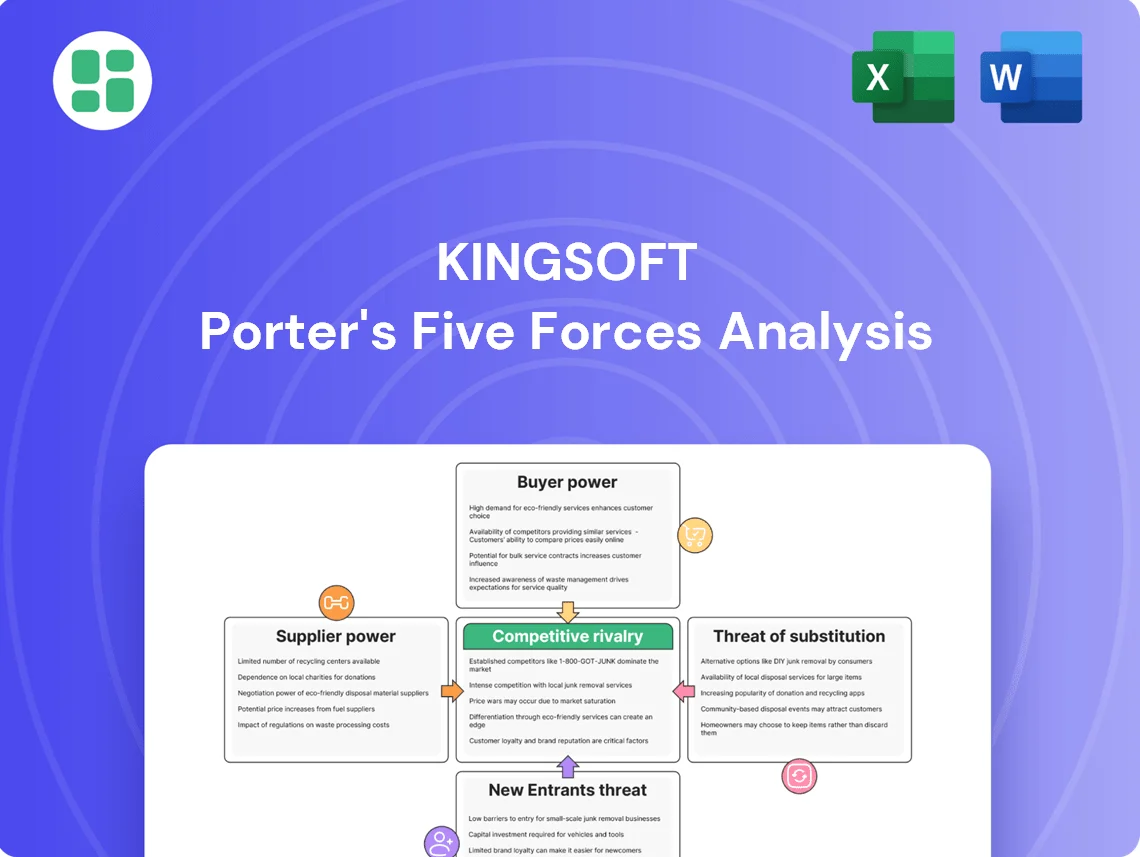
Kingsoft Porter's Five Forces Analysis provides a visual representation of competitive intensity, allowing for rapid identification of key market pressures.
Customers Bargaining Power

Customer Price Sensitivity
Kingsoft's customer base is quite varied, from everyday folks using WPS Office to big companies and government bodies relying on WPS 365 and Kingsoft Cloud. This means their price sensitivity isn't uniform. Individual users, particularly those on free plans, tend to watch every penny.
Enterprise clients, however, often look beyond just the price tag. For them, things like advanced features, dependable performance, and robust security are more important than saving a small amount on the cost. They're willing to pay more for solutions that meet their specific needs and reduce risk.
The market is getting more competitive for both office software and cloud services. This heightened competition naturally puts more pressure on Kingsoft to keep its pricing attractive, especially for those more price-conscious segments of its customer base.
Availability of Substitute Products/Services for Customers
Customers today have a vast array of choices for office productivity software, with options like Microsoft Office and Google Workspace readily available. This abundance of alternatives directly strengthens their negotiating position with Kingsoft.
Similarly, the cloud computing market is highly competitive, featuring major players such as Alibaba Cloud and Tencent Cloud. This means customers can readily shift their business if Kingsoft's cloud services don't align with their needs or budget, amplifying customer bargaining power.

Customer Information and Transparency
In today's digital landscape, Kingsoft customers possess unprecedented access to information. They can easily compare pricing, features, and user reviews for software and cloud services across the market. This readily available data significantly boosts customer power, compelling Kingsoft to maintain competitive pricing and clearly articulate its value.
The proliferation of online review platforms and industry analysis reports further amplifies customer awareness. For instance, in 2024, reports indicated that over 85% of consumers consult online reviews before making software purchases, directly influencing their decision-making process and increasing their leverage in negotiations with providers like Kingsoft.

Switching Costs for Customers
Switching costs for customers significantly influence their bargaining power with Kingsoft. For individual users of WPS Office, the effort to switch to an alternative productivity suite is generally low. This often involves a learning curve for a new interface and re-familiarization with features, a process that can be managed with minimal disruption.
However, for Kingsoft's enterprise clients, particularly those utilizing WPS 365 or Kingsoft Cloud services, the switching costs are considerably higher. These costs include the complex and time-consuming process of data migration, integrating new systems with existing IT infrastructure, and managing potential workflow disruptions during the transition period. This complexity effectively reduces the bargaining power of these larger clients.
In 2024, Kingsoft reported continued growth in its enterprise segment. For instance, Kingsoft Cloud's revenue from its enterprise cloud services saw a substantial increase, indicating a growing reliance on their platform by businesses. This increased integration and data dependency for enterprise clients means that the cost and complexity of switching away from Kingsoft's solutions are substantial, thereby diminishing their leverage.
- Individual User Switching Costs: Low, primarily involving learning new interfaces.
- Enterprise Client Switching Costs: High, encompassing data migration and integration challenges.
- Impact on Bargaining Power: Lower for individuals, significantly reduced for enterprise clients due to integration.
- 2024 Data Point: Growth in Kingsoft Cloud's enterprise revenue highlights increasing client dependency and thus higher switching costs.
Customer Volume and Concentration
While Kingsoft's WPS Office suite reaches millions of individual users, its enterprise and government clients for WPS 365 and Kingsoft Cloud are crucial revenue drivers. The concentration of these larger clients, especially within government sectors and key industries where Kingsoft has expanded its footprint, can grant them significant bargaining power. This is directly tied to the substantial volume of their contracts and the potential impact on Kingsoft's revenue if these relationships were to shift. For instance, a large government contract could represent a significant portion of Kingsoft Cloud's revenue, giving that client considerable leverage in negotiations.
Kingsoft's focus on securing large enterprise and government deals means that a few key clients can disproportionately influence revenue. This concentration amplifies customer bargaining power, as these entities can negotiate for better terms, pricing, or customized solutions due to the sheer scale of their commitment. In 2023, Kingsoft reported that its cloud computing services segment saw substantial growth, indicating an increasing reliance on these larger client relationships.
- Customer Concentration: A few large enterprise and government clients can represent a significant portion of Kingsoft's revenue from WPS 365 and Kingsoft Cloud.
- Volume Discounts: Larger clients can leverage their purchase volume to negotiate lower prices or more favorable contract terms.
- Industry Influence: Key clients in strategic industries, where Kingsoft has a strong presence, may exert greater influence due to their market importance.
- Switching Costs: For large clients, the cost and effort of migrating away from Kingsoft's cloud or office solutions can be high, but if they are significant enough, it can still be a bargaining chip.
Kingsoft's Customer Power: A Diverse Landscape
Kingsoft's bargaining power with customers is influenced by the variety of its user base, from individual WPS Office users to large enterprises and government bodies using WPS 365 and Kingsoft Cloud. While individual users are highly price-sensitive, enterprise clients prioritize features, reliability, and security over minor cost savings. The competitive landscape for both office software and cloud services means Kingsoft faces pressure to maintain attractive pricing, especially for its more price-conscious customer segments.
| Customer Segment | Price Sensitivity | Key Decision Factors | Switching Costs | Bargaining Power |
| Individual Users (WPS Office) | High | Price, Ease of Use | Low | Moderate |
| Enterprise Clients (WPS 365, Kingsoft Cloud) | Moderate | Features, Reliability, Security, Integration | High | Low to Moderate |
| Government Bodies (WPS 365, Kingsoft Cloud) | Moderate | Security, Compliance, Scalability, Vendor Reputation | Very High | High (due to contract size) |
Preview Before You Purchase
Kingsoft Porter's Five Forces Analysis
This preview showcases the complete Kingsoft Porter's Five Forces Analysis, offering a detailed examination of competitive forces within the industry. The document you see here is precisely the same professionally formatted and ready-to-use analysis you will receive immediately after purchase, ensuring no discrepancies or missing information.

Product Information
Product Information
Shipping & Returns
Shipping & Returns
Kingsoft Porter's Five Forces Analysis
Kingsoft Porter's Five Forces Analysis
From Overview to Strategy Blueprint
Kingsoft operates within a dynamic software landscape, facing intense competition and evolving customer demands. Understanding the interplay of these forces is crucial for strategic planning.
The complete report reveals the real forces shaping Kingsoft’s industry—from supplier influence to threat of new entrants. Gain actionable insights to drive smarter decision-making.
Suppliers Bargaining Power
Supplier Concentration and Uniqueness
Kingsoft's bargaining power of suppliers is influenced by the concentration and uniqueness of its input providers. If Kingsoft heavily relies on a few suppliers for critical components like advanced chips for its AI initiatives or specialized game development engines, these suppliers gain significant leverage. For instance, the increasing demand for high-performance AI chips in 2024, with companies like NVIDIA dominating the market, means Kingsoft could face higher costs or supply constraints if it depends heavily on such specialized suppliers.
The uniqueness of these inputs is a key factor; cutting-edge AI technologies or proprietary game engines often have few, if any, substitutes. This lack of alternatives amplifies the supplier's power, potentially forcing Kingsoft into less favorable terms. Conversely, for more standard software development tools or general IT infrastructure, where numerous suppliers exist, Kingsoft's bargaining power would be considerably stronger, as it can easily switch to alternative providers.
Switching Costs for Kingsoft
Kingsoft's reliance on specific supplier technologies or platforms significantly influences its switching costs. If substantial investments have been made in proprietary software or hardware from a particular supplier, Kingsoft faces considerable expenses when considering a change. These costs can include re-training personnel on new systems, migrating vast amounts of data, and the potential for operational disruptions during the transition period.
These high switching costs effectively bolster the bargaining power of Kingsoft's existing suppliers. Suppliers understand that Kingsoft would likely absorb these transition expenses rather than endure the hassle and financial impact of switching. This dynamic makes it more challenging for Kingsoft to negotiate favorable terms or switch to potentially cheaper alternatives.
For instance, if Kingsoft's cloud infrastructure is deeply integrated with a single provider's proprietary services, moving to a different cloud provider could involve significant re-architecting and data transfer fees. While specific figures for Kingsoft's current supplier integrations aren't publicly detailed, the general principle holds true: the deeper the integration, the higher the switching cost and, consequently, the greater the supplier's leverage.
Threat of Forward Integration by Suppliers
Suppliers possessing robust technological expertise or a dominant market standing could potentially engage in forward integration, directly entering the software or internet services arena and competing with Kingsoft. This scenario is especially pertinent if these suppliers furnish essential components that can be readily packaged as a finished product, diminishing Kingsoft's influence over its operational pipeline.
Importance of Kingsoft to Suppliers
Kingsoft's position as a customer significantly shapes its suppliers' bargaining power. If Kingsoft is a major client, representing a substantial portion of a supplier's sales, that supplier may be more amenable to favorable pricing and terms for Kingsoft. Conversely, if Kingsoft is a smaller customer for a supplier, its ability to influence pricing or terms is diminished.
The relative importance of Kingsoft to its suppliers influences their bargaining power. If Kingsoft represents a significant portion of a supplier's revenue, the supplier might be more willing to negotiate favorable terms. However, if Kingsoft is one among many customers, its individual leverage decreases.
- Customer Dependence: If a supplier relies heavily on Kingsoft for its revenue, Kingsoft gains leverage to negotiate better prices or terms. For instance, if a key software component supplier derives over 20% of its income from Kingsoft, its willingness to concede on pricing increases.
- Supplier Concentration: The bargaining power of suppliers is also affected by the concentration within their own industries. If Kingsoft sources from a few specialized providers, those suppliers have more power. However, if the market for Kingsoft's required inputs is highly fragmented with many potential suppliers, Kingsoft's purchasing power is amplified.
- Switching Costs for Kingsoft: The ease or difficulty Kingsoft faces in switching suppliers also plays a role. High switching costs, such as the need for extensive re-integration or retraining, can give existing suppliers more leverage.
Availability of Substitute Inputs
The availability of substitute inputs significantly curtails supplier bargaining power. When Kingsoft can easily switch to alternative suppliers or technologies for its operational needs, the leverage of any single supplier diminishes. For example, the existence of multiple cloud server hardware providers or readily available open-source software components grants Kingsoft greater flexibility and reduces its dependence on any one supplier.
This abundance of alternatives empowers Kingsoft to negotiate better terms and pricing. If a particular supplier attempts to impose unfavorable conditions, Kingsoft can explore other options, thereby keeping suppliers in check.
- Reduced Supplier Leverage: The presence of multiple suppliers for critical components like cloud infrastructure or software development tools limits the ability of any single supplier to dictate terms.
- Cost Optimization: Access to substitute inputs allows Kingsoft to source materials and services at more competitive prices, directly impacting its cost structure. For instance, in 2023, the global cloud infrastructure market saw significant price competition among major providers, benefiting large consumers like Kingsoft.
- Technological Flexibility: The availability of alternative technologies, such as open-source operating systems or development frameworks, provides Kingsoft with options to avoid vendor lock-in and adapt to evolving technological landscapes more efficiently.
Supplier Power Dynamics: Kingsoft's Bargaining Landscape
Kingsoft's suppliers hold moderate bargaining power, primarily due to the availability of substitutes for many of its input needs. While specialized components for AI development might offer some suppliers leverage, the broader market for software development tools and cloud services is competitive. For example, in 2024, the cloud computing market continues to be characterized by intense competition among major providers, allowing companies like Kingsoft to negotiate favorable terms.
High switching costs for Kingsoft, however, can amplify supplier power. If Kingsoft's operations are deeply integrated with a specific supplier's proprietary technology, the expense and disruption involved in changing providers can make suppliers more resistant to price concessions. This is particularly relevant for custom software solutions or specialized hardware where integration is complex.
The concentration of suppliers in Kingsoft's supply chain also plays a role. A fragmented supplier base generally means less power for individual suppliers, whereas reliance on a few key providers for critical inputs can shift leverage towards those suppliers. The relative importance of Kingsoft as a customer to its suppliers also influences negotiations; a larger customer typically has more sway.
What is included in the product
Detailed Word Document
This analysis dissects the competitive landscape for Kingsoft, examining the bargaining power of buyers and suppliers, the threat of new entrants and substitutes, and the intensity of rivalry within its industry.
Customizable Excel Spreadsheet
Kingsoft Porter's Five Forces Analysis provides a visual representation of competitive intensity, allowing for rapid identification of key market pressures.
Customers Bargaining Power
Customer Price Sensitivity
Kingsoft's customer base is quite varied, from everyday folks using WPS Office to big companies and government bodies relying on WPS 365 and Kingsoft Cloud. This means their price sensitivity isn't uniform. Individual users, particularly those on free plans, tend to watch every penny.
Enterprise clients, however, often look beyond just the price tag. For them, things like advanced features, dependable performance, and robust security are more important than saving a small amount on the cost. They're willing to pay more for solutions that meet their specific needs and reduce risk.
The market is getting more competitive for both office software and cloud services. This heightened competition naturally puts more pressure on Kingsoft to keep its pricing attractive, especially for those more price-conscious segments of its customer base.
Availability of Substitute Products/Services for Customers
Customers today have a vast array of choices for office productivity software, with options like Microsoft Office and Google Workspace readily available. This abundance of alternatives directly strengthens their negotiating position with Kingsoft.
Similarly, the cloud computing market is highly competitive, featuring major players such as Alibaba Cloud and Tencent Cloud. This means customers can readily shift their business if Kingsoft's cloud services don't align with their needs or budget, amplifying customer bargaining power.
Customer Information and Transparency
In today's digital landscape, Kingsoft customers possess unprecedented access to information. They can easily compare pricing, features, and user reviews for software and cloud services across the market. This readily available data significantly boosts customer power, compelling Kingsoft to maintain competitive pricing and clearly articulate its value.
The proliferation of online review platforms and industry analysis reports further amplifies customer awareness. For instance, in 2024, reports indicated that over 85% of consumers consult online reviews before making software purchases, directly influencing their decision-making process and increasing their leverage in negotiations with providers like Kingsoft.
Switching Costs for Customers
Switching costs for customers significantly influence their bargaining power with Kingsoft. For individual users of WPS Office, the effort to switch to an alternative productivity suite is generally low. This often involves a learning curve for a new interface and re-familiarization with features, a process that can be managed with minimal disruption.
However, for Kingsoft's enterprise clients, particularly those utilizing WPS 365 or Kingsoft Cloud services, the switching costs are considerably higher. These costs include the complex and time-consuming process of data migration, integrating new systems with existing IT infrastructure, and managing potential workflow disruptions during the transition period. This complexity effectively reduces the bargaining power of these larger clients.
In 2024, Kingsoft reported continued growth in its enterprise segment. For instance, Kingsoft Cloud's revenue from its enterprise cloud services saw a substantial increase, indicating a growing reliance on their platform by businesses. This increased integration and data dependency for enterprise clients means that the cost and complexity of switching away from Kingsoft's solutions are substantial, thereby diminishing their leverage.
- Individual User Switching Costs: Low, primarily involving learning new interfaces.
- Enterprise Client Switching Costs: High, encompassing data migration and integration challenges.
- Impact on Bargaining Power: Lower for individuals, significantly reduced for enterprise clients due to integration.
- 2024 Data Point: Growth in Kingsoft Cloud's enterprise revenue highlights increasing client dependency and thus higher switching costs.
Customer Volume and Concentration
While Kingsoft's WPS Office suite reaches millions of individual users, its enterprise and government clients for WPS 365 and Kingsoft Cloud are crucial revenue drivers. The concentration of these larger clients, especially within government sectors and key industries where Kingsoft has expanded its footprint, can grant them significant bargaining power. This is directly tied to the substantial volume of their contracts and the potential impact on Kingsoft's revenue if these relationships were to shift. For instance, a large government contract could represent a significant portion of Kingsoft Cloud's revenue, giving that client considerable leverage in negotiations.
Kingsoft's focus on securing large enterprise and government deals means that a few key clients can disproportionately influence revenue. This concentration amplifies customer bargaining power, as these entities can negotiate for better terms, pricing, or customized solutions due to the sheer scale of their commitment. In 2023, Kingsoft reported that its cloud computing services segment saw substantial growth, indicating an increasing reliance on these larger client relationships.
- Customer Concentration: A few large enterprise and government clients can represent a significant portion of Kingsoft's revenue from WPS 365 and Kingsoft Cloud.
- Volume Discounts: Larger clients can leverage their purchase volume to negotiate lower prices or more favorable contract terms.
- Industry Influence: Key clients in strategic industries, where Kingsoft has a strong presence, may exert greater influence due to their market importance.
- Switching Costs: For large clients, the cost and effort of migrating away from Kingsoft's cloud or office solutions can be high, but if they are significant enough, it can still be a bargaining chip.
Kingsoft's Customer Power: A Diverse Landscape
Kingsoft's bargaining power with customers is influenced by the variety of its user base, from individual WPS Office users to large enterprises and government bodies using WPS 365 and Kingsoft Cloud. While individual users are highly price-sensitive, enterprise clients prioritize features, reliability, and security over minor cost savings. The competitive landscape for both office software and cloud services means Kingsoft faces pressure to maintain attractive pricing, especially for its more price-conscious customer segments.
| Customer Segment | Price Sensitivity | Key Decision Factors | Switching Costs | Bargaining Power |
| Individual Users (WPS Office) | High | Price, Ease of Use | Low | Moderate |
| Enterprise Clients (WPS 365, Kingsoft Cloud) | Moderate | Features, Reliability, Security, Integration | High | Low to Moderate |
| Government Bodies (WPS 365, Kingsoft Cloud) | Moderate | Security, Compliance, Scalability, Vendor Reputation | Very High | High (due to contract size) |
Preview Before You Purchase
Kingsoft Porter's Five Forces Analysis
This preview showcases the complete Kingsoft Porter's Five Forces Analysis, offering a detailed examination of competitive forces within the industry. The document you see here is precisely the same professionally formatted and ready-to-use analysis you will receive immediately after purchase, ensuring no discrepancies or missing information.
Original: $10.00
-65%$10.00
$3.50Product Information
Product Information
Shipping & Returns
Shipping & Returns
Description
From Overview to Strategy Blueprint
Kingsoft operates within a dynamic software landscape, facing intense competition and evolving customer demands. Understanding the interplay of these forces is crucial for strategic planning.
The complete report reveals the real forces shaping Kingsoft’s industry—from supplier influence to threat of new entrants. Gain actionable insights to drive smarter decision-making.
Suppliers Bargaining Power
Supplier Concentration and Uniqueness
Kingsoft's bargaining power of suppliers is influenced by the concentration and uniqueness of its input providers. If Kingsoft heavily relies on a few suppliers for critical components like advanced chips for its AI initiatives or specialized game development engines, these suppliers gain significant leverage. For instance, the increasing demand for high-performance AI chips in 2024, with companies like NVIDIA dominating the market, means Kingsoft could face higher costs or supply constraints if it depends heavily on such specialized suppliers.
The uniqueness of these inputs is a key factor; cutting-edge AI technologies or proprietary game engines often have few, if any, substitutes. This lack of alternatives amplifies the supplier's power, potentially forcing Kingsoft into less favorable terms. Conversely, for more standard software development tools or general IT infrastructure, where numerous suppliers exist, Kingsoft's bargaining power would be considerably stronger, as it can easily switch to alternative providers.
Switching Costs for Kingsoft
Kingsoft's reliance on specific supplier technologies or platforms significantly influences its switching costs. If substantial investments have been made in proprietary software or hardware from a particular supplier, Kingsoft faces considerable expenses when considering a change. These costs can include re-training personnel on new systems, migrating vast amounts of data, and the potential for operational disruptions during the transition period.
These high switching costs effectively bolster the bargaining power of Kingsoft's existing suppliers. Suppliers understand that Kingsoft would likely absorb these transition expenses rather than endure the hassle and financial impact of switching. This dynamic makes it more challenging for Kingsoft to negotiate favorable terms or switch to potentially cheaper alternatives.
For instance, if Kingsoft's cloud infrastructure is deeply integrated with a single provider's proprietary services, moving to a different cloud provider could involve significant re-architecting and data transfer fees. While specific figures for Kingsoft's current supplier integrations aren't publicly detailed, the general principle holds true: the deeper the integration, the higher the switching cost and, consequently, the greater the supplier's leverage.
Threat of Forward Integration by Suppliers
Suppliers possessing robust technological expertise or a dominant market standing could potentially engage in forward integration, directly entering the software or internet services arena and competing with Kingsoft. This scenario is especially pertinent if these suppliers furnish essential components that can be readily packaged as a finished product, diminishing Kingsoft's influence over its operational pipeline.
Importance of Kingsoft to Suppliers
Kingsoft's position as a customer significantly shapes its suppliers' bargaining power. If Kingsoft is a major client, representing a substantial portion of a supplier's sales, that supplier may be more amenable to favorable pricing and terms for Kingsoft. Conversely, if Kingsoft is a smaller customer for a supplier, its ability to influence pricing or terms is diminished.
The relative importance of Kingsoft to its suppliers influences their bargaining power. If Kingsoft represents a significant portion of a supplier's revenue, the supplier might be more willing to negotiate favorable terms. However, if Kingsoft is one among many customers, its individual leverage decreases.
- Customer Dependence: If a supplier relies heavily on Kingsoft for its revenue, Kingsoft gains leverage to negotiate better prices or terms. For instance, if a key software component supplier derives over 20% of its income from Kingsoft, its willingness to concede on pricing increases.
- Supplier Concentration: The bargaining power of suppliers is also affected by the concentration within their own industries. If Kingsoft sources from a few specialized providers, those suppliers have more power. However, if the market for Kingsoft's required inputs is highly fragmented with many potential suppliers, Kingsoft's purchasing power is amplified.
- Switching Costs for Kingsoft: The ease or difficulty Kingsoft faces in switching suppliers also plays a role. High switching costs, such as the need for extensive re-integration or retraining, can give existing suppliers more leverage.
Availability of Substitute Inputs
The availability of substitute inputs significantly curtails supplier bargaining power. When Kingsoft can easily switch to alternative suppliers or technologies for its operational needs, the leverage of any single supplier diminishes. For example, the existence of multiple cloud server hardware providers or readily available open-source software components grants Kingsoft greater flexibility and reduces its dependence on any one supplier.
This abundance of alternatives empowers Kingsoft to negotiate better terms and pricing. If a particular supplier attempts to impose unfavorable conditions, Kingsoft can explore other options, thereby keeping suppliers in check.
- Reduced Supplier Leverage: The presence of multiple suppliers for critical components like cloud infrastructure or software development tools limits the ability of any single supplier to dictate terms.
- Cost Optimization: Access to substitute inputs allows Kingsoft to source materials and services at more competitive prices, directly impacting its cost structure. For instance, in 2023, the global cloud infrastructure market saw significant price competition among major providers, benefiting large consumers like Kingsoft.
- Technological Flexibility: The availability of alternative technologies, such as open-source operating systems or development frameworks, provides Kingsoft with options to avoid vendor lock-in and adapt to evolving technological landscapes more efficiently.
Supplier Power Dynamics: Kingsoft's Bargaining Landscape
Kingsoft's suppliers hold moderate bargaining power, primarily due to the availability of substitutes for many of its input needs. While specialized components for AI development might offer some suppliers leverage, the broader market for software development tools and cloud services is competitive. For example, in 2024, the cloud computing market continues to be characterized by intense competition among major providers, allowing companies like Kingsoft to negotiate favorable terms.
High switching costs for Kingsoft, however, can amplify supplier power. If Kingsoft's operations are deeply integrated with a specific supplier's proprietary technology, the expense and disruption involved in changing providers can make suppliers more resistant to price concessions. This is particularly relevant for custom software solutions or specialized hardware where integration is complex.
The concentration of suppliers in Kingsoft's supply chain also plays a role. A fragmented supplier base generally means less power for individual suppliers, whereas reliance on a few key providers for critical inputs can shift leverage towards those suppliers. The relative importance of Kingsoft as a customer to its suppliers also influences negotiations; a larger customer typically has more sway.
What is included in the product
Detailed Word Document
This analysis dissects the competitive landscape for Kingsoft, examining the bargaining power of buyers and suppliers, the threat of new entrants and substitutes, and the intensity of rivalry within its industry.
Customizable Excel Spreadsheet
Kingsoft Porter's Five Forces Analysis provides a visual representation of competitive intensity, allowing for rapid identification of key market pressures.
Customers Bargaining Power
Customer Price Sensitivity
Kingsoft's customer base is quite varied, from everyday folks using WPS Office to big companies and government bodies relying on WPS 365 and Kingsoft Cloud. This means their price sensitivity isn't uniform. Individual users, particularly those on free plans, tend to watch every penny.
Enterprise clients, however, often look beyond just the price tag. For them, things like advanced features, dependable performance, and robust security are more important than saving a small amount on the cost. They're willing to pay more for solutions that meet their specific needs and reduce risk.
The market is getting more competitive for both office software and cloud services. This heightened competition naturally puts more pressure on Kingsoft to keep its pricing attractive, especially for those more price-conscious segments of its customer base.
Availability of Substitute Products/Services for Customers
Customers today have a vast array of choices for office productivity software, with options like Microsoft Office and Google Workspace readily available. This abundance of alternatives directly strengthens their negotiating position with Kingsoft.
Similarly, the cloud computing market is highly competitive, featuring major players such as Alibaba Cloud and Tencent Cloud. This means customers can readily shift their business if Kingsoft's cloud services don't align with their needs or budget, amplifying customer bargaining power.
Customer Information and Transparency
In today's digital landscape, Kingsoft customers possess unprecedented access to information. They can easily compare pricing, features, and user reviews for software and cloud services across the market. This readily available data significantly boosts customer power, compelling Kingsoft to maintain competitive pricing and clearly articulate its value.
The proliferation of online review platforms and industry analysis reports further amplifies customer awareness. For instance, in 2024, reports indicated that over 85% of consumers consult online reviews before making software purchases, directly influencing their decision-making process and increasing their leverage in negotiations with providers like Kingsoft.
Switching Costs for Customers
Switching costs for customers significantly influence their bargaining power with Kingsoft. For individual users of WPS Office, the effort to switch to an alternative productivity suite is generally low. This often involves a learning curve for a new interface and re-familiarization with features, a process that can be managed with minimal disruption.
However, for Kingsoft's enterprise clients, particularly those utilizing WPS 365 or Kingsoft Cloud services, the switching costs are considerably higher. These costs include the complex and time-consuming process of data migration, integrating new systems with existing IT infrastructure, and managing potential workflow disruptions during the transition period. This complexity effectively reduces the bargaining power of these larger clients.
In 2024, Kingsoft reported continued growth in its enterprise segment. For instance, Kingsoft Cloud's revenue from its enterprise cloud services saw a substantial increase, indicating a growing reliance on their platform by businesses. This increased integration and data dependency for enterprise clients means that the cost and complexity of switching away from Kingsoft's solutions are substantial, thereby diminishing their leverage.
- Individual User Switching Costs: Low, primarily involving learning new interfaces.
- Enterprise Client Switching Costs: High, encompassing data migration and integration challenges.
- Impact on Bargaining Power: Lower for individuals, significantly reduced for enterprise clients due to integration.
- 2024 Data Point: Growth in Kingsoft Cloud's enterprise revenue highlights increasing client dependency and thus higher switching costs.
Customer Volume and Concentration
While Kingsoft's WPS Office suite reaches millions of individual users, its enterprise and government clients for WPS 365 and Kingsoft Cloud are crucial revenue drivers. The concentration of these larger clients, especially within government sectors and key industries where Kingsoft has expanded its footprint, can grant them significant bargaining power. This is directly tied to the substantial volume of their contracts and the potential impact on Kingsoft's revenue if these relationships were to shift. For instance, a large government contract could represent a significant portion of Kingsoft Cloud's revenue, giving that client considerable leverage in negotiations.
Kingsoft's focus on securing large enterprise and government deals means that a few key clients can disproportionately influence revenue. This concentration amplifies customer bargaining power, as these entities can negotiate for better terms, pricing, or customized solutions due to the sheer scale of their commitment. In 2023, Kingsoft reported that its cloud computing services segment saw substantial growth, indicating an increasing reliance on these larger client relationships.
- Customer Concentration: A few large enterprise and government clients can represent a significant portion of Kingsoft's revenue from WPS 365 and Kingsoft Cloud.
- Volume Discounts: Larger clients can leverage their purchase volume to negotiate lower prices or more favorable contract terms.
- Industry Influence: Key clients in strategic industries, where Kingsoft has a strong presence, may exert greater influence due to their market importance.
- Switching Costs: For large clients, the cost and effort of migrating away from Kingsoft's cloud or office solutions can be high, but if they are significant enough, it can still be a bargaining chip.
Kingsoft's Customer Power: A Diverse Landscape
Kingsoft's bargaining power with customers is influenced by the variety of its user base, from individual WPS Office users to large enterprises and government bodies using WPS 365 and Kingsoft Cloud. While individual users are highly price-sensitive, enterprise clients prioritize features, reliability, and security over minor cost savings. The competitive landscape for both office software and cloud services means Kingsoft faces pressure to maintain attractive pricing, especially for its more price-conscious customer segments.
| Customer Segment | Price Sensitivity | Key Decision Factors | Switching Costs | Bargaining Power |
| Individual Users (WPS Office) | High | Price, Ease of Use | Low | Moderate |
| Enterprise Clients (WPS 365, Kingsoft Cloud) | Moderate | Features, Reliability, Security, Integration | High | Low to Moderate |
| Government Bodies (WPS 365, Kingsoft Cloud) | Moderate | Security, Compliance, Scalability, Vendor Reputation | Very High | High (due to contract size) |
Preview Before You Purchase
Kingsoft Porter's Five Forces Analysis
This preview showcases the complete Kingsoft Porter's Five Forces Analysis, offering a detailed examination of competitive forces within the industry. The document you see here is precisely the same professionally formatted and ready-to-use analysis you will receive immediately after purchase, ensuring no discrepancies or missing information.