Hyundai Steel Porter's Five Forces Analysis

Don't Miss the Bigger Picture
Hyundai Steel operates within a highly competitive steel industry, where buyer bargaining power is a significant force due to the commoditized nature of many steel products. Understanding the intensity of this and other forces is crucial for strategic planning.
The complete report reveals the real forces shaping Hyundai Steel’s industry—from supplier influence to threat of new entrants. Gain actionable insights to drive smarter decision-making.
Suppliers Bargaining Power

Raw Material Dependency
Hyundai Steel's dependence on essential raw materials like iron ore, coking coal, and scrap metal significantly influences supplier power. The global market for these commodities is often dominated by a limited number of major mining companies, which naturally grants them considerable bargaining leverage over steel manufacturers like Hyundai Steel.
This concentration means suppliers can dictate terms, and price volatility directly impacts Hyundai Steel's cost structure and overall profitability. For instance, in early 2024, iron ore prices saw considerable fluctuations, with benchmarks like the Singapore iron ore futures trading around $100-$130 per ton, directly affecting production expenses for steelmakers.
Energy Cost Volatility
Energy costs, especially electricity and natural gas, represent a significant portion of Hyundai Steel's production expenses, particularly for its electric arc furnace operations. The fluctuating nature of global energy markets, coupled with a concentrated supplier base for certain energy sources, amplifies the bargaining power of these suppliers.
This dynamic necessitates that Hyundai Steel actively manages its energy sourcing strategies and investigates renewable energy solutions to mitigate the impact of price swings. For instance, in 2023, global natural gas prices experienced considerable volatility, impacting energy-intensive industries like steel manufacturing.

Technology and Equipment Providers
Technology and equipment providers hold considerable sway in the steel industry, as Hyundai Steel relies on specialized machinery, advanced automation, and proprietary technologies for efficient production. These suppliers, offering unique and high-value capital goods, often command strong bargaining power due to the significant costs and complexities associated with switching to alternative providers.
For instance, the global market for advanced steelmaking equipment, including electric arc furnaces and continuous casting machines, is often dominated by a few key players. These companies can leverage their technological expertise and the critical nature of their offerings to influence pricing and terms. Hyundai Steel's need for cutting-edge solutions means maintaining robust partnerships with these essential technology suppliers is paramount to ensuring operational continuity and competitiveness.

Logistics and Transportation
The bargaining power of suppliers in the logistics and transportation sector significantly impacts Hyundai Steel. Efficient movement of raw materials like iron ore and coal to its plants, and finished steel products to customers globally, is crucial for its operations. When transportation routes are constrained or shipping capacity is limited, logistics providers can command higher prices, directly affecting Hyundai Steel's cost structure. For instance, in 2024, global shipping rates saw fluctuations due to geopolitical events and increased demand for raw materials, potentially increasing these costs for steel producers.
Hyundai Steel's reliance on a vast and complex supply chain necessitates strong relationships with logistics partners. The company must actively manage these relationships to mitigate the suppliers' power. This involves securing long-term contracts and exploring diverse transportation options to ensure supply chain resilience. The ability of logistics firms to charge premium rates can be amplified by factors such as a shortage of specialized vessels or port congestion, which were observed in various regions throughout 2024, impacting the cost and timeliness of deliveries.
- Logistics costs represent a significant portion of Hyundai Steel's operational expenses, directly influenced by supplier power.
- In 2024, disruptions in global supply chains, including port congestion and container shortages, gave logistics providers increased leverage.
- Hyundai Steel's strategy involves diversifying its logistics network to reduce dependence on any single provider or route.
- The company's ability to negotiate favorable terms with shipping companies is critical for managing its cost of goods sold.
Environmental Compliance Inputs
As environmental regulations become more stringent, suppliers of pollution control technologies and specialized waste management services are gaining significant leverage. Hyundai Steel's increasing focus on sustainable production means a greater dependence on these providers, who possess unique expertise and often have few direct competitors.
For instance, the global environmental services market, which includes waste management and pollution control, was projected to reach over $1.5 trillion by 2024. This growth underscores the expanding importance of suppliers in this sector. Hyundai Steel's investments in carbon capture and utilization (CCU) technologies also highlight a reliance on specialized suppliers, whose proprietary solutions can command higher prices and terms.
- Increased Demand for Green Technologies: Suppliers offering solutions for emissions reduction and waste treatment are in higher demand.
- Specialized Knowledge: The technical expertise required for environmental compliance creates a barrier to entry for new suppliers, strengthening the position of existing ones.
- Regulatory Compliance Costs: Hyundai Steel's need to meet evolving environmental standards, such as those related to CO2 emissions, directly impacts its reliance on suppliers capable of providing compliant inputs.
- Limited Alternatives: For highly specific environmental solutions, the number of qualified suppliers may be limited, giving them greater bargaining power.
Supplier Power Shapes Steel Production Costs
Hyundai Steel faces significant supplier power from providers of essential raw materials like iron ore and coking coal, as the market is often concentrated among a few major global players. This concentration allows suppliers to influence pricing and terms, directly impacting Hyundai Steel's production costs. For example, in 2024, iron ore prices remained a key factor, with benchmarks fluctuating, underscoring the suppliers' leverage.
Energy suppliers, particularly for electricity and natural gas, also wield considerable power due to market concentration and price volatility. Hyundai Steel's reliance on these energy sources for its operations means it must actively manage sourcing to mitigate cost impacts. The company's efforts to integrate renewable energy solutions are a direct response to this supplier influence.
Technology and equipment providers, offering specialized and critical machinery, command strong bargaining power due to the high switching costs and the proprietary nature of their offerings. Similarly, logistics and transportation providers can exert influence, especially during periods of supply chain disruption or capacity constraints, as seen with global shipping rates in 2024.
| Supplier Category | Key Factors Influencing Power | Impact on Hyundai Steel | 2024 Data/Trend Example |
| Raw Materials (Iron Ore, Coal) | Market concentration, global demand | Cost of goods sold, production margins | Iron ore prices trading between $100-$130/ton (benchmark futures) |
| Energy (Electricity, Natural Gas) | Market concentration, geopolitical factors | Operational expenses, profitability | Volatility in global natural gas prices affecting energy-intensive industries |
| Technology & Equipment | Proprietary technology, high switching costs | Capital expenditure, operational efficiency | Dominance of a few key players in advanced steelmaking equipment market |
| Logistics & Transportation | Shipping capacity, port congestion, geopolitical events | Supply chain costs, delivery times | Fluctuations in global shipping rates due to increased demand and disruptions |
What is included in the product
 Detailed Word Document
This analysis examines the competitive intensity, buyer and supplier power, threat of new entrants and substitutes impacting Hyundai Steel, providing insights into its market position and strategic considerations.

 Customizable Excel Spreadsheet
Instantly visualize competitive pressures on Hyundai Steel, allowing for swift identification of threats and opportunities to mitigate market volatility.
Customers Bargaining Power

Large, Concentrated Buyers
Hyundai Steel's key customers, including major automotive makers like Hyundai Motor Group, large construction firms, and shipbuilding companies, are typically significant and concentrated buyers. These entities procure steel in massive volumes, granting them considerable influence in negotiating pricing, delivery schedules, and product standards. This concentration often fuels aggressive price competition within the industry.
Price Sensitivity and Standardization
For many standard steel products, differentiation is low, making price a critical factor for customers. Industries like construction and shipbuilding often view steel as a commodity, increasing their price sensitivity. This forces Hyundai Steel to maintain competitive pricing and operational efficiency to secure large orders.

Switching Costs for Customers
For many of Hyundai Steel's products, especially more common steel types, customers face minimal barriers when switching suppliers. This ease of switching means buyers can readily compare prices and terms from various steel producers, putting them in a stronger negotiating position.
While certain specialized steel grades, like those requiring specific automotive certifications or intricate integration into a buyer's manufacturing process, can present higher switching costs, the broader market for generic steel products allows customers significant flexibility. This flexibility directly translates to increased bargaining power for buyers seeking favorable pricing and terms.

Backward Integration Potential
The potential for backward integration by large customers, especially those in the automotive and construction industries, significantly bolsters their bargaining power against steel producers like Hyundai Steel. These major buyers, with substantial financial resources, could explore establishing their own steelmaking facilities or forging deep, long-term supply contracts with several steel manufacturers to mitigate supply chain risks and secure favorable pricing.
This threat, though not always realized, exerts considerable influence. For instance, major automotive manufacturers often have the scale to negotiate aggressively. In 2024, the automotive sector, a key consumer of steel, continued to face production fluctuations, making stable and cost-effective steel sourcing a critical strategic imperative.
- Customer Scale: Large automotive and construction firms operate at a scale that makes backward integration economically feasible.
- Financial Capacity: These industries often possess the capital required to invest in steel production capabilities.
- Supply Chain Control: Diversifying raw material sourcing, including steel, is a common strategy for large manufacturers to enhance control and reduce vulnerability.
- Negotiating Leverage: The mere possibility of backward integration empowers customers to demand better terms and pricing from existing suppliers.
Global Sourcing Options
Many of Hyundai Steel's significant customers are multinational corporations with extensive global operations. This allows them to procure steel from a wide array of international suppliers, significantly broadening their sourcing options.
The presence of numerous global suppliers, particularly those located in regions with lower manufacturing costs, empowers these customers. They can leverage this availability to negotiate for more competitive pricing and more favorable contract terms, directly impacting Hyundai Steel's pricing power.
Hyundai Steel must consistently benchmark its offerings against global competitors to remain attractive to these sophisticated buyers. For instance, in 2024, the average price of hot-rolled coil steel on the global market fluctuated, with certain Asian producers offering prices that put pressure on established players.
- Global Customer Base: Major automotive manufacturers and construction firms, key Hyundai Steel clients, source materials worldwide.
- Supplier Diversity: Access to steel from countries like China, India, and Brazil offers customers alternatives.
- Price Sensitivity: Customers can switch suppliers if Hyundai Steel's pricing is not competitive with global benchmarks.
- Negotiating Leverage: The ability to source globally gives customers significant power to demand better terms and conditions.
Steel Customers Command Strong Bargaining Power
The bargaining power of Hyundai Steel's customers remains substantial, driven by their significant purchasing volume and the commodity nature of many steel products. This allows them to exert considerable pressure on pricing and terms, especially when switching suppliers is easy.
Major buyers, particularly in the automotive and construction sectors, can leverage their scale and financial capacity to explore backward integration, further enhancing their negotiating position. The global availability of steel also means customers can readily compare prices and seek more competitive offers.
In 2024, fluctuations in global steel prices, influenced by factors like production costs in emerging economies, continued to empower customers to demand better terms from suppliers like Hyundai Steel.
| Factor | Impact on Hyundai Steel | Customer Leverage |
| Customer Concentration & Volume | High dependency on large buyers | Ability to negotiate volume discounts and favorable terms |
| Product Standardization | Low differentiation for many steel types | Price becomes the primary competitive factor |
| Switching Costs | Low for standard steel products | Customers can easily shift to competitors |
| Backward Integration Threat | Potential for major customers to produce steel internally | Customers can demand better pricing or risk losing business |
| Global Sourcing Options | Access to a wide array of international suppliers | Customers can leverage global price differences |
Preview Before You Purchase
Hyundai Steel Porter's Five Forces Analysis
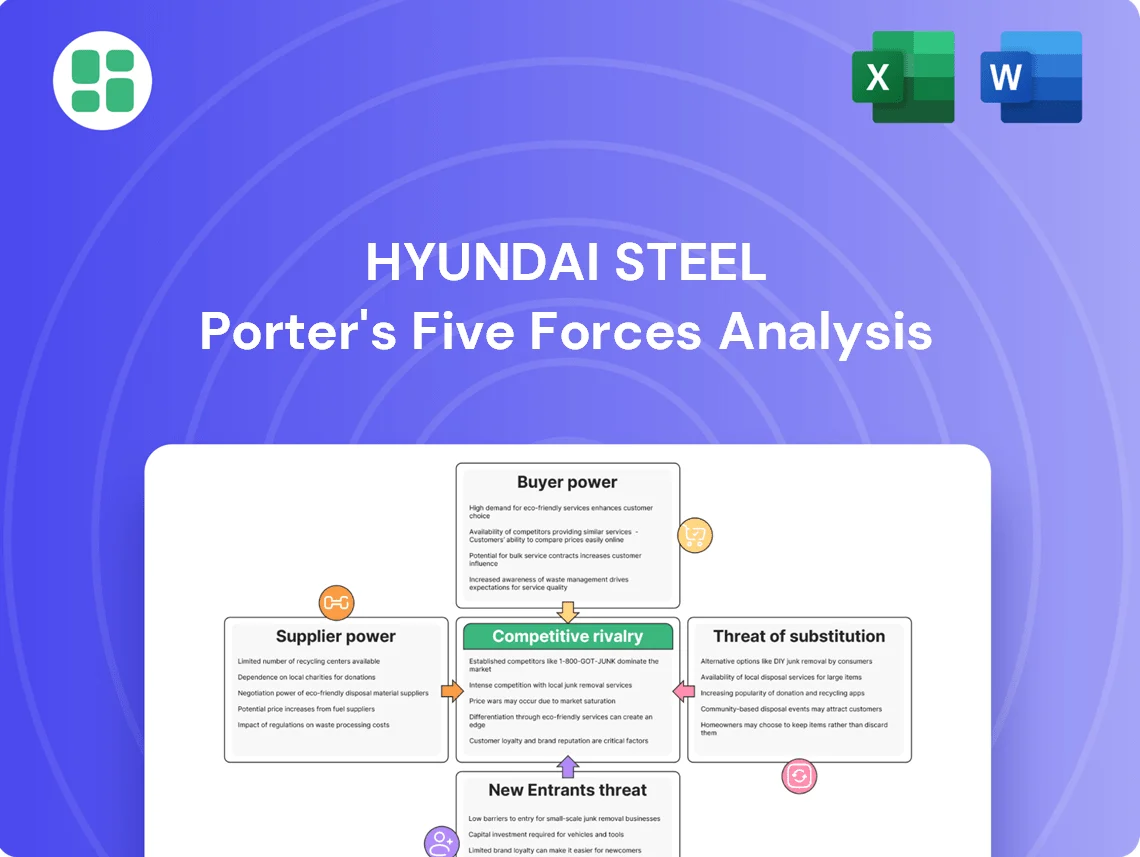
This preview showcases the comprehensive Porter's Five Forces analysis for Hyundai Steel, detailing the competitive landscape and strategic implications for the company. The document you see here is the exact, professionally formatted report you will receive immediately after purchase, offering actionable insights into industry rivalry, buyer and supplier power, the threat of new entrants, and substitute products. Rest assured, there are no placeholders or mockups; what you preview is precisely what you'll be able to download and utilize for your strategic planning.

Product Information
Product Information
Shipping & Returns
Shipping & Returns
Hyundai Steel Porter's Five Forces Analysis
Hyundai Steel Porter's Five Forces Analysis
Don't Miss the Bigger Picture
Hyundai Steel operates within a highly competitive steel industry, where buyer bargaining power is a significant force due to the commoditized nature of many steel products. Understanding the intensity of this and other forces is crucial for strategic planning.
The complete report reveals the real forces shaping Hyundai Steel’s industry—from supplier influence to threat of new entrants. Gain actionable insights to drive smarter decision-making.
Suppliers Bargaining Power
Raw Material Dependency
Hyundai Steel's dependence on essential raw materials like iron ore, coking coal, and scrap metal significantly influences supplier power. The global market for these commodities is often dominated by a limited number of major mining companies, which naturally grants them considerable bargaining leverage over steel manufacturers like Hyundai Steel.
This concentration means suppliers can dictate terms, and price volatility directly impacts Hyundai Steel's cost structure and overall profitability. For instance, in early 2024, iron ore prices saw considerable fluctuations, with benchmarks like the Singapore iron ore futures trading around $100-$130 per ton, directly affecting production expenses for steelmakers.
Energy Cost Volatility
Energy costs, especially electricity and natural gas, represent a significant portion of Hyundai Steel's production expenses, particularly for its electric arc furnace operations. The fluctuating nature of global energy markets, coupled with a concentrated supplier base for certain energy sources, amplifies the bargaining power of these suppliers.
This dynamic necessitates that Hyundai Steel actively manages its energy sourcing strategies and investigates renewable energy solutions to mitigate the impact of price swings. For instance, in 2023, global natural gas prices experienced considerable volatility, impacting energy-intensive industries like steel manufacturing.
Technology and Equipment Providers
Technology and equipment providers hold considerable sway in the steel industry, as Hyundai Steel relies on specialized machinery, advanced automation, and proprietary technologies for efficient production. These suppliers, offering unique and high-value capital goods, often command strong bargaining power due to the significant costs and complexities associated with switching to alternative providers.
For instance, the global market for advanced steelmaking equipment, including electric arc furnaces and continuous casting machines, is often dominated by a few key players. These companies can leverage their technological expertise and the critical nature of their offerings to influence pricing and terms. Hyundai Steel's need for cutting-edge solutions means maintaining robust partnerships with these essential technology suppliers is paramount to ensuring operational continuity and competitiveness.
Logistics and Transportation
The bargaining power of suppliers in the logistics and transportation sector significantly impacts Hyundai Steel. Efficient movement of raw materials like iron ore and coal to its plants, and finished steel products to customers globally, is crucial for its operations. When transportation routes are constrained or shipping capacity is limited, logistics providers can command higher prices, directly affecting Hyundai Steel's cost structure. For instance, in 2024, global shipping rates saw fluctuations due to geopolitical events and increased demand for raw materials, potentially increasing these costs for steel producers.
Hyundai Steel's reliance on a vast and complex supply chain necessitates strong relationships with logistics partners. The company must actively manage these relationships to mitigate the suppliers' power. This involves securing long-term contracts and exploring diverse transportation options to ensure supply chain resilience. The ability of logistics firms to charge premium rates can be amplified by factors such as a shortage of specialized vessels or port congestion, which were observed in various regions throughout 2024, impacting the cost and timeliness of deliveries.
- Logistics costs represent a significant portion of Hyundai Steel's operational expenses, directly influenced by supplier power.
- In 2024, disruptions in global supply chains, including port congestion and container shortages, gave logistics providers increased leverage.
- Hyundai Steel's strategy involves diversifying its logistics network to reduce dependence on any single provider or route.
- The company's ability to negotiate favorable terms with shipping companies is critical for managing its cost of goods sold.
Environmental Compliance Inputs
As environmental regulations become more stringent, suppliers of pollution control technologies and specialized waste management services are gaining significant leverage. Hyundai Steel's increasing focus on sustainable production means a greater dependence on these providers, who possess unique expertise and often have few direct competitors.
For instance, the global environmental services market, which includes waste management and pollution control, was projected to reach over $1.5 trillion by 2024. This growth underscores the expanding importance of suppliers in this sector. Hyundai Steel's investments in carbon capture and utilization (CCU) technologies also highlight a reliance on specialized suppliers, whose proprietary solutions can command higher prices and terms.
- Increased Demand for Green Technologies: Suppliers offering solutions for emissions reduction and waste treatment are in higher demand.
- Specialized Knowledge: The technical expertise required for environmental compliance creates a barrier to entry for new suppliers, strengthening the position of existing ones.
- Regulatory Compliance Costs: Hyundai Steel's need to meet evolving environmental standards, such as those related to CO2 emissions, directly impacts its reliance on suppliers capable of providing compliant inputs.
- Limited Alternatives: For highly specific environmental solutions, the number of qualified suppliers may be limited, giving them greater bargaining power.
Supplier Power Shapes Steel Production Costs
Hyundai Steel faces significant supplier power from providers of essential raw materials like iron ore and coking coal, as the market is often concentrated among a few major global players. This concentration allows suppliers to influence pricing and terms, directly impacting Hyundai Steel's production costs. For example, in 2024, iron ore prices remained a key factor, with benchmarks fluctuating, underscoring the suppliers' leverage.
Energy suppliers, particularly for electricity and natural gas, also wield considerable power due to market concentration and price volatility. Hyundai Steel's reliance on these energy sources for its operations means it must actively manage sourcing to mitigate cost impacts. The company's efforts to integrate renewable energy solutions are a direct response to this supplier influence.
Technology and equipment providers, offering specialized and critical machinery, command strong bargaining power due to the high switching costs and the proprietary nature of their offerings. Similarly, logistics and transportation providers can exert influence, especially during periods of supply chain disruption or capacity constraints, as seen with global shipping rates in 2024.
| Supplier Category | Key Factors Influencing Power | Impact on Hyundai Steel | 2024 Data/Trend Example |
| Raw Materials (Iron Ore, Coal) | Market concentration, global demand | Cost of goods sold, production margins | Iron ore prices trading between $100-$130/ton (benchmark futures) |
| Energy (Electricity, Natural Gas) | Market concentration, geopolitical factors | Operational expenses, profitability | Volatility in global natural gas prices affecting energy-intensive industries |
| Technology & Equipment | Proprietary technology, high switching costs | Capital expenditure, operational efficiency | Dominance of a few key players in advanced steelmaking equipment market |
| Logistics & Transportation | Shipping capacity, port congestion, geopolitical events | Supply chain costs, delivery times | Fluctuations in global shipping rates due to increased demand and disruptions |
What is included in the product
Detailed Word Document
This analysis examines the competitive intensity, buyer and supplier power, threat of new entrants and substitutes impacting Hyundai Steel, providing insights into its market position and strategic considerations.
Customizable Excel Spreadsheet
Instantly visualize competitive pressures on Hyundai Steel, allowing for swift identification of threats and opportunities to mitigate market volatility.
Customers Bargaining Power
Large, Concentrated Buyers
Hyundai Steel's key customers, including major automotive makers like Hyundai Motor Group, large construction firms, and shipbuilding companies, are typically significant and concentrated buyers. These entities procure steel in massive volumes, granting them considerable influence in negotiating pricing, delivery schedules, and product standards. This concentration often fuels aggressive price competition within the industry.
Price Sensitivity and Standardization
For many standard steel products, differentiation is low, making price a critical factor for customers. Industries like construction and shipbuilding often view steel as a commodity, increasing their price sensitivity. This forces Hyundai Steel to maintain competitive pricing and operational efficiency to secure large orders.
Switching Costs for Customers
For many of Hyundai Steel's products, especially more common steel types, customers face minimal barriers when switching suppliers. This ease of switching means buyers can readily compare prices and terms from various steel producers, putting them in a stronger negotiating position.
While certain specialized steel grades, like those requiring specific automotive certifications or intricate integration into a buyer's manufacturing process, can present higher switching costs, the broader market for generic steel products allows customers significant flexibility. This flexibility directly translates to increased bargaining power for buyers seeking favorable pricing and terms.
Backward Integration Potential
The potential for backward integration by large customers, especially those in the automotive and construction industries, significantly bolsters their bargaining power against steel producers like Hyundai Steel. These major buyers, with substantial financial resources, could explore establishing their own steelmaking facilities or forging deep, long-term supply contracts with several steel manufacturers to mitigate supply chain risks and secure favorable pricing.
This threat, though not always realized, exerts considerable influence. For instance, major automotive manufacturers often have the scale to negotiate aggressively. In 2024, the automotive sector, a key consumer of steel, continued to face production fluctuations, making stable and cost-effective steel sourcing a critical strategic imperative.
- Customer Scale: Large automotive and construction firms operate at a scale that makes backward integration economically feasible.
- Financial Capacity: These industries often possess the capital required to invest in steel production capabilities.
- Supply Chain Control: Diversifying raw material sourcing, including steel, is a common strategy for large manufacturers to enhance control and reduce vulnerability.
- Negotiating Leverage: The mere possibility of backward integration empowers customers to demand better terms and pricing from existing suppliers.
Global Sourcing Options
Many of Hyundai Steel's significant customers are multinational corporations with extensive global operations. This allows them to procure steel from a wide array of international suppliers, significantly broadening their sourcing options.
The presence of numerous global suppliers, particularly those located in regions with lower manufacturing costs, empowers these customers. They can leverage this availability to negotiate for more competitive pricing and more favorable contract terms, directly impacting Hyundai Steel's pricing power.
Hyundai Steel must consistently benchmark its offerings against global competitors to remain attractive to these sophisticated buyers. For instance, in 2024, the average price of hot-rolled coil steel on the global market fluctuated, with certain Asian producers offering prices that put pressure on established players.
- Global Customer Base: Major automotive manufacturers and construction firms, key Hyundai Steel clients, source materials worldwide.
- Supplier Diversity: Access to steel from countries like China, India, and Brazil offers customers alternatives.
- Price Sensitivity: Customers can switch suppliers if Hyundai Steel's pricing is not competitive with global benchmarks.
- Negotiating Leverage: The ability to source globally gives customers significant power to demand better terms and conditions.
Steel Customers Command Strong Bargaining Power
The bargaining power of Hyundai Steel's customers remains substantial, driven by their significant purchasing volume and the commodity nature of many steel products. This allows them to exert considerable pressure on pricing and terms, especially when switching suppliers is easy.
Major buyers, particularly in the automotive and construction sectors, can leverage their scale and financial capacity to explore backward integration, further enhancing their negotiating position. The global availability of steel also means customers can readily compare prices and seek more competitive offers.
In 2024, fluctuations in global steel prices, influenced by factors like production costs in emerging economies, continued to empower customers to demand better terms from suppliers like Hyundai Steel.
| Factor | Impact on Hyundai Steel | Customer Leverage |
| Customer Concentration & Volume | High dependency on large buyers | Ability to negotiate volume discounts and favorable terms |
| Product Standardization | Low differentiation for many steel types | Price becomes the primary competitive factor |
| Switching Costs | Low for standard steel products | Customers can easily shift to competitors |
| Backward Integration Threat | Potential for major customers to produce steel internally | Customers can demand better pricing or risk losing business |
| Global Sourcing Options | Access to a wide array of international suppliers | Customers can leverage global price differences |
Preview Before You Purchase
Hyundai Steel Porter's Five Forces Analysis
This preview showcases the comprehensive Porter's Five Forces analysis for Hyundai Steel, detailing the competitive landscape and strategic implications for the company. The document you see here is the exact, professionally formatted report you will receive immediately after purchase, offering actionable insights into industry rivalry, buyer and supplier power, the threat of new entrants, and substitute products. Rest assured, there are no placeholders or mockups; what you preview is precisely what you'll be able to download and utilize for your strategic planning.
Original: $10.00
-65%$10.00
$3.50Product Information
Product Information
Shipping & Returns
Shipping & Returns
Description
Don't Miss the Bigger Picture
Hyundai Steel operates within a highly competitive steel industry, where buyer bargaining power is a significant force due to the commoditized nature of many steel products. Understanding the intensity of this and other forces is crucial for strategic planning.
The complete report reveals the real forces shaping Hyundai Steel’s industry—from supplier influence to threat of new entrants. Gain actionable insights to drive smarter decision-making.
Suppliers Bargaining Power
Raw Material Dependency
Hyundai Steel's dependence on essential raw materials like iron ore, coking coal, and scrap metal significantly influences supplier power. The global market for these commodities is often dominated by a limited number of major mining companies, which naturally grants them considerable bargaining leverage over steel manufacturers like Hyundai Steel.
This concentration means suppliers can dictate terms, and price volatility directly impacts Hyundai Steel's cost structure and overall profitability. For instance, in early 2024, iron ore prices saw considerable fluctuations, with benchmarks like the Singapore iron ore futures trading around $100-$130 per ton, directly affecting production expenses for steelmakers.
Energy Cost Volatility
Energy costs, especially electricity and natural gas, represent a significant portion of Hyundai Steel's production expenses, particularly for its electric arc furnace operations. The fluctuating nature of global energy markets, coupled with a concentrated supplier base for certain energy sources, amplifies the bargaining power of these suppliers.
This dynamic necessitates that Hyundai Steel actively manages its energy sourcing strategies and investigates renewable energy solutions to mitigate the impact of price swings. For instance, in 2023, global natural gas prices experienced considerable volatility, impacting energy-intensive industries like steel manufacturing.
Technology and Equipment Providers
Technology and equipment providers hold considerable sway in the steel industry, as Hyundai Steel relies on specialized machinery, advanced automation, and proprietary technologies for efficient production. These suppliers, offering unique and high-value capital goods, often command strong bargaining power due to the significant costs and complexities associated with switching to alternative providers.
For instance, the global market for advanced steelmaking equipment, including electric arc furnaces and continuous casting machines, is often dominated by a few key players. These companies can leverage their technological expertise and the critical nature of their offerings to influence pricing and terms. Hyundai Steel's need for cutting-edge solutions means maintaining robust partnerships with these essential technology suppliers is paramount to ensuring operational continuity and competitiveness.
Logistics and Transportation
The bargaining power of suppliers in the logistics and transportation sector significantly impacts Hyundai Steel. Efficient movement of raw materials like iron ore and coal to its plants, and finished steel products to customers globally, is crucial for its operations. When transportation routes are constrained or shipping capacity is limited, logistics providers can command higher prices, directly affecting Hyundai Steel's cost structure. For instance, in 2024, global shipping rates saw fluctuations due to geopolitical events and increased demand for raw materials, potentially increasing these costs for steel producers.
Hyundai Steel's reliance on a vast and complex supply chain necessitates strong relationships with logistics partners. The company must actively manage these relationships to mitigate the suppliers' power. This involves securing long-term contracts and exploring diverse transportation options to ensure supply chain resilience. The ability of logistics firms to charge premium rates can be amplified by factors such as a shortage of specialized vessels or port congestion, which were observed in various regions throughout 2024, impacting the cost and timeliness of deliveries.
- Logistics costs represent a significant portion of Hyundai Steel's operational expenses, directly influenced by supplier power.
- In 2024, disruptions in global supply chains, including port congestion and container shortages, gave logistics providers increased leverage.
- Hyundai Steel's strategy involves diversifying its logistics network to reduce dependence on any single provider or route.
- The company's ability to negotiate favorable terms with shipping companies is critical for managing its cost of goods sold.
Environmental Compliance Inputs
As environmental regulations become more stringent, suppliers of pollution control technologies and specialized waste management services are gaining significant leverage. Hyundai Steel's increasing focus on sustainable production means a greater dependence on these providers, who possess unique expertise and often have few direct competitors.
For instance, the global environmental services market, which includes waste management and pollution control, was projected to reach over $1.5 trillion by 2024. This growth underscores the expanding importance of suppliers in this sector. Hyundai Steel's investments in carbon capture and utilization (CCU) technologies also highlight a reliance on specialized suppliers, whose proprietary solutions can command higher prices and terms.
- Increased Demand for Green Technologies: Suppliers offering solutions for emissions reduction and waste treatment are in higher demand.
- Specialized Knowledge: The technical expertise required for environmental compliance creates a barrier to entry for new suppliers, strengthening the position of existing ones.
- Regulatory Compliance Costs: Hyundai Steel's need to meet evolving environmental standards, such as those related to CO2 emissions, directly impacts its reliance on suppliers capable of providing compliant inputs.
- Limited Alternatives: For highly specific environmental solutions, the number of qualified suppliers may be limited, giving them greater bargaining power.
Supplier Power Shapes Steel Production Costs
Hyundai Steel faces significant supplier power from providers of essential raw materials like iron ore and coking coal, as the market is often concentrated among a few major global players. This concentration allows suppliers to influence pricing and terms, directly impacting Hyundai Steel's production costs. For example, in 2024, iron ore prices remained a key factor, with benchmarks fluctuating, underscoring the suppliers' leverage.
Energy suppliers, particularly for electricity and natural gas, also wield considerable power due to market concentration and price volatility. Hyundai Steel's reliance on these energy sources for its operations means it must actively manage sourcing to mitigate cost impacts. The company's efforts to integrate renewable energy solutions are a direct response to this supplier influence.
Technology and equipment providers, offering specialized and critical machinery, command strong bargaining power due to the high switching costs and the proprietary nature of their offerings. Similarly, logistics and transportation providers can exert influence, especially during periods of supply chain disruption or capacity constraints, as seen with global shipping rates in 2024.
| Supplier Category | Key Factors Influencing Power | Impact on Hyundai Steel | 2024 Data/Trend Example |
| Raw Materials (Iron Ore, Coal) | Market concentration, global demand | Cost of goods sold, production margins | Iron ore prices trading between $100-$130/ton (benchmark futures) |
| Energy (Electricity, Natural Gas) | Market concentration, geopolitical factors | Operational expenses, profitability | Volatility in global natural gas prices affecting energy-intensive industries |
| Technology & Equipment | Proprietary technology, high switching costs | Capital expenditure, operational efficiency | Dominance of a few key players in advanced steelmaking equipment market |
| Logistics & Transportation | Shipping capacity, port congestion, geopolitical events | Supply chain costs, delivery times | Fluctuations in global shipping rates due to increased demand and disruptions |
What is included in the product
Detailed Word Document
This analysis examines the competitive intensity, buyer and supplier power, threat of new entrants and substitutes impacting Hyundai Steel, providing insights into its market position and strategic considerations.
Customizable Excel Spreadsheet
Instantly visualize competitive pressures on Hyundai Steel, allowing for swift identification of threats and opportunities to mitigate market volatility.
Customers Bargaining Power
Large, Concentrated Buyers
Hyundai Steel's key customers, including major automotive makers like Hyundai Motor Group, large construction firms, and shipbuilding companies, are typically significant and concentrated buyers. These entities procure steel in massive volumes, granting them considerable influence in negotiating pricing, delivery schedules, and product standards. This concentration often fuels aggressive price competition within the industry.
Price Sensitivity and Standardization
For many standard steel products, differentiation is low, making price a critical factor for customers. Industries like construction and shipbuilding often view steel as a commodity, increasing their price sensitivity. This forces Hyundai Steel to maintain competitive pricing and operational efficiency to secure large orders.
Switching Costs for Customers
For many of Hyundai Steel's products, especially more common steel types, customers face minimal barriers when switching suppliers. This ease of switching means buyers can readily compare prices and terms from various steel producers, putting them in a stronger negotiating position.
While certain specialized steel grades, like those requiring specific automotive certifications or intricate integration into a buyer's manufacturing process, can present higher switching costs, the broader market for generic steel products allows customers significant flexibility. This flexibility directly translates to increased bargaining power for buyers seeking favorable pricing and terms.
Backward Integration Potential
The potential for backward integration by large customers, especially those in the automotive and construction industries, significantly bolsters their bargaining power against steel producers like Hyundai Steel. These major buyers, with substantial financial resources, could explore establishing their own steelmaking facilities or forging deep, long-term supply contracts with several steel manufacturers to mitigate supply chain risks and secure favorable pricing.
This threat, though not always realized, exerts considerable influence. For instance, major automotive manufacturers often have the scale to negotiate aggressively. In 2024, the automotive sector, a key consumer of steel, continued to face production fluctuations, making stable and cost-effective steel sourcing a critical strategic imperative.
- Customer Scale: Large automotive and construction firms operate at a scale that makes backward integration economically feasible.
- Financial Capacity: These industries often possess the capital required to invest in steel production capabilities.
- Supply Chain Control: Diversifying raw material sourcing, including steel, is a common strategy for large manufacturers to enhance control and reduce vulnerability.
- Negotiating Leverage: The mere possibility of backward integration empowers customers to demand better terms and pricing from existing suppliers.
Global Sourcing Options
Many of Hyundai Steel's significant customers are multinational corporations with extensive global operations. This allows them to procure steel from a wide array of international suppliers, significantly broadening their sourcing options.
The presence of numerous global suppliers, particularly those located in regions with lower manufacturing costs, empowers these customers. They can leverage this availability to negotiate for more competitive pricing and more favorable contract terms, directly impacting Hyundai Steel's pricing power.
Hyundai Steel must consistently benchmark its offerings against global competitors to remain attractive to these sophisticated buyers. For instance, in 2024, the average price of hot-rolled coil steel on the global market fluctuated, with certain Asian producers offering prices that put pressure on established players.
- Global Customer Base: Major automotive manufacturers and construction firms, key Hyundai Steel clients, source materials worldwide.
- Supplier Diversity: Access to steel from countries like China, India, and Brazil offers customers alternatives.
- Price Sensitivity: Customers can switch suppliers if Hyundai Steel's pricing is not competitive with global benchmarks.
- Negotiating Leverage: The ability to source globally gives customers significant power to demand better terms and conditions.
Steel Customers Command Strong Bargaining Power
The bargaining power of Hyundai Steel's customers remains substantial, driven by their significant purchasing volume and the commodity nature of many steel products. This allows them to exert considerable pressure on pricing and terms, especially when switching suppliers is easy.
Major buyers, particularly in the automotive and construction sectors, can leverage their scale and financial capacity to explore backward integration, further enhancing their negotiating position. The global availability of steel also means customers can readily compare prices and seek more competitive offers.
In 2024, fluctuations in global steel prices, influenced by factors like production costs in emerging economies, continued to empower customers to demand better terms from suppliers like Hyundai Steel.
| Factor | Impact on Hyundai Steel | Customer Leverage |
| Customer Concentration & Volume | High dependency on large buyers | Ability to negotiate volume discounts and favorable terms |
| Product Standardization | Low differentiation for many steel types | Price becomes the primary competitive factor |
| Switching Costs | Low for standard steel products | Customers can easily shift to competitors |
| Backward Integration Threat | Potential for major customers to produce steel internally | Customers can demand better pricing or risk losing business |
| Global Sourcing Options | Access to a wide array of international suppliers | Customers can leverage global price differences |
Preview Before You Purchase
Hyundai Steel Porter's Five Forces Analysis
This preview showcases the comprehensive Porter's Five Forces analysis for Hyundai Steel, detailing the competitive landscape and strategic implications for the company. The document you see here is the exact, professionally formatted report you will receive immediately after purchase, offering actionable insights into industry rivalry, buyer and supplier power, the threat of new entrants, and substitute products. Rest assured, there are no placeholders or mockups; what you preview is precisely what you'll be able to download and utilize for your strategic planning.