Helmerich & Payne Porter's Five Forces Analysis

Go Beyond the Preview—Access the Full Strategic Report
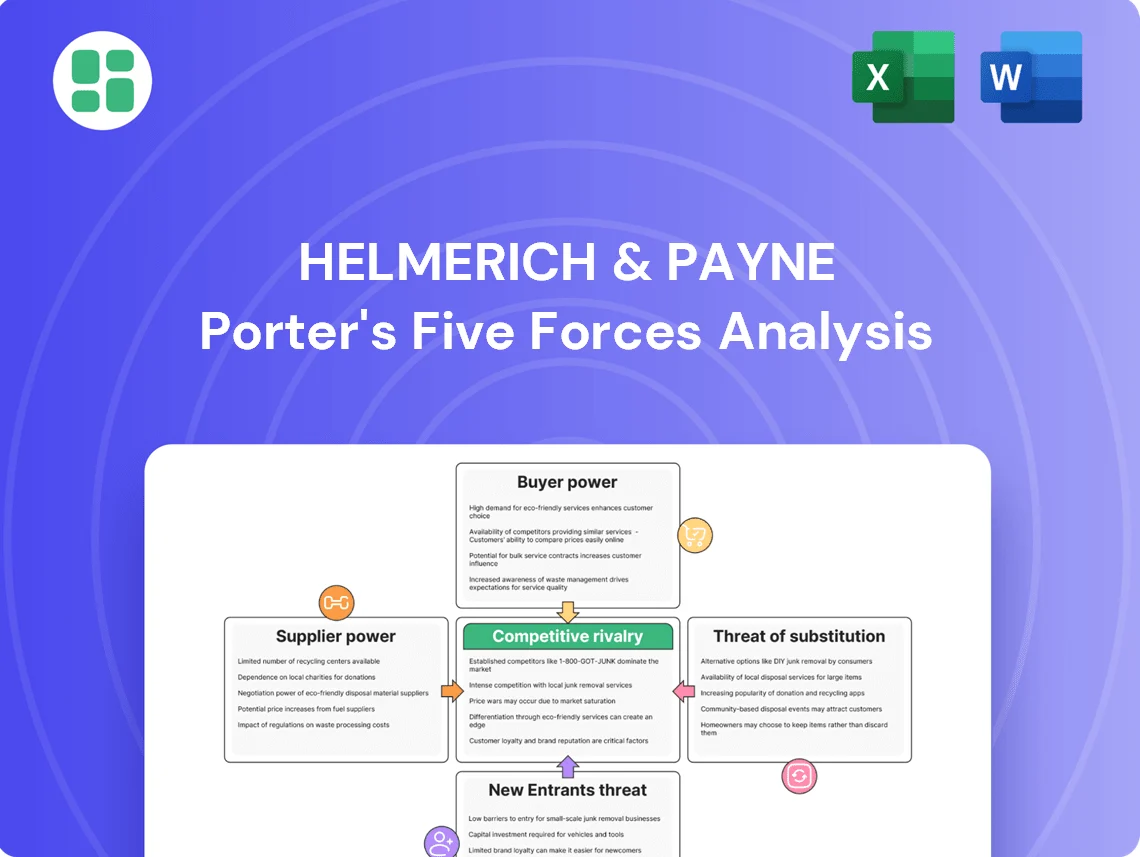
Helmerich & Payne operates in a dynamic oilfield services sector, where understanding the competitive landscape is crucial for success. Our Porter's Five Forces analysis delves into the bargaining power of both buyers and suppliers, the threat of new entrants and substitute products, and the intensity of rivalry within the industry.
This brief snapshot only scratches the surface. Unlock the full Porter's Five Forces Analysis to explore Helmerich & Payne’s competitive dynamics, market pressures, and strategic advantages in detail.
Suppliers Bargaining Power

Supplier Concentration and Specialization
The oil and gas drilling sector, including companies like Helmerich & Payne, often depends on a limited number of suppliers for highly specialized equipment and services. This specialization, ranging from advanced drilling components to sophisticated IT solutions and skilled labor, inherently concentrates power among these providers. For instance, unique drilling muds or specialized cement formulations have demonstrated more consistent pricing in 2024, reflecting the supplier's leverage in these niche markets.
Availability of Skilled Labor
The availability of a skilled workforce, especially for specialized roles like directional drillers, directly impacts supplier power. A shortage in these critical skill sets amplifies the leverage of labor suppliers and specialized service providers.
Helmerich & Payne, like many in the oil and gas sector, has navigated a persistent skillset gap. This scarcity means that companies relying on these specialized services often face increased costs and potentially less favorable terms from suppliers who can command higher prices due to demand.
The industry's push for automation, aimed at improving efficiency and consistency, also highlights the importance of skilled labor. As automation helps address the need for repeatable results, the demand for the human expertise to manage and optimize these advanced systems remains high, further strengthening the bargaining position of those possessing these in-demand skills.

Cost of Key Raw Materials and Components
Suppliers of essential raw materials like steel for drilling rigs and various consumables hold significant bargaining power, largely dictated by the volatility of commodity prices. For instance, while the cost of Oil Country Tubular Goods (OCTG) and sand saw notable decreases in 2024, other critical inputs such as drilling mud and cement maintained more stable pricing, showcasing a differentiated supplier influence across the input spectrum.

Switching Costs for H&P
Helmerich & Payne's significant investments in proprietary rig designs and advanced technologies, particularly its FlexRig fleet, can lead to substantial switching costs for critical components and integrated software. This technological integration means that changing suppliers for these deeply embedded systems would likely involve considerable expense and operational disruption.
For instance, if a key supplier for H&P's advanced drilling automation software or specialized downhole tools were to increase prices, H&P might find it economically challenging to switch to an alternative. This dependency grants suppliers a degree of bargaining power, as the cost and complexity of integrating new systems can be prohibitive.
In 2023, Helmerich & Payne reported capital expenditures of $621 million, a substantial portion of which would have been allocated to the development and maintenance of its technologically advanced fleet. This investment underscores the embedded nature of its supplier relationships and the potential switching costs involved.
- Technological Integration: H&P's proprietary rig designs, like the FlexRig, often utilize highly integrated components and software.
- Supplier Dependency: This deep integration can create a reliance on specific suppliers whose products are essential for H&P's operational efficiency.
- Switching Cost Barrier: Changing suppliers for these specialized or proprietary elements would likely incur significant costs related to re-engineering, testing, and implementation.
- Supplier Bargaining Power: The high switching costs empower suppliers, giving them leverage in price negotiations or contract terms.
Potential for Forward Integration by Suppliers
While less common, some large, integrated oilfield service companies that supply equipment might consider forward integrating into contract drilling. This move could potentially increase their bargaining power by offering a more comprehensive service package. However, the substantial capital expenditure required to own and operate drilling rigs presents a significant barrier for most suppliers looking to enter this market.
The capital intensity of contract drilling is a key factor. For instance, a new land drilling rig can cost upwards of $20 million, with offshore rigs costing significantly more. This high upfront investment makes it challenging for equipment suppliers to absorb the costs associated with operating a fleet of drilling rigs, thereby limiting their ability to forward integrate and exert greater influence.
- High Capital Costs: The purchase and maintenance of drilling rigs represent a major financial commitment, deterring many suppliers from forward integration.
- Operational Expertise: Contract drilling requires specialized operational knowledge and management, which may not be a core competency for equipment manufacturers.
- Market Dynamics: The cyclical nature of the oil and gas industry can make the investment in drilling operations risky for companies primarily focused on equipment supply.
Supplier Power: A Key Factor in Drilling Costs
Suppliers of specialized drilling components and advanced technology for companies like Helmerich & Payne often wield considerable bargaining power due to industry concentration and high switching costs. This is particularly evident with proprietary software and integrated systems, where the expense and complexity of replacement limit H&P's ability to seek alternative providers. For example, in 2024, prices for certain specialized drilling muds and cement formulations remained firm, reflecting the supplier's leverage in these niche markets, despite some commodity price decreases.
The scarcity of highly skilled labor, such as directional drillers, further amplifies supplier power, as companies compete for limited expertise, driving up costs. Helmerich & Payne's 2023 capital expenditures of $621 million highlight the significant investment in its advanced fleet, underscoring the embedded nature of these supplier relationships and the associated switching costs.
While forward integration by equipment suppliers into contract drilling is limited by the substantial capital requirements, estimated at over $20 million per land rig, the bargaining power of specialized component and technology providers remains a key factor for H&P.
| Factor | Impact on Supplier Bargaining Power | Example for Helmerich & Payne |
| Supplier Concentration | High for specialized equipment/services | Limited number of providers for advanced drilling automation software |
| Switching Costs | High due to technological integration | Significant costs to replace proprietary FlexRig components or software |
| Labor Scarcity | High for skilled drilling personnel | Increased costs for specialized labor like directional drillers |
| Commodity Price Volatility | Mixed; some inputs stable, others volatile | Stable pricing for drilling muds in 2024 vs. fluctuating OCTG costs |
What is included in the product
 Detailed Word Document
Tailored exclusively for Helmerich & Payne, analyzing its position within its competitive landscape by evaluating the intensity of rivalry, buyer and supplier power, threat of new entrants, and the impact of substitutes.

 Customizable Excel Spreadsheet
Instantly identify and address competitive threats with a dynamic "what-if" scenario planner for each force.
Customers Bargaining Power

Customer Concentration and Size
Helmerich & Payne's (H&P) customer base is largely comprised of significant exploration and production (E&P) companies, encompassing both major oil corporations and independent producers. This concentration means H&P frequently engages with a select few, very powerful buyers.
The upstream sector has seen substantial consolidation, with notable megamergers occurring in key areas like the Permian Basin. This trend further concentrates H&P's customer base, amplifying the bargaining power of these large, consolidated entities who can demand advanced, scalable services.
Customers' Ability to Switch Contractors
Customers in the drilling sector can switch between contractors, with this ease influenced by rig availability, contract specifics, and the unique skills each company brings. Helmerich & Payne's (H&P) advanced rigs and technology are designed to make switching harder, but the market in 2024 saw declining day rates, indicating customers still have significant sway.

Importance of Drilling Services to Customer Operations
Drilling services are absolutely vital for exploration and production (E&P) companies to get oil and gas out of the ground. This means companies like Helmerich & Payne (H&P) provide a service that's hard to live without. In 2024, E&P companies are really zeroing in on keeping costs down and hitting their profit targets. They're looking for ways to drill more efficiently, often meaning they need fewer rigs to get the job done, which puts pressure on service providers.

Customers' Access to Information and Pricing Transparency
Customers in the drilling services sector, particularly major oil and gas companies, are often sophisticated buyers. They possess considerable market knowledge, enabling them to readily compare pricing and service offerings from various providers. This access to information, especially concerning rig availability and prevailing day rates in active basins, significantly bolsters their negotiating position.
For instance, in 2024, the North American land drilling market saw intense competition among contract drillers. Customers could easily obtain quotes and benchmark day rates, with some reports indicating that average day rates for premium land rigs fluctuated based on demand and rig type, but transparency allowed for informed negotiation. This transparency means customers can effectively leverage competitive bids to secure more favorable terms.
- Informed Negotiation: Customers can compare day rates and service quality across multiple drilling contractors, leading to more competitive pricing.
- Market Data Access: Sophisticated clients have access to industry reports and real-time data on rig utilization and day rates, enhancing their bargaining leverage.
- Competitive Landscape: In basins with numerous drilling service providers, customers benefit from a highly competitive environment that drives down costs.
- Contract Flexibility: Increased information empowers customers to negotiate more flexible contract terms, aligning with their project needs and market outlook.
Potential for Backward Integration by Customers
The potential for customers, particularly large Exploration and Production (E&P) companies, to engage in backward integration by operating their own drilling rigs poses a significant bargaining chip. While the substantial capital investment and specialized knowledge needed make this rare, its mere possibility acts as a latent threat, influencing Helmerich & Payne's pricing power.
For instance, in 2024, the average cost to acquire and outfit a new land drilling rig can range from $15 million to $30 million, a considerable barrier to entry for most E&P firms. Furthermore, the operational expertise required for efficient and safe drilling operations is a highly specialized field, often necessitating dedicated teams and ongoing training.
- Customer Integration Threat: Large E&P companies could, in theory, bring drilling operations in-house.
- Capital Intensity Barrier: Acquiring and maintaining drilling rigs requires significant financial outlay, estimated in the tens of millions of dollars per rig in 2024.
- Operational Expertise Gap: The specialized skills needed for efficient rig operation are a deterrent to self-operation for many E&P firms.
- Pricing Negotiation Leverage: The theoretical ability of customers to integrate backward can influence their willingness to negotiate pricing with rig service providers like Helmerich & Payne.
Client Power Shapes Drilling Service Pricing
Helmerich & Payne's customers, primarily large E&P companies, wield significant bargaining power due to market consolidation and their sophisticated understanding of drilling services. In 2024, the competitive landscape, marked by fluctuating day rates, allowed these clients to leverage market data and benchmark pricing effectively, securing more favorable contract terms. This informed negotiation capability, coupled with the potential for backward integration, keeps pressure on H&P's pricing strategies.
| Customer Type | Bargaining Power Factors | 2024 Market Impact |
|---|---|---|
| Major E&P Companies | Market consolidation, informed negotiation, potential backward integration | Ability to drive down day rates, demand for efficient services |
| Independent Producers | Access to market data, rig availability comparisons | Negotiate based on competitive bids, seek flexible contract terms |
| Overall Customer Base | High switching potential (influenced by rig tech), focus on cost efficiency | Pressure on service providers to offer value-added solutions and competitive pricing |
What You See Is What You Get
Helmerich & Payne Porter's Five Forces Analysis
This preview showcases the complete Helmerich & Payne Porter's Five Forces Analysis, detailing the competitive landscape for the company. The analysis meticulously examines the bargaining power of buyers and suppliers, the threat of new entrants and substitutes, and the intensity of rivalry within the oil and gas drilling sector. What you see here is the exact, professionally formatted document you will receive immediately after purchase, ready for your strategic review.

Product Information
Product Information
Shipping & Returns
Shipping & Returns
Helmerich & Payne Porter's Five Forces Analysis
Helmerich & Payne Porter's Five Forces Analysis
Go Beyond the Preview—Access the Full Strategic Report
Helmerich & Payne operates in a dynamic oilfield services sector, where understanding the competitive landscape is crucial for success. Our Porter's Five Forces analysis delves into the bargaining power of both buyers and suppliers, the threat of new entrants and substitute products, and the intensity of rivalry within the industry.
This brief snapshot only scratches the surface. Unlock the full Porter's Five Forces Analysis to explore Helmerich & Payne’s competitive dynamics, market pressures, and strategic advantages in detail.
Suppliers Bargaining Power
Supplier Concentration and Specialization
The oil and gas drilling sector, including companies like Helmerich & Payne, often depends on a limited number of suppliers for highly specialized equipment and services. This specialization, ranging from advanced drilling components to sophisticated IT solutions and skilled labor, inherently concentrates power among these providers. For instance, unique drilling muds or specialized cement formulations have demonstrated more consistent pricing in 2024, reflecting the supplier's leverage in these niche markets.
Availability of Skilled Labor
The availability of a skilled workforce, especially for specialized roles like directional drillers, directly impacts supplier power. A shortage in these critical skill sets amplifies the leverage of labor suppliers and specialized service providers.
Helmerich & Payne, like many in the oil and gas sector, has navigated a persistent skillset gap. This scarcity means that companies relying on these specialized services often face increased costs and potentially less favorable terms from suppliers who can command higher prices due to demand.
The industry's push for automation, aimed at improving efficiency and consistency, also highlights the importance of skilled labor. As automation helps address the need for repeatable results, the demand for the human expertise to manage and optimize these advanced systems remains high, further strengthening the bargaining position of those possessing these in-demand skills.
Cost of Key Raw Materials and Components
Suppliers of essential raw materials like steel for drilling rigs and various consumables hold significant bargaining power, largely dictated by the volatility of commodity prices. For instance, while the cost of Oil Country Tubular Goods (OCTG) and sand saw notable decreases in 2024, other critical inputs such as drilling mud and cement maintained more stable pricing, showcasing a differentiated supplier influence across the input spectrum.
Switching Costs for H&P
Helmerich & Payne's significant investments in proprietary rig designs and advanced technologies, particularly its FlexRig fleet, can lead to substantial switching costs for critical components and integrated software. This technological integration means that changing suppliers for these deeply embedded systems would likely involve considerable expense and operational disruption.
For instance, if a key supplier for H&P's advanced drilling automation software or specialized downhole tools were to increase prices, H&P might find it economically challenging to switch to an alternative. This dependency grants suppliers a degree of bargaining power, as the cost and complexity of integrating new systems can be prohibitive.
In 2023, Helmerich & Payne reported capital expenditures of $621 million, a substantial portion of which would have been allocated to the development and maintenance of its technologically advanced fleet. This investment underscores the embedded nature of its supplier relationships and the potential switching costs involved.
- Technological Integration: H&P's proprietary rig designs, like the FlexRig, often utilize highly integrated components and software.
- Supplier Dependency: This deep integration can create a reliance on specific suppliers whose products are essential for H&P's operational efficiency.
- Switching Cost Barrier: Changing suppliers for these specialized or proprietary elements would likely incur significant costs related to re-engineering, testing, and implementation.
- Supplier Bargaining Power: The high switching costs empower suppliers, giving them leverage in price negotiations or contract terms.
Potential for Forward Integration by Suppliers
While less common, some large, integrated oilfield service companies that supply equipment might consider forward integrating into contract drilling. This move could potentially increase their bargaining power by offering a more comprehensive service package. However, the substantial capital expenditure required to own and operate drilling rigs presents a significant barrier for most suppliers looking to enter this market.
The capital intensity of contract drilling is a key factor. For instance, a new land drilling rig can cost upwards of $20 million, with offshore rigs costing significantly more. This high upfront investment makes it challenging for equipment suppliers to absorb the costs associated with operating a fleet of drilling rigs, thereby limiting their ability to forward integrate and exert greater influence.
- High Capital Costs: The purchase and maintenance of drilling rigs represent a major financial commitment, deterring many suppliers from forward integration.
- Operational Expertise: Contract drilling requires specialized operational knowledge and management, which may not be a core competency for equipment manufacturers.
- Market Dynamics: The cyclical nature of the oil and gas industry can make the investment in drilling operations risky for companies primarily focused on equipment supply.
Supplier Power: A Key Factor in Drilling Costs
Suppliers of specialized drilling components and advanced technology for companies like Helmerich & Payne often wield considerable bargaining power due to industry concentration and high switching costs. This is particularly evident with proprietary software and integrated systems, where the expense and complexity of replacement limit H&P's ability to seek alternative providers. For example, in 2024, prices for certain specialized drilling muds and cement formulations remained firm, reflecting the supplier's leverage in these niche markets, despite some commodity price decreases.
The scarcity of highly skilled labor, such as directional drillers, further amplifies supplier power, as companies compete for limited expertise, driving up costs. Helmerich & Payne's 2023 capital expenditures of $621 million highlight the significant investment in its advanced fleet, underscoring the embedded nature of these supplier relationships and the associated switching costs.
While forward integration by equipment suppliers into contract drilling is limited by the substantial capital requirements, estimated at over $20 million per land rig, the bargaining power of specialized component and technology providers remains a key factor for H&P.
| Factor | Impact on Supplier Bargaining Power | Example for Helmerich & Payne |
| Supplier Concentration | High for specialized equipment/services | Limited number of providers for advanced drilling automation software |
| Switching Costs | High due to technological integration | Significant costs to replace proprietary FlexRig components or software |
| Labor Scarcity | High for skilled drilling personnel | Increased costs for specialized labor like directional drillers |
| Commodity Price Volatility | Mixed; some inputs stable, others volatile | Stable pricing for drilling muds in 2024 vs. fluctuating OCTG costs |
What is included in the product
Detailed Word Document
Tailored exclusively for Helmerich & Payne, analyzing its position within its competitive landscape by evaluating the intensity of rivalry, buyer and supplier power, threat of new entrants, and the impact of substitutes.
Customizable Excel Spreadsheet
Instantly identify and address competitive threats with a dynamic "what-if" scenario planner for each force.
Customers Bargaining Power
Customer Concentration and Size
Helmerich & Payne's (H&P) customer base is largely comprised of significant exploration and production (E&P) companies, encompassing both major oil corporations and independent producers. This concentration means H&P frequently engages with a select few, very powerful buyers.
The upstream sector has seen substantial consolidation, with notable megamergers occurring in key areas like the Permian Basin. This trend further concentrates H&P's customer base, amplifying the bargaining power of these large, consolidated entities who can demand advanced, scalable services.
Customers' Ability to Switch Contractors
Customers in the drilling sector can switch between contractors, with this ease influenced by rig availability, contract specifics, and the unique skills each company brings. Helmerich & Payne's (H&P) advanced rigs and technology are designed to make switching harder, but the market in 2024 saw declining day rates, indicating customers still have significant sway.
Importance of Drilling Services to Customer Operations
Drilling services are absolutely vital for exploration and production (E&P) companies to get oil and gas out of the ground. This means companies like Helmerich & Payne (H&P) provide a service that's hard to live without. In 2024, E&P companies are really zeroing in on keeping costs down and hitting their profit targets. They're looking for ways to drill more efficiently, often meaning they need fewer rigs to get the job done, which puts pressure on service providers.
Customers' Access to Information and Pricing Transparency
Customers in the drilling services sector, particularly major oil and gas companies, are often sophisticated buyers. They possess considerable market knowledge, enabling them to readily compare pricing and service offerings from various providers. This access to information, especially concerning rig availability and prevailing day rates in active basins, significantly bolsters their negotiating position.
For instance, in 2024, the North American land drilling market saw intense competition among contract drillers. Customers could easily obtain quotes and benchmark day rates, with some reports indicating that average day rates for premium land rigs fluctuated based on demand and rig type, but transparency allowed for informed negotiation. This transparency means customers can effectively leverage competitive bids to secure more favorable terms.
- Informed Negotiation: Customers can compare day rates and service quality across multiple drilling contractors, leading to more competitive pricing.
- Market Data Access: Sophisticated clients have access to industry reports and real-time data on rig utilization and day rates, enhancing their bargaining leverage.
- Competitive Landscape: In basins with numerous drilling service providers, customers benefit from a highly competitive environment that drives down costs.
- Contract Flexibility: Increased information empowers customers to negotiate more flexible contract terms, aligning with their project needs and market outlook.
Potential for Backward Integration by Customers
The potential for customers, particularly large Exploration and Production (E&P) companies, to engage in backward integration by operating their own drilling rigs poses a significant bargaining chip. While the substantial capital investment and specialized knowledge needed make this rare, its mere possibility acts as a latent threat, influencing Helmerich & Payne's pricing power.
For instance, in 2024, the average cost to acquire and outfit a new land drilling rig can range from $15 million to $30 million, a considerable barrier to entry for most E&P firms. Furthermore, the operational expertise required for efficient and safe drilling operations is a highly specialized field, often necessitating dedicated teams and ongoing training.
- Customer Integration Threat: Large E&P companies could, in theory, bring drilling operations in-house.
- Capital Intensity Barrier: Acquiring and maintaining drilling rigs requires significant financial outlay, estimated in the tens of millions of dollars per rig in 2024.
- Operational Expertise Gap: The specialized skills needed for efficient rig operation are a deterrent to self-operation for many E&P firms.
- Pricing Negotiation Leverage: The theoretical ability of customers to integrate backward can influence their willingness to negotiate pricing with rig service providers like Helmerich & Payne.
Client Power Shapes Drilling Service Pricing
Helmerich & Payne's customers, primarily large E&P companies, wield significant bargaining power due to market consolidation and their sophisticated understanding of drilling services. In 2024, the competitive landscape, marked by fluctuating day rates, allowed these clients to leverage market data and benchmark pricing effectively, securing more favorable contract terms. This informed negotiation capability, coupled with the potential for backward integration, keeps pressure on H&P's pricing strategies.
| Customer Type | Bargaining Power Factors | 2024 Market Impact |
|---|---|---|
| Major E&P Companies | Market consolidation, informed negotiation, potential backward integration | Ability to drive down day rates, demand for efficient services |
| Independent Producers | Access to market data, rig availability comparisons | Negotiate based on competitive bids, seek flexible contract terms |
| Overall Customer Base | High switching potential (influenced by rig tech), focus on cost efficiency | Pressure on service providers to offer value-added solutions and competitive pricing |
What You See Is What You Get
Helmerich & Payne Porter's Five Forces Analysis
This preview showcases the complete Helmerich & Payne Porter's Five Forces Analysis, detailing the competitive landscape for the company. The analysis meticulously examines the bargaining power of buyers and suppliers, the threat of new entrants and substitutes, and the intensity of rivalry within the oil and gas drilling sector. What you see here is the exact, professionally formatted document you will receive immediately after purchase, ready for your strategic review.
Product Information
Product Information
Shipping & Returns
Shipping & Returns
Description
Go Beyond the Preview—Access the Full Strategic Report
Helmerich & Payne operates in a dynamic oilfield services sector, where understanding the competitive landscape is crucial for success. Our Porter's Five Forces analysis delves into the bargaining power of both buyers and suppliers, the threat of new entrants and substitute products, and the intensity of rivalry within the industry.
This brief snapshot only scratches the surface. Unlock the full Porter's Five Forces Analysis to explore Helmerich & Payne’s competitive dynamics, market pressures, and strategic advantages in detail.
Suppliers Bargaining Power
Supplier Concentration and Specialization
The oil and gas drilling sector, including companies like Helmerich & Payne, often depends on a limited number of suppliers for highly specialized equipment and services. This specialization, ranging from advanced drilling components to sophisticated IT solutions and skilled labor, inherently concentrates power among these providers. For instance, unique drilling muds or specialized cement formulations have demonstrated more consistent pricing in 2024, reflecting the supplier's leverage in these niche markets.
Availability of Skilled Labor
The availability of a skilled workforce, especially for specialized roles like directional drillers, directly impacts supplier power. A shortage in these critical skill sets amplifies the leverage of labor suppliers and specialized service providers.
Helmerich & Payne, like many in the oil and gas sector, has navigated a persistent skillset gap. This scarcity means that companies relying on these specialized services often face increased costs and potentially less favorable terms from suppliers who can command higher prices due to demand.
The industry's push for automation, aimed at improving efficiency and consistency, also highlights the importance of skilled labor. As automation helps address the need for repeatable results, the demand for the human expertise to manage and optimize these advanced systems remains high, further strengthening the bargaining position of those possessing these in-demand skills.
Cost of Key Raw Materials and Components
Suppliers of essential raw materials like steel for drilling rigs and various consumables hold significant bargaining power, largely dictated by the volatility of commodity prices. For instance, while the cost of Oil Country Tubular Goods (OCTG) and sand saw notable decreases in 2024, other critical inputs such as drilling mud and cement maintained more stable pricing, showcasing a differentiated supplier influence across the input spectrum.
Switching Costs for H&P
Helmerich & Payne's significant investments in proprietary rig designs and advanced technologies, particularly its FlexRig fleet, can lead to substantial switching costs for critical components and integrated software. This technological integration means that changing suppliers for these deeply embedded systems would likely involve considerable expense and operational disruption.
For instance, if a key supplier for H&P's advanced drilling automation software or specialized downhole tools were to increase prices, H&P might find it economically challenging to switch to an alternative. This dependency grants suppliers a degree of bargaining power, as the cost and complexity of integrating new systems can be prohibitive.
In 2023, Helmerich & Payne reported capital expenditures of $621 million, a substantial portion of which would have been allocated to the development and maintenance of its technologically advanced fleet. This investment underscores the embedded nature of its supplier relationships and the potential switching costs involved.
- Technological Integration: H&P's proprietary rig designs, like the FlexRig, often utilize highly integrated components and software.
- Supplier Dependency: This deep integration can create a reliance on specific suppliers whose products are essential for H&P's operational efficiency.
- Switching Cost Barrier: Changing suppliers for these specialized or proprietary elements would likely incur significant costs related to re-engineering, testing, and implementation.
- Supplier Bargaining Power: The high switching costs empower suppliers, giving them leverage in price negotiations or contract terms.
Potential for Forward Integration by Suppliers
While less common, some large, integrated oilfield service companies that supply equipment might consider forward integrating into contract drilling. This move could potentially increase their bargaining power by offering a more comprehensive service package. However, the substantial capital expenditure required to own and operate drilling rigs presents a significant barrier for most suppliers looking to enter this market.
The capital intensity of contract drilling is a key factor. For instance, a new land drilling rig can cost upwards of $20 million, with offshore rigs costing significantly more. This high upfront investment makes it challenging for equipment suppliers to absorb the costs associated with operating a fleet of drilling rigs, thereby limiting their ability to forward integrate and exert greater influence.
- High Capital Costs: The purchase and maintenance of drilling rigs represent a major financial commitment, deterring many suppliers from forward integration.
- Operational Expertise: Contract drilling requires specialized operational knowledge and management, which may not be a core competency for equipment manufacturers.
- Market Dynamics: The cyclical nature of the oil and gas industry can make the investment in drilling operations risky for companies primarily focused on equipment supply.
Supplier Power: A Key Factor in Drilling Costs
Suppliers of specialized drilling components and advanced technology for companies like Helmerich & Payne often wield considerable bargaining power due to industry concentration and high switching costs. This is particularly evident with proprietary software and integrated systems, where the expense and complexity of replacement limit H&P's ability to seek alternative providers. For example, in 2024, prices for certain specialized drilling muds and cement formulations remained firm, reflecting the supplier's leverage in these niche markets, despite some commodity price decreases.
The scarcity of highly skilled labor, such as directional drillers, further amplifies supplier power, as companies compete for limited expertise, driving up costs. Helmerich & Payne's 2023 capital expenditures of $621 million highlight the significant investment in its advanced fleet, underscoring the embedded nature of these supplier relationships and the associated switching costs.
While forward integration by equipment suppliers into contract drilling is limited by the substantial capital requirements, estimated at over $20 million per land rig, the bargaining power of specialized component and technology providers remains a key factor for H&P.
| Factor | Impact on Supplier Bargaining Power | Example for Helmerich & Payne |
| Supplier Concentration | High for specialized equipment/services | Limited number of providers for advanced drilling automation software |
| Switching Costs | High due to technological integration | Significant costs to replace proprietary FlexRig components or software |
| Labor Scarcity | High for skilled drilling personnel | Increased costs for specialized labor like directional drillers |
| Commodity Price Volatility | Mixed; some inputs stable, others volatile | Stable pricing for drilling muds in 2024 vs. fluctuating OCTG costs |
What is included in the product
Detailed Word Document
Tailored exclusively for Helmerich & Payne, analyzing its position within its competitive landscape by evaluating the intensity of rivalry, buyer and supplier power, threat of new entrants, and the impact of substitutes.
Customizable Excel Spreadsheet
Instantly identify and address competitive threats with a dynamic "what-if" scenario planner for each force.
Customers Bargaining Power
Customer Concentration and Size
Helmerich & Payne's (H&P) customer base is largely comprised of significant exploration and production (E&P) companies, encompassing both major oil corporations and independent producers. This concentration means H&P frequently engages with a select few, very powerful buyers.
The upstream sector has seen substantial consolidation, with notable megamergers occurring in key areas like the Permian Basin. This trend further concentrates H&P's customer base, amplifying the bargaining power of these large, consolidated entities who can demand advanced, scalable services.
Customers' Ability to Switch Contractors
Customers in the drilling sector can switch between contractors, with this ease influenced by rig availability, contract specifics, and the unique skills each company brings. Helmerich & Payne's (H&P) advanced rigs and technology are designed to make switching harder, but the market in 2024 saw declining day rates, indicating customers still have significant sway.
Importance of Drilling Services to Customer Operations
Drilling services are absolutely vital for exploration and production (E&P) companies to get oil and gas out of the ground. This means companies like Helmerich & Payne (H&P) provide a service that's hard to live without. In 2024, E&P companies are really zeroing in on keeping costs down and hitting their profit targets. They're looking for ways to drill more efficiently, often meaning they need fewer rigs to get the job done, which puts pressure on service providers.
Customers' Access to Information and Pricing Transparency
Customers in the drilling services sector, particularly major oil and gas companies, are often sophisticated buyers. They possess considerable market knowledge, enabling them to readily compare pricing and service offerings from various providers. This access to information, especially concerning rig availability and prevailing day rates in active basins, significantly bolsters their negotiating position.
For instance, in 2024, the North American land drilling market saw intense competition among contract drillers. Customers could easily obtain quotes and benchmark day rates, with some reports indicating that average day rates for premium land rigs fluctuated based on demand and rig type, but transparency allowed for informed negotiation. This transparency means customers can effectively leverage competitive bids to secure more favorable terms.
- Informed Negotiation: Customers can compare day rates and service quality across multiple drilling contractors, leading to more competitive pricing.
- Market Data Access: Sophisticated clients have access to industry reports and real-time data on rig utilization and day rates, enhancing their bargaining leverage.
- Competitive Landscape: In basins with numerous drilling service providers, customers benefit from a highly competitive environment that drives down costs.
- Contract Flexibility: Increased information empowers customers to negotiate more flexible contract terms, aligning with their project needs and market outlook.
Potential for Backward Integration by Customers
The potential for customers, particularly large Exploration and Production (E&P) companies, to engage in backward integration by operating their own drilling rigs poses a significant bargaining chip. While the substantial capital investment and specialized knowledge needed make this rare, its mere possibility acts as a latent threat, influencing Helmerich & Payne's pricing power.
For instance, in 2024, the average cost to acquire and outfit a new land drilling rig can range from $15 million to $30 million, a considerable barrier to entry for most E&P firms. Furthermore, the operational expertise required for efficient and safe drilling operations is a highly specialized field, often necessitating dedicated teams and ongoing training.
- Customer Integration Threat: Large E&P companies could, in theory, bring drilling operations in-house.
- Capital Intensity Barrier: Acquiring and maintaining drilling rigs requires significant financial outlay, estimated in the tens of millions of dollars per rig in 2024.
- Operational Expertise Gap: The specialized skills needed for efficient rig operation are a deterrent to self-operation for many E&P firms.
- Pricing Negotiation Leverage: The theoretical ability of customers to integrate backward can influence their willingness to negotiate pricing with rig service providers like Helmerich & Payne.
Client Power Shapes Drilling Service Pricing
Helmerich & Payne's customers, primarily large E&P companies, wield significant bargaining power due to market consolidation and their sophisticated understanding of drilling services. In 2024, the competitive landscape, marked by fluctuating day rates, allowed these clients to leverage market data and benchmark pricing effectively, securing more favorable contract terms. This informed negotiation capability, coupled with the potential for backward integration, keeps pressure on H&P's pricing strategies.
| Customer Type | Bargaining Power Factors | 2024 Market Impact |
|---|---|---|
| Major E&P Companies | Market consolidation, informed negotiation, potential backward integration | Ability to drive down day rates, demand for efficient services |
| Independent Producers | Access to market data, rig availability comparisons | Negotiate based on competitive bids, seek flexible contract terms |
| Overall Customer Base | High switching potential (influenced by rig tech), focus on cost efficiency | Pressure on service providers to offer value-added solutions and competitive pricing |
What You See Is What You Get
Helmerich & Payne Porter's Five Forces Analysis
This preview showcases the complete Helmerich & Payne Porter's Five Forces Analysis, detailing the competitive landscape for the company. The analysis meticulously examines the bargaining power of buyers and suppliers, the threat of new entrants and substitutes, and the intensity of rivalry within the oil and gas drilling sector. What you see here is the exact, professionally formatted document you will receive immediately after purchase, ready for your strategic review.