Zhejiang Haers Vacuum Containers Porter's Five Forces Analysis

Don't Miss the Bigger Picture
Zhejiang Haers Vacuum Containers operates in a market characterized by moderate buyer power and intense rivalry, with the threat of substitutes posing a significant challenge. Understanding these dynamics is crucial for navigating the competitive landscape.
The complete report reveals the real forces shaping Zhejiang Haers Vacuum Containers’s industry—from supplier influence to threat of new entrants. Gain actionable insights to drive smarter decision-making.
Suppliers Bargaining Power

Supplier Concentration and Specialization
The bargaining power of suppliers for Zhejiang Haers is significantly shaped by the concentration of providers for essential raw materials like high-grade stainless steel and specialized vacuum insulation components. When a limited number of suppliers control these critical inputs, their leverage grows, potentially driving up manufacturing expenses. For instance, stainless steel prices experienced notable volatility throughout 2024, directly impacting Haers' cost of goods sold.
Availability of Substitute Inputs
The availability of substitute inputs significantly influences the bargaining power of suppliers for Zhejiang Haers Vacuum Containers. While stainless steel is a primary material, the existence of alternative grades or even different insulation technologies, though potentially less efficient, could offer Haers some leverage.
However, Haers' commitment to high-quality vacuum insulation, a key differentiator, means that the practical alternatives are limited. For instance, while some plastics could be used for outer casings, the core vacuum insulation technology relies heavily on specific material properties and manufacturing processes, potentially concentrating power among a few specialized suppliers.

Switching Costs for Haers
Switching suppliers for critical components like specialized stainless steel or vacuum technology involves potential costs for Zhejiang Haers Vacuum Containers. These can include retooling machinery, adjusting quality control processes, and rigorous testing, all of which can increase the bargaining power of existing suppliers. For instance, in 2024, the global stainless steel market saw price volatility, making the cost of supplier change a significant consideration.

Threat of Forward Integration by Suppliers
The threat of suppliers integrating forward into the production of vacuum containers can significantly bolster their bargaining power over companies like Zhejiang Haers. If suppliers possess the necessary capabilities and the motivation to manufacture vacuum containers themselves, they can exert greater pressure on Haers regarding pricing and terms.
However, the insulated drinkware industry, particularly for established players like Haers, often involves complex manufacturing techniques and strong brand loyalty. These factors tend to make forward integration by raw material suppliers a less frequent occurrence, as the barriers to entry in terms of specialized knowledge and market penetration are substantial.
- Supplier Forward Integration Risk: If suppliers can produce vacuum containers, their leverage over Haers increases.
- Industry Barriers: Specialized manufacturing and brand recognition in the vacuum container market limit supplier forward integration.
Importance of Haers to Suppliers
The significance of Zhejiang Haers Vacuum Containers as a customer directly influences its bargaining power with suppliers. When Haers places large-volume orders, it becomes a crucial revenue stream for its suppliers, thereby diminishing the suppliers' leverage. For instance, if Haers accounts for a substantial percentage of a supplier's output, that supplier is more inclined to offer favorable terms to retain Haers' business.
Conversely, if Haers' orders represent a minor fraction of a supplier's overall sales, the supplier is less dependent on Haers and can therefore exert more influence. This imbalance of power can manifest in price negotiations or supply guarantees. The specific raw materials or components involved also play a role; for essential inputs where Haers has few alternative suppliers, supplier power naturally increases.
- Customer Dependence: Zhejiang Haers' substantial order volumes can make it a key client, reducing supplier leverage.
- Supplier Reliance: If Haers' orders are a small part of a supplier's business, that supplier gains more bargaining power.
- Input Specificity: The bargaining power dynamic shifts based on the criticality and availability of specific raw materials or components.
Navigating Supplier Power: Key Factors for Container Manufacturers
The bargaining power of suppliers for Zhejiang Haers Vacuum Containers is influenced by the concentration of suppliers for critical inputs like high-grade stainless steel and specialized vacuum insulation components. Limited suppliers mean greater leverage, potentially increasing manufacturing costs, as seen with stainless steel price volatility in 2024.
The availability of substitute materials is limited for Haers due to its focus on high-quality vacuum insulation. While some alternatives exist for outer casings, core insulation technology relies on specific materials and processes, concentrating power among a few specialized suppliers.
Switching costs, including retooling and testing, can increase supplier bargaining power. The global stainless steel market's 2024 price fluctuations highlighted the financial implications of changing suppliers.
The threat of supplier forward integration is mitigated by high industry barriers, including specialized manufacturing and brand loyalty, making it a less frequent occurrence for raw material providers.
Zhejiang Haers' significant order volumes can reduce supplier leverage, making it a key client. Conversely, if Haers represents a small portion of a supplier's sales, the supplier gains more influence, especially for critical inputs with few alternatives.
| Factor | Impact on Haers | Data Point/Example |
|---|---|---|
| Supplier Concentration | Increases supplier power, potentially raising costs. | Stainless steel price volatility in 2024 impacted cost of goods sold. |
| Availability of Substitutes | Limited for high-quality vacuum insulation, strengthening supplier position. | Core insulation technology requires specific materials and processes. |
| Switching Costs | Can deter Haers from changing suppliers, enhancing existing supplier leverage. | Retooling and testing are significant considerations for input changes. |
| Customer Dependence | Haers' large orders can decrease supplier leverage. | If Haers is a major client, suppliers are more likely to offer favorable terms. |
What is included in the product
 Detailed Word Document
This Porter's Five Forces analysis for Zhejiang Haers Vacuum Containers dissects the competitive intensity within the vacuum container market, examining supplier and buyer power, the threat of new entrants and substitutes, and the rivalry among existing players.

 Customizable Excel Spreadsheet
Effortlessly identify and mitigate competitive threats by visualizing the intensity of each Porter's Five Forces for Zhejiang Haers Vacuum Containers.
Gain immediate clarity on the bargaining power of suppliers and buyers, enabling proactive strategies to protect profit margins.
Customers Bargaining Power

Customer Price Sensitivity
Customer price sensitivity for Zhejiang Haers varies significantly. Large OEM/ODM clients, accounting for a substantial portion of sales, often leverage bulk orders for aggressive price negotiations. For instance, in 2024, industry reports indicated that large B2B clients in the consumer electronics sector, a related market, were seeing average price reductions of 3-5% on high-volume orders due to competitive pressures.
Conversely, end-consumers purchasing insulated drinkware are swayed by factors beyond just price. Brand loyalty, innovative design, and the perceived quality or value of products like those from Zhejiang Haers play a crucial role. While the insulated drinkware market continues its upward trajectory, projected to grow at a CAGR of approximately 4.5% through 2028, intense competition among numerous players ensures that price remains a relevant, though not exclusive, consideration for these buyers.
Availability of Substitute Products for Customers
The sheer volume of insulated drinkware and alternative hydration options means customers have plenty of choices, significantly boosting their negotiating strength. For instance, the global insulated drinkware market was valued at approximately USD 10.5 billion in 2023 and is projected to grow, indicating a highly competitive landscape with numerous players.
Consumers can readily shift their allegiance to brands like Hydro Flask, Yeti, or even simpler, non-insulated bottles if Zhejiang Haers Vacuum Containers' pricing or product features aren't appealing. This ease of switching means Haers must remain competitive to retain its customer base.

Customer Information and Transparency
The internet and e-commerce platforms have dramatically increased customer information accessibility. This allows consumers to easily compare product details, read reviews, and check prices across various brands, significantly boosting their bargaining power. For instance, in 2024, online price comparison tools are ubiquitous, making it simple for buyers to identify the best deals, compelling manufacturers like Zhejiang Haers Vacuum Containers to maintain competitive pricing and superior product quality to attract and retain customers.

Low Switching Costs for Customers
For most consumers, the financial and practical effort involved in switching from one brand of insulated drinkware to another is minimal. This generally translates to simply purchasing a new item, which directly empowers customers.
This low barrier to switching means that if customers are unhappy with Zhejiang Haers Vacuum Containers' products or find a competitor offering better value, they can easily opt for an alternative. This flexibility is a key driver of their bargaining power.
- Low Switching Costs: The cost to change brands for insulated drinkware is typically just the price of a new product.
- Customer Choice: Consumers can readily switch if dissatisfied or if better deals are available elsewhere.
- Market Impact: In 2024, the global insulated drinkware market saw numerous new entrants, intensifying competition and further empowering consumers with more choices and potentially lower prices.
Concentration of Haers' Customers
Zhejiang Haers Vacuum Containers operates in both domestic and international arenas, notably providing OEM/ODM services. This dual market presence means their customer base is diverse, ranging from end consumers to large corporate clients. The concentration of Haers' customers, particularly within its OEM/ODM segment, is a key factor in assessing customer bargaining power.
If a substantial portion of Haers' revenue is generated from a limited number of large OEM/ODM partners or major retail distributors, these powerful buyers can leverage their volume to negotiate more favorable terms. For instance, if a few key clients account for over 30% of Haers' sales, their ability to dictate pricing or demand specific product modifications increases significantly. This concentration means that losing even one major client could have a considerable impact on Haers' profitability and market position.
- Customer Concentration: A significant portion of sales may depend on a few large OEM/ODM clients or major retail chains.
- Volume Purchasing Power: Large clients can use their substantial order volumes to negotiate better prices and terms.
- Demand Specificity: Concentrated customers may impose specific product requirements or delivery schedules, limiting Haers' flexibility.
- Switching Costs: If Haers' clients face high costs in switching suppliers, their bargaining power might be somewhat mitigated, but this depends on the overall market competitiveness.
Customer Power Shapes Insulated Drinkware Market Dynamics
Customers possess significant bargaining power due to a wide array of choices in the insulated drinkware market. The global market, valued at approximately USD 10.5 billion in 2023, is highly competitive, with numerous brands offering similar products. This abundance of options, coupled with low switching costs for consumers, allows them to easily shift to competitors if unsatisfied with pricing or features. In 2024, the proliferation of online price comparison tools further amplifies this power, enabling consumers to readily find the best deals.
Large business clients, particularly OEM/ODM partners, wield considerable influence through their substantial order volumes. These clients can negotiate more favorable pricing and terms, with industry reports in 2024 suggesting average price reductions of 3-5% for high-volume orders in related consumer electronics markets. If a few key clients represent a large percentage of Zhejiang Haers Vacuum Containers' sales, their ability to dictate terms increases, potentially impacting the company's flexibility and profitability.
| Factor | Impact on Haers | Data/Observation |
|---|---|---|
| Customer Choice | High | Global insulated drinkware market valued at ~USD 10.5 billion (2023) with many competitors. |
| Switching Costs | Low | Minimal financial or practical effort for consumers to change brands. |
| Information Accessibility | High | Ubiquitous online price comparison tools in 2024 empower informed consumer decisions. |
| Customer Concentration (OEM/ODM) | Potentially High | Large clients can leverage volume for price negotiations; losing key clients impacts revenue. |
Preview the Actual Deliverable
Zhejiang Haers Vacuum Containers Porter's Five Forces Analysis
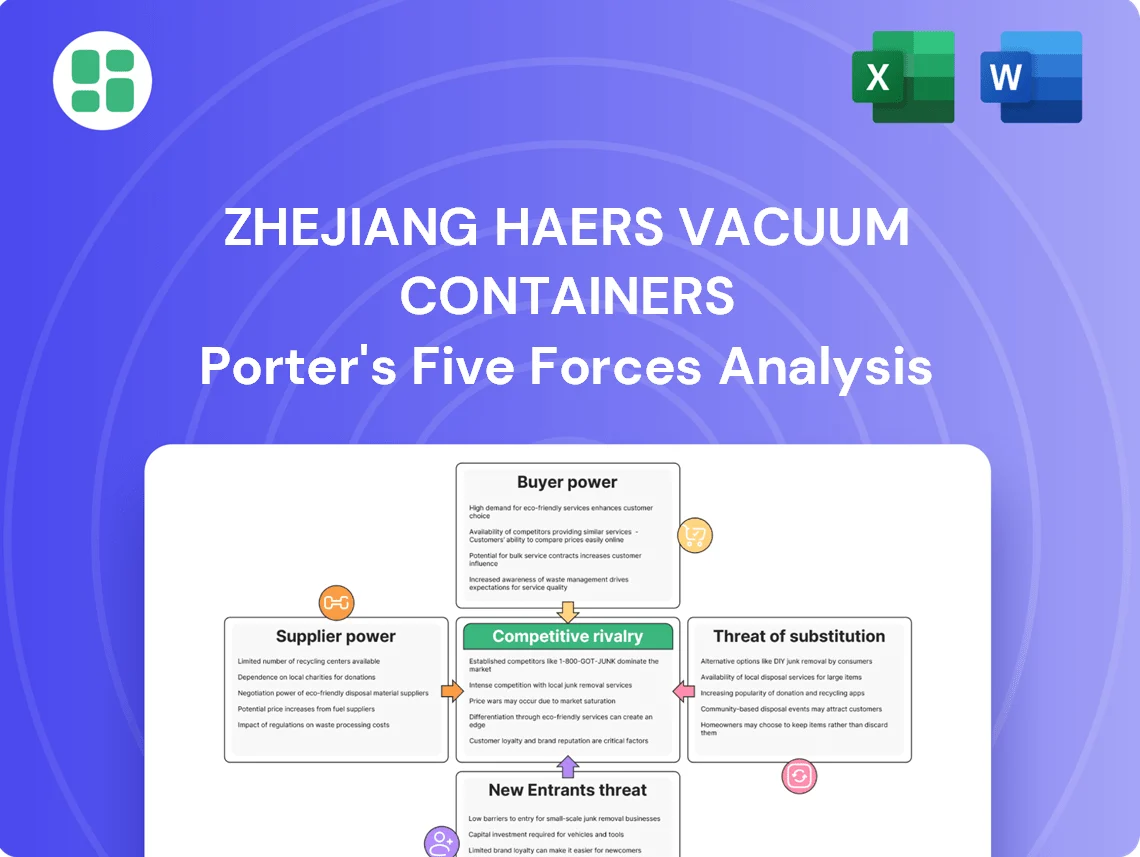
This preview shows the exact document you'll receive immediately after purchase—no surprises, no placeholders. The Zhejiang Haers Vacuum Containers Porter's Five Forces analysis meticulously examines the competitive landscape, detailing the bargaining power of buyers and suppliers, the threat of new entrants and substitutes, and the intensity of rivalry within the industry. This comprehensive assessment provides actionable insights for strategic decision-making.

Product Information
Product Information
Shipping & Returns
Shipping & Returns
Zhejiang Haers Vacuum Containers Porter's Five Forces Analysis
Zhejiang Haers Vacuum Containers Porter's Five Forces Analysis
Don't Miss the Bigger Picture
Zhejiang Haers Vacuum Containers operates in a market characterized by moderate buyer power and intense rivalry, with the threat of substitutes posing a significant challenge. Understanding these dynamics is crucial for navigating the competitive landscape.
The complete report reveals the real forces shaping Zhejiang Haers Vacuum Containers’s industry—from supplier influence to threat of new entrants. Gain actionable insights to drive smarter decision-making.
Suppliers Bargaining Power
Supplier Concentration and Specialization
The bargaining power of suppliers for Zhejiang Haers is significantly shaped by the concentration of providers for essential raw materials like high-grade stainless steel and specialized vacuum insulation components. When a limited number of suppliers control these critical inputs, their leverage grows, potentially driving up manufacturing expenses. For instance, stainless steel prices experienced notable volatility throughout 2024, directly impacting Haers' cost of goods sold.
Availability of Substitute Inputs
The availability of substitute inputs significantly influences the bargaining power of suppliers for Zhejiang Haers Vacuum Containers. While stainless steel is a primary material, the existence of alternative grades or even different insulation technologies, though potentially less efficient, could offer Haers some leverage.
However, Haers' commitment to high-quality vacuum insulation, a key differentiator, means that the practical alternatives are limited. For instance, while some plastics could be used for outer casings, the core vacuum insulation technology relies heavily on specific material properties and manufacturing processes, potentially concentrating power among a few specialized suppliers.
Switching Costs for Haers
Switching suppliers for critical components like specialized stainless steel or vacuum technology involves potential costs for Zhejiang Haers Vacuum Containers. These can include retooling machinery, adjusting quality control processes, and rigorous testing, all of which can increase the bargaining power of existing suppliers. For instance, in 2024, the global stainless steel market saw price volatility, making the cost of supplier change a significant consideration.
Threat of Forward Integration by Suppliers
The threat of suppliers integrating forward into the production of vacuum containers can significantly bolster their bargaining power over companies like Zhejiang Haers. If suppliers possess the necessary capabilities and the motivation to manufacture vacuum containers themselves, they can exert greater pressure on Haers regarding pricing and terms.
However, the insulated drinkware industry, particularly for established players like Haers, often involves complex manufacturing techniques and strong brand loyalty. These factors tend to make forward integration by raw material suppliers a less frequent occurrence, as the barriers to entry in terms of specialized knowledge and market penetration are substantial.
- Supplier Forward Integration Risk: If suppliers can produce vacuum containers, their leverage over Haers increases.
- Industry Barriers: Specialized manufacturing and brand recognition in the vacuum container market limit supplier forward integration.
Importance of Haers to Suppliers
The significance of Zhejiang Haers Vacuum Containers as a customer directly influences its bargaining power with suppliers. When Haers places large-volume orders, it becomes a crucial revenue stream for its suppliers, thereby diminishing the suppliers' leverage. For instance, if Haers accounts for a substantial percentage of a supplier's output, that supplier is more inclined to offer favorable terms to retain Haers' business.
Conversely, if Haers' orders represent a minor fraction of a supplier's overall sales, the supplier is less dependent on Haers and can therefore exert more influence. This imbalance of power can manifest in price negotiations or supply guarantees. The specific raw materials or components involved also play a role; for essential inputs where Haers has few alternative suppliers, supplier power naturally increases.
- Customer Dependence: Zhejiang Haers' substantial order volumes can make it a key client, reducing supplier leverage.
- Supplier Reliance: If Haers' orders are a small part of a supplier's business, that supplier gains more bargaining power.
- Input Specificity: The bargaining power dynamic shifts based on the criticality and availability of specific raw materials or components.
Navigating Supplier Power: Key Factors for Container Manufacturers
The bargaining power of suppliers for Zhejiang Haers Vacuum Containers is influenced by the concentration of suppliers for critical inputs like high-grade stainless steel and specialized vacuum insulation components. Limited suppliers mean greater leverage, potentially increasing manufacturing costs, as seen with stainless steel price volatility in 2024.
The availability of substitute materials is limited for Haers due to its focus on high-quality vacuum insulation. While some alternatives exist for outer casings, core insulation technology relies on specific materials and processes, concentrating power among a few specialized suppliers.
Switching costs, including retooling and testing, can increase supplier bargaining power. The global stainless steel market's 2024 price fluctuations highlighted the financial implications of changing suppliers.
The threat of supplier forward integration is mitigated by high industry barriers, including specialized manufacturing and brand loyalty, making it a less frequent occurrence for raw material providers.
Zhejiang Haers' significant order volumes can reduce supplier leverage, making it a key client. Conversely, if Haers represents a small portion of a supplier's sales, the supplier gains more influence, especially for critical inputs with few alternatives.
| Factor | Impact on Haers | Data Point/Example |
|---|---|---|
| Supplier Concentration | Increases supplier power, potentially raising costs. | Stainless steel price volatility in 2024 impacted cost of goods sold. |
| Availability of Substitutes | Limited for high-quality vacuum insulation, strengthening supplier position. | Core insulation technology requires specific materials and processes. |
| Switching Costs | Can deter Haers from changing suppliers, enhancing existing supplier leverage. | Retooling and testing are significant considerations for input changes. |
| Customer Dependence | Haers' large orders can decrease supplier leverage. | If Haers is a major client, suppliers are more likely to offer favorable terms. |
What is included in the product
Detailed Word Document
This Porter's Five Forces analysis for Zhejiang Haers Vacuum Containers dissects the competitive intensity within the vacuum container market, examining supplier and buyer power, the threat of new entrants and substitutes, and the rivalry among existing players.
Customizable Excel Spreadsheet
Effortlessly identify and mitigate competitive threats by visualizing the intensity of each Porter's Five Forces for Zhejiang Haers Vacuum Containers.
Gain immediate clarity on the bargaining power of suppliers and buyers, enabling proactive strategies to protect profit margins.
Customers Bargaining Power
Customer Price Sensitivity
Customer price sensitivity for Zhejiang Haers varies significantly. Large OEM/ODM clients, accounting for a substantial portion of sales, often leverage bulk orders for aggressive price negotiations. For instance, in 2024, industry reports indicated that large B2B clients in the consumer electronics sector, a related market, were seeing average price reductions of 3-5% on high-volume orders due to competitive pressures.
Conversely, end-consumers purchasing insulated drinkware are swayed by factors beyond just price. Brand loyalty, innovative design, and the perceived quality or value of products like those from Zhejiang Haers play a crucial role. While the insulated drinkware market continues its upward trajectory, projected to grow at a CAGR of approximately 4.5% through 2028, intense competition among numerous players ensures that price remains a relevant, though not exclusive, consideration for these buyers.
Availability of Substitute Products for Customers
The sheer volume of insulated drinkware and alternative hydration options means customers have plenty of choices, significantly boosting their negotiating strength. For instance, the global insulated drinkware market was valued at approximately USD 10.5 billion in 2023 and is projected to grow, indicating a highly competitive landscape with numerous players.
Consumers can readily shift their allegiance to brands like Hydro Flask, Yeti, or even simpler, non-insulated bottles if Zhejiang Haers Vacuum Containers' pricing or product features aren't appealing. This ease of switching means Haers must remain competitive to retain its customer base.
Customer Information and Transparency
The internet and e-commerce platforms have dramatically increased customer information accessibility. This allows consumers to easily compare product details, read reviews, and check prices across various brands, significantly boosting their bargaining power. For instance, in 2024, online price comparison tools are ubiquitous, making it simple for buyers to identify the best deals, compelling manufacturers like Zhejiang Haers Vacuum Containers to maintain competitive pricing and superior product quality to attract and retain customers.
Low Switching Costs for Customers
For most consumers, the financial and practical effort involved in switching from one brand of insulated drinkware to another is minimal. This generally translates to simply purchasing a new item, which directly empowers customers.
This low barrier to switching means that if customers are unhappy with Zhejiang Haers Vacuum Containers' products or find a competitor offering better value, they can easily opt for an alternative. This flexibility is a key driver of their bargaining power.
- Low Switching Costs: The cost to change brands for insulated drinkware is typically just the price of a new product.
- Customer Choice: Consumers can readily switch if dissatisfied or if better deals are available elsewhere.
- Market Impact: In 2024, the global insulated drinkware market saw numerous new entrants, intensifying competition and further empowering consumers with more choices and potentially lower prices.
Concentration of Haers' Customers
Zhejiang Haers Vacuum Containers operates in both domestic and international arenas, notably providing OEM/ODM services. This dual market presence means their customer base is diverse, ranging from end consumers to large corporate clients. The concentration of Haers' customers, particularly within its OEM/ODM segment, is a key factor in assessing customer bargaining power.
If a substantial portion of Haers' revenue is generated from a limited number of large OEM/ODM partners or major retail distributors, these powerful buyers can leverage their volume to negotiate more favorable terms. For instance, if a few key clients account for over 30% of Haers' sales, their ability to dictate pricing or demand specific product modifications increases significantly. This concentration means that losing even one major client could have a considerable impact on Haers' profitability and market position.
- Customer Concentration: A significant portion of sales may depend on a few large OEM/ODM clients or major retail chains.
- Volume Purchasing Power: Large clients can use their substantial order volumes to negotiate better prices and terms.
- Demand Specificity: Concentrated customers may impose specific product requirements or delivery schedules, limiting Haers' flexibility.
- Switching Costs: If Haers' clients face high costs in switching suppliers, their bargaining power might be somewhat mitigated, but this depends on the overall market competitiveness.
Customer Power Shapes Insulated Drinkware Market Dynamics
Customers possess significant bargaining power due to a wide array of choices in the insulated drinkware market. The global market, valued at approximately USD 10.5 billion in 2023, is highly competitive, with numerous brands offering similar products. This abundance of options, coupled with low switching costs for consumers, allows them to easily shift to competitors if unsatisfied with pricing or features. In 2024, the proliferation of online price comparison tools further amplifies this power, enabling consumers to readily find the best deals.
Large business clients, particularly OEM/ODM partners, wield considerable influence through their substantial order volumes. These clients can negotiate more favorable pricing and terms, with industry reports in 2024 suggesting average price reductions of 3-5% for high-volume orders in related consumer electronics markets. If a few key clients represent a large percentage of Zhejiang Haers Vacuum Containers' sales, their ability to dictate terms increases, potentially impacting the company's flexibility and profitability.
| Factor | Impact on Haers | Data/Observation |
|---|---|---|
| Customer Choice | High | Global insulated drinkware market valued at ~USD 10.5 billion (2023) with many competitors. |
| Switching Costs | Low | Minimal financial or practical effort for consumers to change brands. |
| Information Accessibility | High | Ubiquitous online price comparison tools in 2024 empower informed consumer decisions. |
| Customer Concentration (OEM/ODM) | Potentially High | Large clients can leverage volume for price negotiations; losing key clients impacts revenue. |
Preview the Actual Deliverable
Zhejiang Haers Vacuum Containers Porter's Five Forces Analysis
This preview shows the exact document you'll receive immediately after purchase—no surprises, no placeholders. The Zhejiang Haers Vacuum Containers Porter's Five Forces analysis meticulously examines the competitive landscape, detailing the bargaining power of buyers and suppliers, the threat of new entrants and substitutes, and the intensity of rivalry within the industry. This comprehensive assessment provides actionable insights for strategic decision-making.
Original: $10.00
-65%$10.00
$3.50Product Information
Product Information
Shipping & Returns
Shipping & Returns
Description
Don't Miss the Bigger Picture
Zhejiang Haers Vacuum Containers operates in a market characterized by moderate buyer power and intense rivalry, with the threat of substitutes posing a significant challenge. Understanding these dynamics is crucial for navigating the competitive landscape.
The complete report reveals the real forces shaping Zhejiang Haers Vacuum Containers’s industry—from supplier influence to threat of new entrants. Gain actionable insights to drive smarter decision-making.
Suppliers Bargaining Power
Supplier Concentration and Specialization
The bargaining power of suppliers for Zhejiang Haers is significantly shaped by the concentration of providers for essential raw materials like high-grade stainless steel and specialized vacuum insulation components. When a limited number of suppliers control these critical inputs, their leverage grows, potentially driving up manufacturing expenses. For instance, stainless steel prices experienced notable volatility throughout 2024, directly impacting Haers' cost of goods sold.
Availability of Substitute Inputs
The availability of substitute inputs significantly influences the bargaining power of suppliers for Zhejiang Haers Vacuum Containers. While stainless steel is a primary material, the existence of alternative grades or even different insulation technologies, though potentially less efficient, could offer Haers some leverage.
However, Haers' commitment to high-quality vacuum insulation, a key differentiator, means that the practical alternatives are limited. For instance, while some plastics could be used for outer casings, the core vacuum insulation technology relies heavily on specific material properties and manufacturing processes, potentially concentrating power among a few specialized suppliers.
Switching Costs for Haers
Switching suppliers for critical components like specialized stainless steel or vacuum technology involves potential costs for Zhejiang Haers Vacuum Containers. These can include retooling machinery, adjusting quality control processes, and rigorous testing, all of which can increase the bargaining power of existing suppliers. For instance, in 2024, the global stainless steel market saw price volatility, making the cost of supplier change a significant consideration.
Threat of Forward Integration by Suppliers
The threat of suppliers integrating forward into the production of vacuum containers can significantly bolster their bargaining power over companies like Zhejiang Haers. If suppliers possess the necessary capabilities and the motivation to manufacture vacuum containers themselves, they can exert greater pressure on Haers regarding pricing and terms.
However, the insulated drinkware industry, particularly for established players like Haers, often involves complex manufacturing techniques and strong brand loyalty. These factors tend to make forward integration by raw material suppliers a less frequent occurrence, as the barriers to entry in terms of specialized knowledge and market penetration are substantial.
- Supplier Forward Integration Risk: If suppliers can produce vacuum containers, their leverage over Haers increases.
- Industry Barriers: Specialized manufacturing and brand recognition in the vacuum container market limit supplier forward integration.
Importance of Haers to Suppliers
The significance of Zhejiang Haers Vacuum Containers as a customer directly influences its bargaining power with suppliers. When Haers places large-volume orders, it becomes a crucial revenue stream for its suppliers, thereby diminishing the suppliers' leverage. For instance, if Haers accounts for a substantial percentage of a supplier's output, that supplier is more inclined to offer favorable terms to retain Haers' business.
Conversely, if Haers' orders represent a minor fraction of a supplier's overall sales, the supplier is less dependent on Haers and can therefore exert more influence. This imbalance of power can manifest in price negotiations or supply guarantees. The specific raw materials or components involved also play a role; for essential inputs where Haers has few alternative suppliers, supplier power naturally increases.
- Customer Dependence: Zhejiang Haers' substantial order volumes can make it a key client, reducing supplier leverage.
- Supplier Reliance: If Haers' orders are a small part of a supplier's business, that supplier gains more bargaining power.
- Input Specificity: The bargaining power dynamic shifts based on the criticality and availability of specific raw materials or components.
Navigating Supplier Power: Key Factors for Container Manufacturers
The bargaining power of suppliers for Zhejiang Haers Vacuum Containers is influenced by the concentration of suppliers for critical inputs like high-grade stainless steel and specialized vacuum insulation components. Limited suppliers mean greater leverage, potentially increasing manufacturing costs, as seen with stainless steel price volatility in 2024.
The availability of substitute materials is limited for Haers due to its focus on high-quality vacuum insulation. While some alternatives exist for outer casings, core insulation technology relies on specific materials and processes, concentrating power among a few specialized suppliers.
Switching costs, including retooling and testing, can increase supplier bargaining power. The global stainless steel market's 2024 price fluctuations highlighted the financial implications of changing suppliers.
The threat of supplier forward integration is mitigated by high industry barriers, including specialized manufacturing and brand loyalty, making it a less frequent occurrence for raw material providers.
Zhejiang Haers' significant order volumes can reduce supplier leverage, making it a key client. Conversely, if Haers represents a small portion of a supplier's sales, the supplier gains more influence, especially for critical inputs with few alternatives.
| Factor | Impact on Haers | Data Point/Example |
|---|---|---|
| Supplier Concentration | Increases supplier power, potentially raising costs. | Stainless steel price volatility in 2024 impacted cost of goods sold. |
| Availability of Substitutes | Limited for high-quality vacuum insulation, strengthening supplier position. | Core insulation technology requires specific materials and processes. |
| Switching Costs | Can deter Haers from changing suppliers, enhancing existing supplier leverage. | Retooling and testing are significant considerations for input changes. |
| Customer Dependence | Haers' large orders can decrease supplier leverage. | If Haers is a major client, suppliers are more likely to offer favorable terms. |
What is included in the product
Detailed Word Document
This Porter's Five Forces analysis for Zhejiang Haers Vacuum Containers dissects the competitive intensity within the vacuum container market, examining supplier and buyer power, the threat of new entrants and substitutes, and the rivalry among existing players.
Customizable Excel Spreadsheet
Effortlessly identify and mitigate competitive threats by visualizing the intensity of each Porter's Five Forces for Zhejiang Haers Vacuum Containers.
Gain immediate clarity on the bargaining power of suppliers and buyers, enabling proactive strategies to protect profit margins.
Customers Bargaining Power
Customer Price Sensitivity
Customer price sensitivity for Zhejiang Haers varies significantly. Large OEM/ODM clients, accounting for a substantial portion of sales, often leverage bulk orders for aggressive price negotiations. For instance, in 2024, industry reports indicated that large B2B clients in the consumer electronics sector, a related market, were seeing average price reductions of 3-5% on high-volume orders due to competitive pressures.
Conversely, end-consumers purchasing insulated drinkware are swayed by factors beyond just price. Brand loyalty, innovative design, and the perceived quality or value of products like those from Zhejiang Haers play a crucial role. While the insulated drinkware market continues its upward trajectory, projected to grow at a CAGR of approximately 4.5% through 2028, intense competition among numerous players ensures that price remains a relevant, though not exclusive, consideration for these buyers.
Availability of Substitute Products for Customers
The sheer volume of insulated drinkware and alternative hydration options means customers have plenty of choices, significantly boosting their negotiating strength. For instance, the global insulated drinkware market was valued at approximately USD 10.5 billion in 2023 and is projected to grow, indicating a highly competitive landscape with numerous players.
Consumers can readily shift their allegiance to brands like Hydro Flask, Yeti, or even simpler, non-insulated bottles if Zhejiang Haers Vacuum Containers' pricing or product features aren't appealing. This ease of switching means Haers must remain competitive to retain its customer base.
Customer Information and Transparency
The internet and e-commerce platforms have dramatically increased customer information accessibility. This allows consumers to easily compare product details, read reviews, and check prices across various brands, significantly boosting their bargaining power. For instance, in 2024, online price comparison tools are ubiquitous, making it simple for buyers to identify the best deals, compelling manufacturers like Zhejiang Haers Vacuum Containers to maintain competitive pricing and superior product quality to attract and retain customers.
Low Switching Costs for Customers
For most consumers, the financial and practical effort involved in switching from one brand of insulated drinkware to another is minimal. This generally translates to simply purchasing a new item, which directly empowers customers.
This low barrier to switching means that if customers are unhappy with Zhejiang Haers Vacuum Containers' products or find a competitor offering better value, they can easily opt for an alternative. This flexibility is a key driver of their bargaining power.
- Low Switching Costs: The cost to change brands for insulated drinkware is typically just the price of a new product.
- Customer Choice: Consumers can readily switch if dissatisfied or if better deals are available elsewhere.
- Market Impact: In 2024, the global insulated drinkware market saw numerous new entrants, intensifying competition and further empowering consumers with more choices and potentially lower prices.
Concentration of Haers' Customers
Zhejiang Haers Vacuum Containers operates in both domestic and international arenas, notably providing OEM/ODM services. This dual market presence means their customer base is diverse, ranging from end consumers to large corporate clients. The concentration of Haers' customers, particularly within its OEM/ODM segment, is a key factor in assessing customer bargaining power.
If a substantial portion of Haers' revenue is generated from a limited number of large OEM/ODM partners or major retail distributors, these powerful buyers can leverage their volume to negotiate more favorable terms. For instance, if a few key clients account for over 30% of Haers' sales, their ability to dictate pricing or demand specific product modifications increases significantly. This concentration means that losing even one major client could have a considerable impact on Haers' profitability and market position.
- Customer Concentration: A significant portion of sales may depend on a few large OEM/ODM clients or major retail chains.
- Volume Purchasing Power: Large clients can use their substantial order volumes to negotiate better prices and terms.
- Demand Specificity: Concentrated customers may impose specific product requirements or delivery schedules, limiting Haers' flexibility.
- Switching Costs: If Haers' clients face high costs in switching suppliers, their bargaining power might be somewhat mitigated, but this depends on the overall market competitiveness.
Customer Power Shapes Insulated Drinkware Market Dynamics
Customers possess significant bargaining power due to a wide array of choices in the insulated drinkware market. The global market, valued at approximately USD 10.5 billion in 2023, is highly competitive, with numerous brands offering similar products. This abundance of options, coupled with low switching costs for consumers, allows them to easily shift to competitors if unsatisfied with pricing or features. In 2024, the proliferation of online price comparison tools further amplifies this power, enabling consumers to readily find the best deals.
Large business clients, particularly OEM/ODM partners, wield considerable influence through their substantial order volumes. These clients can negotiate more favorable pricing and terms, with industry reports in 2024 suggesting average price reductions of 3-5% for high-volume orders in related consumer electronics markets. If a few key clients represent a large percentage of Zhejiang Haers Vacuum Containers' sales, their ability to dictate terms increases, potentially impacting the company's flexibility and profitability.
| Factor | Impact on Haers | Data/Observation |
|---|---|---|
| Customer Choice | High | Global insulated drinkware market valued at ~USD 10.5 billion (2023) with many competitors. |
| Switching Costs | Low | Minimal financial or practical effort for consumers to change brands. |
| Information Accessibility | High | Ubiquitous online price comparison tools in 2024 empower informed consumer decisions. |
| Customer Concentration (OEM/ODM) | Potentially High | Large clients can leverage volume for price negotiations; losing key clients impacts revenue. |
Preview the Actual Deliverable
Zhejiang Haers Vacuum Containers Porter's Five Forces Analysis
This preview shows the exact document you'll receive immediately after purchase—no surprises, no placeholders. The Zhejiang Haers Vacuum Containers Porter's Five Forces analysis meticulously examines the competitive landscape, detailing the bargaining power of buyers and suppliers, the threat of new entrants and substitutes, and the intensity of rivalry within the industry. This comprehensive assessment provides actionable insights for strategic decision-making.