Flight Centre Porter's Five Forces Analysis

From Overview to Strategy Blueprint
Flight Centre faces significant competitive pressures, with the threat of new entrants and the bargaining power of buyers playing crucial roles in shaping its market. Understanding these dynamics is key to navigating the travel industry.
The complete report reveals the real forces shaping Flight Centre’s industry—from supplier influence to threat of new entrants. Gain actionable insights to drive smarter decision-making.
Suppliers Bargaining Power

Supplier Concentration and Differentiation
The travel industry's reliance on a concentrated group of major airlines and hotel chains grants these suppliers significant leverage. For instance, in 2024, the top three global airlines by passenger revenue controlled a substantial portion of the market, giving them considerable influence over pricing and terms offered to travel agencies like Flight Centre.
These dominant suppliers, with their robust networks and strong brand equity, can dictate terms, including commission structures, to travel retailers. This concentration means that Flight Centre, and similar businesses, have limited alternatives when sourcing core travel inventory, thereby increasing the bargaining power of these key suppliers.
Importance of Supplier Relationships
Flight Centre's business model thrives on its extensive network of partnerships with airlines, hotels, and tour operators. These relationships are fundamental to curating diverse travel packages and securing competitive pricing, directly impacting customer value. For instance, in the 2023 financial year, Flight Centre Travel Group reported a significant rebound, with underlying profit before tax reaching AUD 327 million, underscoring the importance of these supplier collaborations in achieving financial success.

Switching Costs for Flight Centre
Flight Centre's reliance on Global Distribution System (GDS) providers and major airline partners presents a notable supplier bargaining power. While the company cultivates strong relationships, the actual process of switching these critical suppliers would likely incur substantial operational disruptions and considerable financial outlays. This inherent switching cost grants these suppliers significant leverage in price and contract negotiations, impacting Flight Centre's cost structure and operational flexibility.

Impact of Technology and Direct Channels
Airlines are increasingly pushing direct booking channels and New Distribution Capability (NDC) content, which directly impacts intermediaries like Flight Centre by potentially reducing commission payouts. This trend puts pressure on Flight Centre's traditional revenue streams.
To counter this, Flight Centre is making strategic investments in its own technology, notably through its acquisition of TPConnects. This move is designed to lessen dependence on external distribution systems and gain more control over how travel content is offered.
- Direct Booking Trend: Airlines are actively promoting their own websites and NDC content, aiming to capture a larger share of bookings directly from consumers.
- NDC Impact: New Distribution Capability allows airlines to offer richer content and potentially different pricing through direct channels, bypassing traditional Global Distribution Systems (GDS) and travel agencies.
- Flight Centre's Tech Investment: The acquisition of TPConnects, a technology company specializing in NDC integration, signifies Flight Centre's commitment to building its own technological capabilities to compete effectively.
- Mitigating Reliance: By developing in-house technology, Flight Centre aims to reduce its reliance on third-party suppliers and distribution platforms, thereby strengthening its bargaining power in the long run.
Flight Centre's Scale as Countervailing Power
Flight Centre’s immense global footprint as one of the largest travel retailers and corporate travel management companies grants it significant bargaining power. This scale allows Flight Centre to negotiate superior terms, commissions, and pricing with airlines, hotels, and other travel providers. For instance, in the fiscal year 2023, Flight Centre reported total transaction value of AU$17.4 billion, underscoring its substantial purchasing volume.
This considerable buying power acts as a crucial counterweight against supplier influence. By consolidating demand from its vast network of customers and corporate clients, Flight Centre can secure more advantageous arrangements than smaller competitors. This leverage helps to mitigate the impact of suppliers attempting to dictate terms, thereby protecting Flight Centre's profit margins.
The ability to negotiate favorable deals is directly linked to Flight Centre's market share and transaction volume. For example, its corporate travel segment alone managed AU$5.6 billion in travel spending in FY23. This financial clout enables the company to influence supplier behavior and secure benefits that are inaccessible to less dominant players in the travel industry.
- Global Scale: Flight Centre operates in over 20 countries, facilitating substantial purchasing power.
- Negotiating Leverage: The company's large transaction volumes allow for favorable commission rates and terms with suppliers.
- FY23 Performance: A total transaction value of AU$17.4 billion in FY23 highlights Flight Centre's significant buying influence.
- Corporate Travel Dominance: Managing AU$5.6 billion in corporate travel spending in FY23 further strengthens its position with suppliers.
Supplier Bargaining vs. Flight Centre's Buying Power
The bargaining power of suppliers for Flight Centre is significant, primarily due to the concentrated nature of major airlines and hotel chains. In 2024, the top global airlines by passenger revenue held substantial market share, enabling them to influence pricing and terms for travel agencies like Flight Centre.
These dominant suppliers, with their established networks and brand recognition, can dictate terms, including commission structures, to travel retailers. Flight Centre's reliance on these key suppliers, with limited viable alternatives for core travel inventory, amplifies supplier leverage and impacts the company's cost structure.
Flight Centre's substantial global footprint, evidenced by a total transaction value of AU$17.4 billion in FY23, grants it considerable buying power. This scale allows for negotiation of more favorable terms and commissions with suppliers, acting as a counterweight to supplier influence.
| Supplier Type | Key Players | Estimated Market Concentration (2024) | Impact on Flight Centre |
|---|---|---|---|
| Airlines | Major global carriers (e.g., IAG, Lufthansa Group, United Airlines) | Top 3 control significant passenger revenue | Pricing, commission rates, NDC content access |
| Hotels | Large hotel groups (e.g., Marriott International, Hilton Worldwide) | Concentrated ownership of major brands | Room rates, commission structures, package deals |
| Global Distribution Systems (GDS) | Amadeus, Sabre, Travelport | Dominated by a few providers | Technology access fees, booking fees, data access |
What is included in the product
 Detailed Word Document
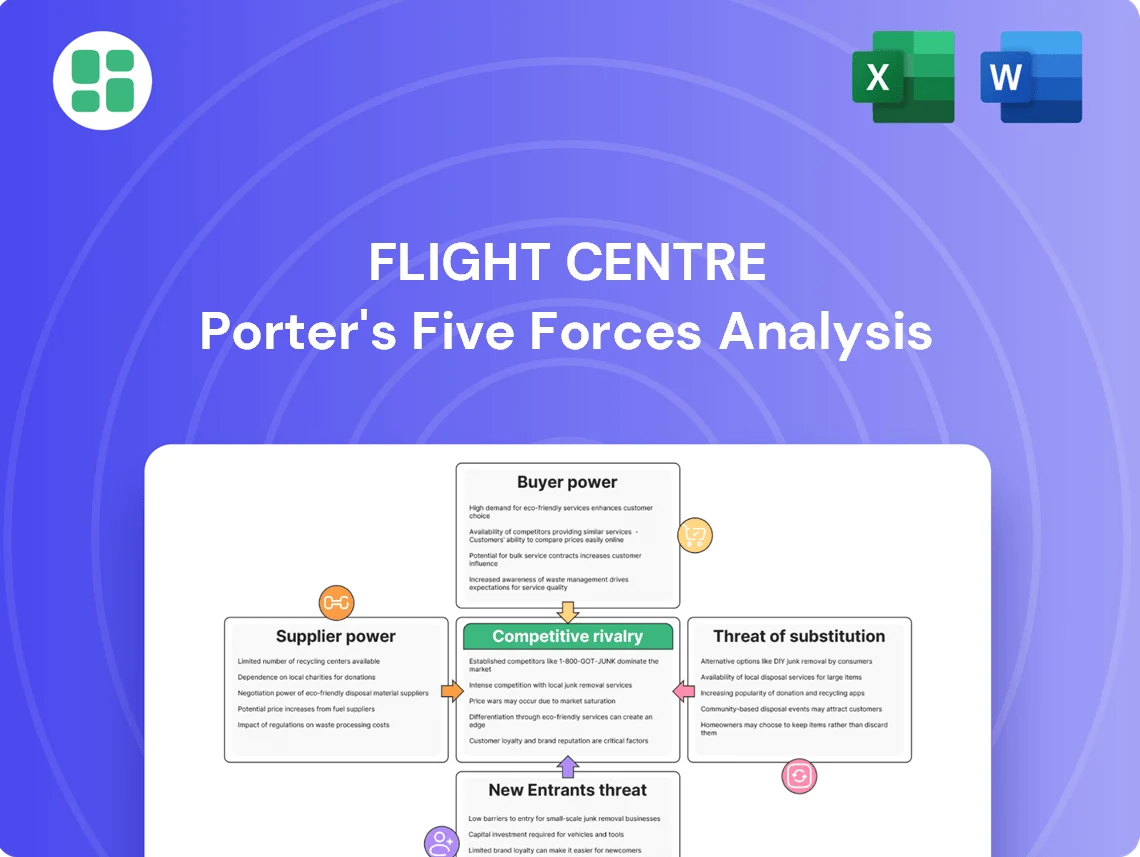
This analysis dissects the competitive forces impacting Flight Centre, examining the threat of new entrants, the bargaining power of buyers and suppliers, the intensity of rivalry, and the threat of substitutes.

 Customizable Excel Spreadsheet
Visually identify and address competitive threats with an intuitive Porter's Five Forces dashboard.
Easily pinpoint areas of strategic vulnerability to proactively mitigate risks and improve competitive positioning.
Customers Bargaining Power

Price Sensitivity and Comparison
Customers, particularly those booking leisure travel, are highly attuned to price. In 2024, the average leisure traveler spent an estimated $1,500 on domestic trips, making them keen to find the best deals. This price sensitivity is amplified by the ease with which they can compare offerings across numerous online travel agencies, airline websites, and even traditional agents, creating significant downward pressure on margins for companies like Flight Centre.
Access to Information and Online Platforms
The rise of online travel agencies and direct booking websites has dramatically increased customer access to information. In 2024, it's estimated that over 80% of travel bookings begin with online research, giving consumers unprecedented power to compare prices and services.
This ease of access to information directly challenges traditional travel agents like Flight Centre. Customers can now easily find and book flights, accommodations, and activities themselves, diminishing the need for intermediaries and thereby increasing their bargaining power.

Low Switching Costs for Customers
For many travel services, including those offered by Flight Centre, customers often face low switching costs. This means it's generally easy and inexpensive for travelers to move from one booking platform or travel agent to another if they find a better offer or a more convenient experience elsewhere.
This ease of switching significantly boosts customer bargaining power. For instance, a survey in early 2024 indicated that over 60% of online travel bookers consider price as the primary factor when choosing a provider, highlighting their willingness to switch for cost savings.
Consequently, Flight Centre must remain competitive on pricing and service quality to retain its customer base. The ability for customers to quickly compare and select alternatives puts pressure on the company to deliver value and avoid complacency, as evidenced by the increasing market share of online travel agencies (OTAs) that often compete on price.

Corporate Client Demand and Loyalty
In the corporate travel sector, Flight Centre engages with substantial businesses that represent considerable travel expenditures. These major clients often seek tailored solutions and aggressive pricing. However, Flight Centre's specialized corporate arms, such as FCM Travel and Corporate Traveller, consistently achieve high customer retention, frequently in the high 90s. This demonstrates a strong perceived value and loyalty among these corporate accounts.
This high retention rate suggests that while corporate clients possess bargaining power due to their spending volume, Flight Centre has successfully established sticky relationships. The ability to retain clients at such elevated levels indicates that the company provides services or benefits that outweigh the potential for clients to switch to competitors based solely on price or standard offerings.
- High Retention Rates: Flight Centre's corporate divisions, like FCM Travel and Corporate Traveller, typically boast customer retention rates exceeding 90%.
- Significant Client Spend: The company serves large corporate clients with substantial annual travel budgets, giving these clients leverage.
- Demand for Customization: Corporate clients often require bespoke travel management solutions, influencing service demands.
- Competitive Pricing Pressure: The large volume of business means these clients can negotiate for more competitive pricing structures.
Trends in Travel Spending
The bargaining power of customers within the travel sector, particularly for Flight Centre, is influenced by evolving spending patterns. Recent surveys highlight a notable trend: businesses are increasingly prioritizing travel in fiscal year 2025. A significant portion of global companies intend to boost their travel activities and associated spending.
This upward trend in corporate travel investment suggests a temporary softening of price sensitivity among business clients. For Flight Centre, this translates into a stronger negotiating position within the corporate segment, as companies are more focused on the value and necessity of travel rather than solely on cost reduction.
- Increased Business Travel Investment: Global businesses are planning to expand travel activities and spending in FY2025.
- Reduced Price Sensitivity: This expansion indicates a temporary decrease in customer price sensitivity in the corporate travel market.
- Strengthened Position: The trend enhances Flight Centre's leverage with corporate clients.
Corporate Travel: Mitigating Price Sensitivity
While leisure travelers exhibit strong price sensitivity and low switching costs, Flight Centre's corporate clients, despite their volume, show high retention. This suggests that specialized services and tailored solutions offered by Flight Centre's corporate divisions, such as FCM Travel and Corporate Traveller, effectively mitigate the customers' bargaining power.
The increasing emphasis on business travel in FY2025, with companies planning to boost spending, further indicates a potential softening of price sensitivity among these key clients. This trend allows Flight Centre to leverage its established relationships and value proposition.
| Customer Segment | Price Sensitivity | Switching Costs | Bargaining Power Impact |
|---|---|---|---|
| Leisure Travelers | High | Low | Significant downward pressure on pricing |
| Corporate Clients | Moderate (increasingly focused on value in FY2025) | Moderate to High (due to specialized services and retention) | Mitigated by high retention rates and tailored offerings |
Preview Before You Purchase
Flight Centre Porter's Five Forces Analysis
You're previewing the final version of the Flight Centre Porter's Five Forces Analysis—precisely the same document that will be available to you instantly after buying. This comprehensive analysis delves into the competitive landscape, detailing the bargaining power of buyers and suppliers, the threat of new entrants and substitutes, and the intensity of rivalry within the travel industry. What you see here is the complete, ready-to-use file, offering actionable insights for strategic decision-making.

Product Information
Product Information
Shipping & Returns
Shipping & Returns
Flight Centre Porter's Five Forces Analysis
Flight Centre Porter's Five Forces Analysis
From Overview to Strategy Blueprint
Flight Centre faces significant competitive pressures, with the threat of new entrants and the bargaining power of buyers playing crucial roles in shaping its market. Understanding these dynamics is key to navigating the travel industry.
The complete report reveals the real forces shaping Flight Centre’s industry—from supplier influence to threat of new entrants. Gain actionable insights to drive smarter decision-making.
Suppliers Bargaining Power
Supplier Concentration and Differentiation
The travel industry's reliance on a concentrated group of major airlines and hotel chains grants these suppliers significant leverage. For instance, in 2024, the top three global airlines by passenger revenue controlled a substantial portion of the market, giving them considerable influence over pricing and terms offered to travel agencies like Flight Centre.
These dominant suppliers, with their robust networks and strong brand equity, can dictate terms, including commission structures, to travel retailers. This concentration means that Flight Centre, and similar businesses, have limited alternatives when sourcing core travel inventory, thereby increasing the bargaining power of these key suppliers.
Importance of Supplier Relationships
Flight Centre's business model thrives on its extensive network of partnerships with airlines, hotels, and tour operators. These relationships are fundamental to curating diverse travel packages and securing competitive pricing, directly impacting customer value. For instance, in the 2023 financial year, Flight Centre Travel Group reported a significant rebound, with underlying profit before tax reaching AUD 327 million, underscoring the importance of these supplier collaborations in achieving financial success.
Switching Costs for Flight Centre
Flight Centre's reliance on Global Distribution System (GDS) providers and major airline partners presents a notable supplier bargaining power. While the company cultivates strong relationships, the actual process of switching these critical suppliers would likely incur substantial operational disruptions and considerable financial outlays. This inherent switching cost grants these suppliers significant leverage in price and contract negotiations, impacting Flight Centre's cost structure and operational flexibility.
Impact of Technology and Direct Channels
Airlines are increasingly pushing direct booking channels and New Distribution Capability (NDC) content, which directly impacts intermediaries like Flight Centre by potentially reducing commission payouts. This trend puts pressure on Flight Centre's traditional revenue streams.
To counter this, Flight Centre is making strategic investments in its own technology, notably through its acquisition of TPConnects. This move is designed to lessen dependence on external distribution systems and gain more control over how travel content is offered.
- Direct Booking Trend: Airlines are actively promoting their own websites and NDC content, aiming to capture a larger share of bookings directly from consumers.
- NDC Impact: New Distribution Capability allows airlines to offer richer content and potentially different pricing through direct channels, bypassing traditional Global Distribution Systems (GDS) and travel agencies.
- Flight Centre's Tech Investment: The acquisition of TPConnects, a technology company specializing in NDC integration, signifies Flight Centre's commitment to building its own technological capabilities to compete effectively.
- Mitigating Reliance: By developing in-house technology, Flight Centre aims to reduce its reliance on third-party suppliers and distribution platforms, thereby strengthening its bargaining power in the long run.
Flight Centre's Scale as Countervailing Power
Flight Centre’s immense global footprint as one of the largest travel retailers and corporate travel management companies grants it significant bargaining power. This scale allows Flight Centre to negotiate superior terms, commissions, and pricing with airlines, hotels, and other travel providers. For instance, in the fiscal year 2023, Flight Centre reported total transaction value of AU$17.4 billion, underscoring its substantial purchasing volume.
This considerable buying power acts as a crucial counterweight against supplier influence. By consolidating demand from its vast network of customers and corporate clients, Flight Centre can secure more advantageous arrangements than smaller competitors. This leverage helps to mitigate the impact of suppliers attempting to dictate terms, thereby protecting Flight Centre's profit margins.
The ability to negotiate favorable deals is directly linked to Flight Centre's market share and transaction volume. For example, its corporate travel segment alone managed AU$5.6 billion in travel spending in FY23. This financial clout enables the company to influence supplier behavior and secure benefits that are inaccessible to less dominant players in the travel industry.
- Global Scale: Flight Centre operates in over 20 countries, facilitating substantial purchasing power.
- Negotiating Leverage: The company's large transaction volumes allow for favorable commission rates and terms with suppliers.
- FY23 Performance: A total transaction value of AU$17.4 billion in FY23 highlights Flight Centre's significant buying influence.
- Corporate Travel Dominance: Managing AU$5.6 billion in corporate travel spending in FY23 further strengthens its position with suppliers.
Supplier Bargaining vs. Flight Centre's Buying Power
The bargaining power of suppliers for Flight Centre is significant, primarily due to the concentrated nature of major airlines and hotel chains. In 2024, the top global airlines by passenger revenue held substantial market share, enabling them to influence pricing and terms for travel agencies like Flight Centre.
These dominant suppliers, with their established networks and brand recognition, can dictate terms, including commission structures, to travel retailers. Flight Centre's reliance on these key suppliers, with limited viable alternatives for core travel inventory, amplifies supplier leverage and impacts the company's cost structure.
Flight Centre's substantial global footprint, evidenced by a total transaction value of AU$17.4 billion in FY23, grants it considerable buying power. This scale allows for negotiation of more favorable terms and commissions with suppliers, acting as a counterweight to supplier influence.
| Supplier Type | Key Players | Estimated Market Concentration (2024) | Impact on Flight Centre |
|---|---|---|---|
| Airlines | Major global carriers (e.g., IAG, Lufthansa Group, United Airlines) | Top 3 control significant passenger revenue | Pricing, commission rates, NDC content access |
| Hotels | Large hotel groups (e.g., Marriott International, Hilton Worldwide) | Concentrated ownership of major brands | Room rates, commission structures, package deals |
| Global Distribution Systems (GDS) | Amadeus, Sabre, Travelport | Dominated by a few providers | Technology access fees, booking fees, data access |
What is included in the product
Detailed Word Document
This analysis dissects the competitive forces impacting Flight Centre, examining the threat of new entrants, the bargaining power of buyers and suppliers, the intensity of rivalry, and the threat of substitutes.
Customizable Excel Spreadsheet
Visually identify and address competitive threats with an intuitive Porter's Five Forces dashboard.
Easily pinpoint areas of strategic vulnerability to proactively mitigate risks and improve competitive positioning.
Customers Bargaining Power
Price Sensitivity and Comparison
Customers, particularly those booking leisure travel, are highly attuned to price. In 2024, the average leisure traveler spent an estimated $1,500 on domestic trips, making them keen to find the best deals. This price sensitivity is amplified by the ease with which they can compare offerings across numerous online travel agencies, airline websites, and even traditional agents, creating significant downward pressure on margins for companies like Flight Centre.
Access to Information and Online Platforms
The rise of online travel agencies and direct booking websites has dramatically increased customer access to information. In 2024, it's estimated that over 80% of travel bookings begin with online research, giving consumers unprecedented power to compare prices and services.
This ease of access to information directly challenges traditional travel agents like Flight Centre. Customers can now easily find and book flights, accommodations, and activities themselves, diminishing the need for intermediaries and thereby increasing their bargaining power.
Low Switching Costs for Customers
For many travel services, including those offered by Flight Centre, customers often face low switching costs. This means it's generally easy and inexpensive for travelers to move from one booking platform or travel agent to another if they find a better offer or a more convenient experience elsewhere.
This ease of switching significantly boosts customer bargaining power. For instance, a survey in early 2024 indicated that over 60% of online travel bookers consider price as the primary factor when choosing a provider, highlighting their willingness to switch for cost savings.
Consequently, Flight Centre must remain competitive on pricing and service quality to retain its customer base. The ability for customers to quickly compare and select alternatives puts pressure on the company to deliver value and avoid complacency, as evidenced by the increasing market share of online travel agencies (OTAs) that often compete on price.
Corporate Client Demand and Loyalty
In the corporate travel sector, Flight Centre engages with substantial businesses that represent considerable travel expenditures. These major clients often seek tailored solutions and aggressive pricing. However, Flight Centre's specialized corporate arms, such as FCM Travel and Corporate Traveller, consistently achieve high customer retention, frequently in the high 90s. This demonstrates a strong perceived value and loyalty among these corporate accounts.
This high retention rate suggests that while corporate clients possess bargaining power due to their spending volume, Flight Centre has successfully established sticky relationships. The ability to retain clients at such elevated levels indicates that the company provides services or benefits that outweigh the potential for clients to switch to competitors based solely on price or standard offerings.
- High Retention Rates: Flight Centre's corporate divisions, like FCM Travel and Corporate Traveller, typically boast customer retention rates exceeding 90%.
- Significant Client Spend: The company serves large corporate clients with substantial annual travel budgets, giving these clients leverage.
- Demand for Customization: Corporate clients often require bespoke travel management solutions, influencing service demands.
- Competitive Pricing Pressure: The large volume of business means these clients can negotiate for more competitive pricing structures.
Trends in Travel Spending
The bargaining power of customers within the travel sector, particularly for Flight Centre, is influenced by evolving spending patterns. Recent surveys highlight a notable trend: businesses are increasingly prioritizing travel in fiscal year 2025. A significant portion of global companies intend to boost their travel activities and associated spending.
This upward trend in corporate travel investment suggests a temporary softening of price sensitivity among business clients. For Flight Centre, this translates into a stronger negotiating position within the corporate segment, as companies are more focused on the value and necessity of travel rather than solely on cost reduction.
- Increased Business Travel Investment: Global businesses are planning to expand travel activities and spending in FY2025.
- Reduced Price Sensitivity: This expansion indicates a temporary decrease in customer price sensitivity in the corporate travel market.
- Strengthened Position: The trend enhances Flight Centre's leverage with corporate clients.
Corporate Travel: Mitigating Price Sensitivity
While leisure travelers exhibit strong price sensitivity and low switching costs, Flight Centre's corporate clients, despite their volume, show high retention. This suggests that specialized services and tailored solutions offered by Flight Centre's corporate divisions, such as FCM Travel and Corporate Traveller, effectively mitigate the customers' bargaining power.
The increasing emphasis on business travel in FY2025, with companies planning to boost spending, further indicates a potential softening of price sensitivity among these key clients. This trend allows Flight Centre to leverage its established relationships and value proposition.
| Customer Segment | Price Sensitivity | Switching Costs | Bargaining Power Impact |
|---|---|---|---|
| Leisure Travelers | High | Low | Significant downward pressure on pricing |
| Corporate Clients | Moderate (increasingly focused on value in FY2025) | Moderate to High (due to specialized services and retention) | Mitigated by high retention rates and tailored offerings |
Preview Before You Purchase
Flight Centre Porter's Five Forces Analysis
You're previewing the final version of the Flight Centre Porter's Five Forces Analysis—precisely the same document that will be available to you instantly after buying. This comprehensive analysis delves into the competitive landscape, detailing the bargaining power of buyers and suppliers, the threat of new entrants and substitutes, and the intensity of rivalry within the travel industry. What you see here is the complete, ready-to-use file, offering actionable insights for strategic decision-making.
Original: $10.00
-65%$10.00
$3.50Product Information
Product Information
Shipping & Returns
Shipping & Returns
Description
From Overview to Strategy Blueprint
Flight Centre faces significant competitive pressures, with the threat of new entrants and the bargaining power of buyers playing crucial roles in shaping its market. Understanding these dynamics is key to navigating the travel industry.
The complete report reveals the real forces shaping Flight Centre’s industry—from supplier influence to threat of new entrants. Gain actionable insights to drive smarter decision-making.
Suppliers Bargaining Power
Supplier Concentration and Differentiation
The travel industry's reliance on a concentrated group of major airlines and hotel chains grants these suppliers significant leverage. For instance, in 2024, the top three global airlines by passenger revenue controlled a substantial portion of the market, giving them considerable influence over pricing and terms offered to travel agencies like Flight Centre.
These dominant suppliers, with their robust networks and strong brand equity, can dictate terms, including commission structures, to travel retailers. This concentration means that Flight Centre, and similar businesses, have limited alternatives when sourcing core travel inventory, thereby increasing the bargaining power of these key suppliers.
Importance of Supplier Relationships
Flight Centre's business model thrives on its extensive network of partnerships with airlines, hotels, and tour operators. These relationships are fundamental to curating diverse travel packages and securing competitive pricing, directly impacting customer value. For instance, in the 2023 financial year, Flight Centre Travel Group reported a significant rebound, with underlying profit before tax reaching AUD 327 million, underscoring the importance of these supplier collaborations in achieving financial success.
Switching Costs for Flight Centre
Flight Centre's reliance on Global Distribution System (GDS) providers and major airline partners presents a notable supplier bargaining power. While the company cultivates strong relationships, the actual process of switching these critical suppliers would likely incur substantial operational disruptions and considerable financial outlays. This inherent switching cost grants these suppliers significant leverage in price and contract negotiations, impacting Flight Centre's cost structure and operational flexibility.
Impact of Technology and Direct Channels
Airlines are increasingly pushing direct booking channels and New Distribution Capability (NDC) content, which directly impacts intermediaries like Flight Centre by potentially reducing commission payouts. This trend puts pressure on Flight Centre's traditional revenue streams.
To counter this, Flight Centre is making strategic investments in its own technology, notably through its acquisition of TPConnects. This move is designed to lessen dependence on external distribution systems and gain more control over how travel content is offered.
- Direct Booking Trend: Airlines are actively promoting their own websites and NDC content, aiming to capture a larger share of bookings directly from consumers.
- NDC Impact: New Distribution Capability allows airlines to offer richer content and potentially different pricing through direct channels, bypassing traditional Global Distribution Systems (GDS) and travel agencies.
- Flight Centre's Tech Investment: The acquisition of TPConnects, a technology company specializing in NDC integration, signifies Flight Centre's commitment to building its own technological capabilities to compete effectively.
- Mitigating Reliance: By developing in-house technology, Flight Centre aims to reduce its reliance on third-party suppliers and distribution platforms, thereby strengthening its bargaining power in the long run.
Flight Centre's Scale as Countervailing Power
Flight Centre’s immense global footprint as one of the largest travel retailers and corporate travel management companies grants it significant bargaining power. This scale allows Flight Centre to negotiate superior terms, commissions, and pricing with airlines, hotels, and other travel providers. For instance, in the fiscal year 2023, Flight Centre reported total transaction value of AU$17.4 billion, underscoring its substantial purchasing volume.
This considerable buying power acts as a crucial counterweight against supplier influence. By consolidating demand from its vast network of customers and corporate clients, Flight Centre can secure more advantageous arrangements than smaller competitors. This leverage helps to mitigate the impact of suppliers attempting to dictate terms, thereby protecting Flight Centre's profit margins.
The ability to negotiate favorable deals is directly linked to Flight Centre's market share and transaction volume. For example, its corporate travel segment alone managed AU$5.6 billion in travel spending in FY23. This financial clout enables the company to influence supplier behavior and secure benefits that are inaccessible to less dominant players in the travel industry.
- Global Scale: Flight Centre operates in over 20 countries, facilitating substantial purchasing power.
- Negotiating Leverage: The company's large transaction volumes allow for favorable commission rates and terms with suppliers.
- FY23 Performance: A total transaction value of AU$17.4 billion in FY23 highlights Flight Centre's significant buying influence.
- Corporate Travel Dominance: Managing AU$5.6 billion in corporate travel spending in FY23 further strengthens its position with suppliers.
Supplier Bargaining vs. Flight Centre's Buying Power
The bargaining power of suppliers for Flight Centre is significant, primarily due to the concentrated nature of major airlines and hotel chains. In 2024, the top global airlines by passenger revenue held substantial market share, enabling them to influence pricing and terms for travel agencies like Flight Centre.
These dominant suppliers, with their established networks and brand recognition, can dictate terms, including commission structures, to travel retailers. Flight Centre's reliance on these key suppliers, with limited viable alternatives for core travel inventory, amplifies supplier leverage and impacts the company's cost structure.
Flight Centre's substantial global footprint, evidenced by a total transaction value of AU$17.4 billion in FY23, grants it considerable buying power. This scale allows for negotiation of more favorable terms and commissions with suppliers, acting as a counterweight to supplier influence.
| Supplier Type | Key Players | Estimated Market Concentration (2024) | Impact on Flight Centre |
|---|---|---|---|
| Airlines | Major global carriers (e.g., IAG, Lufthansa Group, United Airlines) | Top 3 control significant passenger revenue | Pricing, commission rates, NDC content access |
| Hotels | Large hotel groups (e.g., Marriott International, Hilton Worldwide) | Concentrated ownership of major brands | Room rates, commission structures, package deals |
| Global Distribution Systems (GDS) | Amadeus, Sabre, Travelport | Dominated by a few providers | Technology access fees, booking fees, data access |
What is included in the product
Detailed Word Document
This analysis dissects the competitive forces impacting Flight Centre, examining the threat of new entrants, the bargaining power of buyers and suppliers, the intensity of rivalry, and the threat of substitutes.
Customizable Excel Spreadsheet
Visually identify and address competitive threats with an intuitive Porter's Five Forces dashboard.
Easily pinpoint areas of strategic vulnerability to proactively mitigate risks and improve competitive positioning.
Customers Bargaining Power
Price Sensitivity and Comparison
Customers, particularly those booking leisure travel, are highly attuned to price. In 2024, the average leisure traveler spent an estimated $1,500 on domestic trips, making them keen to find the best deals. This price sensitivity is amplified by the ease with which they can compare offerings across numerous online travel agencies, airline websites, and even traditional agents, creating significant downward pressure on margins for companies like Flight Centre.
Access to Information and Online Platforms
The rise of online travel agencies and direct booking websites has dramatically increased customer access to information. In 2024, it's estimated that over 80% of travel bookings begin with online research, giving consumers unprecedented power to compare prices and services.
This ease of access to information directly challenges traditional travel agents like Flight Centre. Customers can now easily find and book flights, accommodations, and activities themselves, diminishing the need for intermediaries and thereby increasing their bargaining power.
Low Switching Costs for Customers
For many travel services, including those offered by Flight Centre, customers often face low switching costs. This means it's generally easy and inexpensive for travelers to move from one booking platform or travel agent to another if they find a better offer or a more convenient experience elsewhere.
This ease of switching significantly boosts customer bargaining power. For instance, a survey in early 2024 indicated that over 60% of online travel bookers consider price as the primary factor when choosing a provider, highlighting their willingness to switch for cost savings.
Consequently, Flight Centre must remain competitive on pricing and service quality to retain its customer base. The ability for customers to quickly compare and select alternatives puts pressure on the company to deliver value and avoid complacency, as evidenced by the increasing market share of online travel agencies (OTAs) that often compete on price.
Corporate Client Demand and Loyalty
In the corporate travel sector, Flight Centre engages with substantial businesses that represent considerable travel expenditures. These major clients often seek tailored solutions and aggressive pricing. However, Flight Centre's specialized corporate arms, such as FCM Travel and Corporate Traveller, consistently achieve high customer retention, frequently in the high 90s. This demonstrates a strong perceived value and loyalty among these corporate accounts.
This high retention rate suggests that while corporate clients possess bargaining power due to their spending volume, Flight Centre has successfully established sticky relationships. The ability to retain clients at such elevated levels indicates that the company provides services or benefits that outweigh the potential for clients to switch to competitors based solely on price or standard offerings.
- High Retention Rates: Flight Centre's corporate divisions, like FCM Travel and Corporate Traveller, typically boast customer retention rates exceeding 90%.
- Significant Client Spend: The company serves large corporate clients with substantial annual travel budgets, giving these clients leverage.
- Demand for Customization: Corporate clients often require bespoke travel management solutions, influencing service demands.
- Competitive Pricing Pressure: The large volume of business means these clients can negotiate for more competitive pricing structures.
Trends in Travel Spending
The bargaining power of customers within the travel sector, particularly for Flight Centre, is influenced by evolving spending patterns. Recent surveys highlight a notable trend: businesses are increasingly prioritizing travel in fiscal year 2025. A significant portion of global companies intend to boost their travel activities and associated spending.
This upward trend in corporate travel investment suggests a temporary softening of price sensitivity among business clients. For Flight Centre, this translates into a stronger negotiating position within the corporate segment, as companies are more focused on the value and necessity of travel rather than solely on cost reduction.
- Increased Business Travel Investment: Global businesses are planning to expand travel activities and spending in FY2025.
- Reduced Price Sensitivity: This expansion indicates a temporary decrease in customer price sensitivity in the corporate travel market.
- Strengthened Position: The trend enhances Flight Centre's leverage with corporate clients.
Corporate Travel: Mitigating Price Sensitivity
While leisure travelers exhibit strong price sensitivity and low switching costs, Flight Centre's corporate clients, despite their volume, show high retention. This suggests that specialized services and tailored solutions offered by Flight Centre's corporate divisions, such as FCM Travel and Corporate Traveller, effectively mitigate the customers' bargaining power.
The increasing emphasis on business travel in FY2025, with companies planning to boost spending, further indicates a potential softening of price sensitivity among these key clients. This trend allows Flight Centre to leverage its established relationships and value proposition.
| Customer Segment | Price Sensitivity | Switching Costs | Bargaining Power Impact |
|---|---|---|---|
| Leisure Travelers | High | Low | Significant downward pressure on pricing |
| Corporate Clients | Moderate (increasingly focused on value in FY2025) | Moderate to High (due to specialized services and retention) | Mitigated by high retention rates and tailored offerings |
Preview Before You Purchase
Flight Centre Porter's Five Forces Analysis
You're previewing the final version of the Flight Centre Porter's Five Forces Analysis—precisely the same document that will be available to you instantly after buying. This comprehensive analysis delves into the competitive landscape, detailing the bargaining power of buyers and suppliers, the threat of new entrants and substitutes, and the intensity of rivalry within the travel industry. What you see here is the complete, ready-to-use file, offering actionable insights for strategic decision-making.