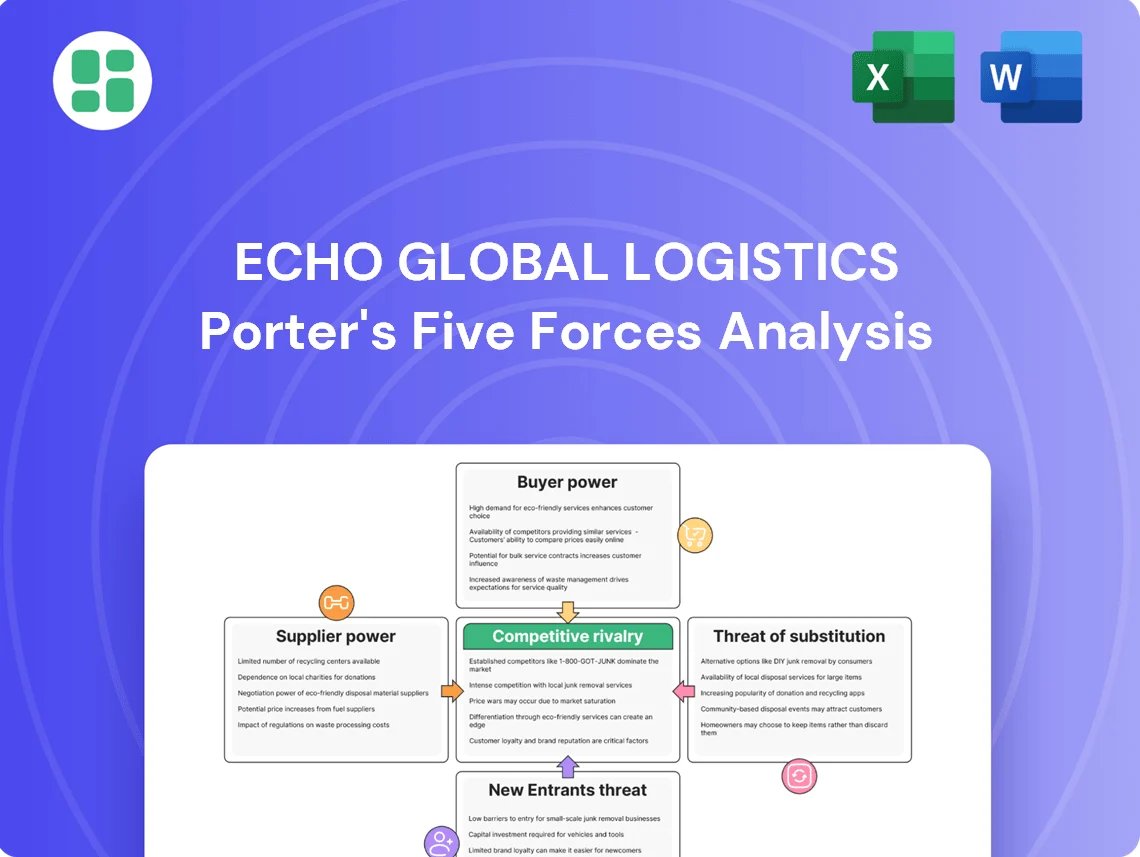
Echo Global Logistics Porter's Five Forces Analysis

From Overview to Strategy Blueprint
Echo Global Logistics operates in a dynamic transportation and logistics sector, where bargaining power of buyers and suppliers can significantly impact profitability. The threat of substitutes is moderate, as various shipping methods exist, but the threat of new entrants is relatively low due to capital intensity and established networks.
The complete report reveals the real forces shaping Echo Global Logistics’s industry—from supplier influence to threat of new entrants. Gain actionable insights to drive smarter decision-making.
Suppliers Bargaining Power

Fragmented Carrier Market
Echo Global Logistics operates within a highly fragmented carrier market, drawing on a diverse network of trucking companies, rail providers, and ocean lines. This vast pool of suppliers generally limits the individual bargaining power of any single carrier.
However, this fragmentation isn't absolute. Specialized carriers or those dominating specific, high-demand routes can exert more influence on pricing for those particular services. For instance, a carrier with exclusive access to a critical port or a unique intermodal solution might command higher rates.
While Echo benefits from numerous carrier options, securing capacity for niche or challenging transportation lanes can shift leverage towards suppliers. This is particularly true for lanes with limited carrier availability or specialized equipment needs, where Echo might face increased pricing pressure.
Fluctuating Operational Costs
Carriers, the backbone of freight movement, are grappling with substantial operational cost increases. In 2024, fuel prices saw significant fluctuations, impacting trucking companies directly. Alongside this, rising driver wages and the escalating cost of equipment maintenance are squeezing carrier margins.
These mounting expenses grant carriers greater leverage when negotiating rates with freight brokers, including Echo Global Logistics. To safeguard their profitability, carriers are increasingly able to demand higher freight charges.
Consequently, Echo's ability to absorb or pass on these increased carrier costs directly influences its own profit margins and its competitiveness in securing business from shippers.

Capacity Utilization and Demand Dynamics
The balance between freight demand and available carrier capacity is a key driver of supplier power for Echo Global Logistics. When demand outstrips available trucks, as was seen in certain freight segments during late 2024 and early 2025, carriers can command higher prices. This tight capacity environment allows them to negotiate more favorable contract terms and push for increased spot rates, directly impacting Echo's operational costs.
Conversely, periods of oversupply in the carrier market shift the leverage back towards logistics providers like Echo. With more trucks chasing fewer loads, carriers become more competitive on pricing to secure business. This dynamic can lead to reduced transportation costs for Echo, enhancing its margins, especially when the market experiences a surplus of available freight capacity.

Technology Adoption by Carriers
Carriers embracing technologies like real-time tracking and telematics are boosting their service efficiency and transparency. This technological advancement strengthens their position, particularly when their systems integrate smoothly with platforms such as Echo Global Logistics. For instance, in 2024, the adoption of AI-powered route optimization in the trucking industry is projected to reduce fuel consumption by up to 10%, directly impacting carrier costs and their ability to negotiate rates.
This enhanced value proposition allows carriers to command better terms, especially if they provide superior data insights or offer seamless integration with broker systems. Echo's strategic investment in technology, aiming for greater operational efficiencies, directly addresses this evolving landscape. By fostering such integrations, Echo seeks to create a more balanced ecosystem where both carriers and the brokerage benefit from technological advancements.
- Increased Carrier Efficiency: Technologies like telematics can improve fuel efficiency and reduce downtime.
- Enhanced Transparency: Real-time tracking offers greater visibility for shippers and brokers.
- Data-Driven Negotiations: Carriers with advanced analytics can better justify their pricing.
- Platform Integration: Seamless integration with broker platforms is key to carrier value.
Switching Costs for Strategic Partnerships
While Echo Global Logistics can readily switch individual carriers for single shipments, the real cost lies in cultivating and maintaining a robust, long-term network of reliable partners. These established relationships, vital for ensuring consistent service and securing necessary capacity, inherently carry switching costs.
The investment in building trust and operational synergy with preferred carriers means that altering this network isn't a simple transactional change. This gives these key partners, particularly high-performing ones, a degree of leverage in negotiating pricing and contract terms.
Echo's demonstrated commitment to supporting its top-tier carriers underscores the significant value placed on these strategic alliances. This often translates into preferred treatment and potentially more favorable terms for carriers who consistently meet Echo's demanding service standards.
- Switching Costs: Building and maintaining a diverse, reliable carrier network involves significant investment in relationship management and operational integration, making abrupt changes costly.
- Carrier Leverage: Long-term partnerships and consistent performance grant preferred carriers greater influence over pricing and terms.
- Relationship Value: Echo's focus on honoring top carriers highlights the strategic importance and associated switching costs of maintaining these crucial relationships.
2024 Carrier Bargaining Power: Key Factors
The bargaining power of suppliers, primarily carriers, for Echo Global Logistics is influenced by market dynamics and carrier operational costs. In 2024, rising fuel prices and increased driver wages significantly impacted carrier profitability, leading to higher rate demands. While Echo benefits from a fragmented market, specialized carriers or those on high-demand routes can exert more leverage, especially during periods of tight capacity. The integration of advanced technologies by carriers also strengthens their negotiating position.
| Factor | Impact on Supplier Bargaining Power | 2024 Data/Trend |
|---|---|---|
| Carrier Operational Costs | Increases supplier power | Fuel prices fluctuated; driver wages and equipment costs rose. |
| Market Fragmentation | Generally lowers individual supplier power | Echo utilizes a diverse network of trucking, rail, and ocean carriers. |
| Capacity vs. Demand | Tight capacity increases supplier power | Certain freight segments experienced tight capacity in late 2024. |
| Carrier Technology Adoption | Enhances supplier value and power | Increased use of telematics and AI for route optimization. |
| Switching Costs for Echo | Strengthens power of established partners | Building and maintaining carrier relationships involves significant investment. |
What is included in the product
 Detailed Word Document
This analysis dissects the competitive forces impacting Echo Global Logistics, evaluating supplier and buyer power, the threat of new entrants and substitutes, and the intensity of rivalry within the logistics industry.

 Customizable Excel Spreadsheet
Effortlessly visualize competitive intensity across all five forces, enabling rapid identification of key strategic vulnerabilities and opportunities for Echo Global Logistics.
Customers Bargaining Power

Abundance of Logistics Providers
Echo Global Logistics operates within a crowded third-party logistics (3PL) landscape, featuring a multitude of freight brokers and asset-based carriers. This abundance of choices significantly bolsters the bargaining power of shippers, Echo's clientele. They can readily compare offerings and secure more advantageous pricing and service agreements.
The sheer volume of available logistics providers grants shippers considerable leverage. For instance, the freight brokerage market in the U.S. is highly fragmented, with thousands of registered brokers. This competitive environment means customers can easily switch providers if terms are not met, pushing down margins for companies like Echo.
Shipper Freight Volume and Consistency
Shippers who consistently move large volumes of freight wield considerable influence over logistics providers like Echo Global Logistics. These major clients can negotiate for better pricing and customized service offerings, as their business is highly valuable. For instance, in 2024, the freight volume handled by the top 10% of Echo's clients likely represented a disproportionately large percentage of its total revenue, granting them enhanced bargaining leverage.

Access to Technology and Data for Self-Management
Shippers are becoming much more tech-savvy, with many now possessing their own transportation management systems (TMS) and advanced data analytics tools. This allows them to track shipments in real-time and manage more logistics internally.
This increased technological capability directly translates into greater bargaining power for customers. By having better visibility and control over their supply chains, shippers can more effectively negotiate rates and terms with logistics providers like Echo Global Logistics.
For instance, a significant portion of large shippers now utilize sophisticated TMS platforms, enabling them to directly tender loads to carriers and bypass traditional broker intermediaries. This trend, particularly evident in 2024, directly challenges the value proposition of brokers by reducing shipper reliance and enhancing their negotiating leverage.

Low Switching Costs for Standard Services
For many standardized freight services, the cost and complexity for a shipper to switch from one logistics provider to another are relatively low. This ease of switching means customers have significant leverage, as they can readily move their business to competitors offering more favorable pricing or terms. In 2024, the intensely competitive nature of the freight brokerage market, with numerous providers offering similar services, further amplifies this customer bargaining power.
Shippers are highly price-sensitive and actively seek out the best deals, often obtaining multiple quotes for the same shipment. This dynamic intensifies competition among brokers like Echo Global Logistics, who must constantly strive to offer competitive rates to retain and attract business. For instance, a significant portion of the freight market involves less-than-truckload (LTL) and truckload (TL) services where differentiation can be minimal, making price a primary decision factor.
- Low Switching Costs: Shippers can easily change logistics providers for standard freight services.
- Price Sensitivity: Customers are highly influenced by pricing and readily switch for better rates.
- Intensified Competition: Numerous providers offering similar services empower customers to demand lower prices.
- Market Dynamics: In 2024, the freight market's competitiveness underscores the significant bargaining power held by shippers.
Demand for Supply Chain Resilience and Efficiency
Customers are increasingly demanding supply chain resilience and real-time visibility, a trend amplified by recent global disruptions. This focus means shippers are more inclined to work with logistics providers that offer advanced technology and comprehensive managed transportation services.
While cost remains a significant factor, the willingness to invest in solutions that enhance operational efficiency and mitigate risk is growing. For instance, shippers are prioritizing partners who can demonstrate robust tracking capabilities and proactive problem-solving, even if it means a slightly higher upfront cost.
- Resilience Focus: Shippers are actively seeking partners who can ensure continuity of operations amidst potential disruptions.
- Visibility Demand: Real-time tracking and transparency throughout the supply chain are becoming non-negotiable requirements.
- Efficiency Gains: Customers are willing to pay for services that demonstrably improve speed, reduce errors, and optimize logistics costs.
- Technology Integration: Providers offering advanced digital platforms and analytics are gaining a competitive edge in securing customer loyalty.
Customer Bargaining Power Shapes Freight Brokerage
The bargaining power of customers for Echo Global Logistics is substantial due to the fragmented nature of the freight brokerage market and the increasing sophistication of shippers. Customers can easily switch providers, especially for standardized services, and are highly price-sensitive. This dynamic forces logistics companies to offer competitive rates and value-added services to retain business.
In 2024, the trend of shippers leveraging technology, such as transportation management systems (TMS), further amplified their negotiating power. Many large shippers now possess the tools to manage logistics more independently, reducing their reliance on brokers and strengthening their position to demand better pricing and customized solutions.
The demand for supply chain resilience and real-time visibility also plays a role. While customers are price-conscious, they are increasingly willing to partner with providers offering advanced technology and robust solutions that ensure operational efficiency and mitigate risks, influencing their choice of logistics partners.
| Factor | Impact on Echo Global Logistics | 2024 Data/Trend |
|---|---|---|
| Market Fragmentation | High customer bargaining power | Thousands of freight brokers in the U.S. |
| Shipper Technology Adoption (TMS) | Reduced reliance on brokers, increased negotiation leverage | Significant portion of large shippers utilize TMS for direct load tendering. |
| Price Sensitivity | Pressure on margins, need for competitive pricing | Standardized freight services (LTL/TL) are highly price-driven. |
| Switching Costs | Low for standard services, empowering customer choice | Ease of moving business to competitors offering better terms. |
Preview Before You Purchase
Echo Global Logistics Porter's Five Forces Analysis
This preview shows the exact, professionally written Echo Global Logistics Porter's Five Forces Analysis you'll receive immediately after purchase, detailing the competitive landscape and strategic implications. You'll gain a comprehensive understanding of the industry's bargaining power of buyers and suppliers, the threat of new entrants and substitutes, and the intensity of rivalry within the logistics sector. This is the complete, ready-to-use analysis file; what you're previewing is what you get.

Product Information
Product Information
Shipping & Returns
Shipping & Returns
Echo Global Logistics Porter's Five Forces Analysis
Echo Global Logistics Porter's Five Forces Analysis
From Overview to Strategy Blueprint
Echo Global Logistics operates in a dynamic transportation and logistics sector, where bargaining power of buyers and suppliers can significantly impact profitability. The threat of substitutes is moderate, as various shipping methods exist, but the threat of new entrants is relatively low due to capital intensity and established networks.
The complete report reveals the real forces shaping Echo Global Logistics’s industry—from supplier influence to threat of new entrants. Gain actionable insights to drive smarter decision-making.
Suppliers Bargaining Power
Fragmented Carrier Market
Echo Global Logistics operates within a highly fragmented carrier market, drawing on a diverse network of trucking companies, rail providers, and ocean lines. This vast pool of suppliers generally limits the individual bargaining power of any single carrier.
However, this fragmentation isn't absolute. Specialized carriers or those dominating specific, high-demand routes can exert more influence on pricing for those particular services. For instance, a carrier with exclusive access to a critical port or a unique intermodal solution might command higher rates.
While Echo benefits from numerous carrier options, securing capacity for niche or challenging transportation lanes can shift leverage towards suppliers. This is particularly true for lanes with limited carrier availability or specialized equipment needs, where Echo might face increased pricing pressure.
Fluctuating Operational Costs
Carriers, the backbone of freight movement, are grappling with substantial operational cost increases. In 2024, fuel prices saw significant fluctuations, impacting trucking companies directly. Alongside this, rising driver wages and the escalating cost of equipment maintenance are squeezing carrier margins.
These mounting expenses grant carriers greater leverage when negotiating rates with freight brokers, including Echo Global Logistics. To safeguard their profitability, carriers are increasingly able to demand higher freight charges.
Consequently, Echo's ability to absorb or pass on these increased carrier costs directly influences its own profit margins and its competitiveness in securing business from shippers.
Capacity Utilization and Demand Dynamics
The balance between freight demand and available carrier capacity is a key driver of supplier power for Echo Global Logistics. When demand outstrips available trucks, as was seen in certain freight segments during late 2024 and early 2025, carriers can command higher prices. This tight capacity environment allows them to negotiate more favorable contract terms and push for increased spot rates, directly impacting Echo's operational costs.
Conversely, periods of oversupply in the carrier market shift the leverage back towards logistics providers like Echo. With more trucks chasing fewer loads, carriers become more competitive on pricing to secure business. This dynamic can lead to reduced transportation costs for Echo, enhancing its margins, especially when the market experiences a surplus of available freight capacity.
Technology Adoption by Carriers
Carriers embracing technologies like real-time tracking and telematics are boosting their service efficiency and transparency. This technological advancement strengthens their position, particularly when their systems integrate smoothly with platforms such as Echo Global Logistics. For instance, in 2024, the adoption of AI-powered route optimization in the trucking industry is projected to reduce fuel consumption by up to 10%, directly impacting carrier costs and their ability to negotiate rates.
This enhanced value proposition allows carriers to command better terms, especially if they provide superior data insights or offer seamless integration with broker systems. Echo's strategic investment in technology, aiming for greater operational efficiencies, directly addresses this evolving landscape. By fostering such integrations, Echo seeks to create a more balanced ecosystem where both carriers and the brokerage benefit from technological advancements.
- Increased Carrier Efficiency: Technologies like telematics can improve fuel efficiency and reduce downtime.
- Enhanced Transparency: Real-time tracking offers greater visibility for shippers and brokers.
- Data-Driven Negotiations: Carriers with advanced analytics can better justify their pricing.
- Platform Integration: Seamless integration with broker platforms is key to carrier value.
Switching Costs for Strategic Partnerships
While Echo Global Logistics can readily switch individual carriers for single shipments, the real cost lies in cultivating and maintaining a robust, long-term network of reliable partners. These established relationships, vital for ensuring consistent service and securing necessary capacity, inherently carry switching costs.
The investment in building trust and operational synergy with preferred carriers means that altering this network isn't a simple transactional change. This gives these key partners, particularly high-performing ones, a degree of leverage in negotiating pricing and contract terms.
Echo's demonstrated commitment to supporting its top-tier carriers underscores the significant value placed on these strategic alliances. This often translates into preferred treatment and potentially more favorable terms for carriers who consistently meet Echo's demanding service standards.
- Switching Costs: Building and maintaining a diverse, reliable carrier network involves significant investment in relationship management and operational integration, making abrupt changes costly.
- Carrier Leverage: Long-term partnerships and consistent performance grant preferred carriers greater influence over pricing and terms.
- Relationship Value: Echo's focus on honoring top carriers highlights the strategic importance and associated switching costs of maintaining these crucial relationships.
2024 Carrier Bargaining Power: Key Factors
The bargaining power of suppliers, primarily carriers, for Echo Global Logistics is influenced by market dynamics and carrier operational costs. In 2024, rising fuel prices and increased driver wages significantly impacted carrier profitability, leading to higher rate demands. While Echo benefits from a fragmented market, specialized carriers or those on high-demand routes can exert more leverage, especially during periods of tight capacity. The integration of advanced technologies by carriers also strengthens their negotiating position.
| Factor | Impact on Supplier Bargaining Power | 2024 Data/Trend |
|---|---|---|
| Carrier Operational Costs | Increases supplier power | Fuel prices fluctuated; driver wages and equipment costs rose. |
| Market Fragmentation | Generally lowers individual supplier power | Echo utilizes a diverse network of trucking, rail, and ocean carriers. |
| Capacity vs. Demand | Tight capacity increases supplier power | Certain freight segments experienced tight capacity in late 2024. |
| Carrier Technology Adoption | Enhances supplier value and power | Increased use of telematics and AI for route optimization. |
| Switching Costs for Echo | Strengthens power of established partners | Building and maintaining carrier relationships involves significant investment. |
What is included in the product
Detailed Word Document
This analysis dissects the competitive forces impacting Echo Global Logistics, evaluating supplier and buyer power, the threat of new entrants and substitutes, and the intensity of rivalry within the logistics industry.
Customizable Excel Spreadsheet
Effortlessly visualize competitive intensity across all five forces, enabling rapid identification of key strategic vulnerabilities and opportunities for Echo Global Logistics.
Customers Bargaining Power
Abundance of Logistics Providers
Echo Global Logistics operates within a crowded third-party logistics (3PL) landscape, featuring a multitude of freight brokers and asset-based carriers. This abundance of choices significantly bolsters the bargaining power of shippers, Echo's clientele. They can readily compare offerings and secure more advantageous pricing and service agreements.
The sheer volume of available logistics providers grants shippers considerable leverage. For instance, the freight brokerage market in the U.S. is highly fragmented, with thousands of registered brokers. This competitive environment means customers can easily switch providers if terms are not met, pushing down margins for companies like Echo.
Shipper Freight Volume and Consistency
Shippers who consistently move large volumes of freight wield considerable influence over logistics providers like Echo Global Logistics. These major clients can negotiate for better pricing and customized service offerings, as their business is highly valuable. For instance, in 2024, the freight volume handled by the top 10% of Echo's clients likely represented a disproportionately large percentage of its total revenue, granting them enhanced bargaining leverage.
Access to Technology and Data for Self-Management
Shippers are becoming much more tech-savvy, with many now possessing their own transportation management systems (TMS) and advanced data analytics tools. This allows them to track shipments in real-time and manage more logistics internally.
This increased technological capability directly translates into greater bargaining power for customers. By having better visibility and control over their supply chains, shippers can more effectively negotiate rates and terms with logistics providers like Echo Global Logistics.
For instance, a significant portion of large shippers now utilize sophisticated TMS platforms, enabling them to directly tender loads to carriers and bypass traditional broker intermediaries. This trend, particularly evident in 2024, directly challenges the value proposition of brokers by reducing shipper reliance and enhancing their negotiating leverage.
Low Switching Costs for Standard Services
For many standardized freight services, the cost and complexity for a shipper to switch from one logistics provider to another are relatively low. This ease of switching means customers have significant leverage, as they can readily move their business to competitors offering more favorable pricing or terms. In 2024, the intensely competitive nature of the freight brokerage market, with numerous providers offering similar services, further amplifies this customer bargaining power.
Shippers are highly price-sensitive and actively seek out the best deals, often obtaining multiple quotes for the same shipment. This dynamic intensifies competition among brokers like Echo Global Logistics, who must constantly strive to offer competitive rates to retain and attract business. For instance, a significant portion of the freight market involves less-than-truckload (LTL) and truckload (TL) services where differentiation can be minimal, making price a primary decision factor.
- Low Switching Costs: Shippers can easily change logistics providers for standard freight services.
- Price Sensitivity: Customers are highly influenced by pricing and readily switch for better rates.
- Intensified Competition: Numerous providers offering similar services empower customers to demand lower prices.
- Market Dynamics: In 2024, the freight market's competitiveness underscores the significant bargaining power held by shippers.
Demand for Supply Chain Resilience and Efficiency
Customers are increasingly demanding supply chain resilience and real-time visibility, a trend amplified by recent global disruptions. This focus means shippers are more inclined to work with logistics providers that offer advanced technology and comprehensive managed transportation services.
While cost remains a significant factor, the willingness to invest in solutions that enhance operational efficiency and mitigate risk is growing. For instance, shippers are prioritizing partners who can demonstrate robust tracking capabilities and proactive problem-solving, even if it means a slightly higher upfront cost.
- Resilience Focus: Shippers are actively seeking partners who can ensure continuity of operations amidst potential disruptions.
- Visibility Demand: Real-time tracking and transparency throughout the supply chain are becoming non-negotiable requirements.
- Efficiency Gains: Customers are willing to pay for services that demonstrably improve speed, reduce errors, and optimize logistics costs.
- Technology Integration: Providers offering advanced digital platforms and analytics are gaining a competitive edge in securing customer loyalty.
Customer Bargaining Power Shapes Freight Brokerage
The bargaining power of customers for Echo Global Logistics is substantial due to the fragmented nature of the freight brokerage market and the increasing sophistication of shippers. Customers can easily switch providers, especially for standardized services, and are highly price-sensitive. This dynamic forces logistics companies to offer competitive rates and value-added services to retain business.
In 2024, the trend of shippers leveraging technology, such as transportation management systems (TMS), further amplified their negotiating power. Many large shippers now possess the tools to manage logistics more independently, reducing their reliance on brokers and strengthening their position to demand better pricing and customized solutions.
The demand for supply chain resilience and real-time visibility also plays a role. While customers are price-conscious, they are increasingly willing to partner with providers offering advanced technology and robust solutions that ensure operational efficiency and mitigate risks, influencing their choice of logistics partners.
| Factor | Impact on Echo Global Logistics | 2024 Data/Trend |
|---|---|---|
| Market Fragmentation | High customer bargaining power | Thousands of freight brokers in the U.S. |
| Shipper Technology Adoption (TMS) | Reduced reliance on brokers, increased negotiation leverage | Significant portion of large shippers utilize TMS for direct load tendering. |
| Price Sensitivity | Pressure on margins, need for competitive pricing | Standardized freight services (LTL/TL) are highly price-driven. |
| Switching Costs | Low for standard services, empowering customer choice | Ease of moving business to competitors offering better terms. |
Preview Before You Purchase
Echo Global Logistics Porter's Five Forces Analysis
This preview shows the exact, professionally written Echo Global Logistics Porter's Five Forces Analysis you'll receive immediately after purchase, detailing the competitive landscape and strategic implications. You'll gain a comprehensive understanding of the industry's bargaining power of buyers and suppliers, the threat of new entrants and substitutes, and the intensity of rivalry within the logistics sector. This is the complete, ready-to-use analysis file; what you're previewing is what you get.
Original: $10.00
-65%$10.00
$3.50Product Information
Product Information
Shipping & Returns
Shipping & Returns
Description
From Overview to Strategy Blueprint
Echo Global Logistics operates in a dynamic transportation and logistics sector, where bargaining power of buyers and suppliers can significantly impact profitability. The threat of substitutes is moderate, as various shipping methods exist, but the threat of new entrants is relatively low due to capital intensity and established networks.
The complete report reveals the real forces shaping Echo Global Logistics’s industry—from supplier influence to threat of new entrants. Gain actionable insights to drive smarter decision-making.
Suppliers Bargaining Power
Fragmented Carrier Market
Echo Global Logistics operates within a highly fragmented carrier market, drawing on a diverse network of trucking companies, rail providers, and ocean lines. This vast pool of suppliers generally limits the individual bargaining power of any single carrier.
However, this fragmentation isn't absolute. Specialized carriers or those dominating specific, high-demand routes can exert more influence on pricing for those particular services. For instance, a carrier with exclusive access to a critical port or a unique intermodal solution might command higher rates.
While Echo benefits from numerous carrier options, securing capacity for niche or challenging transportation lanes can shift leverage towards suppliers. This is particularly true for lanes with limited carrier availability or specialized equipment needs, where Echo might face increased pricing pressure.
Fluctuating Operational Costs
Carriers, the backbone of freight movement, are grappling with substantial operational cost increases. In 2024, fuel prices saw significant fluctuations, impacting trucking companies directly. Alongside this, rising driver wages and the escalating cost of equipment maintenance are squeezing carrier margins.
These mounting expenses grant carriers greater leverage when negotiating rates with freight brokers, including Echo Global Logistics. To safeguard their profitability, carriers are increasingly able to demand higher freight charges.
Consequently, Echo's ability to absorb or pass on these increased carrier costs directly influences its own profit margins and its competitiveness in securing business from shippers.
Capacity Utilization and Demand Dynamics
The balance between freight demand and available carrier capacity is a key driver of supplier power for Echo Global Logistics. When demand outstrips available trucks, as was seen in certain freight segments during late 2024 and early 2025, carriers can command higher prices. This tight capacity environment allows them to negotiate more favorable contract terms and push for increased spot rates, directly impacting Echo's operational costs.
Conversely, periods of oversupply in the carrier market shift the leverage back towards logistics providers like Echo. With more trucks chasing fewer loads, carriers become more competitive on pricing to secure business. This dynamic can lead to reduced transportation costs for Echo, enhancing its margins, especially when the market experiences a surplus of available freight capacity.
Technology Adoption by Carriers
Carriers embracing technologies like real-time tracking and telematics are boosting their service efficiency and transparency. This technological advancement strengthens their position, particularly when their systems integrate smoothly with platforms such as Echo Global Logistics. For instance, in 2024, the adoption of AI-powered route optimization in the trucking industry is projected to reduce fuel consumption by up to 10%, directly impacting carrier costs and their ability to negotiate rates.
This enhanced value proposition allows carriers to command better terms, especially if they provide superior data insights or offer seamless integration with broker systems. Echo's strategic investment in technology, aiming for greater operational efficiencies, directly addresses this evolving landscape. By fostering such integrations, Echo seeks to create a more balanced ecosystem where both carriers and the brokerage benefit from technological advancements.
- Increased Carrier Efficiency: Technologies like telematics can improve fuel efficiency and reduce downtime.
- Enhanced Transparency: Real-time tracking offers greater visibility for shippers and brokers.
- Data-Driven Negotiations: Carriers with advanced analytics can better justify their pricing.
- Platform Integration: Seamless integration with broker platforms is key to carrier value.
Switching Costs for Strategic Partnerships
While Echo Global Logistics can readily switch individual carriers for single shipments, the real cost lies in cultivating and maintaining a robust, long-term network of reliable partners. These established relationships, vital for ensuring consistent service and securing necessary capacity, inherently carry switching costs.
The investment in building trust and operational synergy with preferred carriers means that altering this network isn't a simple transactional change. This gives these key partners, particularly high-performing ones, a degree of leverage in negotiating pricing and contract terms.
Echo's demonstrated commitment to supporting its top-tier carriers underscores the significant value placed on these strategic alliances. This often translates into preferred treatment and potentially more favorable terms for carriers who consistently meet Echo's demanding service standards.
- Switching Costs: Building and maintaining a diverse, reliable carrier network involves significant investment in relationship management and operational integration, making abrupt changes costly.
- Carrier Leverage: Long-term partnerships and consistent performance grant preferred carriers greater influence over pricing and terms.
- Relationship Value: Echo's focus on honoring top carriers highlights the strategic importance and associated switching costs of maintaining these crucial relationships.
2024 Carrier Bargaining Power: Key Factors
The bargaining power of suppliers, primarily carriers, for Echo Global Logistics is influenced by market dynamics and carrier operational costs. In 2024, rising fuel prices and increased driver wages significantly impacted carrier profitability, leading to higher rate demands. While Echo benefits from a fragmented market, specialized carriers or those on high-demand routes can exert more leverage, especially during periods of tight capacity. The integration of advanced technologies by carriers also strengthens their negotiating position.
| Factor | Impact on Supplier Bargaining Power | 2024 Data/Trend |
|---|---|---|
| Carrier Operational Costs | Increases supplier power | Fuel prices fluctuated; driver wages and equipment costs rose. |
| Market Fragmentation | Generally lowers individual supplier power | Echo utilizes a diverse network of trucking, rail, and ocean carriers. |
| Capacity vs. Demand | Tight capacity increases supplier power | Certain freight segments experienced tight capacity in late 2024. |
| Carrier Technology Adoption | Enhances supplier value and power | Increased use of telematics and AI for route optimization. |
| Switching Costs for Echo | Strengthens power of established partners | Building and maintaining carrier relationships involves significant investment. |
What is included in the product
Detailed Word Document
This analysis dissects the competitive forces impacting Echo Global Logistics, evaluating supplier and buyer power, the threat of new entrants and substitutes, and the intensity of rivalry within the logistics industry.
Customizable Excel Spreadsheet
Effortlessly visualize competitive intensity across all five forces, enabling rapid identification of key strategic vulnerabilities and opportunities for Echo Global Logistics.
Customers Bargaining Power
Abundance of Logistics Providers
Echo Global Logistics operates within a crowded third-party logistics (3PL) landscape, featuring a multitude of freight brokers and asset-based carriers. This abundance of choices significantly bolsters the bargaining power of shippers, Echo's clientele. They can readily compare offerings and secure more advantageous pricing and service agreements.
The sheer volume of available logistics providers grants shippers considerable leverage. For instance, the freight brokerage market in the U.S. is highly fragmented, with thousands of registered brokers. This competitive environment means customers can easily switch providers if terms are not met, pushing down margins for companies like Echo.
Shipper Freight Volume and Consistency
Shippers who consistently move large volumes of freight wield considerable influence over logistics providers like Echo Global Logistics. These major clients can negotiate for better pricing and customized service offerings, as their business is highly valuable. For instance, in 2024, the freight volume handled by the top 10% of Echo's clients likely represented a disproportionately large percentage of its total revenue, granting them enhanced bargaining leverage.
Access to Technology and Data for Self-Management
Shippers are becoming much more tech-savvy, with many now possessing their own transportation management systems (TMS) and advanced data analytics tools. This allows them to track shipments in real-time and manage more logistics internally.
This increased technological capability directly translates into greater bargaining power for customers. By having better visibility and control over their supply chains, shippers can more effectively negotiate rates and terms with logistics providers like Echo Global Logistics.
For instance, a significant portion of large shippers now utilize sophisticated TMS platforms, enabling them to directly tender loads to carriers and bypass traditional broker intermediaries. This trend, particularly evident in 2024, directly challenges the value proposition of brokers by reducing shipper reliance and enhancing their negotiating leverage.
Low Switching Costs for Standard Services
For many standardized freight services, the cost and complexity for a shipper to switch from one logistics provider to another are relatively low. This ease of switching means customers have significant leverage, as they can readily move their business to competitors offering more favorable pricing or terms. In 2024, the intensely competitive nature of the freight brokerage market, with numerous providers offering similar services, further amplifies this customer bargaining power.
Shippers are highly price-sensitive and actively seek out the best deals, often obtaining multiple quotes for the same shipment. This dynamic intensifies competition among brokers like Echo Global Logistics, who must constantly strive to offer competitive rates to retain and attract business. For instance, a significant portion of the freight market involves less-than-truckload (LTL) and truckload (TL) services where differentiation can be minimal, making price a primary decision factor.
- Low Switching Costs: Shippers can easily change logistics providers for standard freight services.
- Price Sensitivity: Customers are highly influenced by pricing and readily switch for better rates.
- Intensified Competition: Numerous providers offering similar services empower customers to demand lower prices.
- Market Dynamics: In 2024, the freight market's competitiveness underscores the significant bargaining power held by shippers.
Demand for Supply Chain Resilience and Efficiency
Customers are increasingly demanding supply chain resilience and real-time visibility, a trend amplified by recent global disruptions. This focus means shippers are more inclined to work with logistics providers that offer advanced technology and comprehensive managed transportation services.
While cost remains a significant factor, the willingness to invest in solutions that enhance operational efficiency and mitigate risk is growing. For instance, shippers are prioritizing partners who can demonstrate robust tracking capabilities and proactive problem-solving, even if it means a slightly higher upfront cost.
- Resilience Focus: Shippers are actively seeking partners who can ensure continuity of operations amidst potential disruptions.
- Visibility Demand: Real-time tracking and transparency throughout the supply chain are becoming non-negotiable requirements.
- Efficiency Gains: Customers are willing to pay for services that demonstrably improve speed, reduce errors, and optimize logistics costs.
- Technology Integration: Providers offering advanced digital platforms and analytics are gaining a competitive edge in securing customer loyalty.
Customer Bargaining Power Shapes Freight Brokerage
The bargaining power of customers for Echo Global Logistics is substantial due to the fragmented nature of the freight brokerage market and the increasing sophistication of shippers. Customers can easily switch providers, especially for standardized services, and are highly price-sensitive. This dynamic forces logistics companies to offer competitive rates and value-added services to retain business.
In 2024, the trend of shippers leveraging technology, such as transportation management systems (TMS), further amplified their negotiating power. Many large shippers now possess the tools to manage logistics more independently, reducing their reliance on brokers and strengthening their position to demand better pricing and customized solutions.
The demand for supply chain resilience and real-time visibility also plays a role. While customers are price-conscious, they are increasingly willing to partner with providers offering advanced technology and robust solutions that ensure operational efficiency and mitigate risks, influencing their choice of logistics partners.
| Factor | Impact on Echo Global Logistics | 2024 Data/Trend |
|---|---|---|
| Market Fragmentation | High customer bargaining power | Thousands of freight brokers in the U.S. |
| Shipper Technology Adoption (TMS) | Reduced reliance on brokers, increased negotiation leverage | Significant portion of large shippers utilize TMS for direct load tendering. |
| Price Sensitivity | Pressure on margins, need for competitive pricing | Standardized freight services (LTL/TL) are highly price-driven. |
| Switching Costs | Low for standard services, empowering customer choice | Ease of moving business to competitors offering better terms. |
Preview Before You Purchase
Echo Global Logistics Porter's Five Forces Analysis
This preview shows the exact, professionally written Echo Global Logistics Porter's Five Forces Analysis you'll receive immediately after purchase, detailing the competitive landscape and strategic implications. You'll gain a comprehensive understanding of the industry's bargaining power of buyers and suppliers, the threat of new entrants and substitutes, and the intensity of rivalry within the logistics sector. This is the complete, ready-to-use analysis file; what you're previewing is what you get.