DLH Holdings Porter's Five Forces Analysis

Elevate Your Analysis with the Complete Porter's Five Forces Analysis
DLH Holdings operates within a dynamic landscape shaped by the bargaining power of buyers and the intensity of rivalry among existing competitors. Understanding these forces is crucial for strategic planning.
The full Porter's Five Forces Analysis provides a comprehensive deep dive into DLH Holdings's market, revealing the true impact of supplier power and the threat of new entrants. Unlock actionable insights to drive smarter decision-making.
Suppliers Bargaining Power

Specialized Talent Pool
DLH Holdings Corp. depends on a highly specialized workforce, boasting over 3,000 employees with critical skills in data analytics, systems engineering, and public health, many of whom possess necessary government clearances. This reliance on a niche talent pool significantly influences the bargaining power of suppliers of such expertise.
The broader procurement landscape is currently experiencing shifts in talent availability, with projections indicating a potential scarcity of younger professionals entering specialized fields. This dynamic could amplify the bargaining power of experienced individuals or the organizations that effectively recruit and retain them, potentially impacting DLH Holdings' labor costs and project timelines.
Proprietary Software and Technology Vendors
Proprietary software and technology vendors hold significant bargaining power when DLH Holdings relies on their specialized, advanced solutions like AI and cloud-based platforms. The healthcare IT sector's strong shift towards cloud offerings, a market projected to reach over $100 billion globally by 2025, amplifies this dependence. This reliance means vendors offering unique, integral technologies can dictate terms, impacting DLH's costs and operational flexibility.

Subcontractors with Niche Expertise
For intricate government projects, DLH Holdings often relies on specialized subcontractors possessing unique skills. These niche providers can wield significant bargaining power, especially when their expertise is difficult to replicate or when they are critical to fulfilling contract requirements.
Recent government directives, such as those aimed at increasing subcontracting opportunities for small businesses, could further bolster the negotiating leverage of these specialized firms. For instance, in 2024, small businesses continued to be a focus for federal contracting, potentially allowing niche subcontractors to secure more favorable payment terms and pricing.

Data Providers and Information Services
As a company offering data analytics services, DLH Holdings relies heavily on obtaining comprehensive datasets and information from various providers. The bargaining power of these suppliers can significantly impact DLH's operational costs and strategic flexibility.
The federal health sector, a key market for DLH, places a strong emphasis on standardization, advanced analytics, and interoperability for managing big data. This environment means that suppliers offering unique, proprietary, or critically important data sources could wield considerable influence over DLH. For instance, if a particular data provider holds exclusive rights to a dataset crucial for federal health analytics, they might be able to command higher prices or impose stricter terms. In 2024, the federal government continued its push for data modernization, with initiatives like the President's Management Agenda focusing on improving data governance and accessibility across agencies, potentially shifting the power dynamic for data providers.
- Data Dependency: DLH's core business model is built upon the acquisition and analysis of data, making reliable access to high-quality information a fundamental requirement.
- Federal Health Sector Trends: The increasing demand for standardization, analytics, and interoperability in federal health data suggests that providers of specialized or essential data sets possess leverage.
- Potential for Price Increases: Suppliers of unique or critical data could leverage their position to negotiate higher fees, impacting DLH's cost structure.
- Strategic Importance of Data Sources: The exclusivity or indispensability of certain data sources can grant suppliers significant bargaining power, influencing DLH's ability to innovate and compete.
Government Regulations and Compliance Standards
The government contracting sector, where DLH Holdings operates, is heavily influenced by stringent and ever-changing regulations. This creates significant leverage for suppliers who provide essential compliance tools, cybersecurity solutions, and expert regulatory advice. For instance, the Cybersecurity Maturity Model Certification (CMMC) framework, which became mandatory for many Department of Defense contractors, necessitates specialized software and consulting services, giving those providers increased bargaining power.
DLH's reliance on these specialized suppliers to meet complex government mandates, such as those related to data security and operational compliance, means these vendors are critical to the company's ability to secure and maintain contracts. Failure to comply can result in severe penalties or contract termination, underscoring the indispensable nature of these suppliers' offerings.
- Regulatory Dependence: DLH's adherence to government mandates like CMMC elevates the importance of suppliers offering compliance solutions.
- Cybersecurity Imperatives: The increasing focus on cybersecurity in government contracts strengthens the position of vendors providing advanced security tools and services.
- Supplier Leverage: The critical nature of these specialized services grants suppliers enhanced bargaining power in negotiations with companies like DLH.
DLH Holdings: Supplier Dynamics Impacting Costs and Flexibility
DLH Holdings' reliance on a highly specialized workforce, particularly in data analytics and public health, grants significant bargaining power to suppliers of this niche talent. The federal health sector's demand for advanced analytics and data interoperability further empowers data providers who hold essential, exclusive datasets. This dynamic can lead to increased costs and reduced operational flexibility for DLH.
| Supplier Type | Bargaining Power Factor | Impact on DLH Holdings |
|---|---|---|
| Specialized Workforce | Niche skill requirements, government clearances | Potential for higher labor costs, talent acquisition challenges |
| Data Providers | Exclusivity of critical datasets, federal data modernization initiatives | Increased data acquisition costs, potential limitations on data utilization |
| Proprietary Software/Tech Vendors | Advanced AI, cloud platforms, healthcare IT sector growth | Higher licensing fees, dependence on vendor roadmaps |
| Specialized Subcontractors | Unique skills for government projects, small business contracting focus (2024) | Negotiation leverage on pricing and terms for niche services |
| Compliance/Cybersecurity Solutions | Stringent government regulations (e.g., CMMC), data security imperatives | Increased costs for essential compliance tools and services |
What is included in the product
 Detailed Word Document
DLH Holdings' Porter's Five Forces analysis reveals the competitive intensity within its industry, assessing the bargaining power of buyers and suppliers, the threat of new entrants and substitutes, and the rivalry among existing competitors.

 Customizable Excel Spreadsheet
Instantly identify and mitigate competitive threats with a dynamic, interactive Porter's Five Forces model, allowing for proactive strategic adjustments.
Customers Bargaining Power

Consolidated Customer Base
DLH Holdings' customer base is heavily concentrated among a few major federal government agencies, primarily the Department of Health and Human Services (HHS) and the Department of Defense (DoD). This consolidation means these large entities hold significant sway in negotiations, giving them considerable bargaining power over DLH.
In 2023, DLH reported that approximately 56% of its revenue came from contracts with HHS and DoD. This reliance on a small number of powerful clients amplifies their ability to dictate terms, influence pricing, and demand specific service levels, thereby increasing DLH's vulnerability to customer leverage.
Critical Nature of Services
DLH Holdings provides essential services that significantly impact public health and operational effectiveness for government clients. However, these clients, particularly government agencies, are characterized by rigorous and often lengthy procurement processes. This structured approach allows them to meticulously evaluate service providers and negotiate terms that align with specific public service mandates and budgetary constraints.
The government's ability to dictate terms is further evidenced by initiatives like the TRICARE T-5 contracts, slated to commence in 2025. These contracts are specifically designed to elevate healthcare delivery, improve quality metrics, and broaden access to medical services. This focus on demonstrable outcomes empowers government customers to demand high standards and favorable terms from their contractors, including DLH.

Long-Term Contractual Relationships
Long-term government contracts, like those DLH Holdings secures, can foster stability but also grant customers significant leverage. These multi-year agreements mean clients can exert continuous oversight and use the prospect of future contract renewals to their advantage. For example, DLH's OASIS+ contract, a significant win, includes a five-year base with a potential five-year extension, giving the government considerable influence over the long haul.

Internal Capabilities and Alternatives
Government agencies, as DLH Holdings' customers, can exert significant bargaining power if they develop or possess internal capabilities to perform services DLH offers. This potential for insourcing or developing in-house expertise directly challenges DLH's market position. For instance, a government agency might invest in its own data analytics or IT support infrastructure, reducing its reliance on external contractors.
The government's ongoing emphasis on achieving greater efficiency and securing the best value for taxpayer money intensifies competition among service providers like DLH. This competitive landscape naturally empowers customers, as they can more readily compare offerings and negotiate terms, knowing that alternative solutions exist. In 2024, the U.S. federal government continued its focus on cost-saving measures across various departments, impacting contract negotiations.
- Internal Capabilities: Government agencies may build or acquire in-house skills for functions traditionally outsourced to companies like DLH.
- Insourcing Potential: The possibility of bringing certain contracted services back under direct government management increases customer leverage.
- Efficiency Drive: A government-wide push for operational efficiency and cost-effectiveness encourages agencies to explore all viable service delivery options.
- Competitive Environment: Heightened competition among government contractors, driven by the demand for value, amplifies the bargaining power of federal agencies.
Price Sensitivity and Budget Constraints
Customers, particularly government entities, exhibit significant price sensitivity due to budget constraints and political pressures. This forces a strong emphasis on cost-effectiveness in procurement decisions.
DLH Holdings' financial performance in 2024 reflects this reality, with revenue declines partially attributed to 'small business conversions' and 'program timing.' These factors highlight the government's capacity to unbundle contracts and actively seek more efficient solutions, directly impacting DLH's revenue streams.
- Government procurement is highly sensitive to cost-effectiveness.
- DLH Holdings experienced revenue declines in 2024 due to factors like small business conversions.
- Program timing shifts also contributed to revenue fluctuations, demonstrating customer control over project timelines.
- The ability to unbundle contracts empowers government customers to negotiate better terms and seek specialized, potentially lower-cost providers.
DLH's Fate: Shaped by Powerful Government Client Bargaining
DLH Holdings faces substantial bargaining power from its key government clients, such as HHS and DoD, which accounted for approximately 56% of its revenue in 2023. This concentration means these large entities can significantly influence pricing and service terms, especially given their rigorous procurement processes and focus on value for taxpayer money.
Government agencies' ability to unbundle contracts and their ongoing drive for efficiency, as seen in 2024 with factors like small business conversions impacting DLH's revenue, further amplifies customer leverage. The potential for these agencies to develop internal capabilities or insource services also acts as a significant check on DLH's pricing power.
| Customer Segment | Revenue Contribution (2023) | Key Bargaining Factors | Impact on DLH |
|---|---|---|---|
| Federal Government (HHS, DoD) | ~56% | Concentrated client base, rigorous procurement, cost-effectiveness focus, insourcing potential | High leverage on pricing, terms, and contract renewals |
| Other Government Agencies | ~44% | Budget constraints, competitive bidding, demand for specialized services | Moderate leverage, influenced by specific contract requirements |
Preview the Actual Deliverable
DLH Holdings Porter's Five Forces Analysis
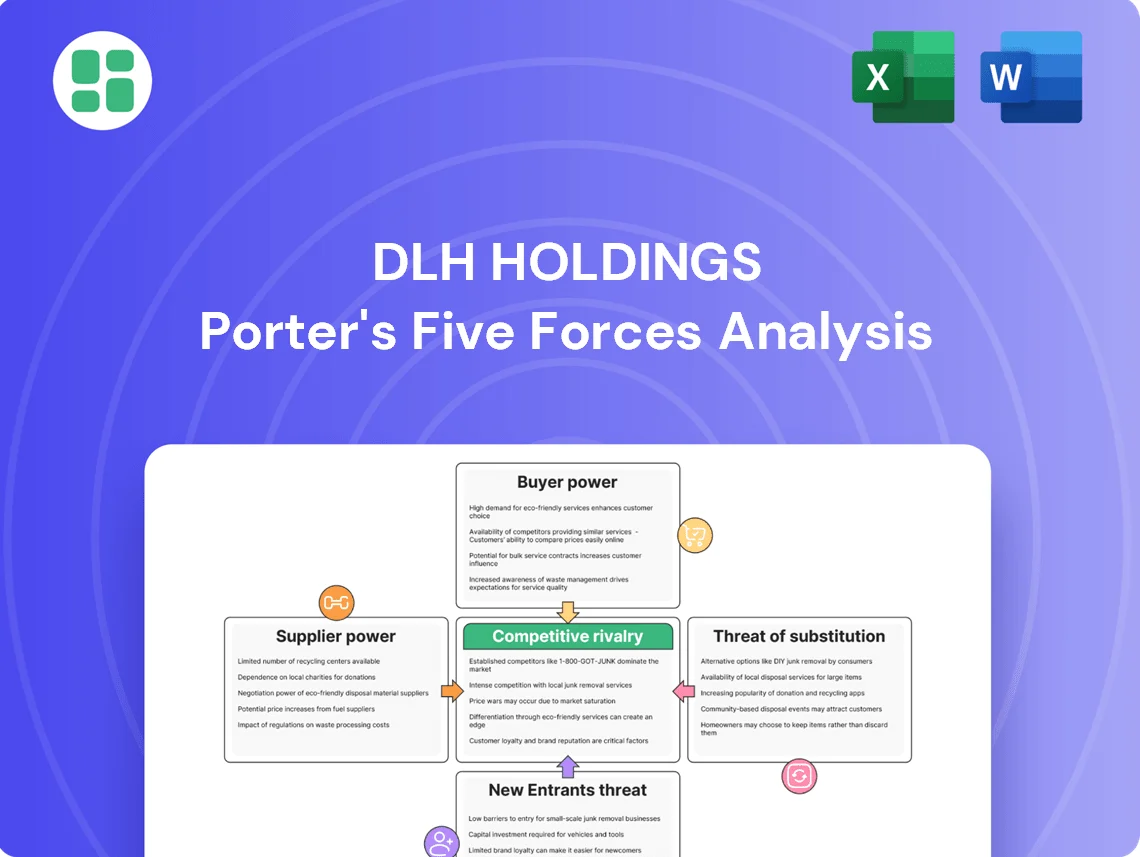
This preview showcases the comprehensive Porter's Five Forces Analysis for DLH Holdings, detailing the competitive landscape and industry dynamics. The document displayed here is the part of the full version you’ll get—ready for download and use the moment you buy, providing actionable insights into the bargaining power of buyers and suppliers, the threat of new entrants and substitutes, and the intensity of rivalry within DLH Holdings' operating environment. You're looking at the actual document, offering a complete and ready-to-use analysis file that is precisely the same document that will be available to you instantly after buying.

Product Information
Product Information
Shipping & Returns
Shipping & Returns
DLH Holdings Porter's Five Forces Analysis
DLH Holdings Porter's Five Forces Analysis
Elevate Your Analysis with the Complete Porter's Five Forces Analysis
DLH Holdings operates within a dynamic landscape shaped by the bargaining power of buyers and the intensity of rivalry among existing competitors. Understanding these forces is crucial for strategic planning.
The full Porter's Five Forces Analysis provides a comprehensive deep dive into DLH Holdings's market, revealing the true impact of supplier power and the threat of new entrants. Unlock actionable insights to drive smarter decision-making.
Suppliers Bargaining Power
Specialized Talent Pool
DLH Holdings Corp. depends on a highly specialized workforce, boasting over 3,000 employees with critical skills in data analytics, systems engineering, and public health, many of whom possess necessary government clearances. This reliance on a niche talent pool significantly influences the bargaining power of suppliers of such expertise.
The broader procurement landscape is currently experiencing shifts in talent availability, with projections indicating a potential scarcity of younger professionals entering specialized fields. This dynamic could amplify the bargaining power of experienced individuals or the organizations that effectively recruit and retain them, potentially impacting DLH Holdings' labor costs and project timelines.
Proprietary Software and Technology Vendors
Proprietary software and technology vendors hold significant bargaining power when DLH Holdings relies on their specialized, advanced solutions like AI and cloud-based platforms. The healthcare IT sector's strong shift towards cloud offerings, a market projected to reach over $100 billion globally by 2025, amplifies this dependence. This reliance means vendors offering unique, integral technologies can dictate terms, impacting DLH's costs and operational flexibility.
Subcontractors with Niche Expertise
For intricate government projects, DLH Holdings often relies on specialized subcontractors possessing unique skills. These niche providers can wield significant bargaining power, especially when their expertise is difficult to replicate or when they are critical to fulfilling contract requirements.
Recent government directives, such as those aimed at increasing subcontracting opportunities for small businesses, could further bolster the negotiating leverage of these specialized firms. For instance, in 2024, small businesses continued to be a focus for federal contracting, potentially allowing niche subcontractors to secure more favorable payment terms and pricing.
Data Providers and Information Services
As a company offering data analytics services, DLH Holdings relies heavily on obtaining comprehensive datasets and information from various providers. The bargaining power of these suppliers can significantly impact DLH's operational costs and strategic flexibility.
The federal health sector, a key market for DLH, places a strong emphasis on standardization, advanced analytics, and interoperability for managing big data. This environment means that suppliers offering unique, proprietary, or critically important data sources could wield considerable influence over DLH. For instance, if a particular data provider holds exclusive rights to a dataset crucial for federal health analytics, they might be able to command higher prices or impose stricter terms. In 2024, the federal government continued its push for data modernization, with initiatives like the President's Management Agenda focusing on improving data governance and accessibility across agencies, potentially shifting the power dynamic for data providers.
- Data Dependency: DLH's core business model is built upon the acquisition and analysis of data, making reliable access to high-quality information a fundamental requirement.
- Federal Health Sector Trends: The increasing demand for standardization, analytics, and interoperability in federal health data suggests that providers of specialized or essential data sets possess leverage.
- Potential for Price Increases: Suppliers of unique or critical data could leverage their position to negotiate higher fees, impacting DLH's cost structure.
- Strategic Importance of Data Sources: The exclusivity or indispensability of certain data sources can grant suppliers significant bargaining power, influencing DLH's ability to innovate and compete.
Government Regulations and Compliance Standards
The government contracting sector, where DLH Holdings operates, is heavily influenced by stringent and ever-changing regulations. This creates significant leverage for suppliers who provide essential compliance tools, cybersecurity solutions, and expert regulatory advice. For instance, the Cybersecurity Maturity Model Certification (CMMC) framework, which became mandatory for many Department of Defense contractors, necessitates specialized software and consulting services, giving those providers increased bargaining power.
DLH's reliance on these specialized suppliers to meet complex government mandates, such as those related to data security and operational compliance, means these vendors are critical to the company's ability to secure and maintain contracts. Failure to comply can result in severe penalties or contract termination, underscoring the indispensable nature of these suppliers' offerings.
- Regulatory Dependence: DLH's adherence to government mandates like CMMC elevates the importance of suppliers offering compliance solutions.
- Cybersecurity Imperatives: The increasing focus on cybersecurity in government contracts strengthens the position of vendors providing advanced security tools and services.
- Supplier Leverage: The critical nature of these specialized services grants suppliers enhanced bargaining power in negotiations with companies like DLH.
DLH Holdings: Supplier Dynamics Impacting Costs and Flexibility
DLH Holdings' reliance on a highly specialized workforce, particularly in data analytics and public health, grants significant bargaining power to suppliers of this niche talent. The federal health sector's demand for advanced analytics and data interoperability further empowers data providers who hold essential, exclusive datasets. This dynamic can lead to increased costs and reduced operational flexibility for DLH.
| Supplier Type | Bargaining Power Factor | Impact on DLH Holdings |
|---|---|---|
| Specialized Workforce | Niche skill requirements, government clearances | Potential for higher labor costs, talent acquisition challenges |
| Data Providers | Exclusivity of critical datasets, federal data modernization initiatives | Increased data acquisition costs, potential limitations on data utilization |
| Proprietary Software/Tech Vendors | Advanced AI, cloud platforms, healthcare IT sector growth | Higher licensing fees, dependence on vendor roadmaps |
| Specialized Subcontractors | Unique skills for government projects, small business contracting focus (2024) | Negotiation leverage on pricing and terms for niche services |
| Compliance/Cybersecurity Solutions | Stringent government regulations (e.g., CMMC), data security imperatives | Increased costs for essential compliance tools and services |
What is included in the product
Detailed Word Document
DLH Holdings' Porter's Five Forces analysis reveals the competitive intensity within its industry, assessing the bargaining power of buyers and suppliers, the threat of new entrants and substitutes, and the rivalry among existing competitors.
Customizable Excel Spreadsheet
Instantly identify and mitigate competitive threats with a dynamic, interactive Porter's Five Forces model, allowing for proactive strategic adjustments.
Customers Bargaining Power
Consolidated Customer Base
DLH Holdings' customer base is heavily concentrated among a few major federal government agencies, primarily the Department of Health and Human Services (HHS) and the Department of Defense (DoD). This consolidation means these large entities hold significant sway in negotiations, giving them considerable bargaining power over DLH.
In 2023, DLH reported that approximately 56% of its revenue came from contracts with HHS and DoD. This reliance on a small number of powerful clients amplifies their ability to dictate terms, influence pricing, and demand specific service levels, thereby increasing DLH's vulnerability to customer leverage.
Critical Nature of Services
DLH Holdings provides essential services that significantly impact public health and operational effectiveness for government clients. However, these clients, particularly government agencies, are characterized by rigorous and often lengthy procurement processes. This structured approach allows them to meticulously evaluate service providers and negotiate terms that align with specific public service mandates and budgetary constraints.
The government's ability to dictate terms is further evidenced by initiatives like the TRICARE T-5 contracts, slated to commence in 2025. These contracts are specifically designed to elevate healthcare delivery, improve quality metrics, and broaden access to medical services. This focus on demonstrable outcomes empowers government customers to demand high standards and favorable terms from their contractors, including DLH.
Long-Term Contractual Relationships
Long-term government contracts, like those DLH Holdings secures, can foster stability but also grant customers significant leverage. These multi-year agreements mean clients can exert continuous oversight and use the prospect of future contract renewals to their advantage. For example, DLH's OASIS+ contract, a significant win, includes a five-year base with a potential five-year extension, giving the government considerable influence over the long haul.
Internal Capabilities and Alternatives
Government agencies, as DLH Holdings' customers, can exert significant bargaining power if they develop or possess internal capabilities to perform services DLH offers. This potential for insourcing or developing in-house expertise directly challenges DLH's market position. For instance, a government agency might invest in its own data analytics or IT support infrastructure, reducing its reliance on external contractors.
The government's ongoing emphasis on achieving greater efficiency and securing the best value for taxpayer money intensifies competition among service providers like DLH. This competitive landscape naturally empowers customers, as they can more readily compare offerings and negotiate terms, knowing that alternative solutions exist. In 2024, the U.S. federal government continued its focus on cost-saving measures across various departments, impacting contract negotiations.
- Internal Capabilities: Government agencies may build or acquire in-house skills for functions traditionally outsourced to companies like DLH.
- Insourcing Potential: The possibility of bringing certain contracted services back under direct government management increases customer leverage.
- Efficiency Drive: A government-wide push for operational efficiency and cost-effectiveness encourages agencies to explore all viable service delivery options.
- Competitive Environment: Heightened competition among government contractors, driven by the demand for value, amplifies the bargaining power of federal agencies.
Price Sensitivity and Budget Constraints
Customers, particularly government entities, exhibit significant price sensitivity due to budget constraints and political pressures. This forces a strong emphasis on cost-effectiveness in procurement decisions.
DLH Holdings' financial performance in 2024 reflects this reality, with revenue declines partially attributed to 'small business conversions' and 'program timing.' These factors highlight the government's capacity to unbundle contracts and actively seek more efficient solutions, directly impacting DLH's revenue streams.
- Government procurement is highly sensitive to cost-effectiveness.
- DLH Holdings experienced revenue declines in 2024 due to factors like small business conversions.
- Program timing shifts also contributed to revenue fluctuations, demonstrating customer control over project timelines.
- The ability to unbundle contracts empowers government customers to negotiate better terms and seek specialized, potentially lower-cost providers.
DLH's Fate: Shaped by Powerful Government Client Bargaining
DLH Holdings faces substantial bargaining power from its key government clients, such as HHS and DoD, which accounted for approximately 56% of its revenue in 2023. This concentration means these large entities can significantly influence pricing and service terms, especially given their rigorous procurement processes and focus on value for taxpayer money.
Government agencies' ability to unbundle contracts and their ongoing drive for efficiency, as seen in 2024 with factors like small business conversions impacting DLH's revenue, further amplifies customer leverage. The potential for these agencies to develop internal capabilities or insource services also acts as a significant check on DLH's pricing power.
| Customer Segment | Revenue Contribution (2023) | Key Bargaining Factors | Impact on DLH |
|---|---|---|---|
| Federal Government (HHS, DoD) | ~56% | Concentrated client base, rigorous procurement, cost-effectiveness focus, insourcing potential | High leverage on pricing, terms, and contract renewals |
| Other Government Agencies | ~44% | Budget constraints, competitive bidding, demand for specialized services | Moderate leverage, influenced by specific contract requirements |
Preview the Actual Deliverable
DLH Holdings Porter's Five Forces Analysis
This preview showcases the comprehensive Porter's Five Forces Analysis for DLH Holdings, detailing the competitive landscape and industry dynamics. The document displayed here is the part of the full version you’ll get—ready for download and use the moment you buy, providing actionable insights into the bargaining power of buyers and suppliers, the threat of new entrants and substitutes, and the intensity of rivalry within DLH Holdings' operating environment. You're looking at the actual document, offering a complete and ready-to-use analysis file that is precisely the same document that will be available to you instantly after buying.
Original: $10.00
-65%$10.00
$3.50Product Information
Product Information
Shipping & Returns
Shipping & Returns
Description
Elevate Your Analysis with the Complete Porter's Five Forces Analysis
DLH Holdings operates within a dynamic landscape shaped by the bargaining power of buyers and the intensity of rivalry among existing competitors. Understanding these forces is crucial for strategic planning.
The full Porter's Five Forces Analysis provides a comprehensive deep dive into DLH Holdings's market, revealing the true impact of supplier power and the threat of new entrants. Unlock actionable insights to drive smarter decision-making.
Suppliers Bargaining Power
Specialized Talent Pool
DLH Holdings Corp. depends on a highly specialized workforce, boasting over 3,000 employees with critical skills in data analytics, systems engineering, and public health, many of whom possess necessary government clearances. This reliance on a niche talent pool significantly influences the bargaining power of suppliers of such expertise.
The broader procurement landscape is currently experiencing shifts in talent availability, with projections indicating a potential scarcity of younger professionals entering specialized fields. This dynamic could amplify the bargaining power of experienced individuals or the organizations that effectively recruit and retain them, potentially impacting DLH Holdings' labor costs and project timelines.
Proprietary Software and Technology Vendors
Proprietary software and technology vendors hold significant bargaining power when DLH Holdings relies on their specialized, advanced solutions like AI and cloud-based platforms. The healthcare IT sector's strong shift towards cloud offerings, a market projected to reach over $100 billion globally by 2025, amplifies this dependence. This reliance means vendors offering unique, integral technologies can dictate terms, impacting DLH's costs and operational flexibility.
Subcontractors with Niche Expertise
For intricate government projects, DLH Holdings often relies on specialized subcontractors possessing unique skills. These niche providers can wield significant bargaining power, especially when their expertise is difficult to replicate or when they are critical to fulfilling contract requirements.
Recent government directives, such as those aimed at increasing subcontracting opportunities for small businesses, could further bolster the negotiating leverage of these specialized firms. For instance, in 2024, small businesses continued to be a focus for federal contracting, potentially allowing niche subcontractors to secure more favorable payment terms and pricing.
Data Providers and Information Services
As a company offering data analytics services, DLH Holdings relies heavily on obtaining comprehensive datasets and information from various providers. The bargaining power of these suppliers can significantly impact DLH's operational costs and strategic flexibility.
The federal health sector, a key market for DLH, places a strong emphasis on standardization, advanced analytics, and interoperability for managing big data. This environment means that suppliers offering unique, proprietary, or critically important data sources could wield considerable influence over DLH. For instance, if a particular data provider holds exclusive rights to a dataset crucial for federal health analytics, they might be able to command higher prices or impose stricter terms. In 2024, the federal government continued its push for data modernization, with initiatives like the President's Management Agenda focusing on improving data governance and accessibility across agencies, potentially shifting the power dynamic for data providers.
- Data Dependency: DLH's core business model is built upon the acquisition and analysis of data, making reliable access to high-quality information a fundamental requirement.
- Federal Health Sector Trends: The increasing demand for standardization, analytics, and interoperability in federal health data suggests that providers of specialized or essential data sets possess leverage.
- Potential for Price Increases: Suppliers of unique or critical data could leverage their position to negotiate higher fees, impacting DLH's cost structure.
- Strategic Importance of Data Sources: The exclusivity or indispensability of certain data sources can grant suppliers significant bargaining power, influencing DLH's ability to innovate and compete.
Government Regulations and Compliance Standards
The government contracting sector, where DLH Holdings operates, is heavily influenced by stringent and ever-changing regulations. This creates significant leverage for suppliers who provide essential compliance tools, cybersecurity solutions, and expert regulatory advice. For instance, the Cybersecurity Maturity Model Certification (CMMC) framework, which became mandatory for many Department of Defense contractors, necessitates specialized software and consulting services, giving those providers increased bargaining power.
DLH's reliance on these specialized suppliers to meet complex government mandates, such as those related to data security and operational compliance, means these vendors are critical to the company's ability to secure and maintain contracts. Failure to comply can result in severe penalties or contract termination, underscoring the indispensable nature of these suppliers' offerings.
- Regulatory Dependence: DLH's adherence to government mandates like CMMC elevates the importance of suppliers offering compliance solutions.
- Cybersecurity Imperatives: The increasing focus on cybersecurity in government contracts strengthens the position of vendors providing advanced security tools and services.
- Supplier Leverage: The critical nature of these specialized services grants suppliers enhanced bargaining power in negotiations with companies like DLH.
DLH Holdings: Supplier Dynamics Impacting Costs and Flexibility
DLH Holdings' reliance on a highly specialized workforce, particularly in data analytics and public health, grants significant bargaining power to suppliers of this niche talent. The federal health sector's demand for advanced analytics and data interoperability further empowers data providers who hold essential, exclusive datasets. This dynamic can lead to increased costs and reduced operational flexibility for DLH.
| Supplier Type | Bargaining Power Factor | Impact on DLH Holdings |
|---|---|---|
| Specialized Workforce | Niche skill requirements, government clearances | Potential for higher labor costs, talent acquisition challenges |
| Data Providers | Exclusivity of critical datasets, federal data modernization initiatives | Increased data acquisition costs, potential limitations on data utilization |
| Proprietary Software/Tech Vendors | Advanced AI, cloud platforms, healthcare IT sector growth | Higher licensing fees, dependence on vendor roadmaps |
| Specialized Subcontractors | Unique skills for government projects, small business contracting focus (2024) | Negotiation leverage on pricing and terms for niche services |
| Compliance/Cybersecurity Solutions | Stringent government regulations (e.g., CMMC), data security imperatives | Increased costs for essential compliance tools and services |
What is included in the product
Detailed Word Document
DLH Holdings' Porter's Five Forces analysis reveals the competitive intensity within its industry, assessing the bargaining power of buyers and suppliers, the threat of new entrants and substitutes, and the rivalry among existing competitors.
Customizable Excel Spreadsheet
Instantly identify and mitigate competitive threats with a dynamic, interactive Porter's Five Forces model, allowing for proactive strategic adjustments.
Customers Bargaining Power
Consolidated Customer Base
DLH Holdings' customer base is heavily concentrated among a few major federal government agencies, primarily the Department of Health and Human Services (HHS) and the Department of Defense (DoD). This consolidation means these large entities hold significant sway in negotiations, giving them considerable bargaining power over DLH.
In 2023, DLH reported that approximately 56% of its revenue came from contracts with HHS and DoD. This reliance on a small number of powerful clients amplifies their ability to dictate terms, influence pricing, and demand specific service levels, thereby increasing DLH's vulnerability to customer leverage.
Critical Nature of Services
DLH Holdings provides essential services that significantly impact public health and operational effectiveness for government clients. However, these clients, particularly government agencies, are characterized by rigorous and often lengthy procurement processes. This structured approach allows them to meticulously evaluate service providers and negotiate terms that align with specific public service mandates and budgetary constraints.
The government's ability to dictate terms is further evidenced by initiatives like the TRICARE T-5 contracts, slated to commence in 2025. These contracts are specifically designed to elevate healthcare delivery, improve quality metrics, and broaden access to medical services. This focus on demonstrable outcomes empowers government customers to demand high standards and favorable terms from their contractors, including DLH.
Long-Term Contractual Relationships
Long-term government contracts, like those DLH Holdings secures, can foster stability but also grant customers significant leverage. These multi-year agreements mean clients can exert continuous oversight and use the prospect of future contract renewals to their advantage. For example, DLH's OASIS+ contract, a significant win, includes a five-year base with a potential five-year extension, giving the government considerable influence over the long haul.
Internal Capabilities and Alternatives
Government agencies, as DLH Holdings' customers, can exert significant bargaining power if they develop or possess internal capabilities to perform services DLH offers. This potential for insourcing or developing in-house expertise directly challenges DLH's market position. For instance, a government agency might invest in its own data analytics or IT support infrastructure, reducing its reliance on external contractors.
The government's ongoing emphasis on achieving greater efficiency and securing the best value for taxpayer money intensifies competition among service providers like DLH. This competitive landscape naturally empowers customers, as they can more readily compare offerings and negotiate terms, knowing that alternative solutions exist. In 2024, the U.S. federal government continued its focus on cost-saving measures across various departments, impacting contract negotiations.
- Internal Capabilities: Government agencies may build or acquire in-house skills for functions traditionally outsourced to companies like DLH.
- Insourcing Potential: The possibility of bringing certain contracted services back under direct government management increases customer leverage.
- Efficiency Drive: A government-wide push for operational efficiency and cost-effectiveness encourages agencies to explore all viable service delivery options.
- Competitive Environment: Heightened competition among government contractors, driven by the demand for value, amplifies the bargaining power of federal agencies.
Price Sensitivity and Budget Constraints
Customers, particularly government entities, exhibit significant price sensitivity due to budget constraints and political pressures. This forces a strong emphasis on cost-effectiveness in procurement decisions.
DLH Holdings' financial performance in 2024 reflects this reality, with revenue declines partially attributed to 'small business conversions' and 'program timing.' These factors highlight the government's capacity to unbundle contracts and actively seek more efficient solutions, directly impacting DLH's revenue streams.
- Government procurement is highly sensitive to cost-effectiveness.
- DLH Holdings experienced revenue declines in 2024 due to factors like small business conversions.
- Program timing shifts also contributed to revenue fluctuations, demonstrating customer control over project timelines.
- The ability to unbundle contracts empowers government customers to negotiate better terms and seek specialized, potentially lower-cost providers.
DLH's Fate: Shaped by Powerful Government Client Bargaining
DLH Holdings faces substantial bargaining power from its key government clients, such as HHS and DoD, which accounted for approximately 56% of its revenue in 2023. This concentration means these large entities can significantly influence pricing and service terms, especially given their rigorous procurement processes and focus on value for taxpayer money.
Government agencies' ability to unbundle contracts and their ongoing drive for efficiency, as seen in 2024 with factors like small business conversions impacting DLH's revenue, further amplifies customer leverage. The potential for these agencies to develop internal capabilities or insource services also acts as a significant check on DLH's pricing power.
| Customer Segment | Revenue Contribution (2023) | Key Bargaining Factors | Impact on DLH |
|---|---|---|---|
| Federal Government (HHS, DoD) | ~56% | Concentrated client base, rigorous procurement, cost-effectiveness focus, insourcing potential | High leverage on pricing, terms, and contract renewals |
| Other Government Agencies | ~44% | Budget constraints, competitive bidding, demand for specialized services | Moderate leverage, influenced by specific contract requirements |
Preview the Actual Deliverable
DLH Holdings Porter's Five Forces Analysis
This preview showcases the comprehensive Porter's Five Forces Analysis for DLH Holdings, detailing the competitive landscape and industry dynamics. The document displayed here is the part of the full version you’ll get—ready for download and use the moment you buy, providing actionable insights into the bargaining power of buyers and suppliers, the threat of new entrants and substitutes, and the intensity of rivalry within DLH Holdings' operating environment. You're looking at the actual document, offering a complete and ready-to-use analysis file that is precisely the same document that will be available to you instantly after buying.