Village Farms PESTLE Analysis

Make Smarter Strategic Decisions with a Complete PESTEL View
Unlock a comprehensive understanding of the external forces shaping Village Farms's trajectory with our in-depth PESTLE analysis. Discover how political shifts, economic volatility, technological advancements, environmental regulations, and social trends are creating both challenges and opportunities for the company. Equip yourself with actionable intelligence to refine your market strategy and gain a competitive edge. Download the full PESTLE analysis now for immediate access to crucial insights.
Political factors

Government Cannabis Policy Evolution
Government cannabis policy is a dynamic force impacting Village Farms. In the US, the potential rescheduling of cannabis from Schedule I to Schedule III is a significant development. This move could alleviate banking access and tax burdens, which are currently substantial hurdles for the industry, including Village Farms' Pure Sunfarms.
Canada's regulatory environment is also evolving, with Health Canada proposing amendments to simplify cannabis rules. These proposed changes aim to streamline licensing, packaging, and reporting, potentially reducing administrative complexities for companies like Village Farms.
These policy shifts present both avenues for growth and necessitate careful navigation of compliance across different legal frameworks. For instance, the US federal rescheduling, if enacted, could unlock new financial opportunities for Pure Sunfarms, while Canadian regulatory updates might improve operational efficiency.
International Market Expansion Policies
Village Farms is aggressively pursuing international market expansion, notably aiming to triple its cannabis sales and quintuple production capacity in the Netherlands. This ambitious growth hinges directly on supportive international trade policies and the progressive legalization of cannabis across key European and Oceanic markets, including Germany, the UK, Australia, and New Zealand.
The company's success in navigating the complex and varied regulatory landscapes of these target countries is paramount. For instance, Germany's recent steps towards decriminalization and its planned regulated cannabis sales model present significant opportunities, while the UK and Australia are showing increasing openness to medical cannabis programs, which Village Farms can leverage.

Agricultural Subsidies and Trade Agreements
Government support and trade agreements are crucial for Village Farms. In 2024, the US Department of Agriculture continued its programs offering financial assistance and technical support to agricultural producers, which can indirectly benefit greenhouse operations like Village Farms by stabilizing input costs or supporting market development. These policies, alongside trade pacts such as the United States-Mexico-Canada Agreement (USMCA), shape the competitive landscape for produce, influencing import/export dynamics and consumer pricing.
Policies concerning import tariffs and agricultural subsidies directly affect the cost of goods and market access for Village Farms. For instance, changes in tariffs on imported vegetables could make domestically grown produce, including Village Farms' greenhouse products, more competitive. Conversely, shifts in subsidy programs in competing nations might alter the cost structure of their agricultural exports, impacting Village Farms' market share.
Food safety standards, enforced by bodies like the FDA in the US and the CFIA in Canada, are also critical. Adherence to these evolving regulations, which often become more stringent, requires ongoing investment in operational processes and quality control. Village Farms' commitment to these standards in 2024 and beyond is vital for maintaining consumer trust and ensuring continued market access across North America.

CBD Regulatory Clarity
Village Farms, through its subsidiary Balanced Health Botanicals, operates within the burgeoning CBD market, which is currently characterized by significant regulatory uncertainty, especially in the United States. The Food and Drug Administration (FDA) is in the process of developing formal guidelines for the use of CBD in various consumer products. This regulatory evolution is crucial for market stability and consumer trust.
Efforts such as the proposed Cannabinoid Safety and Regulation Act are also underway to define the legal status of CBD. Greater clarity and standardization in these regulations are anticipated to bolster consumer confidence, thereby fostering substantial market growth. For instance, the US CBD market was projected to reach approximately $5.7 billion in 2023, with potential for significant expansion under clearer regulatory frameworks.
- FDA Guideline Development: The FDA's ongoing work on formal CBD guidelines is a critical factor influencing market access and product development.
- Legislative Efforts: Acts like the Cannabinoid Safety and Regulation Act aim to provide a clearer legal pathway for CBD products.
- Market Growth Impact: Regulatory clarity is expected to unlock further market potential, potentially accelerating growth beyond current projections.
- Consumer Confidence: Standardized regulations are vital for building consumer trust, a key driver for sustained market expansion.
Environmental and Energy Policies
Government policies championing sustainable agriculture and clean energy are pivotal for Village Farms' operational landscape. For instance, the company's strategic investment in a renewable natural gas project in British Columbia directly supports these broader environmental mandates.
Future regulatory shifts concerning carbon emissions, water conservation, and sustainable farming techniques are anticipated to impact operational expenditures. These changes may also drive further capital allocation towards advanced, eco-friendly technologies to maintain compliance and competitive advantage.
- Renewable Energy Investment: Village Farms' commitment to renewable natural gas projects demonstrates proactive alignment with environmental policy trends.
- Regulatory Impact: Anticipated regulations on carbon emissions and water usage could necessitate increased operational costs or further technological investments.
- Sustainable Practices: Evolving standards for sustainable farming will likely require ongoing adaptation and potential upgrades to existing infrastructure.
Cannabis Policy Shifts: Easing Burdens for Operators
Government policies on cannabis legalization and regulation continue to shape Village Farms' opportunities, particularly with potential US rescheduling from Schedule I to Schedule III. This shift could significantly ease banking and tax burdens for its Pure Sunfarms operations. Meanwhile, Canada's proposed simplifications to cannabis rules by Health Canada aim to reduce administrative complexities for companies like Village Farms.
What is included in the product
 Detailed Word Document
This PESTLE analysis of Village Farms provides a comprehensive examination of the Political, Economic, Social, Technological, Environmental, and Legal factors impacting the company, offering strategic insights for navigating the external landscape.

 Customizable Excel Spreadsheet
Village Farms' PESTLE analysis acts as a pain point reliever by providing a clear, summarized version of external factors for easy referencing during strategic planning, ensuring all stakeholders understand market dynamics.
Economic factors

Inflation and Input Costs
Inflationary pressures continue to significantly impact the agricultural sector, driving up costs for crucial inputs like fertilizers, energy, and labor. While some of these costs have seen slight reductions, they generally remain elevated compared to pre-inflationary periods, squeezing farm business margins.
For Village Farms, a substantial agricultural producer with operations in both produce and cannabis, effectively managing these volatile input costs is paramount to sustaining profitability. For instance, fertilizer prices, a key component of agricultural production, saw substantial increases in 2023 and while moderating, remain a concern for 2024. Energy costs, particularly for greenhouse operations, also continue to be a significant factor impacting operational expenses.
Consumer Spending and Demand Trends
Consumer demand for fresh, locally sourced, and healthy produce remains a strong tailwind for Village Farms. Despite inflationary pressures in 2024, consumers are increasingly prioritizing fresh foods, with younger demographics showing a notable uptick in consumption, according to recent market reports.
The cannabis and CBD markets are experiencing growth, fueled by rising acceptance and a consumer pivot towards wellness. However, the US CBD market has encountered some deceleration in 2024, attributed to ongoing regulatory ambiguity and competitive pricing dynamics.

Cannabis Market Competition and Pricing
The Canadian cannabis market is experiencing significant price compression due to increasing competition. Village Farms' Pure Sunfarms, despite its strong standing in dried flower and pre-rolls, faces pressure to maintain profitability in this oversaturated environment.
As of early 2024, the average price per gram for legal cannabis in Canada has seen a notable decline, impacting revenue streams for all licensed producers. Village Farms is actively addressing this by introducing new product lines and pursuing international market opportunities to diversify and mitigate domestic pricing pressures.

Interest Rates and Access to Capital
Changes in interest rates directly affect the cost of borrowing for companies like Village Farms. Even as inflation shows signs of easing, elevated interest rates in 2024 and projected into 2025 can significantly increase capital expenditures for expansion and day-to-day operational funding. This makes securing affordable loans a critical consideration.
Access to capital, particularly for businesses in the cannabis sector, remains a sensitive economic factor. Federal banking regulations continue to influence the availability and cost of lending. For instance, the Secure and Fair Enforcement (SAFE) Banking Act, if passed, could dramatically improve access to traditional banking services and capital for cannabis-related businesses, potentially lowering borrowing costs and facilitating investment.
The Federal Reserve's monetary policy decisions on interest rates will be a key determinant of borrowing costs throughout 2024 and 2025. For example, the Federal Funds Rate, which influences broader lending rates, has remained at elevated levels, impacting the cost of capital for agricultural and cannabis businesses alike. This environment necessitates careful financial planning and a focus on efficient capital management.
- Impact of Interest Rates: Higher interest rates increase the cost of debt financing for Village Farms' capital projects and operational needs.
- Inflationary Environment: While inflation has moderated, the lingering effects combined with higher rates can squeeze margins and investment capacity.
- Cannabis Banking Access: Federal banking regulations remain a significant hurdle for cannabis businesses seeking affordable and accessible capital.
- Federal Reserve Policy: The Federal Funds Rate and future policy shifts will continue to shape the cost and availability of capital in 2024-2025.
Currency Fluctuations
Village Farms, with its significant operations in both the United States and Canada, alongside its international expansion, is directly exposed to the volatility of currency exchange rates. Fluctuations between the US dollar and the Canadian dollar, and indeed other global currencies, can materially affect the company's reported revenues and expenses.
These currency shifts directly influence Village Farms' overall financial performance and profitability, as earnings generated in one currency are translated into another. For instance, a stronger US dollar relative to the Canadian dollar could reduce the reported value of Canadian earnings when consolidated into US dollar financial statements.
- US Dollar to Canadian Dollar Exchange Rate: The CAD/USD exchange rate has seen considerable movement. For example, in early 2024, the Canadian dollar traded around 0.73 USD, a slight depreciation from earlier periods, impacting the translation of Canadian operations' financial results.
- International Currency Exposure: As Village Farms expands into new international markets, its exposure to a wider range of currency fluctuations increases, adding complexity to financial reporting and risk management.
- Impact on Profitability: Adverse currency movements can erode profit margins on goods sold in foreign markets or increase the cost of imported inputs, directly affecting Village Farms' bottom line.
Village Farms: 2024-2025 Economic Outlook and Strategic Impact
The economic landscape for Village Farms in 2024 and projected into 2025 presents a mixed bag of challenges and opportunities, primarily influenced by inflation, interest rates, and currency fluctuations.
| Economic Factor | 2024/2025 Outlook | Impact on Village Farms | Data Point/Example |
|---|---|---|---|
| Inflationary Pressures | Moderating but still elevated | Increased input costs (fertilizer, energy, labor) squeezing margins, but some cost reductions are occurring. | Fertilizer prices remain a concern, though showing some moderation from 2023 highs. |
| Interest Rates | Elevated, potentially stable or slowly declining | Higher borrowing costs for capital expenditures and operations, impacting investment capacity. | Federal Funds Rate remains at elevated levels, increasing the cost of capital. |
| Currency Exchange Rates | Volatile, with CAD/USD fluctuations | Affects reported revenues and expenses, impacting profitability of international operations. | In early 2024, the Canadian dollar traded around 0.73 USD, impacting the translation of Canadian earnings. |
Same Document Delivered
Village Farms PESTLE Analysis
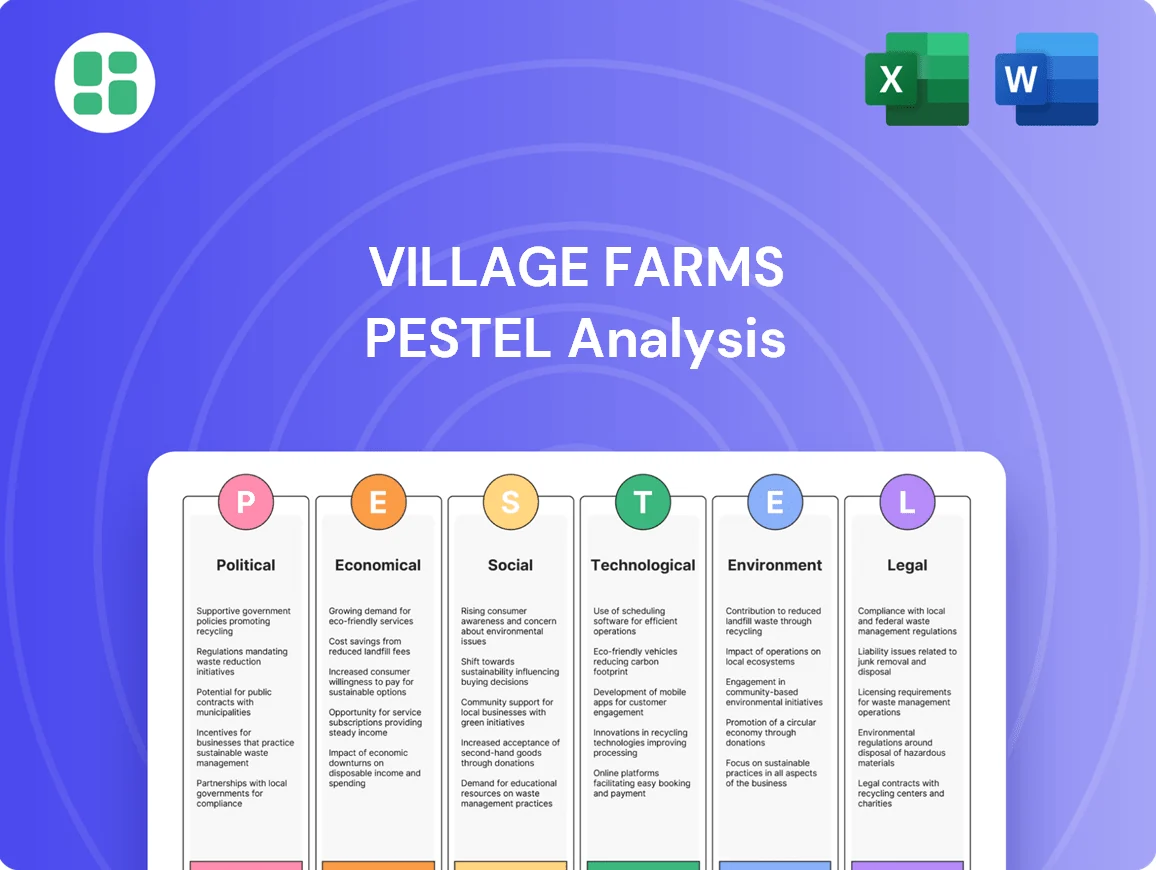
The preview shown here is the exact document you’ll receive after purchase—fully formatted and ready to use. This comprehensive PESTLE analysis of Village Farms delves into Political, Economic, Social, Technological, Legal, and Environmental factors impacting the company, providing actionable insights.

Product Information
Product Information
Shipping & Returns
Shipping & Returns
Village Farms PESTLE Analysis
Village Farms PESTLE Analysis
Make Smarter Strategic Decisions with a Complete PESTEL View
Unlock a comprehensive understanding of the external forces shaping Village Farms's trajectory with our in-depth PESTLE analysis. Discover how political shifts, economic volatility, technological advancements, environmental regulations, and social trends are creating both challenges and opportunities for the company. Equip yourself with actionable intelligence to refine your market strategy and gain a competitive edge. Download the full PESTLE analysis now for immediate access to crucial insights.
Political factors
Government Cannabis Policy Evolution
Government cannabis policy is a dynamic force impacting Village Farms. In the US, the potential rescheduling of cannabis from Schedule I to Schedule III is a significant development. This move could alleviate banking access and tax burdens, which are currently substantial hurdles for the industry, including Village Farms' Pure Sunfarms.
Canada's regulatory environment is also evolving, with Health Canada proposing amendments to simplify cannabis rules. These proposed changes aim to streamline licensing, packaging, and reporting, potentially reducing administrative complexities for companies like Village Farms.
These policy shifts present both avenues for growth and necessitate careful navigation of compliance across different legal frameworks. For instance, the US federal rescheduling, if enacted, could unlock new financial opportunities for Pure Sunfarms, while Canadian regulatory updates might improve operational efficiency.
International Market Expansion Policies
Village Farms is aggressively pursuing international market expansion, notably aiming to triple its cannabis sales and quintuple production capacity in the Netherlands. This ambitious growth hinges directly on supportive international trade policies and the progressive legalization of cannabis across key European and Oceanic markets, including Germany, the UK, Australia, and New Zealand.
The company's success in navigating the complex and varied regulatory landscapes of these target countries is paramount. For instance, Germany's recent steps towards decriminalization and its planned regulated cannabis sales model present significant opportunities, while the UK and Australia are showing increasing openness to medical cannabis programs, which Village Farms can leverage.
Agricultural Subsidies and Trade Agreements
Government support and trade agreements are crucial for Village Farms. In 2024, the US Department of Agriculture continued its programs offering financial assistance and technical support to agricultural producers, which can indirectly benefit greenhouse operations like Village Farms by stabilizing input costs or supporting market development. These policies, alongside trade pacts such as the United States-Mexico-Canada Agreement (USMCA), shape the competitive landscape for produce, influencing import/export dynamics and consumer pricing.
Policies concerning import tariffs and agricultural subsidies directly affect the cost of goods and market access for Village Farms. For instance, changes in tariffs on imported vegetables could make domestically grown produce, including Village Farms' greenhouse products, more competitive. Conversely, shifts in subsidy programs in competing nations might alter the cost structure of their agricultural exports, impacting Village Farms' market share.
Food safety standards, enforced by bodies like the FDA in the US and the CFIA in Canada, are also critical. Adherence to these evolving regulations, which often become more stringent, requires ongoing investment in operational processes and quality control. Village Farms' commitment to these standards in 2024 and beyond is vital for maintaining consumer trust and ensuring continued market access across North America.
CBD Regulatory Clarity
Village Farms, through its subsidiary Balanced Health Botanicals, operates within the burgeoning CBD market, which is currently characterized by significant regulatory uncertainty, especially in the United States. The Food and Drug Administration (FDA) is in the process of developing formal guidelines for the use of CBD in various consumer products. This regulatory evolution is crucial for market stability and consumer trust.
Efforts such as the proposed Cannabinoid Safety and Regulation Act are also underway to define the legal status of CBD. Greater clarity and standardization in these regulations are anticipated to bolster consumer confidence, thereby fostering substantial market growth. For instance, the US CBD market was projected to reach approximately $5.7 billion in 2023, with potential for significant expansion under clearer regulatory frameworks.
- FDA Guideline Development: The FDA's ongoing work on formal CBD guidelines is a critical factor influencing market access and product development.
- Legislative Efforts: Acts like the Cannabinoid Safety and Regulation Act aim to provide a clearer legal pathway for CBD products.
- Market Growth Impact: Regulatory clarity is expected to unlock further market potential, potentially accelerating growth beyond current projections.
- Consumer Confidence: Standardized regulations are vital for building consumer trust, a key driver for sustained market expansion.
Environmental and Energy Policies
Government policies championing sustainable agriculture and clean energy are pivotal for Village Farms' operational landscape. For instance, the company's strategic investment in a renewable natural gas project in British Columbia directly supports these broader environmental mandates.
Future regulatory shifts concerning carbon emissions, water conservation, and sustainable farming techniques are anticipated to impact operational expenditures. These changes may also drive further capital allocation towards advanced, eco-friendly technologies to maintain compliance and competitive advantage.
- Renewable Energy Investment: Village Farms' commitment to renewable natural gas projects demonstrates proactive alignment with environmental policy trends.
- Regulatory Impact: Anticipated regulations on carbon emissions and water usage could necessitate increased operational costs or further technological investments.
- Sustainable Practices: Evolving standards for sustainable farming will likely require ongoing adaptation and potential upgrades to existing infrastructure.
Cannabis Policy Shifts: Easing Burdens for Operators
Government policies on cannabis legalization and regulation continue to shape Village Farms' opportunities, particularly with potential US rescheduling from Schedule I to Schedule III. This shift could significantly ease banking and tax burdens for its Pure Sunfarms operations. Meanwhile, Canada's proposed simplifications to cannabis rules by Health Canada aim to reduce administrative complexities for companies like Village Farms.
What is included in the product
Detailed Word Document
This PESTLE analysis of Village Farms provides a comprehensive examination of the Political, Economic, Social, Technological, Environmental, and Legal factors impacting the company, offering strategic insights for navigating the external landscape.
Customizable Excel Spreadsheet
Village Farms' PESTLE analysis acts as a pain point reliever by providing a clear, summarized version of external factors for easy referencing during strategic planning, ensuring all stakeholders understand market dynamics.
Economic factors
Inflation and Input Costs
Inflationary pressures continue to significantly impact the agricultural sector, driving up costs for crucial inputs like fertilizers, energy, and labor. While some of these costs have seen slight reductions, they generally remain elevated compared to pre-inflationary periods, squeezing farm business margins.
For Village Farms, a substantial agricultural producer with operations in both produce and cannabis, effectively managing these volatile input costs is paramount to sustaining profitability. For instance, fertilizer prices, a key component of agricultural production, saw substantial increases in 2023 and while moderating, remain a concern for 2024. Energy costs, particularly for greenhouse operations, also continue to be a significant factor impacting operational expenses.
Consumer Spending and Demand Trends
Consumer demand for fresh, locally sourced, and healthy produce remains a strong tailwind for Village Farms. Despite inflationary pressures in 2024, consumers are increasingly prioritizing fresh foods, with younger demographics showing a notable uptick in consumption, according to recent market reports.
The cannabis and CBD markets are experiencing growth, fueled by rising acceptance and a consumer pivot towards wellness. However, the US CBD market has encountered some deceleration in 2024, attributed to ongoing regulatory ambiguity and competitive pricing dynamics.
Cannabis Market Competition and Pricing
The Canadian cannabis market is experiencing significant price compression due to increasing competition. Village Farms' Pure Sunfarms, despite its strong standing in dried flower and pre-rolls, faces pressure to maintain profitability in this oversaturated environment.
As of early 2024, the average price per gram for legal cannabis in Canada has seen a notable decline, impacting revenue streams for all licensed producers. Village Farms is actively addressing this by introducing new product lines and pursuing international market opportunities to diversify and mitigate domestic pricing pressures.
Interest Rates and Access to Capital
Changes in interest rates directly affect the cost of borrowing for companies like Village Farms. Even as inflation shows signs of easing, elevated interest rates in 2024 and projected into 2025 can significantly increase capital expenditures for expansion and day-to-day operational funding. This makes securing affordable loans a critical consideration.
Access to capital, particularly for businesses in the cannabis sector, remains a sensitive economic factor. Federal banking regulations continue to influence the availability and cost of lending. For instance, the Secure and Fair Enforcement (SAFE) Banking Act, if passed, could dramatically improve access to traditional banking services and capital for cannabis-related businesses, potentially lowering borrowing costs and facilitating investment.
The Federal Reserve's monetary policy decisions on interest rates will be a key determinant of borrowing costs throughout 2024 and 2025. For example, the Federal Funds Rate, which influences broader lending rates, has remained at elevated levels, impacting the cost of capital for agricultural and cannabis businesses alike. This environment necessitates careful financial planning and a focus on efficient capital management.
- Impact of Interest Rates: Higher interest rates increase the cost of debt financing for Village Farms' capital projects and operational needs.
- Inflationary Environment: While inflation has moderated, the lingering effects combined with higher rates can squeeze margins and investment capacity.
- Cannabis Banking Access: Federal banking regulations remain a significant hurdle for cannabis businesses seeking affordable and accessible capital.
- Federal Reserve Policy: The Federal Funds Rate and future policy shifts will continue to shape the cost and availability of capital in 2024-2025.
Currency Fluctuations
Village Farms, with its significant operations in both the United States and Canada, alongside its international expansion, is directly exposed to the volatility of currency exchange rates. Fluctuations between the US dollar and the Canadian dollar, and indeed other global currencies, can materially affect the company's reported revenues and expenses.
These currency shifts directly influence Village Farms' overall financial performance and profitability, as earnings generated in one currency are translated into another. For instance, a stronger US dollar relative to the Canadian dollar could reduce the reported value of Canadian earnings when consolidated into US dollar financial statements.
- US Dollar to Canadian Dollar Exchange Rate: The CAD/USD exchange rate has seen considerable movement. For example, in early 2024, the Canadian dollar traded around 0.73 USD, a slight depreciation from earlier periods, impacting the translation of Canadian operations' financial results.
- International Currency Exposure: As Village Farms expands into new international markets, its exposure to a wider range of currency fluctuations increases, adding complexity to financial reporting and risk management.
- Impact on Profitability: Adverse currency movements can erode profit margins on goods sold in foreign markets or increase the cost of imported inputs, directly affecting Village Farms' bottom line.
Village Farms: 2024-2025 Economic Outlook and Strategic Impact
The economic landscape for Village Farms in 2024 and projected into 2025 presents a mixed bag of challenges and opportunities, primarily influenced by inflation, interest rates, and currency fluctuations.
| Economic Factor | 2024/2025 Outlook | Impact on Village Farms | Data Point/Example |
|---|---|---|---|
| Inflationary Pressures | Moderating but still elevated | Increased input costs (fertilizer, energy, labor) squeezing margins, but some cost reductions are occurring. | Fertilizer prices remain a concern, though showing some moderation from 2023 highs. |
| Interest Rates | Elevated, potentially stable or slowly declining | Higher borrowing costs for capital expenditures and operations, impacting investment capacity. | Federal Funds Rate remains at elevated levels, increasing the cost of capital. |
| Currency Exchange Rates | Volatile, with CAD/USD fluctuations | Affects reported revenues and expenses, impacting profitability of international operations. | In early 2024, the Canadian dollar traded around 0.73 USD, impacting the translation of Canadian earnings. |
Same Document Delivered
Village Farms PESTLE Analysis
The preview shown here is the exact document you’ll receive after purchase—fully formatted and ready to use. This comprehensive PESTLE analysis of Village Farms delves into Political, Economic, Social, Technological, Legal, and Environmental factors impacting the company, providing actionable insights.
Product Information
Product Information
Shipping & Returns
Shipping & Returns
Description
Make Smarter Strategic Decisions with a Complete PESTEL View
Unlock a comprehensive understanding of the external forces shaping Village Farms's trajectory with our in-depth PESTLE analysis. Discover how political shifts, economic volatility, technological advancements, environmental regulations, and social trends are creating both challenges and opportunities for the company. Equip yourself with actionable intelligence to refine your market strategy and gain a competitive edge. Download the full PESTLE analysis now for immediate access to crucial insights.
Political factors
Government Cannabis Policy Evolution
Government cannabis policy is a dynamic force impacting Village Farms. In the US, the potential rescheduling of cannabis from Schedule I to Schedule III is a significant development. This move could alleviate banking access and tax burdens, which are currently substantial hurdles for the industry, including Village Farms' Pure Sunfarms.
Canada's regulatory environment is also evolving, with Health Canada proposing amendments to simplify cannabis rules. These proposed changes aim to streamline licensing, packaging, and reporting, potentially reducing administrative complexities for companies like Village Farms.
These policy shifts present both avenues for growth and necessitate careful navigation of compliance across different legal frameworks. For instance, the US federal rescheduling, if enacted, could unlock new financial opportunities for Pure Sunfarms, while Canadian regulatory updates might improve operational efficiency.
International Market Expansion Policies
Village Farms is aggressively pursuing international market expansion, notably aiming to triple its cannabis sales and quintuple production capacity in the Netherlands. This ambitious growth hinges directly on supportive international trade policies and the progressive legalization of cannabis across key European and Oceanic markets, including Germany, the UK, Australia, and New Zealand.
The company's success in navigating the complex and varied regulatory landscapes of these target countries is paramount. For instance, Germany's recent steps towards decriminalization and its planned regulated cannabis sales model present significant opportunities, while the UK and Australia are showing increasing openness to medical cannabis programs, which Village Farms can leverage.
Agricultural Subsidies and Trade Agreements
Government support and trade agreements are crucial for Village Farms. In 2024, the US Department of Agriculture continued its programs offering financial assistance and technical support to agricultural producers, which can indirectly benefit greenhouse operations like Village Farms by stabilizing input costs or supporting market development. These policies, alongside trade pacts such as the United States-Mexico-Canada Agreement (USMCA), shape the competitive landscape for produce, influencing import/export dynamics and consumer pricing.
Policies concerning import tariffs and agricultural subsidies directly affect the cost of goods and market access for Village Farms. For instance, changes in tariffs on imported vegetables could make domestically grown produce, including Village Farms' greenhouse products, more competitive. Conversely, shifts in subsidy programs in competing nations might alter the cost structure of their agricultural exports, impacting Village Farms' market share.
Food safety standards, enforced by bodies like the FDA in the US and the CFIA in Canada, are also critical. Adherence to these evolving regulations, which often become more stringent, requires ongoing investment in operational processes and quality control. Village Farms' commitment to these standards in 2024 and beyond is vital for maintaining consumer trust and ensuring continued market access across North America.
CBD Regulatory Clarity
Village Farms, through its subsidiary Balanced Health Botanicals, operates within the burgeoning CBD market, which is currently characterized by significant regulatory uncertainty, especially in the United States. The Food and Drug Administration (FDA) is in the process of developing formal guidelines for the use of CBD in various consumer products. This regulatory evolution is crucial for market stability and consumer trust.
Efforts such as the proposed Cannabinoid Safety and Regulation Act are also underway to define the legal status of CBD. Greater clarity and standardization in these regulations are anticipated to bolster consumer confidence, thereby fostering substantial market growth. For instance, the US CBD market was projected to reach approximately $5.7 billion in 2023, with potential for significant expansion under clearer regulatory frameworks.
- FDA Guideline Development: The FDA's ongoing work on formal CBD guidelines is a critical factor influencing market access and product development.
- Legislative Efforts: Acts like the Cannabinoid Safety and Regulation Act aim to provide a clearer legal pathway for CBD products.
- Market Growth Impact: Regulatory clarity is expected to unlock further market potential, potentially accelerating growth beyond current projections.
- Consumer Confidence: Standardized regulations are vital for building consumer trust, a key driver for sustained market expansion.
Environmental and Energy Policies
Government policies championing sustainable agriculture and clean energy are pivotal for Village Farms' operational landscape. For instance, the company's strategic investment in a renewable natural gas project in British Columbia directly supports these broader environmental mandates.
Future regulatory shifts concerning carbon emissions, water conservation, and sustainable farming techniques are anticipated to impact operational expenditures. These changes may also drive further capital allocation towards advanced, eco-friendly technologies to maintain compliance and competitive advantage.
- Renewable Energy Investment: Village Farms' commitment to renewable natural gas projects demonstrates proactive alignment with environmental policy trends.
- Regulatory Impact: Anticipated regulations on carbon emissions and water usage could necessitate increased operational costs or further technological investments.
- Sustainable Practices: Evolving standards for sustainable farming will likely require ongoing adaptation and potential upgrades to existing infrastructure.
Cannabis Policy Shifts: Easing Burdens for Operators
Government policies on cannabis legalization and regulation continue to shape Village Farms' opportunities, particularly with potential US rescheduling from Schedule I to Schedule III. This shift could significantly ease banking and tax burdens for its Pure Sunfarms operations. Meanwhile, Canada's proposed simplifications to cannabis rules by Health Canada aim to reduce administrative complexities for companies like Village Farms.
What is included in the product
Detailed Word Document
This PESTLE analysis of Village Farms provides a comprehensive examination of the Political, Economic, Social, Technological, Environmental, and Legal factors impacting the company, offering strategic insights for navigating the external landscape.
Customizable Excel Spreadsheet
Village Farms' PESTLE analysis acts as a pain point reliever by providing a clear, summarized version of external factors for easy referencing during strategic planning, ensuring all stakeholders understand market dynamics.
Economic factors
Inflation and Input Costs
Inflationary pressures continue to significantly impact the agricultural sector, driving up costs for crucial inputs like fertilizers, energy, and labor. While some of these costs have seen slight reductions, they generally remain elevated compared to pre-inflationary periods, squeezing farm business margins.
For Village Farms, a substantial agricultural producer with operations in both produce and cannabis, effectively managing these volatile input costs is paramount to sustaining profitability. For instance, fertilizer prices, a key component of agricultural production, saw substantial increases in 2023 and while moderating, remain a concern for 2024. Energy costs, particularly for greenhouse operations, also continue to be a significant factor impacting operational expenses.
Consumer Spending and Demand Trends
Consumer demand for fresh, locally sourced, and healthy produce remains a strong tailwind for Village Farms. Despite inflationary pressures in 2024, consumers are increasingly prioritizing fresh foods, with younger demographics showing a notable uptick in consumption, according to recent market reports.
The cannabis and CBD markets are experiencing growth, fueled by rising acceptance and a consumer pivot towards wellness. However, the US CBD market has encountered some deceleration in 2024, attributed to ongoing regulatory ambiguity and competitive pricing dynamics.
Cannabis Market Competition and Pricing
The Canadian cannabis market is experiencing significant price compression due to increasing competition. Village Farms' Pure Sunfarms, despite its strong standing in dried flower and pre-rolls, faces pressure to maintain profitability in this oversaturated environment.
As of early 2024, the average price per gram for legal cannabis in Canada has seen a notable decline, impacting revenue streams for all licensed producers. Village Farms is actively addressing this by introducing new product lines and pursuing international market opportunities to diversify and mitigate domestic pricing pressures.
Interest Rates and Access to Capital
Changes in interest rates directly affect the cost of borrowing for companies like Village Farms. Even as inflation shows signs of easing, elevated interest rates in 2024 and projected into 2025 can significantly increase capital expenditures for expansion and day-to-day operational funding. This makes securing affordable loans a critical consideration.
Access to capital, particularly for businesses in the cannabis sector, remains a sensitive economic factor. Federal banking regulations continue to influence the availability and cost of lending. For instance, the Secure and Fair Enforcement (SAFE) Banking Act, if passed, could dramatically improve access to traditional banking services and capital for cannabis-related businesses, potentially lowering borrowing costs and facilitating investment.
The Federal Reserve's monetary policy decisions on interest rates will be a key determinant of borrowing costs throughout 2024 and 2025. For example, the Federal Funds Rate, which influences broader lending rates, has remained at elevated levels, impacting the cost of capital for agricultural and cannabis businesses alike. This environment necessitates careful financial planning and a focus on efficient capital management.
- Impact of Interest Rates: Higher interest rates increase the cost of debt financing for Village Farms' capital projects and operational needs.
- Inflationary Environment: While inflation has moderated, the lingering effects combined with higher rates can squeeze margins and investment capacity.
- Cannabis Banking Access: Federal banking regulations remain a significant hurdle for cannabis businesses seeking affordable and accessible capital.
- Federal Reserve Policy: The Federal Funds Rate and future policy shifts will continue to shape the cost and availability of capital in 2024-2025.
Currency Fluctuations
Village Farms, with its significant operations in both the United States and Canada, alongside its international expansion, is directly exposed to the volatility of currency exchange rates. Fluctuations between the US dollar and the Canadian dollar, and indeed other global currencies, can materially affect the company's reported revenues and expenses.
These currency shifts directly influence Village Farms' overall financial performance and profitability, as earnings generated in one currency are translated into another. For instance, a stronger US dollar relative to the Canadian dollar could reduce the reported value of Canadian earnings when consolidated into US dollar financial statements.
- US Dollar to Canadian Dollar Exchange Rate: The CAD/USD exchange rate has seen considerable movement. For example, in early 2024, the Canadian dollar traded around 0.73 USD, a slight depreciation from earlier periods, impacting the translation of Canadian operations' financial results.
- International Currency Exposure: As Village Farms expands into new international markets, its exposure to a wider range of currency fluctuations increases, adding complexity to financial reporting and risk management.
- Impact on Profitability: Adverse currency movements can erode profit margins on goods sold in foreign markets or increase the cost of imported inputs, directly affecting Village Farms' bottom line.
Village Farms: 2024-2025 Economic Outlook and Strategic Impact
The economic landscape for Village Farms in 2024 and projected into 2025 presents a mixed bag of challenges and opportunities, primarily influenced by inflation, interest rates, and currency fluctuations.
| Economic Factor | 2024/2025 Outlook | Impact on Village Farms | Data Point/Example |
|---|---|---|---|
| Inflationary Pressures | Moderating but still elevated | Increased input costs (fertilizer, energy, labor) squeezing margins, but some cost reductions are occurring. | Fertilizer prices remain a concern, though showing some moderation from 2023 highs. |
| Interest Rates | Elevated, potentially stable or slowly declining | Higher borrowing costs for capital expenditures and operations, impacting investment capacity. | Federal Funds Rate remains at elevated levels, increasing the cost of capital. |
| Currency Exchange Rates | Volatile, with CAD/USD fluctuations | Affects reported revenues and expenses, impacting profitability of international operations. | In early 2024, the Canadian dollar traded around 0.73 USD, impacting the translation of Canadian earnings. |
Same Document Delivered
Village Farms PESTLE Analysis
The preview shown here is the exact document you’ll receive after purchase—fully formatted and ready to use. This comprehensive PESTLE analysis of Village Farms delves into Political, Economic, Social, Technological, Legal, and Environmental factors impacting the company, providing actionable insights.