EZCORP PESTLE Analysis

Your Shortcut to Market Insight Starts Here
Navigate the complex external forces shaping EZCORP's trajectory with our meticulously crafted PESTLE analysis. Understand the political, economic, social, technological, legal, and environmental factors that present both opportunities and challenges for the company. Equip yourself with actionable intelligence to refine your investment strategy and gain a competitive edge. Purchase the full report now for a comprehensive understanding.
Political factors

Government Regulation and Oversight
Changes in political administrations, such as potential shifts in economic policy following the 2024 US election, can impact the regulatory landscape for companies like EZCORP. For instance, a new administration might prioritize consumer protection, potentially leading to stricter rules on interest rates and fees for pawn loans, which are often seen as short-term credit solutions.
Increased legislative focus on consumer lending practices, particularly after periods of economic strain, could result in new regulations. For example, if there's a perceived rise in predatory lending, lawmakers might introduce caps on Annual Percentage Rates (APRs) for pawn transactions, directly affecting EZCORP's revenue streams.
Industry advocacy groups, like the National Pawnbrokers Association, play a crucial role in shaping these regulations. Their engagement with federal lawmakers aims to highlight the essential financial services pawn shops provide, especially to underserved communities, potentially influencing the outcome of proposed legislation in 2024 and beyond.
Consumer Protection Initiatives
Political pressure to bolster consumer protection is on the rise, potentially leading to more stringent requirements for transparency, detailed disclosures, and clearer dispute resolution mechanisms for lenders like EZCORP. This focus on safeguarding consumers, particularly vulnerable groups who represent a substantial segment of EZCORP's clientele, could translate into increased operational complexities and higher compliance expenditures for the company.

Economic Stimulus and Welfare Policies
Government economic stimulus and welfare policies can significantly influence the demand for pawn loans. For instance, during periods of robust economic growth and strong social safety nets, like the projected stability in the US labor market through 2025 with unemployment rates anticipated to remain below 4%, individuals may have less need for short-term, non-recourse loans.
Conversely, a reduction in unemployment benefits or other welfare programs, as seen in some localized austerity measures or shifts in social spending, could lead to increased reliance on services like EZCORP’s.
For example, if a government program that provided direct financial aid to low-income households were to be scaled back in 2025, this could potentially boost the customer base for pawn shops as individuals seek alternative funding sources for immediate needs.

International Relations and Trade Policies
EZCORP's international relations and trade policies directly impact its merchandise sales, particularly the resale of forfeited pawn collateral. Tariffs and trade agreements can alter the cost of acquiring and selling goods, potentially affecting profit margins. For instance, changes in import duties on electronics or jewelry could influence the price point at which EZCORP can profitably move inventory.
The global economic climate, heavily shaped by international trade dynamics, also indirectly influences EZCORP's core pawn operations. A robust global economy often correlates with stronger consumer spending and higher collateral values, benefiting EZCORP's loan portfolio. Conversely, trade disputes or economic slowdowns in major economies can dampen consumer confidence and reduce the perceived value of assets used as collateral.
Political stability in Latin America, where EZCORP has a significant presence, is a critical factor for its business continuity and expansion strategies. For example, in Mexico, where EZCORP operates under the name Presto, shifts in government policy or economic instability can affect regulatory frameworks and consumer purchasing power. As of early 2024, many Latin American economies are navigating inflationary pressures and varying degrees of political uncertainty, which EZCORP must closely monitor.
- Trade Policy Impact: Tariffs on imported goods, a common tool in international trade negotiations, can increase the acquisition cost of resale merchandise for EZCORP, potentially squeezing margins.
- Global Economic Influence: A strong global economy, often fostered by stable trade relations, generally supports higher consumer spending and better collateral valuations for EZCORP's pawn loans.
- Latin American Operations: Political stability in countries like Mexico is crucial; for example, regulatory changes or economic downturns can directly affect EZCORP's profitability in those regions.
- Consumer Confidence: International trade tensions can create economic uncertainty, leading to reduced consumer confidence and a potential decrease in the demand for pawn services and resale items.
Political Stability in Operating Regions
Political stability in the United States and Latin American countries where EZCORP operates significantly influences its operational security and investor confidence. Instability can trigger economic volatility, currency swings, and potential unrest, disrupting operations and demand. This is especially critical given EZCORP's expansion in Latin America.
For instance, political uncertainty in Mexico, a key market for EZCORP, can lead to shifts in consumer spending habits. In 2024, ongoing political transitions and policy debates in several Latin American nations where EZCORP has a presence create a dynamic operating landscape. These shifts can impact regulatory environments and the overall ease of doing business.
- United States: A stable political climate in the US supports consistent consumer spending, a core driver for EZCORP's pawn and credit services.
- Mexico: Political stability in Mexico is crucial, as it directly affects economic conditions and consumer purchasing power, impacting loan demand and repayment rates.
- Latin America Expansion: EZCORP's strategy to grow in Latin America necessitates careful monitoring of political developments in countries like Colombia and Peru, where policy changes can rapidly alter market dynamics.
EZCORP's Political Climate: Regulations, Trade, and Stability
Government policies regarding consumer protection and lending practices are a significant political factor for EZCORP. For example, potential new regulations in 2024 or 2025 could cap interest rates or mandate stricter disclosure requirements for pawn loans, impacting revenue. Industry lobbying efforts by groups like the National Pawnbrokers Association aim to influence these legislative outcomes.
International trade policies and political stability in regions like Latin America, where EZCORP operates, also play a crucial role. Tariffs can affect the cost of resale inventory, while political instability in countries such as Mexico can impact consumer spending and regulatory environments. For instance, as of early 2024, several Latin American economies are navigating inflation and political uncertainty.
| Political Factor | Impact on EZCORP | Example/Data Point (2024/2025) |
|---|---|---|
| Consumer Protection Laws | Stricter regulations on interest rates and disclosures could reduce profitability. | Potential for APR caps on pawn transactions in the US. |
| Trade Policy | Tariffs can increase the cost of acquiring resale merchandise. | Changes in import duties on electronics or jewelry. |
| Political Stability (Latin America) | Instability can affect operations, consumer spending, and regulatory frameworks. | Monitoring political transitions in Mexico and other key markets in 2024. |
What is included in the product
 Detailed Word Document
This PESTLE analysis provides a comprehensive examination of the external macro-environmental factors impacting EZCORP, covering Political, Economic, Social, Technological, Environmental, and Legal dimensions, to identify strategic opportunities and threats.

 Customizable Excel Spreadsheet
Provides a concise version that can be dropped into PowerPoints or used in group planning sessions, simplifying complex external factors for actionable insights.
Economic factors

Interest Rate Environment and Monetary Policy
Fluctuations in benchmark interest rates, like those set by the Federal Reserve, directly affect EZCORP's cost of borrowing and the overall credit landscape. While EZCORP's pawn loans are secured and non-recourse, broader interest rate movements can influence consumer willingness to take on debt and access traditional financing.
As of mid-2025, the Federal Reserve has maintained a steady benchmark interest rate, reflecting a cautious approach to inflation management. This stability provides a predictable cost of capital for EZCORP, though consumer borrowing behavior may still be influenced by the lingering effects of prior rate hikes and the anticipation of future adjustments.
The expectation of potential interest rate cuts later in 2025 could subtly alter consumer financial decisions, potentially leading some individuals to explore more traditional credit options. However, the unique, often higher, interest rate structure of pawn loans may limit the direct impact of these broader rate shifts on EZCORP's core business model.
Unemployment Rates and Economic Downturns
During economic downturns, unemployment often rises, prompting individuals to seek quick financial assistance. This trend directly benefits companies like EZCORP, whose pawn loan services become more attractive when traditional credit options are limited.
EZCORP's financial performance reflects this dynamic. For instance, in the third quarter of 2024, the company reported a significant increase in its Pawn Loans Outstanding (PLO), reaching $533.2 million, up 12% year-over-year. This growth underscores the sustained demand for their services during periods of economic strain.
Furthermore, EZCORP's revenue saw a robust increase of 10% in the same quarter, totaling $320.7 million. This financial success is largely attributed to the increased customer reliance on short-term, accessible lending solutions provided by the company, especially when facing economic uncertainties.

Inflation and Cost of Living
Rising inflation and the increasing cost of living directly impact EZCORP's customer base. As household budgets tighten, more individuals may turn to pawn loans for immediate cash to manage essential expenses. This trend was evident in late 2024 and early 2025, with reports indicating a significant uptick in demand for short-term credit solutions as consumer prices continued their ascent.
Inflation also presents a dual challenge for EZCORP: it affects the value of the merchandise they acquire and sell, while simultaneously increasing their own operational expenses. For instance, higher utility costs and increased wage demands from employees can erode profit margins. EZCORP's ability to effectively manage its inventory, adjust pricing strategies, and control operating costs is therefore paramount to maintaining profitability in this economic climate.

Consumer Credit Availability and Debt Levels
The accessibility of traditional credit significantly impacts the demand for pawn services. When banks tighten lending, or consumers carry substantial debt, pawn shops often see increased traffic as people seek quick, albeit often more expensive, financing. For instance, in late 2024, while some consumer credit access saw slight improvements, a substantial portion of the population, particularly those with lower incomes, still struggles with traditional banking relationships, making pawn services a necessary option.
Rising consumer debt levels can create a dual effect. On one hand, it might signal economic strain leading to increased demand for pawn services. On the other hand, if debt levels become unmanageable, it could also lead to reduced discretionary spending, potentially impacting the volume of goods available for pawn. As of early 2025, total U.S. consumer debt, excluding mortgages, remained elevated, with credit card debt continuing to be a significant burden for many households.
- Consumer Credit Tightening: In the first half of 2025, surveys indicated that a notable percentage of U.S. banks maintained or tightened lending standards for consumer loans, particularly for individuals with lower credit scores.
- Unbanked and Underbanked Population: Approximately 5-7% of U.S. households remained unbanked or underbanked in 2024, highlighting a persistent need for alternative financial services like pawn shops.
- Debt Burden: By mid-2025, average credit card debt per household was estimated to be over $9,000, a figure that continues to pressure household budgets and potentially drives demand for short-term credit solutions.
Disposable Income and Consumer Spending
Changes in disposable income directly influence the demand for pawn loans. For instance, if disposable income shrinks, more individuals may turn to pawn shops for immediate cash, benefiting companies like EZCORP. Conversely, strong consumer spending can invigorate EZCORP's retail segment, as people are more likely to purchase pre-owned merchandise.
In 2024, the U.S. personal saving rate, a key indicator of disposable income available for spending, saw fluctuations. While it remained elevated compared to pre-pandemic levels, shifts in inflation and employment impacted how much consumers had left after essential expenses. This dynamic creates both opportunities and challenges for EZCORP's dual business model.
- Increased Demand for Pawn Services: A decline in disposable income often correlates with a rise in customers seeking short-term liquidity through pawn loans.
- Boosted Retail Sales: Robust consumer spending environments can lead to higher sales volumes for EZCORP's retail operations, as consumers are more willing to purchase discounted goods.
- Dual Revenue Streams: EZCORP's ability to capitalize on both the lending and retail aspects of its business provides resilience, as economic conditions can favor one segment over the other at different times.
Economic Factors Shape Financial Service Operations
Economic factors significantly shape EZCORP's operational landscape. Fluctuations in interest rates, while not directly impacting pawn loan terms due to their secured nature, influence the broader credit environment and consumer borrowing appetite. During economic downturns, rising unemployment and tighter traditional credit access often drive increased demand for EZCORP's pawn services, as seen by the 12% year-over-year increase in Pawn Loans Outstanding to $533.2 million in Q3 2024.
Inflation presents a dual challenge, affecting both the value of inventory and operational costs for EZCORP, while also potentially increasing demand for quick cash solutions among consumers. Changes in disposable income also play a crucial role; a decline can boost pawn loan demand, whereas strong consumer spending can invigorate EZCORP's retail segment. For instance, in 2024, the U.S. personal saving rate's fluctuations directly impacted consumer spending power, influencing EZCORP's dual revenue streams.
| Economic Factor | Impact on EZCORP | Relevant Data (2024-2025) |
|---|---|---|
| Interest Rates | Influences broader credit environment and consumer borrowing. | Federal Reserve maintained steady benchmark interest rates mid-2025; potential cuts anticipated later in 2025. |
| Unemployment/Economic Downturns | Increases demand for pawn services. | Pawn Loans Outstanding (PLO) grew 12% year-over-year to $533.2 million in Q3 2024. |
| Inflation | Affects inventory value and operational costs; can increase demand for pawn services. | Consumer prices continued to ascend, impacting household budgets in late 2024/early 2025. |
| Disposable Income | Impacts demand for pawn loans and retail sales. | U.S. personal saving rate fluctuated in 2024, affecting consumer spending power. |
| Consumer Credit Access | Drives demand for alternative financial services. | 5-7% of U.S. households remained unbanked/underbanked in 2024; banks maintained/tightened lending standards in H1 2025. |
Full Version Awaits
EZCORP PESTLE Analysis
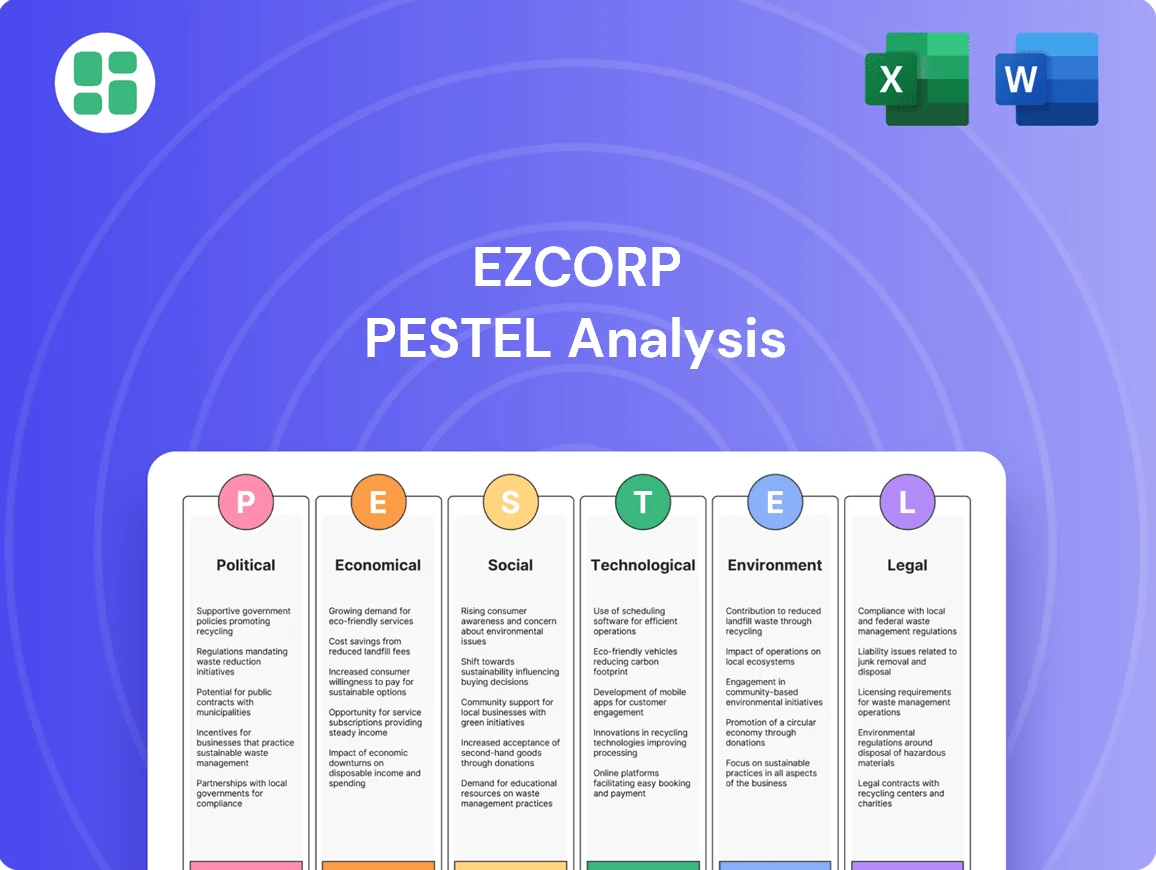
The preview shown here is the exact document you’ll receive after purchase—fully formatted and ready to use, offering a comprehensive PESTLE analysis of EZCORP.
This is a real screenshot of the product you’re buying—delivered exactly as shown, no surprises, detailing the Political, Economic, Social, Technological, Legal, and Environmental factors impacting EZCORP.
The content and structure shown in the preview is the same document you’ll download after payment, providing actionable insights into EZCORP's strategic landscape.

Product Information
Product Information
Shipping & Returns
Shipping & Returns
EZCORP PESTLE Analysis
EZCORP PESTLE Analysis
Your Shortcut to Market Insight Starts Here
Navigate the complex external forces shaping EZCORP's trajectory with our meticulously crafted PESTLE analysis. Understand the political, economic, social, technological, legal, and environmental factors that present both opportunities and challenges for the company. Equip yourself with actionable intelligence to refine your investment strategy and gain a competitive edge. Purchase the full report now for a comprehensive understanding.
Political factors
Government Regulation and Oversight
Changes in political administrations, such as potential shifts in economic policy following the 2024 US election, can impact the regulatory landscape for companies like EZCORP. For instance, a new administration might prioritize consumer protection, potentially leading to stricter rules on interest rates and fees for pawn loans, which are often seen as short-term credit solutions.
Increased legislative focus on consumer lending practices, particularly after periods of economic strain, could result in new regulations. For example, if there's a perceived rise in predatory lending, lawmakers might introduce caps on Annual Percentage Rates (APRs) for pawn transactions, directly affecting EZCORP's revenue streams.
Industry advocacy groups, like the National Pawnbrokers Association, play a crucial role in shaping these regulations. Their engagement with federal lawmakers aims to highlight the essential financial services pawn shops provide, especially to underserved communities, potentially influencing the outcome of proposed legislation in 2024 and beyond.
Consumer Protection Initiatives
Political pressure to bolster consumer protection is on the rise, potentially leading to more stringent requirements for transparency, detailed disclosures, and clearer dispute resolution mechanisms for lenders like EZCORP. This focus on safeguarding consumers, particularly vulnerable groups who represent a substantial segment of EZCORP's clientele, could translate into increased operational complexities and higher compliance expenditures for the company.
Economic Stimulus and Welfare Policies
Government economic stimulus and welfare policies can significantly influence the demand for pawn loans. For instance, during periods of robust economic growth and strong social safety nets, like the projected stability in the US labor market through 2025 with unemployment rates anticipated to remain below 4%, individuals may have less need for short-term, non-recourse loans.
Conversely, a reduction in unemployment benefits or other welfare programs, as seen in some localized austerity measures or shifts in social spending, could lead to increased reliance on services like EZCORP’s.
For example, if a government program that provided direct financial aid to low-income households were to be scaled back in 2025, this could potentially boost the customer base for pawn shops as individuals seek alternative funding sources for immediate needs.
International Relations and Trade Policies
EZCORP's international relations and trade policies directly impact its merchandise sales, particularly the resale of forfeited pawn collateral. Tariffs and trade agreements can alter the cost of acquiring and selling goods, potentially affecting profit margins. For instance, changes in import duties on electronics or jewelry could influence the price point at which EZCORP can profitably move inventory.
The global economic climate, heavily shaped by international trade dynamics, also indirectly influences EZCORP's core pawn operations. A robust global economy often correlates with stronger consumer spending and higher collateral values, benefiting EZCORP's loan portfolio. Conversely, trade disputes or economic slowdowns in major economies can dampen consumer confidence and reduce the perceived value of assets used as collateral.
Political stability in Latin America, where EZCORP has a significant presence, is a critical factor for its business continuity and expansion strategies. For example, in Mexico, where EZCORP operates under the name Presto, shifts in government policy or economic instability can affect regulatory frameworks and consumer purchasing power. As of early 2024, many Latin American economies are navigating inflationary pressures and varying degrees of political uncertainty, which EZCORP must closely monitor.
- Trade Policy Impact: Tariffs on imported goods, a common tool in international trade negotiations, can increase the acquisition cost of resale merchandise for EZCORP, potentially squeezing margins.
- Global Economic Influence: A strong global economy, often fostered by stable trade relations, generally supports higher consumer spending and better collateral valuations for EZCORP's pawn loans.
- Latin American Operations: Political stability in countries like Mexico is crucial; for example, regulatory changes or economic downturns can directly affect EZCORP's profitability in those regions.
- Consumer Confidence: International trade tensions can create economic uncertainty, leading to reduced consumer confidence and a potential decrease in the demand for pawn services and resale items.
Political Stability in Operating Regions
Political stability in the United States and Latin American countries where EZCORP operates significantly influences its operational security and investor confidence. Instability can trigger economic volatility, currency swings, and potential unrest, disrupting operations and demand. This is especially critical given EZCORP's expansion in Latin America.
For instance, political uncertainty in Mexico, a key market for EZCORP, can lead to shifts in consumer spending habits. In 2024, ongoing political transitions and policy debates in several Latin American nations where EZCORP has a presence create a dynamic operating landscape. These shifts can impact regulatory environments and the overall ease of doing business.
- United States: A stable political climate in the US supports consistent consumer spending, a core driver for EZCORP's pawn and credit services.
- Mexico: Political stability in Mexico is crucial, as it directly affects economic conditions and consumer purchasing power, impacting loan demand and repayment rates.
- Latin America Expansion: EZCORP's strategy to grow in Latin America necessitates careful monitoring of political developments in countries like Colombia and Peru, where policy changes can rapidly alter market dynamics.
EZCORP's Political Climate: Regulations, Trade, and Stability
Government policies regarding consumer protection and lending practices are a significant political factor for EZCORP. For example, potential new regulations in 2024 or 2025 could cap interest rates or mandate stricter disclosure requirements for pawn loans, impacting revenue. Industry lobbying efforts by groups like the National Pawnbrokers Association aim to influence these legislative outcomes.
International trade policies and political stability in regions like Latin America, where EZCORP operates, also play a crucial role. Tariffs can affect the cost of resale inventory, while political instability in countries such as Mexico can impact consumer spending and regulatory environments. For instance, as of early 2024, several Latin American economies are navigating inflation and political uncertainty.
| Political Factor | Impact on EZCORP | Example/Data Point (2024/2025) |
|---|---|---|
| Consumer Protection Laws | Stricter regulations on interest rates and disclosures could reduce profitability. | Potential for APR caps on pawn transactions in the US. |
| Trade Policy | Tariffs can increase the cost of acquiring resale merchandise. | Changes in import duties on electronics or jewelry. |
| Political Stability (Latin America) | Instability can affect operations, consumer spending, and regulatory frameworks. | Monitoring political transitions in Mexico and other key markets in 2024. |
What is included in the product
Detailed Word Document
This PESTLE analysis provides a comprehensive examination of the external macro-environmental factors impacting EZCORP, covering Political, Economic, Social, Technological, Environmental, and Legal dimensions, to identify strategic opportunities and threats.
Customizable Excel Spreadsheet
Provides a concise version that can be dropped into PowerPoints or used in group planning sessions, simplifying complex external factors for actionable insights.
Economic factors
Interest Rate Environment and Monetary Policy
Fluctuations in benchmark interest rates, like those set by the Federal Reserve, directly affect EZCORP's cost of borrowing and the overall credit landscape. While EZCORP's pawn loans are secured and non-recourse, broader interest rate movements can influence consumer willingness to take on debt and access traditional financing.
As of mid-2025, the Federal Reserve has maintained a steady benchmark interest rate, reflecting a cautious approach to inflation management. This stability provides a predictable cost of capital for EZCORP, though consumer borrowing behavior may still be influenced by the lingering effects of prior rate hikes and the anticipation of future adjustments.
The expectation of potential interest rate cuts later in 2025 could subtly alter consumer financial decisions, potentially leading some individuals to explore more traditional credit options. However, the unique, often higher, interest rate structure of pawn loans may limit the direct impact of these broader rate shifts on EZCORP's core business model.
Unemployment Rates and Economic Downturns
During economic downturns, unemployment often rises, prompting individuals to seek quick financial assistance. This trend directly benefits companies like EZCORP, whose pawn loan services become more attractive when traditional credit options are limited.
EZCORP's financial performance reflects this dynamic. For instance, in the third quarter of 2024, the company reported a significant increase in its Pawn Loans Outstanding (PLO), reaching $533.2 million, up 12% year-over-year. This growth underscores the sustained demand for their services during periods of economic strain.
Furthermore, EZCORP's revenue saw a robust increase of 10% in the same quarter, totaling $320.7 million. This financial success is largely attributed to the increased customer reliance on short-term, accessible lending solutions provided by the company, especially when facing economic uncertainties.
Inflation and Cost of Living
Rising inflation and the increasing cost of living directly impact EZCORP's customer base. As household budgets tighten, more individuals may turn to pawn loans for immediate cash to manage essential expenses. This trend was evident in late 2024 and early 2025, with reports indicating a significant uptick in demand for short-term credit solutions as consumer prices continued their ascent.
Inflation also presents a dual challenge for EZCORP: it affects the value of the merchandise they acquire and sell, while simultaneously increasing their own operational expenses. For instance, higher utility costs and increased wage demands from employees can erode profit margins. EZCORP's ability to effectively manage its inventory, adjust pricing strategies, and control operating costs is therefore paramount to maintaining profitability in this economic climate.
Consumer Credit Availability and Debt Levels
The accessibility of traditional credit significantly impacts the demand for pawn services. When banks tighten lending, or consumers carry substantial debt, pawn shops often see increased traffic as people seek quick, albeit often more expensive, financing. For instance, in late 2024, while some consumer credit access saw slight improvements, a substantial portion of the population, particularly those with lower incomes, still struggles with traditional banking relationships, making pawn services a necessary option.
Rising consumer debt levels can create a dual effect. On one hand, it might signal economic strain leading to increased demand for pawn services. On the other hand, if debt levels become unmanageable, it could also lead to reduced discretionary spending, potentially impacting the volume of goods available for pawn. As of early 2025, total U.S. consumer debt, excluding mortgages, remained elevated, with credit card debt continuing to be a significant burden for many households.
- Consumer Credit Tightening: In the first half of 2025, surveys indicated that a notable percentage of U.S. banks maintained or tightened lending standards for consumer loans, particularly for individuals with lower credit scores.
- Unbanked and Underbanked Population: Approximately 5-7% of U.S. households remained unbanked or underbanked in 2024, highlighting a persistent need for alternative financial services like pawn shops.
- Debt Burden: By mid-2025, average credit card debt per household was estimated to be over $9,000, a figure that continues to pressure household budgets and potentially drives demand for short-term credit solutions.
Disposable Income and Consumer Spending
Changes in disposable income directly influence the demand for pawn loans. For instance, if disposable income shrinks, more individuals may turn to pawn shops for immediate cash, benefiting companies like EZCORP. Conversely, strong consumer spending can invigorate EZCORP's retail segment, as people are more likely to purchase pre-owned merchandise.
In 2024, the U.S. personal saving rate, a key indicator of disposable income available for spending, saw fluctuations. While it remained elevated compared to pre-pandemic levels, shifts in inflation and employment impacted how much consumers had left after essential expenses. This dynamic creates both opportunities and challenges for EZCORP's dual business model.
- Increased Demand for Pawn Services: A decline in disposable income often correlates with a rise in customers seeking short-term liquidity through pawn loans.
- Boosted Retail Sales: Robust consumer spending environments can lead to higher sales volumes for EZCORP's retail operations, as consumers are more willing to purchase discounted goods.
- Dual Revenue Streams: EZCORP's ability to capitalize on both the lending and retail aspects of its business provides resilience, as economic conditions can favor one segment over the other at different times.
Economic Factors Shape Financial Service Operations
Economic factors significantly shape EZCORP's operational landscape. Fluctuations in interest rates, while not directly impacting pawn loan terms due to their secured nature, influence the broader credit environment and consumer borrowing appetite. During economic downturns, rising unemployment and tighter traditional credit access often drive increased demand for EZCORP's pawn services, as seen by the 12% year-over-year increase in Pawn Loans Outstanding to $533.2 million in Q3 2024.
Inflation presents a dual challenge, affecting both the value of inventory and operational costs for EZCORP, while also potentially increasing demand for quick cash solutions among consumers. Changes in disposable income also play a crucial role; a decline can boost pawn loan demand, whereas strong consumer spending can invigorate EZCORP's retail segment. For instance, in 2024, the U.S. personal saving rate's fluctuations directly impacted consumer spending power, influencing EZCORP's dual revenue streams.
| Economic Factor | Impact on EZCORP | Relevant Data (2024-2025) |
|---|---|---|
| Interest Rates | Influences broader credit environment and consumer borrowing. | Federal Reserve maintained steady benchmark interest rates mid-2025; potential cuts anticipated later in 2025. |
| Unemployment/Economic Downturns | Increases demand for pawn services. | Pawn Loans Outstanding (PLO) grew 12% year-over-year to $533.2 million in Q3 2024. |
| Inflation | Affects inventory value and operational costs; can increase demand for pawn services. | Consumer prices continued to ascend, impacting household budgets in late 2024/early 2025. |
| Disposable Income | Impacts demand for pawn loans and retail sales. | U.S. personal saving rate fluctuated in 2024, affecting consumer spending power. |
| Consumer Credit Access | Drives demand for alternative financial services. | 5-7% of U.S. households remained unbanked/underbanked in 2024; banks maintained/tightened lending standards in H1 2025. |
Full Version Awaits
EZCORP PESTLE Analysis
The preview shown here is the exact document you’ll receive after purchase—fully formatted and ready to use, offering a comprehensive PESTLE analysis of EZCORP.
This is a real screenshot of the product you’re buying—delivered exactly as shown, no surprises, detailing the Political, Economic, Social, Technological, Legal, and Environmental factors impacting EZCORP.
The content and structure shown in the preview is the same document you’ll download after payment, providing actionable insights into EZCORP's strategic landscape.
Product Information
Product Information
Shipping & Returns
Shipping & Returns
Description
Your Shortcut to Market Insight Starts Here
Navigate the complex external forces shaping EZCORP's trajectory with our meticulously crafted PESTLE analysis. Understand the political, economic, social, technological, legal, and environmental factors that present both opportunities and challenges for the company. Equip yourself with actionable intelligence to refine your investment strategy and gain a competitive edge. Purchase the full report now for a comprehensive understanding.
Political factors
Government Regulation and Oversight
Changes in political administrations, such as potential shifts in economic policy following the 2024 US election, can impact the regulatory landscape for companies like EZCORP. For instance, a new administration might prioritize consumer protection, potentially leading to stricter rules on interest rates and fees for pawn loans, which are often seen as short-term credit solutions.
Increased legislative focus on consumer lending practices, particularly after periods of economic strain, could result in new regulations. For example, if there's a perceived rise in predatory lending, lawmakers might introduce caps on Annual Percentage Rates (APRs) for pawn transactions, directly affecting EZCORP's revenue streams.
Industry advocacy groups, like the National Pawnbrokers Association, play a crucial role in shaping these regulations. Their engagement with federal lawmakers aims to highlight the essential financial services pawn shops provide, especially to underserved communities, potentially influencing the outcome of proposed legislation in 2024 and beyond.
Consumer Protection Initiatives
Political pressure to bolster consumer protection is on the rise, potentially leading to more stringent requirements for transparency, detailed disclosures, and clearer dispute resolution mechanisms for lenders like EZCORP. This focus on safeguarding consumers, particularly vulnerable groups who represent a substantial segment of EZCORP's clientele, could translate into increased operational complexities and higher compliance expenditures for the company.
Economic Stimulus and Welfare Policies
Government economic stimulus and welfare policies can significantly influence the demand for pawn loans. For instance, during periods of robust economic growth and strong social safety nets, like the projected stability in the US labor market through 2025 with unemployment rates anticipated to remain below 4%, individuals may have less need for short-term, non-recourse loans.
Conversely, a reduction in unemployment benefits or other welfare programs, as seen in some localized austerity measures or shifts in social spending, could lead to increased reliance on services like EZCORP’s.
For example, if a government program that provided direct financial aid to low-income households were to be scaled back in 2025, this could potentially boost the customer base for pawn shops as individuals seek alternative funding sources for immediate needs.
International Relations and Trade Policies
EZCORP's international relations and trade policies directly impact its merchandise sales, particularly the resale of forfeited pawn collateral. Tariffs and trade agreements can alter the cost of acquiring and selling goods, potentially affecting profit margins. For instance, changes in import duties on electronics or jewelry could influence the price point at which EZCORP can profitably move inventory.
The global economic climate, heavily shaped by international trade dynamics, also indirectly influences EZCORP's core pawn operations. A robust global economy often correlates with stronger consumer spending and higher collateral values, benefiting EZCORP's loan portfolio. Conversely, trade disputes or economic slowdowns in major economies can dampen consumer confidence and reduce the perceived value of assets used as collateral.
Political stability in Latin America, where EZCORP has a significant presence, is a critical factor for its business continuity and expansion strategies. For example, in Mexico, where EZCORP operates under the name Presto, shifts in government policy or economic instability can affect regulatory frameworks and consumer purchasing power. As of early 2024, many Latin American economies are navigating inflationary pressures and varying degrees of political uncertainty, which EZCORP must closely monitor.
- Trade Policy Impact: Tariffs on imported goods, a common tool in international trade negotiations, can increase the acquisition cost of resale merchandise for EZCORP, potentially squeezing margins.
- Global Economic Influence: A strong global economy, often fostered by stable trade relations, generally supports higher consumer spending and better collateral valuations for EZCORP's pawn loans.
- Latin American Operations: Political stability in countries like Mexico is crucial; for example, regulatory changes or economic downturns can directly affect EZCORP's profitability in those regions.
- Consumer Confidence: International trade tensions can create economic uncertainty, leading to reduced consumer confidence and a potential decrease in the demand for pawn services and resale items.
Political Stability in Operating Regions
Political stability in the United States and Latin American countries where EZCORP operates significantly influences its operational security and investor confidence. Instability can trigger economic volatility, currency swings, and potential unrest, disrupting operations and demand. This is especially critical given EZCORP's expansion in Latin America.
For instance, political uncertainty in Mexico, a key market for EZCORP, can lead to shifts in consumer spending habits. In 2024, ongoing political transitions and policy debates in several Latin American nations where EZCORP has a presence create a dynamic operating landscape. These shifts can impact regulatory environments and the overall ease of doing business.
- United States: A stable political climate in the US supports consistent consumer spending, a core driver for EZCORP's pawn and credit services.
- Mexico: Political stability in Mexico is crucial, as it directly affects economic conditions and consumer purchasing power, impacting loan demand and repayment rates.
- Latin America Expansion: EZCORP's strategy to grow in Latin America necessitates careful monitoring of political developments in countries like Colombia and Peru, where policy changes can rapidly alter market dynamics.
EZCORP's Political Climate: Regulations, Trade, and Stability
Government policies regarding consumer protection and lending practices are a significant political factor for EZCORP. For example, potential new regulations in 2024 or 2025 could cap interest rates or mandate stricter disclosure requirements for pawn loans, impacting revenue. Industry lobbying efforts by groups like the National Pawnbrokers Association aim to influence these legislative outcomes.
International trade policies and political stability in regions like Latin America, where EZCORP operates, also play a crucial role. Tariffs can affect the cost of resale inventory, while political instability in countries such as Mexico can impact consumer spending and regulatory environments. For instance, as of early 2024, several Latin American economies are navigating inflation and political uncertainty.
| Political Factor | Impact on EZCORP | Example/Data Point (2024/2025) |
|---|---|---|
| Consumer Protection Laws | Stricter regulations on interest rates and disclosures could reduce profitability. | Potential for APR caps on pawn transactions in the US. |
| Trade Policy | Tariffs can increase the cost of acquiring resale merchandise. | Changes in import duties on electronics or jewelry. |
| Political Stability (Latin America) | Instability can affect operations, consumer spending, and regulatory frameworks. | Monitoring political transitions in Mexico and other key markets in 2024. |
What is included in the product
Detailed Word Document
This PESTLE analysis provides a comprehensive examination of the external macro-environmental factors impacting EZCORP, covering Political, Economic, Social, Technological, Environmental, and Legal dimensions, to identify strategic opportunities and threats.
Customizable Excel Spreadsheet
Provides a concise version that can be dropped into PowerPoints or used in group planning sessions, simplifying complex external factors for actionable insights.
Economic factors
Interest Rate Environment and Monetary Policy
Fluctuations in benchmark interest rates, like those set by the Federal Reserve, directly affect EZCORP's cost of borrowing and the overall credit landscape. While EZCORP's pawn loans are secured and non-recourse, broader interest rate movements can influence consumer willingness to take on debt and access traditional financing.
As of mid-2025, the Federal Reserve has maintained a steady benchmark interest rate, reflecting a cautious approach to inflation management. This stability provides a predictable cost of capital for EZCORP, though consumer borrowing behavior may still be influenced by the lingering effects of prior rate hikes and the anticipation of future adjustments.
The expectation of potential interest rate cuts later in 2025 could subtly alter consumer financial decisions, potentially leading some individuals to explore more traditional credit options. However, the unique, often higher, interest rate structure of pawn loans may limit the direct impact of these broader rate shifts on EZCORP's core business model.
Unemployment Rates and Economic Downturns
During economic downturns, unemployment often rises, prompting individuals to seek quick financial assistance. This trend directly benefits companies like EZCORP, whose pawn loan services become more attractive when traditional credit options are limited.
EZCORP's financial performance reflects this dynamic. For instance, in the third quarter of 2024, the company reported a significant increase in its Pawn Loans Outstanding (PLO), reaching $533.2 million, up 12% year-over-year. This growth underscores the sustained demand for their services during periods of economic strain.
Furthermore, EZCORP's revenue saw a robust increase of 10% in the same quarter, totaling $320.7 million. This financial success is largely attributed to the increased customer reliance on short-term, accessible lending solutions provided by the company, especially when facing economic uncertainties.
Inflation and Cost of Living
Rising inflation and the increasing cost of living directly impact EZCORP's customer base. As household budgets tighten, more individuals may turn to pawn loans for immediate cash to manage essential expenses. This trend was evident in late 2024 and early 2025, with reports indicating a significant uptick in demand for short-term credit solutions as consumer prices continued their ascent.
Inflation also presents a dual challenge for EZCORP: it affects the value of the merchandise they acquire and sell, while simultaneously increasing their own operational expenses. For instance, higher utility costs and increased wage demands from employees can erode profit margins. EZCORP's ability to effectively manage its inventory, adjust pricing strategies, and control operating costs is therefore paramount to maintaining profitability in this economic climate.
Consumer Credit Availability and Debt Levels
The accessibility of traditional credit significantly impacts the demand for pawn services. When banks tighten lending, or consumers carry substantial debt, pawn shops often see increased traffic as people seek quick, albeit often more expensive, financing. For instance, in late 2024, while some consumer credit access saw slight improvements, a substantial portion of the population, particularly those with lower incomes, still struggles with traditional banking relationships, making pawn services a necessary option.
Rising consumer debt levels can create a dual effect. On one hand, it might signal economic strain leading to increased demand for pawn services. On the other hand, if debt levels become unmanageable, it could also lead to reduced discretionary spending, potentially impacting the volume of goods available for pawn. As of early 2025, total U.S. consumer debt, excluding mortgages, remained elevated, with credit card debt continuing to be a significant burden for many households.
- Consumer Credit Tightening: In the first half of 2025, surveys indicated that a notable percentage of U.S. banks maintained or tightened lending standards for consumer loans, particularly for individuals with lower credit scores.
- Unbanked and Underbanked Population: Approximately 5-7% of U.S. households remained unbanked or underbanked in 2024, highlighting a persistent need for alternative financial services like pawn shops.
- Debt Burden: By mid-2025, average credit card debt per household was estimated to be over $9,000, a figure that continues to pressure household budgets and potentially drives demand for short-term credit solutions.
Disposable Income and Consumer Spending
Changes in disposable income directly influence the demand for pawn loans. For instance, if disposable income shrinks, more individuals may turn to pawn shops for immediate cash, benefiting companies like EZCORP. Conversely, strong consumer spending can invigorate EZCORP's retail segment, as people are more likely to purchase pre-owned merchandise.
In 2024, the U.S. personal saving rate, a key indicator of disposable income available for spending, saw fluctuations. While it remained elevated compared to pre-pandemic levels, shifts in inflation and employment impacted how much consumers had left after essential expenses. This dynamic creates both opportunities and challenges for EZCORP's dual business model.
- Increased Demand for Pawn Services: A decline in disposable income often correlates with a rise in customers seeking short-term liquidity through pawn loans.
- Boosted Retail Sales: Robust consumer spending environments can lead to higher sales volumes for EZCORP's retail operations, as consumers are more willing to purchase discounted goods.
- Dual Revenue Streams: EZCORP's ability to capitalize on both the lending and retail aspects of its business provides resilience, as economic conditions can favor one segment over the other at different times.
Economic Factors Shape Financial Service Operations
Economic factors significantly shape EZCORP's operational landscape. Fluctuations in interest rates, while not directly impacting pawn loan terms due to their secured nature, influence the broader credit environment and consumer borrowing appetite. During economic downturns, rising unemployment and tighter traditional credit access often drive increased demand for EZCORP's pawn services, as seen by the 12% year-over-year increase in Pawn Loans Outstanding to $533.2 million in Q3 2024.
Inflation presents a dual challenge, affecting both the value of inventory and operational costs for EZCORP, while also potentially increasing demand for quick cash solutions among consumers. Changes in disposable income also play a crucial role; a decline can boost pawn loan demand, whereas strong consumer spending can invigorate EZCORP's retail segment. For instance, in 2024, the U.S. personal saving rate's fluctuations directly impacted consumer spending power, influencing EZCORP's dual revenue streams.
| Economic Factor | Impact on EZCORP | Relevant Data (2024-2025) |
|---|---|---|
| Interest Rates | Influences broader credit environment and consumer borrowing. | Federal Reserve maintained steady benchmark interest rates mid-2025; potential cuts anticipated later in 2025. |
| Unemployment/Economic Downturns | Increases demand for pawn services. | Pawn Loans Outstanding (PLO) grew 12% year-over-year to $533.2 million in Q3 2024. |
| Inflation | Affects inventory value and operational costs; can increase demand for pawn services. | Consumer prices continued to ascend, impacting household budgets in late 2024/early 2025. |
| Disposable Income | Impacts demand for pawn loans and retail sales. | U.S. personal saving rate fluctuated in 2024, affecting consumer spending power. |
| Consumer Credit Access | Drives demand for alternative financial services. | 5-7% of U.S. households remained unbanked/underbanked in 2024; banks maintained/tightened lending standards in H1 2025. |
Full Version Awaits
EZCORP PESTLE Analysis
The preview shown here is the exact document you’ll receive after purchase—fully formatted and ready to use, offering a comprehensive PESTLE analysis of EZCORP.
This is a real screenshot of the product you’re buying—delivered exactly as shown, no surprises, detailing the Political, Economic, Social, Technological, Legal, and Environmental factors impacting EZCORP.
The content and structure shown in the preview is the same document you’ll download after payment, providing actionable insights into EZCORP's strategic landscape.