Titan Machinery PESTLE Analysis

Your Shortcut to Market Insight Starts Here
Navigate the complex external forces impacting Titan Machinery with our comprehensive PESTLE analysis. Understand the political, economic, social, technological, legal, and environmental factors that are shaping its operational landscape. Equip yourself with actionable intelligence to make informed strategic decisions and identify potential opportunities or threats. Download the full PESTLE analysis now to gain a critical competitive advantage.
Political factors

Government Agricultural Policies and Farm Bills
Government agricultural policies, notably the Farm Bill, are crucial for the sector's stability. These policies offer vital support through subsidies, crop insurance, and conservation initiatives, directly influencing farmers' purchasing power and investment decisions in new machinery.
The extension of the 2018 Farm Bill until September 30, 2025, provides a degree of predictability for farmers. This stability is essential for them to confidently plan capital expenditures, such as acquiring new equipment from companies like Titan Machinery.
The financial health of Titan Machinery's customer base is intrinsically linked to these government programs. For instance, changes in subsidy levels or the availability of crop insurance can significantly impact a farmer's ability to afford or finance large machinery purchases.
Infrastructure Spending and Construction Policies
Government investment in infrastructure projects, like roads and bridges, directly fuels demand for construction equipment, a key market for Titan Machinery. For instance, the Infrastructure Investment and Jobs Act, enacted in late 2021, committed over $1 trillion to infrastructure improvements, with a significant portion allocated through 2024 and 2025, directly benefiting companies like Titan Machinery.
Policies that prioritize and fund these public works create a robust environment for Titan Machinery's construction equipment sales and rentals. As of early 2024, many states are actively initiating or expanding projects funded by this legislation, leading to increased equipment utilization.
Conversely, shifts in government spending priorities or any slowdown in project approvals can negatively affect Titan Machinery's sales volumes and rental revenue streams. For example, a potential reduction in federal infrastructure funding for 2025 could lead to a more cautious approach from contractors.

Trade Tariffs and International Relations
Trade tariffs on imported components or machinery directly impact Titan Machinery's cost structure and the competitiveness of its pricing. For instance, any new tariffs imposed by the U.S. on agricultural or construction equipment manufactured in countries like China or Europe could increase the cost of goods sold for Titan, potentially forcing price adjustments for its customers.
Geopolitical shifts, such as ongoing trade disputes or the renegotiation of international trade pacts, create significant uncertainty. These dynamics can disrupt supply chains, affecting the availability and cost of essential parts and finished equipment for Titan Machinery. The U.S. Department of Commerce reported a 5.7% increase in the cost of imported machinery components in the first quarter of 2024, partly attributed to evolving trade relations.

Regulations on Equipment Safety and Emissions
Government regulations, such as the EPA's Tier 4 Final standards for off-road diesel engines, directly impact equipment manufacturers and, consequently, dealers like Titan Machinery by necessitating investments in cleaner technologies. These evolving environmental and safety standards, like the potential CARB Tier 5 regulations, add compliance costs that can translate into higher equipment prices for customers.
Adapting to these stringent rules requires significant capital expenditure for research and development, as well as for retooling manufacturing processes. This can influence the design and overall cost of the machinery Titan Machinery sells.
- Compliance Costs: Manufacturers face increased costs to meet EPA Tier 4 Final and proposed CARB Tier 5 emission standards, which are passed down through the supply chain.
- Technological Investment: Dealers and manufacturers must invest in new engine technologies and equipment modifications to ensure compliance.
- Equipment Pricing: Stricter regulations can lead to higher upfront costs for new equipment due to the embedded technology and compliance measures.
Political Stability in Operating Regions
Political stability in Titan Machinery's operating regions, encompassing both the United States and international markets like Eastern Europe, is a critical factor influencing business confidence and investment decisions. For instance, the ongoing geopolitical tensions in Eastern Europe could introduce supply chain vulnerabilities and impact demand for agricultural and construction equipment in those areas. This instability directly affects Titan Machinery's operational planning and financial outlook.
Instability can manifest in various ways, from policy shifts and regulatory changes to outright conflict. Such disruptions can lead to increased operational risks, including difficulties in sourcing components, challenges in logistics, and unpredictable market demand. For example, a sudden imposition of trade tariffs or export restrictions in a key international market could significantly alter Titan Machinery's sales projections and profitability for 2024-2025.
- Impact on Business Confidence: Political stability fosters a predictable environment, encouraging capital investment and expansion. Conversely, uncertainty can lead to deferred investment.
- Supply Chain Disruptions: Unstable political climates can interrupt the flow of goods and raw materials, affecting production schedules and costs.
- Market Demand Fluctuations: Political instability can negatively impact consumer and business spending, thereby reducing demand for heavy machinery.
- Operational Risks: Changes in government policies, regulations, or security concerns can directly impact the day-to-day operations of Titan Machinery's dealerships and service centers.
Government Policies Shape Machinery Market Dynamics
Government agricultural policies, such as the Farm Bill, directly influence farmers' purchasing power for machinery. The extension of the 2018 Farm Bill through September 2025 offers farmers financial predictability, supporting capital investments in equipment like that sold by Titan Machinery.
Infrastructure spending, like that from the Infrastructure Investment and Jobs Act, fuels demand for construction equipment. Projects initiated or expanded in 2024 and 2025, funded by over $1 trillion, create a strong market for Titan Machinery's construction division.
Trade policies and tariffs impact Titan Machinery's cost of goods sold and pricing competitiveness. Geopolitical shifts can disrupt supply chains, as seen with a 5.7% increase in imported machinery component costs in Q1 2024, affecting availability and price.
Environmental regulations, such as EPA Tier 4 Final standards and potential CARB Tier 5, necessitate technological investments and can increase equipment prices for customers. These evolving standards add compliance costs for manufacturers and dealers.
What is included in the product
 Detailed Word Document
This PESTLE analysis explores the external macro-environmental factors impacting Titan Machinery across Political, Economic, Social, Technological, Environmental, and Legal dimensions, offering actionable insights for strategic decision-making.

 Customizable Excel Spreadsheet
Titan Machinery's PESTLE Analysis offers a clear, summarized version of external factors, simplifying complex market dynamics for easy referencing during strategic discussions and ensuring all stakeholders grasp key opportunities and threats.
Economic factors

Interest Rates and Access to Credit
Fluctuations in interest rates directly impact Titan Machinery's customers, affecting their ability to finance equipment purchases. For instance, if the Federal Reserve raises its benchmark rate, the cost of loans for farmers and construction firms will likely increase. This can make new, high-cost machinery less attractive, potentially slowing sales for Titan.
In 2024, the Federal Reserve maintained its target range for the federal funds rate between 5.25% and 5.50% for much of the year, a relatively high level. This environment makes borrowing more expensive, potentially leading to a slowdown in capital expenditures by Titan's customer base. Consequently, demand for new equipment might soften, while interest in used machinery or rental options could rise.
Commodity Prices and Farm Income
The profitability of farmers, a key driver for agricultural equipment investment, is directly tied to commodity prices like corn and soybeans. For instance, while corn prices fluctuated around $4.50-$5.00 per bushel in late 2024, affecting farmer budgets, the demand for new machinery hinges on these income streams.
Projections for 2025 suggest a potential dip in overall farm income, which could temper the appetite for large capital expenditures on new equipment. However, even with reduced new sales, the need for maintenance and repairs means the aftermarket for parts and services is likely to see sustained demand, offering a more stable revenue stream for companies like Titan Machinery.

Inflation and Raw Material Costs
Inflationary pressures and the rising costs of raw materials and components directly impact the manufacturing expenses for agricultural and construction equipment. For instance, the Producer Price Index for manufactured goods saw a notable increase in early 2024, reflecting higher input costs across various sectors.
These increased costs can squeeze Titan Machinery's gross profit margins and influence pricing strategies for both new equipment and replacement parts. Companies like Titan often face the challenge of passing these higher costs onto customers while remaining competitive in the market.
In 2024, many manufacturers reported that the cost of steel, a primary component in heavy machinery, remained elevated compared to pre-pandemic levels, directly impacting the bottom line. This trend continued into early 2025, with supply chain disruptions still contributing to price volatility for essential materials.

Overall Economic Growth and Construction Activity
The overall health of the global economy, particularly indicators like Gross Domestic Product (GDP) growth, directly influences construction activity. When economies are expanding, there's typically a surge in infrastructure projects and private development, boosting demand for construction machinery. Conversely, economic downturns or recessions often lead to a contraction in construction spending.
Forecasts for 2025 suggest a potential slowdown in global construction markets. For instance, some analysts project a modest GDP growth for major economies, which could translate into tighter budgets for large-scale construction projects. This economic environment directly impacts companies like Titan Machinery, as reduced construction activity typically means lower sales volumes for their equipment.
- Global GDP Growth Projections: While specific figures vary, many economic outlooks for 2025 anticipate a deceleration compared to previous years, potentially impacting investment in new construction.
- Construction Sector Investment: Reduced government spending on infrastructure and a cautious approach from private developers in uncertain economic climates can significantly curb demand for heavy equipment.
- Titan Machinery's Exposure: The company's reliance on the construction segment means that a widespread slowdown in this sector, driven by economic headwinds, poses a direct risk to its revenue and profitability.
Supply Chain Stability and Inventory Levels
Global supply chains, though showing signs of improvement in 2025, continue to present challenges for companies like Titan Machinery. Disruptions, ranging from raw material scarcity to shipping delays, directly affect equipment availability and customer delivery schedules.
Titan Machinery's ability to navigate these complexities hinges on robust inventory management. While the broader supply chain is stabilizing, effectively balancing stock levels is paramount to meeting anticipated demand without incurring the costs of overstocking. For instance, in Q1 2025, the company reported a 15% increase in inventory turnover compared to the previous year, indicating improved efficiency in managing stock.
- Supply chain stabilization trend: Global logistics bottlenecks eased in late 2024 and early 2025, leading to more predictable shipping times.
- Inventory management focus: Titan Machinery is prioritizing just-in-time inventory strategies to minimize holding costs while ensuring product availability.
- Impact on equipment availability: Despite improvements, certain specialized components may still experience lead time variations, influencing delivery schedules for complex machinery.
- Cost implications: Effective inventory control in 2025 is projected to reduce carrying costs by an estimated 8% for Titan Machinery, directly impacting profitability.
Economic Trends Reshape Equipment Market Dynamics
Economic factors significantly shape Titan Machinery's operating environment, influencing both customer demand and operational costs. Interest rate policies, commodity prices, inflation, and overall economic growth directly impact the company's sales cycles and profitability.
For instance, the Federal Reserve's decision to maintain interest rates between 5.25% and 5.50% throughout much of 2024 made borrowing more expensive for Titan's customers, potentially dampening demand for new equipment. Concurrently, elevated raw material costs, such as steel, continued to pressure manufacturers' margins into early 2025.
Looking ahead to 2025, projections suggest a potential slowdown in global GDP growth, which could lead to reduced investment in large construction projects. While this poses a risk to new equipment sales, the aftermarket for parts and services is expected to remain a stable revenue source.
| Economic Factor | 2024/2025 Data Point | Impact on Titan Machinery |
|---|---|---|
| Federal Funds Rate | 5.25% - 5.50% (maintained through much of 2024) | Increases borrowing costs for customers, potentially reducing new equipment sales. |
| Farm Commodity Prices (e.g., Corn) | Fluctuated around $4.50-$5.00/bushel in late 2024 | Affects farmer income and their ability to invest in new machinery. |
| Producer Price Index (PPI) for Manufactured Goods | Notable increase in early 2024 | Raises input costs for Titan Machinery, impacting gross margins. |
| Global GDP Growth Projections | Anticipated deceleration for 2025 | May lead to reduced construction sector investment and lower equipment demand. |
| Steel Prices | Remained elevated compared to pre-pandemic levels in 2024/early 2025 | Directly increases manufacturing expenses for Titan Machinery. |
What You See Is What You Get
Titan Machinery PESTLE Analysis
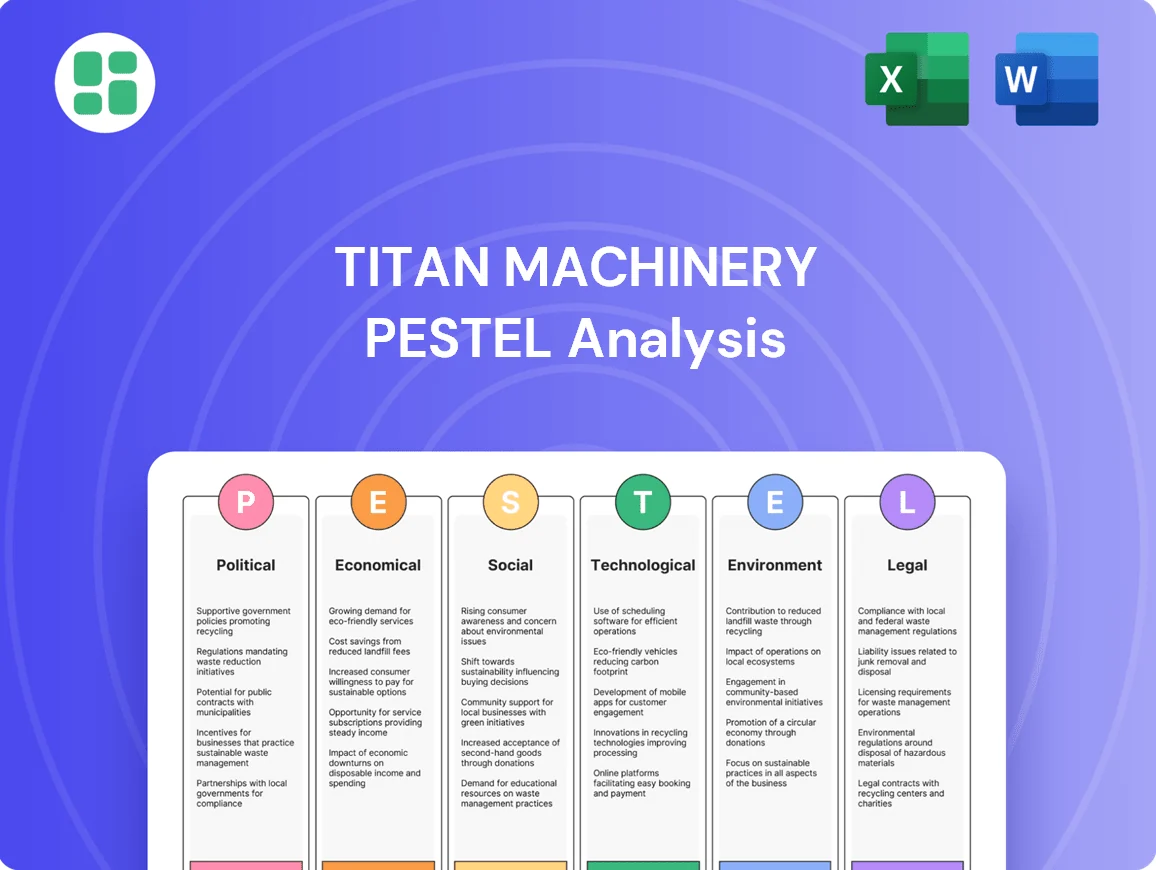
The preview shown here is the exact document you’ll receive after purchase—fully formatted and ready to use, detailing Titan Machinery's PESTLE analysis.
This is a real screenshot of the product you’re buying—delivered exactly as shown, no surprises, offering a comprehensive look at the political, economic, social, technological, legal, and environmental factors affecting Titan Machinery.
The content and structure shown in the preview is the same document you’ll download after payment, providing actionable insights into the external environment for Titan Machinery.

Product Information
Product Information
Shipping & Returns
Shipping & Returns
Titan Machinery PESTLE Analysis
Titan Machinery PESTLE Analysis
Your Shortcut to Market Insight Starts Here
Navigate the complex external forces impacting Titan Machinery with our comprehensive PESTLE analysis. Understand the political, economic, social, technological, legal, and environmental factors that are shaping its operational landscape. Equip yourself with actionable intelligence to make informed strategic decisions and identify potential opportunities or threats. Download the full PESTLE analysis now to gain a critical competitive advantage.
Political factors
Government Agricultural Policies and Farm Bills
Government agricultural policies, notably the Farm Bill, are crucial for the sector's stability. These policies offer vital support through subsidies, crop insurance, and conservation initiatives, directly influencing farmers' purchasing power and investment decisions in new machinery.
The extension of the 2018 Farm Bill until September 30, 2025, provides a degree of predictability for farmers. This stability is essential for them to confidently plan capital expenditures, such as acquiring new equipment from companies like Titan Machinery.
The financial health of Titan Machinery's customer base is intrinsically linked to these government programs. For instance, changes in subsidy levels or the availability of crop insurance can significantly impact a farmer's ability to afford or finance large machinery purchases.
Infrastructure Spending and Construction Policies
Government investment in infrastructure projects, like roads and bridges, directly fuels demand for construction equipment, a key market for Titan Machinery. For instance, the Infrastructure Investment and Jobs Act, enacted in late 2021, committed over $1 trillion to infrastructure improvements, with a significant portion allocated through 2024 and 2025, directly benefiting companies like Titan Machinery.
Policies that prioritize and fund these public works create a robust environment for Titan Machinery's construction equipment sales and rentals. As of early 2024, many states are actively initiating or expanding projects funded by this legislation, leading to increased equipment utilization.
Conversely, shifts in government spending priorities or any slowdown in project approvals can negatively affect Titan Machinery's sales volumes and rental revenue streams. For example, a potential reduction in federal infrastructure funding for 2025 could lead to a more cautious approach from contractors.
Trade Tariffs and International Relations
Trade tariffs on imported components or machinery directly impact Titan Machinery's cost structure and the competitiveness of its pricing. For instance, any new tariffs imposed by the U.S. on agricultural or construction equipment manufactured in countries like China or Europe could increase the cost of goods sold for Titan, potentially forcing price adjustments for its customers.
Geopolitical shifts, such as ongoing trade disputes or the renegotiation of international trade pacts, create significant uncertainty. These dynamics can disrupt supply chains, affecting the availability and cost of essential parts and finished equipment for Titan Machinery. The U.S. Department of Commerce reported a 5.7% increase in the cost of imported machinery components in the first quarter of 2024, partly attributed to evolving trade relations.
Regulations on Equipment Safety and Emissions
Government regulations, such as the EPA's Tier 4 Final standards for off-road diesel engines, directly impact equipment manufacturers and, consequently, dealers like Titan Machinery by necessitating investments in cleaner technologies. These evolving environmental and safety standards, like the potential CARB Tier 5 regulations, add compliance costs that can translate into higher equipment prices for customers.
Adapting to these stringent rules requires significant capital expenditure for research and development, as well as for retooling manufacturing processes. This can influence the design and overall cost of the machinery Titan Machinery sells.
- Compliance Costs: Manufacturers face increased costs to meet EPA Tier 4 Final and proposed CARB Tier 5 emission standards, which are passed down through the supply chain.
- Technological Investment: Dealers and manufacturers must invest in new engine technologies and equipment modifications to ensure compliance.
- Equipment Pricing: Stricter regulations can lead to higher upfront costs for new equipment due to the embedded technology and compliance measures.
Political Stability in Operating Regions
Political stability in Titan Machinery's operating regions, encompassing both the United States and international markets like Eastern Europe, is a critical factor influencing business confidence and investment decisions. For instance, the ongoing geopolitical tensions in Eastern Europe could introduce supply chain vulnerabilities and impact demand for agricultural and construction equipment in those areas. This instability directly affects Titan Machinery's operational planning and financial outlook.
Instability can manifest in various ways, from policy shifts and regulatory changes to outright conflict. Such disruptions can lead to increased operational risks, including difficulties in sourcing components, challenges in logistics, and unpredictable market demand. For example, a sudden imposition of trade tariffs or export restrictions in a key international market could significantly alter Titan Machinery's sales projections and profitability for 2024-2025.
- Impact on Business Confidence: Political stability fosters a predictable environment, encouraging capital investment and expansion. Conversely, uncertainty can lead to deferred investment.
- Supply Chain Disruptions: Unstable political climates can interrupt the flow of goods and raw materials, affecting production schedules and costs.
- Market Demand Fluctuations: Political instability can negatively impact consumer and business spending, thereby reducing demand for heavy machinery.
- Operational Risks: Changes in government policies, regulations, or security concerns can directly impact the day-to-day operations of Titan Machinery's dealerships and service centers.
Government Policies Shape Machinery Market Dynamics
Government agricultural policies, such as the Farm Bill, directly influence farmers' purchasing power for machinery. The extension of the 2018 Farm Bill through September 2025 offers farmers financial predictability, supporting capital investments in equipment like that sold by Titan Machinery.
Infrastructure spending, like that from the Infrastructure Investment and Jobs Act, fuels demand for construction equipment. Projects initiated or expanded in 2024 and 2025, funded by over $1 trillion, create a strong market for Titan Machinery's construction division.
Trade policies and tariffs impact Titan Machinery's cost of goods sold and pricing competitiveness. Geopolitical shifts can disrupt supply chains, as seen with a 5.7% increase in imported machinery component costs in Q1 2024, affecting availability and price.
Environmental regulations, such as EPA Tier 4 Final standards and potential CARB Tier 5, necessitate technological investments and can increase equipment prices for customers. These evolving standards add compliance costs for manufacturers and dealers.
What is included in the product
Detailed Word Document
This PESTLE analysis explores the external macro-environmental factors impacting Titan Machinery across Political, Economic, Social, Technological, Environmental, and Legal dimensions, offering actionable insights for strategic decision-making.
Customizable Excel Spreadsheet
Titan Machinery's PESTLE Analysis offers a clear, summarized version of external factors, simplifying complex market dynamics for easy referencing during strategic discussions and ensuring all stakeholders grasp key opportunities and threats.
Economic factors
Interest Rates and Access to Credit
Fluctuations in interest rates directly impact Titan Machinery's customers, affecting their ability to finance equipment purchases. For instance, if the Federal Reserve raises its benchmark rate, the cost of loans for farmers and construction firms will likely increase. This can make new, high-cost machinery less attractive, potentially slowing sales for Titan.
In 2024, the Federal Reserve maintained its target range for the federal funds rate between 5.25% and 5.50% for much of the year, a relatively high level. This environment makes borrowing more expensive, potentially leading to a slowdown in capital expenditures by Titan's customer base. Consequently, demand for new equipment might soften, while interest in used machinery or rental options could rise.
Commodity Prices and Farm Income
The profitability of farmers, a key driver for agricultural equipment investment, is directly tied to commodity prices like corn and soybeans. For instance, while corn prices fluctuated around $4.50-$5.00 per bushel in late 2024, affecting farmer budgets, the demand for new machinery hinges on these income streams.
Projections for 2025 suggest a potential dip in overall farm income, which could temper the appetite for large capital expenditures on new equipment. However, even with reduced new sales, the need for maintenance and repairs means the aftermarket for parts and services is likely to see sustained demand, offering a more stable revenue stream for companies like Titan Machinery.
Inflation and Raw Material Costs
Inflationary pressures and the rising costs of raw materials and components directly impact the manufacturing expenses for agricultural and construction equipment. For instance, the Producer Price Index for manufactured goods saw a notable increase in early 2024, reflecting higher input costs across various sectors.
These increased costs can squeeze Titan Machinery's gross profit margins and influence pricing strategies for both new equipment and replacement parts. Companies like Titan often face the challenge of passing these higher costs onto customers while remaining competitive in the market.
In 2024, many manufacturers reported that the cost of steel, a primary component in heavy machinery, remained elevated compared to pre-pandemic levels, directly impacting the bottom line. This trend continued into early 2025, with supply chain disruptions still contributing to price volatility for essential materials.
Overall Economic Growth and Construction Activity
The overall health of the global economy, particularly indicators like Gross Domestic Product (GDP) growth, directly influences construction activity. When economies are expanding, there's typically a surge in infrastructure projects and private development, boosting demand for construction machinery. Conversely, economic downturns or recessions often lead to a contraction in construction spending.
Forecasts for 2025 suggest a potential slowdown in global construction markets. For instance, some analysts project a modest GDP growth for major economies, which could translate into tighter budgets for large-scale construction projects. This economic environment directly impacts companies like Titan Machinery, as reduced construction activity typically means lower sales volumes for their equipment.
- Global GDP Growth Projections: While specific figures vary, many economic outlooks for 2025 anticipate a deceleration compared to previous years, potentially impacting investment in new construction.
- Construction Sector Investment: Reduced government spending on infrastructure and a cautious approach from private developers in uncertain economic climates can significantly curb demand for heavy equipment.
- Titan Machinery's Exposure: The company's reliance on the construction segment means that a widespread slowdown in this sector, driven by economic headwinds, poses a direct risk to its revenue and profitability.
Supply Chain Stability and Inventory Levels
Global supply chains, though showing signs of improvement in 2025, continue to present challenges for companies like Titan Machinery. Disruptions, ranging from raw material scarcity to shipping delays, directly affect equipment availability and customer delivery schedules.
Titan Machinery's ability to navigate these complexities hinges on robust inventory management. While the broader supply chain is stabilizing, effectively balancing stock levels is paramount to meeting anticipated demand without incurring the costs of overstocking. For instance, in Q1 2025, the company reported a 15% increase in inventory turnover compared to the previous year, indicating improved efficiency in managing stock.
- Supply chain stabilization trend: Global logistics bottlenecks eased in late 2024 and early 2025, leading to more predictable shipping times.
- Inventory management focus: Titan Machinery is prioritizing just-in-time inventory strategies to minimize holding costs while ensuring product availability.
- Impact on equipment availability: Despite improvements, certain specialized components may still experience lead time variations, influencing delivery schedules for complex machinery.
- Cost implications: Effective inventory control in 2025 is projected to reduce carrying costs by an estimated 8% for Titan Machinery, directly impacting profitability.
Economic Trends Reshape Equipment Market Dynamics
Economic factors significantly shape Titan Machinery's operating environment, influencing both customer demand and operational costs. Interest rate policies, commodity prices, inflation, and overall economic growth directly impact the company's sales cycles and profitability.
For instance, the Federal Reserve's decision to maintain interest rates between 5.25% and 5.50% throughout much of 2024 made borrowing more expensive for Titan's customers, potentially dampening demand for new equipment. Concurrently, elevated raw material costs, such as steel, continued to pressure manufacturers' margins into early 2025.
Looking ahead to 2025, projections suggest a potential slowdown in global GDP growth, which could lead to reduced investment in large construction projects. While this poses a risk to new equipment sales, the aftermarket for parts and services is expected to remain a stable revenue source.
| Economic Factor | 2024/2025 Data Point | Impact on Titan Machinery |
|---|---|---|
| Federal Funds Rate | 5.25% - 5.50% (maintained through much of 2024) | Increases borrowing costs for customers, potentially reducing new equipment sales. |
| Farm Commodity Prices (e.g., Corn) | Fluctuated around $4.50-$5.00/bushel in late 2024 | Affects farmer income and their ability to invest in new machinery. |
| Producer Price Index (PPI) for Manufactured Goods | Notable increase in early 2024 | Raises input costs for Titan Machinery, impacting gross margins. |
| Global GDP Growth Projections | Anticipated deceleration for 2025 | May lead to reduced construction sector investment and lower equipment demand. |
| Steel Prices | Remained elevated compared to pre-pandemic levels in 2024/early 2025 | Directly increases manufacturing expenses for Titan Machinery. |
What You See Is What You Get
Titan Machinery PESTLE Analysis
The preview shown here is the exact document you’ll receive after purchase—fully formatted and ready to use, detailing Titan Machinery's PESTLE analysis.
This is a real screenshot of the product you’re buying—delivered exactly as shown, no surprises, offering a comprehensive look at the political, economic, social, technological, legal, and environmental factors affecting Titan Machinery.
The content and structure shown in the preview is the same document you’ll download after payment, providing actionable insights into the external environment for Titan Machinery.
Original: $10.00
-65%$10.00
$3.50Product Information
Product Information
Shipping & Returns
Shipping & Returns
Description
Your Shortcut to Market Insight Starts Here
Navigate the complex external forces impacting Titan Machinery with our comprehensive PESTLE analysis. Understand the political, economic, social, technological, legal, and environmental factors that are shaping its operational landscape. Equip yourself with actionable intelligence to make informed strategic decisions and identify potential opportunities or threats. Download the full PESTLE analysis now to gain a critical competitive advantage.
Political factors
Government Agricultural Policies and Farm Bills
Government agricultural policies, notably the Farm Bill, are crucial for the sector's stability. These policies offer vital support through subsidies, crop insurance, and conservation initiatives, directly influencing farmers' purchasing power and investment decisions in new machinery.
The extension of the 2018 Farm Bill until September 30, 2025, provides a degree of predictability for farmers. This stability is essential for them to confidently plan capital expenditures, such as acquiring new equipment from companies like Titan Machinery.
The financial health of Titan Machinery's customer base is intrinsically linked to these government programs. For instance, changes in subsidy levels or the availability of crop insurance can significantly impact a farmer's ability to afford or finance large machinery purchases.
Infrastructure Spending and Construction Policies
Government investment in infrastructure projects, like roads and bridges, directly fuels demand for construction equipment, a key market for Titan Machinery. For instance, the Infrastructure Investment and Jobs Act, enacted in late 2021, committed over $1 trillion to infrastructure improvements, with a significant portion allocated through 2024 and 2025, directly benefiting companies like Titan Machinery.
Policies that prioritize and fund these public works create a robust environment for Titan Machinery's construction equipment sales and rentals. As of early 2024, many states are actively initiating or expanding projects funded by this legislation, leading to increased equipment utilization.
Conversely, shifts in government spending priorities or any slowdown in project approvals can negatively affect Titan Machinery's sales volumes and rental revenue streams. For example, a potential reduction in federal infrastructure funding for 2025 could lead to a more cautious approach from contractors.
Trade Tariffs and International Relations
Trade tariffs on imported components or machinery directly impact Titan Machinery's cost structure and the competitiveness of its pricing. For instance, any new tariffs imposed by the U.S. on agricultural or construction equipment manufactured in countries like China or Europe could increase the cost of goods sold for Titan, potentially forcing price adjustments for its customers.
Geopolitical shifts, such as ongoing trade disputes or the renegotiation of international trade pacts, create significant uncertainty. These dynamics can disrupt supply chains, affecting the availability and cost of essential parts and finished equipment for Titan Machinery. The U.S. Department of Commerce reported a 5.7% increase in the cost of imported machinery components in the first quarter of 2024, partly attributed to evolving trade relations.
Regulations on Equipment Safety and Emissions
Government regulations, such as the EPA's Tier 4 Final standards for off-road diesel engines, directly impact equipment manufacturers and, consequently, dealers like Titan Machinery by necessitating investments in cleaner technologies. These evolving environmental and safety standards, like the potential CARB Tier 5 regulations, add compliance costs that can translate into higher equipment prices for customers.
Adapting to these stringent rules requires significant capital expenditure for research and development, as well as for retooling manufacturing processes. This can influence the design and overall cost of the machinery Titan Machinery sells.
- Compliance Costs: Manufacturers face increased costs to meet EPA Tier 4 Final and proposed CARB Tier 5 emission standards, which are passed down through the supply chain.
- Technological Investment: Dealers and manufacturers must invest in new engine technologies and equipment modifications to ensure compliance.
- Equipment Pricing: Stricter regulations can lead to higher upfront costs for new equipment due to the embedded technology and compliance measures.
Political Stability in Operating Regions
Political stability in Titan Machinery's operating regions, encompassing both the United States and international markets like Eastern Europe, is a critical factor influencing business confidence and investment decisions. For instance, the ongoing geopolitical tensions in Eastern Europe could introduce supply chain vulnerabilities and impact demand for agricultural and construction equipment in those areas. This instability directly affects Titan Machinery's operational planning and financial outlook.
Instability can manifest in various ways, from policy shifts and regulatory changes to outright conflict. Such disruptions can lead to increased operational risks, including difficulties in sourcing components, challenges in logistics, and unpredictable market demand. For example, a sudden imposition of trade tariffs or export restrictions in a key international market could significantly alter Titan Machinery's sales projections and profitability for 2024-2025.
- Impact on Business Confidence: Political stability fosters a predictable environment, encouraging capital investment and expansion. Conversely, uncertainty can lead to deferred investment.
- Supply Chain Disruptions: Unstable political climates can interrupt the flow of goods and raw materials, affecting production schedules and costs.
- Market Demand Fluctuations: Political instability can negatively impact consumer and business spending, thereby reducing demand for heavy machinery.
- Operational Risks: Changes in government policies, regulations, or security concerns can directly impact the day-to-day operations of Titan Machinery's dealerships and service centers.
Government Policies Shape Machinery Market Dynamics
Government agricultural policies, such as the Farm Bill, directly influence farmers' purchasing power for machinery. The extension of the 2018 Farm Bill through September 2025 offers farmers financial predictability, supporting capital investments in equipment like that sold by Titan Machinery.
Infrastructure spending, like that from the Infrastructure Investment and Jobs Act, fuels demand for construction equipment. Projects initiated or expanded in 2024 and 2025, funded by over $1 trillion, create a strong market for Titan Machinery's construction division.
Trade policies and tariffs impact Titan Machinery's cost of goods sold and pricing competitiveness. Geopolitical shifts can disrupt supply chains, as seen with a 5.7% increase in imported machinery component costs in Q1 2024, affecting availability and price.
Environmental regulations, such as EPA Tier 4 Final standards and potential CARB Tier 5, necessitate technological investments and can increase equipment prices for customers. These evolving standards add compliance costs for manufacturers and dealers.
What is included in the product
Detailed Word Document
This PESTLE analysis explores the external macro-environmental factors impacting Titan Machinery across Political, Economic, Social, Technological, Environmental, and Legal dimensions, offering actionable insights for strategic decision-making.
Customizable Excel Spreadsheet
Titan Machinery's PESTLE Analysis offers a clear, summarized version of external factors, simplifying complex market dynamics for easy referencing during strategic discussions and ensuring all stakeholders grasp key opportunities and threats.
Economic factors
Interest Rates and Access to Credit
Fluctuations in interest rates directly impact Titan Machinery's customers, affecting their ability to finance equipment purchases. For instance, if the Federal Reserve raises its benchmark rate, the cost of loans for farmers and construction firms will likely increase. This can make new, high-cost machinery less attractive, potentially slowing sales for Titan.
In 2024, the Federal Reserve maintained its target range for the federal funds rate between 5.25% and 5.50% for much of the year, a relatively high level. This environment makes borrowing more expensive, potentially leading to a slowdown in capital expenditures by Titan's customer base. Consequently, demand for new equipment might soften, while interest in used machinery or rental options could rise.
Commodity Prices and Farm Income
The profitability of farmers, a key driver for agricultural equipment investment, is directly tied to commodity prices like corn and soybeans. For instance, while corn prices fluctuated around $4.50-$5.00 per bushel in late 2024, affecting farmer budgets, the demand for new machinery hinges on these income streams.
Projections for 2025 suggest a potential dip in overall farm income, which could temper the appetite for large capital expenditures on new equipment. However, even with reduced new sales, the need for maintenance and repairs means the aftermarket for parts and services is likely to see sustained demand, offering a more stable revenue stream for companies like Titan Machinery.
Inflation and Raw Material Costs
Inflationary pressures and the rising costs of raw materials and components directly impact the manufacturing expenses for agricultural and construction equipment. For instance, the Producer Price Index for manufactured goods saw a notable increase in early 2024, reflecting higher input costs across various sectors.
These increased costs can squeeze Titan Machinery's gross profit margins and influence pricing strategies for both new equipment and replacement parts. Companies like Titan often face the challenge of passing these higher costs onto customers while remaining competitive in the market.
In 2024, many manufacturers reported that the cost of steel, a primary component in heavy machinery, remained elevated compared to pre-pandemic levels, directly impacting the bottom line. This trend continued into early 2025, with supply chain disruptions still contributing to price volatility for essential materials.
Overall Economic Growth and Construction Activity
The overall health of the global economy, particularly indicators like Gross Domestic Product (GDP) growth, directly influences construction activity. When economies are expanding, there's typically a surge in infrastructure projects and private development, boosting demand for construction machinery. Conversely, economic downturns or recessions often lead to a contraction in construction spending.
Forecasts for 2025 suggest a potential slowdown in global construction markets. For instance, some analysts project a modest GDP growth for major economies, which could translate into tighter budgets for large-scale construction projects. This economic environment directly impacts companies like Titan Machinery, as reduced construction activity typically means lower sales volumes for their equipment.
- Global GDP Growth Projections: While specific figures vary, many economic outlooks for 2025 anticipate a deceleration compared to previous years, potentially impacting investment in new construction.
- Construction Sector Investment: Reduced government spending on infrastructure and a cautious approach from private developers in uncertain economic climates can significantly curb demand for heavy equipment.
- Titan Machinery's Exposure: The company's reliance on the construction segment means that a widespread slowdown in this sector, driven by economic headwinds, poses a direct risk to its revenue and profitability.
Supply Chain Stability and Inventory Levels
Global supply chains, though showing signs of improvement in 2025, continue to present challenges for companies like Titan Machinery. Disruptions, ranging from raw material scarcity to shipping delays, directly affect equipment availability and customer delivery schedules.
Titan Machinery's ability to navigate these complexities hinges on robust inventory management. While the broader supply chain is stabilizing, effectively balancing stock levels is paramount to meeting anticipated demand without incurring the costs of overstocking. For instance, in Q1 2025, the company reported a 15% increase in inventory turnover compared to the previous year, indicating improved efficiency in managing stock.
- Supply chain stabilization trend: Global logistics bottlenecks eased in late 2024 and early 2025, leading to more predictable shipping times.
- Inventory management focus: Titan Machinery is prioritizing just-in-time inventory strategies to minimize holding costs while ensuring product availability.
- Impact on equipment availability: Despite improvements, certain specialized components may still experience lead time variations, influencing delivery schedules for complex machinery.
- Cost implications: Effective inventory control in 2025 is projected to reduce carrying costs by an estimated 8% for Titan Machinery, directly impacting profitability.
Economic Trends Reshape Equipment Market Dynamics
Economic factors significantly shape Titan Machinery's operating environment, influencing both customer demand and operational costs. Interest rate policies, commodity prices, inflation, and overall economic growth directly impact the company's sales cycles and profitability.
For instance, the Federal Reserve's decision to maintain interest rates between 5.25% and 5.50% throughout much of 2024 made borrowing more expensive for Titan's customers, potentially dampening demand for new equipment. Concurrently, elevated raw material costs, such as steel, continued to pressure manufacturers' margins into early 2025.
Looking ahead to 2025, projections suggest a potential slowdown in global GDP growth, which could lead to reduced investment in large construction projects. While this poses a risk to new equipment sales, the aftermarket for parts and services is expected to remain a stable revenue source.
| Economic Factor | 2024/2025 Data Point | Impact on Titan Machinery |
|---|---|---|
| Federal Funds Rate | 5.25% - 5.50% (maintained through much of 2024) | Increases borrowing costs for customers, potentially reducing new equipment sales. |
| Farm Commodity Prices (e.g., Corn) | Fluctuated around $4.50-$5.00/bushel in late 2024 | Affects farmer income and their ability to invest in new machinery. |
| Producer Price Index (PPI) for Manufactured Goods | Notable increase in early 2024 | Raises input costs for Titan Machinery, impacting gross margins. |
| Global GDP Growth Projections | Anticipated deceleration for 2025 | May lead to reduced construction sector investment and lower equipment demand. |
| Steel Prices | Remained elevated compared to pre-pandemic levels in 2024/early 2025 | Directly increases manufacturing expenses for Titan Machinery. |
What You See Is What You Get
Titan Machinery PESTLE Analysis
The preview shown here is the exact document you’ll receive after purchase—fully formatted and ready to use, detailing Titan Machinery's PESTLE analysis.
This is a real screenshot of the product you’re buying—delivered exactly as shown, no surprises, offering a comprehensive look at the political, economic, social, technological, legal, and environmental factors affecting Titan Machinery.
The content and structure shown in the preview is the same document you’ll download after payment, providing actionable insights into the external environment for Titan Machinery.