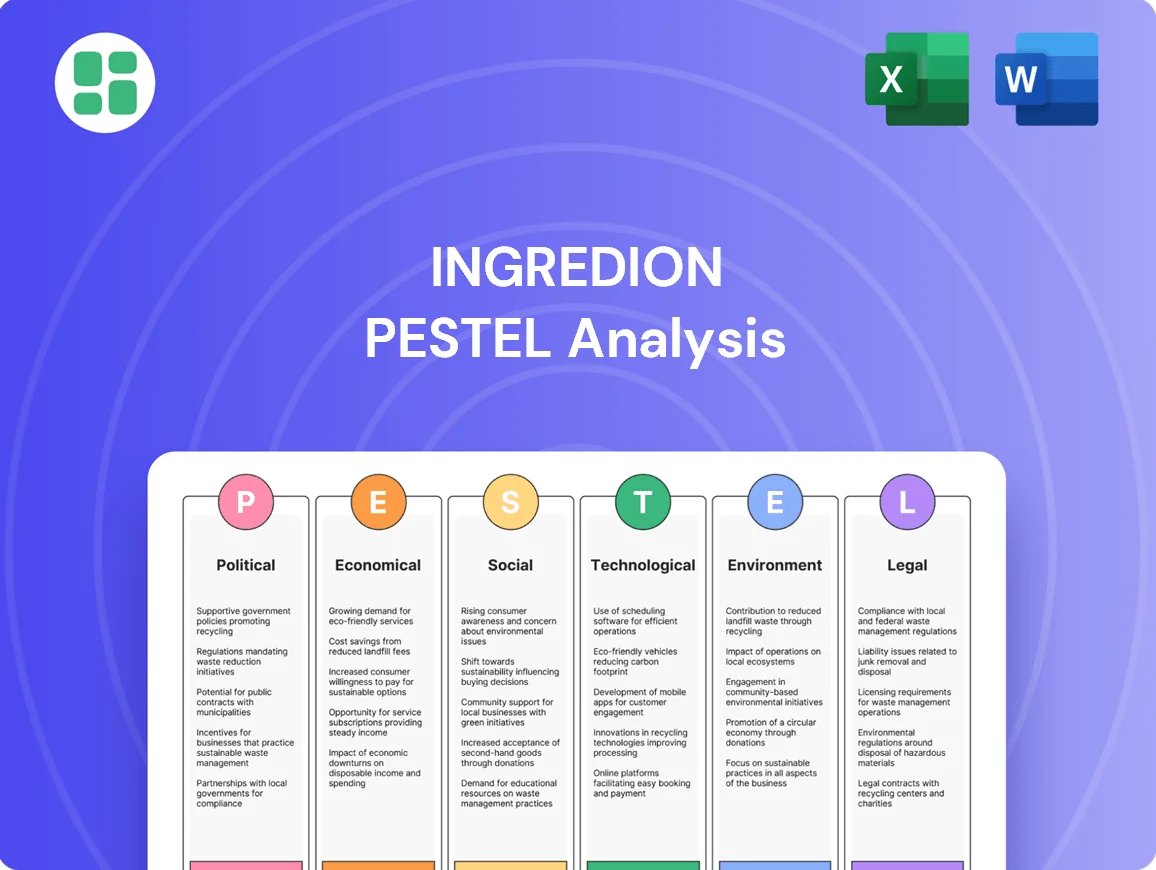
Sumitomo Rubber Industries PESTLE Analysis

Plan Smarter. Present Sharper. Compete Stronger.
Navigate the complex external forces shaping Sumitomo Rubber Industries's future. Our PESTLE analysis delves into political stability, economic fluctuations, technological advancements, environmental regulations, and socio-cultural shifts impacting the tire and rubber industry. Gain a strategic advantage by understanding these critical factors.
Unlock actionable intelligence on Sumitomo Rubber Industries's operating environment. This comprehensive PESTLE analysis provides deep insights into how global trends can be leveraged for growth or mitigated as risks. Don't miss out on crucial market foresight.
Equip yourself with the knowledge to make informed decisions about Sumitomo Rubber Industries. Our PESTLE analysis offers a clear roadmap of the external landscape, empowering you to anticipate challenges and capitalize on opportunities. Download the full version for immediate strategic clarity.
Political factors

Political factor 1
Global trade policies, including tariffs and import/export duties, directly impact Sumitomo Rubber Industries' international business. For instance, the ongoing trade friction between major economies can lead to increased costs for raw materials like natural rubber and synthetic polymers, as well as for finished tire products. In 2024, many countries are reviewing their trade agreements, potentially altering market access and competitive dynamics for Sumitomo's diverse product lines.
Political factor 2
Government regulations concerning vehicle emissions and safety standards in key markets significantly shape tire design and production for Sumitomo Rubber Industries. For instance, by 2025, the European Union aims for fleet-wide average CO2 emissions of 95g/km, pushing tire manufacturers to prioritize low-rolling-resistance technologies to meet fuel efficiency mandates.
Stricter environmental rules, such as those targeting reduced CO2 output, compel continuous innovation in tire technology, leading to the development of advanced materials and designs that enhance fuel economy. Evolving safety standards, like updated UN ECE regulations for tire performance in wet conditions, directly influence the performance benchmarks and rigorous testing procedures Sumitomo must adhere to for all its tire offerings.

Political factor 3
Geopolitical stability is paramount for Sumitomo Rubber Industries, especially in its key manufacturing and sourcing regions. Political instability, conflicts, or trade disputes in nations where the company operates production facilities or procures essential raw materials like natural rubber can severely disrupt supply chains. These disruptions can heighten operational risks, leading to production delays and increased costs, impacting Sumitomo Rubber's ability to maintain consistent operations and meet market demand.

Political factor 4
Government support for green initiatives and electric vehicle (EV) adoption directly impacts Sumitomo Rubber Industries. Policies encouraging sustainable manufacturing and the use of eco-friendly materials can boost demand for specialized tires. For instance, as of early 2024, many governments globally are offering tax credits for EV purchases, which indirectly benefits tire manufacturers like Sumitomo by increasing the overall EV market size.
Sumitomo can capitalize on these trends by aligning its product development with government incentives. Investing in research and development for tires optimized for EVs, which often require different performance characteristics than traditional tires, is crucial. This strategic alignment can position Sumitomo to benefit from:
- Increased demand for EV-specific tires: As EV adoption grows, so does the need for tires designed for their unique torque and weight.
- Opportunities in sustainable materials: Government push for recycled and bio-based materials in manufacturing can lead to new product lines.
- Potential for subsidies and grants: R&D investments in green technologies may qualify for government funding, reducing development costs.
Political factor 5
Sumitomo Rubber Industries navigates a complex web of industrial policies and labor laws across its global manufacturing bases, directly influencing production costs and operational agility. Government incentives, such as tax breaks for new manufacturing facilities or subsidies for adopting advanced technologies, can significantly reduce capital expenditure. For instance, many Southeast Asian nations actively offer such incentives to attract automotive component manufacturers like Sumitomo.
Regulations concerning industrial development and local labor laws, particularly those dictating minimum wages, working hours, and collective bargaining rights, are critical. In 2024, many European countries saw increases in minimum wage legislation, impacting Sumitomo's labor expenses in those regions. The company's human resource management and overall production expenses are therefore directly tied to its ability to adapt to these varying legal frameworks, ensuring compliance and operational efficiency worldwide.
- Impact of Industrial Policies: Government support, like R&D tax credits or grants for green manufacturing initiatives, can lower operational overhead.
- Labor Law Variations: Divergent wage laws and worker protection regulations in countries like Japan, the US, and Germany create distinct cost structures and HR management challenges.
- Regulatory Compliance: Adherence to environmental standards and product safety regulations, often driven by political agendas, necessitates ongoing investment in compliance measures.
- Trade Agreements: Political shifts affecting international trade pacts can alter import/export duties and supply chain logistics, impacting Sumitomo's cost of goods sold.
Government Policies: Steering the Global Tire Industry's Future
Political stability and government policies significantly influence Sumitomo Rubber Industries' global operations and market access. Trade agreements and tariffs, such as those impacting automotive parts between major economic blocs, directly affect production costs and sales strategies. For example, the US Inflation Reduction Act of 2022, while primarily focused on EVs, has broader implications for supply chains and manufacturing localization that Sumitomo must monitor.
Regulatory environments concerning vehicle emissions and tire performance are critical. Many nations are tightening these standards, with the EU targeting a 15% reduction in CO2 emissions for heavy-duty vehicles by 2025, which influences tire design for fuel efficiency. Furthermore, geopolitical tensions can disrupt raw material sourcing, like natural rubber from Southeast Asia, impacting supply chain stability and pricing for Sumitomo.
Government support for electric vehicles (EVs) and sustainable manufacturing presents both opportunities and challenges. Policies offering subsidies for EV purchases, as seen in many countries in 2024, indirectly boost demand for specialized EV tires. Sumitomo's ability to adapt its product portfolio to meet evolving environmental regulations and leverage government incentives for green technologies will be key to its success.
| Policy Area | Impact on Sumitomo Rubber | Example/Data (2024-2025) |
|---|---|---|
| Trade Policies | Affects import/export costs and market access. | Potential for increased tariffs on automotive components in ongoing trade disputes. |
| Environmental Regulations | Drives innovation in tire design for fuel efficiency and reduced emissions. | EU fleet CO2 targets push for low-rolling-resistance tire technology. |
| EV Adoption Support | Increases demand for specialized EV tires. | Global government EV purchase incentives boost the overall EV market size. |
| Labor Laws | Influences production costs and HR management. | Minimum wage increases in European nations in 2024 impact labor expenses. |
What is included in the product
 Detailed Word Document
This PESTLE analysis provides a comprehensive examination of the external macro-environmental forces impacting Sumitomo Rubber Industries, covering Political, Economic, Social, Technological, Environmental, and Legal factors to identify strategic opportunities and threats.

 Customizable Excel Spreadsheet
Provides a concise version that can be dropped into PowerPoints or used in group planning sessions, offering a clear overview of Sumitomo Rubber Industries' external environment to inform strategic decisions.
Easily shareable summary format ideal for quick alignment across teams or departments, ensuring everyone understands the key political, economic, social, technological, environmental, and legal factors impacting Sumitomo Rubber Industries.
Economic factors

Economic factor 1
Global economic growth significantly influences Sumitomo Rubber Industries' performance, as consumer spending directly ties into vehicle demand and tire sales. A strong global economy typically translates to increased vehicle purchases and a higher need for replacement tires, bolstering Sumitomo's revenue streams. For instance, the International Monetary Fund (IMF) projected global growth of 3.2% for 2024, a slight uptick from 2023, indicating a generally supportive environment for automotive markets.
Economic factor 2
Fluctuations in raw material prices, especially for natural rubber and synthetic rubber, directly affect Sumitomo Rubber Industries' production costs. For instance, in early 2024, natural rubber prices saw significant volatility, influenced by weather patterns in Southeast Asia and global demand shifts. This volatility can compress profit margins if not offset by strategic pricing or hedging, making continuous monitoring of commodity markets crucial for cost management.

Economic factor 3
Exchange rate volatility presents a significant economic challenge for Sumitomo Rubber Industries, a global player. Fluctuations in currencies directly impact the cost of raw materials sourced internationally and the repatriated value of sales generated in foreign markets. For instance, a stronger Japanese Yen in late 2024 could reduce the Yen-denominated value of its U.S. dollar earnings.
These currency movements can materially affect Sumitomo Rubber's profitability and its competitive standing. A sudden appreciation of the Yen against key trading currencies, such as the Euro or the U.S. Dollar, could make its products more expensive for overseas buyers, potentially dampening demand. Conversely, a weaker Yen could boost export revenues but increase the cost of imported components for its manufacturing facilities.

Economic factor 4
Interest rates and credit availability significantly shape Sumitomo Rubber Industries' operating environment by affecting both consumer spending and the company's financing expenses. For instance, as of early 2024, many central banks, including the US Federal Reserve and the European Central Bank, maintained relatively high interest rates to combat inflation. This can make it more costly for consumers to finance vehicle purchases, potentially leading to reduced demand for new tires.
Higher borrowing costs directly impact Sumitomo's financial health. For capital expenditures, such as upgrading manufacturing facilities or expanding production capacity, increased interest rates translate to higher debt servicing costs. In 2024, companies like Sumitomo faced a landscape where the cost of capital was elevated compared to previous years, influencing decisions on investment timing and scale. This financial pressure can affect profitability and the ability to pursue growth opportunities.
- Interest Rate Impact: Elevated interest rates in 2024, with benchmark rates in major economies like the US hovering around 5-5.25%, increase the cost of borrowing for consumers and businesses.
- Consumer Demand: Higher rates can dampen demand for new vehicles, a key driver for tire sales, as financing becomes more expensive for purchasers.
- Corporate Financing: Sumitomo Rubber Industries faces increased interest expenses on its debt for operations and investments, potentially affecting its net income and investment capacity.
- Credit Availability: Tighter credit conditions, often accompanying higher interest rates, can further restrict both consumer and business access to necessary financing, impacting sales and expansion plans.
Economic factor 5
Inflationary pressures are a significant concern for Sumitomo Rubber Industries, with rising energy, transportation, and labor costs directly impacting its operational expenses. For instance, global energy prices saw considerable volatility in 2024, with Brent crude oil averaging around $83 per barrel for the year, impacting manufacturing and logistics costs. Persistent inflation can erode profit margins if Sumitomo cannot fully pass on these increased input costs through product price adjustments.
To navigate this challenging economic landscape, Sumitomo Rubber Industries must implement robust cost management strategies and adopt dynamic pricing models. This proactive approach is crucial for mitigating the adverse effects of inflationary environments and maintaining profitability.
- Rising Input Costs: Global commodity prices, including raw materials for tire production, experienced upward trends throughout 2024, adding pressure to manufacturing costs.
- Labor Cost Increases: In key markets, average wages saw an increase of 3-5% in 2024, contributing to higher operational expenditures.
- Transportation Expenses: Shipping and freight costs remained elevated in 2024 due to ongoing supply chain complexities and fuel price fluctuations.
- Margin Erosion Risk: Failure to adequately adjust product pricing to match rising input costs could lead to a reduction in Sumitomo's profit margins.
Navigating Global Economic Currents: Growth, Costs, and Currency Impacts
Sumitomo Rubber Industries operates within a dynamic global economic environment where growth forecasts and commodity price volatility directly impact its revenue and costs. For instance, the IMF projected 3.2% global growth for 2024, a positive signal for automotive markets, yet natural rubber prices saw significant fluctuations in early 2024, affecting production expenses.
Currency exchange rates pose a constant challenge, with a stronger Yen in late 2024 potentially reducing the value of U.S. dollar earnings. Elevated interest rates, with US benchmark rates around 5-5.25% in 2024, increase borrowing costs for consumers and the company alike, potentially dampening vehicle demand and raising Sumitomo's financing expenses.
Inflationary pressures, driven by rising energy and labor costs, with Brent crude averaging $83 per barrel in 2024 and average wages increasing 3-5% in key markets, further squeeze profit margins if not passed on through pricing. Sumitomo must manage these economic factors through cost control and adaptive pricing strategies.
| Economic Factor | 2024 Projection/Average | Impact on Sumitomo Rubber Industries |
|---|---|---|
| Global GDP Growth | 3.2% (IMF projection) | Supports vehicle demand and tire sales. |
| Natural Rubber Price | Volatile (early 2024) | Affects production costs and profit margins. |
| US Federal Funds Rate | ~5.00-5.25% | Increases borrowing costs for consumers and the company. |
| Brent Crude Oil Price | ~$83/barrel (average) | Impacts transportation and manufacturing energy costs. |
| Average Wage Increase | 3-5% (key markets) | Contributes to higher operational expenditures. |
Same Document Delivered
Sumitomo Rubber Industries PESTLE Analysis
The preview shown here is the exact document you’ll receive after purchase—fully formatted and ready to use. This comprehensive PESTLE analysis of Sumitomo Rubber Industries delves into the Political, Economic, Social, Technological, Legal, and Environmental factors impacting their operations. It provides a strategic overview to inform business decisions.

Product Information
Product Information
Shipping & Returns
Shipping & Returns

Sumitomo Rubber Industries PESTLE Analysis
Sumitomo Rubber Industries PESTLE Analysis
Plan Smarter. Present Sharper. Compete Stronger.
Navigate the complex external forces shaping Sumitomo Rubber Industries's future. Our PESTLE analysis delves into political stability, economic fluctuations, technological advancements, environmental regulations, and socio-cultural shifts impacting the tire and rubber industry. Gain a strategic advantage by understanding these critical factors.
Unlock actionable intelligence on Sumitomo Rubber Industries's operating environment. This comprehensive PESTLE analysis provides deep insights into how global trends can be leveraged for growth or mitigated as risks. Don't miss out on crucial market foresight.
Equip yourself with the knowledge to make informed decisions about Sumitomo Rubber Industries. Our PESTLE analysis offers a clear roadmap of the external landscape, empowering you to anticipate challenges and capitalize on opportunities. Download the full version for immediate strategic clarity.
Political factors
Political factor 1
Global trade policies, including tariffs and import/export duties, directly impact Sumitomo Rubber Industries' international business. For instance, the ongoing trade friction between major economies can lead to increased costs for raw materials like natural rubber and synthetic polymers, as well as for finished tire products. In 2024, many countries are reviewing their trade agreements, potentially altering market access and competitive dynamics for Sumitomo's diverse product lines.
Political factor 2
Government regulations concerning vehicle emissions and safety standards in key markets significantly shape tire design and production for Sumitomo Rubber Industries. For instance, by 2025, the European Union aims for fleet-wide average CO2 emissions of 95g/km, pushing tire manufacturers to prioritize low-rolling-resistance technologies to meet fuel efficiency mandates.
Stricter environmental rules, such as those targeting reduced CO2 output, compel continuous innovation in tire technology, leading to the development of advanced materials and designs that enhance fuel economy. Evolving safety standards, like updated UN ECE regulations for tire performance in wet conditions, directly influence the performance benchmarks and rigorous testing procedures Sumitomo must adhere to for all its tire offerings.
Political factor 3
Geopolitical stability is paramount for Sumitomo Rubber Industries, especially in its key manufacturing and sourcing regions. Political instability, conflicts, or trade disputes in nations where the company operates production facilities or procures essential raw materials like natural rubber can severely disrupt supply chains. These disruptions can heighten operational risks, leading to production delays and increased costs, impacting Sumitomo Rubber's ability to maintain consistent operations and meet market demand.
Political factor 4
Government support for green initiatives and electric vehicle (EV) adoption directly impacts Sumitomo Rubber Industries. Policies encouraging sustainable manufacturing and the use of eco-friendly materials can boost demand for specialized tires. For instance, as of early 2024, many governments globally are offering tax credits for EV purchases, which indirectly benefits tire manufacturers like Sumitomo by increasing the overall EV market size.
Sumitomo can capitalize on these trends by aligning its product development with government incentives. Investing in research and development for tires optimized for EVs, which often require different performance characteristics than traditional tires, is crucial. This strategic alignment can position Sumitomo to benefit from:
- Increased demand for EV-specific tires: As EV adoption grows, so does the need for tires designed for their unique torque and weight.
- Opportunities in sustainable materials: Government push for recycled and bio-based materials in manufacturing can lead to new product lines.
- Potential for subsidies and grants: R&D investments in green technologies may qualify for government funding, reducing development costs.
Political factor 5
Sumitomo Rubber Industries navigates a complex web of industrial policies and labor laws across its global manufacturing bases, directly influencing production costs and operational agility. Government incentives, such as tax breaks for new manufacturing facilities or subsidies for adopting advanced technologies, can significantly reduce capital expenditure. For instance, many Southeast Asian nations actively offer such incentives to attract automotive component manufacturers like Sumitomo.
Regulations concerning industrial development and local labor laws, particularly those dictating minimum wages, working hours, and collective bargaining rights, are critical. In 2024, many European countries saw increases in minimum wage legislation, impacting Sumitomo's labor expenses in those regions. The company's human resource management and overall production expenses are therefore directly tied to its ability to adapt to these varying legal frameworks, ensuring compliance and operational efficiency worldwide.
- Impact of Industrial Policies: Government support, like R&D tax credits or grants for green manufacturing initiatives, can lower operational overhead.
- Labor Law Variations: Divergent wage laws and worker protection regulations in countries like Japan, the US, and Germany create distinct cost structures and HR management challenges.
- Regulatory Compliance: Adherence to environmental standards and product safety regulations, often driven by political agendas, necessitates ongoing investment in compliance measures.
- Trade Agreements: Political shifts affecting international trade pacts can alter import/export duties and supply chain logistics, impacting Sumitomo's cost of goods sold.
Government Policies: Steering the Global Tire Industry's Future
Political stability and government policies significantly influence Sumitomo Rubber Industries' global operations and market access. Trade agreements and tariffs, such as those impacting automotive parts between major economic blocs, directly affect production costs and sales strategies. For example, the US Inflation Reduction Act of 2022, while primarily focused on EVs, has broader implications for supply chains and manufacturing localization that Sumitomo must monitor.
Regulatory environments concerning vehicle emissions and tire performance are critical. Many nations are tightening these standards, with the EU targeting a 15% reduction in CO2 emissions for heavy-duty vehicles by 2025, which influences tire design for fuel efficiency. Furthermore, geopolitical tensions can disrupt raw material sourcing, like natural rubber from Southeast Asia, impacting supply chain stability and pricing for Sumitomo.
Government support for electric vehicles (EVs) and sustainable manufacturing presents both opportunities and challenges. Policies offering subsidies for EV purchases, as seen in many countries in 2024, indirectly boost demand for specialized EV tires. Sumitomo's ability to adapt its product portfolio to meet evolving environmental regulations and leverage government incentives for green technologies will be key to its success.
| Policy Area | Impact on Sumitomo Rubber | Example/Data (2024-2025) |
|---|---|---|
| Trade Policies | Affects import/export costs and market access. | Potential for increased tariffs on automotive components in ongoing trade disputes. |
| Environmental Regulations | Drives innovation in tire design for fuel efficiency and reduced emissions. | EU fleet CO2 targets push for low-rolling-resistance tire technology. |
| EV Adoption Support | Increases demand for specialized EV tires. | Global government EV purchase incentives boost the overall EV market size. |
| Labor Laws | Influences production costs and HR management. | Minimum wage increases in European nations in 2024 impact labor expenses. |
What is included in the product
Detailed Word Document
This PESTLE analysis provides a comprehensive examination of the external macro-environmental forces impacting Sumitomo Rubber Industries, covering Political, Economic, Social, Technological, Environmental, and Legal factors to identify strategic opportunities and threats.
Customizable Excel Spreadsheet
Provides a concise version that can be dropped into PowerPoints or used in group planning sessions, offering a clear overview of Sumitomo Rubber Industries' external environment to inform strategic decisions.
Easily shareable summary format ideal for quick alignment across teams or departments, ensuring everyone understands the key political, economic, social, technological, environmental, and legal factors impacting Sumitomo Rubber Industries.
Economic factors
Economic factor 1
Global economic growth significantly influences Sumitomo Rubber Industries' performance, as consumer spending directly ties into vehicle demand and tire sales. A strong global economy typically translates to increased vehicle purchases and a higher need for replacement tires, bolstering Sumitomo's revenue streams. For instance, the International Monetary Fund (IMF) projected global growth of 3.2% for 2024, a slight uptick from 2023, indicating a generally supportive environment for automotive markets.
Economic factor 2
Fluctuations in raw material prices, especially for natural rubber and synthetic rubber, directly affect Sumitomo Rubber Industries' production costs. For instance, in early 2024, natural rubber prices saw significant volatility, influenced by weather patterns in Southeast Asia and global demand shifts. This volatility can compress profit margins if not offset by strategic pricing or hedging, making continuous monitoring of commodity markets crucial for cost management.
Economic factor 3
Exchange rate volatility presents a significant economic challenge for Sumitomo Rubber Industries, a global player. Fluctuations in currencies directly impact the cost of raw materials sourced internationally and the repatriated value of sales generated in foreign markets. For instance, a stronger Japanese Yen in late 2024 could reduce the Yen-denominated value of its U.S. dollar earnings.
These currency movements can materially affect Sumitomo Rubber's profitability and its competitive standing. A sudden appreciation of the Yen against key trading currencies, such as the Euro or the U.S. Dollar, could make its products more expensive for overseas buyers, potentially dampening demand. Conversely, a weaker Yen could boost export revenues but increase the cost of imported components for its manufacturing facilities.
Economic factor 4
Interest rates and credit availability significantly shape Sumitomo Rubber Industries' operating environment by affecting both consumer spending and the company's financing expenses. For instance, as of early 2024, many central banks, including the US Federal Reserve and the European Central Bank, maintained relatively high interest rates to combat inflation. This can make it more costly for consumers to finance vehicle purchases, potentially leading to reduced demand for new tires.
Higher borrowing costs directly impact Sumitomo's financial health. For capital expenditures, such as upgrading manufacturing facilities or expanding production capacity, increased interest rates translate to higher debt servicing costs. In 2024, companies like Sumitomo faced a landscape where the cost of capital was elevated compared to previous years, influencing decisions on investment timing and scale. This financial pressure can affect profitability and the ability to pursue growth opportunities.
- Interest Rate Impact: Elevated interest rates in 2024, with benchmark rates in major economies like the US hovering around 5-5.25%, increase the cost of borrowing for consumers and businesses.
- Consumer Demand: Higher rates can dampen demand for new vehicles, a key driver for tire sales, as financing becomes more expensive for purchasers.
- Corporate Financing: Sumitomo Rubber Industries faces increased interest expenses on its debt for operations and investments, potentially affecting its net income and investment capacity.
- Credit Availability: Tighter credit conditions, often accompanying higher interest rates, can further restrict both consumer and business access to necessary financing, impacting sales and expansion plans.
Economic factor 5
Inflationary pressures are a significant concern for Sumitomo Rubber Industries, with rising energy, transportation, and labor costs directly impacting its operational expenses. For instance, global energy prices saw considerable volatility in 2024, with Brent crude oil averaging around $83 per barrel for the year, impacting manufacturing and logistics costs. Persistent inflation can erode profit margins if Sumitomo cannot fully pass on these increased input costs through product price adjustments.
To navigate this challenging economic landscape, Sumitomo Rubber Industries must implement robust cost management strategies and adopt dynamic pricing models. This proactive approach is crucial for mitigating the adverse effects of inflationary environments and maintaining profitability.
- Rising Input Costs: Global commodity prices, including raw materials for tire production, experienced upward trends throughout 2024, adding pressure to manufacturing costs.
- Labor Cost Increases: In key markets, average wages saw an increase of 3-5% in 2024, contributing to higher operational expenditures.
- Transportation Expenses: Shipping and freight costs remained elevated in 2024 due to ongoing supply chain complexities and fuel price fluctuations.
- Margin Erosion Risk: Failure to adequately adjust product pricing to match rising input costs could lead to a reduction in Sumitomo's profit margins.
Navigating Global Economic Currents: Growth, Costs, and Currency Impacts
Sumitomo Rubber Industries operates within a dynamic global economic environment where growth forecasts and commodity price volatility directly impact its revenue and costs. For instance, the IMF projected 3.2% global growth for 2024, a positive signal for automotive markets, yet natural rubber prices saw significant fluctuations in early 2024, affecting production expenses.
Currency exchange rates pose a constant challenge, with a stronger Yen in late 2024 potentially reducing the value of U.S. dollar earnings. Elevated interest rates, with US benchmark rates around 5-5.25% in 2024, increase borrowing costs for consumers and the company alike, potentially dampening vehicle demand and raising Sumitomo's financing expenses.
Inflationary pressures, driven by rising energy and labor costs, with Brent crude averaging $83 per barrel in 2024 and average wages increasing 3-5% in key markets, further squeeze profit margins if not passed on through pricing. Sumitomo must manage these economic factors through cost control and adaptive pricing strategies.
| Economic Factor | 2024 Projection/Average | Impact on Sumitomo Rubber Industries |
|---|---|---|
| Global GDP Growth | 3.2% (IMF projection) | Supports vehicle demand and tire sales. |
| Natural Rubber Price | Volatile (early 2024) | Affects production costs and profit margins. |
| US Federal Funds Rate | ~5.00-5.25% | Increases borrowing costs for consumers and the company. |
| Brent Crude Oil Price | ~$83/barrel (average) | Impacts transportation and manufacturing energy costs. |
| Average Wage Increase | 3-5% (key markets) | Contributes to higher operational expenditures. |
Same Document Delivered
Sumitomo Rubber Industries PESTLE Analysis
The preview shown here is the exact document you’ll receive after purchase—fully formatted and ready to use. This comprehensive PESTLE analysis of Sumitomo Rubber Industries delves into the Political, Economic, Social, Technological, Legal, and Environmental factors impacting their operations. It provides a strategic overview to inform business decisions.
Original: $10.00
-65%$10.00
$3.50Product Information
Product Information
Shipping & Returns
Shipping & Returns
Description
Plan Smarter. Present Sharper. Compete Stronger.
Navigate the complex external forces shaping Sumitomo Rubber Industries's future. Our PESTLE analysis delves into political stability, economic fluctuations, technological advancements, environmental regulations, and socio-cultural shifts impacting the tire and rubber industry. Gain a strategic advantage by understanding these critical factors.
Unlock actionable intelligence on Sumitomo Rubber Industries's operating environment. This comprehensive PESTLE analysis provides deep insights into how global trends can be leveraged for growth or mitigated as risks. Don't miss out on crucial market foresight.
Equip yourself with the knowledge to make informed decisions about Sumitomo Rubber Industries. Our PESTLE analysis offers a clear roadmap of the external landscape, empowering you to anticipate challenges and capitalize on opportunities. Download the full version for immediate strategic clarity.
Political factors
Political factor 1
Global trade policies, including tariffs and import/export duties, directly impact Sumitomo Rubber Industries' international business. For instance, the ongoing trade friction between major economies can lead to increased costs for raw materials like natural rubber and synthetic polymers, as well as for finished tire products. In 2024, many countries are reviewing their trade agreements, potentially altering market access and competitive dynamics for Sumitomo's diverse product lines.
Political factor 2
Government regulations concerning vehicle emissions and safety standards in key markets significantly shape tire design and production for Sumitomo Rubber Industries. For instance, by 2025, the European Union aims for fleet-wide average CO2 emissions of 95g/km, pushing tire manufacturers to prioritize low-rolling-resistance technologies to meet fuel efficiency mandates.
Stricter environmental rules, such as those targeting reduced CO2 output, compel continuous innovation in tire technology, leading to the development of advanced materials and designs that enhance fuel economy. Evolving safety standards, like updated UN ECE regulations for tire performance in wet conditions, directly influence the performance benchmarks and rigorous testing procedures Sumitomo must adhere to for all its tire offerings.
Political factor 3
Geopolitical stability is paramount for Sumitomo Rubber Industries, especially in its key manufacturing and sourcing regions. Political instability, conflicts, or trade disputes in nations where the company operates production facilities or procures essential raw materials like natural rubber can severely disrupt supply chains. These disruptions can heighten operational risks, leading to production delays and increased costs, impacting Sumitomo Rubber's ability to maintain consistent operations and meet market demand.
Political factor 4
Government support for green initiatives and electric vehicle (EV) adoption directly impacts Sumitomo Rubber Industries. Policies encouraging sustainable manufacturing and the use of eco-friendly materials can boost demand for specialized tires. For instance, as of early 2024, many governments globally are offering tax credits for EV purchases, which indirectly benefits tire manufacturers like Sumitomo by increasing the overall EV market size.
Sumitomo can capitalize on these trends by aligning its product development with government incentives. Investing in research and development for tires optimized for EVs, which often require different performance characteristics than traditional tires, is crucial. This strategic alignment can position Sumitomo to benefit from:
- Increased demand for EV-specific tires: As EV adoption grows, so does the need for tires designed for their unique torque and weight.
- Opportunities in sustainable materials: Government push for recycled and bio-based materials in manufacturing can lead to new product lines.
- Potential for subsidies and grants: R&D investments in green technologies may qualify for government funding, reducing development costs.
Political factor 5
Sumitomo Rubber Industries navigates a complex web of industrial policies and labor laws across its global manufacturing bases, directly influencing production costs and operational agility. Government incentives, such as tax breaks for new manufacturing facilities or subsidies for adopting advanced technologies, can significantly reduce capital expenditure. For instance, many Southeast Asian nations actively offer such incentives to attract automotive component manufacturers like Sumitomo.
Regulations concerning industrial development and local labor laws, particularly those dictating minimum wages, working hours, and collective bargaining rights, are critical. In 2024, many European countries saw increases in minimum wage legislation, impacting Sumitomo's labor expenses in those regions. The company's human resource management and overall production expenses are therefore directly tied to its ability to adapt to these varying legal frameworks, ensuring compliance and operational efficiency worldwide.
- Impact of Industrial Policies: Government support, like R&D tax credits or grants for green manufacturing initiatives, can lower operational overhead.
- Labor Law Variations: Divergent wage laws and worker protection regulations in countries like Japan, the US, and Germany create distinct cost structures and HR management challenges.
- Regulatory Compliance: Adherence to environmental standards and product safety regulations, often driven by political agendas, necessitates ongoing investment in compliance measures.
- Trade Agreements: Political shifts affecting international trade pacts can alter import/export duties and supply chain logistics, impacting Sumitomo's cost of goods sold.
Government Policies: Steering the Global Tire Industry's Future
Political stability and government policies significantly influence Sumitomo Rubber Industries' global operations and market access. Trade agreements and tariffs, such as those impacting automotive parts between major economic blocs, directly affect production costs and sales strategies. For example, the US Inflation Reduction Act of 2022, while primarily focused on EVs, has broader implications for supply chains and manufacturing localization that Sumitomo must monitor.
Regulatory environments concerning vehicle emissions and tire performance are critical. Many nations are tightening these standards, with the EU targeting a 15% reduction in CO2 emissions for heavy-duty vehicles by 2025, which influences tire design for fuel efficiency. Furthermore, geopolitical tensions can disrupt raw material sourcing, like natural rubber from Southeast Asia, impacting supply chain stability and pricing for Sumitomo.
Government support for electric vehicles (EVs) and sustainable manufacturing presents both opportunities and challenges. Policies offering subsidies for EV purchases, as seen in many countries in 2024, indirectly boost demand for specialized EV tires. Sumitomo's ability to adapt its product portfolio to meet evolving environmental regulations and leverage government incentives for green technologies will be key to its success.
| Policy Area | Impact on Sumitomo Rubber | Example/Data (2024-2025) |
|---|---|---|
| Trade Policies | Affects import/export costs and market access. | Potential for increased tariffs on automotive components in ongoing trade disputes. |
| Environmental Regulations | Drives innovation in tire design for fuel efficiency and reduced emissions. | EU fleet CO2 targets push for low-rolling-resistance tire technology. |
| EV Adoption Support | Increases demand for specialized EV tires. | Global government EV purchase incentives boost the overall EV market size. |
| Labor Laws | Influences production costs and HR management. | Minimum wage increases in European nations in 2024 impact labor expenses. |
What is included in the product
Detailed Word Document
This PESTLE analysis provides a comprehensive examination of the external macro-environmental forces impacting Sumitomo Rubber Industries, covering Political, Economic, Social, Technological, Environmental, and Legal factors to identify strategic opportunities and threats.
Customizable Excel Spreadsheet
Provides a concise version that can be dropped into PowerPoints or used in group planning sessions, offering a clear overview of Sumitomo Rubber Industries' external environment to inform strategic decisions.
Easily shareable summary format ideal for quick alignment across teams or departments, ensuring everyone understands the key political, economic, social, technological, environmental, and legal factors impacting Sumitomo Rubber Industries.
Economic factors
Economic factor 1
Global economic growth significantly influences Sumitomo Rubber Industries' performance, as consumer spending directly ties into vehicle demand and tire sales. A strong global economy typically translates to increased vehicle purchases and a higher need for replacement tires, bolstering Sumitomo's revenue streams. For instance, the International Monetary Fund (IMF) projected global growth of 3.2% for 2024, a slight uptick from 2023, indicating a generally supportive environment for automotive markets.
Economic factor 2
Fluctuations in raw material prices, especially for natural rubber and synthetic rubber, directly affect Sumitomo Rubber Industries' production costs. For instance, in early 2024, natural rubber prices saw significant volatility, influenced by weather patterns in Southeast Asia and global demand shifts. This volatility can compress profit margins if not offset by strategic pricing or hedging, making continuous monitoring of commodity markets crucial for cost management.
Economic factor 3
Exchange rate volatility presents a significant economic challenge for Sumitomo Rubber Industries, a global player. Fluctuations in currencies directly impact the cost of raw materials sourced internationally and the repatriated value of sales generated in foreign markets. For instance, a stronger Japanese Yen in late 2024 could reduce the Yen-denominated value of its U.S. dollar earnings.
These currency movements can materially affect Sumitomo Rubber's profitability and its competitive standing. A sudden appreciation of the Yen against key trading currencies, such as the Euro or the U.S. Dollar, could make its products more expensive for overseas buyers, potentially dampening demand. Conversely, a weaker Yen could boost export revenues but increase the cost of imported components for its manufacturing facilities.
Economic factor 4
Interest rates and credit availability significantly shape Sumitomo Rubber Industries' operating environment by affecting both consumer spending and the company's financing expenses. For instance, as of early 2024, many central banks, including the US Federal Reserve and the European Central Bank, maintained relatively high interest rates to combat inflation. This can make it more costly for consumers to finance vehicle purchases, potentially leading to reduced demand for new tires.
Higher borrowing costs directly impact Sumitomo's financial health. For capital expenditures, such as upgrading manufacturing facilities or expanding production capacity, increased interest rates translate to higher debt servicing costs. In 2024, companies like Sumitomo faced a landscape where the cost of capital was elevated compared to previous years, influencing decisions on investment timing and scale. This financial pressure can affect profitability and the ability to pursue growth opportunities.
- Interest Rate Impact: Elevated interest rates in 2024, with benchmark rates in major economies like the US hovering around 5-5.25%, increase the cost of borrowing for consumers and businesses.
- Consumer Demand: Higher rates can dampen demand for new vehicles, a key driver for tire sales, as financing becomes more expensive for purchasers.
- Corporate Financing: Sumitomo Rubber Industries faces increased interest expenses on its debt for operations and investments, potentially affecting its net income and investment capacity.
- Credit Availability: Tighter credit conditions, often accompanying higher interest rates, can further restrict both consumer and business access to necessary financing, impacting sales and expansion plans.
Economic factor 5
Inflationary pressures are a significant concern for Sumitomo Rubber Industries, with rising energy, transportation, and labor costs directly impacting its operational expenses. For instance, global energy prices saw considerable volatility in 2024, with Brent crude oil averaging around $83 per barrel for the year, impacting manufacturing and logistics costs. Persistent inflation can erode profit margins if Sumitomo cannot fully pass on these increased input costs through product price adjustments.
To navigate this challenging economic landscape, Sumitomo Rubber Industries must implement robust cost management strategies and adopt dynamic pricing models. This proactive approach is crucial for mitigating the adverse effects of inflationary environments and maintaining profitability.
- Rising Input Costs: Global commodity prices, including raw materials for tire production, experienced upward trends throughout 2024, adding pressure to manufacturing costs.
- Labor Cost Increases: In key markets, average wages saw an increase of 3-5% in 2024, contributing to higher operational expenditures.
- Transportation Expenses: Shipping and freight costs remained elevated in 2024 due to ongoing supply chain complexities and fuel price fluctuations.
- Margin Erosion Risk: Failure to adequately adjust product pricing to match rising input costs could lead to a reduction in Sumitomo's profit margins.
Navigating Global Economic Currents: Growth, Costs, and Currency Impacts
Sumitomo Rubber Industries operates within a dynamic global economic environment where growth forecasts and commodity price volatility directly impact its revenue and costs. For instance, the IMF projected 3.2% global growth for 2024, a positive signal for automotive markets, yet natural rubber prices saw significant fluctuations in early 2024, affecting production expenses.
Currency exchange rates pose a constant challenge, with a stronger Yen in late 2024 potentially reducing the value of U.S. dollar earnings. Elevated interest rates, with US benchmark rates around 5-5.25% in 2024, increase borrowing costs for consumers and the company alike, potentially dampening vehicle demand and raising Sumitomo's financing expenses.
Inflationary pressures, driven by rising energy and labor costs, with Brent crude averaging $83 per barrel in 2024 and average wages increasing 3-5% in key markets, further squeeze profit margins if not passed on through pricing. Sumitomo must manage these economic factors through cost control and adaptive pricing strategies.
| Economic Factor | 2024 Projection/Average | Impact on Sumitomo Rubber Industries |
|---|---|---|
| Global GDP Growth | 3.2% (IMF projection) | Supports vehicle demand and tire sales. |
| Natural Rubber Price | Volatile (early 2024) | Affects production costs and profit margins. |
| US Federal Funds Rate | ~5.00-5.25% | Increases borrowing costs for consumers and the company. |
| Brent Crude Oil Price | ~$83/barrel (average) | Impacts transportation and manufacturing energy costs. |
| Average Wage Increase | 3-5% (key markets) | Contributes to higher operational expenditures. |
Same Document Delivered
Sumitomo Rubber Industries PESTLE Analysis
The preview shown here is the exact document you’ll receive after purchase—fully formatted and ready to use. This comprehensive PESTLE analysis of Sumitomo Rubber Industries delves into the Political, Economic, Social, Technological, Legal, and Environmental factors impacting their operations. It provides a strategic overview to inform business decisions.