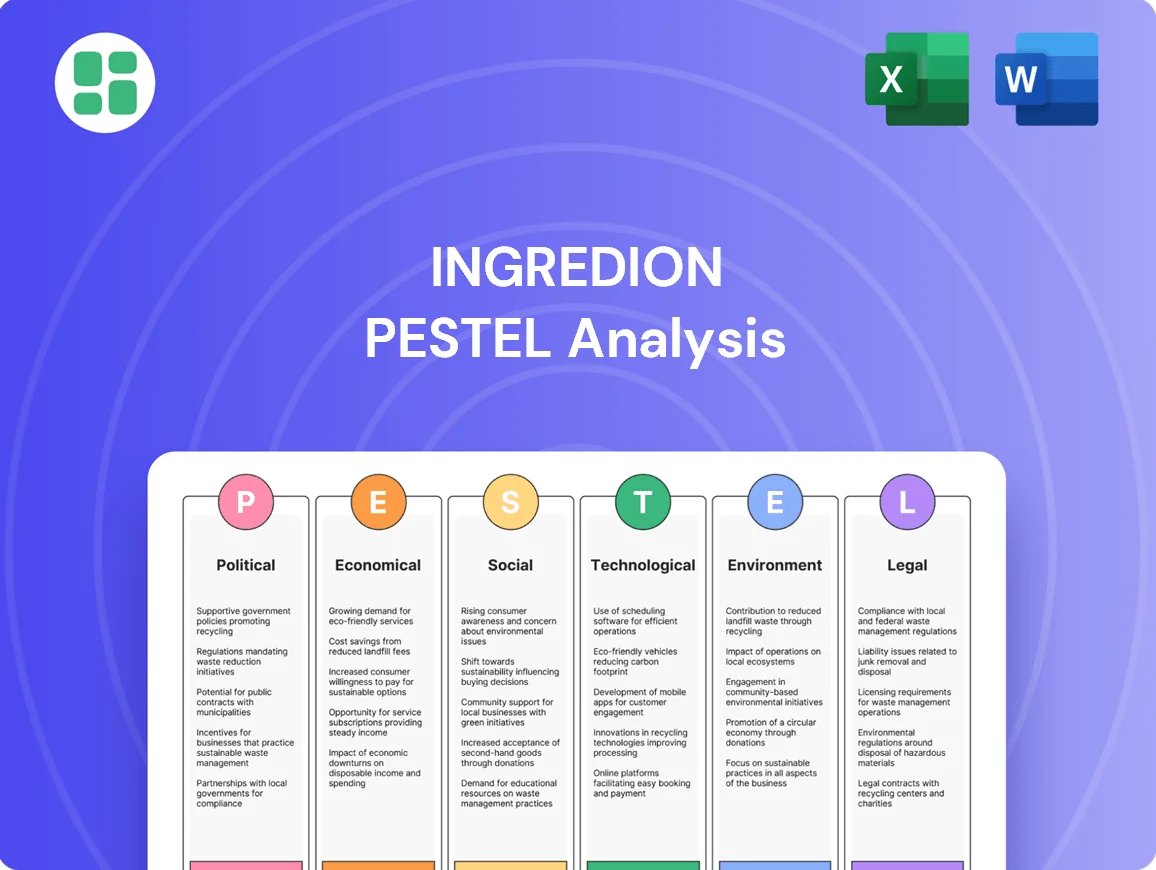
Siemens Gamesa Renewable Energy PESTLE Analysis

Plan Smarter. Present Sharper. Compete Stronger.
Navigate the complex external landscape impacting Siemens Gamesa Renewable Energy with our comprehensive PESTLE analysis. Understand how political stability, economic fluctuations, technological advancements, environmental regulations, and social trends are shaping the renewable energy sector and influencing Siemens Gamesa's strategic direction. Gain a competitive edge by leveraging these critical insights to inform your own business planning and investment decisions. Download the full PESTLE analysis now for actionable intelligence.
Political factors

Government Policies and Subsidies
Government policies are a major driver for Siemens Gamesa. Renewable energy targets, like the European Union's aim for 111 GW of offshore wind capacity by 2030 and 320 GW by 2050, directly create demand for their turbines. These ambitious goals translate into significant market opportunities.
Incentive schemes also play a crucial role. The US Inflation Reduction Act (IRA), for example, provides substantial tax credits for clean energy projects, encouraging investment and driving down the overall cost of wind energy. This makes wind power more competitive and boosts adoption, benefiting manufacturers like Siemens Gamesa.
Trade Barriers and Market Fragmentation
The global wind sector grapples with trade barriers and market fragmentation, creating ripples through international supply chains. This can make it harder for companies like Siemens Gamesa to source components and distribute their products efficiently across borders.
Geopolitical tensions, notably between China and Western nations, are fueling protectionist policies. These include higher tariffs aimed at shielding domestic industries, directly affecting Siemens Gamesa's worldwide operations and how it plans its supply chains. For instance, Siemens Energy, the parent company, anticipates only a minor financial hit from new US tariffs, suggesting a degree of resilience and ongoing adjustments to these trade challenges.

Permitting and Grid Integration
Permitting hurdles continue to slow down new wind farm development globally, with complex processes delaying crucial project timelines. This is a major concern for companies like Siemens Gamesa, aiming to scale up renewable energy solutions.
Inadequate grid infrastructure and the pace of new grid connection approvals are also significant roadblocks, preventing the necessary rapid expansion of wind power capacity. For instance, the European Union's target to install 320 GW of wind power by 2030 relies heavily on overcoming these integration challenges.
Governments are being urged to fully implement new EU permitting rules and the Wind Power Package to speed up deployment. In 2023, the EU reported that permitting times for offshore wind projects could still take an average of 4.5 years, highlighting the urgency for reform.

International Climate Commitments
Global climate commitments, including the Paris Agreement and the widespread pursuit of net-zero emissions targets, are significant drivers for renewable energy solutions, particularly wind power. Siemens Gamesa Renewable Energy actively participates in this transition, aiming for net-zero CO2 emissions across its value chain by 2040, demonstrating its alignment with international environmental goals.
The urgency for expanding wind energy capacity is underscored by the fact that current global progress is insufficient to meet the targets required to limit global warming to 1.5°C. For instance, the International Energy Agency (IEA) reported in 2023 that while wind power capacity is growing, it needs to accelerate substantially to align with climate objectives.
- Paris Agreement: Aims to limit global warming to well below 2, preferably to 1.5 degrees Celsius, compared to pre-industrial levels.
- Net-Zero Targets: Over 130 countries have set or are considering net-zero emission targets, creating a strong policy push for renewables.
- Siemens Gamesa's Commitment: Targeting net-zero CO2 emissions by 2040 across its entire value chain.
- Capacity Gap: The Global Wind Energy Council (GWEC) highlights that the world needs to install approximately 390 GW of wind power annually by 2030 to stay on track for 1.5°C, a significant increase from the 86 GW installed in 2023.
Geopolitical Stability and Energy Security
Geopolitical shifts, particularly those impacting energy markets, directly influence investment in renewables. For instance, the ongoing conflicts in Eastern Europe have underscored the fragility of traditional energy supplies, driving a greater push for energy independence. This trend, evident in many European nations, has accelerated investments in wind power, a core area for Siemens Gamesa.
The strategic importance of companies like Siemens Gamesa is amplified by this global focus on energy security. As nations aim to diversify their energy portfolios away from volatile fossil fuel markets, wind energy emerges as a key component. This diversification strategy is crucial for long-term economic stability and national security, making Siemens Gamesa's offerings increasingly vital.
However, geopolitical instability also presents significant challenges. Supply chain disruptions, a persistent issue since 2021, can impact the availability and cost of raw materials essential for wind turbine manufacturing, such as rare earth metals. For example, the price of neodymium, a key component in magnets for direct-drive turbines, saw significant volatility in 2023 due to supply chain concerns. This unpredictability can affect project timelines and profitability for Siemens Gamesa and its clients.
Wind Energy's Future: Policy, Geopolitics, and Permitting Challenges
Government policies remain a primary driver, with ambitious renewable energy targets like the EU's goal of 320 GW of offshore wind by 2050 directly shaping demand for Siemens Gamesa's turbines. Incentive programs, such as the US Inflation Reduction Act, further bolster the market by providing tax credits that enhance the competitiveness of wind power. However, permitting delays and inadequate grid infrastructure continue to hinder the rapid expansion of wind energy projects globally, with EU offshore wind projects averaging 4.5 years for permitting in 2023.
Geopolitical shifts, particularly concerning energy security, are accelerating investments in wind power as nations seek to reduce reliance on volatile fossil fuel markets. This trend enhances the strategic importance of companies like Siemens Gamesa, though geopolitical instability also introduces supply chain risks, impacting the cost and availability of critical components like rare earth metals, as seen with neodymium price volatility in 2023.
| Factor | Impact on Siemens Gamesa | Data/Example (2023-2025) |
| Government Targets | Drives demand for wind turbines. | EU aims for 320 GW offshore wind by 2050. |
| Incentive Schemes | Increases investment and competitiveness. | US IRA tax credits for clean energy. |
| Permitting & Grid Infrastructure | Slows project development and deployment. | EU offshore wind permitting averaged 4.5 years in 2023. |
| Geopolitical Shifts | Increases demand for energy independence; creates supply chain risks. | Neodymium price volatility due to supply chain concerns in 2023. |
What is included in the product
 Detailed Word Document
This PESTLE analysis of Siemens Gamesa Renewable Energy examines the impact of Political, Economic, Social, Technological, Environmental, and Legal factors, providing a comprehensive understanding of the external forces shaping the renewable energy sector.
It identifies key opportunities and threats arising from global trends, policy shifts, and market dynamics, offering strategic insights for navigating the complex landscape of renewable energy development.

 Customizable Excel Spreadsheet
A concise PESTLE analysis of Siemens Gamesa Renewable Energy provides a clear, actionable framework to navigate complex external factors, alleviating the pain of uncertainty in strategic decision-making.
Economic factors

Global Economic Growth and Investment
The global economic outlook significantly shapes Siemens Gamesa's prospects. While the broader economic environment faced headwinds in early 2024, the renewable energy sector demonstrated resilience. The wind industry, a core market for Siemens Gamesa, achieved record installations in 2024, underscoring sustained global investment in clean energy solutions.
Despite this overall growth, investment in new wind farm projects saw a dip in the first half of 2024 compared to the same period in 2023. This indicates that while demand remains strong, the pace of new project financing and development faced some temporary challenges, potentially influencing order pipelines for turbine manufacturers like Siemens Gamesa.
Interest Rates and Inflation
High interest rates and persistent inflation have significantly impacted the offshore wind sector, including companies like Siemens Gamesa. These economic headwinds have driven up the costs of essential materials and the capital needed to fund massive projects. For instance, many offshore wind projects experienced cost overruns in 2023 and early 2024 due to these inflationary pressures.
While there's an expectation for interest rates to gradually decline through 2025, the current elevated levels continue to pose a challenge. This environment makes it difficult for developers to commit to new offshore wind farm investments, particularly for the large-scale developments that are crucial for renewable energy targets.

Energy Prices and Competitiveness
Fluctuating energy prices directly impact the competitiveness of wind power against traditional sources. Siemens Gamesa is actively working to reduce the Levelized Cost of Energy (LCoE) for offshore wind, targeting below eight euro cents per kilowatt-hour by 2025, a figure that encompasses grid connection expenses.
This strategic push towards cost reduction is fundamental for wind energy to achieve grid parity, meaning its cost becomes comparable to or lower than conventional power generation, thereby accelerating its market adoption.

Supply Chain Costs and Disruptions
The wind energy sector's supply chain is grappling with significant hurdles, including extended lead times, escalating costs, and insufficient manufacturing capacity, especially in regions beyond primary markets. These issues were exacerbated in 2023 and early 2024 by global events, such as the ongoing geopolitical instability and persistent high commodity prices, revealing vulnerabilities that have affected the financial performance and operational steadiness of companies like Siemens Gamesa.
Siemens Gamesa is actively working to mitigate these supply chain challenges. For instance, in their 2023/2024 fiscal year, the company reported efforts to secure critical components and increase local production to reduce reliance on distant suppliers. This strategic focus aims to enhance efficiency and bolster the company's resilience against future disruptions.
- Extended Lead Times: Components for wind turbines can have lead times of over a year, impacting project timelines and deployment schedules.
- Rising Material Costs: Prices for key materials like steel, copper, and rare earth elements saw significant volatility in 2023, directly impacting manufacturing costs.
- Manufacturing Capacity Gaps: A lack of specialized manufacturing facilities globally creates bottlenecks, particularly for larger components like turbine blades and towers.
- Geopolitical Impact: Events such as the war in Ukraine have disrupted logistics and increased energy costs, further straining supply chains.
Siemens Gamesa's Financial Performance and Turnaround
Siemens Gamesa is in the midst of a major overhaul, aiming for break-even by fiscal year 2026 and a return to profitable expansion. The company's financial results for the fourth quarter of fiscal year 2024 showed a reduction in losses, a positive sign stemming from operational stabilization efforts. This progress is being made even as the company navigates persistent quality concerns with some of its onshore turbine models and initial production hurdles in the offshore wind market.
Siemens Energy, the parent company, has indicated that sales for Siemens Gamesa's 5.X onshore turbine are anticipated to restart in fiscal year 2025. This resumption is crucial for the company's revenue generation and market position.
- Fiscal Year 2026 Target: Break-even point.
- Q4 FY2024 Performance: Narrowing losses achieved through operational stabilization.
- FY2025 Outlook: Resumption of sales for the 5.X onshore turbine platform expected.
- Ongoing Challenges: Quality issues with certain onshore turbines and offshore ramp-up difficulties persist.
Navigating Wind Energy's Economic Headwinds and Strategic Shifts
The global economic landscape in 2024 presented mixed signals for Siemens Gamesa. While the renewable energy sector showed resilience with record wind installations globally, new project financing experienced a slowdown in early 2024. High inflation and interest rates continued to impact offshore wind projects, leading to cost overruns and making new investments challenging, although a gradual decline in rates is anticipated through 2025.
Siemens Gamesa's strategy focuses on reducing the Levelized Cost of Energy (LCoE) for offshore wind to below eight euro cents per kilowatt-hour by 2025, aiming for grid parity. However, supply chain disruptions, including extended lead times for components and rising material costs, persisted through early 2024, affecting manufacturing capacity and logistics.
The company is undergoing a significant restructuring with a target to achieve break-even by fiscal year 2026, showing progress with narrowed losses in Q4 FY2024. Sales of its 5.X onshore turbine are expected to resume in fiscal year 2025, crucial for revenue, though quality issues and offshore ramp-up challenges remain.
| Key Economic Factors Impacting Siemens Gamesa | Data Point / Trend | Implication for Siemens Gamesa |
| Global Wind Installations (2024) | Record installations | Sustained demand for wind turbines |
| New Project Financing (H1 2024 vs H1 2023) | Dip in financing | Potential impact on future order pipelines |
| Offshore Wind Project Costs | Cost overruns (2023-early 2024) | Increased capital expenditure, pressure on margins |
| Interest Rate Outlook | Gradual decline expected through 2025 | Potential easing of financing costs for projects |
| Target LCoE (Offshore Wind) | Below 8 euro cents/kWh by 2025 | Strategic focus on cost competitiveness |
| Supply Chain Lead Times | Over a year for some components | Project delays, operational challenges |
| Material Costs (Steel, Copper, Rare Earths) | Volatile in 2023 | Increased manufacturing costs |
| Break-even Target | Fiscal Year 2026 | Focus on financial recovery and profitability |
| 5.X Onshore Turbine Sales Resumption | Expected FY2025 | Key for revenue generation |
Preview Before You Purchase
Siemens Gamesa Renewable Energy PESTLE Analysis
The preview shown here is the exact document you’ll receive after purchase—fully formatted and ready to use, providing a comprehensive PESTLE analysis of Siemens Gamesa Renewable Energy. This detailed breakdown covers Political, Economic, Social, Technological, Legal, and Environmental factors impacting the company's operations and strategic decisions.
This is a real screenshot of the product you’re buying—delivered exactly as shown, no surprises. You'll gain immediate access to the full PESTLE analysis, offering critical insights into the external forces shaping Siemens Gamesa's renewable energy market position.
The content and structure shown in the preview is the same document you’ll download after payment. This includes an in-depth examination of how global trends and regulatory landscapes influence Siemens Gamesa's growth and innovation in the renewable sector.

Product Information
Product Information
Shipping & Returns
Shipping & Returns

Siemens Gamesa Renewable Energy PESTLE Analysis
Siemens Gamesa Renewable Energy PESTLE Analysis
Plan Smarter. Present Sharper. Compete Stronger.
Navigate the complex external landscape impacting Siemens Gamesa Renewable Energy with our comprehensive PESTLE analysis. Understand how political stability, economic fluctuations, technological advancements, environmental regulations, and social trends are shaping the renewable energy sector and influencing Siemens Gamesa's strategic direction. Gain a competitive edge by leveraging these critical insights to inform your own business planning and investment decisions. Download the full PESTLE analysis now for actionable intelligence.
Political factors
Government Policies and Subsidies
Government policies are a major driver for Siemens Gamesa. Renewable energy targets, like the European Union's aim for 111 GW of offshore wind capacity by 2030 and 320 GW by 2050, directly create demand for their turbines. These ambitious goals translate into significant market opportunities.
Incentive schemes also play a crucial role. The US Inflation Reduction Act (IRA), for example, provides substantial tax credits for clean energy projects, encouraging investment and driving down the overall cost of wind energy. This makes wind power more competitive and boosts adoption, benefiting manufacturers like Siemens Gamesa.
Trade Barriers and Market Fragmentation
The global wind sector grapples with trade barriers and market fragmentation, creating ripples through international supply chains. This can make it harder for companies like Siemens Gamesa to source components and distribute their products efficiently across borders.
Geopolitical tensions, notably between China and Western nations, are fueling protectionist policies. These include higher tariffs aimed at shielding domestic industries, directly affecting Siemens Gamesa's worldwide operations and how it plans its supply chains. For instance, Siemens Energy, the parent company, anticipates only a minor financial hit from new US tariffs, suggesting a degree of resilience and ongoing adjustments to these trade challenges.
Permitting and Grid Integration
Permitting hurdles continue to slow down new wind farm development globally, with complex processes delaying crucial project timelines. This is a major concern for companies like Siemens Gamesa, aiming to scale up renewable energy solutions.
Inadequate grid infrastructure and the pace of new grid connection approvals are also significant roadblocks, preventing the necessary rapid expansion of wind power capacity. For instance, the European Union's target to install 320 GW of wind power by 2030 relies heavily on overcoming these integration challenges.
Governments are being urged to fully implement new EU permitting rules and the Wind Power Package to speed up deployment. In 2023, the EU reported that permitting times for offshore wind projects could still take an average of 4.5 years, highlighting the urgency for reform.
International Climate Commitments
Global climate commitments, including the Paris Agreement and the widespread pursuit of net-zero emissions targets, are significant drivers for renewable energy solutions, particularly wind power. Siemens Gamesa Renewable Energy actively participates in this transition, aiming for net-zero CO2 emissions across its value chain by 2040, demonstrating its alignment with international environmental goals.
The urgency for expanding wind energy capacity is underscored by the fact that current global progress is insufficient to meet the targets required to limit global warming to 1.5°C. For instance, the International Energy Agency (IEA) reported in 2023 that while wind power capacity is growing, it needs to accelerate substantially to align with climate objectives.
- Paris Agreement: Aims to limit global warming to well below 2, preferably to 1.5 degrees Celsius, compared to pre-industrial levels.
- Net-Zero Targets: Over 130 countries have set or are considering net-zero emission targets, creating a strong policy push for renewables.
- Siemens Gamesa's Commitment: Targeting net-zero CO2 emissions by 2040 across its entire value chain.
- Capacity Gap: The Global Wind Energy Council (GWEC) highlights that the world needs to install approximately 390 GW of wind power annually by 2030 to stay on track for 1.5°C, a significant increase from the 86 GW installed in 2023.
Geopolitical Stability and Energy Security
Geopolitical shifts, particularly those impacting energy markets, directly influence investment in renewables. For instance, the ongoing conflicts in Eastern Europe have underscored the fragility of traditional energy supplies, driving a greater push for energy independence. This trend, evident in many European nations, has accelerated investments in wind power, a core area for Siemens Gamesa.
The strategic importance of companies like Siemens Gamesa is amplified by this global focus on energy security. As nations aim to diversify their energy portfolios away from volatile fossil fuel markets, wind energy emerges as a key component. This diversification strategy is crucial for long-term economic stability and national security, making Siemens Gamesa's offerings increasingly vital.
However, geopolitical instability also presents significant challenges. Supply chain disruptions, a persistent issue since 2021, can impact the availability and cost of raw materials essential for wind turbine manufacturing, such as rare earth metals. For example, the price of neodymium, a key component in magnets for direct-drive turbines, saw significant volatility in 2023 due to supply chain concerns. This unpredictability can affect project timelines and profitability for Siemens Gamesa and its clients.
Wind Energy's Future: Policy, Geopolitics, and Permitting Challenges
Government policies remain a primary driver, with ambitious renewable energy targets like the EU's goal of 320 GW of offshore wind by 2050 directly shaping demand for Siemens Gamesa's turbines. Incentive programs, such as the US Inflation Reduction Act, further bolster the market by providing tax credits that enhance the competitiveness of wind power. However, permitting delays and inadequate grid infrastructure continue to hinder the rapid expansion of wind energy projects globally, with EU offshore wind projects averaging 4.5 years for permitting in 2023.
Geopolitical shifts, particularly concerning energy security, are accelerating investments in wind power as nations seek to reduce reliance on volatile fossil fuel markets. This trend enhances the strategic importance of companies like Siemens Gamesa, though geopolitical instability also introduces supply chain risks, impacting the cost and availability of critical components like rare earth metals, as seen with neodymium price volatility in 2023.
| Factor | Impact on Siemens Gamesa | Data/Example (2023-2025) |
| Government Targets | Drives demand for wind turbines. | EU aims for 320 GW offshore wind by 2050. |
| Incentive Schemes | Increases investment and competitiveness. | US IRA tax credits for clean energy. |
| Permitting & Grid Infrastructure | Slows project development and deployment. | EU offshore wind permitting averaged 4.5 years in 2023. |
| Geopolitical Shifts | Increases demand for energy independence; creates supply chain risks. | Neodymium price volatility due to supply chain concerns in 2023. |
What is included in the product
Detailed Word Document
This PESTLE analysis of Siemens Gamesa Renewable Energy examines the impact of Political, Economic, Social, Technological, Environmental, and Legal factors, providing a comprehensive understanding of the external forces shaping the renewable energy sector.
It identifies key opportunities and threats arising from global trends, policy shifts, and market dynamics, offering strategic insights for navigating the complex landscape of renewable energy development.
Customizable Excel Spreadsheet
A concise PESTLE analysis of Siemens Gamesa Renewable Energy provides a clear, actionable framework to navigate complex external factors, alleviating the pain of uncertainty in strategic decision-making.
Economic factors
Global Economic Growth and Investment
The global economic outlook significantly shapes Siemens Gamesa's prospects. While the broader economic environment faced headwinds in early 2024, the renewable energy sector demonstrated resilience. The wind industry, a core market for Siemens Gamesa, achieved record installations in 2024, underscoring sustained global investment in clean energy solutions.
Despite this overall growth, investment in new wind farm projects saw a dip in the first half of 2024 compared to the same period in 2023. This indicates that while demand remains strong, the pace of new project financing and development faced some temporary challenges, potentially influencing order pipelines for turbine manufacturers like Siemens Gamesa.
Interest Rates and Inflation
High interest rates and persistent inflation have significantly impacted the offshore wind sector, including companies like Siemens Gamesa. These economic headwinds have driven up the costs of essential materials and the capital needed to fund massive projects. For instance, many offshore wind projects experienced cost overruns in 2023 and early 2024 due to these inflationary pressures.
While there's an expectation for interest rates to gradually decline through 2025, the current elevated levels continue to pose a challenge. This environment makes it difficult for developers to commit to new offshore wind farm investments, particularly for the large-scale developments that are crucial for renewable energy targets.
Energy Prices and Competitiveness
Fluctuating energy prices directly impact the competitiveness of wind power against traditional sources. Siemens Gamesa is actively working to reduce the Levelized Cost of Energy (LCoE) for offshore wind, targeting below eight euro cents per kilowatt-hour by 2025, a figure that encompasses grid connection expenses.
This strategic push towards cost reduction is fundamental for wind energy to achieve grid parity, meaning its cost becomes comparable to or lower than conventional power generation, thereby accelerating its market adoption.
Supply Chain Costs and Disruptions
The wind energy sector's supply chain is grappling with significant hurdles, including extended lead times, escalating costs, and insufficient manufacturing capacity, especially in regions beyond primary markets. These issues were exacerbated in 2023 and early 2024 by global events, such as the ongoing geopolitical instability and persistent high commodity prices, revealing vulnerabilities that have affected the financial performance and operational steadiness of companies like Siemens Gamesa.
Siemens Gamesa is actively working to mitigate these supply chain challenges. For instance, in their 2023/2024 fiscal year, the company reported efforts to secure critical components and increase local production to reduce reliance on distant suppliers. This strategic focus aims to enhance efficiency and bolster the company's resilience against future disruptions.
- Extended Lead Times: Components for wind turbines can have lead times of over a year, impacting project timelines and deployment schedules.
- Rising Material Costs: Prices for key materials like steel, copper, and rare earth elements saw significant volatility in 2023, directly impacting manufacturing costs.
- Manufacturing Capacity Gaps: A lack of specialized manufacturing facilities globally creates bottlenecks, particularly for larger components like turbine blades and towers.
- Geopolitical Impact: Events such as the war in Ukraine have disrupted logistics and increased energy costs, further straining supply chains.
Siemens Gamesa's Financial Performance and Turnaround
Siemens Gamesa is in the midst of a major overhaul, aiming for break-even by fiscal year 2026 and a return to profitable expansion. The company's financial results for the fourth quarter of fiscal year 2024 showed a reduction in losses, a positive sign stemming from operational stabilization efforts. This progress is being made even as the company navigates persistent quality concerns with some of its onshore turbine models and initial production hurdles in the offshore wind market.
Siemens Energy, the parent company, has indicated that sales for Siemens Gamesa's 5.X onshore turbine are anticipated to restart in fiscal year 2025. This resumption is crucial for the company's revenue generation and market position.
- Fiscal Year 2026 Target: Break-even point.
- Q4 FY2024 Performance: Narrowing losses achieved through operational stabilization.
- FY2025 Outlook: Resumption of sales for the 5.X onshore turbine platform expected.
- Ongoing Challenges: Quality issues with certain onshore turbines and offshore ramp-up difficulties persist.
Navigating Wind Energy's Economic Headwinds and Strategic Shifts
The global economic landscape in 2024 presented mixed signals for Siemens Gamesa. While the renewable energy sector showed resilience with record wind installations globally, new project financing experienced a slowdown in early 2024. High inflation and interest rates continued to impact offshore wind projects, leading to cost overruns and making new investments challenging, although a gradual decline in rates is anticipated through 2025.
Siemens Gamesa's strategy focuses on reducing the Levelized Cost of Energy (LCoE) for offshore wind to below eight euro cents per kilowatt-hour by 2025, aiming for grid parity. However, supply chain disruptions, including extended lead times for components and rising material costs, persisted through early 2024, affecting manufacturing capacity and logistics.
The company is undergoing a significant restructuring with a target to achieve break-even by fiscal year 2026, showing progress with narrowed losses in Q4 FY2024. Sales of its 5.X onshore turbine are expected to resume in fiscal year 2025, crucial for revenue, though quality issues and offshore ramp-up challenges remain.
| Key Economic Factors Impacting Siemens Gamesa | Data Point / Trend | Implication for Siemens Gamesa |
| Global Wind Installations (2024) | Record installations | Sustained demand for wind turbines |
| New Project Financing (H1 2024 vs H1 2023) | Dip in financing | Potential impact on future order pipelines |
| Offshore Wind Project Costs | Cost overruns (2023-early 2024) | Increased capital expenditure, pressure on margins |
| Interest Rate Outlook | Gradual decline expected through 2025 | Potential easing of financing costs for projects |
| Target LCoE (Offshore Wind) | Below 8 euro cents/kWh by 2025 | Strategic focus on cost competitiveness |
| Supply Chain Lead Times | Over a year for some components | Project delays, operational challenges |
| Material Costs (Steel, Copper, Rare Earths) | Volatile in 2023 | Increased manufacturing costs |
| Break-even Target | Fiscal Year 2026 | Focus on financial recovery and profitability |
| 5.X Onshore Turbine Sales Resumption | Expected FY2025 | Key for revenue generation |
Preview Before You Purchase
Siemens Gamesa Renewable Energy PESTLE Analysis
The preview shown here is the exact document you’ll receive after purchase—fully formatted and ready to use, providing a comprehensive PESTLE analysis of Siemens Gamesa Renewable Energy. This detailed breakdown covers Political, Economic, Social, Technological, Legal, and Environmental factors impacting the company's operations and strategic decisions.
This is a real screenshot of the product you’re buying—delivered exactly as shown, no surprises. You'll gain immediate access to the full PESTLE analysis, offering critical insights into the external forces shaping Siemens Gamesa's renewable energy market position.
The content and structure shown in the preview is the same document you’ll download after payment. This includes an in-depth examination of how global trends and regulatory landscapes influence Siemens Gamesa's growth and innovation in the renewable sector.
Product Information
Product Information
Shipping & Returns
Shipping & Returns
Description
Plan Smarter. Present Sharper. Compete Stronger.
Navigate the complex external landscape impacting Siemens Gamesa Renewable Energy with our comprehensive PESTLE analysis. Understand how political stability, economic fluctuations, technological advancements, environmental regulations, and social trends are shaping the renewable energy sector and influencing Siemens Gamesa's strategic direction. Gain a competitive edge by leveraging these critical insights to inform your own business planning and investment decisions. Download the full PESTLE analysis now for actionable intelligence.
Political factors
Government Policies and Subsidies
Government policies are a major driver for Siemens Gamesa. Renewable energy targets, like the European Union's aim for 111 GW of offshore wind capacity by 2030 and 320 GW by 2050, directly create demand for their turbines. These ambitious goals translate into significant market opportunities.
Incentive schemes also play a crucial role. The US Inflation Reduction Act (IRA), for example, provides substantial tax credits for clean energy projects, encouraging investment and driving down the overall cost of wind energy. This makes wind power more competitive and boosts adoption, benefiting manufacturers like Siemens Gamesa.
Trade Barriers and Market Fragmentation
The global wind sector grapples with trade barriers and market fragmentation, creating ripples through international supply chains. This can make it harder for companies like Siemens Gamesa to source components and distribute their products efficiently across borders.
Geopolitical tensions, notably between China and Western nations, are fueling protectionist policies. These include higher tariffs aimed at shielding domestic industries, directly affecting Siemens Gamesa's worldwide operations and how it plans its supply chains. For instance, Siemens Energy, the parent company, anticipates only a minor financial hit from new US tariffs, suggesting a degree of resilience and ongoing adjustments to these trade challenges.
Permitting and Grid Integration
Permitting hurdles continue to slow down new wind farm development globally, with complex processes delaying crucial project timelines. This is a major concern for companies like Siemens Gamesa, aiming to scale up renewable energy solutions.
Inadequate grid infrastructure and the pace of new grid connection approvals are also significant roadblocks, preventing the necessary rapid expansion of wind power capacity. For instance, the European Union's target to install 320 GW of wind power by 2030 relies heavily on overcoming these integration challenges.
Governments are being urged to fully implement new EU permitting rules and the Wind Power Package to speed up deployment. In 2023, the EU reported that permitting times for offshore wind projects could still take an average of 4.5 years, highlighting the urgency for reform.
International Climate Commitments
Global climate commitments, including the Paris Agreement and the widespread pursuit of net-zero emissions targets, are significant drivers for renewable energy solutions, particularly wind power. Siemens Gamesa Renewable Energy actively participates in this transition, aiming for net-zero CO2 emissions across its value chain by 2040, demonstrating its alignment with international environmental goals.
The urgency for expanding wind energy capacity is underscored by the fact that current global progress is insufficient to meet the targets required to limit global warming to 1.5°C. For instance, the International Energy Agency (IEA) reported in 2023 that while wind power capacity is growing, it needs to accelerate substantially to align with climate objectives.
- Paris Agreement: Aims to limit global warming to well below 2, preferably to 1.5 degrees Celsius, compared to pre-industrial levels.
- Net-Zero Targets: Over 130 countries have set or are considering net-zero emission targets, creating a strong policy push for renewables.
- Siemens Gamesa's Commitment: Targeting net-zero CO2 emissions by 2040 across its entire value chain.
- Capacity Gap: The Global Wind Energy Council (GWEC) highlights that the world needs to install approximately 390 GW of wind power annually by 2030 to stay on track for 1.5°C, a significant increase from the 86 GW installed in 2023.
Geopolitical Stability and Energy Security
Geopolitical shifts, particularly those impacting energy markets, directly influence investment in renewables. For instance, the ongoing conflicts in Eastern Europe have underscored the fragility of traditional energy supplies, driving a greater push for energy independence. This trend, evident in many European nations, has accelerated investments in wind power, a core area for Siemens Gamesa.
The strategic importance of companies like Siemens Gamesa is amplified by this global focus on energy security. As nations aim to diversify their energy portfolios away from volatile fossil fuel markets, wind energy emerges as a key component. This diversification strategy is crucial for long-term economic stability and national security, making Siemens Gamesa's offerings increasingly vital.
However, geopolitical instability also presents significant challenges. Supply chain disruptions, a persistent issue since 2021, can impact the availability and cost of raw materials essential for wind turbine manufacturing, such as rare earth metals. For example, the price of neodymium, a key component in magnets for direct-drive turbines, saw significant volatility in 2023 due to supply chain concerns. This unpredictability can affect project timelines and profitability for Siemens Gamesa and its clients.
Wind Energy's Future: Policy, Geopolitics, and Permitting Challenges
Government policies remain a primary driver, with ambitious renewable energy targets like the EU's goal of 320 GW of offshore wind by 2050 directly shaping demand for Siemens Gamesa's turbines. Incentive programs, such as the US Inflation Reduction Act, further bolster the market by providing tax credits that enhance the competitiveness of wind power. However, permitting delays and inadequate grid infrastructure continue to hinder the rapid expansion of wind energy projects globally, with EU offshore wind projects averaging 4.5 years for permitting in 2023.
Geopolitical shifts, particularly concerning energy security, are accelerating investments in wind power as nations seek to reduce reliance on volatile fossil fuel markets. This trend enhances the strategic importance of companies like Siemens Gamesa, though geopolitical instability also introduces supply chain risks, impacting the cost and availability of critical components like rare earth metals, as seen with neodymium price volatility in 2023.
| Factor | Impact on Siemens Gamesa | Data/Example (2023-2025) |
| Government Targets | Drives demand for wind turbines. | EU aims for 320 GW offshore wind by 2050. |
| Incentive Schemes | Increases investment and competitiveness. | US IRA tax credits for clean energy. |
| Permitting & Grid Infrastructure | Slows project development and deployment. | EU offshore wind permitting averaged 4.5 years in 2023. |
| Geopolitical Shifts | Increases demand for energy independence; creates supply chain risks. | Neodymium price volatility due to supply chain concerns in 2023. |
What is included in the product
Detailed Word Document
This PESTLE analysis of Siemens Gamesa Renewable Energy examines the impact of Political, Economic, Social, Technological, Environmental, and Legal factors, providing a comprehensive understanding of the external forces shaping the renewable energy sector.
It identifies key opportunities and threats arising from global trends, policy shifts, and market dynamics, offering strategic insights for navigating the complex landscape of renewable energy development.
Customizable Excel Spreadsheet
A concise PESTLE analysis of Siemens Gamesa Renewable Energy provides a clear, actionable framework to navigate complex external factors, alleviating the pain of uncertainty in strategic decision-making.
Economic factors
Global Economic Growth and Investment
The global economic outlook significantly shapes Siemens Gamesa's prospects. While the broader economic environment faced headwinds in early 2024, the renewable energy sector demonstrated resilience. The wind industry, a core market for Siemens Gamesa, achieved record installations in 2024, underscoring sustained global investment in clean energy solutions.
Despite this overall growth, investment in new wind farm projects saw a dip in the first half of 2024 compared to the same period in 2023. This indicates that while demand remains strong, the pace of new project financing and development faced some temporary challenges, potentially influencing order pipelines for turbine manufacturers like Siemens Gamesa.
Interest Rates and Inflation
High interest rates and persistent inflation have significantly impacted the offshore wind sector, including companies like Siemens Gamesa. These economic headwinds have driven up the costs of essential materials and the capital needed to fund massive projects. For instance, many offshore wind projects experienced cost overruns in 2023 and early 2024 due to these inflationary pressures.
While there's an expectation for interest rates to gradually decline through 2025, the current elevated levels continue to pose a challenge. This environment makes it difficult for developers to commit to new offshore wind farm investments, particularly for the large-scale developments that are crucial for renewable energy targets.
Energy Prices and Competitiveness
Fluctuating energy prices directly impact the competitiveness of wind power against traditional sources. Siemens Gamesa is actively working to reduce the Levelized Cost of Energy (LCoE) for offshore wind, targeting below eight euro cents per kilowatt-hour by 2025, a figure that encompasses grid connection expenses.
This strategic push towards cost reduction is fundamental for wind energy to achieve grid parity, meaning its cost becomes comparable to or lower than conventional power generation, thereby accelerating its market adoption.
Supply Chain Costs and Disruptions
The wind energy sector's supply chain is grappling with significant hurdles, including extended lead times, escalating costs, and insufficient manufacturing capacity, especially in regions beyond primary markets. These issues were exacerbated in 2023 and early 2024 by global events, such as the ongoing geopolitical instability and persistent high commodity prices, revealing vulnerabilities that have affected the financial performance and operational steadiness of companies like Siemens Gamesa.
Siemens Gamesa is actively working to mitigate these supply chain challenges. For instance, in their 2023/2024 fiscal year, the company reported efforts to secure critical components and increase local production to reduce reliance on distant suppliers. This strategic focus aims to enhance efficiency and bolster the company's resilience against future disruptions.
- Extended Lead Times: Components for wind turbines can have lead times of over a year, impacting project timelines and deployment schedules.
- Rising Material Costs: Prices for key materials like steel, copper, and rare earth elements saw significant volatility in 2023, directly impacting manufacturing costs.
- Manufacturing Capacity Gaps: A lack of specialized manufacturing facilities globally creates bottlenecks, particularly for larger components like turbine blades and towers.
- Geopolitical Impact: Events such as the war in Ukraine have disrupted logistics and increased energy costs, further straining supply chains.
Siemens Gamesa's Financial Performance and Turnaround
Siemens Gamesa is in the midst of a major overhaul, aiming for break-even by fiscal year 2026 and a return to profitable expansion. The company's financial results for the fourth quarter of fiscal year 2024 showed a reduction in losses, a positive sign stemming from operational stabilization efforts. This progress is being made even as the company navigates persistent quality concerns with some of its onshore turbine models and initial production hurdles in the offshore wind market.
Siemens Energy, the parent company, has indicated that sales for Siemens Gamesa's 5.X onshore turbine are anticipated to restart in fiscal year 2025. This resumption is crucial for the company's revenue generation and market position.
- Fiscal Year 2026 Target: Break-even point.
- Q4 FY2024 Performance: Narrowing losses achieved through operational stabilization.
- FY2025 Outlook: Resumption of sales for the 5.X onshore turbine platform expected.
- Ongoing Challenges: Quality issues with certain onshore turbines and offshore ramp-up difficulties persist.
Navigating Wind Energy's Economic Headwinds and Strategic Shifts
The global economic landscape in 2024 presented mixed signals for Siemens Gamesa. While the renewable energy sector showed resilience with record wind installations globally, new project financing experienced a slowdown in early 2024. High inflation and interest rates continued to impact offshore wind projects, leading to cost overruns and making new investments challenging, although a gradual decline in rates is anticipated through 2025.
Siemens Gamesa's strategy focuses on reducing the Levelized Cost of Energy (LCoE) for offshore wind to below eight euro cents per kilowatt-hour by 2025, aiming for grid parity. However, supply chain disruptions, including extended lead times for components and rising material costs, persisted through early 2024, affecting manufacturing capacity and logistics.
The company is undergoing a significant restructuring with a target to achieve break-even by fiscal year 2026, showing progress with narrowed losses in Q4 FY2024. Sales of its 5.X onshore turbine are expected to resume in fiscal year 2025, crucial for revenue, though quality issues and offshore ramp-up challenges remain.
| Key Economic Factors Impacting Siemens Gamesa | Data Point / Trend | Implication for Siemens Gamesa |
| Global Wind Installations (2024) | Record installations | Sustained demand for wind turbines |
| New Project Financing (H1 2024 vs H1 2023) | Dip in financing | Potential impact on future order pipelines |
| Offshore Wind Project Costs | Cost overruns (2023-early 2024) | Increased capital expenditure, pressure on margins |
| Interest Rate Outlook | Gradual decline expected through 2025 | Potential easing of financing costs for projects |
| Target LCoE (Offshore Wind) | Below 8 euro cents/kWh by 2025 | Strategic focus on cost competitiveness |
| Supply Chain Lead Times | Over a year for some components | Project delays, operational challenges |
| Material Costs (Steel, Copper, Rare Earths) | Volatile in 2023 | Increased manufacturing costs |
| Break-even Target | Fiscal Year 2026 | Focus on financial recovery and profitability |
| 5.X Onshore Turbine Sales Resumption | Expected FY2025 | Key for revenue generation |
Preview Before You Purchase
Siemens Gamesa Renewable Energy PESTLE Analysis
The preview shown here is the exact document you’ll receive after purchase—fully formatted and ready to use, providing a comprehensive PESTLE analysis of Siemens Gamesa Renewable Energy. This detailed breakdown covers Political, Economic, Social, Technological, Legal, and Environmental factors impacting the company's operations and strategic decisions.
This is a real screenshot of the product you’re buying—delivered exactly as shown, no surprises. You'll gain immediate access to the full PESTLE analysis, offering critical insights into the external forces shaping Siemens Gamesa's renewable energy market position.
The content and structure shown in the preview is the same document you’ll download after payment. This includes an in-depth examination of how global trends and regulatory landscapes influence Siemens Gamesa's growth and innovation in the renewable sector.