
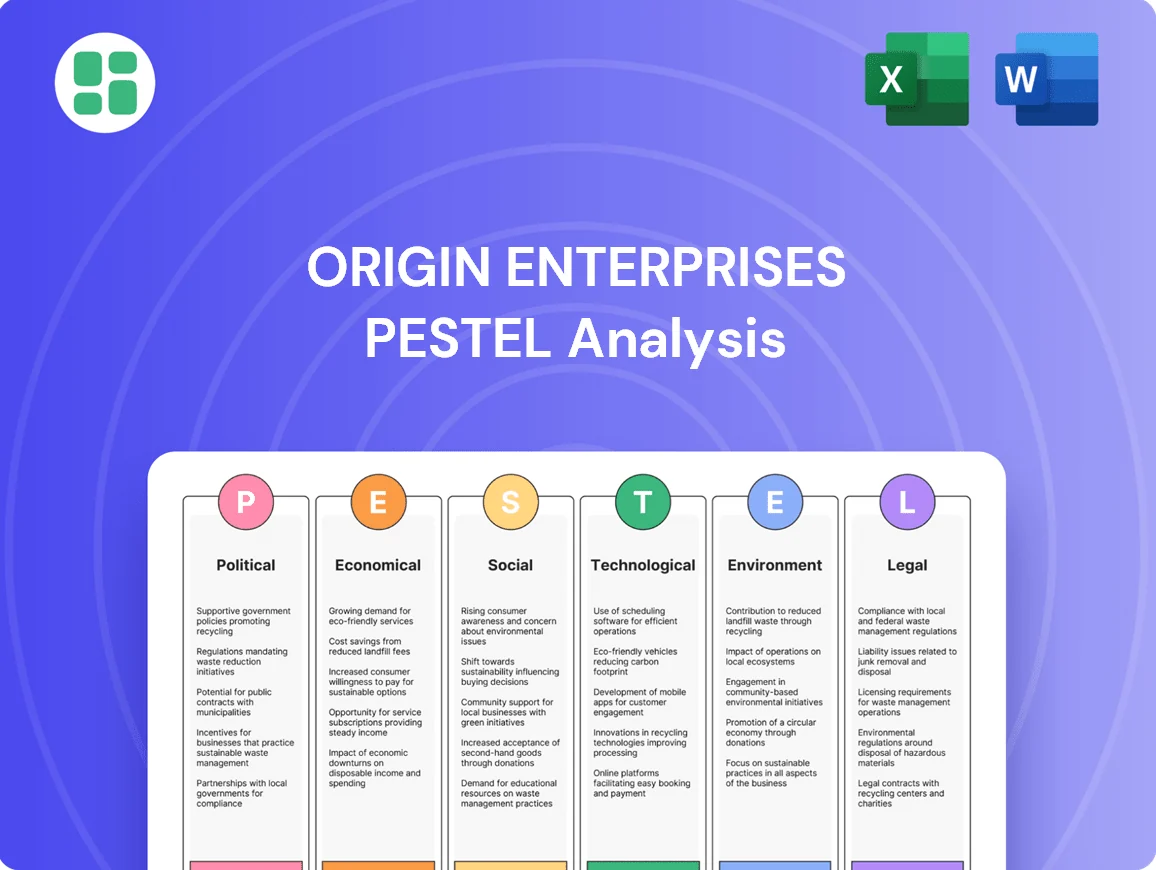
Origin Enterprises PESTLE Analysis

Your Shortcut to Market Insight Starts Here
Uncover the critical political, economic, social, technological, legal, and environmental factors shaping Origin Enterprises. Our PESTLE analysis provides a deep dive into the external forces impacting the company's strategic landscape. Gain the foresight needed to navigate challenges and capitalize on opportunities. Download the full PESTLE analysis now for actionable intelligence.
Political factors

Evolving Agricultural Policies and Subsidies
Governments in the UK and EU are actively reshaping agricultural policies, moving away from traditional direct payments towards environmental land management. For instance, the UK's Agricultural Transition Plan is phasing out the Basic Payment Scheme, with significant funding redirected to new environmental schemes by 2027. This policy shift directly influences farmer profitability and their willingness to invest in sustainable practices, which in turn affects the demand for Origin Enterprises' advisory and technological solutions.
Impact of Geopolitical Instability on Food Security
Ongoing geopolitical instability, exemplified by the protracted conflict in Ukraine, significantly impacts global food security. This conflict has disrupted critical supply chains and commodity markets, contributing to a notable surge in the price of agricultural inputs like fertilizers and energy, as well as outputs such as grains and edible oils. For instance, in early 2024, global wheat prices remained elevated compared to pre-conflict levels, directly affecting the cost of food production worldwide.
In response, governments globally are increasingly prioritizing food security. This focus is likely to translate into policies designed to bolster domestic agricultural production and enhance supply chain resilience. Such initiatives could create opportunities for companies like Origin Enterprises, which specialize in optimizing crop yields and improving agricultural efficiency, potentially positioning them as key partners in national food security strategies.

Government Support for Digital and Sustainable Farming
Governments, including the EU, are actively backing the digitalization of agriculture. This support comes in the form of policies and grants aimed at encouraging the use of precision farming tools and eco-friendly methods. For instance, the EU's Farm to Fork strategy, a key component of the European Green Deal, emphasizes sustainable food systems and innovation, directly benefiting AgriTech sectors.
These initiatives, like national digital farming programs, are channeling significant investment into AgriTech. This creates a fertile ground for companies like Origin Enterprises, whose digital agricultural services and solutions align perfectly with these forward-looking strategies. The drive for sustainability and efficiency in farming is a major tailwind.

Trade Agreements and Market Access
Post-Brexit trade agreements are reshaping the UK's agricultural landscape, directly impacting tariffs and import/export standards for products. For instance, the UK's trade deal with Australia, fully implemented in mid-2023, aims to eventually remove all tariffs on goods, potentially altering the competitive dynamics for UK farmers. These shifts in market access and regulatory environments can indirectly influence the demand for crop inputs and advisory services offered by companies like Origin Enterprises, as farmers adapt to new trading conditions.
New and revised international trade deals in other operating countries also play a crucial role. For example, as of early 2024, the European Union continues to negotiate its Common Agricultural Policy (CAP) reforms, which include provisions on trade and market access that affect member states. Such agreements can create both opportunities and challenges for Origin, by altering the cost of imported inputs or opening new markets for agricultural produce from the regions it serves.
- UK's Trade Deals: The UK has signed over 70 trade agreements with countries worldwide, following its departure from the EU, aiming to maintain continuity and explore new market access.
- EU's CAP Reforms: The EU's Common Agricultural Policy continues to evolve, with ongoing discussions in 2024 focusing on sustainability and market orientation, impacting trade flows.
- Impact on Competitiveness: Changes in tariffs and standards can alter the cost-effectiveness of farming practices, directly affecting farmer demand for inputs and services.
Regulatory Landscape for Biotechnology
The regulatory environment for agricultural biotechnology, particularly for gene-edited crops and biological solutions, is in a state of flux. This evolving landscape directly impacts companies like Origin Enterprises. For instance, the United States is working to update its regulations, which have been seen by some as potentially hindering innovation in this space.
Meanwhile, the European Union is also navigating its own intricate set of rules for these technologies. Origin's strategic direction, especially concerning its innovative digital tools and BioSolutions, will be significantly shaped by how these regulations are further developed and, crucially, harmonized across different global markets.
- US Regulatory Review: The USDA's proposed updates to biotechnology regulations aim to streamline processes for gene-edited products, with final rules anticipated in late 2024 or early 2025.
- EU's Evolving Stance: The EU's approach to gene-edited crops remains complex, with ongoing discussions and varying member state interpretations impacting market access.
- Global Harmonization Efforts: International bodies are increasingly focused on aligning regulatory frameworks for agricultural biotech to facilitate trade and innovation, a trend that will benefit companies with a global outlook.
Policy Shifts Drive Agricultural Innovation & Growth
Governments are increasingly prioritizing national food security, leading to policies that bolster domestic production and supply chain resilience. This focus creates opportunities for companies like Origin Enterprises, which enhance agricultural efficiency. For example, the UK's Agriculture and Food Supply Chain Act, passed in 2023, aims to improve the resilience of the food supply chain, potentially driving demand for Origin's advisory services.
The digitalization of agriculture is a key government objective, supported by grants and policies encouraging precision farming. The EU's Farm to Fork strategy, a cornerstone of the European Green Deal, champions sustainable food systems and innovation, directly benefiting AgriTech sectors. This trend is channeling significant investment into AgriTech, aligning with Origin Enterprises' digital agricultural services.
Trade agreements continue to reshape agricultural markets, influencing tariffs and import/export standards. As of early 2024, the UK has over 70 trade agreements in place, impacting market access for farmers. Similarly, EU CAP reforms in 2024 are focusing on sustainability and market orientation, affecting trade flows and the competitiveness of farming practices.
| Policy Area | Key Initiative | Impact on Origin Enterprises |
|---|---|---|
| Environmental Land Management | UK's Agricultural Transition Plan (phasing out Basic Payment Scheme by 2027) | Increases demand for sustainable farming advisory services. |
| Food Security | UK's Agriculture and Food Supply Chain Act (2023) | Drives demand for efficiency-enhancing agricultural solutions. |
| Digitalization of Agriculture | EU's Farm to Fork strategy | Creates opportunities for digital agricultural services and AgriTech solutions. |
| Trade Policy | UK's 70+ trade agreements (as of early 2024) | Alters competitive dynamics and market access for farmers. |
What is included in the product
 Detailed Word Document
This PESTLE analysis provides a comprehensive examination of the external macro-environmental factors influencing Origin Enterprises, covering Political, Economic, Social, Technological, Environmental, and Legal dimensions.
It offers actionable insights by detailing specific threats and opportunities within each category, supported by relevant data and forward-looking perspectives to aid strategic decision-making.

 Customizable Excel Spreadsheet
This PESTLE analysis for Origin Enterprises offers a clear, summarized version of the full analysis, making it easy to reference during meetings or presentations, thereby relieving the pain point of information overload.
Economic factors

Agricultural Commodity Price Volatility
Fluctuations in global agricultural commodity prices, influenced by weather patterns, demand shifts, and geopolitical tensions, directly affect farmer profitability. For instance, while wheat prices were expected to remain elevated into 2025, many other agricultural commodities are projected for a gradual decline, potentially squeezing margins for farmers who rely on Origin Enterprises for inputs and services.
This projected price softening could lead to reduced farmer spending on essential agricultural inputs, impacting Origin Enterprises' revenue streams. A 2024 USDA report indicated that while input costs remained high, the projected decrease in commodity prices could create a challenging environment for farm investment, a key market for Origin.
Rising Input Costs and Inflationary Pressures
Farmers are grappling with persistently high costs for crucial agricultural inputs like fuel and fertilizers. This situation is further aggravated by ongoing inflationary pressures and the impact of increased interest rates, making borrowing more expensive for essential purchases.
These escalating operational expenses directly squeeze farm profitability, potentially causing farmers to re-evaluate their spending on vital crop inputs and professional advisory services. Consequently, Origin Enterprises may experience a noticeable slowdown in sales volumes and a reduction in profit margins as demand softens.
For instance, in late 2024, global fertilizer prices, while showing some moderation from their 2022 peaks, remained significantly above pre-pandemic levels. Similarly, diesel fuel costs, a major expense for farm machinery, have seen volatility, with average prices in many agricultural regions remaining elevated throughout 2024, impacting farmers' purchasing power for Origin Enterprises' products and services.

Farmer Profitability and Investment Capacity
The economic health of farmers is a critical driver for Origin Enterprises. In 2024, many agricultural sectors faced fluctuating commodity prices and rising input costs, impacting farmer profitability. For instance, while corn prices saw some stability in early 2024, the cost of fertilizers and fuel remained elevated, squeezing margins for many producers.
This reduced profitability can directly affect farmers' investment capacity in advanced solutions. If farm incomes are down, producers might delay or scale back purchases of new technologies, precision agriculture tools, or digital management platforms that Origin Enterprises offers. A cautious approach to spending is a natural response when financial resources are tighter.
For example, a study by the American Farm Bureau Federation in late 2023 indicated that net farm income for 2024 was projected to be lower than in previous years, driven by increased operating expenses. This trend suggests that Origin Enterprises may need to adapt its offerings and pricing strategies to align with the current financial realities faced by its customer base.

Impact of Interest Rates and Access to Credit
Higher interest rates directly impact the cost of capital for agricultural businesses, including those that might adopt Origin Enterprises' solutions. For instance, if benchmark rates like the US Federal Funds Rate are elevated, the cost of loans for farm equipment or expansion rises. This can make farmers more hesitant to invest in new technologies or upgrades, potentially slowing the adoption of integrated crop management systems that require upfront investment.
The availability and cost of credit are crucial economic factors influencing investment in agricultural technology. In 2024, many central banks, including the European Central Bank, have maintained or cautiously lowered interest rates, but the overall cost of borrowing remains a consideration for capital-intensive sectors like agriculture. For example, a farmer needing to finance a new precision agriculture system, a core area for Origin, will face higher repayment costs if interest rates are significantly above historical lows.
- Increased Borrowing Costs: Higher interest rates, such as those seen in the 2024 economic climate where inflation concerns persist, directly increase the cost of loans for farmers.
- Impact on Investment Decisions: This makes investments in farm upgrades, new technologies, and working capital more expensive, potentially delaying or reducing capital expenditure.
- Slower Technology Adoption: The increased cost of credit can slow the pace at which farmers adopt advanced solutions like Origin's integrated crop management systems.
- Access to Credit: Tighter lending standards or reduced credit availability, often accompanying periods of economic uncertainty, can further limit farmers' ability to finance necessary investments.
Global Economic Growth and Demand for Food
Global economic growth is a significant driver for Origin Enterprises, directly impacting the demand for food and agricultural products. When economies expand, consumer spending power generally increases, leading to higher consumption of a wider range of food items and, consequently, boosting demand for agricultural outputs. For instance, the International Monetary Fund (IMF) projected global growth to be 3.2% in 2024, a slight uptick from 3.1% in 2023, indicating a generally supportive environment for agricultural demand.
Conversely, a slowdown in global economic expansion can dampen consumer appetite for food products, potentially pressuring farm gate prices and impacting Origin Enterprises' profitability. Emerging economies, particularly large ones like China, play a crucial role. Sustained robust growth in these regions often translates into increased demand for agricultural commodities, benefiting companies like Origin Enterprises through enhanced export opportunities and improved sector-wide performance. China’s economic performance remains a key indicator for global agricultural trade flows.
- Global growth projections for 2024 were around 3.2% (IMF).
- Stronger economic growth in developing nations often fuels demand for higher-value food products.
- A slowdown in major importing economies can reduce export volumes for agricultural producers.
- Consumer spending on food is highly correlated with disposable income, which is tied to economic health.
Economic Pressures: Impacting Farm Profitability and Investment
Economic factors significantly shape the agricultural landscape for Origin Enterprises. Fluctuations in commodity prices, like the projected decline in many agricultural goods into 2025, alongside persistently high input costs for fertilizers and fuel in 2024, directly squeeze farmer profitability. This economic pressure can lead to reduced farmer spending on essential inputs and advanced solutions, impacting Origin Enterprises' revenue and profit margins. For instance, net farm income was projected lower for 2024 compared to previous years due to increased operating expenses, according to a late 2023 American Farm Bureau Federation study.
Higher interest rates, a persistent economic theme in 2024, increase the cost of capital for farmers, making investments in new technologies or upgrades more expensive and potentially slowing adoption. For example, the cost of borrowing for precision agriculture systems, a key offering for Origin, is directly influenced by benchmark rates. Global economic growth, projected at 3.2% for 2024 by the IMF, also plays a crucial role, as stronger growth in emerging economies often fuels demand for agricultural products, benefiting companies like Origin Enterprises.
Preview the Actual Deliverable
Origin Enterprises PESTLE Analysis
The preview shown here is the exact document you’ll receive after purchase—fully formatted and ready to use. This comprehensive PESTLE analysis of Origin Enterprises covers all key external factors impacting the business. You'll gain immediate access to this detailed report upon completing your purchase.

Product Information
Product Information
Shipping & Returns
Shipping & Returns
Origin Enterprises PESTLE Analysis
Origin Enterprises PESTLE Analysis
Your Shortcut to Market Insight Starts Here
Uncover the critical political, economic, social, technological, legal, and environmental factors shaping Origin Enterprises. Our PESTLE analysis provides a deep dive into the external forces impacting the company's strategic landscape. Gain the foresight needed to navigate challenges and capitalize on opportunities. Download the full PESTLE analysis now for actionable intelligence.
Political factors
Evolving Agricultural Policies and Subsidies
Governments in the UK and EU are actively reshaping agricultural policies, moving away from traditional direct payments towards environmental land management. For instance, the UK's Agricultural Transition Plan is phasing out the Basic Payment Scheme, with significant funding redirected to new environmental schemes by 2027. This policy shift directly influences farmer profitability and their willingness to invest in sustainable practices, which in turn affects the demand for Origin Enterprises' advisory and technological solutions.
Impact of Geopolitical Instability on Food Security
Ongoing geopolitical instability, exemplified by the protracted conflict in Ukraine, significantly impacts global food security. This conflict has disrupted critical supply chains and commodity markets, contributing to a notable surge in the price of agricultural inputs like fertilizers and energy, as well as outputs such as grains and edible oils. For instance, in early 2024, global wheat prices remained elevated compared to pre-conflict levels, directly affecting the cost of food production worldwide.
In response, governments globally are increasingly prioritizing food security. This focus is likely to translate into policies designed to bolster domestic agricultural production and enhance supply chain resilience. Such initiatives could create opportunities for companies like Origin Enterprises, which specialize in optimizing crop yields and improving agricultural efficiency, potentially positioning them as key partners in national food security strategies.
Government Support for Digital and Sustainable Farming
Governments, including the EU, are actively backing the digitalization of agriculture. This support comes in the form of policies and grants aimed at encouraging the use of precision farming tools and eco-friendly methods. For instance, the EU's Farm to Fork strategy, a key component of the European Green Deal, emphasizes sustainable food systems and innovation, directly benefiting AgriTech sectors.
These initiatives, like national digital farming programs, are channeling significant investment into AgriTech. This creates a fertile ground for companies like Origin Enterprises, whose digital agricultural services and solutions align perfectly with these forward-looking strategies. The drive for sustainability and efficiency in farming is a major tailwind.
Trade Agreements and Market Access
Post-Brexit trade agreements are reshaping the UK's agricultural landscape, directly impacting tariffs and import/export standards for products. For instance, the UK's trade deal with Australia, fully implemented in mid-2023, aims to eventually remove all tariffs on goods, potentially altering the competitive dynamics for UK farmers. These shifts in market access and regulatory environments can indirectly influence the demand for crop inputs and advisory services offered by companies like Origin Enterprises, as farmers adapt to new trading conditions.
New and revised international trade deals in other operating countries also play a crucial role. For example, as of early 2024, the European Union continues to negotiate its Common Agricultural Policy (CAP) reforms, which include provisions on trade and market access that affect member states. Such agreements can create both opportunities and challenges for Origin, by altering the cost of imported inputs or opening new markets for agricultural produce from the regions it serves.
- UK's Trade Deals: The UK has signed over 70 trade agreements with countries worldwide, following its departure from the EU, aiming to maintain continuity and explore new market access.
- EU's CAP Reforms: The EU's Common Agricultural Policy continues to evolve, with ongoing discussions in 2024 focusing on sustainability and market orientation, impacting trade flows.
- Impact on Competitiveness: Changes in tariffs and standards can alter the cost-effectiveness of farming practices, directly affecting farmer demand for inputs and services.
Regulatory Landscape for Biotechnology
The regulatory environment for agricultural biotechnology, particularly for gene-edited crops and biological solutions, is in a state of flux. This evolving landscape directly impacts companies like Origin Enterprises. For instance, the United States is working to update its regulations, which have been seen by some as potentially hindering innovation in this space.
Meanwhile, the European Union is also navigating its own intricate set of rules for these technologies. Origin's strategic direction, especially concerning its innovative digital tools and BioSolutions, will be significantly shaped by how these regulations are further developed and, crucially, harmonized across different global markets.
- US Regulatory Review: The USDA's proposed updates to biotechnology regulations aim to streamline processes for gene-edited products, with final rules anticipated in late 2024 or early 2025.
- EU's Evolving Stance: The EU's approach to gene-edited crops remains complex, with ongoing discussions and varying member state interpretations impacting market access.
- Global Harmonization Efforts: International bodies are increasingly focused on aligning regulatory frameworks for agricultural biotech to facilitate trade and innovation, a trend that will benefit companies with a global outlook.
Policy Shifts Drive Agricultural Innovation & Growth
Governments are increasingly prioritizing national food security, leading to policies that bolster domestic production and supply chain resilience. This focus creates opportunities for companies like Origin Enterprises, which enhance agricultural efficiency. For example, the UK's Agriculture and Food Supply Chain Act, passed in 2023, aims to improve the resilience of the food supply chain, potentially driving demand for Origin's advisory services.
The digitalization of agriculture is a key government objective, supported by grants and policies encouraging precision farming. The EU's Farm to Fork strategy, a cornerstone of the European Green Deal, champions sustainable food systems and innovation, directly benefiting AgriTech sectors. This trend is channeling significant investment into AgriTech, aligning with Origin Enterprises' digital agricultural services.
Trade agreements continue to reshape agricultural markets, influencing tariffs and import/export standards. As of early 2024, the UK has over 70 trade agreements in place, impacting market access for farmers. Similarly, EU CAP reforms in 2024 are focusing on sustainability and market orientation, affecting trade flows and the competitiveness of farming practices.
| Policy Area | Key Initiative | Impact on Origin Enterprises |
|---|---|---|
| Environmental Land Management | UK's Agricultural Transition Plan (phasing out Basic Payment Scheme by 2027) | Increases demand for sustainable farming advisory services. |
| Food Security | UK's Agriculture and Food Supply Chain Act (2023) | Drives demand for efficiency-enhancing agricultural solutions. |
| Digitalization of Agriculture | EU's Farm to Fork strategy | Creates opportunities for digital agricultural services and AgriTech solutions. |
| Trade Policy | UK's 70+ trade agreements (as of early 2024) | Alters competitive dynamics and market access for farmers. |
What is included in the product
Detailed Word Document
This PESTLE analysis provides a comprehensive examination of the external macro-environmental factors influencing Origin Enterprises, covering Political, Economic, Social, Technological, Environmental, and Legal dimensions.
It offers actionable insights by detailing specific threats and opportunities within each category, supported by relevant data and forward-looking perspectives to aid strategic decision-making.
Customizable Excel Spreadsheet
This PESTLE analysis for Origin Enterprises offers a clear, summarized version of the full analysis, making it easy to reference during meetings or presentations, thereby relieving the pain point of information overload.
Economic factors
Agricultural Commodity Price Volatility
Fluctuations in global agricultural commodity prices, influenced by weather patterns, demand shifts, and geopolitical tensions, directly affect farmer profitability. For instance, while wheat prices were expected to remain elevated into 2025, many other agricultural commodities are projected for a gradual decline, potentially squeezing margins for farmers who rely on Origin Enterprises for inputs and services.
This projected price softening could lead to reduced farmer spending on essential agricultural inputs, impacting Origin Enterprises' revenue streams. A 2024 USDA report indicated that while input costs remained high, the projected decrease in commodity prices could create a challenging environment for farm investment, a key market for Origin.
Rising Input Costs and Inflationary Pressures
Farmers are grappling with persistently high costs for crucial agricultural inputs like fuel and fertilizers. This situation is further aggravated by ongoing inflationary pressures and the impact of increased interest rates, making borrowing more expensive for essential purchases.
These escalating operational expenses directly squeeze farm profitability, potentially causing farmers to re-evaluate their spending on vital crop inputs and professional advisory services. Consequently, Origin Enterprises may experience a noticeable slowdown in sales volumes and a reduction in profit margins as demand softens.
For instance, in late 2024, global fertilizer prices, while showing some moderation from their 2022 peaks, remained significantly above pre-pandemic levels. Similarly, diesel fuel costs, a major expense for farm machinery, have seen volatility, with average prices in many agricultural regions remaining elevated throughout 2024, impacting farmers' purchasing power for Origin Enterprises' products and services.
Farmer Profitability and Investment Capacity
The economic health of farmers is a critical driver for Origin Enterprises. In 2024, many agricultural sectors faced fluctuating commodity prices and rising input costs, impacting farmer profitability. For instance, while corn prices saw some stability in early 2024, the cost of fertilizers and fuel remained elevated, squeezing margins for many producers.
This reduced profitability can directly affect farmers' investment capacity in advanced solutions. If farm incomes are down, producers might delay or scale back purchases of new technologies, precision agriculture tools, or digital management platforms that Origin Enterprises offers. A cautious approach to spending is a natural response when financial resources are tighter.
For example, a study by the American Farm Bureau Federation in late 2023 indicated that net farm income for 2024 was projected to be lower than in previous years, driven by increased operating expenses. This trend suggests that Origin Enterprises may need to adapt its offerings and pricing strategies to align with the current financial realities faced by its customer base.
Impact of Interest Rates and Access to Credit
Higher interest rates directly impact the cost of capital for agricultural businesses, including those that might adopt Origin Enterprises' solutions. For instance, if benchmark rates like the US Federal Funds Rate are elevated, the cost of loans for farm equipment or expansion rises. This can make farmers more hesitant to invest in new technologies or upgrades, potentially slowing the adoption of integrated crop management systems that require upfront investment.
The availability and cost of credit are crucial economic factors influencing investment in agricultural technology. In 2024, many central banks, including the European Central Bank, have maintained or cautiously lowered interest rates, but the overall cost of borrowing remains a consideration for capital-intensive sectors like agriculture. For example, a farmer needing to finance a new precision agriculture system, a core area for Origin, will face higher repayment costs if interest rates are significantly above historical lows.
- Increased Borrowing Costs: Higher interest rates, such as those seen in the 2024 economic climate where inflation concerns persist, directly increase the cost of loans for farmers.
- Impact on Investment Decisions: This makes investments in farm upgrades, new technologies, and working capital more expensive, potentially delaying or reducing capital expenditure.
- Slower Technology Adoption: The increased cost of credit can slow the pace at which farmers adopt advanced solutions like Origin's integrated crop management systems.
- Access to Credit: Tighter lending standards or reduced credit availability, often accompanying periods of economic uncertainty, can further limit farmers' ability to finance necessary investments.
Global Economic Growth and Demand for Food
Global economic growth is a significant driver for Origin Enterprises, directly impacting the demand for food and agricultural products. When economies expand, consumer spending power generally increases, leading to higher consumption of a wider range of food items and, consequently, boosting demand for agricultural outputs. For instance, the International Monetary Fund (IMF) projected global growth to be 3.2% in 2024, a slight uptick from 3.1% in 2023, indicating a generally supportive environment for agricultural demand.
Conversely, a slowdown in global economic expansion can dampen consumer appetite for food products, potentially pressuring farm gate prices and impacting Origin Enterprises' profitability. Emerging economies, particularly large ones like China, play a crucial role. Sustained robust growth in these regions often translates into increased demand for agricultural commodities, benefiting companies like Origin Enterprises through enhanced export opportunities and improved sector-wide performance. China’s economic performance remains a key indicator for global agricultural trade flows.
- Global growth projections for 2024 were around 3.2% (IMF).
- Stronger economic growth in developing nations often fuels demand for higher-value food products.
- A slowdown in major importing economies can reduce export volumes for agricultural producers.
- Consumer spending on food is highly correlated with disposable income, which is tied to economic health.
Economic Pressures: Impacting Farm Profitability and Investment
Economic factors significantly shape the agricultural landscape for Origin Enterprises. Fluctuations in commodity prices, like the projected decline in many agricultural goods into 2025, alongside persistently high input costs for fertilizers and fuel in 2024, directly squeeze farmer profitability. This economic pressure can lead to reduced farmer spending on essential inputs and advanced solutions, impacting Origin Enterprises' revenue and profit margins. For instance, net farm income was projected lower for 2024 compared to previous years due to increased operating expenses, according to a late 2023 American Farm Bureau Federation study.
Higher interest rates, a persistent economic theme in 2024, increase the cost of capital for farmers, making investments in new technologies or upgrades more expensive and potentially slowing adoption. For example, the cost of borrowing for precision agriculture systems, a key offering for Origin, is directly influenced by benchmark rates. Global economic growth, projected at 3.2% for 2024 by the IMF, also plays a crucial role, as stronger growth in emerging economies often fuels demand for agricultural products, benefiting companies like Origin Enterprises.
Preview the Actual Deliverable
Origin Enterprises PESTLE Analysis
The preview shown here is the exact document you’ll receive after purchase—fully formatted and ready to use. This comprehensive PESTLE analysis of Origin Enterprises covers all key external factors impacting the business. You'll gain immediate access to this detailed report upon completing your purchase.
Original: $10.00
-65%$10.00
$3.50Product Information
Product Information
Shipping & Returns
Shipping & Returns
Description
Your Shortcut to Market Insight Starts Here
Uncover the critical political, economic, social, technological, legal, and environmental factors shaping Origin Enterprises. Our PESTLE analysis provides a deep dive into the external forces impacting the company's strategic landscape. Gain the foresight needed to navigate challenges and capitalize on opportunities. Download the full PESTLE analysis now for actionable intelligence.
Political factors
Evolving Agricultural Policies and Subsidies
Governments in the UK and EU are actively reshaping agricultural policies, moving away from traditional direct payments towards environmental land management. For instance, the UK's Agricultural Transition Plan is phasing out the Basic Payment Scheme, with significant funding redirected to new environmental schemes by 2027. This policy shift directly influences farmer profitability and their willingness to invest in sustainable practices, which in turn affects the demand for Origin Enterprises' advisory and technological solutions.
Impact of Geopolitical Instability on Food Security
Ongoing geopolitical instability, exemplified by the protracted conflict in Ukraine, significantly impacts global food security. This conflict has disrupted critical supply chains and commodity markets, contributing to a notable surge in the price of agricultural inputs like fertilizers and energy, as well as outputs such as grains and edible oils. For instance, in early 2024, global wheat prices remained elevated compared to pre-conflict levels, directly affecting the cost of food production worldwide.
In response, governments globally are increasingly prioritizing food security. This focus is likely to translate into policies designed to bolster domestic agricultural production and enhance supply chain resilience. Such initiatives could create opportunities for companies like Origin Enterprises, which specialize in optimizing crop yields and improving agricultural efficiency, potentially positioning them as key partners in national food security strategies.
Government Support for Digital and Sustainable Farming
Governments, including the EU, are actively backing the digitalization of agriculture. This support comes in the form of policies and grants aimed at encouraging the use of precision farming tools and eco-friendly methods. For instance, the EU's Farm to Fork strategy, a key component of the European Green Deal, emphasizes sustainable food systems and innovation, directly benefiting AgriTech sectors.
These initiatives, like national digital farming programs, are channeling significant investment into AgriTech. This creates a fertile ground for companies like Origin Enterprises, whose digital agricultural services and solutions align perfectly with these forward-looking strategies. The drive for sustainability and efficiency in farming is a major tailwind.
Trade Agreements and Market Access
Post-Brexit trade agreements are reshaping the UK's agricultural landscape, directly impacting tariffs and import/export standards for products. For instance, the UK's trade deal with Australia, fully implemented in mid-2023, aims to eventually remove all tariffs on goods, potentially altering the competitive dynamics for UK farmers. These shifts in market access and regulatory environments can indirectly influence the demand for crop inputs and advisory services offered by companies like Origin Enterprises, as farmers adapt to new trading conditions.
New and revised international trade deals in other operating countries also play a crucial role. For example, as of early 2024, the European Union continues to negotiate its Common Agricultural Policy (CAP) reforms, which include provisions on trade and market access that affect member states. Such agreements can create both opportunities and challenges for Origin, by altering the cost of imported inputs or opening new markets for agricultural produce from the regions it serves.
- UK's Trade Deals: The UK has signed over 70 trade agreements with countries worldwide, following its departure from the EU, aiming to maintain continuity and explore new market access.
- EU's CAP Reforms: The EU's Common Agricultural Policy continues to evolve, with ongoing discussions in 2024 focusing on sustainability and market orientation, impacting trade flows.
- Impact on Competitiveness: Changes in tariffs and standards can alter the cost-effectiveness of farming practices, directly affecting farmer demand for inputs and services.
Regulatory Landscape for Biotechnology
The regulatory environment for agricultural biotechnology, particularly for gene-edited crops and biological solutions, is in a state of flux. This evolving landscape directly impacts companies like Origin Enterprises. For instance, the United States is working to update its regulations, which have been seen by some as potentially hindering innovation in this space.
Meanwhile, the European Union is also navigating its own intricate set of rules for these technologies. Origin's strategic direction, especially concerning its innovative digital tools and BioSolutions, will be significantly shaped by how these regulations are further developed and, crucially, harmonized across different global markets.
- US Regulatory Review: The USDA's proposed updates to biotechnology regulations aim to streamline processes for gene-edited products, with final rules anticipated in late 2024 or early 2025.
- EU's Evolving Stance: The EU's approach to gene-edited crops remains complex, with ongoing discussions and varying member state interpretations impacting market access.
- Global Harmonization Efforts: International bodies are increasingly focused on aligning regulatory frameworks for agricultural biotech to facilitate trade and innovation, a trend that will benefit companies with a global outlook.
Policy Shifts Drive Agricultural Innovation & Growth
Governments are increasingly prioritizing national food security, leading to policies that bolster domestic production and supply chain resilience. This focus creates opportunities for companies like Origin Enterprises, which enhance agricultural efficiency. For example, the UK's Agriculture and Food Supply Chain Act, passed in 2023, aims to improve the resilience of the food supply chain, potentially driving demand for Origin's advisory services.
The digitalization of agriculture is a key government objective, supported by grants and policies encouraging precision farming. The EU's Farm to Fork strategy, a cornerstone of the European Green Deal, champions sustainable food systems and innovation, directly benefiting AgriTech sectors. This trend is channeling significant investment into AgriTech, aligning with Origin Enterprises' digital agricultural services.
Trade agreements continue to reshape agricultural markets, influencing tariffs and import/export standards. As of early 2024, the UK has over 70 trade agreements in place, impacting market access for farmers. Similarly, EU CAP reforms in 2024 are focusing on sustainability and market orientation, affecting trade flows and the competitiveness of farming practices.
| Policy Area | Key Initiative | Impact on Origin Enterprises |
|---|---|---|
| Environmental Land Management | UK's Agricultural Transition Plan (phasing out Basic Payment Scheme by 2027) | Increases demand for sustainable farming advisory services. |
| Food Security | UK's Agriculture and Food Supply Chain Act (2023) | Drives demand for efficiency-enhancing agricultural solutions. |
| Digitalization of Agriculture | EU's Farm to Fork strategy | Creates opportunities for digital agricultural services and AgriTech solutions. |
| Trade Policy | UK's 70+ trade agreements (as of early 2024) | Alters competitive dynamics and market access for farmers. |
What is included in the product
Detailed Word Document
This PESTLE analysis provides a comprehensive examination of the external macro-environmental factors influencing Origin Enterprises, covering Political, Economic, Social, Technological, Environmental, and Legal dimensions.
It offers actionable insights by detailing specific threats and opportunities within each category, supported by relevant data and forward-looking perspectives to aid strategic decision-making.
Customizable Excel Spreadsheet
This PESTLE analysis for Origin Enterprises offers a clear, summarized version of the full analysis, making it easy to reference during meetings or presentations, thereby relieving the pain point of information overload.
Economic factors
Agricultural Commodity Price Volatility
Fluctuations in global agricultural commodity prices, influenced by weather patterns, demand shifts, and geopolitical tensions, directly affect farmer profitability. For instance, while wheat prices were expected to remain elevated into 2025, many other agricultural commodities are projected for a gradual decline, potentially squeezing margins for farmers who rely on Origin Enterprises for inputs and services.
This projected price softening could lead to reduced farmer spending on essential agricultural inputs, impacting Origin Enterprises' revenue streams. A 2024 USDA report indicated that while input costs remained high, the projected decrease in commodity prices could create a challenging environment for farm investment, a key market for Origin.
Rising Input Costs and Inflationary Pressures
Farmers are grappling with persistently high costs for crucial agricultural inputs like fuel and fertilizers. This situation is further aggravated by ongoing inflationary pressures and the impact of increased interest rates, making borrowing more expensive for essential purchases.
These escalating operational expenses directly squeeze farm profitability, potentially causing farmers to re-evaluate their spending on vital crop inputs and professional advisory services. Consequently, Origin Enterprises may experience a noticeable slowdown in sales volumes and a reduction in profit margins as demand softens.
For instance, in late 2024, global fertilizer prices, while showing some moderation from their 2022 peaks, remained significantly above pre-pandemic levels. Similarly, diesel fuel costs, a major expense for farm machinery, have seen volatility, with average prices in many agricultural regions remaining elevated throughout 2024, impacting farmers' purchasing power for Origin Enterprises' products and services.
Farmer Profitability and Investment Capacity
The economic health of farmers is a critical driver for Origin Enterprises. In 2024, many agricultural sectors faced fluctuating commodity prices and rising input costs, impacting farmer profitability. For instance, while corn prices saw some stability in early 2024, the cost of fertilizers and fuel remained elevated, squeezing margins for many producers.
This reduced profitability can directly affect farmers' investment capacity in advanced solutions. If farm incomes are down, producers might delay or scale back purchases of new technologies, precision agriculture tools, or digital management platforms that Origin Enterprises offers. A cautious approach to spending is a natural response when financial resources are tighter.
For example, a study by the American Farm Bureau Federation in late 2023 indicated that net farm income for 2024 was projected to be lower than in previous years, driven by increased operating expenses. This trend suggests that Origin Enterprises may need to adapt its offerings and pricing strategies to align with the current financial realities faced by its customer base.
Impact of Interest Rates and Access to Credit
Higher interest rates directly impact the cost of capital for agricultural businesses, including those that might adopt Origin Enterprises' solutions. For instance, if benchmark rates like the US Federal Funds Rate are elevated, the cost of loans for farm equipment or expansion rises. This can make farmers more hesitant to invest in new technologies or upgrades, potentially slowing the adoption of integrated crop management systems that require upfront investment.
The availability and cost of credit are crucial economic factors influencing investment in agricultural technology. In 2024, many central banks, including the European Central Bank, have maintained or cautiously lowered interest rates, but the overall cost of borrowing remains a consideration for capital-intensive sectors like agriculture. For example, a farmer needing to finance a new precision agriculture system, a core area for Origin, will face higher repayment costs if interest rates are significantly above historical lows.
- Increased Borrowing Costs: Higher interest rates, such as those seen in the 2024 economic climate where inflation concerns persist, directly increase the cost of loans for farmers.
- Impact on Investment Decisions: This makes investments in farm upgrades, new technologies, and working capital more expensive, potentially delaying or reducing capital expenditure.
- Slower Technology Adoption: The increased cost of credit can slow the pace at which farmers adopt advanced solutions like Origin's integrated crop management systems.
- Access to Credit: Tighter lending standards or reduced credit availability, often accompanying periods of economic uncertainty, can further limit farmers' ability to finance necessary investments.
Global Economic Growth and Demand for Food
Global economic growth is a significant driver for Origin Enterprises, directly impacting the demand for food and agricultural products. When economies expand, consumer spending power generally increases, leading to higher consumption of a wider range of food items and, consequently, boosting demand for agricultural outputs. For instance, the International Monetary Fund (IMF) projected global growth to be 3.2% in 2024, a slight uptick from 3.1% in 2023, indicating a generally supportive environment for agricultural demand.
Conversely, a slowdown in global economic expansion can dampen consumer appetite for food products, potentially pressuring farm gate prices and impacting Origin Enterprises' profitability. Emerging economies, particularly large ones like China, play a crucial role. Sustained robust growth in these regions often translates into increased demand for agricultural commodities, benefiting companies like Origin Enterprises through enhanced export opportunities and improved sector-wide performance. China’s economic performance remains a key indicator for global agricultural trade flows.
- Global growth projections for 2024 were around 3.2% (IMF).
- Stronger economic growth in developing nations often fuels demand for higher-value food products.
- A slowdown in major importing economies can reduce export volumes for agricultural producers.
- Consumer spending on food is highly correlated with disposable income, which is tied to economic health.
Economic Pressures: Impacting Farm Profitability and Investment
Economic factors significantly shape the agricultural landscape for Origin Enterprises. Fluctuations in commodity prices, like the projected decline in many agricultural goods into 2025, alongside persistently high input costs for fertilizers and fuel in 2024, directly squeeze farmer profitability. This economic pressure can lead to reduced farmer spending on essential inputs and advanced solutions, impacting Origin Enterprises' revenue and profit margins. For instance, net farm income was projected lower for 2024 compared to previous years due to increased operating expenses, according to a late 2023 American Farm Bureau Federation study.
Higher interest rates, a persistent economic theme in 2024, increase the cost of capital for farmers, making investments in new technologies or upgrades more expensive and potentially slowing adoption. For example, the cost of borrowing for precision agriculture systems, a key offering for Origin, is directly influenced by benchmark rates. Global economic growth, projected at 3.2% for 2024 by the IMF, also plays a crucial role, as stronger growth in emerging economies often fuels demand for agricultural products, benefiting companies like Origin Enterprises.
Preview the Actual Deliverable
Origin Enterprises PESTLE Analysis
The preview shown here is the exact document you’ll receive after purchase—fully formatted and ready to use. This comprehensive PESTLE analysis of Origin Enterprises covers all key external factors impacting the business. You'll gain immediate access to this detailed report upon completing your purchase.











