
Incap PESTLE Analysis

Your Competitive Advantage Starts with This Report
Navigate the complex external environment impacting Incap with our comprehensive PESTLE analysis. Understand how political shifts, economic fluctuations, technological advancements, environmental concerns, and legal frameworks are shaping the company's trajectory. Equip yourself with actionable intelligence to make informed strategic decisions and gain a competitive advantage. Download the full report for an in-depth understanding.
Political factors

Trade Policies and Tariffs
Changes in global trade policies, including tariffs on electronic components and finished goods, directly affect Incap's cost of production and market competitiveness. For instance, the ongoing trade tensions between major economic blocs can lead to increased import duties, impacting the price of raw materials and components essential for Incap's manufacturing processes.
Recent geopolitical shifts and trade disputes have created market uncertainty, prompting some of Incap's clients to delay or re-evaluate their projects. The US administration's trade actions, for example, have been cited as a reason for customers postponing engagements, potentially affecting Incap's order book and revenue streams in the near term.
Geopolitical Stability in Manufacturing Regions
Incap's manufacturing footprint spans Finland, Estonia, India, Slovakia, the UK, and the USA. Geopolitical instability in any of these operational hubs, such as recent tensions in Eastern Europe impacting Estonia and Slovakia, can directly affect Incap's production capabilities and the reliability of its supply chains.

Government Incentives for Electronics Manufacturing
Governments worldwide are increasingly offering incentives and subsidies to bolster domestic electronics manufacturing, particularly for advanced sectors like semiconductors and green electronics. These initiatives aim to reduce reliance on foreign supply chains and foster technological innovation. For Incap, this translates into potential opportunities for cost reduction and enhanced competitiveness through targeted support programs.

Regulatory Changes in Target Markets
New or revised regulations in Incap's key markets, such as the European Union's evolving ecodesign directives or the United States' potential tariffs on electronic components, directly impact its operational costs and market access. For instance, stricter product safety standards implemented in Germany in 2024 could necessitate redesigns, increasing production expenses for Incap's electronics manufacturing services.
Compliance with a patchwork of international standards, including those for cybersecurity in Canada and material restrictions in Japan, presents ongoing challenges. These regulatory shifts require continuous monitoring and adaptation to ensure Incap's offerings remain competitive and legally sound across its diverse customer base.
Key regulatory considerations for Incap include:
- Product Safety Standards: Adherence to updated safety certifications for electronic devices, especially in the EU and North America.
- Import/Export Controls: Navigating changes in trade agreements and tariffs that could affect the cost of components and finished goods.
- Market Access Requirements: Meeting local content rules or specific testing protocols mandated by governments for entry into new markets.
- Environmental Regulations: Complying with directives like RoHS and REACH, which restrict hazardous substances in electronics manufacturing.
International Relations Impacting Supply Chains
Broader international relations and alliances significantly influence the stability and cost of global supply chains for electronic components and raw materials, a key consideration for Incap. For instance, ongoing trade disputes and shifting alliances can lead to unpredictable tariffs and sourcing challenges.
Geopolitical tensions continue to threaten supply chain stability, making diversification a critical element of risk management for Electronic Manufacturing Services (EMS) providers like Incap. The ongoing conflict in Eastern Europe, for example, has impacted the availability and pricing of certain critical raw materials used in electronics manufacturing throughout 2024.
Incap's strategic approach to navigating these international relations includes:
- Diversifying supplier base across different geopolitical regions to mitigate single-point-of-failure risks.
- Actively monitoring international trade agreements and policy changes that could affect component costs or availability.
- Developing robust contingency plans for potential disruptions stemming from international conflicts or sanctions.
- Strengthening relationships with key suppliers in politically stable regions to ensure consistent material flow.
Political Factors: Incap's 2024 Operational and Supply Chain Resilience
Political factors significantly shape Incap's operational landscape through trade policies and geopolitical stability. Shifting global trade dynamics, including tariffs and trade disputes, directly impact Incap's production costs and market access, as seen with US trade actions affecting client project timelines in 2024. Geopolitical instability in regions where Incap operates, such as Eastern Europe, can disrupt production and supply chains, highlighting the need for diversified sourcing strategies.
Government incentives for domestic electronics manufacturing present opportunities for Incap, while evolving regulations like the EU's ecodesign directives in 2024 necessitate continuous adaptation to ensure compliance and market competitiveness.
International relations and alliances are crucial for supply chain stability, with ongoing conflicts impacting raw material availability and pricing throughout 2024. Incap's strategic response involves diversifying its supplier base and actively monitoring policy changes to mitigate risks.
What is included in the product
 Detailed Word Document
The Incap PESTLE analysis meticulously examines the Political, Economic, Social, Technological, Environmental, and Legal factors influencing the company's operations and strategic direction.

 Customizable Excel Spreadsheet
The Incap PESTLE Analysis provides a clear, summarized version of the full analysis for easy referencing during meetings or presentations, alleviating the pain of sifting through extensive data.
Economic factors

Global Economic Growth and Consumer Spending
Global economic growth is a key driver for Incap's business. A robust economy typically translates to higher consumer spending, which in turn boosts demand for electronic products. For instance, the International Monetary Fund (IMF) projected global growth to be 3.2% in 2024, a slight slowdown from 2023, but still indicative of ongoing economic activity that supports consumer purchases of electronics.
The electronics manufacturing services (EMS) sector, where Incap operates, benefits directly from this consumer demand. The increasing integration of electronics in everyday life, from smart home devices to advanced medical equipment and industrial automation, fuels the EMS industry's expansion. This trend is expected to continue, with the global EMS market size projected to reach over $1 trillion by 2027, demonstrating a strong underlying growth trajectory.
Inflation and Interest Rates
Rising inflation is a significant concern for Incap, as it directly impacts operating expenses. For instance, the Eurozone's inflation rate stood at 2.4% in May 2024, a slight decrease from previous months but still elevated, meaning Incap likely faces higher costs for crucial inputs like electronic components and labor, potentially compressing their profit margins.
Furthermore, the prevailing higher interest rate environment, with the European Central Bank's main refinancing operations rate at 4.50% as of June 2024, increases the cost of capital. This makes it more expensive for Incap to finance new projects, acquire advanced manufacturing equipment, or fund strategic expansions, impacting their ability to invest in future growth.

Currency Exchange Rate Fluctuations
Currency exchange rate fluctuations present a significant economic factor for Incap. As a global company with operations and customers across various continents, shifts in currency values directly influence its financial reporting. For instance, a weakened US Dollar and Indian Rupee against the Euro can affect Incap's reported revenue and profitability.
In the first half of 2024, the Euro strengthened against both the US Dollar and the Indian Rupee. This trend means that revenue earned in USD and INR would translate to a lower Euro amount when reported, potentially impacting Incap's top-line figures. Conversely, costs incurred in Euros would become relatively cheaper for operations based in the US and India.

Supply Chain Costs and Raw Material Prices
The cost and availability of electronic components and raw materials are absolutely crucial for Incap's operations. The global electronics supply chain has been navigating a complex landscape, experiencing a mix of cost pressures. While material costs have seen increases, there's a silver lining as lead times for many components have shown improvement compared to the prior year.
For instance, the price of copper, a key raw material, experienced fluctuations throughout 2024, with some periods seeing prices above $9,000 per metric ton, impacting manufacturing costs. Similarly, the cost of semiconductors, vital for electronics manufacturing, remained a significant factor, though industry analysts projected a stabilization in pricing for certain chip categories by late 2024 after earlier surges.
- Rising Material Costs: Key inputs like copper and aluminum have seen price volatility, contributing to increased production expenses for Incap.
- Component Availability: While lead times have generally improved from 2023 peaks, securing certain specialized electronic components can still present challenges and affect production schedules.
- Energy Price Impact: Fluctuations in global energy prices, particularly for natural gas and electricity, directly influence the cost of processing raw materials and manufacturing components.
- Geopolitical Influences: Trade policies and geopolitical tensions can create uncertainty and impact the sourcing and pricing of essential raw materials and finished electronic parts.
Labor Costs and Availability
The cost and availability of skilled labor are critical economic drivers for Incap. As of early 2024, many developed economies are experiencing upward pressure on wages, making lower-cost manufacturing locations increasingly attractive for Original Equipment Manufacturers (OEMs). This dynamic directly benefits Electronic Manufacturing Services (EMS) providers like Incap, who leverage their global footprint to offer competitive production solutions.
Incap's operational strategy hinges on accessing cost-effective, skilled workforces. For instance, in countries like Estonia, a key Incap location, average manufacturing wages have seen steady increases, but remain significantly lower than in Western Europe. This allows Incap to absorb some of these rising costs while still presenting a compelling value proposition to clients.
- Skilled Labor Availability: Access to a trained and adaptable workforce is paramount for Incap's manufacturing efficiency.
- Wage Inflation: Global wage inflation, particularly in developed nations, encourages a shift towards outsourcing manufacturing to regions with more favorable labor cost structures.
- Competitive Advantage: Incap's ability to manage labor costs effectively in its operational hubs, such as India and China, provides a distinct competitive edge in the EMS market.
- Talent Acquisition: Ongoing investment in training and development is essential for Incap to maintain a high level of skill within its workforce, ensuring quality and productivity.
Economic Forces Shaping Electronics Manufacturing Profitability
Global economic growth remains a crucial factor for Incap, with the IMF projecting 3.2% global growth for 2024, supporting consumer demand for electronics. The EMS market is set to exceed $1 trillion by 2027, indicating sustained industry expansion. However, elevated inflation, like the 2.4% in the Eurozone in May 2024, increases Incap's operating costs for components and labor, potentially squeezing profit margins.
Higher interest rates, exemplified by the ECB's 4.50% rate in June 2024, also raise the cost of capital, impacting Incap's investment and expansion capabilities. Currency fluctuations, such as the Euro's strengthening against the USD and INR in early 2024, directly influence Incap's reported revenue and profitability, affecting its global financial performance.
Material costs, including copper prices fluctuating above $9,000 per metric ton in 2024, and semiconductor pricing, which showed signs of stabilization for some categories by late 2024, continue to influence Incap's manufacturing expenses. Skilled labor availability and wage inflation in developed nations also drive Incap's strategy to leverage cost-effective manufacturing locations, such as India, to maintain a competitive edge in the EMS sector.
| Economic Factor | Impact on Incap | Relevant Data (2024/2025) |
|---|---|---|
| Global Economic Growth | Drives consumer spending on electronics, increasing demand for EMS. | IMF projected 3.2% global growth in 2024. Global EMS market projected to exceed $1 trillion by 2027. |
| Inflation | Increases operating costs for components and labor. | Eurozone inflation at 2.4% in May 2024. |
| Interest Rates | Raises the cost of capital for investments and expansion. | ECB main refinancing rate at 4.50% as of June 2024. |
| Currency Exchange Rates | Affects reported revenue and profitability due to global operations. | Euro strengthened against USD and INR in early 2024. |
| Material & Component Costs | Impacts manufacturing expenses and production schedules. | Copper prices fluctuated above $9,000/metric ton in 2024. Semiconductor pricing showed signs of stabilization for some categories by late 2024. |
| Skilled Labor Costs | Influences operational location strategy and competitive advantage. | Upward wage pressure in developed economies; favorable labor costs in India. |
Same Document Delivered
Incap PESTLE Analysis
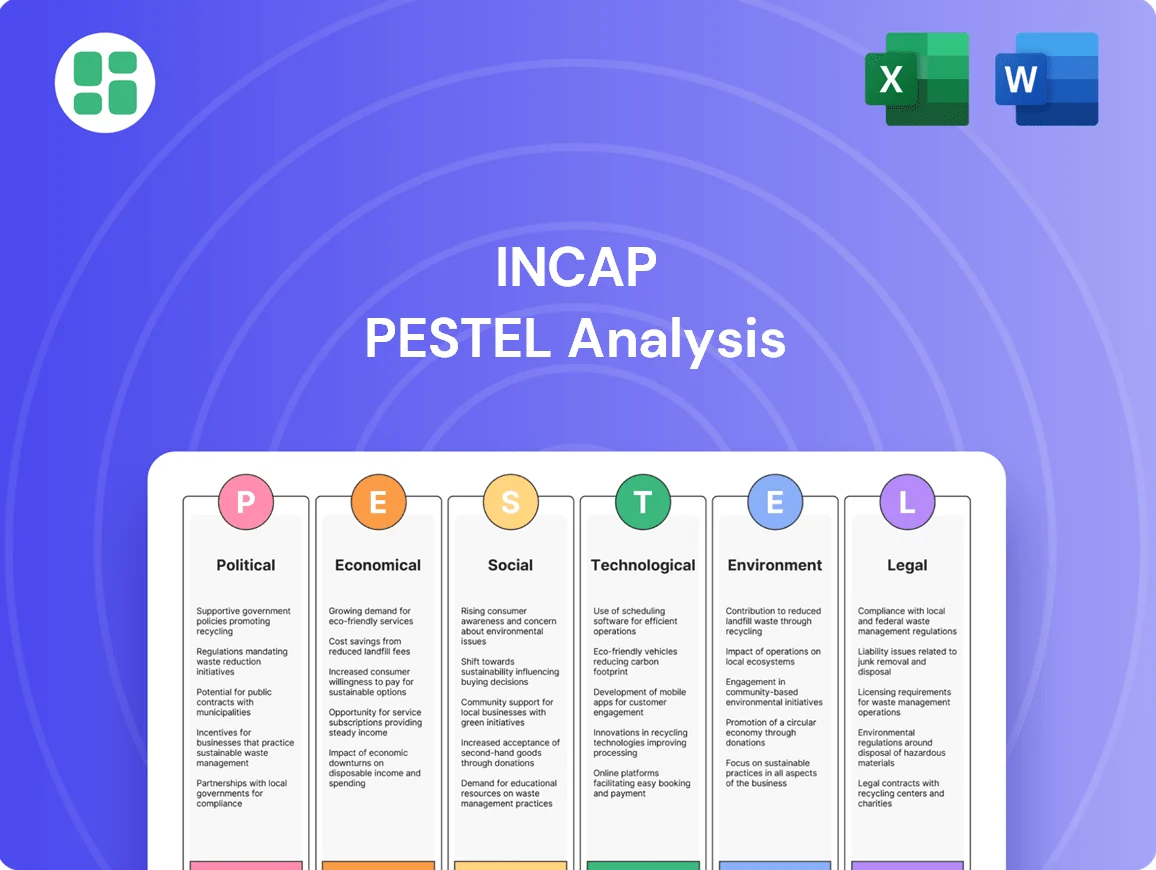
The preview shown here is the exact document you’ll receive after purchase—fully formatted and ready to use, offering a comprehensive Incap PESTLE Analysis.
This is a real screenshot of the product you’re buying—delivered exactly as shown, no surprises, allowing you to immediately leverage Incap's strategic insights.
The content and structure shown in the preview is the same document you’ll download after payment, providing a detailed PESTLE breakdown for Incap.

Product Information
Product Information
Shipping & Returns
Shipping & Returns
Incap PESTLE Analysis
Incap PESTLE Analysis
Your Competitive Advantage Starts with This Report
Navigate the complex external environment impacting Incap with our comprehensive PESTLE analysis. Understand how political shifts, economic fluctuations, technological advancements, environmental concerns, and legal frameworks are shaping the company's trajectory. Equip yourself with actionable intelligence to make informed strategic decisions and gain a competitive advantage. Download the full report for an in-depth understanding.
Political factors
Trade Policies and Tariffs
Changes in global trade policies, including tariffs on electronic components and finished goods, directly affect Incap's cost of production and market competitiveness. For instance, the ongoing trade tensions between major economic blocs can lead to increased import duties, impacting the price of raw materials and components essential for Incap's manufacturing processes.
Recent geopolitical shifts and trade disputes have created market uncertainty, prompting some of Incap's clients to delay or re-evaluate their projects. The US administration's trade actions, for example, have been cited as a reason for customers postponing engagements, potentially affecting Incap's order book and revenue streams in the near term.
Geopolitical Stability in Manufacturing Regions
Incap's manufacturing footprint spans Finland, Estonia, India, Slovakia, the UK, and the USA. Geopolitical instability in any of these operational hubs, such as recent tensions in Eastern Europe impacting Estonia and Slovakia, can directly affect Incap's production capabilities and the reliability of its supply chains.
Government Incentives for Electronics Manufacturing
Governments worldwide are increasingly offering incentives and subsidies to bolster domestic electronics manufacturing, particularly for advanced sectors like semiconductors and green electronics. These initiatives aim to reduce reliance on foreign supply chains and foster technological innovation. For Incap, this translates into potential opportunities for cost reduction and enhanced competitiveness through targeted support programs.
Regulatory Changes in Target Markets
New or revised regulations in Incap's key markets, such as the European Union's evolving ecodesign directives or the United States' potential tariffs on electronic components, directly impact its operational costs and market access. For instance, stricter product safety standards implemented in Germany in 2024 could necessitate redesigns, increasing production expenses for Incap's electronics manufacturing services.
Compliance with a patchwork of international standards, including those for cybersecurity in Canada and material restrictions in Japan, presents ongoing challenges. These regulatory shifts require continuous monitoring and adaptation to ensure Incap's offerings remain competitive and legally sound across its diverse customer base.
Key regulatory considerations for Incap include:
- Product Safety Standards: Adherence to updated safety certifications for electronic devices, especially in the EU and North America.
- Import/Export Controls: Navigating changes in trade agreements and tariffs that could affect the cost of components and finished goods.
- Market Access Requirements: Meeting local content rules or specific testing protocols mandated by governments for entry into new markets.
- Environmental Regulations: Complying with directives like RoHS and REACH, which restrict hazardous substances in electronics manufacturing.
International Relations Impacting Supply Chains
Broader international relations and alliances significantly influence the stability and cost of global supply chains for electronic components and raw materials, a key consideration for Incap. For instance, ongoing trade disputes and shifting alliances can lead to unpredictable tariffs and sourcing challenges.
Geopolitical tensions continue to threaten supply chain stability, making diversification a critical element of risk management for Electronic Manufacturing Services (EMS) providers like Incap. The ongoing conflict in Eastern Europe, for example, has impacted the availability and pricing of certain critical raw materials used in electronics manufacturing throughout 2024.
Incap's strategic approach to navigating these international relations includes:
- Diversifying supplier base across different geopolitical regions to mitigate single-point-of-failure risks.
- Actively monitoring international trade agreements and policy changes that could affect component costs or availability.
- Developing robust contingency plans for potential disruptions stemming from international conflicts or sanctions.
- Strengthening relationships with key suppliers in politically stable regions to ensure consistent material flow.
Political Factors: Incap's 2024 Operational and Supply Chain Resilience
Political factors significantly shape Incap's operational landscape through trade policies and geopolitical stability. Shifting global trade dynamics, including tariffs and trade disputes, directly impact Incap's production costs and market access, as seen with US trade actions affecting client project timelines in 2024. Geopolitical instability in regions where Incap operates, such as Eastern Europe, can disrupt production and supply chains, highlighting the need for diversified sourcing strategies.
Government incentives for domestic electronics manufacturing present opportunities for Incap, while evolving regulations like the EU's ecodesign directives in 2024 necessitate continuous adaptation to ensure compliance and market competitiveness.
International relations and alliances are crucial for supply chain stability, with ongoing conflicts impacting raw material availability and pricing throughout 2024. Incap's strategic response involves diversifying its supplier base and actively monitoring policy changes to mitigate risks.
What is included in the product
Detailed Word Document
The Incap PESTLE analysis meticulously examines the Political, Economic, Social, Technological, Environmental, and Legal factors influencing the company's operations and strategic direction.
Customizable Excel Spreadsheet
The Incap PESTLE Analysis provides a clear, summarized version of the full analysis for easy referencing during meetings or presentations, alleviating the pain of sifting through extensive data.
Economic factors
Global Economic Growth and Consumer Spending
Global economic growth is a key driver for Incap's business. A robust economy typically translates to higher consumer spending, which in turn boosts demand for electronic products. For instance, the International Monetary Fund (IMF) projected global growth to be 3.2% in 2024, a slight slowdown from 2023, but still indicative of ongoing economic activity that supports consumer purchases of electronics.
The electronics manufacturing services (EMS) sector, where Incap operates, benefits directly from this consumer demand. The increasing integration of electronics in everyday life, from smart home devices to advanced medical equipment and industrial automation, fuels the EMS industry's expansion. This trend is expected to continue, with the global EMS market size projected to reach over $1 trillion by 2027, demonstrating a strong underlying growth trajectory.
Inflation and Interest Rates
Rising inflation is a significant concern for Incap, as it directly impacts operating expenses. For instance, the Eurozone's inflation rate stood at 2.4% in May 2024, a slight decrease from previous months but still elevated, meaning Incap likely faces higher costs for crucial inputs like electronic components and labor, potentially compressing their profit margins.
Furthermore, the prevailing higher interest rate environment, with the European Central Bank's main refinancing operations rate at 4.50% as of June 2024, increases the cost of capital. This makes it more expensive for Incap to finance new projects, acquire advanced manufacturing equipment, or fund strategic expansions, impacting their ability to invest in future growth.
Currency Exchange Rate Fluctuations
Currency exchange rate fluctuations present a significant economic factor for Incap. As a global company with operations and customers across various continents, shifts in currency values directly influence its financial reporting. For instance, a weakened US Dollar and Indian Rupee against the Euro can affect Incap's reported revenue and profitability.
In the first half of 2024, the Euro strengthened against both the US Dollar and the Indian Rupee. This trend means that revenue earned in USD and INR would translate to a lower Euro amount when reported, potentially impacting Incap's top-line figures. Conversely, costs incurred in Euros would become relatively cheaper for operations based in the US and India.
Supply Chain Costs and Raw Material Prices
The cost and availability of electronic components and raw materials are absolutely crucial for Incap's operations. The global electronics supply chain has been navigating a complex landscape, experiencing a mix of cost pressures. While material costs have seen increases, there's a silver lining as lead times for many components have shown improvement compared to the prior year.
For instance, the price of copper, a key raw material, experienced fluctuations throughout 2024, with some periods seeing prices above $9,000 per metric ton, impacting manufacturing costs. Similarly, the cost of semiconductors, vital for electronics manufacturing, remained a significant factor, though industry analysts projected a stabilization in pricing for certain chip categories by late 2024 after earlier surges.
- Rising Material Costs: Key inputs like copper and aluminum have seen price volatility, contributing to increased production expenses for Incap.
- Component Availability: While lead times have generally improved from 2023 peaks, securing certain specialized electronic components can still present challenges and affect production schedules.
- Energy Price Impact: Fluctuations in global energy prices, particularly for natural gas and electricity, directly influence the cost of processing raw materials and manufacturing components.
- Geopolitical Influences: Trade policies and geopolitical tensions can create uncertainty and impact the sourcing and pricing of essential raw materials and finished electronic parts.
Labor Costs and Availability
The cost and availability of skilled labor are critical economic drivers for Incap. As of early 2024, many developed economies are experiencing upward pressure on wages, making lower-cost manufacturing locations increasingly attractive for Original Equipment Manufacturers (OEMs). This dynamic directly benefits Electronic Manufacturing Services (EMS) providers like Incap, who leverage their global footprint to offer competitive production solutions.
Incap's operational strategy hinges on accessing cost-effective, skilled workforces. For instance, in countries like Estonia, a key Incap location, average manufacturing wages have seen steady increases, but remain significantly lower than in Western Europe. This allows Incap to absorb some of these rising costs while still presenting a compelling value proposition to clients.
- Skilled Labor Availability: Access to a trained and adaptable workforce is paramount for Incap's manufacturing efficiency.
- Wage Inflation: Global wage inflation, particularly in developed nations, encourages a shift towards outsourcing manufacturing to regions with more favorable labor cost structures.
- Competitive Advantage: Incap's ability to manage labor costs effectively in its operational hubs, such as India and China, provides a distinct competitive edge in the EMS market.
- Talent Acquisition: Ongoing investment in training and development is essential for Incap to maintain a high level of skill within its workforce, ensuring quality and productivity.
Economic Forces Shaping Electronics Manufacturing Profitability
Global economic growth remains a crucial factor for Incap, with the IMF projecting 3.2% global growth for 2024, supporting consumer demand for electronics. The EMS market is set to exceed $1 trillion by 2027, indicating sustained industry expansion. However, elevated inflation, like the 2.4% in the Eurozone in May 2024, increases Incap's operating costs for components and labor, potentially squeezing profit margins.
Higher interest rates, exemplified by the ECB's 4.50% rate in June 2024, also raise the cost of capital, impacting Incap's investment and expansion capabilities. Currency fluctuations, such as the Euro's strengthening against the USD and INR in early 2024, directly influence Incap's reported revenue and profitability, affecting its global financial performance.
Material costs, including copper prices fluctuating above $9,000 per metric ton in 2024, and semiconductor pricing, which showed signs of stabilization for some categories by late 2024, continue to influence Incap's manufacturing expenses. Skilled labor availability and wage inflation in developed nations also drive Incap's strategy to leverage cost-effective manufacturing locations, such as India, to maintain a competitive edge in the EMS sector.
| Economic Factor | Impact on Incap | Relevant Data (2024/2025) |
|---|---|---|
| Global Economic Growth | Drives consumer spending on electronics, increasing demand for EMS. | IMF projected 3.2% global growth in 2024. Global EMS market projected to exceed $1 trillion by 2027. |
| Inflation | Increases operating costs for components and labor. | Eurozone inflation at 2.4% in May 2024. |
| Interest Rates | Raises the cost of capital for investments and expansion. | ECB main refinancing rate at 4.50% as of June 2024. |
| Currency Exchange Rates | Affects reported revenue and profitability due to global operations. | Euro strengthened against USD and INR in early 2024. |
| Material & Component Costs | Impacts manufacturing expenses and production schedules. | Copper prices fluctuated above $9,000/metric ton in 2024. Semiconductor pricing showed signs of stabilization for some categories by late 2024. |
| Skilled Labor Costs | Influences operational location strategy and competitive advantage. | Upward wage pressure in developed economies; favorable labor costs in India. |
Same Document Delivered
Incap PESTLE Analysis
The preview shown here is the exact document you’ll receive after purchase—fully formatted and ready to use, offering a comprehensive Incap PESTLE Analysis.
This is a real screenshot of the product you’re buying—delivered exactly as shown, no surprises, allowing you to immediately leverage Incap's strategic insights.
The content and structure shown in the preview is the same document you’ll download after payment, providing a detailed PESTLE breakdown for Incap.
Original: $10.00
-65%$10.00
$3.50Product Information
Product Information
Shipping & Returns
Shipping & Returns
Description
Your Competitive Advantage Starts with This Report
Navigate the complex external environment impacting Incap with our comprehensive PESTLE analysis. Understand how political shifts, economic fluctuations, technological advancements, environmental concerns, and legal frameworks are shaping the company's trajectory. Equip yourself with actionable intelligence to make informed strategic decisions and gain a competitive advantage. Download the full report for an in-depth understanding.
Political factors
Trade Policies and Tariffs
Changes in global trade policies, including tariffs on electronic components and finished goods, directly affect Incap's cost of production and market competitiveness. For instance, the ongoing trade tensions between major economic blocs can lead to increased import duties, impacting the price of raw materials and components essential for Incap's manufacturing processes.
Recent geopolitical shifts and trade disputes have created market uncertainty, prompting some of Incap's clients to delay or re-evaluate their projects. The US administration's trade actions, for example, have been cited as a reason for customers postponing engagements, potentially affecting Incap's order book and revenue streams in the near term.
Geopolitical Stability in Manufacturing Regions
Incap's manufacturing footprint spans Finland, Estonia, India, Slovakia, the UK, and the USA. Geopolitical instability in any of these operational hubs, such as recent tensions in Eastern Europe impacting Estonia and Slovakia, can directly affect Incap's production capabilities and the reliability of its supply chains.
Government Incentives for Electronics Manufacturing
Governments worldwide are increasingly offering incentives and subsidies to bolster domestic electronics manufacturing, particularly for advanced sectors like semiconductors and green electronics. These initiatives aim to reduce reliance on foreign supply chains and foster technological innovation. For Incap, this translates into potential opportunities for cost reduction and enhanced competitiveness through targeted support programs.
Regulatory Changes in Target Markets
New or revised regulations in Incap's key markets, such as the European Union's evolving ecodesign directives or the United States' potential tariffs on electronic components, directly impact its operational costs and market access. For instance, stricter product safety standards implemented in Germany in 2024 could necessitate redesigns, increasing production expenses for Incap's electronics manufacturing services.
Compliance with a patchwork of international standards, including those for cybersecurity in Canada and material restrictions in Japan, presents ongoing challenges. These regulatory shifts require continuous monitoring and adaptation to ensure Incap's offerings remain competitive and legally sound across its diverse customer base.
Key regulatory considerations for Incap include:
- Product Safety Standards: Adherence to updated safety certifications for electronic devices, especially in the EU and North America.
- Import/Export Controls: Navigating changes in trade agreements and tariffs that could affect the cost of components and finished goods.
- Market Access Requirements: Meeting local content rules or specific testing protocols mandated by governments for entry into new markets.
- Environmental Regulations: Complying with directives like RoHS and REACH, which restrict hazardous substances in electronics manufacturing.
International Relations Impacting Supply Chains
Broader international relations and alliances significantly influence the stability and cost of global supply chains for electronic components and raw materials, a key consideration for Incap. For instance, ongoing trade disputes and shifting alliances can lead to unpredictable tariffs and sourcing challenges.
Geopolitical tensions continue to threaten supply chain stability, making diversification a critical element of risk management for Electronic Manufacturing Services (EMS) providers like Incap. The ongoing conflict in Eastern Europe, for example, has impacted the availability and pricing of certain critical raw materials used in electronics manufacturing throughout 2024.
Incap's strategic approach to navigating these international relations includes:
- Diversifying supplier base across different geopolitical regions to mitigate single-point-of-failure risks.
- Actively monitoring international trade agreements and policy changes that could affect component costs or availability.
- Developing robust contingency plans for potential disruptions stemming from international conflicts or sanctions.
- Strengthening relationships with key suppliers in politically stable regions to ensure consistent material flow.
Political Factors: Incap's 2024 Operational and Supply Chain Resilience
Political factors significantly shape Incap's operational landscape through trade policies and geopolitical stability. Shifting global trade dynamics, including tariffs and trade disputes, directly impact Incap's production costs and market access, as seen with US trade actions affecting client project timelines in 2024. Geopolitical instability in regions where Incap operates, such as Eastern Europe, can disrupt production and supply chains, highlighting the need for diversified sourcing strategies.
Government incentives for domestic electronics manufacturing present opportunities for Incap, while evolving regulations like the EU's ecodesign directives in 2024 necessitate continuous adaptation to ensure compliance and market competitiveness.
International relations and alliances are crucial for supply chain stability, with ongoing conflicts impacting raw material availability and pricing throughout 2024. Incap's strategic response involves diversifying its supplier base and actively monitoring policy changes to mitigate risks.
What is included in the product
Detailed Word Document
The Incap PESTLE analysis meticulously examines the Political, Economic, Social, Technological, Environmental, and Legal factors influencing the company's operations and strategic direction.
Customizable Excel Spreadsheet
The Incap PESTLE Analysis provides a clear, summarized version of the full analysis for easy referencing during meetings or presentations, alleviating the pain of sifting through extensive data.
Economic factors
Global Economic Growth and Consumer Spending
Global economic growth is a key driver for Incap's business. A robust economy typically translates to higher consumer spending, which in turn boosts demand for electronic products. For instance, the International Monetary Fund (IMF) projected global growth to be 3.2% in 2024, a slight slowdown from 2023, but still indicative of ongoing economic activity that supports consumer purchases of electronics.
The electronics manufacturing services (EMS) sector, where Incap operates, benefits directly from this consumer demand. The increasing integration of electronics in everyday life, from smart home devices to advanced medical equipment and industrial automation, fuels the EMS industry's expansion. This trend is expected to continue, with the global EMS market size projected to reach over $1 trillion by 2027, demonstrating a strong underlying growth trajectory.
Inflation and Interest Rates
Rising inflation is a significant concern for Incap, as it directly impacts operating expenses. For instance, the Eurozone's inflation rate stood at 2.4% in May 2024, a slight decrease from previous months but still elevated, meaning Incap likely faces higher costs for crucial inputs like electronic components and labor, potentially compressing their profit margins.
Furthermore, the prevailing higher interest rate environment, with the European Central Bank's main refinancing operations rate at 4.50% as of June 2024, increases the cost of capital. This makes it more expensive for Incap to finance new projects, acquire advanced manufacturing equipment, or fund strategic expansions, impacting their ability to invest in future growth.
Currency Exchange Rate Fluctuations
Currency exchange rate fluctuations present a significant economic factor for Incap. As a global company with operations and customers across various continents, shifts in currency values directly influence its financial reporting. For instance, a weakened US Dollar and Indian Rupee against the Euro can affect Incap's reported revenue and profitability.
In the first half of 2024, the Euro strengthened against both the US Dollar and the Indian Rupee. This trend means that revenue earned in USD and INR would translate to a lower Euro amount when reported, potentially impacting Incap's top-line figures. Conversely, costs incurred in Euros would become relatively cheaper for operations based in the US and India.
Supply Chain Costs and Raw Material Prices
The cost and availability of electronic components and raw materials are absolutely crucial for Incap's operations. The global electronics supply chain has been navigating a complex landscape, experiencing a mix of cost pressures. While material costs have seen increases, there's a silver lining as lead times for many components have shown improvement compared to the prior year.
For instance, the price of copper, a key raw material, experienced fluctuations throughout 2024, with some periods seeing prices above $9,000 per metric ton, impacting manufacturing costs. Similarly, the cost of semiconductors, vital for electronics manufacturing, remained a significant factor, though industry analysts projected a stabilization in pricing for certain chip categories by late 2024 after earlier surges.
- Rising Material Costs: Key inputs like copper and aluminum have seen price volatility, contributing to increased production expenses for Incap.
- Component Availability: While lead times have generally improved from 2023 peaks, securing certain specialized electronic components can still present challenges and affect production schedules.
- Energy Price Impact: Fluctuations in global energy prices, particularly for natural gas and electricity, directly influence the cost of processing raw materials and manufacturing components.
- Geopolitical Influences: Trade policies and geopolitical tensions can create uncertainty and impact the sourcing and pricing of essential raw materials and finished electronic parts.
Labor Costs and Availability
The cost and availability of skilled labor are critical economic drivers for Incap. As of early 2024, many developed economies are experiencing upward pressure on wages, making lower-cost manufacturing locations increasingly attractive for Original Equipment Manufacturers (OEMs). This dynamic directly benefits Electronic Manufacturing Services (EMS) providers like Incap, who leverage their global footprint to offer competitive production solutions.
Incap's operational strategy hinges on accessing cost-effective, skilled workforces. For instance, in countries like Estonia, a key Incap location, average manufacturing wages have seen steady increases, but remain significantly lower than in Western Europe. This allows Incap to absorb some of these rising costs while still presenting a compelling value proposition to clients.
- Skilled Labor Availability: Access to a trained and adaptable workforce is paramount for Incap's manufacturing efficiency.
- Wage Inflation: Global wage inflation, particularly in developed nations, encourages a shift towards outsourcing manufacturing to regions with more favorable labor cost structures.
- Competitive Advantage: Incap's ability to manage labor costs effectively in its operational hubs, such as India and China, provides a distinct competitive edge in the EMS market.
- Talent Acquisition: Ongoing investment in training and development is essential for Incap to maintain a high level of skill within its workforce, ensuring quality and productivity.
Economic Forces Shaping Electronics Manufacturing Profitability
Global economic growth remains a crucial factor for Incap, with the IMF projecting 3.2% global growth for 2024, supporting consumer demand for electronics. The EMS market is set to exceed $1 trillion by 2027, indicating sustained industry expansion. However, elevated inflation, like the 2.4% in the Eurozone in May 2024, increases Incap's operating costs for components and labor, potentially squeezing profit margins.
Higher interest rates, exemplified by the ECB's 4.50% rate in June 2024, also raise the cost of capital, impacting Incap's investment and expansion capabilities. Currency fluctuations, such as the Euro's strengthening against the USD and INR in early 2024, directly influence Incap's reported revenue and profitability, affecting its global financial performance.
Material costs, including copper prices fluctuating above $9,000 per metric ton in 2024, and semiconductor pricing, which showed signs of stabilization for some categories by late 2024, continue to influence Incap's manufacturing expenses. Skilled labor availability and wage inflation in developed nations also drive Incap's strategy to leverage cost-effective manufacturing locations, such as India, to maintain a competitive edge in the EMS sector.
| Economic Factor | Impact on Incap | Relevant Data (2024/2025) |
|---|---|---|
| Global Economic Growth | Drives consumer spending on electronics, increasing demand for EMS. | IMF projected 3.2% global growth in 2024. Global EMS market projected to exceed $1 trillion by 2027. |
| Inflation | Increases operating costs for components and labor. | Eurozone inflation at 2.4% in May 2024. |
| Interest Rates | Raises the cost of capital for investments and expansion. | ECB main refinancing rate at 4.50% as of June 2024. |
| Currency Exchange Rates | Affects reported revenue and profitability due to global operations. | Euro strengthened against USD and INR in early 2024. |
| Material & Component Costs | Impacts manufacturing expenses and production schedules. | Copper prices fluctuated above $9,000/metric ton in 2024. Semiconductor pricing showed signs of stabilization for some categories by late 2024. |
| Skilled Labor Costs | Influences operational location strategy and competitive advantage. | Upward wage pressure in developed economies; favorable labor costs in India. |
Same Document Delivered
Incap PESTLE Analysis
The preview shown here is the exact document you’ll receive after purchase—fully formatted and ready to use, offering a comprehensive Incap PESTLE Analysis.
This is a real screenshot of the product you’re buying—delivered exactly as shown, no surprises, allowing you to immediately leverage Incap's strategic insights.
The content and structure shown in the preview is the same document you’ll download after payment, providing a detailed PESTLE breakdown for Incap.











