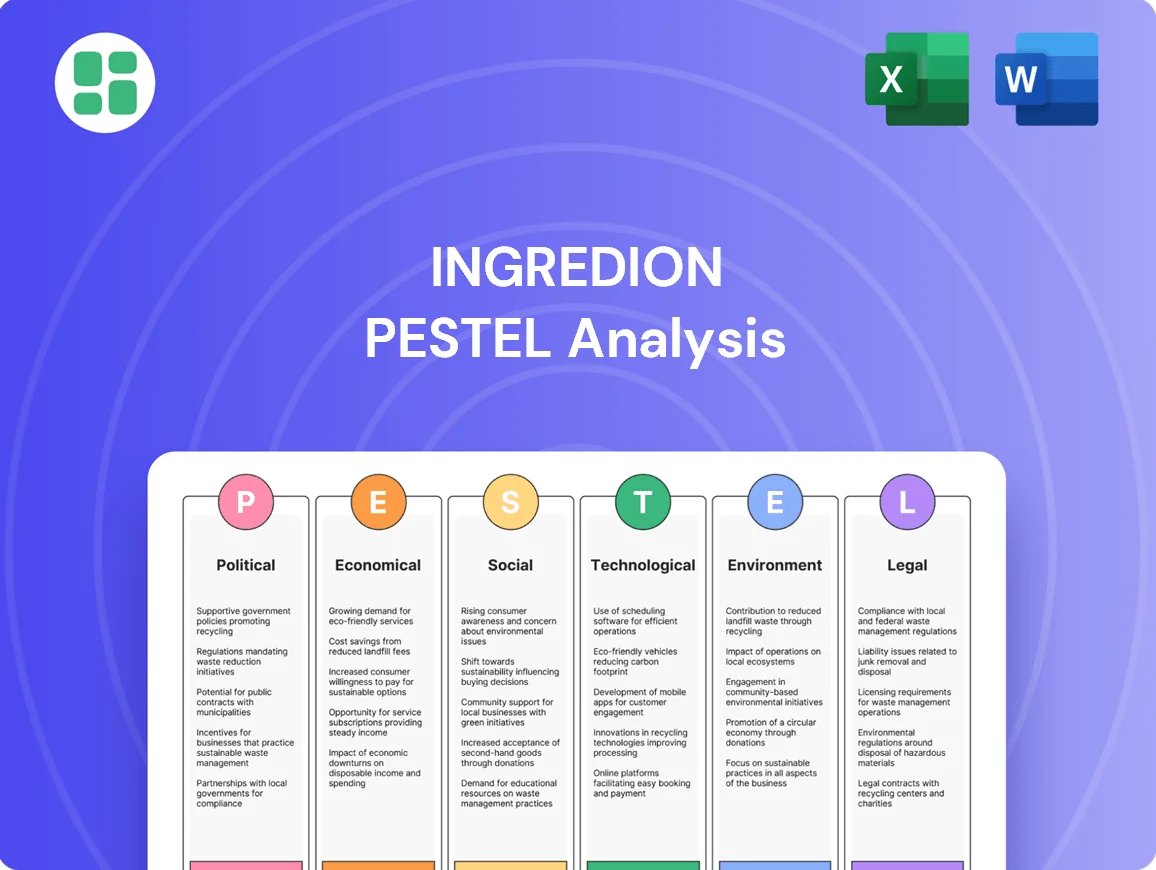
Iluka PESTLE Analysis

Your Competitive Advantage Starts with This Report
Unlock the critical external factors shaping Iluka's future with our comprehensive PESTLE analysis. Understand the political, economic, social, technological, legal, and environmental forces that present both opportunities and threats to the company. Equip yourself with the strategic intelligence needed to navigate this dynamic landscape. Download the full analysis now and gain a decisive advantage.
Political factors

Government Mining Policies & Regulations
Iluka's operations are entirely based in Australia, making government mining policies and regulations a critical factor. Changes in these rules, from permitting processes to operational standards, can directly influence project schedules and expenses. For instance, evolving environmental regulations might necessitate additional investment in compliance measures.
The Australian political landscape shows a clear commitment to critical minerals, which is beneficial for Iluka. A prime example is the A$120 million non-recourse loan provided by the Australian Government for Iluka's Eneabba Rare Earths Refinery. This financial backing underscores a supportive stance towards strategic resource development.
Trade Agreements & Protectionism
Global trade dynamics significantly shape Iluka's operational environment. The shifting landscape, marked by both expansive trade agreements and the resurgence of protectionist policies, directly impacts Iluka's access to key export markets and its position within the competitive arena. For example, while specific titanium dioxide feedstocks and rare earths have seen exemptions from recent US tariff impositions, zircon, a crucial product for Iluka, faces a 10% tariff. This tariff could potentially dampen sales volumes into the United States, necessitating strategic adjustments in marketing and market diversification efforts.

Geopolitical Stability in Operating Regions
Geopolitical stability in Australia, where Iluka Resources primarily operates, remains a key strength. As of early 2024, Australia's stable political environment supports consistent operations and access to global markets for mineral sands. This contrasts with regions experiencing higher geopolitical volatility, which could disrupt supply chains for competitors.
However, shifts in global trade policies and international relations can still impact Iluka's market access and the reliability of demand forecasts. For instance, changes in tariffs or trade agreements involving key export markets could necessitate adjustments to Iluka's sales strategies and customer diversification efforts. The company's robust Australian base provides a degree of insulation from these broader international risks.

Resource Nationalism
Governments increasingly asserting control over natural resources, known as resource nationalism, poses a risk to Iluka's long-term access to mineral reserves and its operational freedom. This can manifest as altered royalty payments, new ownership mandates, or tighter regulations on export quantities. For instance, in 2024, several African nations continued to review and revise their mining codes to secure a larger share of resource revenues, a trend that, while not directly impacting Iluka's Australian operations, signals a broader global shift.
Iluka's primary operations are in Australia, a jurisdiction generally characterized by a stable regulatory environment. However, the company must remain vigilant to global trends in resource nationalism. For example, in late 2023, some South American countries implemented higher export taxes on critical minerals, demonstrating how quickly the landscape can change. Iluka's strategic planning must account for potential shifts in fiscal regimes or ownership requirements that could impact profitability and operational flexibility.
- Global Resource Nationalism Trends: Monitoring policy shifts in key resource-rich regions globally.
- Australian Regulatory Environment: Assessing the stability and potential changes in Australian mining laws and taxation.
- Impact on Reserve Access: Evaluating how potential government interventions might affect Iluka's ability to access and develop its mineral deposits.
- Operational Autonomy: Considering how changes in ownership requirements or export controls could limit strategic decision-making.
Government Support for Critical Minerals
Government initiatives to secure critical mineral supply chains are a significant tailwind for companies like Iluka. Australia's Critical Minerals Facility, for instance, has provided crucial funding for Iluka's Eneabba Rare Earths Refinery project. This facility is designed to de-risk and accelerate the development of strategic mineral projects, directly benefiting Iluka's expansion into the rare earths sector.
These policies offer tangible strategic advantages by potentially providing direct financial support, helping to secure off-take agreements with downstream users, and streamlining the often lengthy approval processes. Such governmental backing bolsters Iluka's competitive standing in the global rare earths market, a sector vital for advanced manufacturing and clean energy technologies.
- Government Funding: Australia's Critical Minerals Facility has committed significant capital to projects like Iluka's Eneabba refinery, underscoring direct financial support.
- Supply Chain Security: Policies aim to onshore and diversify supply chains for critical minerals, reducing reliance on single sources and enhancing national economic security.
- Expedited Approvals: Governments are increasingly looking to fast-track permitting and regulatory processes for critical mineral projects to meet demand.
- Strategic Partnerships: Government support often facilitates collaboration and off-take agreements, creating stable demand for Iluka's products.
Political Currents: Navigating Global Policies and Resource Shifts
Australia's stable political environment is a key asset for Iluka, fostering consistent operations and market access. Government backing for critical minerals, such as the A$120 million loan for Iluka's Eneabba Rare Earths Refinery, highlights a supportive stance. However, global resource nationalism trends, like increased export taxes seen in some South American nations in late 2023, present a risk that Iluka must monitor. Shifts in trade policies, including tariffs on products like zircon, can also impact sales volumes into key markets, necessitating strategic adaptation.
| Political Factor | Description | Impact on Iluka | Example/Data |
| Government Mining Policies & Regulations | Rules governing exploration, extraction, environmental standards, and permitting. | Affects project timelines, operational costs, and compliance requirements. | Evolving environmental regulations may require additional investment. |
| Critical Minerals Support | Government initiatives to boost domestic production and supply chains for strategic minerals. | Provides financial backing, de-risks projects, and potentially streamlines approvals. | A$120 million loan from Australian Government for Eneabba Rare Earths Refinery. |
| Global Trade Dynamics & Tariffs | International trade agreements, protectionist policies, and import/export duties. | Influences market access, competitiveness, and sales volumes in export markets. | 10% US tariff on zircon could dampen sales volumes into the United States. |
| Resource Nationalism | Governments asserting greater control over natural resources, often through higher royalties or ownership mandates. | Risks long-term reserve access, operational freedom, and profitability. | Increased export taxes on critical minerals in some South American countries (late 2023). |
What is included in the product
 Detailed Word Document
This Iluka PESTLE analysis meticulously examines the Political, Economic, Social, Technological, Environmental, and Legal forces impacting the company, offering a comprehensive understanding of its operating landscape.
It provides actionable insights for strategic decision-making by identifying key external drivers and their potential influence on Iluka's future performance and market position.

 Customizable Excel Spreadsheet
Iluka's PESTLE analysis provides a clear, summarized version of external factors, simplifying complex market dynamics for easier referencing during strategic planning and reducing the pain of information overload.
Economic factors

Global Commodity Prices (Zircon, Rutile, Rare Earths)
Global commodity prices for zircon, rutile, and rare earth elements are critical to Iluka's financial performance. Fluctuations in these prices directly affect Iluka's revenue streams and overall profitability, as these are key products for the company.
In fiscal year 2024, Iluka experienced a downturn in mineral sands revenue, largely attributed to subdued demand in significant markets and seasonal factors impacting sales volumes. This highlights the sensitivity of Iluka's earnings to broader economic conditions and cyclical buying patterns.
The rare earth market presents its own set of challenges. While an established floor price exists for these commodities, the inherent volatility in their pricing introduces a notable risk factor for Iluka, potentially impacting forward-looking revenue projections and strategic planning.
Global Economic Growth & Industrial Demand
The global economic outlook significantly influences Iluka's performance, particularly through its impact on industrial demand for its core products. A robust global economy generally translates to increased construction and manufacturing activity, directly boosting the need for mineral sands like titanium dioxide pigment, a key component in paints, plastics, and paper. For instance, in 2024, projections from the IMF anticipate global growth around 3.2%, a moderate but steady pace that should support demand for these industrial materials.
Conversely, any deceleration in global economic growth, or specific downturns in major manufacturing hubs, can lead to reduced industrial output and, consequently, lower demand for Iluka's mineral sands. A slowdown in sectors like automotive or construction, which are significant consumers of titanium dioxide, would directly impact Iluka's sales volumes and pricing power. The ongoing geopolitical uncertainties and inflationary pressures observed through early 2025 continue to pose risks to sustained global industrial expansion.
Iluka's strategic focus on critical minerals positions it to benefit from a strong global economy that drives demand across a wider array of industrial applications. As industries increasingly rely on advanced materials for technological innovation and infrastructure development, the demand for Iluka’s resources, including those used in welding applications and advanced ceramics, is expected to remain a key growth driver. The push towards electrification and renewable energy infrastructure, for example, often requires specialized mineral inputs that Iluka may supply.

Exchange Rate Fluctuations (AUD/USD)
As an Australian company with significant international sales, Iluka's financial performance is sensitive to fluctuations in the AUD/USD exchange rate. For instance, during the first half of 2024, a generally stronger Australian dollar against the US dollar would have a dampening effect on the reported Australian dollar value of Iluka's US dollar-denominated export revenues.
Conversely, a weaker Australian dollar, as seen in some periods of 2023 where the AUD dipped below 0.65 USD, would have the opposite effect, boosting the local currency value of those same international sales and potentially improving profit margins on exported goods.

Inflationary Pressures on Operating Costs
Rising inflation significantly impacts Iluka's operating expenses. Increased costs for essential inputs like energy, skilled labor, and machinery directly affect profitability in the mining and processing sectors.
Iluka itself acknowledged this trend, reporting a 3% increase in its total cash cost of production for fiscal year 2024. This figure highlights the tangible effect of these inflationary pressures on the company’s bottom line.
- Energy Costs: Global energy prices have seen upward volatility, directly increasing fuel and electricity expenses for mining operations.
- Labor Expenses: A tight labor market and wage inflation contribute to higher personnel costs for skilled workers.
- Equipment and Materials: The cost of acquiring and maintaining mining equipment and essential raw materials has also risen.
Effectively managing these escalating operating costs is paramount for Iluka to sustain its profit margins and maintain a competitive edge in the market.
Interest Rate Environment & Capital Costs
Changes in the interest rate environment directly impact Iluka's cost of capital. For instance, if central banks like the Reserve Bank of Australia or the US Federal Reserve continue their tightening cycles through 2024 and into 2025, borrowing costs for new projects or refinancing existing debt will likely increase. This could make the economics of developing new mineral sands projects or expanding existing operations less attractive.
Iluka's ability to manage these rising capital costs is partly supported by its financial health. As of its latest reports, the company has maintained a robust net cash position, which can provide a buffer against higher borrowing expenses and allow for more flexible financing of capital expenditures. This financial resilience is crucial in an environment where debt servicing becomes more expensive.
The impact of interest rates on Iluka's investment decisions is significant. For example, a project requiring substantial upfront capital investment might be re-evaluated if the projected return on investment falls below the increased hurdle rate dictated by higher interest rates. This could lead to a slowdown in the pace of new mine development or capacity expansions.
- Interest Rate Hikes: Global central banks, including the RBA and Federal Reserve, have signaled a cautious approach to rate cuts in 2024, with potential for continued stability or even further increases if inflation proves persistent, impacting Iluka's borrowing costs.
- Cost of Capital: Higher interest rates translate directly to increased costs for any new debt financing Iluka might seek for expansion projects or acquisitions, potentially raising the minimum acceptable return for new investments.
- Project Viability: The economic feasibility of Iluka's long-term projects, such as the development of new mines or processing facilities, becomes more sensitive to interest rate fluctuations, potentially delaying or altering investment plans.
- Net Cash Position: Iluka's reported net cash balance provides a degree of insulation, allowing it to self-fund certain initiatives or reduce reliance on external borrowing in a rising rate environment.
Economic Shifts and Costs Shape Mineral Sands Performance
Iluka's financial performance is closely tied to global economic growth, which influences demand for its mineral sands. Projections for 2024 suggested moderate global growth, generally supporting industrial activity. However, economic slowdowns in key markets or manufacturing hubs pose a direct risk to Iluka's sales volumes and pricing power.
The company's strategic focus on critical minerals is a positive factor, aligning with industries driving technological innovation and infrastructure development. Continued investment in electrification and renewable energy is expected to sustain demand for Iluka's specialized resources.
Iluka's profitability is also impacted by currency fluctuations. A stronger Australian dollar in early 2024 reduced the reported value of its US dollar export revenues. Conversely, a weaker Australian dollar, as seen in periods of 2023, would enhance the local currency value of these sales.
Rising inflation significantly affects Iluka's operational costs, with the company reporting a 3% increase in its total cash cost of production for fiscal year 2024. Key cost drivers include energy, labor, and equipment expenses, necessitating effective cost management to maintain profit margins.
Full Version Awaits
Iluka PESTLE Analysis
The preview shown here is the exact document you’ll receive after purchase—fully formatted and ready to use. This comprehensive Iluka PESTLE analysis delves into the Political, Economic, Social, Technological, Legal, and Environmental factors impacting the company. Gain immediate access to this detailed report to inform your strategic decisions.

Product Information
Product Information
Shipping & Returns
Shipping & Returns

Iluka PESTLE Analysis
Iluka PESTLE Analysis
Your Competitive Advantage Starts with This Report
Unlock the critical external factors shaping Iluka's future with our comprehensive PESTLE analysis. Understand the political, economic, social, technological, legal, and environmental forces that present both opportunities and threats to the company. Equip yourself with the strategic intelligence needed to navigate this dynamic landscape. Download the full analysis now and gain a decisive advantage.
Political factors
Government Mining Policies & Regulations
Iluka's operations are entirely based in Australia, making government mining policies and regulations a critical factor. Changes in these rules, from permitting processes to operational standards, can directly influence project schedules and expenses. For instance, evolving environmental regulations might necessitate additional investment in compliance measures.
The Australian political landscape shows a clear commitment to critical minerals, which is beneficial for Iluka. A prime example is the A$120 million non-recourse loan provided by the Australian Government for Iluka's Eneabba Rare Earths Refinery. This financial backing underscores a supportive stance towards strategic resource development.
Trade Agreements & Protectionism
Global trade dynamics significantly shape Iluka's operational environment. The shifting landscape, marked by both expansive trade agreements and the resurgence of protectionist policies, directly impacts Iluka's access to key export markets and its position within the competitive arena. For example, while specific titanium dioxide feedstocks and rare earths have seen exemptions from recent US tariff impositions, zircon, a crucial product for Iluka, faces a 10% tariff. This tariff could potentially dampen sales volumes into the United States, necessitating strategic adjustments in marketing and market diversification efforts.
Geopolitical Stability in Operating Regions
Geopolitical stability in Australia, where Iluka Resources primarily operates, remains a key strength. As of early 2024, Australia's stable political environment supports consistent operations and access to global markets for mineral sands. This contrasts with regions experiencing higher geopolitical volatility, which could disrupt supply chains for competitors.
However, shifts in global trade policies and international relations can still impact Iluka's market access and the reliability of demand forecasts. For instance, changes in tariffs or trade agreements involving key export markets could necessitate adjustments to Iluka's sales strategies and customer diversification efforts. The company's robust Australian base provides a degree of insulation from these broader international risks.
Resource Nationalism
Governments increasingly asserting control over natural resources, known as resource nationalism, poses a risk to Iluka's long-term access to mineral reserves and its operational freedom. This can manifest as altered royalty payments, new ownership mandates, or tighter regulations on export quantities. For instance, in 2024, several African nations continued to review and revise their mining codes to secure a larger share of resource revenues, a trend that, while not directly impacting Iluka's Australian operations, signals a broader global shift.
Iluka's primary operations are in Australia, a jurisdiction generally characterized by a stable regulatory environment. However, the company must remain vigilant to global trends in resource nationalism. For example, in late 2023, some South American countries implemented higher export taxes on critical minerals, demonstrating how quickly the landscape can change. Iluka's strategic planning must account for potential shifts in fiscal regimes or ownership requirements that could impact profitability and operational flexibility.
- Global Resource Nationalism Trends: Monitoring policy shifts in key resource-rich regions globally.
- Australian Regulatory Environment: Assessing the stability and potential changes in Australian mining laws and taxation.
- Impact on Reserve Access: Evaluating how potential government interventions might affect Iluka's ability to access and develop its mineral deposits.
- Operational Autonomy: Considering how changes in ownership requirements or export controls could limit strategic decision-making.
Government Support for Critical Minerals
Government initiatives to secure critical mineral supply chains are a significant tailwind for companies like Iluka. Australia's Critical Minerals Facility, for instance, has provided crucial funding for Iluka's Eneabba Rare Earths Refinery project. This facility is designed to de-risk and accelerate the development of strategic mineral projects, directly benefiting Iluka's expansion into the rare earths sector.
These policies offer tangible strategic advantages by potentially providing direct financial support, helping to secure off-take agreements with downstream users, and streamlining the often lengthy approval processes. Such governmental backing bolsters Iluka's competitive standing in the global rare earths market, a sector vital for advanced manufacturing and clean energy technologies.
- Government Funding: Australia's Critical Minerals Facility has committed significant capital to projects like Iluka's Eneabba refinery, underscoring direct financial support.
- Supply Chain Security: Policies aim to onshore and diversify supply chains for critical minerals, reducing reliance on single sources and enhancing national economic security.
- Expedited Approvals: Governments are increasingly looking to fast-track permitting and regulatory processes for critical mineral projects to meet demand.
- Strategic Partnerships: Government support often facilitates collaboration and off-take agreements, creating stable demand for Iluka's products.
Political Currents: Navigating Global Policies and Resource Shifts
Australia's stable political environment is a key asset for Iluka, fostering consistent operations and market access. Government backing for critical minerals, such as the A$120 million loan for Iluka's Eneabba Rare Earths Refinery, highlights a supportive stance. However, global resource nationalism trends, like increased export taxes seen in some South American nations in late 2023, present a risk that Iluka must monitor. Shifts in trade policies, including tariffs on products like zircon, can also impact sales volumes into key markets, necessitating strategic adaptation.
| Political Factor | Description | Impact on Iluka | Example/Data |
| Government Mining Policies & Regulations | Rules governing exploration, extraction, environmental standards, and permitting. | Affects project timelines, operational costs, and compliance requirements. | Evolving environmental regulations may require additional investment. |
| Critical Minerals Support | Government initiatives to boost domestic production and supply chains for strategic minerals. | Provides financial backing, de-risks projects, and potentially streamlines approvals. | A$120 million loan from Australian Government for Eneabba Rare Earths Refinery. |
| Global Trade Dynamics & Tariffs | International trade agreements, protectionist policies, and import/export duties. | Influences market access, competitiveness, and sales volumes in export markets. | 10% US tariff on zircon could dampen sales volumes into the United States. |
| Resource Nationalism | Governments asserting greater control over natural resources, often through higher royalties or ownership mandates. | Risks long-term reserve access, operational freedom, and profitability. | Increased export taxes on critical minerals in some South American countries (late 2023). |
What is included in the product
Detailed Word Document
This Iluka PESTLE analysis meticulously examines the Political, Economic, Social, Technological, Environmental, and Legal forces impacting the company, offering a comprehensive understanding of its operating landscape.
It provides actionable insights for strategic decision-making by identifying key external drivers and their potential influence on Iluka's future performance and market position.
Customizable Excel Spreadsheet
Iluka's PESTLE analysis provides a clear, summarized version of external factors, simplifying complex market dynamics for easier referencing during strategic planning and reducing the pain of information overload.
Economic factors
Global Commodity Prices (Zircon, Rutile, Rare Earths)
Global commodity prices for zircon, rutile, and rare earth elements are critical to Iluka's financial performance. Fluctuations in these prices directly affect Iluka's revenue streams and overall profitability, as these are key products for the company.
In fiscal year 2024, Iluka experienced a downturn in mineral sands revenue, largely attributed to subdued demand in significant markets and seasonal factors impacting sales volumes. This highlights the sensitivity of Iluka's earnings to broader economic conditions and cyclical buying patterns.
The rare earth market presents its own set of challenges. While an established floor price exists for these commodities, the inherent volatility in their pricing introduces a notable risk factor for Iluka, potentially impacting forward-looking revenue projections and strategic planning.
Global Economic Growth & Industrial Demand
The global economic outlook significantly influences Iluka's performance, particularly through its impact on industrial demand for its core products. A robust global economy generally translates to increased construction and manufacturing activity, directly boosting the need for mineral sands like titanium dioxide pigment, a key component in paints, plastics, and paper. For instance, in 2024, projections from the IMF anticipate global growth around 3.2%, a moderate but steady pace that should support demand for these industrial materials.
Conversely, any deceleration in global economic growth, or specific downturns in major manufacturing hubs, can lead to reduced industrial output and, consequently, lower demand for Iluka's mineral sands. A slowdown in sectors like automotive or construction, which are significant consumers of titanium dioxide, would directly impact Iluka's sales volumes and pricing power. The ongoing geopolitical uncertainties and inflationary pressures observed through early 2025 continue to pose risks to sustained global industrial expansion.
Iluka's strategic focus on critical minerals positions it to benefit from a strong global economy that drives demand across a wider array of industrial applications. As industries increasingly rely on advanced materials for technological innovation and infrastructure development, the demand for Iluka’s resources, including those used in welding applications and advanced ceramics, is expected to remain a key growth driver. The push towards electrification and renewable energy infrastructure, for example, often requires specialized mineral inputs that Iluka may supply.
Exchange Rate Fluctuations (AUD/USD)
As an Australian company with significant international sales, Iluka's financial performance is sensitive to fluctuations in the AUD/USD exchange rate. For instance, during the first half of 2024, a generally stronger Australian dollar against the US dollar would have a dampening effect on the reported Australian dollar value of Iluka's US dollar-denominated export revenues.
Conversely, a weaker Australian dollar, as seen in some periods of 2023 where the AUD dipped below 0.65 USD, would have the opposite effect, boosting the local currency value of those same international sales and potentially improving profit margins on exported goods.
Inflationary Pressures on Operating Costs
Rising inflation significantly impacts Iluka's operating expenses. Increased costs for essential inputs like energy, skilled labor, and machinery directly affect profitability in the mining and processing sectors.
Iluka itself acknowledged this trend, reporting a 3% increase in its total cash cost of production for fiscal year 2024. This figure highlights the tangible effect of these inflationary pressures on the company’s bottom line.
- Energy Costs: Global energy prices have seen upward volatility, directly increasing fuel and electricity expenses for mining operations.
- Labor Expenses: A tight labor market and wage inflation contribute to higher personnel costs for skilled workers.
- Equipment and Materials: The cost of acquiring and maintaining mining equipment and essential raw materials has also risen.
Effectively managing these escalating operating costs is paramount for Iluka to sustain its profit margins and maintain a competitive edge in the market.
Interest Rate Environment & Capital Costs
Changes in the interest rate environment directly impact Iluka's cost of capital. For instance, if central banks like the Reserve Bank of Australia or the US Federal Reserve continue their tightening cycles through 2024 and into 2025, borrowing costs for new projects or refinancing existing debt will likely increase. This could make the economics of developing new mineral sands projects or expanding existing operations less attractive.
Iluka's ability to manage these rising capital costs is partly supported by its financial health. As of its latest reports, the company has maintained a robust net cash position, which can provide a buffer against higher borrowing expenses and allow for more flexible financing of capital expenditures. This financial resilience is crucial in an environment where debt servicing becomes more expensive.
The impact of interest rates on Iluka's investment decisions is significant. For example, a project requiring substantial upfront capital investment might be re-evaluated if the projected return on investment falls below the increased hurdle rate dictated by higher interest rates. This could lead to a slowdown in the pace of new mine development or capacity expansions.
- Interest Rate Hikes: Global central banks, including the RBA and Federal Reserve, have signaled a cautious approach to rate cuts in 2024, with potential for continued stability or even further increases if inflation proves persistent, impacting Iluka's borrowing costs.
- Cost of Capital: Higher interest rates translate directly to increased costs for any new debt financing Iluka might seek for expansion projects or acquisitions, potentially raising the minimum acceptable return for new investments.
- Project Viability: The economic feasibility of Iluka's long-term projects, such as the development of new mines or processing facilities, becomes more sensitive to interest rate fluctuations, potentially delaying or altering investment plans.
- Net Cash Position: Iluka's reported net cash balance provides a degree of insulation, allowing it to self-fund certain initiatives or reduce reliance on external borrowing in a rising rate environment.
Economic Shifts and Costs Shape Mineral Sands Performance
Iluka's financial performance is closely tied to global economic growth, which influences demand for its mineral sands. Projections for 2024 suggested moderate global growth, generally supporting industrial activity. However, economic slowdowns in key markets or manufacturing hubs pose a direct risk to Iluka's sales volumes and pricing power.
The company's strategic focus on critical minerals is a positive factor, aligning with industries driving technological innovation and infrastructure development. Continued investment in electrification and renewable energy is expected to sustain demand for Iluka's specialized resources.
Iluka's profitability is also impacted by currency fluctuations. A stronger Australian dollar in early 2024 reduced the reported value of its US dollar export revenues. Conversely, a weaker Australian dollar, as seen in periods of 2023, would enhance the local currency value of these sales.
Rising inflation significantly affects Iluka's operational costs, with the company reporting a 3% increase in its total cash cost of production for fiscal year 2024. Key cost drivers include energy, labor, and equipment expenses, necessitating effective cost management to maintain profit margins.
Full Version Awaits
Iluka PESTLE Analysis
The preview shown here is the exact document you’ll receive after purchase—fully formatted and ready to use. This comprehensive Iluka PESTLE analysis delves into the Political, Economic, Social, Technological, Legal, and Environmental factors impacting the company. Gain immediate access to this detailed report to inform your strategic decisions.
Product Information
Product Information
Shipping & Returns
Shipping & Returns
Description
Your Competitive Advantage Starts with This Report
Unlock the critical external factors shaping Iluka's future with our comprehensive PESTLE analysis. Understand the political, economic, social, technological, legal, and environmental forces that present both opportunities and threats to the company. Equip yourself with the strategic intelligence needed to navigate this dynamic landscape. Download the full analysis now and gain a decisive advantage.
Political factors
Government Mining Policies & Regulations
Iluka's operations are entirely based in Australia, making government mining policies and regulations a critical factor. Changes in these rules, from permitting processes to operational standards, can directly influence project schedules and expenses. For instance, evolving environmental regulations might necessitate additional investment in compliance measures.
The Australian political landscape shows a clear commitment to critical minerals, which is beneficial for Iluka. A prime example is the A$120 million non-recourse loan provided by the Australian Government for Iluka's Eneabba Rare Earths Refinery. This financial backing underscores a supportive stance towards strategic resource development.
Trade Agreements & Protectionism
Global trade dynamics significantly shape Iluka's operational environment. The shifting landscape, marked by both expansive trade agreements and the resurgence of protectionist policies, directly impacts Iluka's access to key export markets and its position within the competitive arena. For example, while specific titanium dioxide feedstocks and rare earths have seen exemptions from recent US tariff impositions, zircon, a crucial product for Iluka, faces a 10% tariff. This tariff could potentially dampen sales volumes into the United States, necessitating strategic adjustments in marketing and market diversification efforts.
Geopolitical Stability in Operating Regions
Geopolitical stability in Australia, where Iluka Resources primarily operates, remains a key strength. As of early 2024, Australia's stable political environment supports consistent operations and access to global markets for mineral sands. This contrasts with regions experiencing higher geopolitical volatility, which could disrupt supply chains for competitors.
However, shifts in global trade policies and international relations can still impact Iluka's market access and the reliability of demand forecasts. For instance, changes in tariffs or trade agreements involving key export markets could necessitate adjustments to Iluka's sales strategies and customer diversification efforts. The company's robust Australian base provides a degree of insulation from these broader international risks.
Resource Nationalism
Governments increasingly asserting control over natural resources, known as resource nationalism, poses a risk to Iluka's long-term access to mineral reserves and its operational freedom. This can manifest as altered royalty payments, new ownership mandates, or tighter regulations on export quantities. For instance, in 2024, several African nations continued to review and revise their mining codes to secure a larger share of resource revenues, a trend that, while not directly impacting Iluka's Australian operations, signals a broader global shift.
Iluka's primary operations are in Australia, a jurisdiction generally characterized by a stable regulatory environment. However, the company must remain vigilant to global trends in resource nationalism. For example, in late 2023, some South American countries implemented higher export taxes on critical minerals, demonstrating how quickly the landscape can change. Iluka's strategic planning must account for potential shifts in fiscal regimes or ownership requirements that could impact profitability and operational flexibility.
- Global Resource Nationalism Trends: Monitoring policy shifts in key resource-rich regions globally.
- Australian Regulatory Environment: Assessing the stability and potential changes in Australian mining laws and taxation.
- Impact on Reserve Access: Evaluating how potential government interventions might affect Iluka's ability to access and develop its mineral deposits.
- Operational Autonomy: Considering how changes in ownership requirements or export controls could limit strategic decision-making.
Government Support for Critical Minerals
Government initiatives to secure critical mineral supply chains are a significant tailwind for companies like Iluka. Australia's Critical Minerals Facility, for instance, has provided crucial funding for Iluka's Eneabba Rare Earths Refinery project. This facility is designed to de-risk and accelerate the development of strategic mineral projects, directly benefiting Iluka's expansion into the rare earths sector.
These policies offer tangible strategic advantages by potentially providing direct financial support, helping to secure off-take agreements with downstream users, and streamlining the often lengthy approval processes. Such governmental backing bolsters Iluka's competitive standing in the global rare earths market, a sector vital for advanced manufacturing and clean energy technologies.
- Government Funding: Australia's Critical Minerals Facility has committed significant capital to projects like Iluka's Eneabba refinery, underscoring direct financial support.
- Supply Chain Security: Policies aim to onshore and diversify supply chains for critical minerals, reducing reliance on single sources and enhancing national economic security.
- Expedited Approvals: Governments are increasingly looking to fast-track permitting and regulatory processes for critical mineral projects to meet demand.
- Strategic Partnerships: Government support often facilitates collaboration and off-take agreements, creating stable demand for Iluka's products.
Political Currents: Navigating Global Policies and Resource Shifts
Australia's stable political environment is a key asset for Iluka, fostering consistent operations and market access. Government backing for critical minerals, such as the A$120 million loan for Iluka's Eneabba Rare Earths Refinery, highlights a supportive stance. However, global resource nationalism trends, like increased export taxes seen in some South American nations in late 2023, present a risk that Iluka must monitor. Shifts in trade policies, including tariffs on products like zircon, can also impact sales volumes into key markets, necessitating strategic adaptation.
| Political Factor | Description | Impact on Iluka | Example/Data |
| Government Mining Policies & Regulations | Rules governing exploration, extraction, environmental standards, and permitting. | Affects project timelines, operational costs, and compliance requirements. | Evolving environmental regulations may require additional investment. |
| Critical Minerals Support | Government initiatives to boost domestic production and supply chains for strategic minerals. | Provides financial backing, de-risks projects, and potentially streamlines approvals. | A$120 million loan from Australian Government for Eneabba Rare Earths Refinery. |
| Global Trade Dynamics & Tariffs | International trade agreements, protectionist policies, and import/export duties. | Influences market access, competitiveness, and sales volumes in export markets. | 10% US tariff on zircon could dampen sales volumes into the United States. |
| Resource Nationalism | Governments asserting greater control over natural resources, often through higher royalties or ownership mandates. | Risks long-term reserve access, operational freedom, and profitability. | Increased export taxes on critical minerals in some South American countries (late 2023). |
What is included in the product
Detailed Word Document
This Iluka PESTLE analysis meticulously examines the Political, Economic, Social, Technological, Environmental, and Legal forces impacting the company, offering a comprehensive understanding of its operating landscape.
It provides actionable insights for strategic decision-making by identifying key external drivers and their potential influence on Iluka's future performance and market position.
Customizable Excel Spreadsheet
Iluka's PESTLE analysis provides a clear, summarized version of external factors, simplifying complex market dynamics for easier referencing during strategic planning and reducing the pain of information overload.
Economic factors
Global Commodity Prices (Zircon, Rutile, Rare Earths)
Global commodity prices for zircon, rutile, and rare earth elements are critical to Iluka's financial performance. Fluctuations in these prices directly affect Iluka's revenue streams and overall profitability, as these are key products for the company.
In fiscal year 2024, Iluka experienced a downturn in mineral sands revenue, largely attributed to subdued demand in significant markets and seasonal factors impacting sales volumes. This highlights the sensitivity of Iluka's earnings to broader economic conditions and cyclical buying patterns.
The rare earth market presents its own set of challenges. While an established floor price exists for these commodities, the inherent volatility in their pricing introduces a notable risk factor for Iluka, potentially impacting forward-looking revenue projections and strategic planning.
Global Economic Growth & Industrial Demand
The global economic outlook significantly influences Iluka's performance, particularly through its impact on industrial demand for its core products. A robust global economy generally translates to increased construction and manufacturing activity, directly boosting the need for mineral sands like titanium dioxide pigment, a key component in paints, plastics, and paper. For instance, in 2024, projections from the IMF anticipate global growth around 3.2%, a moderate but steady pace that should support demand for these industrial materials.
Conversely, any deceleration in global economic growth, or specific downturns in major manufacturing hubs, can lead to reduced industrial output and, consequently, lower demand for Iluka's mineral sands. A slowdown in sectors like automotive or construction, which are significant consumers of titanium dioxide, would directly impact Iluka's sales volumes and pricing power. The ongoing geopolitical uncertainties and inflationary pressures observed through early 2025 continue to pose risks to sustained global industrial expansion.
Iluka's strategic focus on critical minerals positions it to benefit from a strong global economy that drives demand across a wider array of industrial applications. As industries increasingly rely on advanced materials for technological innovation and infrastructure development, the demand for Iluka’s resources, including those used in welding applications and advanced ceramics, is expected to remain a key growth driver. The push towards electrification and renewable energy infrastructure, for example, often requires specialized mineral inputs that Iluka may supply.
Exchange Rate Fluctuations (AUD/USD)
As an Australian company with significant international sales, Iluka's financial performance is sensitive to fluctuations in the AUD/USD exchange rate. For instance, during the first half of 2024, a generally stronger Australian dollar against the US dollar would have a dampening effect on the reported Australian dollar value of Iluka's US dollar-denominated export revenues.
Conversely, a weaker Australian dollar, as seen in some periods of 2023 where the AUD dipped below 0.65 USD, would have the opposite effect, boosting the local currency value of those same international sales and potentially improving profit margins on exported goods.
Inflationary Pressures on Operating Costs
Rising inflation significantly impacts Iluka's operating expenses. Increased costs for essential inputs like energy, skilled labor, and machinery directly affect profitability in the mining and processing sectors.
Iluka itself acknowledged this trend, reporting a 3% increase in its total cash cost of production for fiscal year 2024. This figure highlights the tangible effect of these inflationary pressures on the company’s bottom line.
- Energy Costs: Global energy prices have seen upward volatility, directly increasing fuel and electricity expenses for mining operations.
- Labor Expenses: A tight labor market and wage inflation contribute to higher personnel costs for skilled workers.
- Equipment and Materials: The cost of acquiring and maintaining mining equipment and essential raw materials has also risen.
Effectively managing these escalating operating costs is paramount for Iluka to sustain its profit margins and maintain a competitive edge in the market.
Interest Rate Environment & Capital Costs
Changes in the interest rate environment directly impact Iluka's cost of capital. For instance, if central banks like the Reserve Bank of Australia or the US Federal Reserve continue their tightening cycles through 2024 and into 2025, borrowing costs for new projects or refinancing existing debt will likely increase. This could make the economics of developing new mineral sands projects or expanding existing operations less attractive.
Iluka's ability to manage these rising capital costs is partly supported by its financial health. As of its latest reports, the company has maintained a robust net cash position, which can provide a buffer against higher borrowing expenses and allow for more flexible financing of capital expenditures. This financial resilience is crucial in an environment where debt servicing becomes more expensive.
The impact of interest rates on Iluka's investment decisions is significant. For example, a project requiring substantial upfront capital investment might be re-evaluated if the projected return on investment falls below the increased hurdle rate dictated by higher interest rates. This could lead to a slowdown in the pace of new mine development or capacity expansions.
- Interest Rate Hikes: Global central banks, including the RBA and Federal Reserve, have signaled a cautious approach to rate cuts in 2024, with potential for continued stability or even further increases if inflation proves persistent, impacting Iluka's borrowing costs.
- Cost of Capital: Higher interest rates translate directly to increased costs for any new debt financing Iluka might seek for expansion projects or acquisitions, potentially raising the minimum acceptable return for new investments.
- Project Viability: The economic feasibility of Iluka's long-term projects, such as the development of new mines or processing facilities, becomes more sensitive to interest rate fluctuations, potentially delaying or altering investment plans.
- Net Cash Position: Iluka's reported net cash balance provides a degree of insulation, allowing it to self-fund certain initiatives or reduce reliance on external borrowing in a rising rate environment.
Economic Shifts and Costs Shape Mineral Sands Performance
Iluka's financial performance is closely tied to global economic growth, which influences demand for its mineral sands. Projections for 2024 suggested moderate global growth, generally supporting industrial activity. However, economic slowdowns in key markets or manufacturing hubs pose a direct risk to Iluka's sales volumes and pricing power.
The company's strategic focus on critical minerals is a positive factor, aligning with industries driving technological innovation and infrastructure development. Continued investment in electrification and renewable energy is expected to sustain demand for Iluka's specialized resources.
Iluka's profitability is also impacted by currency fluctuations. A stronger Australian dollar in early 2024 reduced the reported value of its US dollar export revenues. Conversely, a weaker Australian dollar, as seen in periods of 2023, would enhance the local currency value of these sales.
Rising inflation significantly affects Iluka's operational costs, with the company reporting a 3% increase in its total cash cost of production for fiscal year 2024. Key cost drivers include energy, labor, and equipment expenses, necessitating effective cost management to maintain profit margins.
Full Version Awaits
Iluka PESTLE Analysis
The preview shown here is the exact document you’ll receive after purchase—fully formatted and ready to use. This comprehensive Iluka PESTLE analysis delves into the Political, Economic, Social, Technological, Legal, and Environmental factors impacting the company. Gain immediate access to this detailed report to inform your strategic decisions.