
Horizon Bank PESTLE Analysis

Your Shortcut to Market Insight Starts Here
Uncover the critical political, economic, social, technological, legal, and environmental factors shaping Horizon Bank's strategic landscape. Our expert-crafted PESTLE analysis provides actionable intelligence to anticipate market shifts and identify growth opportunities. Don't just react to change—lead it. Download the full PESTLE analysis now and gain the competitive edge you need.
Political factors

Government Regulatory Stance
The current political climate, particularly the stance of the US administration towards financial institutions, directly shapes Horizon Bank's regulatory landscape. For instance, the Federal Reserve's monetary policy decisions, influenced by political priorities, impact interest rates and credit availability, affecting Horizon Bank's profitability. As of late 2024, discussions around potential regulatory adjustments following the 2023 regional banking stress events are ongoing, suggesting a continued focus on capital adequacy and liquidity.
Monetary Policy Direction
Central bank decisions, like those from the Federal Reserve, significantly impact Horizon Bank's bottom line. For instance, the Fed's September 2024 decision to hold interest rates steady at 5.25%-5.50% influences borrowing costs and deposit yields for banks.
A hawkish stance, characterized by rising interest rates, can boost net interest margins by increasing lending revenue faster than deposit costs. Conversely, a dovish policy, with lower rates, might compress margins but could stimulate loan demand, impacting Horizon Bank's overall loan portfolio performance.

Geopolitical Stability and Trade Relations
Global geopolitical tensions, such as ongoing conflicts and evolving trade agreements, directly influence investor sentiment and economic stability. For instance, the International Monetary Fund (IMF) projected global growth to be 3.2% in 2024, a figure susceptible to geopolitical shocks that could dampen international trade and capital flows, thereby affecting Horizon Bank's clients and investment portfolios.
Shifts in international trade policies, including tariff adjustments or the formation of new trade blocs, can significantly impact the profitability and operational capacity of Horizon Bank's corporate clients. A slowdown in global trade, as evidenced by the World Trade Organization's (WTO) forecast of a mere 2.6% growth in merchandise trade volume for 2024, could lead to reduced demand for business loans and increased credit risk for the bank.

Fiscal Policy and Government Spending
Government fiscal policies, such as changes in tax rates and levels of government spending, significantly shape the economic landscape. For instance, the US federal budget deficit was projected to reach $1.9 trillion in fiscal year 2024, a substantial figure that can influence interest rates and overall economic stability. These policies directly impact Horizon Bank by affecting the disposable income of its customers and the financial health of businesses, which in turn influences loan demand and repayment capacity.
Infrastructure spending, a key component of fiscal policy, can stimulate economic activity and create opportunities for businesses. If Horizon Bank operates in regions benefiting from increased infrastructure investment, it could see higher demand for commercial loans and improved business performance among its clients. Conversely, rising budget deficits could lead to tighter monetary policy and potentially slower economic growth, impacting the bank's lending and deposit strategies.
- Tax Reforms: Changes in corporate or individual income taxes can alter disposable income and business profitability, affecting loan demand and deposit levels for Horizon Bank.
- Government Spending: Increased public investment in areas like infrastructure can boost local economies, potentially improving loan performance and creating new business opportunities for the bank.
- Budget Deficits: Persistent government deficits might lead to higher interest rates or inflation, impacting the cost of funds for Horizon Bank and the borrowing capacity of its customers.
Consumer Protection and Data Privacy Regulations
Political forces are increasingly shaping consumer protection and data privacy. We're seeing a trend towards stronger regulations, with potential federal laws mirroring existing state-level privacy acts. This means Horizon Bank needs to stay agile, constantly updating its data handling, cybersecurity, and fair lending practices to meet these evolving demands. Such compliance often requires substantial investment in new technology and employee training.
The financial sector is particularly sensitive to these regulatory shifts. For instance, the U.S. saw a significant increase in data privacy legislation proposals at the state level leading up to 2024. Horizon Bank's ability to adapt proactively to these changes will be crucial for maintaining customer trust and avoiding penalties.
- Increased Compliance Costs: Adapting to new data privacy laws can lead to higher operational expenses for Horizon Bank due to technology upgrades and staff training.
- Enhanced Customer Trust: Strong data protection measures can bolster customer confidence, a key competitive differentiator in the banking sector.
- Potential for Fines: Non-compliance with consumer protection and data privacy regulations can result in significant financial penalties.
- Reputational Risk: Data breaches or unfair lending practices can severely damage Horizon Bank's reputation, impacting its market position.
Political Forces Shaping Banking Profitability
Government policy significantly influences Horizon Bank's operating environment. For example, the US Federal Reserve's monetary policy, such as the September 2024 decision to maintain the federal funds rate between 5.25%-5.50%, directly impacts lending rates and profitability. Ongoing discussions about potential regulatory adjustments following 2023 banking stress events underscore a continued focus on capital adequacy and liquidity for institutions like Horizon Bank.
Global economic stability, often shaped by geopolitical events and trade policies, affects Horizon Bank's international operations and client portfolios. The International Monetary Fund projected 3.2% global growth for 2024, a figure vulnerable to shocks that could disrupt trade and capital flows. Similarly, the World Trade Organization forecast a modest 2.6% growth in merchandise trade for 2024, potentially impacting corporate clients' demand for loans and increasing credit risk.
Fiscal policies, including tax rates and government spending, also play a crucial role. The projected US federal budget deficit of $1.9 trillion for fiscal year 2024 could influence interest rates and economic stability, affecting customer borrowing capacity and loan demand for Horizon Bank.
| Political Factor | Impact on Horizon Bank | Supporting Data/Trend |
| Monetary Policy (Interest Rates) | Affects net interest margins, loan demand, and borrowing costs. | Federal Reserve target rate: 5.25%-5.50% (as of Sept 2024). |
| Regulatory Environment | Shapes capital requirements, liquidity, and compliance costs. | Ongoing review of regulations post-2023 regional banking stress. |
| Trade Policies | Influences international business operations and client credit risk. | WTO forecast: 2.6% merchandise trade volume growth for 2024. |
| Fiscal Policy (Budget Deficits) | Impacts economic stability, interest rates, and customer financial health. | Projected US federal budget deficit: $1.9 trillion for FY 2024. |
What is included in the product
 Detailed Word Document
This PESTLE analysis meticulously examines the Political, Economic, Social, Technological, Environmental, and Legal forces impacting Horizon Bank, offering a comprehensive view of its external operating landscape.

 Customizable Excel Spreadsheet
Horizon Bank's PESTLE analysis provides a clear, summarized version of external factors for easy referencing during meetings, alleviating the pain point of sifting through dense reports.
Visually segmented by PESTEL categories, Horizon Bank's analysis allows for quick interpretation at a glance, relieving the pressure of understanding complex market dynamics.
Economic factors

Interest Rate Environment
The current interest rate environment is a significant factor for Horizon Bank. As of late 2024, the Federal Reserve has maintained a relatively high federal funds rate, aiming to curb inflation. This directly impacts Horizon Bank's net interest margin, as the cost of attracting deposits increases while loan demand might soften.
Projections for 2025 suggest a potential stabilization or even a slight decrease in interest rates, depending on economic performance and inflation trends. For Horizon Bank, this means carefully managing its asset-liability structure to capitalize on any shifts. A declining rate environment could boost loan origination but compress margins on existing variable-rate assets.
The bank's profitability hinges on its ability to accurately forecast these rate movements and adjust its lending and investment strategies accordingly. For instance, if rates are expected to fall, Horizon Bank might prioritize locking in longer-term fixed-rate loans to secure future revenue streams.
Inflationary Pressures and Consumer Purchasing Power
Inflation significantly impacts how much consumers and businesses can buy, affecting their capacity to save, take out loans, and pay them back. For Horizon Bank, sustained high inflation can diminish the actual worth of customer deposits and possibly lead to more loan defaults. It also drives up the bank's operating expenses for employee compensation and technology upgrades.

Regional Economic Growth and Employment Rates
Horizon Bank's performance is intrinsically linked to the economic vitality of its key operating areas. For instance, in the Midwest, where Horizon Bank has a significant presence, the unemployment rate stood at a robust 3.5% in April 2024, indicating a healthy job market. This strong employment environment typically fuels consumer confidence and business expansion, driving demand for banking services.
Regions experiencing higher GDP growth tend to see increased activity in commercial lending and a greater volume of transactions, which are crucial for Horizon Bank's revenue streams. As of Q1 2024, several Midwestern states reported GDP growth exceeding the national average, suggesting a favorable climate for business investment and, consequently, for the bank's lending portfolios.
Low unemployment rates directly translate into improved loan repayment performance for Horizon Bank. When individuals and businesses are employed and earning, they are better positioned to meet their financial obligations, reducing the bank's exposure to non-performing loans and bolstering its overall financial stability.

Consumer and Business Spending Trends
Consumer confidence remains a key indicator for Horizon Bank, directly affecting demand for mortgages and personal loans. In early 2024, the Conference Board Consumer Confidence Index showed a slight uptick, suggesting a cautious but generally positive outlook, though inflation concerns persist.
Business spending patterns are equally crucial, influencing demand for commercial loans and lines of credit. Many businesses, anticipating continued economic growth in 2024, have signaled intentions to increase capital expenditures, particularly in technology and infrastructure, which bodes well for commercial banking services.
- Consumer Confidence: The Conference Board's Consumer Confidence Index stood at 104.7 in March 2024, indicating a slight improvement but still reflecting economic uncertainties.
- Business Investment: Projections for 2024 suggest a potential 5-7% increase in business investment across various sectors, driven by technological advancements and reshoring efforts.
- Loan Demand: Mortgage applications saw a modest increase in early 2024, while commercial loan demand remained robust, particularly from small and medium-sized enterprises seeking expansion capital.
- Savings Rates: While consumer spending shows signs of recovery, personal savings rates in the US have remained elevated compared to pre-pandemic levels, suggesting a preference for financial prudence.
Real Estate Market Dynamics
The real estate market's health is paramount for Horizon Bank, given its significant exposure to mortgage and commercial property loans. Fluctuations in housing prices and commercial property values directly affect the bank's loan portfolio quality and its capacity for new lending. For instance, the U.S. median home price saw a notable increase, reaching approximately $412,200 in Q1 2024, according to the National Association of Realtors, indicating a generally robust market, though regional variations exist.
Construction activity also plays a crucial role, influencing economic growth and demand for commercial lending. In 2023, U.S. housing starts totaled around 1.56 million units, a slight decrease from the previous year but still reflecting ongoing development. This level of activity impacts Horizon Bank's commercial real estate lending opportunities and the overall risk profile of its assets.
- Housing Price Trends: Continued appreciation in median home prices, such as the Q1 2024 figure of $412,200, supports existing mortgage values and borrower equity.
- Commercial Property Values: Stability or growth in commercial property valuations is essential for Horizon Bank's commercial lending segment, impacting collateral and loan performance.
- Construction Activity: The pace of new construction, with approximately 1.56 million housing starts in 2023, signals opportunities for construction financing and impacts the broader economic environment.
- Interest Rate Sensitivity: The real estate market is highly sensitive to interest rates, which directly influence mortgage affordability and borrowing costs for commercial developers.
Economic Shifts: Navigating Rates, Inflation, and Growth for Banking Success
Economic factors significantly shape Horizon Bank's operational landscape. The prevailing interest rate environment, with the Federal Reserve maintaining higher rates through late 2024 to combat inflation, directly impacts the bank's net interest margins and loan demand. Projections for 2025 suggest potential rate stabilization or a slight decrease, necessitating strategic asset-liability management.
Inflation's persistent presence erodes the real value of deposits and can increase loan default risks for Horizon Bank, while also escalating operational costs. Conversely, robust economic growth in key operating regions, evidenced by strong GDP growth in several Midwestern states in Q1 2024 and a 3.5% unemployment rate in April 2024, fuels demand for banking services and improves loan repayment performance.
Consumer and business confidence levels are critical. The Conference Board's Consumer Confidence Index showed a slight uptick in March 2024, and businesses signaled increased capital expenditures for 2024, particularly in technology, bolstering commercial lending opportunities for Horizon Bank.
The real estate market's health, with median home prices reaching approximately $412,200 in Q1 2024, directly influences Horizon Bank's mortgage and commercial property loan portfolios. Despite a slight dip in housing starts to around 1.56 million units in 2023, ongoing development presents lending opportunities.
| Economic Indicator | Value/Trend | Impact on Horizon Bank |
|---|---|---|
| Federal Funds Rate (Late 2024) | Relatively High | Pressures Net Interest Margin, Potentially Softens Loan Demand |
| Projected Interest Rates (2025) | Stabilization/Slight Decrease | Opportunity for Loan Origination, Margin Compression on Variable Assets |
| US Unemployment Rate (April 2024) | 3.5% (Midwest) | Supports Loan Repayment, Reduces Non-Performing Loans |
| US Median Home Price (Q1 2024) | ~$412,200 | Bolsters Mortgage Portfolio Value, Borrower Equity |
| US Housing Starts (2023) | ~1.56 Million Units | Indicates Construction Lending Opportunities, Broader Economic Activity |
Full Version Awaits
Horizon Bank PESTLE Analysis
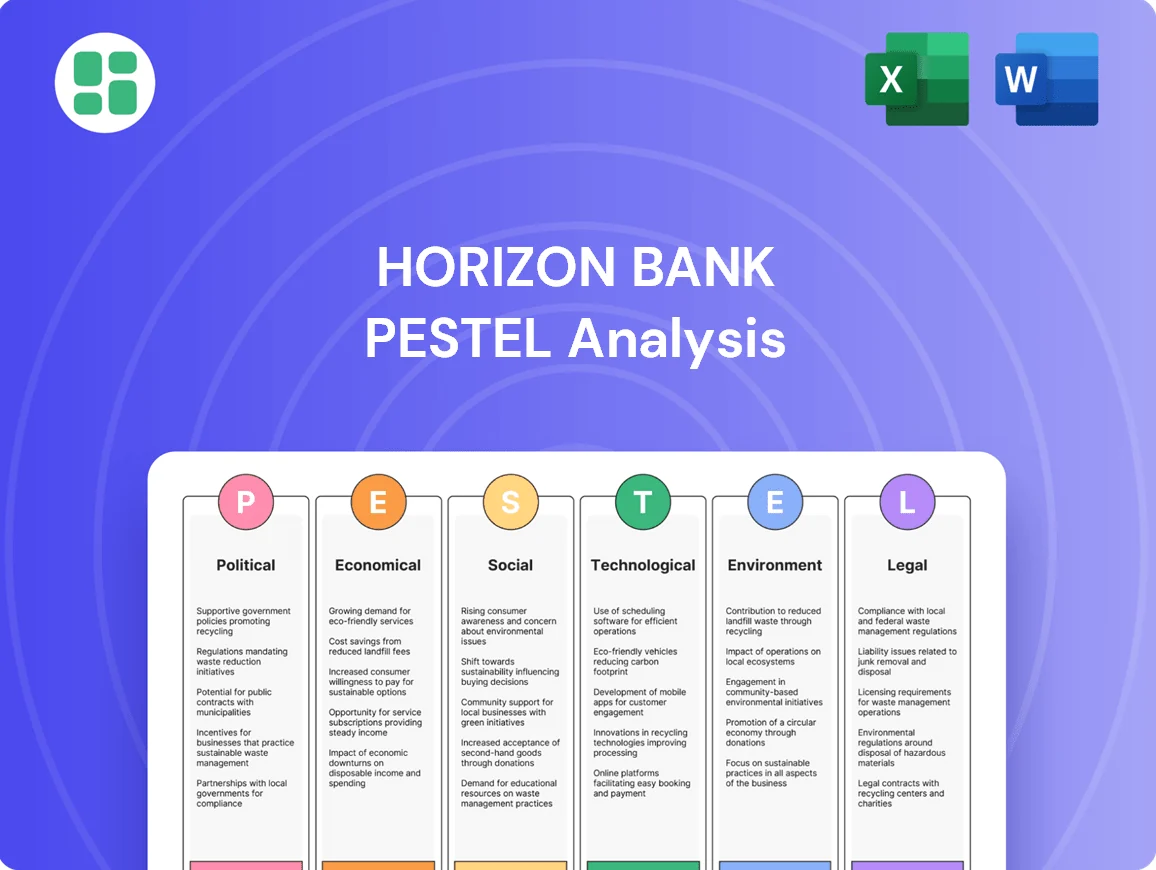
The preview shown here is the exact document you’ll receive after purchase—fully formatted and ready to use. This comprehensive Horizon Bank PESTLE Analysis delves into the Political, Economic, Social, Technological, Legal, and Environmental factors impacting the institution. You'll gain actionable insights to inform strategic decision-making.

Product Information
Product Information
Shipping & Returns
Shipping & Returns
Horizon Bank PESTLE Analysis
Horizon Bank PESTLE Analysis
Your Shortcut to Market Insight Starts Here
Uncover the critical political, economic, social, technological, legal, and environmental factors shaping Horizon Bank's strategic landscape. Our expert-crafted PESTLE analysis provides actionable intelligence to anticipate market shifts and identify growth opportunities. Don't just react to change—lead it. Download the full PESTLE analysis now and gain the competitive edge you need.
Political factors
Government Regulatory Stance
The current political climate, particularly the stance of the US administration towards financial institutions, directly shapes Horizon Bank's regulatory landscape. For instance, the Federal Reserve's monetary policy decisions, influenced by political priorities, impact interest rates and credit availability, affecting Horizon Bank's profitability. As of late 2024, discussions around potential regulatory adjustments following the 2023 regional banking stress events are ongoing, suggesting a continued focus on capital adequacy and liquidity.
Monetary Policy Direction
Central bank decisions, like those from the Federal Reserve, significantly impact Horizon Bank's bottom line. For instance, the Fed's September 2024 decision to hold interest rates steady at 5.25%-5.50% influences borrowing costs and deposit yields for banks.
A hawkish stance, characterized by rising interest rates, can boost net interest margins by increasing lending revenue faster than deposit costs. Conversely, a dovish policy, with lower rates, might compress margins but could stimulate loan demand, impacting Horizon Bank's overall loan portfolio performance.
Geopolitical Stability and Trade Relations
Global geopolitical tensions, such as ongoing conflicts and evolving trade agreements, directly influence investor sentiment and economic stability. For instance, the International Monetary Fund (IMF) projected global growth to be 3.2% in 2024, a figure susceptible to geopolitical shocks that could dampen international trade and capital flows, thereby affecting Horizon Bank's clients and investment portfolios.
Shifts in international trade policies, including tariff adjustments or the formation of new trade blocs, can significantly impact the profitability and operational capacity of Horizon Bank's corporate clients. A slowdown in global trade, as evidenced by the World Trade Organization's (WTO) forecast of a mere 2.6% growth in merchandise trade volume for 2024, could lead to reduced demand for business loans and increased credit risk for the bank.
Fiscal Policy and Government Spending
Government fiscal policies, such as changes in tax rates and levels of government spending, significantly shape the economic landscape. For instance, the US federal budget deficit was projected to reach $1.9 trillion in fiscal year 2024, a substantial figure that can influence interest rates and overall economic stability. These policies directly impact Horizon Bank by affecting the disposable income of its customers and the financial health of businesses, which in turn influences loan demand and repayment capacity.
Infrastructure spending, a key component of fiscal policy, can stimulate economic activity and create opportunities for businesses. If Horizon Bank operates in regions benefiting from increased infrastructure investment, it could see higher demand for commercial loans and improved business performance among its clients. Conversely, rising budget deficits could lead to tighter monetary policy and potentially slower economic growth, impacting the bank's lending and deposit strategies.
- Tax Reforms: Changes in corporate or individual income taxes can alter disposable income and business profitability, affecting loan demand and deposit levels for Horizon Bank.
- Government Spending: Increased public investment in areas like infrastructure can boost local economies, potentially improving loan performance and creating new business opportunities for the bank.
- Budget Deficits: Persistent government deficits might lead to higher interest rates or inflation, impacting the cost of funds for Horizon Bank and the borrowing capacity of its customers.
Consumer Protection and Data Privacy Regulations
Political forces are increasingly shaping consumer protection and data privacy. We're seeing a trend towards stronger regulations, with potential federal laws mirroring existing state-level privacy acts. This means Horizon Bank needs to stay agile, constantly updating its data handling, cybersecurity, and fair lending practices to meet these evolving demands. Such compliance often requires substantial investment in new technology and employee training.
The financial sector is particularly sensitive to these regulatory shifts. For instance, the U.S. saw a significant increase in data privacy legislation proposals at the state level leading up to 2024. Horizon Bank's ability to adapt proactively to these changes will be crucial for maintaining customer trust and avoiding penalties.
- Increased Compliance Costs: Adapting to new data privacy laws can lead to higher operational expenses for Horizon Bank due to technology upgrades and staff training.
- Enhanced Customer Trust: Strong data protection measures can bolster customer confidence, a key competitive differentiator in the banking sector.
- Potential for Fines: Non-compliance with consumer protection and data privacy regulations can result in significant financial penalties.
- Reputational Risk: Data breaches or unfair lending practices can severely damage Horizon Bank's reputation, impacting its market position.
Political Forces Shaping Banking Profitability
Government policy significantly influences Horizon Bank's operating environment. For example, the US Federal Reserve's monetary policy, such as the September 2024 decision to maintain the federal funds rate between 5.25%-5.50%, directly impacts lending rates and profitability. Ongoing discussions about potential regulatory adjustments following 2023 banking stress events underscore a continued focus on capital adequacy and liquidity for institutions like Horizon Bank.
Global economic stability, often shaped by geopolitical events and trade policies, affects Horizon Bank's international operations and client portfolios. The International Monetary Fund projected 3.2% global growth for 2024, a figure vulnerable to shocks that could disrupt trade and capital flows. Similarly, the World Trade Organization forecast a modest 2.6% growth in merchandise trade for 2024, potentially impacting corporate clients' demand for loans and increasing credit risk.
Fiscal policies, including tax rates and government spending, also play a crucial role. The projected US federal budget deficit of $1.9 trillion for fiscal year 2024 could influence interest rates and economic stability, affecting customer borrowing capacity and loan demand for Horizon Bank.
| Political Factor | Impact on Horizon Bank | Supporting Data/Trend |
| Monetary Policy (Interest Rates) | Affects net interest margins, loan demand, and borrowing costs. | Federal Reserve target rate: 5.25%-5.50% (as of Sept 2024). |
| Regulatory Environment | Shapes capital requirements, liquidity, and compliance costs. | Ongoing review of regulations post-2023 regional banking stress. |
| Trade Policies | Influences international business operations and client credit risk. | WTO forecast: 2.6% merchandise trade volume growth for 2024. |
| Fiscal Policy (Budget Deficits) | Impacts economic stability, interest rates, and customer financial health. | Projected US federal budget deficit: $1.9 trillion for FY 2024. |
What is included in the product
Detailed Word Document
This PESTLE analysis meticulously examines the Political, Economic, Social, Technological, Environmental, and Legal forces impacting Horizon Bank, offering a comprehensive view of its external operating landscape.
Customizable Excel Spreadsheet
Horizon Bank's PESTLE analysis provides a clear, summarized version of external factors for easy referencing during meetings, alleviating the pain point of sifting through dense reports.
Visually segmented by PESTEL categories, Horizon Bank's analysis allows for quick interpretation at a glance, relieving the pressure of understanding complex market dynamics.
Economic factors
Interest Rate Environment
The current interest rate environment is a significant factor for Horizon Bank. As of late 2024, the Federal Reserve has maintained a relatively high federal funds rate, aiming to curb inflation. This directly impacts Horizon Bank's net interest margin, as the cost of attracting deposits increases while loan demand might soften.
Projections for 2025 suggest a potential stabilization or even a slight decrease in interest rates, depending on economic performance and inflation trends. For Horizon Bank, this means carefully managing its asset-liability structure to capitalize on any shifts. A declining rate environment could boost loan origination but compress margins on existing variable-rate assets.
The bank's profitability hinges on its ability to accurately forecast these rate movements and adjust its lending and investment strategies accordingly. For instance, if rates are expected to fall, Horizon Bank might prioritize locking in longer-term fixed-rate loans to secure future revenue streams.
Inflationary Pressures and Consumer Purchasing Power
Inflation significantly impacts how much consumers and businesses can buy, affecting their capacity to save, take out loans, and pay them back. For Horizon Bank, sustained high inflation can diminish the actual worth of customer deposits and possibly lead to more loan defaults. It also drives up the bank's operating expenses for employee compensation and technology upgrades.
Regional Economic Growth and Employment Rates
Horizon Bank's performance is intrinsically linked to the economic vitality of its key operating areas. For instance, in the Midwest, where Horizon Bank has a significant presence, the unemployment rate stood at a robust 3.5% in April 2024, indicating a healthy job market. This strong employment environment typically fuels consumer confidence and business expansion, driving demand for banking services.
Regions experiencing higher GDP growth tend to see increased activity in commercial lending and a greater volume of transactions, which are crucial for Horizon Bank's revenue streams. As of Q1 2024, several Midwestern states reported GDP growth exceeding the national average, suggesting a favorable climate for business investment and, consequently, for the bank's lending portfolios.
Low unemployment rates directly translate into improved loan repayment performance for Horizon Bank. When individuals and businesses are employed and earning, they are better positioned to meet their financial obligations, reducing the bank's exposure to non-performing loans and bolstering its overall financial stability.
Consumer and Business Spending Trends
Consumer confidence remains a key indicator for Horizon Bank, directly affecting demand for mortgages and personal loans. In early 2024, the Conference Board Consumer Confidence Index showed a slight uptick, suggesting a cautious but generally positive outlook, though inflation concerns persist.
Business spending patterns are equally crucial, influencing demand for commercial loans and lines of credit. Many businesses, anticipating continued economic growth in 2024, have signaled intentions to increase capital expenditures, particularly in technology and infrastructure, which bodes well for commercial banking services.
- Consumer Confidence: The Conference Board's Consumer Confidence Index stood at 104.7 in March 2024, indicating a slight improvement but still reflecting economic uncertainties.
- Business Investment: Projections for 2024 suggest a potential 5-7% increase in business investment across various sectors, driven by technological advancements and reshoring efforts.
- Loan Demand: Mortgage applications saw a modest increase in early 2024, while commercial loan demand remained robust, particularly from small and medium-sized enterprises seeking expansion capital.
- Savings Rates: While consumer spending shows signs of recovery, personal savings rates in the US have remained elevated compared to pre-pandemic levels, suggesting a preference for financial prudence.
Real Estate Market Dynamics
The real estate market's health is paramount for Horizon Bank, given its significant exposure to mortgage and commercial property loans. Fluctuations in housing prices and commercial property values directly affect the bank's loan portfolio quality and its capacity for new lending. For instance, the U.S. median home price saw a notable increase, reaching approximately $412,200 in Q1 2024, according to the National Association of Realtors, indicating a generally robust market, though regional variations exist.
Construction activity also plays a crucial role, influencing economic growth and demand for commercial lending. In 2023, U.S. housing starts totaled around 1.56 million units, a slight decrease from the previous year but still reflecting ongoing development. This level of activity impacts Horizon Bank's commercial real estate lending opportunities and the overall risk profile of its assets.
- Housing Price Trends: Continued appreciation in median home prices, such as the Q1 2024 figure of $412,200, supports existing mortgage values and borrower equity.
- Commercial Property Values: Stability or growth in commercial property valuations is essential for Horizon Bank's commercial lending segment, impacting collateral and loan performance.
- Construction Activity: The pace of new construction, with approximately 1.56 million housing starts in 2023, signals opportunities for construction financing and impacts the broader economic environment.
- Interest Rate Sensitivity: The real estate market is highly sensitive to interest rates, which directly influence mortgage affordability and borrowing costs for commercial developers.
Economic Shifts: Navigating Rates, Inflation, and Growth for Banking Success
Economic factors significantly shape Horizon Bank's operational landscape. The prevailing interest rate environment, with the Federal Reserve maintaining higher rates through late 2024 to combat inflation, directly impacts the bank's net interest margins and loan demand. Projections for 2025 suggest potential rate stabilization or a slight decrease, necessitating strategic asset-liability management.
Inflation's persistent presence erodes the real value of deposits and can increase loan default risks for Horizon Bank, while also escalating operational costs. Conversely, robust economic growth in key operating regions, evidenced by strong GDP growth in several Midwestern states in Q1 2024 and a 3.5% unemployment rate in April 2024, fuels demand for banking services and improves loan repayment performance.
Consumer and business confidence levels are critical. The Conference Board's Consumer Confidence Index showed a slight uptick in March 2024, and businesses signaled increased capital expenditures for 2024, particularly in technology, bolstering commercial lending opportunities for Horizon Bank.
The real estate market's health, with median home prices reaching approximately $412,200 in Q1 2024, directly influences Horizon Bank's mortgage and commercial property loan portfolios. Despite a slight dip in housing starts to around 1.56 million units in 2023, ongoing development presents lending opportunities.
| Economic Indicator | Value/Trend | Impact on Horizon Bank |
|---|---|---|
| Federal Funds Rate (Late 2024) | Relatively High | Pressures Net Interest Margin, Potentially Softens Loan Demand |
| Projected Interest Rates (2025) | Stabilization/Slight Decrease | Opportunity for Loan Origination, Margin Compression on Variable Assets |
| US Unemployment Rate (April 2024) | 3.5% (Midwest) | Supports Loan Repayment, Reduces Non-Performing Loans |
| US Median Home Price (Q1 2024) | ~$412,200 | Bolsters Mortgage Portfolio Value, Borrower Equity |
| US Housing Starts (2023) | ~1.56 Million Units | Indicates Construction Lending Opportunities, Broader Economic Activity |
Full Version Awaits
Horizon Bank PESTLE Analysis
The preview shown here is the exact document you’ll receive after purchase—fully formatted and ready to use. This comprehensive Horizon Bank PESTLE Analysis delves into the Political, Economic, Social, Technological, Legal, and Environmental factors impacting the institution. You'll gain actionable insights to inform strategic decision-making.
Original: $10.00
-65%$10.00
$3.50Product Information
Product Information
Shipping & Returns
Shipping & Returns
Description
Your Shortcut to Market Insight Starts Here
Uncover the critical political, economic, social, technological, legal, and environmental factors shaping Horizon Bank's strategic landscape. Our expert-crafted PESTLE analysis provides actionable intelligence to anticipate market shifts and identify growth opportunities. Don't just react to change—lead it. Download the full PESTLE analysis now and gain the competitive edge you need.
Political factors
Government Regulatory Stance
The current political climate, particularly the stance of the US administration towards financial institutions, directly shapes Horizon Bank's regulatory landscape. For instance, the Federal Reserve's monetary policy decisions, influenced by political priorities, impact interest rates and credit availability, affecting Horizon Bank's profitability. As of late 2024, discussions around potential regulatory adjustments following the 2023 regional banking stress events are ongoing, suggesting a continued focus on capital adequacy and liquidity.
Monetary Policy Direction
Central bank decisions, like those from the Federal Reserve, significantly impact Horizon Bank's bottom line. For instance, the Fed's September 2024 decision to hold interest rates steady at 5.25%-5.50% influences borrowing costs and deposit yields for banks.
A hawkish stance, characterized by rising interest rates, can boost net interest margins by increasing lending revenue faster than deposit costs. Conversely, a dovish policy, with lower rates, might compress margins but could stimulate loan demand, impacting Horizon Bank's overall loan portfolio performance.
Geopolitical Stability and Trade Relations
Global geopolitical tensions, such as ongoing conflicts and evolving trade agreements, directly influence investor sentiment and economic stability. For instance, the International Monetary Fund (IMF) projected global growth to be 3.2% in 2024, a figure susceptible to geopolitical shocks that could dampen international trade and capital flows, thereby affecting Horizon Bank's clients and investment portfolios.
Shifts in international trade policies, including tariff adjustments or the formation of new trade blocs, can significantly impact the profitability and operational capacity of Horizon Bank's corporate clients. A slowdown in global trade, as evidenced by the World Trade Organization's (WTO) forecast of a mere 2.6% growth in merchandise trade volume for 2024, could lead to reduced demand for business loans and increased credit risk for the bank.
Fiscal Policy and Government Spending
Government fiscal policies, such as changes in tax rates and levels of government spending, significantly shape the economic landscape. For instance, the US federal budget deficit was projected to reach $1.9 trillion in fiscal year 2024, a substantial figure that can influence interest rates and overall economic stability. These policies directly impact Horizon Bank by affecting the disposable income of its customers and the financial health of businesses, which in turn influences loan demand and repayment capacity.
Infrastructure spending, a key component of fiscal policy, can stimulate economic activity and create opportunities for businesses. If Horizon Bank operates in regions benefiting from increased infrastructure investment, it could see higher demand for commercial loans and improved business performance among its clients. Conversely, rising budget deficits could lead to tighter monetary policy and potentially slower economic growth, impacting the bank's lending and deposit strategies.
- Tax Reforms: Changes in corporate or individual income taxes can alter disposable income and business profitability, affecting loan demand and deposit levels for Horizon Bank.
- Government Spending: Increased public investment in areas like infrastructure can boost local economies, potentially improving loan performance and creating new business opportunities for the bank.
- Budget Deficits: Persistent government deficits might lead to higher interest rates or inflation, impacting the cost of funds for Horizon Bank and the borrowing capacity of its customers.
Consumer Protection and Data Privacy Regulations
Political forces are increasingly shaping consumer protection and data privacy. We're seeing a trend towards stronger regulations, with potential federal laws mirroring existing state-level privacy acts. This means Horizon Bank needs to stay agile, constantly updating its data handling, cybersecurity, and fair lending practices to meet these evolving demands. Such compliance often requires substantial investment in new technology and employee training.
The financial sector is particularly sensitive to these regulatory shifts. For instance, the U.S. saw a significant increase in data privacy legislation proposals at the state level leading up to 2024. Horizon Bank's ability to adapt proactively to these changes will be crucial for maintaining customer trust and avoiding penalties.
- Increased Compliance Costs: Adapting to new data privacy laws can lead to higher operational expenses for Horizon Bank due to technology upgrades and staff training.
- Enhanced Customer Trust: Strong data protection measures can bolster customer confidence, a key competitive differentiator in the banking sector.
- Potential for Fines: Non-compliance with consumer protection and data privacy regulations can result in significant financial penalties.
- Reputational Risk: Data breaches or unfair lending practices can severely damage Horizon Bank's reputation, impacting its market position.
Political Forces Shaping Banking Profitability
Government policy significantly influences Horizon Bank's operating environment. For example, the US Federal Reserve's monetary policy, such as the September 2024 decision to maintain the federal funds rate between 5.25%-5.50%, directly impacts lending rates and profitability. Ongoing discussions about potential regulatory adjustments following 2023 banking stress events underscore a continued focus on capital adequacy and liquidity for institutions like Horizon Bank.
Global economic stability, often shaped by geopolitical events and trade policies, affects Horizon Bank's international operations and client portfolios. The International Monetary Fund projected 3.2% global growth for 2024, a figure vulnerable to shocks that could disrupt trade and capital flows. Similarly, the World Trade Organization forecast a modest 2.6% growth in merchandise trade for 2024, potentially impacting corporate clients' demand for loans and increasing credit risk.
Fiscal policies, including tax rates and government spending, also play a crucial role. The projected US federal budget deficit of $1.9 trillion for fiscal year 2024 could influence interest rates and economic stability, affecting customer borrowing capacity and loan demand for Horizon Bank.
| Political Factor | Impact on Horizon Bank | Supporting Data/Trend |
| Monetary Policy (Interest Rates) | Affects net interest margins, loan demand, and borrowing costs. | Federal Reserve target rate: 5.25%-5.50% (as of Sept 2024). |
| Regulatory Environment | Shapes capital requirements, liquidity, and compliance costs. | Ongoing review of regulations post-2023 regional banking stress. |
| Trade Policies | Influences international business operations and client credit risk. | WTO forecast: 2.6% merchandise trade volume growth for 2024. |
| Fiscal Policy (Budget Deficits) | Impacts economic stability, interest rates, and customer financial health. | Projected US federal budget deficit: $1.9 trillion for FY 2024. |
What is included in the product
Detailed Word Document
This PESTLE analysis meticulously examines the Political, Economic, Social, Technological, Environmental, and Legal forces impacting Horizon Bank, offering a comprehensive view of its external operating landscape.
Customizable Excel Spreadsheet
Horizon Bank's PESTLE analysis provides a clear, summarized version of external factors for easy referencing during meetings, alleviating the pain point of sifting through dense reports.
Visually segmented by PESTEL categories, Horizon Bank's analysis allows for quick interpretation at a glance, relieving the pressure of understanding complex market dynamics.
Economic factors
Interest Rate Environment
The current interest rate environment is a significant factor for Horizon Bank. As of late 2024, the Federal Reserve has maintained a relatively high federal funds rate, aiming to curb inflation. This directly impacts Horizon Bank's net interest margin, as the cost of attracting deposits increases while loan demand might soften.
Projections for 2025 suggest a potential stabilization or even a slight decrease in interest rates, depending on economic performance and inflation trends. For Horizon Bank, this means carefully managing its asset-liability structure to capitalize on any shifts. A declining rate environment could boost loan origination but compress margins on existing variable-rate assets.
The bank's profitability hinges on its ability to accurately forecast these rate movements and adjust its lending and investment strategies accordingly. For instance, if rates are expected to fall, Horizon Bank might prioritize locking in longer-term fixed-rate loans to secure future revenue streams.
Inflationary Pressures and Consumer Purchasing Power
Inflation significantly impacts how much consumers and businesses can buy, affecting their capacity to save, take out loans, and pay them back. For Horizon Bank, sustained high inflation can diminish the actual worth of customer deposits and possibly lead to more loan defaults. It also drives up the bank's operating expenses for employee compensation and technology upgrades.
Regional Economic Growth and Employment Rates
Horizon Bank's performance is intrinsically linked to the economic vitality of its key operating areas. For instance, in the Midwest, where Horizon Bank has a significant presence, the unemployment rate stood at a robust 3.5% in April 2024, indicating a healthy job market. This strong employment environment typically fuels consumer confidence and business expansion, driving demand for banking services.
Regions experiencing higher GDP growth tend to see increased activity in commercial lending and a greater volume of transactions, which are crucial for Horizon Bank's revenue streams. As of Q1 2024, several Midwestern states reported GDP growth exceeding the national average, suggesting a favorable climate for business investment and, consequently, for the bank's lending portfolios.
Low unemployment rates directly translate into improved loan repayment performance for Horizon Bank. When individuals and businesses are employed and earning, they are better positioned to meet their financial obligations, reducing the bank's exposure to non-performing loans and bolstering its overall financial stability.
Consumer and Business Spending Trends
Consumer confidence remains a key indicator for Horizon Bank, directly affecting demand for mortgages and personal loans. In early 2024, the Conference Board Consumer Confidence Index showed a slight uptick, suggesting a cautious but generally positive outlook, though inflation concerns persist.
Business spending patterns are equally crucial, influencing demand for commercial loans and lines of credit. Many businesses, anticipating continued economic growth in 2024, have signaled intentions to increase capital expenditures, particularly in technology and infrastructure, which bodes well for commercial banking services.
- Consumer Confidence: The Conference Board's Consumer Confidence Index stood at 104.7 in March 2024, indicating a slight improvement but still reflecting economic uncertainties.
- Business Investment: Projections for 2024 suggest a potential 5-7% increase in business investment across various sectors, driven by technological advancements and reshoring efforts.
- Loan Demand: Mortgage applications saw a modest increase in early 2024, while commercial loan demand remained robust, particularly from small and medium-sized enterprises seeking expansion capital.
- Savings Rates: While consumer spending shows signs of recovery, personal savings rates in the US have remained elevated compared to pre-pandemic levels, suggesting a preference for financial prudence.
Real Estate Market Dynamics
The real estate market's health is paramount for Horizon Bank, given its significant exposure to mortgage and commercial property loans. Fluctuations in housing prices and commercial property values directly affect the bank's loan portfolio quality and its capacity for new lending. For instance, the U.S. median home price saw a notable increase, reaching approximately $412,200 in Q1 2024, according to the National Association of Realtors, indicating a generally robust market, though regional variations exist.
Construction activity also plays a crucial role, influencing economic growth and demand for commercial lending. In 2023, U.S. housing starts totaled around 1.56 million units, a slight decrease from the previous year but still reflecting ongoing development. This level of activity impacts Horizon Bank's commercial real estate lending opportunities and the overall risk profile of its assets.
- Housing Price Trends: Continued appreciation in median home prices, such as the Q1 2024 figure of $412,200, supports existing mortgage values and borrower equity.
- Commercial Property Values: Stability or growth in commercial property valuations is essential for Horizon Bank's commercial lending segment, impacting collateral and loan performance.
- Construction Activity: The pace of new construction, with approximately 1.56 million housing starts in 2023, signals opportunities for construction financing and impacts the broader economic environment.
- Interest Rate Sensitivity: The real estate market is highly sensitive to interest rates, which directly influence mortgage affordability and borrowing costs for commercial developers.
Economic Shifts: Navigating Rates, Inflation, and Growth for Banking Success
Economic factors significantly shape Horizon Bank's operational landscape. The prevailing interest rate environment, with the Federal Reserve maintaining higher rates through late 2024 to combat inflation, directly impacts the bank's net interest margins and loan demand. Projections for 2025 suggest potential rate stabilization or a slight decrease, necessitating strategic asset-liability management.
Inflation's persistent presence erodes the real value of deposits and can increase loan default risks for Horizon Bank, while also escalating operational costs. Conversely, robust economic growth in key operating regions, evidenced by strong GDP growth in several Midwestern states in Q1 2024 and a 3.5% unemployment rate in April 2024, fuels demand for banking services and improves loan repayment performance.
Consumer and business confidence levels are critical. The Conference Board's Consumer Confidence Index showed a slight uptick in March 2024, and businesses signaled increased capital expenditures for 2024, particularly in technology, bolstering commercial lending opportunities for Horizon Bank.
The real estate market's health, with median home prices reaching approximately $412,200 in Q1 2024, directly influences Horizon Bank's mortgage and commercial property loan portfolios. Despite a slight dip in housing starts to around 1.56 million units in 2023, ongoing development presents lending opportunities.
| Economic Indicator | Value/Trend | Impact on Horizon Bank |
|---|---|---|
| Federal Funds Rate (Late 2024) | Relatively High | Pressures Net Interest Margin, Potentially Softens Loan Demand |
| Projected Interest Rates (2025) | Stabilization/Slight Decrease | Opportunity for Loan Origination, Margin Compression on Variable Assets |
| US Unemployment Rate (April 2024) | 3.5% (Midwest) | Supports Loan Repayment, Reduces Non-Performing Loans |
| US Median Home Price (Q1 2024) | ~$412,200 | Bolsters Mortgage Portfolio Value, Borrower Equity |
| US Housing Starts (2023) | ~1.56 Million Units | Indicates Construction Lending Opportunities, Broader Economic Activity |
Full Version Awaits
Horizon Bank PESTLE Analysis
The preview shown here is the exact document you’ll receive after purchase—fully formatted and ready to use. This comprehensive Horizon Bank PESTLE Analysis delves into the Political, Economic, Social, Technological, Legal, and Environmental factors impacting the institution. You'll gain actionable insights to inform strategic decision-making.











