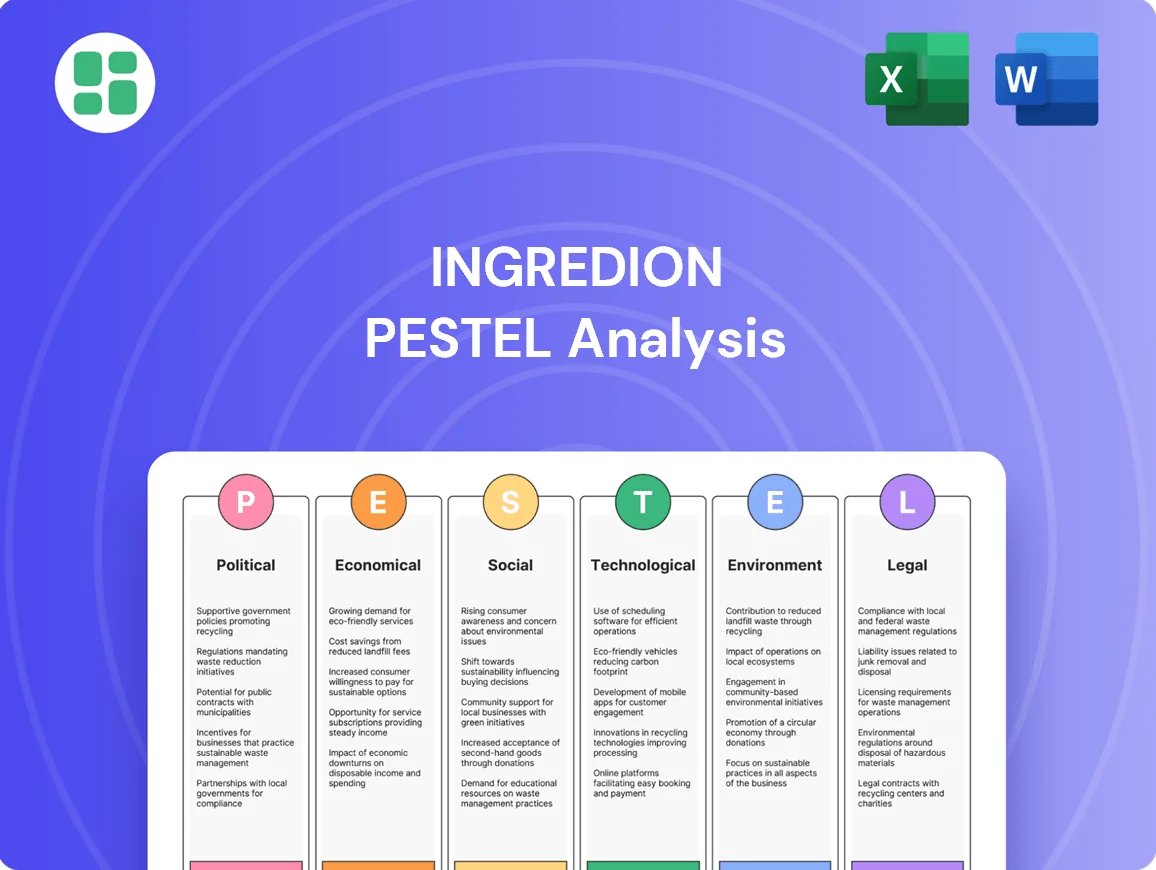
Grupo Nutresa PESTLE Analysis

Plan Smarter. Present Sharper. Compete Stronger.
Grupo Nutresa operates within a dynamic global landscape, influenced by evolving political stability, economic fluctuations, and significant technological advancements. Understanding these external forces is crucial for anticipating market shifts and identifying strategic opportunities.
Our comprehensive PESTLE analysis delves deep into how these factors, along with social trends, environmental regulations, and legal frameworks, are shaping Grupo Nutresa's operations and future trajectory. Gain a competitive edge by leveraging these expert insights.
Don't miss out on actionable intelligence. Download the full PESTLE analysis of Grupo Nutresa now to empower your strategic planning and investment decisions.
Political factors

Government Stability and Policy Environment
Grupo Nutresa's operations are heavily influenced by the political stability of its core markets, particularly Colombia and other Latin American nations. Political shifts can alter regulatory frameworks and economic policies, directly impacting the food processing industry.
Government policies concerning trade agreements, agricultural subsidies, and foreign direct investment are critical for Grupo Nutresa's growth and operational efficiency. Favorable policies can unlock new market opportunities and reduce operational costs.
Colombia's government has historically shown support for the food processing sector, which has been a positive driver for companies like Grupo Nutresa. For instance, initiatives aimed at boosting agricultural productivity and food export competitiveness, such as those seen in recent years, directly benefit the sector's expansion and investment climate.
Trade Agreements and Regional Integration
Grupo Nutresa's significant operations across the Andean region, Central America, and the Caribbean make it highly sensitive to regional trade pacts such as MERCOSUR. These agreements are crucial as they streamline cross-border product flow, lower import duties, and harmonize trade regulations, ultimately improving market entry and streamlining supply chains.
For instance, the Pacific Alliance, which includes Colombia, Peru, Chile, and Mexico, has worked to reduce tariffs on many goods traded between member countries, directly benefiting companies like Grupo Nutresa by lowering costs for imported ingredients and exported finished products. This bloc’s continued efforts towards economic integration in 2024 and 2025 are expected to further enhance these advantages.

Food Safety and Labeling Regulations
Governments across Latin America are tightening food safety and nutritional labeling rules, impacting companies like Grupo Nutresa. For instance, countries like Colombia, Mexico, and Chile are adopting front-of-pack warning labels for products high in sugar, sodium, or saturated fats.
These evolving regulations require significant adjustments, including product reformulation and packaging redesigns. This push towards transparency aims to guide consumers toward healthier food choices, a trend Grupo Nutresa must navigate to maintain market relevance and consumer trust.

Government Collaboration on Sustainability Initiatives
Grupo Nutresa actively partners with the Colombian government on various sustainability initiatives, notably in strengthening the cocoa value chain. For instance, their involvement includes establishing cocoa nurseries, a key component in improving agricultural productivity and quality. These collaborations are crucial as they often unlock access to government grants, tax benefits, and favorable regulatory frameworks, directly supporting Nutresa's operational efficiency and market competitiveness. Such alignment with national development agendas also significantly bolsters the company's public image and social license to operate.
These government collaborations provide tangible benefits that directly impact Grupo Nutresa's performance. For example, by participating in programs aimed at improving the cocoa sector, the company can secure more stable and higher-quality raw material supply, reducing input costs and price volatility. Furthermore, the positive association with government-backed sustainability projects can enhance brand loyalty among consumers who increasingly prioritize ethical and environmentally conscious brands. In 2023, Colombian agricultural exports, including cocoa, saw significant growth, underscoring the potential for companies like Nutresa to leverage these partnerships for expanded market reach and profitability.
- Government Support: Partnerships provide access to financial incentives and regulatory advantages, reducing operational costs and easing market entry for sustainable products.
- Supply Chain Resilience: Investments in agricultural programs, like cocoa nurseries, ensure a more stable and higher-quality supply of raw materials, mitigating risks for Nutresa.
- Enhanced Reputation: Aligning with national sustainability goals and government-backed initiatives improves public perception and brand image, appealing to socially conscious consumers.
- Market Access: Collaborative efforts can open doors to new markets or strengthen existing ones by meeting international sustainability standards often supported by government trade agreements.
Political Interventions in Market Dynamics
Political decisions significantly shape the operating environment for companies like Grupo Nutresa. For instance, government policies on price controls or subsidies directly influence the cost of raw materials and the final pricing of consumer goods, impacting profit margins. In 2024, several Latin American countries experienced persistent inflation, prompting governments to consider or implement measures that could affect food and beverage sectors, including potential price adjustments or consumer support programs.
Import and export restrictions, often enacted for protectionist reasons or to manage trade balances, can disrupt supply chains and affect the availability and cost of key ingredients for Grupo Nutresa. For example, tariffs or quotas on agricultural products could increase production costs. The ongoing trade negotiations and geopolitical shifts in 2024-2025 may introduce new regulatory landscapes for international trade, requiring agile adaptation from multinational food producers.
Economic crises or periods of high inflation can lead to increased political intervention. Governments might introduce measures to protect consumers, such as temporary price caps on essential food items, which can squeeze manufacturer profitability. This was observed in various emerging markets during 2024, where governments grappled with rising food prices, potentially impacting companies with significant operations in those regions.
- Price Controls: Governments may implement price ceilings on essential food items, directly affecting Grupo Nutresa's revenue and profit potential.
- Subsidies: Subsidies on agricultural inputs could lower production costs, while consumer subsidies might boost demand for processed foods.
- Trade Restrictions: Tariffs or quotas on imported ingredients or finished goods can alter supply chain costs and market access for Grupo Nutresa.
- Inflationary Pressures: Rising inflation in key markets can lead to government interventions aimed at stabilizing prices, potentially impacting company margins.
Government Policies: Shaping Business in Latin America
Political stability remains a paramount concern for Grupo Nutresa, influencing its operational landscape across Latin America. Government policies regarding trade, agricultural support, and foreign investment directly shape the company's growth trajectory and efficiency. For instance, favorable trade pacts like the Pacific Alliance, which continued to foster economic integration in 2024 and 2025, streamline cross-border transactions, reducing costs for both imported ingredients and exported finished goods.
Regulatory shifts, particularly concerning food safety and nutritional labeling, necessitate ongoing adaptation. Many Latin American nations, including Colombia, Mexico, and Chile, have implemented front-of-pack warning labels on products high in sugar, sodium, or saturated fats, compelling companies like Grupo Nutresa to reformulate products and redesign packaging to align with evolving consumer health consciousness and governmental directives.
Grupo Nutresa's engagement with government sustainability initiatives, such as strengthening the cocoa value chain through partnerships for cocoa nurseries, yields tangible benefits. These collaborations can unlock access to grants and tax incentives, thereby enhancing operational efficiency and market competitiveness. Such alignment with national development agendas also bolsters the company's public image and social license to operate, a factor increasingly valued by consumers and investors alike.
Government interventions, driven by economic fluctuations like inflation, can significantly impact pricing strategies and profit margins. In 2024, persistent inflation in several Latin American markets led to governmental considerations of measures like temporary price caps on essential food items, posing potential challenges to profitability for companies operating in these regions.
What is included in the product
 Detailed Word Document
This PESTLE analysis examines the external macro-environmental forces impacting Grupo Nutresa, covering Political, Economic, Social, Technological, Environmental, and Legal factors, providing a comprehensive overview of its operating landscape.

 Customizable Excel Spreadsheet
This PESTLE analysis for Grupo Nutresa offers a streamlined, actionable framework, serving as a pain point reliver by simplifying complex external factors into easily digestible insights for strategic decision-making.
Economic factors

Inflation and Currency Fluctuations
Inflationary pressures, especially on food and energy, are a significant concern for Grupo Nutresa. For instance, Colombia's inflation rate hovered around 4.32% in April 2024, a slight decrease from previous months but still impacting consumer spending and input costs. This can directly affect the company's profitability by increasing the cost of raw materials and potentially reducing consumer demand for its products.
Currency fluctuations, particularly the Colombian Peso (COP) against the US Dollar (USD), present another challenge. A weaker COP, which has seen fluctuations throughout 2024, makes imported raw materials more expensive for Grupo Nutresa. Conversely, it can make the company's exports more competitive, but the net effect depends on the balance of imports and exports and the company's hedging strategies.
Consumer Purchasing Power and Disposable Income
The economic vitality of Latin America, marked by GDP expansion and job growth, directly impacts consumer spending on processed foods. For instance, in 2024, several Latin American economies, including Mexico and Colombia, are projected to see GDP growth above 2%, fostering an environment where consumers are more likely to spend on packaged goods.
A growing middle class with increasing disposable income is a key driver for demand in the processed food sector. As more households move into this demographic, they tend to favor convenient, ready-to-eat, and packaged food options, which Grupo Nutresa is well-positioned to supply.

Regional Economic Growth and Market Potential
The Latin American processed food market is showing robust expansion, with Colombia expected to see a compound annual growth rate of 6.4% between 2024 and 2030. This presents a substantial opportunity for Grupo Nutresa to leverage its established presence.
Grupo Nutresa's diversified operations across countries like Brazil, Argentina, and Peru enable it to benefit from the distinct economic growth trajectories within the region. This broad footprint allows the company to adapt and capitalize on varying market potentials.

Commodity Price Volatility
Grupo Nutresa's reliance on key agricultural commodities such as cocoa, coffee, and sugar makes it highly susceptible to price fluctuations. For instance, the International Cocoa Organization reported that cocoa prices surged by over 200% in the first half of 2024, reaching record highs due to supply concerns in West Africa. This significant increase directly impacts Nutresa's raw material costs.
Such volatility, driven by factors like climate change affecting harvests and geopolitical tensions disrupting supply chains, can directly squeeze gross profit margins. For example, a 10% increase in the cost of a primary commodity could translate to a substantial hit on profitability if not effectively managed through hedging or price adjustments.
- Cocoa Price Surge: Cocoa prices exceeded $10,000 per metric ton in early 2024, a dramatic rise from around $3,000 per ton a year prior.
- Coffee Market Dynamics: Arabica coffee prices, a key input for Nutresa, saw significant volatility in 2024, influenced by weather patterns in Brazil and Vietnam.
- Sugar Supply Concerns: Global sugar prices remained elevated in 2024 due to lower production forecasts in India and Thailand, impacting confectionery and beverage inputs.
- Impact on Margins: Increased commodity expenses can erode gross profit margins if companies cannot pass these costs onto consumers or secure favorable long-term supply contracts.
Investment Climate and Access to Capital
Grupo Nutresa's ability to attract capital is significantly influenced by the investment climate in its operating regions and its access to global financial markets. A stable and welcoming environment for foreign investment encourages the flow of funds necessary for expansion and innovation.
The company's successful foray into international capital markets, exemplified by its first bond issuance, underscores its capacity to secure substantial funding for strategic projects. This access to diverse funding sources is crucial for pursuing ambitious growth objectives.
- Bond Issuance Success: In 2024, Grupo Nutresa successfully placed its inaugural international bond, raising $500 million.
- Investor Confidence: This issuance was oversubscribed, indicating strong investor confidence in the company's financial health and future prospects.
- Strategic Funding: The capital raised is earmarked for strategic acquisitions and operational enhancements, supporting its long-term expansion strategy.
Latin America's Economic Pulse: Growth, Inflation, and Capital
Economic stability and growth in Latin America are crucial for Grupo Nutresa's performance. While projected GDP growth for countries like Mexico and Colombia remains positive in 2024, around 2% or higher, inflationary pressures, particularly on food and energy, continue to impact consumer spending power. For instance, Colombia's inflation rate was approximately 4.32% in April 2024, a factor that can increase input costs and potentially dampen demand for processed foods.
The company's financial health is also tied to currency exchange rates, with the Colombian Peso experiencing fluctuations against major currencies like the US Dollar throughout 2024. This volatility affects the cost of imported raw materials and the competitiveness of exports. Furthermore, Grupo Nutresa's reliance on commodities like cocoa, coffee, and sugar exposes it to significant price swings, as evidenced by cocoa prices surging over 200% in early 2024, directly impacting profit margins.
Grupo Nutresa's access to capital markets remains strong, highlighted by its successful $500 million international bond issuance in 2024, which was oversubscribed. This demonstrates robust investor confidence and provides essential funding for strategic growth initiatives, including acquisitions and operational improvements, vital for navigating the dynamic economic landscape of Latin America.
| Economic Factor | 2024 Projection/Data | Impact on Grupo Nutresa |
|---|---|---|
| Latin America GDP Growth | Projected >2% for key markets (e.g., Mexico, Colombia) | Supports consumer spending on packaged goods |
| Colombia Inflation Rate | ~4.32% (April 2024) | Increases input costs, potentially reduces consumer demand |
| Cocoa Prices | Surged >200% (early 2024) | Significantly increases raw material costs, impacting margins |
| International Bond Issuance | $500 million raised (2024) | Provides capital for strategic growth and operational enhancements |
What You See Is What You Get
Grupo Nutresa PESTLE Analysis
The preview shown here is the exact document you’ll receive after purchase—fully formatted and ready to use. This comprehensive PESTLE analysis of Grupo Nutresa delves into the Political, Economic, Social, Technological, Legal, and Environmental factors influencing its operations and strategic decisions. You'll gain valuable insights into the external forces shaping the company's future.

Product Information
Product Information
Shipping & Returns
Shipping & Returns
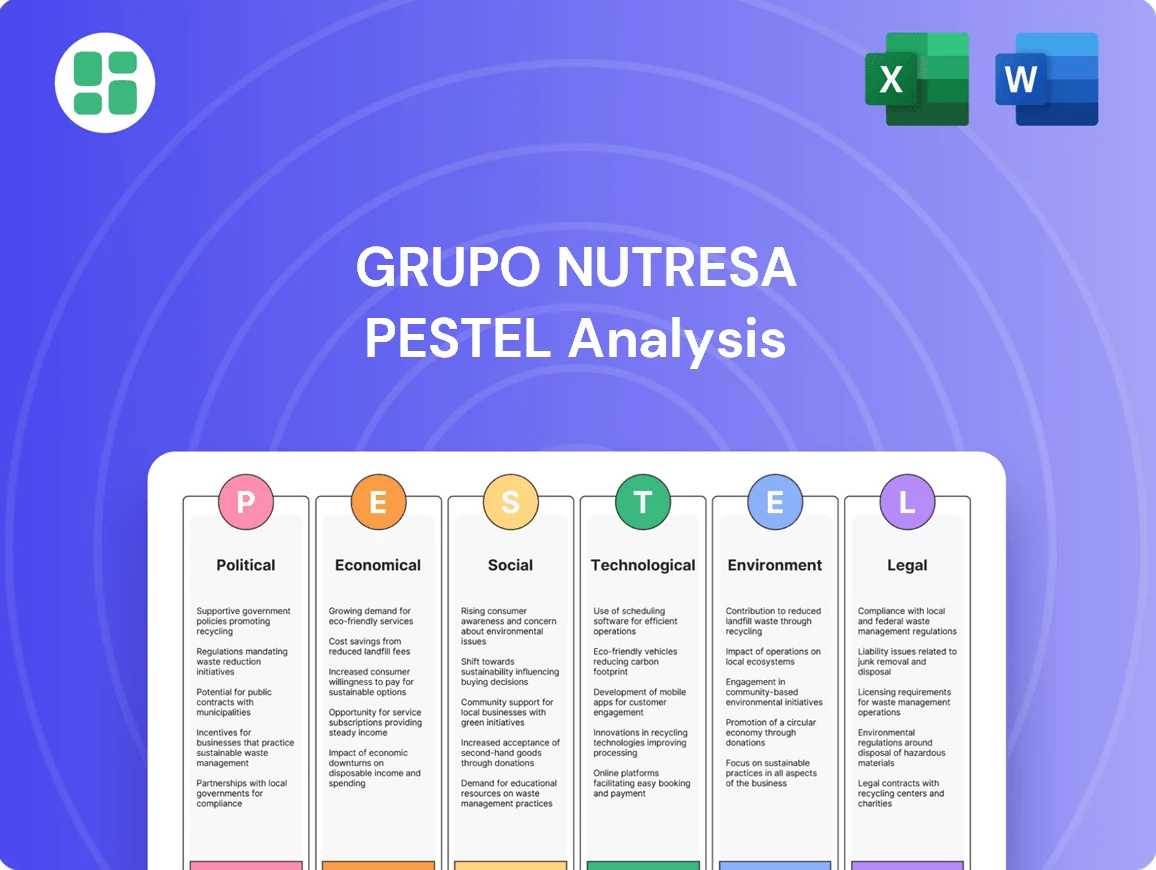
Grupo Nutresa PESTLE Analysis
Grupo Nutresa PESTLE Analysis
Plan Smarter. Present Sharper. Compete Stronger.
Grupo Nutresa operates within a dynamic global landscape, influenced by evolving political stability, economic fluctuations, and significant technological advancements. Understanding these external forces is crucial for anticipating market shifts and identifying strategic opportunities.
Our comprehensive PESTLE analysis delves deep into how these factors, along with social trends, environmental regulations, and legal frameworks, are shaping Grupo Nutresa's operations and future trajectory. Gain a competitive edge by leveraging these expert insights.
Don't miss out on actionable intelligence. Download the full PESTLE analysis of Grupo Nutresa now to empower your strategic planning and investment decisions.
Political factors
Government Stability and Policy Environment
Grupo Nutresa's operations are heavily influenced by the political stability of its core markets, particularly Colombia and other Latin American nations. Political shifts can alter regulatory frameworks and economic policies, directly impacting the food processing industry.
Government policies concerning trade agreements, agricultural subsidies, and foreign direct investment are critical for Grupo Nutresa's growth and operational efficiency. Favorable policies can unlock new market opportunities and reduce operational costs.
Colombia's government has historically shown support for the food processing sector, which has been a positive driver for companies like Grupo Nutresa. For instance, initiatives aimed at boosting agricultural productivity and food export competitiveness, such as those seen in recent years, directly benefit the sector's expansion and investment climate.
Trade Agreements and Regional Integration
Grupo Nutresa's significant operations across the Andean region, Central America, and the Caribbean make it highly sensitive to regional trade pacts such as MERCOSUR. These agreements are crucial as they streamline cross-border product flow, lower import duties, and harmonize trade regulations, ultimately improving market entry and streamlining supply chains.
For instance, the Pacific Alliance, which includes Colombia, Peru, Chile, and Mexico, has worked to reduce tariffs on many goods traded between member countries, directly benefiting companies like Grupo Nutresa by lowering costs for imported ingredients and exported finished products. This bloc’s continued efforts towards economic integration in 2024 and 2025 are expected to further enhance these advantages.
Food Safety and Labeling Regulations
Governments across Latin America are tightening food safety and nutritional labeling rules, impacting companies like Grupo Nutresa. For instance, countries like Colombia, Mexico, and Chile are adopting front-of-pack warning labels for products high in sugar, sodium, or saturated fats.
These evolving regulations require significant adjustments, including product reformulation and packaging redesigns. This push towards transparency aims to guide consumers toward healthier food choices, a trend Grupo Nutresa must navigate to maintain market relevance and consumer trust.
Government Collaboration on Sustainability Initiatives
Grupo Nutresa actively partners with the Colombian government on various sustainability initiatives, notably in strengthening the cocoa value chain. For instance, their involvement includes establishing cocoa nurseries, a key component in improving agricultural productivity and quality. These collaborations are crucial as they often unlock access to government grants, tax benefits, and favorable regulatory frameworks, directly supporting Nutresa's operational efficiency and market competitiveness. Such alignment with national development agendas also significantly bolsters the company's public image and social license to operate.
These government collaborations provide tangible benefits that directly impact Grupo Nutresa's performance. For example, by participating in programs aimed at improving the cocoa sector, the company can secure more stable and higher-quality raw material supply, reducing input costs and price volatility. Furthermore, the positive association with government-backed sustainability projects can enhance brand loyalty among consumers who increasingly prioritize ethical and environmentally conscious brands. In 2023, Colombian agricultural exports, including cocoa, saw significant growth, underscoring the potential for companies like Nutresa to leverage these partnerships for expanded market reach and profitability.
- Government Support: Partnerships provide access to financial incentives and regulatory advantages, reducing operational costs and easing market entry for sustainable products.
- Supply Chain Resilience: Investments in agricultural programs, like cocoa nurseries, ensure a more stable and higher-quality supply of raw materials, mitigating risks for Nutresa.
- Enhanced Reputation: Aligning with national sustainability goals and government-backed initiatives improves public perception and brand image, appealing to socially conscious consumers.
- Market Access: Collaborative efforts can open doors to new markets or strengthen existing ones by meeting international sustainability standards often supported by government trade agreements.
Political Interventions in Market Dynamics
Political decisions significantly shape the operating environment for companies like Grupo Nutresa. For instance, government policies on price controls or subsidies directly influence the cost of raw materials and the final pricing of consumer goods, impacting profit margins. In 2024, several Latin American countries experienced persistent inflation, prompting governments to consider or implement measures that could affect food and beverage sectors, including potential price adjustments or consumer support programs.
Import and export restrictions, often enacted for protectionist reasons or to manage trade balances, can disrupt supply chains and affect the availability and cost of key ingredients for Grupo Nutresa. For example, tariffs or quotas on agricultural products could increase production costs. The ongoing trade negotiations and geopolitical shifts in 2024-2025 may introduce new regulatory landscapes for international trade, requiring agile adaptation from multinational food producers.
Economic crises or periods of high inflation can lead to increased political intervention. Governments might introduce measures to protect consumers, such as temporary price caps on essential food items, which can squeeze manufacturer profitability. This was observed in various emerging markets during 2024, where governments grappled with rising food prices, potentially impacting companies with significant operations in those regions.
- Price Controls: Governments may implement price ceilings on essential food items, directly affecting Grupo Nutresa's revenue and profit potential.
- Subsidies: Subsidies on agricultural inputs could lower production costs, while consumer subsidies might boost demand for processed foods.
- Trade Restrictions: Tariffs or quotas on imported ingredients or finished goods can alter supply chain costs and market access for Grupo Nutresa.
- Inflationary Pressures: Rising inflation in key markets can lead to government interventions aimed at stabilizing prices, potentially impacting company margins.
Government Policies: Shaping Business in Latin America
Political stability remains a paramount concern for Grupo Nutresa, influencing its operational landscape across Latin America. Government policies regarding trade, agricultural support, and foreign investment directly shape the company's growth trajectory and efficiency. For instance, favorable trade pacts like the Pacific Alliance, which continued to foster economic integration in 2024 and 2025, streamline cross-border transactions, reducing costs for both imported ingredients and exported finished goods.
Regulatory shifts, particularly concerning food safety and nutritional labeling, necessitate ongoing adaptation. Many Latin American nations, including Colombia, Mexico, and Chile, have implemented front-of-pack warning labels on products high in sugar, sodium, or saturated fats, compelling companies like Grupo Nutresa to reformulate products and redesign packaging to align with evolving consumer health consciousness and governmental directives.
Grupo Nutresa's engagement with government sustainability initiatives, such as strengthening the cocoa value chain through partnerships for cocoa nurseries, yields tangible benefits. These collaborations can unlock access to grants and tax incentives, thereby enhancing operational efficiency and market competitiveness. Such alignment with national development agendas also bolsters the company's public image and social license to operate, a factor increasingly valued by consumers and investors alike.
Government interventions, driven by economic fluctuations like inflation, can significantly impact pricing strategies and profit margins. In 2024, persistent inflation in several Latin American markets led to governmental considerations of measures like temporary price caps on essential food items, posing potential challenges to profitability for companies operating in these regions.
What is included in the product
Detailed Word Document
This PESTLE analysis examines the external macro-environmental forces impacting Grupo Nutresa, covering Political, Economic, Social, Technological, Environmental, and Legal factors, providing a comprehensive overview of its operating landscape.
Customizable Excel Spreadsheet
This PESTLE analysis for Grupo Nutresa offers a streamlined, actionable framework, serving as a pain point reliver by simplifying complex external factors into easily digestible insights for strategic decision-making.
Economic factors
Inflation and Currency Fluctuations
Inflationary pressures, especially on food and energy, are a significant concern for Grupo Nutresa. For instance, Colombia's inflation rate hovered around 4.32% in April 2024, a slight decrease from previous months but still impacting consumer spending and input costs. This can directly affect the company's profitability by increasing the cost of raw materials and potentially reducing consumer demand for its products.
Currency fluctuations, particularly the Colombian Peso (COP) against the US Dollar (USD), present another challenge. A weaker COP, which has seen fluctuations throughout 2024, makes imported raw materials more expensive for Grupo Nutresa. Conversely, it can make the company's exports more competitive, but the net effect depends on the balance of imports and exports and the company's hedging strategies.
Consumer Purchasing Power and Disposable Income
The economic vitality of Latin America, marked by GDP expansion and job growth, directly impacts consumer spending on processed foods. For instance, in 2024, several Latin American economies, including Mexico and Colombia, are projected to see GDP growth above 2%, fostering an environment where consumers are more likely to spend on packaged goods.
A growing middle class with increasing disposable income is a key driver for demand in the processed food sector. As more households move into this demographic, they tend to favor convenient, ready-to-eat, and packaged food options, which Grupo Nutresa is well-positioned to supply.
Regional Economic Growth and Market Potential
The Latin American processed food market is showing robust expansion, with Colombia expected to see a compound annual growth rate of 6.4% between 2024 and 2030. This presents a substantial opportunity for Grupo Nutresa to leverage its established presence.
Grupo Nutresa's diversified operations across countries like Brazil, Argentina, and Peru enable it to benefit from the distinct economic growth trajectories within the region. This broad footprint allows the company to adapt and capitalize on varying market potentials.
Commodity Price Volatility
Grupo Nutresa's reliance on key agricultural commodities such as cocoa, coffee, and sugar makes it highly susceptible to price fluctuations. For instance, the International Cocoa Organization reported that cocoa prices surged by over 200% in the first half of 2024, reaching record highs due to supply concerns in West Africa. This significant increase directly impacts Nutresa's raw material costs.
Such volatility, driven by factors like climate change affecting harvests and geopolitical tensions disrupting supply chains, can directly squeeze gross profit margins. For example, a 10% increase in the cost of a primary commodity could translate to a substantial hit on profitability if not effectively managed through hedging or price adjustments.
- Cocoa Price Surge: Cocoa prices exceeded $10,000 per metric ton in early 2024, a dramatic rise from around $3,000 per ton a year prior.
- Coffee Market Dynamics: Arabica coffee prices, a key input for Nutresa, saw significant volatility in 2024, influenced by weather patterns in Brazil and Vietnam.
- Sugar Supply Concerns: Global sugar prices remained elevated in 2024 due to lower production forecasts in India and Thailand, impacting confectionery and beverage inputs.
- Impact on Margins: Increased commodity expenses can erode gross profit margins if companies cannot pass these costs onto consumers or secure favorable long-term supply contracts.
Investment Climate and Access to Capital
Grupo Nutresa's ability to attract capital is significantly influenced by the investment climate in its operating regions and its access to global financial markets. A stable and welcoming environment for foreign investment encourages the flow of funds necessary for expansion and innovation.
The company's successful foray into international capital markets, exemplified by its first bond issuance, underscores its capacity to secure substantial funding for strategic projects. This access to diverse funding sources is crucial for pursuing ambitious growth objectives.
- Bond Issuance Success: In 2024, Grupo Nutresa successfully placed its inaugural international bond, raising $500 million.
- Investor Confidence: This issuance was oversubscribed, indicating strong investor confidence in the company's financial health and future prospects.
- Strategic Funding: The capital raised is earmarked for strategic acquisitions and operational enhancements, supporting its long-term expansion strategy.
Latin America's Economic Pulse: Growth, Inflation, and Capital
Economic stability and growth in Latin America are crucial for Grupo Nutresa's performance. While projected GDP growth for countries like Mexico and Colombia remains positive in 2024, around 2% or higher, inflationary pressures, particularly on food and energy, continue to impact consumer spending power. For instance, Colombia's inflation rate was approximately 4.32% in April 2024, a factor that can increase input costs and potentially dampen demand for processed foods.
The company's financial health is also tied to currency exchange rates, with the Colombian Peso experiencing fluctuations against major currencies like the US Dollar throughout 2024. This volatility affects the cost of imported raw materials and the competitiveness of exports. Furthermore, Grupo Nutresa's reliance on commodities like cocoa, coffee, and sugar exposes it to significant price swings, as evidenced by cocoa prices surging over 200% in early 2024, directly impacting profit margins.
Grupo Nutresa's access to capital markets remains strong, highlighted by its successful $500 million international bond issuance in 2024, which was oversubscribed. This demonstrates robust investor confidence and provides essential funding for strategic growth initiatives, including acquisitions and operational improvements, vital for navigating the dynamic economic landscape of Latin America.
| Economic Factor | 2024 Projection/Data | Impact on Grupo Nutresa |
|---|---|---|
| Latin America GDP Growth | Projected >2% for key markets (e.g., Mexico, Colombia) | Supports consumer spending on packaged goods |
| Colombia Inflation Rate | ~4.32% (April 2024) | Increases input costs, potentially reduces consumer demand |
| Cocoa Prices | Surged >200% (early 2024) | Significantly increases raw material costs, impacting margins |
| International Bond Issuance | $500 million raised (2024) | Provides capital for strategic growth and operational enhancements |
What You See Is What You Get
Grupo Nutresa PESTLE Analysis
The preview shown here is the exact document you’ll receive after purchase—fully formatted and ready to use. This comprehensive PESTLE analysis of Grupo Nutresa delves into the Political, Economic, Social, Technological, Legal, and Environmental factors influencing its operations and strategic decisions. You'll gain valuable insights into the external forces shaping the company's future.
Original: $10.00
-65%$10.00
$3.50Product Information
Product Information
Shipping & Returns
Shipping & Returns
Description
Plan Smarter. Present Sharper. Compete Stronger.
Grupo Nutresa operates within a dynamic global landscape, influenced by evolving political stability, economic fluctuations, and significant technological advancements. Understanding these external forces is crucial for anticipating market shifts and identifying strategic opportunities.
Our comprehensive PESTLE analysis delves deep into how these factors, along with social trends, environmental regulations, and legal frameworks, are shaping Grupo Nutresa's operations and future trajectory. Gain a competitive edge by leveraging these expert insights.
Don't miss out on actionable intelligence. Download the full PESTLE analysis of Grupo Nutresa now to empower your strategic planning and investment decisions.
Political factors
Government Stability and Policy Environment
Grupo Nutresa's operations are heavily influenced by the political stability of its core markets, particularly Colombia and other Latin American nations. Political shifts can alter regulatory frameworks and economic policies, directly impacting the food processing industry.
Government policies concerning trade agreements, agricultural subsidies, and foreign direct investment are critical for Grupo Nutresa's growth and operational efficiency. Favorable policies can unlock new market opportunities and reduce operational costs.
Colombia's government has historically shown support for the food processing sector, which has been a positive driver for companies like Grupo Nutresa. For instance, initiatives aimed at boosting agricultural productivity and food export competitiveness, such as those seen in recent years, directly benefit the sector's expansion and investment climate.
Trade Agreements and Regional Integration
Grupo Nutresa's significant operations across the Andean region, Central America, and the Caribbean make it highly sensitive to regional trade pacts such as MERCOSUR. These agreements are crucial as they streamline cross-border product flow, lower import duties, and harmonize trade regulations, ultimately improving market entry and streamlining supply chains.
For instance, the Pacific Alliance, which includes Colombia, Peru, Chile, and Mexico, has worked to reduce tariffs on many goods traded between member countries, directly benefiting companies like Grupo Nutresa by lowering costs for imported ingredients and exported finished products. This bloc’s continued efforts towards economic integration in 2024 and 2025 are expected to further enhance these advantages.
Food Safety and Labeling Regulations
Governments across Latin America are tightening food safety and nutritional labeling rules, impacting companies like Grupo Nutresa. For instance, countries like Colombia, Mexico, and Chile are adopting front-of-pack warning labels for products high in sugar, sodium, or saturated fats.
These evolving regulations require significant adjustments, including product reformulation and packaging redesigns. This push towards transparency aims to guide consumers toward healthier food choices, a trend Grupo Nutresa must navigate to maintain market relevance and consumer trust.
Government Collaboration on Sustainability Initiatives
Grupo Nutresa actively partners with the Colombian government on various sustainability initiatives, notably in strengthening the cocoa value chain. For instance, their involvement includes establishing cocoa nurseries, a key component in improving agricultural productivity and quality. These collaborations are crucial as they often unlock access to government grants, tax benefits, and favorable regulatory frameworks, directly supporting Nutresa's operational efficiency and market competitiveness. Such alignment with national development agendas also significantly bolsters the company's public image and social license to operate.
These government collaborations provide tangible benefits that directly impact Grupo Nutresa's performance. For example, by participating in programs aimed at improving the cocoa sector, the company can secure more stable and higher-quality raw material supply, reducing input costs and price volatility. Furthermore, the positive association with government-backed sustainability projects can enhance brand loyalty among consumers who increasingly prioritize ethical and environmentally conscious brands. In 2023, Colombian agricultural exports, including cocoa, saw significant growth, underscoring the potential for companies like Nutresa to leverage these partnerships for expanded market reach and profitability.
- Government Support: Partnerships provide access to financial incentives and regulatory advantages, reducing operational costs and easing market entry for sustainable products.
- Supply Chain Resilience: Investments in agricultural programs, like cocoa nurseries, ensure a more stable and higher-quality supply of raw materials, mitigating risks for Nutresa.
- Enhanced Reputation: Aligning with national sustainability goals and government-backed initiatives improves public perception and brand image, appealing to socially conscious consumers.
- Market Access: Collaborative efforts can open doors to new markets or strengthen existing ones by meeting international sustainability standards often supported by government trade agreements.
Political Interventions in Market Dynamics
Political decisions significantly shape the operating environment for companies like Grupo Nutresa. For instance, government policies on price controls or subsidies directly influence the cost of raw materials and the final pricing of consumer goods, impacting profit margins. In 2024, several Latin American countries experienced persistent inflation, prompting governments to consider or implement measures that could affect food and beverage sectors, including potential price adjustments or consumer support programs.
Import and export restrictions, often enacted for protectionist reasons or to manage trade balances, can disrupt supply chains and affect the availability and cost of key ingredients for Grupo Nutresa. For example, tariffs or quotas on agricultural products could increase production costs. The ongoing trade negotiations and geopolitical shifts in 2024-2025 may introduce new regulatory landscapes for international trade, requiring agile adaptation from multinational food producers.
Economic crises or periods of high inflation can lead to increased political intervention. Governments might introduce measures to protect consumers, such as temporary price caps on essential food items, which can squeeze manufacturer profitability. This was observed in various emerging markets during 2024, where governments grappled with rising food prices, potentially impacting companies with significant operations in those regions.
- Price Controls: Governments may implement price ceilings on essential food items, directly affecting Grupo Nutresa's revenue and profit potential.
- Subsidies: Subsidies on agricultural inputs could lower production costs, while consumer subsidies might boost demand for processed foods.
- Trade Restrictions: Tariffs or quotas on imported ingredients or finished goods can alter supply chain costs and market access for Grupo Nutresa.
- Inflationary Pressures: Rising inflation in key markets can lead to government interventions aimed at stabilizing prices, potentially impacting company margins.
Government Policies: Shaping Business in Latin America
Political stability remains a paramount concern for Grupo Nutresa, influencing its operational landscape across Latin America. Government policies regarding trade, agricultural support, and foreign investment directly shape the company's growth trajectory and efficiency. For instance, favorable trade pacts like the Pacific Alliance, which continued to foster economic integration in 2024 and 2025, streamline cross-border transactions, reducing costs for both imported ingredients and exported finished goods.
Regulatory shifts, particularly concerning food safety and nutritional labeling, necessitate ongoing adaptation. Many Latin American nations, including Colombia, Mexico, and Chile, have implemented front-of-pack warning labels on products high in sugar, sodium, or saturated fats, compelling companies like Grupo Nutresa to reformulate products and redesign packaging to align with evolving consumer health consciousness and governmental directives.
Grupo Nutresa's engagement with government sustainability initiatives, such as strengthening the cocoa value chain through partnerships for cocoa nurseries, yields tangible benefits. These collaborations can unlock access to grants and tax incentives, thereby enhancing operational efficiency and market competitiveness. Such alignment with national development agendas also bolsters the company's public image and social license to operate, a factor increasingly valued by consumers and investors alike.
Government interventions, driven by economic fluctuations like inflation, can significantly impact pricing strategies and profit margins. In 2024, persistent inflation in several Latin American markets led to governmental considerations of measures like temporary price caps on essential food items, posing potential challenges to profitability for companies operating in these regions.
What is included in the product
Detailed Word Document
This PESTLE analysis examines the external macro-environmental forces impacting Grupo Nutresa, covering Political, Economic, Social, Technological, Environmental, and Legal factors, providing a comprehensive overview of its operating landscape.
Customizable Excel Spreadsheet
This PESTLE analysis for Grupo Nutresa offers a streamlined, actionable framework, serving as a pain point reliver by simplifying complex external factors into easily digestible insights for strategic decision-making.
Economic factors
Inflation and Currency Fluctuations
Inflationary pressures, especially on food and energy, are a significant concern for Grupo Nutresa. For instance, Colombia's inflation rate hovered around 4.32% in April 2024, a slight decrease from previous months but still impacting consumer spending and input costs. This can directly affect the company's profitability by increasing the cost of raw materials and potentially reducing consumer demand for its products.
Currency fluctuations, particularly the Colombian Peso (COP) against the US Dollar (USD), present another challenge. A weaker COP, which has seen fluctuations throughout 2024, makes imported raw materials more expensive for Grupo Nutresa. Conversely, it can make the company's exports more competitive, but the net effect depends on the balance of imports and exports and the company's hedging strategies.
Consumer Purchasing Power and Disposable Income
The economic vitality of Latin America, marked by GDP expansion and job growth, directly impacts consumer spending on processed foods. For instance, in 2024, several Latin American economies, including Mexico and Colombia, are projected to see GDP growth above 2%, fostering an environment where consumers are more likely to spend on packaged goods.
A growing middle class with increasing disposable income is a key driver for demand in the processed food sector. As more households move into this demographic, they tend to favor convenient, ready-to-eat, and packaged food options, which Grupo Nutresa is well-positioned to supply.
Regional Economic Growth and Market Potential
The Latin American processed food market is showing robust expansion, with Colombia expected to see a compound annual growth rate of 6.4% between 2024 and 2030. This presents a substantial opportunity for Grupo Nutresa to leverage its established presence.
Grupo Nutresa's diversified operations across countries like Brazil, Argentina, and Peru enable it to benefit from the distinct economic growth trajectories within the region. This broad footprint allows the company to adapt and capitalize on varying market potentials.
Commodity Price Volatility
Grupo Nutresa's reliance on key agricultural commodities such as cocoa, coffee, and sugar makes it highly susceptible to price fluctuations. For instance, the International Cocoa Organization reported that cocoa prices surged by over 200% in the first half of 2024, reaching record highs due to supply concerns in West Africa. This significant increase directly impacts Nutresa's raw material costs.
Such volatility, driven by factors like climate change affecting harvests and geopolitical tensions disrupting supply chains, can directly squeeze gross profit margins. For example, a 10% increase in the cost of a primary commodity could translate to a substantial hit on profitability if not effectively managed through hedging or price adjustments.
- Cocoa Price Surge: Cocoa prices exceeded $10,000 per metric ton in early 2024, a dramatic rise from around $3,000 per ton a year prior.
- Coffee Market Dynamics: Arabica coffee prices, a key input for Nutresa, saw significant volatility in 2024, influenced by weather patterns in Brazil and Vietnam.
- Sugar Supply Concerns: Global sugar prices remained elevated in 2024 due to lower production forecasts in India and Thailand, impacting confectionery and beverage inputs.
- Impact on Margins: Increased commodity expenses can erode gross profit margins if companies cannot pass these costs onto consumers or secure favorable long-term supply contracts.
Investment Climate and Access to Capital
Grupo Nutresa's ability to attract capital is significantly influenced by the investment climate in its operating regions and its access to global financial markets. A stable and welcoming environment for foreign investment encourages the flow of funds necessary for expansion and innovation.
The company's successful foray into international capital markets, exemplified by its first bond issuance, underscores its capacity to secure substantial funding for strategic projects. This access to diverse funding sources is crucial for pursuing ambitious growth objectives.
- Bond Issuance Success: In 2024, Grupo Nutresa successfully placed its inaugural international bond, raising $500 million.
- Investor Confidence: This issuance was oversubscribed, indicating strong investor confidence in the company's financial health and future prospects.
- Strategic Funding: The capital raised is earmarked for strategic acquisitions and operational enhancements, supporting its long-term expansion strategy.
Latin America's Economic Pulse: Growth, Inflation, and Capital
Economic stability and growth in Latin America are crucial for Grupo Nutresa's performance. While projected GDP growth for countries like Mexico and Colombia remains positive in 2024, around 2% or higher, inflationary pressures, particularly on food and energy, continue to impact consumer spending power. For instance, Colombia's inflation rate was approximately 4.32% in April 2024, a factor that can increase input costs and potentially dampen demand for processed foods.
The company's financial health is also tied to currency exchange rates, with the Colombian Peso experiencing fluctuations against major currencies like the US Dollar throughout 2024. This volatility affects the cost of imported raw materials and the competitiveness of exports. Furthermore, Grupo Nutresa's reliance on commodities like cocoa, coffee, and sugar exposes it to significant price swings, as evidenced by cocoa prices surging over 200% in early 2024, directly impacting profit margins.
Grupo Nutresa's access to capital markets remains strong, highlighted by its successful $500 million international bond issuance in 2024, which was oversubscribed. This demonstrates robust investor confidence and provides essential funding for strategic growth initiatives, including acquisitions and operational improvements, vital for navigating the dynamic economic landscape of Latin America.
| Economic Factor | 2024 Projection/Data | Impact on Grupo Nutresa |
|---|---|---|
| Latin America GDP Growth | Projected >2% for key markets (e.g., Mexico, Colombia) | Supports consumer spending on packaged goods |
| Colombia Inflation Rate | ~4.32% (April 2024) | Increases input costs, potentially reduces consumer demand |
| Cocoa Prices | Surged >200% (early 2024) | Significantly increases raw material costs, impacting margins |
| International Bond Issuance | $500 million raised (2024) | Provides capital for strategic growth and operational enhancements |
What You See Is What You Get
Grupo Nutresa PESTLE Analysis
The preview shown here is the exact document you’ll receive after purchase—fully formatted and ready to use. This comprehensive PESTLE analysis of Grupo Nutresa delves into the Political, Economic, Social, Technological, Legal, and Environmental factors influencing its operations and strategic decisions. You'll gain valuable insights into the external forces shaping the company's future.