SPIE Business Model Canvas

SPIE's Business Model: A Deep Dive
Unlock the full strategic blueprint behind SPIE's business model. This in-depth Business Model Canvas reveals how the company drives value, captures market share, and stays ahead in a competitive landscape. Ideal for entrepreneurs, consultants, and investors looking for actionable insights.
Partnerships

Technology Providers
SPIE partners with premier technology providers to integrate advanced HVAC, smart building, and ICT systems. These collaborations, including those with major vendors for specialized software and hardware in 2024, guarantee access to the newest innovations, allowing SPIE to offer customers state-of-the-art solutions.
Subcontractors and Specialized Firms
SPIE frequently collaborates with specialized subcontractors for large-scale projects or tasks requiring niche expertise, such as advanced cybersecurity or specific industrial automation. This strategic reliance on external partners enables SPIE to scale operations rapidly and access specialized skills, which is crucial for managing complex, multi-disciplinary projects efficiently. For instance, in 2024, SPIE's ability to leverage a network of over 1,000 subcontractors across Europe was instrumental in securing and executing several major infrastructure upgrades, ensuring both timely completion and high-quality delivery.

Equipment and Material Suppliers
SPIE relies heavily on its equipment and material suppliers to deliver high-quality components for its diverse projects, ranging from electrical installations to complex industrial machinery. These partnerships are foundational for ensuring project timelines and cost control. For instance, in 2024, SPIE's procurement strategies focused on securing bulk discounts and guaranteed delivery windows from key electrical component manufacturers.

Energy Companies and Utilities
SPIE's collaborations with energy companies and utilities are fundamental for advancing energy efficiency, optimizing power grids, and integrating renewable energy sources. These alliances provide critical market access, regulatory insights, and shared project ventures that accelerate the energy transition for their clientele.
These partnerships are particularly vital for executing large-scale infrastructure development and decarbonization efforts. For instance, in 2024, SPIE's involvement in grid modernization projects across Europe, often in conjunction with major utility providers, underscored the necessity of such strategic alignments. These collaborations allow for the deployment of advanced technologies and the management of complex energy systems, contributing to a more sustainable energy future.
- Market Access: Gaining entry into regulated energy markets and securing contracts for large-scale infrastructure upgrades.
- Regulatory Expertise: Leveraging the deep understanding of energy sector regulations and compliance requirements held by utility partners.
- Joint Project Development: Co-developing and implementing innovative solutions for energy efficiency, smart grids, and renewable energy integration.
- De-risking Investments: Sharing the financial and operational risks associated with major energy transition projects.
Digital Solution Partners
SPIE's digital transformation hinges on strong alliances with digital solution partners. These collaborations are vital for developing and integrating cutting-edge technologies.
- Software Developers: Partnerships with software developers are crucial for creating bespoke platforms and applications that streamline operations and enhance client services. For instance, in 2024, SPIE continued to invest in custom software for energy management systems, aiming to improve efficiency by up to 15% for clients.
- Cybersecurity Firms: With the increasing reliance on digital infrastructure, collaborations with cybersecurity firms are paramount to protect sensitive data and ensure the resilience of client systems. SPIE's commitment to cybersecurity saw a 20% increase in cybersecurity-related service offerings in 2024, addressing growing threats.
- IoT Solution Providers: Working with IoT solution providers enables SPIE to offer advanced data collection and analysis capabilities, powering services like predictive maintenance and smart building management. The company reported a 25% growth in IoT-enabled projects by the end of 2024, demonstrating the demand for these integrated solutions.
- AI and Emerging Technology Specialists: To stay at the forefront of innovation, SPIE partners with specialists in artificial intelligence and other emerging technologies. These alliances are key to unlocking new efficiencies and developing forward-thinking solutions, such as AI-driven energy optimization which showed promising pilot results in late 2024.
Strategic Partnerships Drive Integrated Solutions
SPIE's key partnerships are essential for delivering integrated solutions across its service lines. Collaborations with technology providers, specialized subcontractors, and material suppliers are fundamental for innovation and project execution. These alliances ensure access to cutting-edge technology, niche expertise, and quality components, enabling SPIE to tackle complex projects efficiently and maintain competitive advantage.
What is included in the product
 Detailed Word Document
A structured framework for outlining SPIE's business strategy, detailing key partners, activities, and resources to deliver value propositions. It maps out customer relationships, channels, and segments, alongside cost structures and revenue streams.

 Customizable Excel Spreadsheet
The SPIE Business Model Canvas streamlines strategic planning by offering a clear, visual representation of a company's core elements, alleviating the pain of complex, unstructured strategy development.
Activities

Design and Engineering
SPIE's design and engineering activities are central to its operations, focusing on the intricate planning of technical systems for buildings and industrial facilities. This crucial phase involves developing detailed blueprints, precise specifications, and comprehensive technical plans to guarantee that all systems function at peak efficiency and adhere to strict industry standards and regulations.
In 2024, SPIE continued to leverage its expertise in this area, contributing to projects that demand sophisticated engineering solutions. For instance, their work in the energy sector often involves designing complex electrical grids and renewable energy integration systems, ensuring reliability and sustainability.
Installation and Commissioning
SPIE's core activities include the installation and commissioning of diverse technical systems. This covers everything from heating, ventilation, and air conditioning (HVAC) to electrical networks and information and communication technology (ICT) infrastructure. In 2024, SPIE continued to execute complex installation projects across various sectors.
The commissioning phase involves rigorous testing and integration to guarantee that all installed equipment functions as intended and adheres to precise performance benchmarks. This meticulous process is fundamental to delivering reliable and efficient systems. For instance, successful commissioning of a new data center's cooling system ensures optimal operating temperatures, crucial for uninterrupted service.
The efficiency and quality of SPIE's installation and commissioning work directly impact project timelines and overall client satisfaction. A well-executed commissioning process can prevent costly future issues and ensure the long-term operational success of the installed systems, reinforcing SPIE's reputation for technical excellence.

Maintenance and Operation
Maintenance and Operation are central to SPIE's business, focusing on keeping installed technical systems running smoothly. This involves scheduled checks, fixing issues as they arise, and making sure everything operates efficiently. These ongoing services are crucial for customer retention and predictable income streams.
In 2024, SPIE's commitment to maintenance and operation is evident in its robust service offerings. For instance, the company secured a significant contract in France for the maintenance of public lighting and traffic management systems, highlighting the long-term nature of these engagements. This segment of their business is a cornerstone for stable revenue generation.

Energy Efficiency Consulting and Implementation
SPIE excels in energy efficiency consulting, offering expert advice and implementing tailored solutions to help clients reduce energy consumption and their environmental impact. This includes conducting thorough energy audits, identifying areas for improvement, and recommending specific upgrades to infrastructure and operational processes.
The company's services extend to deploying advanced energy management systems designed to monitor and optimize energy usage in real-time, facilitating a smoother transition towards more sustainable business practices. This focus directly addresses the growing global demand for energy transition solutions, a critical megatrend shaping industries worldwide.
SPIE's commitment to energy efficiency is backed by tangible results. For instance, in 2024, their projects have consistently achieved energy savings of 15-25% for clients, directly contributing to reduced operational costs and a lower carbon footprint. This aligns with broader sustainability goals, as many businesses are setting ambitious targets for emissions reduction in the coming years.
- Conducting detailed energy audits to pinpoint inefficiencies.
- Recommending and implementing technological upgrades for optimized energy use.
- Deploying intelligent energy management systems for continuous monitoring and control.
- Supporting clients in achieving their carbon reduction and sustainability objectives.
Digital Transformation Support
SPIE actively champions its clients' digital journeys by weaving digital services and solutions directly into their existing technical frameworks. This strategic integration encompasses advanced smart building technologies, cutting-edge industrial automation, and comprehensive ICT services, all designed to empower clients in harnessing digital tools for enhanced operational efficiency and fostering innovation.
This focus on digital transformation is a significant engine for SPIE's growth. For instance, in 2023, SPIE reported that its digital activities contributed to a substantial portion of its revenue, demonstrating a clear market demand for these integrated solutions.
- Smart Building Technologies: Enhancing building performance and user experience through connected systems.
- Industrial Automation: Streamlining manufacturing processes and improving productivity with intelligent automation.
- ICT Services: Providing robust communication and information technology infrastructure for seamless digital operations.
- Operational Optimization: Leveraging digital tools to drive efficiency and cost savings across client operations.
SPIE: Driving Energy Savings & Digital Transformation in Technical Systems
SPIE's key activities revolve around the design, installation, commissioning, maintenance, and operation of technical systems. They also provide crucial energy efficiency consulting and champion digital transformation for their clients.
In 2024, SPIE's focus on energy efficiency consulting led to projects achieving 15-25% energy savings for clients, directly impacting operational costs and carbon footprints.
The company's digital activities, including smart building technologies and industrial automation, contributed significantly to its revenue in 2023, underscoring market demand.
SPIE's maintenance and operation services are a stable revenue generator, as seen in their 2024 contract for public lighting and traffic management systems in France.
Full Version Awaits
Business Model Canvas
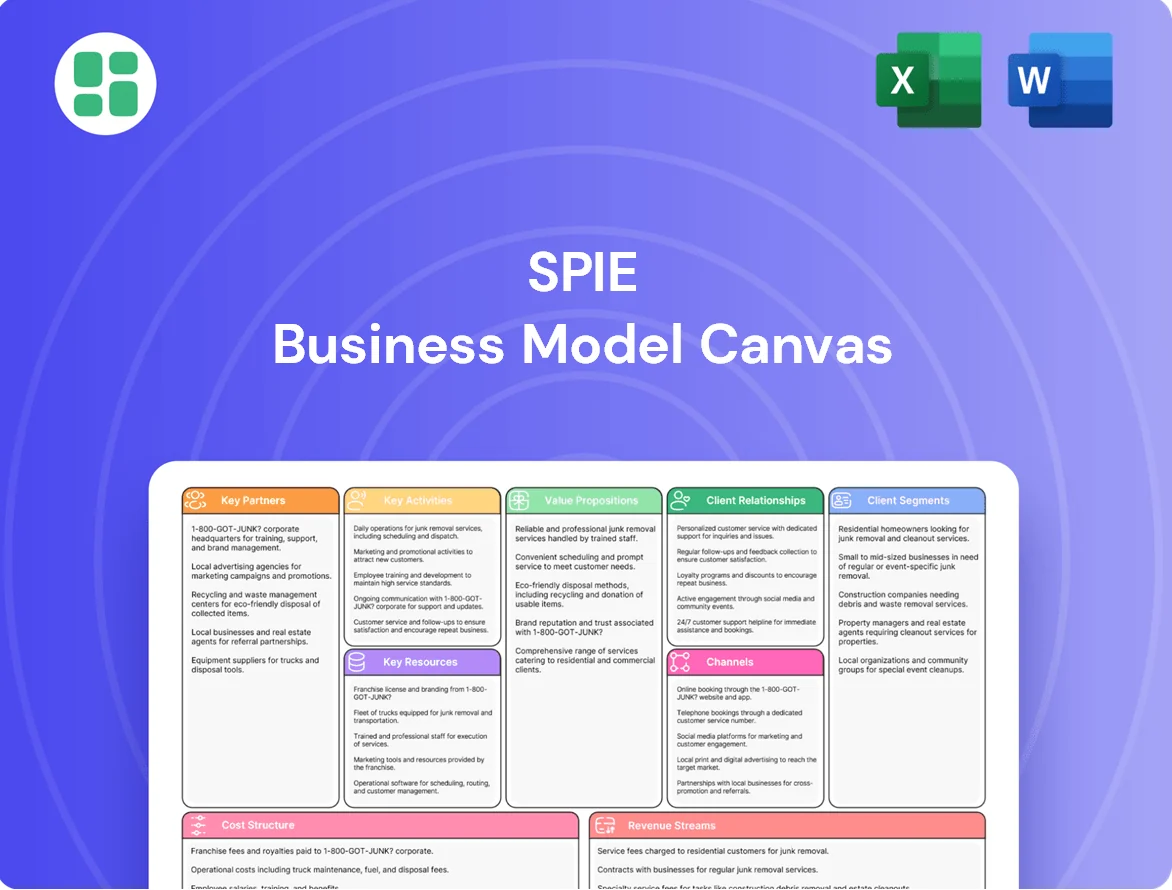
This preview offers a direct glimpse into the SPIE Business Model Canvas you will receive upon purchase. The structure, content, and formatting you see here are precisely what will be delivered, ensuring no surprises. You are viewing the actual document, ready for your strategic planning needs.

Product Information
Product Information
Shipping & Returns
Shipping & Returns
SPIE Business Model Canvas
SPIE Business Model Canvas
SPIE's Business Model: A Deep Dive
Unlock the full strategic blueprint behind SPIE's business model. This in-depth Business Model Canvas reveals how the company drives value, captures market share, and stays ahead in a competitive landscape. Ideal for entrepreneurs, consultants, and investors looking for actionable insights.
Partnerships
Technology Providers
SPIE partners with premier technology providers to integrate advanced HVAC, smart building, and ICT systems. These collaborations, including those with major vendors for specialized software and hardware in 2024, guarantee access to the newest innovations, allowing SPIE to offer customers state-of-the-art solutions.
Subcontractors and Specialized Firms
SPIE frequently collaborates with specialized subcontractors for large-scale projects or tasks requiring niche expertise, such as advanced cybersecurity or specific industrial automation. This strategic reliance on external partners enables SPIE to scale operations rapidly and access specialized skills, which is crucial for managing complex, multi-disciplinary projects efficiently. For instance, in 2024, SPIE's ability to leverage a network of over 1,000 subcontractors across Europe was instrumental in securing and executing several major infrastructure upgrades, ensuring both timely completion and high-quality delivery.
Equipment and Material Suppliers
SPIE relies heavily on its equipment and material suppliers to deliver high-quality components for its diverse projects, ranging from electrical installations to complex industrial machinery. These partnerships are foundational for ensuring project timelines and cost control. For instance, in 2024, SPIE's procurement strategies focused on securing bulk discounts and guaranteed delivery windows from key electrical component manufacturers.
Energy Companies and Utilities
SPIE's collaborations with energy companies and utilities are fundamental for advancing energy efficiency, optimizing power grids, and integrating renewable energy sources. These alliances provide critical market access, regulatory insights, and shared project ventures that accelerate the energy transition for their clientele.
These partnerships are particularly vital for executing large-scale infrastructure development and decarbonization efforts. For instance, in 2024, SPIE's involvement in grid modernization projects across Europe, often in conjunction with major utility providers, underscored the necessity of such strategic alignments. These collaborations allow for the deployment of advanced technologies and the management of complex energy systems, contributing to a more sustainable energy future.
- Market Access: Gaining entry into regulated energy markets and securing contracts for large-scale infrastructure upgrades.
- Regulatory Expertise: Leveraging the deep understanding of energy sector regulations and compliance requirements held by utility partners.
- Joint Project Development: Co-developing and implementing innovative solutions for energy efficiency, smart grids, and renewable energy integration.
- De-risking Investments: Sharing the financial and operational risks associated with major energy transition projects.
Digital Solution Partners
SPIE's digital transformation hinges on strong alliances with digital solution partners. These collaborations are vital for developing and integrating cutting-edge technologies.
- Software Developers: Partnerships with software developers are crucial for creating bespoke platforms and applications that streamline operations and enhance client services. For instance, in 2024, SPIE continued to invest in custom software for energy management systems, aiming to improve efficiency by up to 15% for clients.
- Cybersecurity Firms: With the increasing reliance on digital infrastructure, collaborations with cybersecurity firms are paramount to protect sensitive data and ensure the resilience of client systems. SPIE's commitment to cybersecurity saw a 20% increase in cybersecurity-related service offerings in 2024, addressing growing threats.
- IoT Solution Providers: Working with IoT solution providers enables SPIE to offer advanced data collection and analysis capabilities, powering services like predictive maintenance and smart building management. The company reported a 25% growth in IoT-enabled projects by the end of 2024, demonstrating the demand for these integrated solutions.
- AI and Emerging Technology Specialists: To stay at the forefront of innovation, SPIE partners with specialists in artificial intelligence and other emerging technologies. These alliances are key to unlocking new efficiencies and developing forward-thinking solutions, such as AI-driven energy optimization which showed promising pilot results in late 2024.
Strategic Partnerships Drive Integrated Solutions
SPIE's key partnerships are essential for delivering integrated solutions across its service lines. Collaborations with technology providers, specialized subcontractors, and material suppliers are fundamental for innovation and project execution. These alliances ensure access to cutting-edge technology, niche expertise, and quality components, enabling SPIE to tackle complex projects efficiently and maintain competitive advantage.
What is included in the product
Detailed Word Document
A structured framework for outlining SPIE's business strategy, detailing key partners, activities, and resources to deliver value propositions. It maps out customer relationships, channels, and segments, alongside cost structures and revenue streams.
Customizable Excel Spreadsheet
The SPIE Business Model Canvas streamlines strategic planning by offering a clear, visual representation of a company's core elements, alleviating the pain of complex, unstructured strategy development.
Activities
Design and Engineering
SPIE's design and engineering activities are central to its operations, focusing on the intricate planning of technical systems for buildings and industrial facilities. This crucial phase involves developing detailed blueprints, precise specifications, and comprehensive technical plans to guarantee that all systems function at peak efficiency and adhere to strict industry standards and regulations.
In 2024, SPIE continued to leverage its expertise in this area, contributing to projects that demand sophisticated engineering solutions. For instance, their work in the energy sector often involves designing complex electrical grids and renewable energy integration systems, ensuring reliability and sustainability.
Installation and Commissioning
SPIE's core activities include the installation and commissioning of diverse technical systems. This covers everything from heating, ventilation, and air conditioning (HVAC) to electrical networks and information and communication technology (ICT) infrastructure. In 2024, SPIE continued to execute complex installation projects across various sectors.
The commissioning phase involves rigorous testing and integration to guarantee that all installed equipment functions as intended and adheres to precise performance benchmarks. This meticulous process is fundamental to delivering reliable and efficient systems. For instance, successful commissioning of a new data center's cooling system ensures optimal operating temperatures, crucial for uninterrupted service.
The efficiency and quality of SPIE's installation and commissioning work directly impact project timelines and overall client satisfaction. A well-executed commissioning process can prevent costly future issues and ensure the long-term operational success of the installed systems, reinforcing SPIE's reputation for technical excellence.
Maintenance and Operation
Maintenance and Operation are central to SPIE's business, focusing on keeping installed technical systems running smoothly. This involves scheduled checks, fixing issues as they arise, and making sure everything operates efficiently. These ongoing services are crucial for customer retention and predictable income streams.
In 2024, SPIE's commitment to maintenance and operation is evident in its robust service offerings. For instance, the company secured a significant contract in France for the maintenance of public lighting and traffic management systems, highlighting the long-term nature of these engagements. This segment of their business is a cornerstone for stable revenue generation.
Energy Efficiency Consulting and Implementation
SPIE excels in energy efficiency consulting, offering expert advice and implementing tailored solutions to help clients reduce energy consumption and their environmental impact. This includes conducting thorough energy audits, identifying areas for improvement, and recommending specific upgrades to infrastructure and operational processes.
The company's services extend to deploying advanced energy management systems designed to monitor and optimize energy usage in real-time, facilitating a smoother transition towards more sustainable business practices. This focus directly addresses the growing global demand for energy transition solutions, a critical megatrend shaping industries worldwide.
SPIE's commitment to energy efficiency is backed by tangible results. For instance, in 2024, their projects have consistently achieved energy savings of 15-25% for clients, directly contributing to reduced operational costs and a lower carbon footprint. This aligns with broader sustainability goals, as many businesses are setting ambitious targets for emissions reduction in the coming years.
- Conducting detailed energy audits to pinpoint inefficiencies.
- Recommending and implementing technological upgrades for optimized energy use.
- Deploying intelligent energy management systems for continuous monitoring and control.
- Supporting clients in achieving their carbon reduction and sustainability objectives.
Digital Transformation Support
SPIE actively champions its clients' digital journeys by weaving digital services and solutions directly into their existing technical frameworks. This strategic integration encompasses advanced smart building technologies, cutting-edge industrial automation, and comprehensive ICT services, all designed to empower clients in harnessing digital tools for enhanced operational efficiency and fostering innovation.
This focus on digital transformation is a significant engine for SPIE's growth. For instance, in 2023, SPIE reported that its digital activities contributed to a substantial portion of its revenue, demonstrating a clear market demand for these integrated solutions.
- Smart Building Technologies: Enhancing building performance and user experience through connected systems.
- Industrial Automation: Streamlining manufacturing processes and improving productivity with intelligent automation.
- ICT Services: Providing robust communication and information technology infrastructure for seamless digital operations.
- Operational Optimization: Leveraging digital tools to drive efficiency and cost savings across client operations.
SPIE: Driving Energy Savings & Digital Transformation in Technical Systems
SPIE's key activities revolve around the design, installation, commissioning, maintenance, and operation of technical systems. They also provide crucial energy efficiency consulting and champion digital transformation for their clients.
In 2024, SPIE's focus on energy efficiency consulting led to projects achieving 15-25% energy savings for clients, directly impacting operational costs and carbon footprints.
The company's digital activities, including smart building technologies and industrial automation, contributed significantly to its revenue in 2023, underscoring market demand.
SPIE's maintenance and operation services are a stable revenue generator, as seen in their 2024 contract for public lighting and traffic management systems in France.
Full Version Awaits
Business Model Canvas
This preview offers a direct glimpse into the SPIE Business Model Canvas you will receive upon purchase. The structure, content, and formatting you see here are precisely what will be delivered, ensuring no surprises. You are viewing the actual document, ready for your strategic planning needs.
Product Information
Product Information
Shipping & Returns
Shipping & Returns
Description
SPIE's Business Model: A Deep Dive
Unlock the full strategic blueprint behind SPIE's business model. This in-depth Business Model Canvas reveals how the company drives value, captures market share, and stays ahead in a competitive landscape. Ideal for entrepreneurs, consultants, and investors looking for actionable insights.
Partnerships
Technology Providers
SPIE partners with premier technology providers to integrate advanced HVAC, smart building, and ICT systems. These collaborations, including those with major vendors for specialized software and hardware in 2024, guarantee access to the newest innovations, allowing SPIE to offer customers state-of-the-art solutions.
Subcontractors and Specialized Firms
SPIE frequently collaborates with specialized subcontractors for large-scale projects or tasks requiring niche expertise, such as advanced cybersecurity or specific industrial automation. This strategic reliance on external partners enables SPIE to scale operations rapidly and access specialized skills, which is crucial for managing complex, multi-disciplinary projects efficiently. For instance, in 2024, SPIE's ability to leverage a network of over 1,000 subcontractors across Europe was instrumental in securing and executing several major infrastructure upgrades, ensuring both timely completion and high-quality delivery.
Equipment and Material Suppliers
SPIE relies heavily on its equipment and material suppliers to deliver high-quality components for its diverse projects, ranging from electrical installations to complex industrial machinery. These partnerships are foundational for ensuring project timelines and cost control. For instance, in 2024, SPIE's procurement strategies focused on securing bulk discounts and guaranteed delivery windows from key electrical component manufacturers.
Energy Companies and Utilities
SPIE's collaborations with energy companies and utilities are fundamental for advancing energy efficiency, optimizing power grids, and integrating renewable energy sources. These alliances provide critical market access, regulatory insights, and shared project ventures that accelerate the energy transition for their clientele.
These partnerships are particularly vital for executing large-scale infrastructure development and decarbonization efforts. For instance, in 2024, SPIE's involvement in grid modernization projects across Europe, often in conjunction with major utility providers, underscored the necessity of such strategic alignments. These collaborations allow for the deployment of advanced technologies and the management of complex energy systems, contributing to a more sustainable energy future.
- Market Access: Gaining entry into regulated energy markets and securing contracts for large-scale infrastructure upgrades.
- Regulatory Expertise: Leveraging the deep understanding of energy sector regulations and compliance requirements held by utility partners.
- Joint Project Development: Co-developing and implementing innovative solutions for energy efficiency, smart grids, and renewable energy integration.
- De-risking Investments: Sharing the financial and operational risks associated with major energy transition projects.
Digital Solution Partners
SPIE's digital transformation hinges on strong alliances with digital solution partners. These collaborations are vital for developing and integrating cutting-edge technologies.
- Software Developers: Partnerships with software developers are crucial for creating bespoke platforms and applications that streamline operations and enhance client services. For instance, in 2024, SPIE continued to invest in custom software for energy management systems, aiming to improve efficiency by up to 15% for clients.
- Cybersecurity Firms: With the increasing reliance on digital infrastructure, collaborations with cybersecurity firms are paramount to protect sensitive data and ensure the resilience of client systems. SPIE's commitment to cybersecurity saw a 20% increase in cybersecurity-related service offerings in 2024, addressing growing threats.
- IoT Solution Providers: Working with IoT solution providers enables SPIE to offer advanced data collection and analysis capabilities, powering services like predictive maintenance and smart building management. The company reported a 25% growth in IoT-enabled projects by the end of 2024, demonstrating the demand for these integrated solutions.
- AI and Emerging Technology Specialists: To stay at the forefront of innovation, SPIE partners with specialists in artificial intelligence and other emerging technologies. These alliances are key to unlocking new efficiencies and developing forward-thinking solutions, such as AI-driven energy optimization which showed promising pilot results in late 2024.
Strategic Partnerships Drive Integrated Solutions
SPIE's key partnerships are essential for delivering integrated solutions across its service lines. Collaborations with technology providers, specialized subcontractors, and material suppliers are fundamental for innovation and project execution. These alliances ensure access to cutting-edge technology, niche expertise, and quality components, enabling SPIE to tackle complex projects efficiently and maintain competitive advantage.
What is included in the product
Detailed Word Document
A structured framework for outlining SPIE's business strategy, detailing key partners, activities, and resources to deliver value propositions. It maps out customer relationships, channels, and segments, alongside cost structures and revenue streams.
Customizable Excel Spreadsheet
The SPIE Business Model Canvas streamlines strategic planning by offering a clear, visual representation of a company's core elements, alleviating the pain of complex, unstructured strategy development.
Activities
Design and Engineering
SPIE's design and engineering activities are central to its operations, focusing on the intricate planning of technical systems for buildings and industrial facilities. This crucial phase involves developing detailed blueprints, precise specifications, and comprehensive technical plans to guarantee that all systems function at peak efficiency and adhere to strict industry standards and regulations.
In 2024, SPIE continued to leverage its expertise in this area, contributing to projects that demand sophisticated engineering solutions. For instance, their work in the energy sector often involves designing complex electrical grids and renewable energy integration systems, ensuring reliability and sustainability.
Installation and Commissioning
SPIE's core activities include the installation and commissioning of diverse technical systems. This covers everything from heating, ventilation, and air conditioning (HVAC) to electrical networks and information and communication technology (ICT) infrastructure. In 2024, SPIE continued to execute complex installation projects across various sectors.
The commissioning phase involves rigorous testing and integration to guarantee that all installed equipment functions as intended and adheres to precise performance benchmarks. This meticulous process is fundamental to delivering reliable and efficient systems. For instance, successful commissioning of a new data center's cooling system ensures optimal operating temperatures, crucial for uninterrupted service.
The efficiency and quality of SPIE's installation and commissioning work directly impact project timelines and overall client satisfaction. A well-executed commissioning process can prevent costly future issues and ensure the long-term operational success of the installed systems, reinforcing SPIE's reputation for technical excellence.
Maintenance and Operation
Maintenance and Operation are central to SPIE's business, focusing on keeping installed technical systems running smoothly. This involves scheduled checks, fixing issues as they arise, and making sure everything operates efficiently. These ongoing services are crucial for customer retention and predictable income streams.
In 2024, SPIE's commitment to maintenance and operation is evident in its robust service offerings. For instance, the company secured a significant contract in France for the maintenance of public lighting and traffic management systems, highlighting the long-term nature of these engagements. This segment of their business is a cornerstone for stable revenue generation.
Energy Efficiency Consulting and Implementation
SPIE excels in energy efficiency consulting, offering expert advice and implementing tailored solutions to help clients reduce energy consumption and their environmental impact. This includes conducting thorough energy audits, identifying areas for improvement, and recommending specific upgrades to infrastructure and operational processes.
The company's services extend to deploying advanced energy management systems designed to monitor and optimize energy usage in real-time, facilitating a smoother transition towards more sustainable business practices. This focus directly addresses the growing global demand for energy transition solutions, a critical megatrend shaping industries worldwide.
SPIE's commitment to energy efficiency is backed by tangible results. For instance, in 2024, their projects have consistently achieved energy savings of 15-25% for clients, directly contributing to reduced operational costs and a lower carbon footprint. This aligns with broader sustainability goals, as many businesses are setting ambitious targets for emissions reduction in the coming years.
- Conducting detailed energy audits to pinpoint inefficiencies.
- Recommending and implementing technological upgrades for optimized energy use.
- Deploying intelligent energy management systems for continuous monitoring and control.
- Supporting clients in achieving their carbon reduction and sustainability objectives.
Digital Transformation Support
SPIE actively champions its clients' digital journeys by weaving digital services and solutions directly into their existing technical frameworks. This strategic integration encompasses advanced smart building technologies, cutting-edge industrial automation, and comprehensive ICT services, all designed to empower clients in harnessing digital tools for enhanced operational efficiency and fostering innovation.
This focus on digital transformation is a significant engine for SPIE's growth. For instance, in 2023, SPIE reported that its digital activities contributed to a substantial portion of its revenue, demonstrating a clear market demand for these integrated solutions.
- Smart Building Technologies: Enhancing building performance and user experience through connected systems.
- Industrial Automation: Streamlining manufacturing processes and improving productivity with intelligent automation.
- ICT Services: Providing robust communication and information technology infrastructure for seamless digital operations.
- Operational Optimization: Leveraging digital tools to drive efficiency and cost savings across client operations.
SPIE: Driving Energy Savings & Digital Transformation in Technical Systems
SPIE's key activities revolve around the design, installation, commissioning, maintenance, and operation of technical systems. They also provide crucial energy efficiency consulting and champion digital transformation for their clients.
In 2024, SPIE's focus on energy efficiency consulting led to projects achieving 15-25% energy savings for clients, directly impacting operational costs and carbon footprints.
The company's digital activities, including smart building technologies and industrial automation, contributed significantly to its revenue in 2023, underscoring market demand.
SPIE's maintenance and operation services are a stable revenue generator, as seen in their 2024 contract for public lighting and traffic management systems in France.
Full Version Awaits
Business Model Canvas
This preview offers a direct glimpse into the SPIE Business Model Canvas you will receive upon purchase. The structure, content, and formatting you see here are precisely what will be delivered, ensuring no surprises. You are viewing the actual document, ready for your strategic planning needs.