Pacific Basin Shipping Business Model Canvas

Pacific Basin's Business Model Unveiled!
Unlock the strategic core of Pacific Basin Shipping's operations with our comprehensive Business Model Canvas. Discover their key partners, value propositions, and revenue streams that drive success in the global shipping industry. This detailed canvas is your essential guide to understanding their competitive advantage.
Dive into the actionable insights of Pacific Basin Shipping's business model. Our full Business Model Canvas breaks down their customer relationships, cost structure, and key resources, offering a clear roadmap to their market dominance. Get the complete blueprint to inform your own strategy.
Partnerships

Shipyards and Equipment Suppliers
Pacific Basin actively partners with shipyards and equipment suppliers to maintain a modern and efficient fleet. These collaborations are vital for new vessel construction, routine dry-docking, and integrating specialized, advanced equipment, which directly supports fleet renewal and technological upgrades.
These strategic alliances are fundamental to Pacific Basin's long-term competitiveness and its commitment to decarbonization. For instance, the company recently secured contracts for four dual-fuel Ultramax newbuilding vessels, designed for lower emissions, highlighting the importance of these supplier relationships in achieving sustainability targets.
Cargo Owners and Charterers
Pacific Basin’s core strength lies in its enduring ties with cargo owners and charterers, including major industrial users, traders, and producers of dry bulk commodities. These relationships are the bedrock of their business, ensuring consistent cargo flow and predictable revenue. In 2024, the company continued to leverage these partnerships, which are crucial for maintaining high fleet utilization and minimizing costly downtime.
By fostering deep, long-term connections with over 600 customers globally, Pacific Basin secures a steady stream of business. This broad customer base, spanning various commodity sectors, provides resilience and stability, even amidst market fluctuations. These partnerships are not just transactional; they are strategic alliances that support efficient operations and sustained profitability.

Port Authorities and Terminal Operators
Pacific Basin Shipping's key partnerships with port authorities and terminal operators are crucial for its global operations. Effective coordination ensures quick vessel turnaround and efficient cargo handling, directly impacting service reliability for its customers.
In 2024, the company's extensive network saw it calling at 882 ports across 100 countries, highlighting the critical nature of these relationships for minimizing delays and optimizing logistics worldwide.

Financial Institutions and Investors
Pacific Basin's financial backbone relies heavily on its relationships with financial institutions and investors. Securing financing for fleet expansion, working capital, and strategic investments through banks and other financial entities is vital for business growth and stability. Maintaining strong investor relations ensures access to capital markets and supports shareholder value.
These partnerships are crucial for funding new vessel acquisitions and upgrades. For instance, in July 2025, Pacific Basin successfully secured a new US$250 million sustainability-linked credit facility. This demonstrates ongoing access to capital and a commitment to environmentally responsible financing.
- Banks and Financial Institutions: Provide essential debt financing for fleet expansion and operational needs.
- Equity Investors: Supply capital through stock issuance and contribute to shareholder value.
- Credit Rating Agencies: Influence borrowing costs and investor confidence through their assessments.
- Investment Funds: Offer diverse capital sources and strategic investment opportunities.
Maritime Service Providers
Pacific Basin Shipping strategically partners with key maritime service providers to ensure operational excellence and cost-effectiveness. These collaborations are vital for maintaining a modern and efficient fleet. For instance, by working with reputable bunker suppliers, the company can secure fuel at competitive prices, a critical factor given that fuel costs often represent a significant portion of operating expenses for shipping companies. In 2024, the global average price for Very Low Sulphur Fuel Oil (VLSFO) hovered around $600-$700 per metric ton, making efficient procurement paramount.
Furthermore, partnerships with specialized crewing agencies are essential for sourcing and managing skilled seafarers. These agencies provide access to a global pool of qualified officers and ratings, ensuring compliance with international labor conventions and maintaining high standards of crew welfare and training. Similarly, marine insurance providers offer crucial risk management solutions, covering potential liabilities and asset damage. The marine insurance market in 2024 continued to be influenced by geopolitical events and increasing claims, underscoring the importance of robust coverage. Technical management firms also play a role in ensuring the fleet's seaworthiness and compliance with environmental regulations, such as those set by the International Maritime Organization (IMO).
- Bunker Suppliers: Securing cost-effective fuel procurement.
- Crewing Agencies: Accessing skilled and compliant seafarers.
- Marine Insurance Providers: Comprehensive risk coverage for the fleet.
- Technical Management Firms: Ensuring operational efficiency and regulatory adherence.
Strategic Alliances Power Maritime Industry Leadership and Growth
Pacific Basin's success is built on strong relationships with cargo owners and charterers, ensuring consistent demand for its services. These partnerships are the bedrock of their business, guaranteeing steady cargo flow and predictable revenue streams. The company's extensive network of over 600 global customers, spanning diverse commodity sectors, provides resilience and stability, even during market downturns, as seen in their continued high fleet utilization throughout 2024.
Collaborations with shipyards and equipment suppliers are crucial for maintaining a modern, efficient, and increasingly sustainable fleet. These alliances facilitate new vessel construction and technological upgrades, such as the recent contracts for four dual-fuel Ultramax newbuilding vessels designed for lower emissions, directly supporting decarbonization efforts.
Key partnerships with financial institutions and investors are vital for funding fleet expansion and ensuring operational stability. Access to credit facilities, like the US$250 million sustainability-linked credit facility secured in July 2025, underscores the company's ability to finance growth and maintain strong investor confidence.
Essential alliances with maritime service providers, including bunker suppliers and crewing agencies, ensure operational excellence and cost-effectiveness. These partnerships are critical for managing fuel costs, which in 2024 averaged between $600-$700 per metric ton for VLSFO, and for sourcing skilled seafarers.
What is included in the product
 Detailed Word Document
A detailed exploration of the Pacific Basin Shipping Business Model Canvas, offering a strategic blueprint for operational success and market positioning.
This canvas comprehensively outlines customer segments, value propositions, and key activities, reflecting real-world shipping operations and strategic planning.

 Customizable Excel Spreadsheet
The Pacific Basin Shipping Business Model Canvas acts as a pain point reliever by offering a high-level view of the company’s business model with editable cells, allowing for quick identification of core components.
Activities

Vessel Ownership and Operation
Pacific Basin's core activity revolves around the strategic management and deployment of its extensive fleet of Handysize and Supramax dry bulk vessels. This encompasses meticulous voyage planning, route optimization, and ensuring the safe, efficient transport of a wide array of commodities worldwide.
The company owns and operates a significant number of interchangeable dry bulk ships, allowing for flexibility in responding to market demands and optimizing cargo movements. As of late 2024, Pacific Basin managed a fleet of approximately 240 vessels, a substantial portion of which are owned, demonstrating their commitment to direct operational control.
Fleet Management and Maintenance
Pacific Basin Shipping's key activity of fleet management and maintenance is crucial for delivering reliable services and ensuring operational efficiency. This involves rigorous regular maintenance, timely repairs, and thorough inspections to keep their fleet in top condition. Adherence to stringent safety and environmental regulations is a core component of these activities.
The company places a significant emphasis on the safety, health, and overall wellbeing of its seafarers. Furthermore, continuous efforts are made to optimize fleet performance, specifically targeting improvements in fuel efficiency and reductions in carbon emissions. For instance, in 2024, Pacific Basin Shipping continued its investment in newer, more fuel-efficient vessels as part of its ongoing fleet renewal program.

Chartering and Commercial Management
Pacific Basin actively navigates the dry bulk freight market, securing cargo contracts and negotiating charter rates to optimize vessel utilization. They employ a strategy of balancing spot market opportunities with longer-term charter agreements, a critical approach for maximizing earnings and navigating market volatility.
In 2024, Pacific Basin reported that a substantial portion of its vessel days were covered by charter agreements, demonstrating the effectiveness of their chartering and commercial management in ensuring consistent revenue streams and operational efficiency.

Fuel Procurement and Decarbonization Initiatives
Pacific Basin Shipping's key activities include the strategic procurement of marine fuels, a critical component for operational efficiency and environmental compliance. This involves navigating volatile fuel markets and securing reliable supplies to power their diverse fleet of Handysize and Supramax vessels.
A significant focus is placed on decarbonization initiatives. The company is actively investing in measures to enhance fuel efficiency and reduce its carbon footprint. This strategic direction is underscored by their November 2024 contract for four dual-fuel Ultramax newbuilding vessels, designed to operate on lower-emission fuels and meet increasingly stringent environmental regulations.
- Fuel Procurement: Securing cost-effective and reliable marine fuels, including traditional and alternative options, to maintain fleet operations.
- Fleet Efficiency: Implementing technologies and operational practices to improve fuel consumption across the Handysize and Supramax segments.
- Decarbonization Investment: Committing capital to low-emission vessel newbuildings and exploring future fuel technologies.
- Regulatory Compliance: Proactively adapting to evolving international maritime environmental standards and emissions targets.
Risk Management and Compliance
Pacific Basin Shipping’s key activities include robust risk management and compliance. This involves constantly watching for and reducing operational, financial, and geopolitical risks. Ensuring adherence to international maritime rules, environmental targets, and corporate governance is paramount.
A proactive stance in these areas is crucial for protecting the company's standing and ensuring smooth operations. For instance, in 2024, the shipping industry faced ongoing geopolitical tensions in key trade routes, impacting insurance costs and transit times, which Pacific Basin actively managed.
- Operational Risk: Mitigating risks related to vessel safety, cargo damage, and port congestion.
- Financial Risk: Managing currency fluctuations, interest rate changes, and charter rate volatility.
- Compliance: Adhering to IMO 2020 sulfur cap regulations and other environmental standards.
- Geopolitical Risk: Navigating trade disputes, sanctions, and regional instability affecting shipping lanes.
Global Dry Bulk Shipping: Strategic Fleet Operations & Decarbonization
Pacific Basin's key activities are centered on efficiently managing and operating its large fleet of Handysize and Supramax dry bulk vessels. This includes strategic voyage planning, route optimization, and ensuring the safe, reliable transport of various commodities globally. They actively engage in securing cargo contracts and negotiating charter rates, balancing spot market opportunities with longer-term agreements to maximize earnings and navigate market volatility.
Fleet management and maintenance are paramount, involving rigorous upkeep, timely repairs, and inspections to ensure optimal operational efficiency and safety. The company also focuses on strategic fuel procurement, managing volatile markets to secure reliable supplies, and investing in decarbonization efforts, such as acquiring fuel-efficient newbuildings. Navigating geopolitical and financial risks through robust risk management and compliance with international regulations are also critical ongoing activities.
| Key Activity | Description | 2024 Relevance/Data |
|---|---|---|
| Fleet Operation & Deployment | Managing and optimizing the global movement of dry bulk cargo. | Operated a fleet of approximately 240 vessels in late 2024. |
| Chartering & Commercial Management | Securing cargo and negotiating charter rates. | A substantial portion of vessel days covered by charter agreements in 2024. |
| Fleet Maintenance & Safety | Ensuring vessels are in top condition and adhere to safety standards. | Continuous investment in fleet renewal for efficiency and compliance. |
| Fuel Procurement & Decarbonization | Sourcing marine fuels and investing in lower-emission technologies. | Contracted four dual-fuel Ultramax newbuildings in November 2024. |
| Risk Management & Compliance | Mitigating operational, financial, and geopolitical risks. | Navigated geopolitical tensions impacting shipping lanes in 2024. |
Preview Before You Purchase
Business Model Canvas
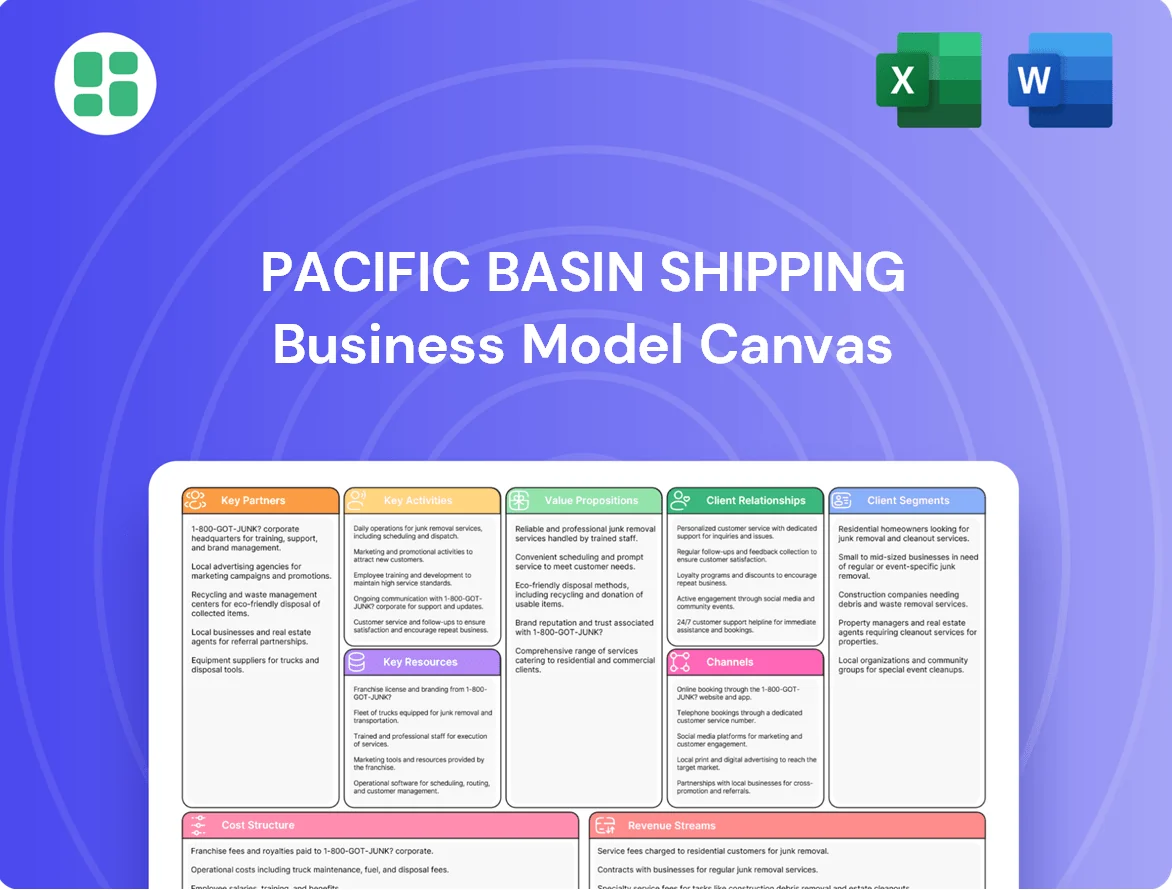
The Pacific Basin Shipping Business Model Canvas you are previewing is the actual document you will receive upon purchase. This isn't a sample or a mockup; it's a direct representation of the complete, ready-to-use file. Once your order is processed, you'll gain full access to this same comprehensive Business Model Canvas, allowing you to immediately leverage its insights for your strategic planning.

Product Information
Product Information
Shipping & Returns
Shipping & Returns
Pacific Basin Shipping Business Model Canvas
Pacific Basin Shipping Business Model Canvas
Pacific Basin's Business Model Unveiled!
Unlock the strategic core of Pacific Basin Shipping's operations with our comprehensive Business Model Canvas. Discover their key partners, value propositions, and revenue streams that drive success in the global shipping industry. This detailed canvas is your essential guide to understanding their competitive advantage.
Dive into the actionable insights of Pacific Basin Shipping's business model. Our full Business Model Canvas breaks down their customer relationships, cost structure, and key resources, offering a clear roadmap to their market dominance. Get the complete blueprint to inform your own strategy.
Partnerships
Shipyards and Equipment Suppliers
Pacific Basin actively partners with shipyards and equipment suppliers to maintain a modern and efficient fleet. These collaborations are vital for new vessel construction, routine dry-docking, and integrating specialized, advanced equipment, which directly supports fleet renewal and technological upgrades.
These strategic alliances are fundamental to Pacific Basin's long-term competitiveness and its commitment to decarbonization. For instance, the company recently secured contracts for four dual-fuel Ultramax newbuilding vessels, designed for lower emissions, highlighting the importance of these supplier relationships in achieving sustainability targets.
Cargo Owners and Charterers
Pacific Basin’s core strength lies in its enduring ties with cargo owners and charterers, including major industrial users, traders, and producers of dry bulk commodities. These relationships are the bedrock of their business, ensuring consistent cargo flow and predictable revenue. In 2024, the company continued to leverage these partnerships, which are crucial for maintaining high fleet utilization and minimizing costly downtime.
By fostering deep, long-term connections with over 600 customers globally, Pacific Basin secures a steady stream of business. This broad customer base, spanning various commodity sectors, provides resilience and stability, even amidst market fluctuations. These partnerships are not just transactional; they are strategic alliances that support efficient operations and sustained profitability.
Port Authorities and Terminal Operators
Pacific Basin Shipping's key partnerships with port authorities and terminal operators are crucial for its global operations. Effective coordination ensures quick vessel turnaround and efficient cargo handling, directly impacting service reliability for its customers.
In 2024, the company's extensive network saw it calling at 882 ports across 100 countries, highlighting the critical nature of these relationships for minimizing delays and optimizing logistics worldwide.
Financial Institutions and Investors
Pacific Basin's financial backbone relies heavily on its relationships with financial institutions and investors. Securing financing for fleet expansion, working capital, and strategic investments through banks and other financial entities is vital for business growth and stability. Maintaining strong investor relations ensures access to capital markets and supports shareholder value.
These partnerships are crucial for funding new vessel acquisitions and upgrades. For instance, in July 2025, Pacific Basin successfully secured a new US$250 million sustainability-linked credit facility. This demonstrates ongoing access to capital and a commitment to environmentally responsible financing.
- Banks and Financial Institutions: Provide essential debt financing for fleet expansion and operational needs.
- Equity Investors: Supply capital through stock issuance and contribute to shareholder value.
- Credit Rating Agencies: Influence borrowing costs and investor confidence through their assessments.
- Investment Funds: Offer diverse capital sources and strategic investment opportunities.
Maritime Service Providers
Pacific Basin Shipping strategically partners with key maritime service providers to ensure operational excellence and cost-effectiveness. These collaborations are vital for maintaining a modern and efficient fleet. For instance, by working with reputable bunker suppliers, the company can secure fuel at competitive prices, a critical factor given that fuel costs often represent a significant portion of operating expenses for shipping companies. In 2024, the global average price for Very Low Sulphur Fuel Oil (VLSFO) hovered around $600-$700 per metric ton, making efficient procurement paramount.
Furthermore, partnerships with specialized crewing agencies are essential for sourcing and managing skilled seafarers. These agencies provide access to a global pool of qualified officers and ratings, ensuring compliance with international labor conventions and maintaining high standards of crew welfare and training. Similarly, marine insurance providers offer crucial risk management solutions, covering potential liabilities and asset damage. The marine insurance market in 2024 continued to be influenced by geopolitical events and increasing claims, underscoring the importance of robust coverage. Technical management firms also play a role in ensuring the fleet's seaworthiness and compliance with environmental regulations, such as those set by the International Maritime Organization (IMO).
- Bunker Suppliers: Securing cost-effective fuel procurement.
- Crewing Agencies: Accessing skilled and compliant seafarers.
- Marine Insurance Providers: Comprehensive risk coverage for the fleet.
- Technical Management Firms: Ensuring operational efficiency and regulatory adherence.
Strategic Alliances Power Maritime Industry Leadership and Growth
Pacific Basin's success is built on strong relationships with cargo owners and charterers, ensuring consistent demand for its services. These partnerships are the bedrock of their business, guaranteeing steady cargo flow and predictable revenue streams. The company's extensive network of over 600 global customers, spanning diverse commodity sectors, provides resilience and stability, even during market downturns, as seen in their continued high fleet utilization throughout 2024.
Collaborations with shipyards and equipment suppliers are crucial for maintaining a modern, efficient, and increasingly sustainable fleet. These alliances facilitate new vessel construction and technological upgrades, such as the recent contracts for four dual-fuel Ultramax newbuilding vessels designed for lower emissions, directly supporting decarbonization efforts.
Key partnerships with financial institutions and investors are vital for funding fleet expansion and ensuring operational stability. Access to credit facilities, like the US$250 million sustainability-linked credit facility secured in July 2025, underscores the company's ability to finance growth and maintain strong investor confidence.
Essential alliances with maritime service providers, including bunker suppliers and crewing agencies, ensure operational excellence and cost-effectiveness. These partnerships are critical for managing fuel costs, which in 2024 averaged between $600-$700 per metric ton for VLSFO, and for sourcing skilled seafarers.
What is included in the product
Detailed Word Document
A detailed exploration of the Pacific Basin Shipping Business Model Canvas, offering a strategic blueprint for operational success and market positioning.
This canvas comprehensively outlines customer segments, value propositions, and key activities, reflecting real-world shipping operations and strategic planning.
Customizable Excel Spreadsheet
The Pacific Basin Shipping Business Model Canvas acts as a pain point reliever by offering a high-level view of the company’s business model with editable cells, allowing for quick identification of core components.
Activities
Vessel Ownership and Operation
Pacific Basin's core activity revolves around the strategic management and deployment of its extensive fleet of Handysize and Supramax dry bulk vessels. This encompasses meticulous voyage planning, route optimization, and ensuring the safe, efficient transport of a wide array of commodities worldwide.
The company owns and operates a significant number of interchangeable dry bulk ships, allowing for flexibility in responding to market demands and optimizing cargo movements. As of late 2024, Pacific Basin managed a fleet of approximately 240 vessels, a substantial portion of which are owned, demonstrating their commitment to direct operational control.
Fleet Management and Maintenance
Pacific Basin Shipping's key activity of fleet management and maintenance is crucial for delivering reliable services and ensuring operational efficiency. This involves rigorous regular maintenance, timely repairs, and thorough inspections to keep their fleet in top condition. Adherence to stringent safety and environmental regulations is a core component of these activities.
The company places a significant emphasis on the safety, health, and overall wellbeing of its seafarers. Furthermore, continuous efforts are made to optimize fleet performance, specifically targeting improvements in fuel efficiency and reductions in carbon emissions. For instance, in 2024, Pacific Basin Shipping continued its investment in newer, more fuel-efficient vessels as part of its ongoing fleet renewal program.
Chartering and Commercial Management
Pacific Basin actively navigates the dry bulk freight market, securing cargo contracts and negotiating charter rates to optimize vessel utilization. They employ a strategy of balancing spot market opportunities with longer-term charter agreements, a critical approach for maximizing earnings and navigating market volatility.
In 2024, Pacific Basin reported that a substantial portion of its vessel days were covered by charter agreements, demonstrating the effectiveness of their chartering and commercial management in ensuring consistent revenue streams and operational efficiency.
Fuel Procurement and Decarbonization Initiatives
Pacific Basin Shipping's key activities include the strategic procurement of marine fuels, a critical component for operational efficiency and environmental compliance. This involves navigating volatile fuel markets and securing reliable supplies to power their diverse fleet of Handysize and Supramax vessels.
A significant focus is placed on decarbonization initiatives. The company is actively investing in measures to enhance fuel efficiency and reduce its carbon footprint. This strategic direction is underscored by their November 2024 contract for four dual-fuel Ultramax newbuilding vessels, designed to operate on lower-emission fuels and meet increasingly stringent environmental regulations.
- Fuel Procurement: Securing cost-effective and reliable marine fuels, including traditional and alternative options, to maintain fleet operations.
- Fleet Efficiency: Implementing technologies and operational practices to improve fuel consumption across the Handysize and Supramax segments.
- Decarbonization Investment: Committing capital to low-emission vessel newbuildings and exploring future fuel technologies.
- Regulatory Compliance: Proactively adapting to evolving international maritime environmental standards and emissions targets.
Risk Management and Compliance
Pacific Basin Shipping’s key activities include robust risk management and compliance. This involves constantly watching for and reducing operational, financial, and geopolitical risks. Ensuring adherence to international maritime rules, environmental targets, and corporate governance is paramount.
A proactive stance in these areas is crucial for protecting the company's standing and ensuring smooth operations. For instance, in 2024, the shipping industry faced ongoing geopolitical tensions in key trade routes, impacting insurance costs and transit times, which Pacific Basin actively managed.
- Operational Risk: Mitigating risks related to vessel safety, cargo damage, and port congestion.
- Financial Risk: Managing currency fluctuations, interest rate changes, and charter rate volatility.
- Compliance: Adhering to IMO 2020 sulfur cap regulations and other environmental standards.
- Geopolitical Risk: Navigating trade disputes, sanctions, and regional instability affecting shipping lanes.
Global Dry Bulk Shipping: Strategic Fleet Operations & Decarbonization
Pacific Basin's key activities are centered on efficiently managing and operating its large fleet of Handysize and Supramax dry bulk vessels. This includes strategic voyage planning, route optimization, and ensuring the safe, reliable transport of various commodities globally. They actively engage in securing cargo contracts and negotiating charter rates, balancing spot market opportunities with longer-term agreements to maximize earnings and navigate market volatility.
Fleet management and maintenance are paramount, involving rigorous upkeep, timely repairs, and inspections to ensure optimal operational efficiency and safety. The company also focuses on strategic fuel procurement, managing volatile markets to secure reliable supplies, and investing in decarbonization efforts, such as acquiring fuel-efficient newbuildings. Navigating geopolitical and financial risks through robust risk management and compliance with international regulations are also critical ongoing activities.
| Key Activity | Description | 2024 Relevance/Data |
|---|---|---|
| Fleet Operation & Deployment | Managing and optimizing the global movement of dry bulk cargo. | Operated a fleet of approximately 240 vessels in late 2024. |
| Chartering & Commercial Management | Securing cargo and negotiating charter rates. | A substantial portion of vessel days covered by charter agreements in 2024. |
| Fleet Maintenance & Safety | Ensuring vessels are in top condition and adhere to safety standards. | Continuous investment in fleet renewal for efficiency and compliance. |
| Fuel Procurement & Decarbonization | Sourcing marine fuels and investing in lower-emission technologies. | Contracted four dual-fuel Ultramax newbuildings in November 2024. |
| Risk Management & Compliance | Mitigating operational, financial, and geopolitical risks. | Navigated geopolitical tensions impacting shipping lanes in 2024. |
Preview Before You Purchase
Business Model Canvas
The Pacific Basin Shipping Business Model Canvas you are previewing is the actual document you will receive upon purchase. This isn't a sample or a mockup; it's a direct representation of the complete, ready-to-use file. Once your order is processed, you'll gain full access to this same comprehensive Business Model Canvas, allowing you to immediately leverage its insights for your strategic planning.
Product Information
Product Information
Shipping & Returns
Shipping & Returns
Description
Pacific Basin's Business Model Unveiled!
Unlock the strategic core of Pacific Basin Shipping's operations with our comprehensive Business Model Canvas. Discover their key partners, value propositions, and revenue streams that drive success in the global shipping industry. This detailed canvas is your essential guide to understanding their competitive advantage.
Dive into the actionable insights of Pacific Basin Shipping's business model. Our full Business Model Canvas breaks down their customer relationships, cost structure, and key resources, offering a clear roadmap to their market dominance. Get the complete blueprint to inform your own strategy.
Partnerships
Shipyards and Equipment Suppliers
Pacific Basin actively partners with shipyards and equipment suppliers to maintain a modern and efficient fleet. These collaborations are vital for new vessel construction, routine dry-docking, and integrating specialized, advanced equipment, which directly supports fleet renewal and technological upgrades.
These strategic alliances are fundamental to Pacific Basin's long-term competitiveness and its commitment to decarbonization. For instance, the company recently secured contracts for four dual-fuel Ultramax newbuilding vessels, designed for lower emissions, highlighting the importance of these supplier relationships in achieving sustainability targets.
Cargo Owners and Charterers
Pacific Basin’s core strength lies in its enduring ties with cargo owners and charterers, including major industrial users, traders, and producers of dry bulk commodities. These relationships are the bedrock of their business, ensuring consistent cargo flow and predictable revenue. In 2024, the company continued to leverage these partnerships, which are crucial for maintaining high fleet utilization and minimizing costly downtime.
By fostering deep, long-term connections with over 600 customers globally, Pacific Basin secures a steady stream of business. This broad customer base, spanning various commodity sectors, provides resilience and stability, even amidst market fluctuations. These partnerships are not just transactional; they are strategic alliances that support efficient operations and sustained profitability.
Port Authorities and Terminal Operators
Pacific Basin Shipping's key partnerships with port authorities and terminal operators are crucial for its global operations. Effective coordination ensures quick vessel turnaround and efficient cargo handling, directly impacting service reliability for its customers.
In 2024, the company's extensive network saw it calling at 882 ports across 100 countries, highlighting the critical nature of these relationships for minimizing delays and optimizing logistics worldwide.
Financial Institutions and Investors
Pacific Basin's financial backbone relies heavily on its relationships with financial institutions and investors. Securing financing for fleet expansion, working capital, and strategic investments through banks and other financial entities is vital for business growth and stability. Maintaining strong investor relations ensures access to capital markets and supports shareholder value.
These partnerships are crucial for funding new vessel acquisitions and upgrades. For instance, in July 2025, Pacific Basin successfully secured a new US$250 million sustainability-linked credit facility. This demonstrates ongoing access to capital and a commitment to environmentally responsible financing.
- Banks and Financial Institutions: Provide essential debt financing for fleet expansion and operational needs.
- Equity Investors: Supply capital through stock issuance and contribute to shareholder value.
- Credit Rating Agencies: Influence borrowing costs and investor confidence through their assessments.
- Investment Funds: Offer diverse capital sources and strategic investment opportunities.
Maritime Service Providers
Pacific Basin Shipping strategically partners with key maritime service providers to ensure operational excellence and cost-effectiveness. These collaborations are vital for maintaining a modern and efficient fleet. For instance, by working with reputable bunker suppliers, the company can secure fuel at competitive prices, a critical factor given that fuel costs often represent a significant portion of operating expenses for shipping companies. In 2024, the global average price for Very Low Sulphur Fuel Oil (VLSFO) hovered around $600-$700 per metric ton, making efficient procurement paramount.
Furthermore, partnerships with specialized crewing agencies are essential for sourcing and managing skilled seafarers. These agencies provide access to a global pool of qualified officers and ratings, ensuring compliance with international labor conventions and maintaining high standards of crew welfare and training. Similarly, marine insurance providers offer crucial risk management solutions, covering potential liabilities and asset damage. The marine insurance market in 2024 continued to be influenced by geopolitical events and increasing claims, underscoring the importance of robust coverage. Technical management firms also play a role in ensuring the fleet's seaworthiness and compliance with environmental regulations, such as those set by the International Maritime Organization (IMO).
- Bunker Suppliers: Securing cost-effective fuel procurement.
- Crewing Agencies: Accessing skilled and compliant seafarers.
- Marine Insurance Providers: Comprehensive risk coverage for the fleet.
- Technical Management Firms: Ensuring operational efficiency and regulatory adherence.
Strategic Alliances Power Maritime Industry Leadership and Growth
Pacific Basin's success is built on strong relationships with cargo owners and charterers, ensuring consistent demand for its services. These partnerships are the bedrock of their business, guaranteeing steady cargo flow and predictable revenue streams. The company's extensive network of over 600 global customers, spanning diverse commodity sectors, provides resilience and stability, even during market downturns, as seen in their continued high fleet utilization throughout 2024.
Collaborations with shipyards and equipment suppliers are crucial for maintaining a modern, efficient, and increasingly sustainable fleet. These alliances facilitate new vessel construction and technological upgrades, such as the recent contracts for four dual-fuel Ultramax newbuilding vessels designed for lower emissions, directly supporting decarbonization efforts.
Key partnerships with financial institutions and investors are vital for funding fleet expansion and ensuring operational stability. Access to credit facilities, like the US$250 million sustainability-linked credit facility secured in July 2025, underscores the company's ability to finance growth and maintain strong investor confidence.
Essential alliances with maritime service providers, including bunker suppliers and crewing agencies, ensure operational excellence and cost-effectiveness. These partnerships are critical for managing fuel costs, which in 2024 averaged between $600-$700 per metric ton for VLSFO, and for sourcing skilled seafarers.
What is included in the product
Detailed Word Document
A detailed exploration of the Pacific Basin Shipping Business Model Canvas, offering a strategic blueprint for operational success and market positioning.
This canvas comprehensively outlines customer segments, value propositions, and key activities, reflecting real-world shipping operations and strategic planning.
Customizable Excel Spreadsheet
The Pacific Basin Shipping Business Model Canvas acts as a pain point reliever by offering a high-level view of the company’s business model with editable cells, allowing for quick identification of core components.
Activities
Vessel Ownership and Operation
Pacific Basin's core activity revolves around the strategic management and deployment of its extensive fleet of Handysize and Supramax dry bulk vessels. This encompasses meticulous voyage planning, route optimization, and ensuring the safe, efficient transport of a wide array of commodities worldwide.
The company owns and operates a significant number of interchangeable dry bulk ships, allowing for flexibility in responding to market demands and optimizing cargo movements. As of late 2024, Pacific Basin managed a fleet of approximately 240 vessels, a substantial portion of which are owned, demonstrating their commitment to direct operational control.
Fleet Management and Maintenance
Pacific Basin Shipping's key activity of fleet management and maintenance is crucial for delivering reliable services and ensuring operational efficiency. This involves rigorous regular maintenance, timely repairs, and thorough inspections to keep their fleet in top condition. Adherence to stringent safety and environmental regulations is a core component of these activities.
The company places a significant emphasis on the safety, health, and overall wellbeing of its seafarers. Furthermore, continuous efforts are made to optimize fleet performance, specifically targeting improvements in fuel efficiency and reductions in carbon emissions. For instance, in 2024, Pacific Basin Shipping continued its investment in newer, more fuel-efficient vessels as part of its ongoing fleet renewal program.
Chartering and Commercial Management
Pacific Basin actively navigates the dry bulk freight market, securing cargo contracts and negotiating charter rates to optimize vessel utilization. They employ a strategy of balancing spot market opportunities with longer-term charter agreements, a critical approach for maximizing earnings and navigating market volatility.
In 2024, Pacific Basin reported that a substantial portion of its vessel days were covered by charter agreements, demonstrating the effectiveness of their chartering and commercial management in ensuring consistent revenue streams and operational efficiency.
Fuel Procurement and Decarbonization Initiatives
Pacific Basin Shipping's key activities include the strategic procurement of marine fuels, a critical component for operational efficiency and environmental compliance. This involves navigating volatile fuel markets and securing reliable supplies to power their diverse fleet of Handysize and Supramax vessels.
A significant focus is placed on decarbonization initiatives. The company is actively investing in measures to enhance fuel efficiency and reduce its carbon footprint. This strategic direction is underscored by their November 2024 contract for four dual-fuel Ultramax newbuilding vessels, designed to operate on lower-emission fuels and meet increasingly stringent environmental regulations.
- Fuel Procurement: Securing cost-effective and reliable marine fuels, including traditional and alternative options, to maintain fleet operations.
- Fleet Efficiency: Implementing technologies and operational practices to improve fuel consumption across the Handysize and Supramax segments.
- Decarbonization Investment: Committing capital to low-emission vessel newbuildings and exploring future fuel technologies.
- Regulatory Compliance: Proactively adapting to evolving international maritime environmental standards and emissions targets.
Risk Management and Compliance
Pacific Basin Shipping’s key activities include robust risk management and compliance. This involves constantly watching for and reducing operational, financial, and geopolitical risks. Ensuring adherence to international maritime rules, environmental targets, and corporate governance is paramount.
A proactive stance in these areas is crucial for protecting the company's standing and ensuring smooth operations. For instance, in 2024, the shipping industry faced ongoing geopolitical tensions in key trade routes, impacting insurance costs and transit times, which Pacific Basin actively managed.
- Operational Risk: Mitigating risks related to vessel safety, cargo damage, and port congestion.
- Financial Risk: Managing currency fluctuations, interest rate changes, and charter rate volatility.
- Compliance: Adhering to IMO 2020 sulfur cap regulations and other environmental standards.
- Geopolitical Risk: Navigating trade disputes, sanctions, and regional instability affecting shipping lanes.
Global Dry Bulk Shipping: Strategic Fleet Operations & Decarbonization
Pacific Basin's key activities are centered on efficiently managing and operating its large fleet of Handysize and Supramax dry bulk vessels. This includes strategic voyage planning, route optimization, and ensuring the safe, reliable transport of various commodities globally. They actively engage in securing cargo contracts and negotiating charter rates, balancing spot market opportunities with longer-term agreements to maximize earnings and navigate market volatility.
Fleet management and maintenance are paramount, involving rigorous upkeep, timely repairs, and inspections to ensure optimal operational efficiency and safety. The company also focuses on strategic fuel procurement, managing volatile markets to secure reliable supplies, and investing in decarbonization efforts, such as acquiring fuel-efficient newbuildings. Navigating geopolitical and financial risks through robust risk management and compliance with international regulations are also critical ongoing activities.
| Key Activity | Description | 2024 Relevance/Data |
|---|---|---|
| Fleet Operation & Deployment | Managing and optimizing the global movement of dry bulk cargo. | Operated a fleet of approximately 240 vessels in late 2024. |
| Chartering & Commercial Management | Securing cargo and negotiating charter rates. | A substantial portion of vessel days covered by charter agreements in 2024. |
| Fleet Maintenance & Safety | Ensuring vessels are in top condition and adhere to safety standards. | Continuous investment in fleet renewal for efficiency and compliance. |
| Fuel Procurement & Decarbonization | Sourcing marine fuels and investing in lower-emission technologies. | Contracted four dual-fuel Ultramax newbuildings in November 2024. |
| Risk Management & Compliance | Mitigating operational, financial, and geopolitical risks. | Navigated geopolitical tensions impacting shipping lanes in 2024. |
Preview Before You Purchase
Business Model Canvas
The Pacific Basin Shipping Business Model Canvas you are previewing is the actual document you will receive upon purchase. This isn't a sample or a mockup; it's a direct representation of the complete, ready-to-use file. Once your order is processed, you'll gain full access to this same comprehensive Business Model Canvas, allowing you to immediately leverage its insights for your strategic planning.