Ferrovial SWOT Analysis

Make Insightful Decisions Backed by Expert Research
Ferrovial's robust infrastructure expertise and global diversification are significant strengths, but potential regulatory shifts and economic downturns present key challenges. Understanding these dynamics is crucial for navigating the competitive landscape.
Want the full story behind Ferrovial's strengths, risks, and growth drivers? Purchase the complete SWOT analysis to gain access to a professionally written, fully editable report designed to support planning, pitches, and research.
Strengths

Global Leadership and Strong Market Position
Ferrovial stands as a preeminent global force in infrastructure, particularly renowned for its extensive portfolio of transportation assets, including major highways and airports. This strong, established market position offers a substantial competitive edge and a robust platform for future expansion.
The company's comprehensive expertise covers the full spectrum of infrastructure development, from initial planning and financing through to construction and ongoing operation. This end-to-end capability allows Ferrovial to deliver integrated, high-quality solutions and manage assets effectively throughout their lifecycle.
Robust Financial Performance and Liquidity
Ferrovial has showcased impressive financial performance, with significant revenue and adjusted EBITDA growth reported throughout 2024 and into Q1/H1 2025. This consistent upward trend highlights the company's operational efficiency and market demand for its services.
The company maintains a robust liquidity position and a net cash balance, even when excluding its extensive infrastructure project investments. This financial health provides substantial flexibility for strategic capital allocation.
This strong financial footing empowers Ferrovial to readily fund new growth opportunities, manage shareholder returns effectively, and navigate potential economic downturns with resilience, ensuring continued operational stability and expansion.

Strategic Focus on North American Growth
Ferrovial's strategic emphasis on North America, especially the U.S. and Canada, is a major strength. This region now represents a substantial part of the company's equity value and its backlog of projects.
This concentrated effort in a stable and expanding market is paying off. Successful projects like managed lanes and the significant JFK New Terminal One development at JFK Airport are prime examples of this strategic success, setting the stage for ongoing strong performance.
The North American market presents a robust pipeline of critical infrastructure projects. This provides Ferrovial with ample opportunities for future growth and continued business development.

Integrated Business Model and Expertise
Ferrovial's strength lies in its integrated business model, spanning Highways, Airports, Construction, and Energy. This allows for vertical integration across project lifecycles, from initial design to long-term operation. Such a comprehensive approach, as demonstrated by their involvement in major infrastructure projects, ensures greater efficiency and quality control.
This integrated capability is crucial for undertaking complex, large-scale developments. For instance, Ferrovial's Airports division, which managed over 230 million passengers in 2023, benefits from the company's construction expertise for terminal expansions and upgrades. This synergy reduces reliance on external contractors and enhances overall project value creation.
- Vertical Integration: Controls all stages of infrastructure development and management.
- Efficiency Gains: Streamlined processes from design to operation reduce costs and timelines.
- Risk Mitigation: Reduced dependence on external partners for critical project phases.
- Complex Project Capability: Ability to manage large-scale, multifaceted infrastructure initiatives.
Commitment to Sustainability and ESG
Ferrovial demonstrates a significant commitment to sustainability by embedding Environmental, Social, and Governance (ESG) principles across its business. This dedication is underscored by ambitious goals for reducing emissions and water usage, coupled with substantial investments in renewable energy infrastructure like solar farms, reflecting a forward-looking approach to environmental stewardship.
This strong ESG focus is not merely aspirational; it translates into tangible actions and strategic advantages. For instance, Ferrovial has pledged to achieve carbon neutrality by 2050 and has set interim targets to reduce its Scope 1 and 2 emissions by 42% by 2030 compared to a 2019 baseline. The company's investment in green energy projects, such as the 600 MW solar farm in Texas, showcases its active role in the energy transition.
- Ambitious Emission Reduction Targets: Ferrovial aims for a 42% reduction in Scope 1 and 2 emissions by 2030 (vs. 2019).
- Investment in Green Energy: Significant capital allocated to renewable energy projects, including a 600 MW solar farm in Texas.
- ESG Appeal: Enhanced attractiveness to investors and stakeholders prioritizing sustainable and responsible business practices.
- Water Footprint Management: Active strategies to minimize water consumption and impact across operations.
Infrastructure Powerhouse: Financial Strength, North American Focus, Sustainable Growth
Ferrovial's strong financial health is a significant asset, demonstrated by its robust liquidity and net cash position, even after accounting for substantial infrastructure investments. This financial stability provides considerable flexibility for strategic capital deployment, enabling the company to pursue new growth avenues and manage shareholder returns effectively.
The company's strategic focus on North America, particularly the U.S. and Canada, is a key strength, with this region now constituting a large portion of its equity value and project backlog. Successful projects like managed lanes and the JFK New Terminal One development highlight the effectiveness of this regional concentration, positioning Ferrovial for continued strong performance in a market with a rich pipeline of infrastructure needs.
Ferrovial's integrated business model, encompassing Highways, Airports, Construction, and Energy, allows for vertical integration across the entire project lifecycle, from planning and financing to construction and long-term operation. This end-to-end capability, as evidenced by their management of over 230 million passengers in their Airports division in 2023, fosters greater efficiency, quality control, and risk mitigation, particularly for complex, large-scale developments.
The company's commitment to sustainability, with ambitious ESG goals including a 42% reduction in Scope 1 and 2 emissions by 2030 (compared to 2019) and significant investments in renewable energy like a 600 MW solar farm in Texas, enhances its appeal to investors and positions it favorably in the evolving energy landscape.
| Strength | Description | Supporting Data/Examples |
| Financial Stability | Robust liquidity and net cash position. | Provides flexibility for strategic capital allocation and funding growth. |
| North American Focus | Significant presence and project backlog in the U.S. and Canada. | JFK New Terminal One development; strong pipeline of projects. |
| Integrated Business Model | End-to-end capabilities across infrastructure lifecycle. | Airports division handled over 230 million passengers in 2023; efficiency in complex projects. |
| Sustainability Commitment | Ambitious ESG goals and investments in renewables. | Targeting 42% Scope 1 & 2 emission reduction by 2030; 600 MW solar farm in Texas. |
What is included in the product
 Detailed Word Document
Delivers a strategic overview of Ferrovial’s internal and external business factors, highlighting its strengths in infrastructure development and international presence, while identifying potential weaknesses in project execution and opportunities in sustainable infrastructure.

 Customizable Excel Spreadsheet
Offers a clear, actionable framework to identify and address Ferrovial's strategic challenges and opportunities.
Weaknesses

Exposure to Macroeconomic Volatility
Ferrovial's reliance on concession-based infrastructure, a significant portion of its portfolio, leaves it exposed to macroeconomic volatility. Factors like inflation, interest rate shifts, and currency fluctuations can directly impact project profitability and financing costs. While some toll roads are indexed to inflation, sustained high inflation can still erode margins by increasing operational expenses faster than toll revenue can adjust.
The company's financial health is also sensitive to interest rate environments. For instance, rising interest rates in 2023 and projected for 2024 could increase the cost of servicing existing debt and make new project financing more expensive. This sensitivity was highlighted in their 2023 financial reports, where financing costs were a notable factor in their results.
Concentration Risk in Key Geographies
Ferrovial's significant strategic focus and investment concentration in North America, particularly in the United States, presents a notable weakness. While this market offers substantial growth prospects, an over-reliance on a single geographic region exposes the company to specific economic downturns, regulatory shifts, or political instability within those countries.
For instance, as of the first half of 2024, North America accounted for approximately 60% of Ferrovial's revenue, highlighting this concentration. This dependence means that adverse events impacting the US or Canadian markets could disproportionately affect the company's overall financial performance, despite its efforts towards broader geographic diversification.

High Capital Expenditure Requirements
Ferrovial's commitment to developing and operating large-scale infrastructure, particularly new greenfield projects, necessitates significant upfront capital. This high capital expenditure profile can strain financial resources, especially in the current climate of elevated interest rates, potentially increasing financial risk.
The extended payback periods typical for these infrastructure assets mean that capital can remain tied up for considerable lengths of time. For instance, major projects like airport expansions or toll road constructions often have multi-decade concession periods, impacting liquidity and requiring robust long-term financial planning.

Intense Competition in the Infrastructure Sector
Ferrovial navigates a fiercely competitive global infrastructure and construction landscape, contending with established multinational players. This intense rivalry directly impacts pricing strategies and can compress profit margins during the crucial bidding phases for lucrative projects. The drive to secure new, high-value contracts necessitates substantial investment in tender preparation, further straining resources.
For instance, in the 2023 fiscal year, the global infrastructure market saw significant bidding activity, with major players like Vinci and ACS frequently competing for large-scale projects. Ferrovial's success in these tenders is vital, but the pressure to offer competitive bids can limit the profitability of secured contracts. The company must continuously innovate and demonstrate value to stand out against a backdrop of numerous capable competitors, each vying for a share of global infrastructure development.
- Intense Global Competition: Ferrovial faces strong rivalry from major multinational infrastructure firms.
- Pricing Pressure: Competition leads to pressure on pricing and potentially lower profit margins on bids.
- Tender Costs: Securing new contracts requires significant expenditure on competitive bidding processes.
Workforce and Supply Chain Challenges
The construction and infrastructure sector, including Ferrovial, continues to grapple with significant workforce and supply chain disruptions. Skilled labor shortages remain a persistent issue, impacting project execution and potentially extending timelines. For instance, in the UK, a recent industry report indicated a shortage of around 200,000 skilled workers needed to meet projected infrastructure demand through 2027, a trend likely to affect companies like Ferrovial.
Material cost volatility and supply chain disruptions pose further risks. The ongoing global economic climate means that the price of key construction materials, such as steel and concrete, can fluctuate unpredictably. This volatility, coupled with potential delays in material delivery, can directly impact Ferrovial's operational costs and the profitability of its extensive order book, which stood at €16.3 billion as of the first quarter of 2024.
- Skilled Labor Shortages: Affecting project timelines and increasing labor costs across the industry.
- Material Cost Volatility: Fluctuations in prices for steel, concrete, and other essential materials impact project budgets.
- Supply Chain Disruptions: Potential delays in material delivery can lead to project scheduling issues.
- Profitability Impact: These challenges could compress profit margins on existing and future projects for Ferrovial.
Infrastructure Firm Faces Macroeconomic and Operational Headwinds
Ferrovial's significant exposure to concession-based infrastructure makes it vulnerable to economic downturns and interest rate hikes. The company's heavy reliance on North America, accounting for around 60% of its revenue in the first half of 2024, also poses a risk due to potential regional economic or political instability.
High capital expenditure for new projects, coupled with long payback periods, can strain financial resources and liquidity. Furthermore, intense global competition in the infrastructure sector exerts pressure on pricing and profit margins, while labor shortages and material cost volatility in 2023-2024 impact project execution and profitability.
| Weakness | Description | Impact |
| Macroeconomic Sensitivity | Reliance on concessions vulnerable to inflation, interest rates, and currency fluctuations. | Erodes margins, increases financing costs. |
| Geographic Concentration | Over 60% of H1 2024 revenue from North America. | Exposes company to specific regional economic or political risks. |
| High Capital Expenditure | Significant upfront investment for large-scale projects with long payback periods. | Strains financial resources, increases financial risk, ties up liquidity. |
| Intense Competition | Facing established multinational players in global infrastructure. | Leads to pricing pressure and reduced profit margins on bids. |
| Operational Challenges | Skilled labor shortages and material cost volatility (2023-2024). | Impacts project timelines, increases costs, compresses profit margins. |
Same Document Delivered
Ferrovial SWOT Analysis
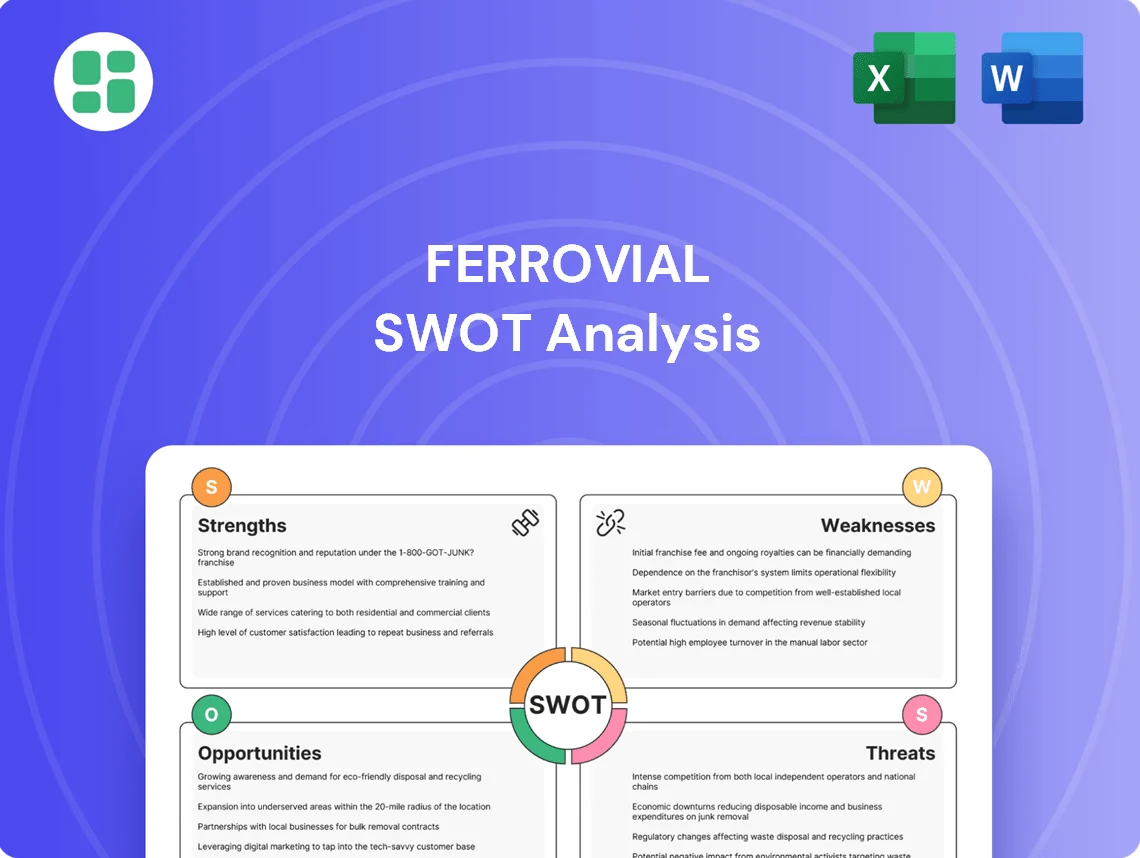
This is the actual SWOT analysis document you’ll receive upon purchase—no surprises, just professional quality. You're seeing a genuine snapshot of the comprehensive Ferrovial SWOT, ready to inform your strategic decisions.
The preview below is taken directly from the full SWOT report you'll get. Purchase unlocks the entire in-depth version, offering a complete picture of Ferrovial's strategic landscape.
This preview reflects the real document you'll receive—professional, structured, and ready to use. It showcases the depth and clarity of our Ferrovial SWOT analysis.

Product Information
Product Information
Shipping & Returns
Shipping & Returns
Ferrovial SWOT Analysis
Ferrovial SWOT Analysis
Make Insightful Decisions Backed by Expert Research
Ferrovial's robust infrastructure expertise and global diversification are significant strengths, but potential regulatory shifts and economic downturns present key challenges. Understanding these dynamics is crucial for navigating the competitive landscape.
Want the full story behind Ferrovial's strengths, risks, and growth drivers? Purchase the complete SWOT analysis to gain access to a professionally written, fully editable report designed to support planning, pitches, and research.
Strengths
Global Leadership and Strong Market Position
Ferrovial stands as a preeminent global force in infrastructure, particularly renowned for its extensive portfolio of transportation assets, including major highways and airports. This strong, established market position offers a substantial competitive edge and a robust platform for future expansion.
The company's comprehensive expertise covers the full spectrum of infrastructure development, from initial planning and financing through to construction and ongoing operation. This end-to-end capability allows Ferrovial to deliver integrated, high-quality solutions and manage assets effectively throughout their lifecycle.
Robust Financial Performance and Liquidity
Ferrovial has showcased impressive financial performance, with significant revenue and adjusted EBITDA growth reported throughout 2024 and into Q1/H1 2025. This consistent upward trend highlights the company's operational efficiency and market demand for its services.
The company maintains a robust liquidity position and a net cash balance, even when excluding its extensive infrastructure project investments. This financial health provides substantial flexibility for strategic capital allocation.
This strong financial footing empowers Ferrovial to readily fund new growth opportunities, manage shareholder returns effectively, and navigate potential economic downturns with resilience, ensuring continued operational stability and expansion.
Strategic Focus on North American Growth
Ferrovial's strategic emphasis on North America, especially the U.S. and Canada, is a major strength. This region now represents a substantial part of the company's equity value and its backlog of projects.
This concentrated effort in a stable and expanding market is paying off. Successful projects like managed lanes and the significant JFK New Terminal One development at JFK Airport are prime examples of this strategic success, setting the stage for ongoing strong performance.
The North American market presents a robust pipeline of critical infrastructure projects. This provides Ferrovial with ample opportunities for future growth and continued business development.
Integrated Business Model and Expertise
Ferrovial's strength lies in its integrated business model, spanning Highways, Airports, Construction, and Energy. This allows for vertical integration across project lifecycles, from initial design to long-term operation. Such a comprehensive approach, as demonstrated by their involvement in major infrastructure projects, ensures greater efficiency and quality control.
This integrated capability is crucial for undertaking complex, large-scale developments. For instance, Ferrovial's Airports division, which managed over 230 million passengers in 2023, benefits from the company's construction expertise for terminal expansions and upgrades. This synergy reduces reliance on external contractors and enhances overall project value creation.
- Vertical Integration: Controls all stages of infrastructure development and management.
- Efficiency Gains: Streamlined processes from design to operation reduce costs and timelines.
- Risk Mitigation: Reduced dependence on external partners for critical project phases.
- Complex Project Capability: Ability to manage large-scale, multifaceted infrastructure initiatives.
Commitment to Sustainability and ESG
Ferrovial demonstrates a significant commitment to sustainability by embedding Environmental, Social, and Governance (ESG) principles across its business. This dedication is underscored by ambitious goals for reducing emissions and water usage, coupled with substantial investments in renewable energy infrastructure like solar farms, reflecting a forward-looking approach to environmental stewardship.
This strong ESG focus is not merely aspirational; it translates into tangible actions and strategic advantages. For instance, Ferrovial has pledged to achieve carbon neutrality by 2050 and has set interim targets to reduce its Scope 1 and 2 emissions by 42% by 2030 compared to a 2019 baseline. The company's investment in green energy projects, such as the 600 MW solar farm in Texas, showcases its active role in the energy transition.
- Ambitious Emission Reduction Targets: Ferrovial aims for a 42% reduction in Scope 1 and 2 emissions by 2030 (vs. 2019).
- Investment in Green Energy: Significant capital allocated to renewable energy projects, including a 600 MW solar farm in Texas.
- ESG Appeal: Enhanced attractiveness to investors and stakeholders prioritizing sustainable and responsible business practices.
- Water Footprint Management: Active strategies to minimize water consumption and impact across operations.
Infrastructure Powerhouse: Financial Strength, North American Focus, Sustainable Growth
Ferrovial's strong financial health is a significant asset, demonstrated by its robust liquidity and net cash position, even after accounting for substantial infrastructure investments. This financial stability provides considerable flexibility for strategic capital deployment, enabling the company to pursue new growth avenues and manage shareholder returns effectively.
The company's strategic focus on North America, particularly the U.S. and Canada, is a key strength, with this region now constituting a large portion of its equity value and project backlog. Successful projects like managed lanes and the JFK New Terminal One development highlight the effectiveness of this regional concentration, positioning Ferrovial for continued strong performance in a market with a rich pipeline of infrastructure needs.
Ferrovial's integrated business model, encompassing Highways, Airports, Construction, and Energy, allows for vertical integration across the entire project lifecycle, from planning and financing to construction and long-term operation. This end-to-end capability, as evidenced by their management of over 230 million passengers in their Airports division in 2023, fosters greater efficiency, quality control, and risk mitigation, particularly for complex, large-scale developments.
The company's commitment to sustainability, with ambitious ESG goals including a 42% reduction in Scope 1 and 2 emissions by 2030 (compared to 2019) and significant investments in renewable energy like a 600 MW solar farm in Texas, enhances its appeal to investors and positions it favorably in the evolving energy landscape.
| Strength | Description | Supporting Data/Examples |
| Financial Stability | Robust liquidity and net cash position. | Provides flexibility for strategic capital allocation and funding growth. |
| North American Focus | Significant presence and project backlog in the U.S. and Canada. | JFK New Terminal One development; strong pipeline of projects. |
| Integrated Business Model | End-to-end capabilities across infrastructure lifecycle. | Airports division handled over 230 million passengers in 2023; efficiency in complex projects. |
| Sustainability Commitment | Ambitious ESG goals and investments in renewables. | Targeting 42% Scope 1 & 2 emission reduction by 2030; 600 MW solar farm in Texas. |
What is included in the product
Detailed Word Document
Delivers a strategic overview of Ferrovial’s internal and external business factors, highlighting its strengths in infrastructure development and international presence, while identifying potential weaknesses in project execution and opportunities in sustainable infrastructure.
Customizable Excel Spreadsheet
Offers a clear, actionable framework to identify and address Ferrovial's strategic challenges and opportunities.
Weaknesses
Exposure to Macroeconomic Volatility
Ferrovial's reliance on concession-based infrastructure, a significant portion of its portfolio, leaves it exposed to macroeconomic volatility. Factors like inflation, interest rate shifts, and currency fluctuations can directly impact project profitability and financing costs. While some toll roads are indexed to inflation, sustained high inflation can still erode margins by increasing operational expenses faster than toll revenue can adjust.
The company's financial health is also sensitive to interest rate environments. For instance, rising interest rates in 2023 and projected for 2024 could increase the cost of servicing existing debt and make new project financing more expensive. This sensitivity was highlighted in their 2023 financial reports, where financing costs were a notable factor in their results.
Concentration Risk in Key Geographies
Ferrovial's significant strategic focus and investment concentration in North America, particularly in the United States, presents a notable weakness. While this market offers substantial growth prospects, an over-reliance on a single geographic region exposes the company to specific economic downturns, regulatory shifts, or political instability within those countries.
For instance, as of the first half of 2024, North America accounted for approximately 60% of Ferrovial's revenue, highlighting this concentration. This dependence means that adverse events impacting the US or Canadian markets could disproportionately affect the company's overall financial performance, despite its efforts towards broader geographic diversification.
High Capital Expenditure Requirements
Ferrovial's commitment to developing and operating large-scale infrastructure, particularly new greenfield projects, necessitates significant upfront capital. This high capital expenditure profile can strain financial resources, especially in the current climate of elevated interest rates, potentially increasing financial risk.
The extended payback periods typical for these infrastructure assets mean that capital can remain tied up for considerable lengths of time. For instance, major projects like airport expansions or toll road constructions often have multi-decade concession periods, impacting liquidity and requiring robust long-term financial planning.
Intense Competition in the Infrastructure Sector
Ferrovial navigates a fiercely competitive global infrastructure and construction landscape, contending with established multinational players. This intense rivalry directly impacts pricing strategies and can compress profit margins during the crucial bidding phases for lucrative projects. The drive to secure new, high-value contracts necessitates substantial investment in tender preparation, further straining resources.
For instance, in the 2023 fiscal year, the global infrastructure market saw significant bidding activity, with major players like Vinci and ACS frequently competing for large-scale projects. Ferrovial's success in these tenders is vital, but the pressure to offer competitive bids can limit the profitability of secured contracts. The company must continuously innovate and demonstrate value to stand out against a backdrop of numerous capable competitors, each vying for a share of global infrastructure development.
- Intense Global Competition: Ferrovial faces strong rivalry from major multinational infrastructure firms.
- Pricing Pressure: Competition leads to pressure on pricing and potentially lower profit margins on bids.
- Tender Costs: Securing new contracts requires significant expenditure on competitive bidding processes.
Workforce and Supply Chain Challenges
The construction and infrastructure sector, including Ferrovial, continues to grapple with significant workforce and supply chain disruptions. Skilled labor shortages remain a persistent issue, impacting project execution and potentially extending timelines. For instance, in the UK, a recent industry report indicated a shortage of around 200,000 skilled workers needed to meet projected infrastructure demand through 2027, a trend likely to affect companies like Ferrovial.
Material cost volatility and supply chain disruptions pose further risks. The ongoing global economic climate means that the price of key construction materials, such as steel and concrete, can fluctuate unpredictably. This volatility, coupled with potential delays in material delivery, can directly impact Ferrovial's operational costs and the profitability of its extensive order book, which stood at €16.3 billion as of the first quarter of 2024.
- Skilled Labor Shortages: Affecting project timelines and increasing labor costs across the industry.
- Material Cost Volatility: Fluctuations in prices for steel, concrete, and other essential materials impact project budgets.
- Supply Chain Disruptions: Potential delays in material delivery can lead to project scheduling issues.
- Profitability Impact: These challenges could compress profit margins on existing and future projects for Ferrovial.
Infrastructure Firm Faces Macroeconomic and Operational Headwinds
Ferrovial's significant exposure to concession-based infrastructure makes it vulnerable to economic downturns and interest rate hikes. The company's heavy reliance on North America, accounting for around 60% of its revenue in the first half of 2024, also poses a risk due to potential regional economic or political instability.
High capital expenditure for new projects, coupled with long payback periods, can strain financial resources and liquidity. Furthermore, intense global competition in the infrastructure sector exerts pressure on pricing and profit margins, while labor shortages and material cost volatility in 2023-2024 impact project execution and profitability.
| Weakness | Description | Impact |
| Macroeconomic Sensitivity | Reliance on concessions vulnerable to inflation, interest rates, and currency fluctuations. | Erodes margins, increases financing costs. |
| Geographic Concentration | Over 60% of H1 2024 revenue from North America. | Exposes company to specific regional economic or political risks. |
| High Capital Expenditure | Significant upfront investment for large-scale projects with long payback periods. | Strains financial resources, increases financial risk, ties up liquidity. |
| Intense Competition | Facing established multinational players in global infrastructure. | Leads to pricing pressure and reduced profit margins on bids. |
| Operational Challenges | Skilled labor shortages and material cost volatility (2023-2024). | Impacts project timelines, increases costs, compresses profit margins. |
Same Document Delivered
Ferrovial SWOT Analysis
This is the actual SWOT analysis document you’ll receive upon purchase—no surprises, just professional quality. You're seeing a genuine snapshot of the comprehensive Ferrovial SWOT, ready to inform your strategic decisions.
The preview below is taken directly from the full SWOT report you'll get. Purchase unlocks the entire in-depth version, offering a complete picture of Ferrovial's strategic landscape.
This preview reflects the real document you'll receive—professional, structured, and ready to use. It showcases the depth and clarity of our Ferrovial SWOT analysis.
Product Information
Product Information
Shipping & Returns
Shipping & Returns
Description
Make Insightful Decisions Backed by Expert Research
Ferrovial's robust infrastructure expertise and global diversification are significant strengths, but potential regulatory shifts and economic downturns present key challenges. Understanding these dynamics is crucial for navigating the competitive landscape.
Want the full story behind Ferrovial's strengths, risks, and growth drivers? Purchase the complete SWOT analysis to gain access to a professionally written, fully editable report designed to support planning, pitches, and research.
Strengths
Global Leadership and Strong Market Position
Ferrovial stands as a preeminent global force in infrastructure, particularly renowned for its extensive portfolio of transportation assets, including major highways and airports. This strong, established market position offers a substantial competitive edge and a robust platform for future expansion.
The company's comprehensive expertise covers the full spectrum of infrastructure development, from initial planning and financing through to construction and ongoing operation. This end-to-end capability allows Ferrovial to deliver integrated, high-quality solutions and manage assets effectively throughout their lifecycle.
Robust Financial Performance and Liquidity
Ferrovial has showcased impressive financial performance, with significant revenue and adjusted EBITDA growth reported throughout 2024 and into Q1/H1 2025. This consistent upward trend highlights the company's operational efficiency and market demand for its services.
The company maintains a robust liquidity position and a net cash balance, even when excluding its extensive infrastructure project investments. This financial health provides substantial flexibility for strategic capital allocation.
This strong financial footing empowers Ferrovial to readily fund new growth opportunities, manage shareholder returns effectively, and navigate potential economic downturns with resilience, ensuring continued operational stability and expansion.
Strategic Focus on North American Growth
Ferrovial's strategic emphasis on North America, especially the U.S. and Canada, is a major strength. This region now represents a substantial part of the company's equity value and its backlog of projects.
This concentrated effort in a stable and expanding market is paying off. Successful projects like managed lanes and the significant JFK New Terminal One development at JFK Airport are prime examples of this strategic success, setting the stage for ongoing strong performance.
The North American market presents a robust pipeline of critical infrastructure projects. This provides Ferrovial with ample opportunities for future growth and continued business development.
Integrated Business Model and Expertise
Ferrovial's strength lies in its integrated business model, spanning Highways, Airports, Construction, and Energy. This allows for vertical integration across project lifecycles, from initial design to long-term operation. Such a comprehensive approach, as demonstrated by their involvement in major infrastructure projects, ensures greater efficiency and quality control.
This integrated capability is crucial for undertaking complex, large-scale developments. For instance, Ferrovial's Airports division, which managed over 230 million passengers in 2023, benefits from the company's construction expertise for terminal expansions and upgrades. This synergy reduces reliance on external contractors and enhances overall project value creation.
- Vertical Integration: Controls all stages of infrastructure development and management.
- Efficiency Gains: Streamlined processes from design to operation reduce costs and timelines.
- Risk Mitigation: Reduced dependence on external partners for critical project phases.
- Complex Project Capability: Ability to manage large-scale, multifaceted infrastructure initiatives.
Commitment to Sustainability and ESG
Ferrovial demonstrates a significant commitment to sustainability by embedding Environmental, Social, and Governance (ESG) principles across its business. This dedication is underscored by ambitious goals for reducing emissions and water usage, coupled with substantial investments in renewable energy infrastructure like solar farms, reflecting a forward-looking approach to environmental stewardship.
This strong ESG focus is not merely aspirational; it translates into tangible actions and strategic advantages. For instance, Ferrovial has pledged to achieve carbon neutrality by 2050 and has set interim targets to reduce its Scope 1 and 2 emissions by 42% by 2030 compared to a 2019 baseline. The company's investment in green energy projects, such as the 600 MW solar farm in Texas, showcases its active role in the energy transition.
- Ambitious Emission Reduction Targets: Ferrovial aims for a 42% reduction in Scope 1 and 2 emissions by 2030 (vs. 2019).
- Investment in Green Energy: Significant capital allocated to renewable energy projects, including a 600 MW solar farm in Texas.
- ESG Appeal: Enhanced attractiveness to investors and stakeholders prioritizing sustainable and responsible business practices.
- Water Footprint Management: Active strategies to minimize water consumption and impact across operations.
Infrastructure Powerhouse: Financial Strength, North American Focus, Sustainable Growth
Ferrovial's strong financial health is a significant asset, demonstrated by its robust liquidity and net cash position, even after accounting for substantial infrastructure investments. This financial stability provides considerable flexibility for strategic capital deployment, enabling the company to pursue new growth avenues and manage shareholder returns effectively.
The company's strategic focus on North America, particularly the U.S. and Canada, is a key strength, with this region now constituting a large portion of its equity value and project backlog. Successful projects like managed lanes and the JFK New Terminal One development highlight the effectiveness of this regional concentration, positioning Ferrovial for continued strong performance in a market with a rich pipeline of infrastructure needs.
Ferrovial's integrated business model, encompassing Highways, Airports, Construction, and Energy, allows for vertical integration across the entire project lifecycle, from planning and financing to construction and long-term operation. This end-to-end capability, as evidenced by their management of over 230 million passengers in their Airports division in 2023, fosters greater efficiency, quality control, and risk mitigation, particularly for complex, large-scale developments.
The company's commitment to sustainability, with ambitious ESG goals including a 42% reduction in Scope 1 and 2 emissions by 2030 (compared to 2019) and significant investments in renewable energy like a 600 MW solar farm in Texas, enhances its appeal to investors and positions it favorably in the evolving energy landscape.
| Strength | Description | Supporting Data/Examples |
| Financial Stability | Robust liquidity and net cash position. | Provides flexibility for strategic capital allocation and funding growth. |
| North American Focus | Significant presence and project backlog in the U.S. and Canada. | JFK New Terminal One development; strong pipeline of projects. |
| Integrated Business Model | End-to-end capabilities across infrastructure lifecycle. | Airports division handled over 230 million passengers in 2023; efficiency in complex projects. |
| Sustainability Commitment | Ambitious ESG goals and investments in renewables. | Targeting 42% Scope 1 & 2 emission reduction by 2030; 600 MW solar farm in Texas. |
What is included in the product
Detailed Word Document
Delivers a strategic overview of Ferrovial’s internal and external business factors, highlighting its strengths in infrastructure development and international presence, while identifying potential weaknesses in project execution and opportunities in sustainable infrastructure.
Customizable Excel Spreadsheet
Offers a clear, actionable framework to identify and address Ferrovial's strategic challenges and opportunities.
Weaknesses
Exposure to Macroeconomic Volatility
Ferrovial's reliance on concession-based infrastructure, a significant portion of its portfolio, leaves it exposed to macroeconomic volatility. Factors like inflation, interest rate shifts, and currency fluctuations can directly impact project profitability and financing costs. While some toll roads are indexed to inflation, sustained high inflation can still erode margins by increasing operational expenses faster than toll revenue can adjust.
The company's financial health is also sensitive to interest rate environments. For instance, rising interest rates in 2023 and projected for 2024 could increase the cost of servicing existing debt and make new project financing more expensive. This sensitivity was highlighted in their 2023 financial reports, where financing costs were a notable factor in their results.
Concentration Risk in Key Geographies
Ferrovial's significant strategic focus and investment concentration in North America, particularly in the United States, presents a notable weakness. While this market offers substantial growth prospects, an over-reliance on a single geographic region exposes the company to specific economic downturns, regulatory shifts, or political instability within those countries.
For instance, as of the first half of 2024, North America accounted for approximately 60% of Ferrovial's revenue, highlighting this concentration. This dependence means that adverse events impacting the US or Canadian markets could disproportionately affect the company's overall financial performance, despite its efforts towards broader geographic diversification.
High Capital Expenditure Requirements
Ferrovial's commitment to developing and operating large-scale infrastructure, particularly new greenfield projects, necessitates significant upfront capital. This high capital expenditure profile can strain financial resources, especially in the current climate of elevated interest rates, potentially increasing financial risk.
The extended payback periods typical for these infrastructure assets mean that capital can remain tied up for considerable lengths of time. For instance, major projects like airport expansions or toll road constructions often have multi-decade concession periods, impacting liquidity and requiring robust long-term financial planning.
Intense Competition in the Infrastructure Sector
Ferrovial navigates a fiercely competitive global infrastructure and construction landscape, contending with established multinational players. This intense rivalry directly impacts pricing strategies and can compress profit margins during the crucial bidding phases for lucrative projects. The drive to secure new, high-value contracts necessitates substantial investment in tender preparation, further straining resources.
For instance, in the 2023 fiscal year, the global infrastructure market saw significant bidding activity, with major players like Vinci and ACS frequently competing for large-scale projects. Ferrovial's success in these tenders is vital, but the pressure to offer competitive bids can limit the profitability of secured contracts. The company must continuously innovate and demonstrate value to stand out against a backdrop of numerous capable competitors, each vying for a share of global infrastructure development.
- Intense Global Competition: Ferrovial faces strong rivalry from major multinational infrastructure firms.
- Pricing Pressure: Competition leads to pressure on pricing and potentially lower profit margins on bids.
- Tender Costs: Securing new contracts requires significant expenditure on competitive bidding processes.
Workforce and Supply Chain Challenges
The construction and infrastructure sector, including Ferrovial, continues to grapple with significant workforce and supply chain disruptions. Skilled labor shortages remain a persistent issue, impacting project execution and potentially extending timelines. For instance, in the UK, a recent industry report indicated a shortage of around 200,000 skilled workers needed to meet projected infrastructure demand through 2027, a trend likely to affect companies like Ferrovial.
Material cost volatility and supply chain disruptions pose further risks. The ongoing global economic climate means that the price of key construction materials, such as steel and concrete, can fluctuate unpredictably. This volatility, coupled with potential delays in material delivery, can directly impact Ferrovial's operational costs and the profitability of its extensive order book, which stood at €16.3 billion as of the first quarter of 2024.
- Skilled Labor Shortages: Affecting project timelines and increasing labor costs across the industry.
- Material Cost Volatility: Fluctuations in prices for steel, concrete, and other essential materials impact project budgets.
- Supply Chain Disruptions: Potential delays in material delivery can lead to project scheduling issues.
- Profitability Impact: These challenges could compress profit margins on existing and future projects for Ferrovial.
Infrastructure Firm Faces Macroeconomic and Operational Headwinds
Ferrovial's significant exposure to concession-based infrastructure makes it vulnerable to economic downturns and interest rate hikes. The company's heavy reliance on North America, accounting for around 60% of its revenue in the first half of 2024, also poses a risk due to potential regional economic or political instability.
High capital expenditure for new projects, coupled with long payback periods, can strain financial resources and liquidity. Furthermore, intense global competition in the infrastructure sector exerts pressure on pricing and profit margins, while labor shortages and material cost volatility in 2023-2024 impact project execution and profitability.
| Weakness | Description | Impact |
| Macroeconomic Sensitivity | Reliance on concessions vulnerable to inflation, interest rates, and currency fluctuations. | Erodes margins, increases financing costs. |
| Geographic Concentration | Over 60% of H1 2024 revenue from North America. | Exposes company to specific regional economic or political risks. |
| High Capital Expenditure | Significant upfront investment for large-scale projects with long payback periods. | Strains financial resources, increases financial risk, ties up liquidity. |
| Intense Competition | Facing established multinational players in global infrastructure. | Leads to pricing pressure and reduced profit margins on bids. |
| Operational Challenges | Skilled labor shortages and material cost volatility (2023-2024). | Impacts project timelines, increases costs, compresses profit margins. |
Same Document Delivered
Ferrovial SWOT Analysis
This is the actual SWOT analysis document you’ll receive upon purchase—no surprises, just professional quality. You're seeing a genuine snapshot of the comprehensive Ferrovial SWOT, ready to inform your strategic decisions.
The preview below is taken directly from the full SWOT report you'll get. Purchase unlocks the entire in-depth version, offering a complete picture of Ferrovial's strategic landscape.
This preview reflects the real document you'll receive—professional, structured, and ready to use. It showcases the depth and clarity of our Ferrovial SWOT analysis.