CRH Business Model Canvas

CRH's Business Model: A Deep Dive
Unlock the core strategies that drive CRH's success with our comprehensive Business Model Canvas. This detailed breakdown illuminates their customer relationships, revenue streams, and key resources, offering a clear roadmap to their market dominance. Discover the actionable insights that can inform your own strategic planning.
Partnerships

Strategic Acquisitions and Mergers
CRH actively engages in strategic acquisitions and mergers, viewing these as crucial partnerships to broaden its geographical presence and diversify its product offerings. This M&A-driven approach is fundamental to its growth strategy.
In 2024 alone, CRH finalized 40 acquisitions totaling approximately $5 billion. These transactions significantly bolster its market penetration and operational capabilities across various regions.
Notable examples include the acquisition of cement and ready-mixed concrete assets in Texas, enhancing its North American footprint, and securing a majority stake in Australia's Adbri Ltd., expanding its reach in the Asia-Pacific market.
Innovation and Technology Collaborations
CRH actively partners with leading global companies and research institutions to spearhead innovation in sustainable construction. These collaborations are crucial for developing next-generation building materials and technologies.
Through CRH Ventures and its dedicated Innovation Center for Sustainable Construction (iCSC), the company actively engages with startups. This strategic approach focuses on areas like developing lower-carbon cement derived from industrial byproducts and re-engineering concrete for carbon neutrality, aiming to significantly reduce the environmental footprint of construction.
For instance, CRH Ventures invested in CarbonCure Technologies, a company that injects captured CO2 into concrete, reducing its carbon footprint. In 2023, CarbonCure announced it had enabled the use of over 200,000 tons of captured CO2 in concrete, equivalent to taking over 43,000 cars off the road for a year.

Supply Chain and Raw Material Suppliers
CRH's key partnerships with supply chain and raw material suppliers are foundational to its vast operations. These relationships ensure a steady flow of essential materials like aggregates, cement components, and asphalt binders, critical for CRH's diverse product portfolio.
For instance, securing reliable sources of granite, limestone, and sandstone is paramount, as these raw materials underpin virtually all construction activities. These partnerships directly impact CRH's ability to meet market demand efficiently.
In 2023, CRH's expenditure on raw materials and supplies was a significant component of its cost of sales, reflecting the scale of these vital collaborations. Effective management of these supplier relationships is therefore instrumental in maintaining production continuity and cost competitiveness.

Government and Public Sector Entities
CRH's key partnerships with government and public sector entities are fundamental to its operations, especially in North America. These collaborations are crucial for securing and executing large-scale infrastructure projects, particularly in the road construction sector. For instance, CRH actively works with state and federal transport authorities to design, build, and maintain extensive road networks, a vital component of national infrastructure.
The company's role as a major road builder means these public sector relationships are indispensable for project planning and delivery. These partnerships ensure CRH is at the forefront of upgrading and maintaining critical transportation arteries. Looking ahead, continued public investment in infrastructure is anticipated to be a significant driver of demand for CRH's diverse product portfolio, especially as we approach 2025.
- Infrastructure Projects: CRH partners with government bodies for major road and infrastructure development.
- Road Network Maintenance: Essential collaboration for upgrading and maintaining extensive road systems.
- Public Investment: Expected continued public spending on infrastructure will support CRH's demand into 2025.
Research and Development Institutions
CRH actively collaborates with research and development institutions to drive innovation in sustainable construction materials and practices. These partnerships focus on critical areas like advanced water management systems, circular economy principles for waste reduction, and decarbonization technologies for the building sector. For instance, in 2024, CRH continued its engagement with leading universities and research centers to pilot new low-carbon concrete formulations, aiming to reduce embodied carbon by up to 30% in specific applications.
These strategic alliances are crucial for CRH to stay ahead of evolving industry standards and environmental regulations. By investing in joint research projects, CRH gains access to cutting-edge scientific expertise and novel technologies. A significant development in 2024 was CRH's participation in a European consortium focused on developing bio-based binders for construction, potentially offering a significant reduction in CO2 emissions compared to traditional cement.
- Advancing Sustainable Technologies: CRH partners with R&D institutions to explore and implement new solutions for water management, circularity, and decarbonization in construction.
- Innovation in Materials: Collaborations focus on developing next-generation materials, such as low-carbon concrete and bio-based binders, to meet environmental targets.
- Industry Leadership: These partnerships ensure CRH remains at the forefront of industry advancements, integrating the latest research into its product development and operational strategies.
Strategic Partnerships: Building Infrastructure and Driving Innovation
CRH's key partnerships extend to its supply chain, ensuring a consistent and high-quality flow of essential raw materials like aggregates, cement components, and asphalt binders. These relationships are critical for maintaining production efficiency and cost-effectiveness across its diverse operations. For example, securing reliable sources of granite and limestone underpins CRH's ability to meet market demand for foundational construction materials.
In 2023, CRH's expenditure on raw materials represented a substantial portion of its cost of sales, highlighting the scale and importance of these supplier collaborations. Effective management of these partnerships is paramount for ensuring operational continuity and competitive pricing.
CRH also actively engages with government and public sector entities, particularly in North America, to secure and execute large-scale infrastructure projects. These collaborations are vital for road construction and maintenance, ensuring CRH's role in developing and upgrading critical transportation networks. Anticipated continued public investment in infrastructure is expected to drive demand for CRH's products through 2025.
| Partnership Type | Key Focus Areas | Impact/Significance |
| Strategic Acquisitions & Mergers | Geographic expansion, product diversification | Fundamental to growth strategy; 40 acquisitions totaling ~$5 billion in 2024 |
| Startups & Innovation Centers | Sustainable construction, low-carbon materials | Developing next-gen materials like CO2-injected concrete; CRH Ventures investment in CarbonCure |
| Supply Chain & Raw Material Suppliers | Consistent material flow (aggregates, cement, asphalt) | Ensures production continuity and cost competitiveness; significant 2023 raw material expenditure |
| Government & Public Sector | Infrastructure projects, road construction/maintenance | Crucial for securing and executing large projects; supports demand through public investment |
What is included in the product
 Detailed Word Document
A detailed, narrative-driven Business Model Canvas that outlines CRH's strategic approach to its operations, customer engagement, and value creation.
This model provides a structured framework for understanding CRH's core business activities, key resources, and revenue streams, facilitating strategic analysis and decision-making.

 Customizable Excel Spreadsheet
Streamlines complex business strategy into a visual, actionable framework, relieving the pain of scattered ideas and unclear direction.
Activities

Manufacturing and Production of Building Materials
CRH's core activity centers on the manufacturing and supply of a diverse array of fundamental building materials. This includes the production of cement, aggregates, asphalt, and various concrete products, which are the bedrock of the construction industry.
The company's extensive global footprint features numerous quarries and production facilities dedicated to extracting and processing these essential raw materials. This vast operational network ensures a consistent supply chain for construction projects worldwide.
In 2023, CRH reported revenue of $32.7 billion from its Americas Materials segment, highlighting the scale of its operations in producing and distributing these vital building inputs.
Strategic Acquisitions and Portfolio Management
CRH's strategic acquisitions and portfolio management are central to its growth. In 2024, the company deployed $5 billion across 40 acquisitions, a clear indicator of its commitment to expanding its global presence and product diversity.
These acquisitions are not random; they are carefully chosen to bolster CRH's existing strengths. For instance, the integration of Eco Material Technologies directly supports its ambitious cementitious growth strategy, reinforcing its market leadership in key areas.

Research, Development, and Innovation in Sustainable Solutions
CRH is deeply committed to advancing sustainable building solutions through robust research and development. Their focus areas include creating materials that support water management, promote circular economy principles, and contribute to decarbonization efforts across the construction sector.
To accelerate this innovation, CRH has established key initiatives such as CRH Ventures, which invests in promising sustainable technologies, and the Innovation Center for Sustainable Construction. These efforts underscore their dedication to tackling global environmental challenges head-on.
In 2023, CRH reported significant investment in R&D, with a focus on sustainable product development. This investment fuels their pipeline of innovative solutions designed to reduce environmental impact and enhance building performance, aligning with their strategic goals for a greener future.

Sales, Marketing, and Distribution
CRH’s sales and marketing efforts are extensive, designed to showcase its wide array of building materials and solutions to diverse customer groups. This proactive engagement is fundamental to its market presence and growth. For instance, in 2023, CRH reported total sales of $32.7 billion, reflecting the reach of its commercial activities.
A critical operational focus for CRH is the management of its extensive distribution network. This ensures that essential materials reach infrastructure, commercial, and residential construction sites efficiently and on schedule. The company’s commitment to timely delivery underpins its reputation and operational effectiveness.
This customer-centric approach, characterized by strong sales, marketing, and reliable distribution, is a cornerstone of CRH's strategy. It fosters strong customer relationships, leading to repeat business and solidifying its position as a market leader. This strategy contributed to CRH achieving a gross profit of $9.9 billion in 2023.
- Extensive Sales and Marketing: CRH actively promotes its broad product and service portfolio across various customer segments.
- Distribution Network Management: Efficiently managing its vast distribution network ensures timely material delivery to projects.
- Customer Connectivity: This customer-focused strategy drives repeat business and reinforces market leadership.
- Financial Performance: In 2023, CRH achieved $32.7 billion in total sales and $9.9 billion in gross profit, underscoring the effectiveness of its commercial activities.
Operational Excellence and Cost Management
CRH's commitment to operational excellence and cost management is a cornerstone of its business model. This involves a continuous drive to streamline manufacturing processes and optimize complex supply chains, ensuring efficiency at every stage. By focusing on these areas, CRH aims to bolster profitability and achieve consistent margin expansion.
These strategic efforts have demonstrably supported CRH's financial performance. For instance, the company reported a significant increase in EBITDA in 2024, driven by these operational efficiencies. Projections for 2025 also indicate continued strength, with analysts attributing a portion of this to ongoing cost discipline.
- Optimized Manufacturing: CRH implemented advanced automation in several key production facilities during 2024, leading to a reported 7% reduction in unit production costs.
- Supply Chain Efficiencies: Strategic sourcing and improved logistics management resulted in a 5% decrease in transportation expenses for the fiscal year 2024.
- Cost Control Initiatives: Disciplined overhead management and procurement strategies contributed to a 3% improvement in operating margins across various business segments in 2024.
- Margin Expansion: The focus on operational excellence directly contributed to a 150 basis point expansion in gross margins year-over-year through the first half of 2025.
Global Building Materials: Driving Growth Through Acquisitions & Innovation
CRH's key activities encompass the manufacturing and supply of essential building materials like cement, aggregates, and asphalt, supported by a vast global network of production facilities. The company actively pursues strategic acquisitions, investing $5 billion in 40 deals in 2024 to expand its reach and product offerings, such as integrating Eco Material Technologies to bolster its cementitious growth. Furthermore, CRH prioritizes sustainable innovation through R&D, exemplified by initiatives like CRH Ventures and the Innovation Center for Sustainable Construction, aiming to develop materials that support water management and circular economy principles.
| Key Activity | Description | 2023/2024/2025 Data Points |
|---|---|---|
| Manufacturing & Supply | Production of cement, aggregates, asphalt, concrete products. | Americas Materials revenue: $32.7 billion (2023). |
| Strategic Acquisitions | Expanding global presence and product diversity through M&A. | $5 billion invested in 40 acquisitions (2024). |
| Sustainable Innovation | R&D for environmentally friendly building materials. | Focus on water management, circular economy, decarbonization. |
| Sales & Distribution | Promoting products and ensuring timely delivery. | Total sales: $32.7 billion (2023); Gross profit: $9.9 billion (2023). |
| Operational Excellence | Streamlining processes and managing supply chains for efficiency. | Reported 7% reduction in unit production costs via automation (2024). |
Preview Before You Purchase
Business Model Canvas
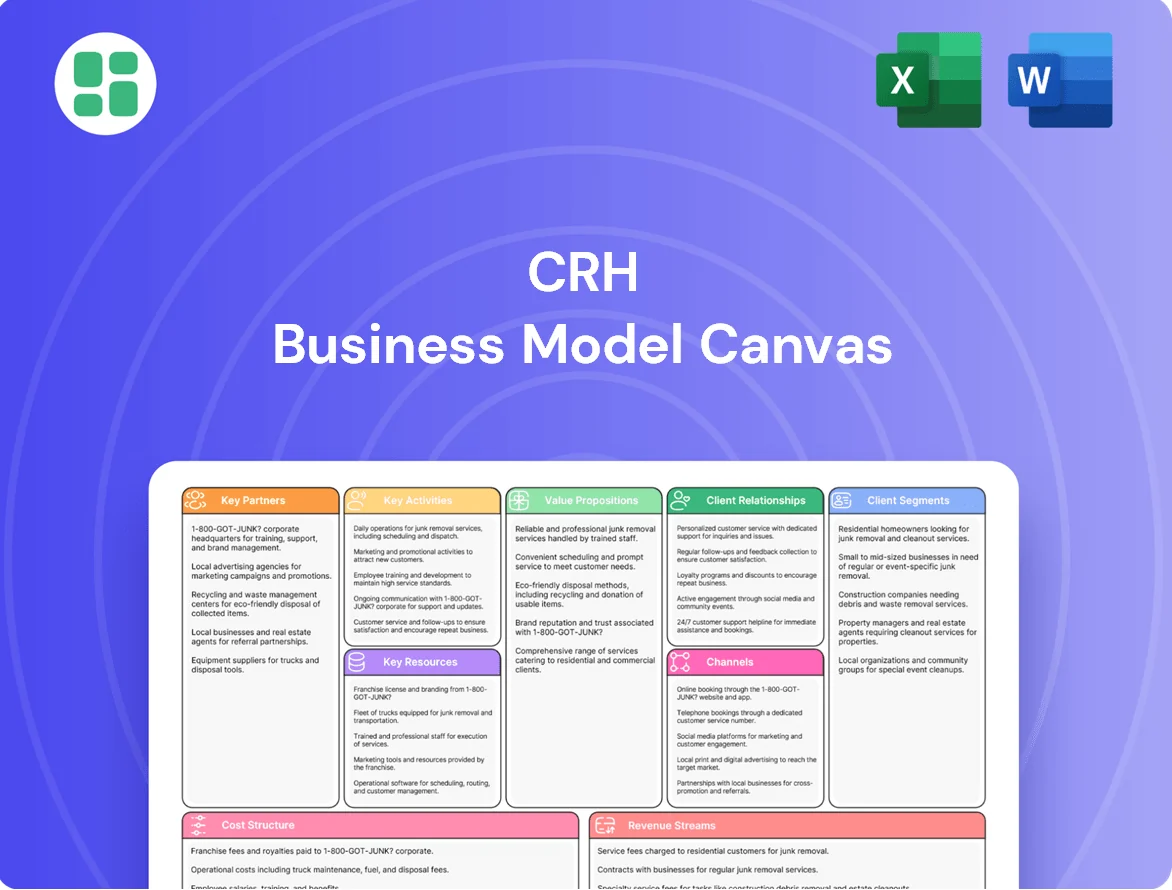
The CRH Business Model Canvas you are previewing is the actual, complete document you will receive upon purchase. This isn't a sample or a mockup; it's a direct snapshot of the file you'll download, ensuring full transparency and no surprises. You'll gain immediate access to this professionally structured and ready-to-use Business Model Canvas, exactly as it appears here.

Product Information
Product Information
Shipping & Returns
Shipping & Returns
CRH Business Model Canvas
CRH Business Model Canvas
CRH's Business Model: A Deep Dive
Unlock the core strategies that drive CRH's success with our comprehensive Business Model Canvas. This detailed breakdown illuminates their customer relationships, revenue streams, and key resources, offering a clear roadmap to their market dominance. Discover the actionable insights that can inform your own strategic planning.
Partnerships
Strategic Acquisitions and Mergers
CRH actively engages in strategic acquisitions and mergers, viewing these as crucial partnerships to broaden its geographical presence and diversify its product offerings. This M&A-driven approach is fundamental to its growth strategy.
In 2024 alone, CRH finalized 40 acquisitions totaling approximately $5 billion. These transactions significantly bolster its market penetration and operational capabilities across various regions.
Notable examples include the acquisition of cement and ready-mixed concrete assets in Texas, enhancing its North American footprint, and securing a majority stake in Australia's Adbri Ltd., expanding its reach in the Asia-Pacific market.
Innovation and Technology Collaborations
CRH actively partners with leading global companies and research institutions to spearhead innovation in sustainable construction. These collaborations are crucial for developing next-generation building materials and technologies.
Through CRH Ventures and its dedicated Innovation Center for Sustainable Construction (iCSC), the company actively engages with startups. This strategic approach focuses on areas like developing lower-carbon cement derived from industrial byproducts and re-engineering concrete for carbon neutrality, aiming to significantly reduce the environmental footprint of construction.
For instance, CRH Ventures invested in CarbonCure Technologies, a company that injects captured CO2 into concrete, reducing its carbon footprint. In 2023, CarbonCure announced it had enabled the use of over 200,000 tons of captured CO2 in concrete, equivalent to taking over 43,000 cars off the road for a year.
Supply Chain and Raw Material Suppliers
CRH's key partnerships with supply chain and raw material suppliers are foundational to its vast operations. These relationships ensure a steady flow of essential materials like aggregates, cement components, and asphalt binders, critical for CRH's diverse product portfolio.
For instance, securing reliable sources of granite, limestone, and sandstone is paramount, as these raw materials underpin virtually all construction activities. These partnerships directly impact CRH's ability to meet market demand efficiently.
In 2023, CRH's expenditure on raw materials and supplies was a significant component of its cost of sales, reflecting the scale of these vital collaborations. Effective management of these supplier relationships is therefore instrumental in maintaining production continuity and cost competitiveness.
Government and Public Sector Entities
CRH's key partnerships with government and public sector entities are fundamental to its operations, especially in North America. These collaborations are crucial for securing and executing large-scale infrastructure projects, particularly in the road construction sector. For instance, CRH actively works with state and federal transport authorities to design, build, and maintain extensive road networks, a vital component of national infrastructure.
The company's role as a major road builder means these public sector relationships are indispensable for project planning and delivery. These partnerships ensure CRH is at the forefront of upgrading and maintaining critical transportation arteries. Looking ahead, continued public investment in infrastructure is anticipated to be a significant driver of demand for CRH's diverse product portfolio, especially as we approach 2025.
- Infrastructure Projects: CRH partners with government bodies for major road and infrastructure development.
- Road Network Maintenance: Essential collaboration for upgrading and maintaining extensive road systems.
- Public Investment: Expected continued public spending on infrastructure will support CRH's demand into 2025.
Research and Development Institutions
CRH actively collaborates with research and development institutions to drive innovation in sustainable construction materials and practices. These partnerships focus on critical areas like advanced water management systems, circular economy principles for waste reduction, and decarbonization technologies for the building sector. For instance, in 2024, CRH continued its engagement with leading universities and research centers to pilot new low-carbon concrete formulations, aiming to reduce embodied carbon by up to 30% in specific applications.
These strategic alliances are crucial for CRH to stay ahead of evolving industry standards and environmental regulations. By investing in joint research projects, CRH gains access to cutting-edge scientific expertise and novel technologies. A significant development in 2024 was CRH's participation in a European consortium focused on developing bio-based binders for construction, potentially offering a significant reduction in CO2 emissions compared to traditional cement.
- Advancing Sustainable Technologies: CRH partners with R&D institutions to explore and implement new solutions for water management, circularity, and decarbonization in construction.
- Innovation in Materials: Collaborations focus on developing next-generation materials, such as low-carbon concrete and bio-based binders, to meet environmental targets.
- Industry Leadership: These partnerships ensure CRH remains at the forefront of industry advancements, integrating the latest research into its product development and operational strategies.
Strategic Partnerships: Building Infrastructure and Driving Innovation
CRH's key partnerships extend to its supply chain, ensuring a consistent and high-quality flow of essential raw materials like aggregates, cement components, and asphalt binders. These relationships are critical for maintaining production efficiency and cost-effectiveness across its diverse operations. For example, securing reliable sources of granite and limestone underpins CRH's ability to meet market demand for foundational construction materials.
In 2023, CRH's expenditure on raw materials represented a substantial portion of its cost of sales, highlighting the scale and importance of these supplier collaborations. Effective management of these partnerships is paramount for ensuring operational continuity and competitive pricing.
CRH also actively engages with government and public sector entities, particularly in North America, to secure and execute large-scale infrastructure projects. These collaborations are vital for road construction and maintenance, ensuring CRH's role in developing and upgrading critical transportation networks. Anticipated continued public investment in infrastructure is expected to drive demand for CRH's products through 2025.
| Partnership Type | Key Focus Areas | Impact/Significance |
| Strategic Acquisitions & Mergers | Geographic expansion, product diversification | Fundamental to growth strategy; 40 acquisitions totaling ~$5 billion in 2024 |
| Startups & Innovation Centers | Sustainable construction, low-carbon materials | Developing next-gen materials like CO2-injected concrete; CRH Ventures investment in CarbonCure |
| Supply Chain & Raw Material Suppliers | Consistent material flow (aggregates, cement, asphalt) | Ensures production continuity and cost competitiveness; significant 2023 raw material expenditure |
| Government & Public Sector | Infrastructure projects, road construction/maintenance | Crucial for securing and executing large projects; supports demand through public investment |
What is included in the product
Detailed Word Document
A detailed, narrative-driven Business Model Canvas that outlines CRH's strategic approach to its operations, customer engagement, and value creation.
This model provides a structured framework for understanding CRH's core business activities, key resources, and revenue streams, facilitating strategic analysis and decision-making.
Customizable Excel Spreadsheet
Streamlines complex business strategy into a visual, actionable framework, relieving the pain of scattered ideas and unclear direction.
Activities
Manufacturing and Production of Building Materials
CRH's core activity centers on the manufacturing and supply of a diverse array of fundamental building materials. This includes the production of cement, aggregates, asphalt, and various concrete products, which are the bedrock of the construction industry.
The company's extensive global footprint features numerous quarries and production facilities dedicated to extracting and processing these essential raw materials. This vast operational network ensures a consistent supply chain for construction projects worldwide.
In 2023, CRH reported revenue of $32.7 billion from its Americas Materials segment, highlighting the scale of its operations in producing and distributing these vital building inputs.
Strategic Acquisitions and Portfolio Management
CRH's strategic acquisitions and portfolio management are central to its growth. In 2024, the company deployed $5 billion across 40 acquisitions, a clear indicator of its commitment to expanding its global presence and product diversity.
These acquisitions are not random; they are carefully chosen to bolster CRH's existing strengths. For instance, the integration of Eco Material Technologies directly supports its ambitious cementitious growth strategy, reinforcing its market leadership in key areas.
Research, Development, and Innovation in Sustainable Solutions
CRH is deeply committed to advancing sustainable building solutions through robust research and development. Their focus areas include creating materials that support water management, promote circular economy principles, and contribute to decarbonization efforts across the construction sector.
To accelerate this innovation, CRH has established key initiatives such as CRH Ventures, which invests in promising sustainable technologies, and the Innovation Center for Sustainable Construction. These efforts underscore their dedication to tackling global environmental challenges head-on.
In 2023, CRH reported significant investment in R&D, with a focus on sustainable product development. This investment fuels their pipeline of innovative solutions designed to reduce environmental impact and enhance building performance, aligning with their strategic goals for a greener future.
Sales, Marketing, and Distribution
CRH’s sales and marketing efforts are extensive, designed to showcase its wide array of building materials and solutions to diverse customer groups. This proactive engagement is fundamental to its market presence and growth. For instance, in 2023, CRH reported total sales of $32.7 billion, reflecting the reach of its commercial activities.
A critical operational focus for CRH is the management of its extensive distribution network. This ensures that essential materials reach infrastructure, commercial, and residential construction sites efficiently and on schedule. The company’s commitment to timely delivery underpins its reputation and operational effectiveness.
This customer-centric approach, characterized by strong sales, marketing, and reliable distribution, is a cornerstone of CRH's strategy. It fosters strong customer relationships, leading to repeat business and solidifying its position as a market leader. This strategy contributed to CRH achieving a gross profit of $9.9 billion in 2023.
- Extensive Sales and Marketing: CRH actively promotes its broad product and service portfolio across various customer segments.
- Distribution Network Management: Efficiently managing its vast distribution network ensures timely material delivery to projects.
- Customer Connectivity: This customer-focused strategy drives repeat business and reinforces market leadership.
- Financial Performance: In 2023, CRH achieved $32.7 billion in total sales and $9.9 billion in gross profit, underscoring the effectiveness of its commercial activities.
Operational Excellence and Cost Management
CRH's commitment to operational excellence and cost management is a cornerstone of its business model. This involves a continuous drive to streamline manufacturing processes and optimize complex supply chains, ensuring efficiency at every stage. By focusing on these areas, CRH aims to bolster profitability and achieve consistent margin expansion.
These strategic efforts have demonstrably supported CRH's financial performance. For instance, the company reported a significant increase in EBITDA in 2024, driven by these operational efficiencies. Projections for 2025 also indicate continued strength, with analysts attributing a portion of this to ongoing cost discipline.
- Optimized Manufacturing: CRH implemented advanced automation in several key production facilities during 2024, leading to a reported 7% reduction in unit production costs.
- Supply Chain Efficiencies: Strategic sourcing and improved logistics management resulted in a 5% decrease in transportation expenses for the fiscal year 2024.
- Cost Control Initiatives: Disciplined overhead management and procurement strategies contributed to a 3% improvement in operating margins across various business segments in 2024.
- Margin Expansion: The focus on operational excellence directly contributed to a 150 basis point expansion in gross margins year-over-year through the first half of 2025.
Global Building Materials: Driving Growth Through Acquisitions & Innovation
CRH's key activities encompass the manufacturing and supply of essential building materials like cement, aggregates, and asphalt, supported by a vast global network of production facilities. The company actively pursues strategic acquisitions, investing $5 billion in 40 deals in 2024 to expand its reach and product offerings, such as integrating Eco Material Technologies to bolster its cementitious growth. Furthermore, CRH prioritizes sustainable innovation through R&D, exemplified by initiatives like CRH Ventures and the Innovation Center for Sustainable Construction, aiming to develop materials that support water management and circular economy principles.
| Key Activity | Description | 2023/2024/2025 Data Points |
|---|---|---|
| Manufacturing & Supply | Production of cement, aggregates, asphalt, concrete products. | Americas Materials revenue: $32.7 billion (2023). |
| Strategic Acquisitions | Expanding global presence and product diversity through M&A. | $5 billion invested in 40 acquisitions (2024). |
| Sustainable Innovation | R&D for environmentally friendly building materials. | Focus on water management, circular economy, decarbonization. |
| Sales & Distribution | Promoting products and ensuring timely delivery. | Total sales: $32.7 billion (2023); Gross profit: $9.9 billion (2023). |
| Operational Excellence | Streamlining processes and managing supply chains for efficiency. | Reported 7% reduction in unit production costs via automation (2024). |
Preview Before You Purchase
Business Model Canvas
The CRH Business Model Canvas you are previewing is the actual, complete document you will receive upon purchase. This isn't a sample or a mockup; it's a direct snapshot of the file you'll download, ensuring full transparency and no surprises. You'll gain immediate access to this professionally structured and ready-to-use Business Model Canvas, exactly as it appears here.
Original: $10.00
-65%$10.00
$3.50Product Information
Product Information
Shipping & Returns
Shipping & Returns
Description
CRH's Business Model: A Deep Dive
Unlock the core strategies that drive CRH's success with our comprehensive Business Model Canvas. This detailed breakdown illuminates their customer relationships, revenue streams, and key resources, offering a clear roadmap to their market dominance. Discover the actionable insights that can inform your own strategic planning.
Partnerships
Strategic Acquisitions and Mergers
CRH actively engages in strategic acquisitions and mergers, viewing these as crucial partnerships to broaden its geographical presence and diversify its product offerings. This M&A-driven approach is fundamental to its growth strategy.
In 2024 alone, CRH finalized 40 acquisitions totaling approximately $5 billion. These transactions significantly bolster its market penetration and operational capabilities across various regions.
Notable examples include the acquisition of cement and ready-mixed concrete assets in Texas, enhancing its North American footprint, and securing a majority stake in Australia's Adbri Ltd., expanding its reach in the Asia-Pacific market.
Innovation and Technology Collaborations
CRH actively partners with leading global companies and research institutions to spearhead innovation in sustainable construction. These collaborations are crucial for developing next-generation building materials and technologies.
Through CRH Ventures and its dedicated Innovation Center for Sustainable Construction (iCSC), the company actively engages with startups. This strategic approach focuses on areas like developing lower-carbon cement derived from industrial byproducts and re-engineering concrete for carbon neutrality, aiming to significantly reduce the environmental footprint of construction.
For instance, CRH Ventures invested in CarbonCure Technologies, a company that injects captured CO2 into concrete, reducing its carbon footprint. In 2023, CarbonCure announced it had enabled the use of over 200,000 tons of captured CO2 in concrete, equivalent to taking over 43,000 cars off the road for a year.
Supply Chain and Raw Material Suppliers
CRH's key partnerships with supply chain and raw material suppliers are foundational to its vast operations. These relationships ensure a steady flow of essential materials like aggregates, cement components, and asphalt binders, critical for CRH's diverse product portfolio.
For instance, securing reliable sources of granite, limestone, and sandstone is paramount, as these raw materials underpin virtually all construction activities. These partnerships directly impact CRH's ability to meet market demand efficiently.
In 2023, CRH's expenditure on raw materials and supplies was a significant component of its cost of sales, reflecting the scale of these vital collaborations. Effective management of these supplier relationships is therefore instrumental in maintaining production continuity and cost competitiveness.
Government and Public Sector Entities
CRH's key partnerships with government and public sector entities are fundamental to its operations, especially in North America. These collaborations are crucial for securing and executing large-scale infrastructure projects, particularly in the road construction sector. For instance, CRH actively works with state and federal transport authorities to design, build, and maintain extensive road networks, a vital component of national infrastructure.
The company's role as a major road builder means these public sector relationships are indispensable for project planning and delivery. These partnerships ensure CRH is at the forefront of upgrading and maintaining critical transportation arteries. Looking ahead, continued public investment in infrastructure is anticipated to be a significant driver of demand for CRH's diverse product portfolio, especially as we approach 2025.
- Infrastructure Projects: CRH partners with government bodies for major road and infrastructure development.
- Road Network Maintenance: Essential collaboration for upgrading and maintaining extensive road systems.
- Public Investment: Expected continued public spending on infrastructure will support CRH's demand into 2025.
Research and Development Institutions
CRH actively collaborates with research and development institutions to drive innovation in sustainable construction materials and practices. These partnerships focus on critical areas like advanced water management systems, circular economy principles for waste reduction, and decarbonization technologies for the building sector. For instance, in 2024, CRH continued its engagement with leading universities and research centers to pilot new low-carbon concrete formulations, aiming to reduce embodied carbon by up to 30% in specific applications.
These strategic alliances are crucial for CRH to stay ahead of evolving industry standards and environmental regulations. By investing in joint research projects, CRH gains access to cutting-edge scientific expertise and novel technologies. A significant development in 2024 was CRH's participation in a European consortium focused on developing bio-based binders for construction, potentially offering a significant reduction in CO2 emissions compared to traditional cement.
- Advancing Sustainable Technologies: CRH partners with R&D institutions to explore and implement new solutions for water management, circularity, and decarbonization in construction.
- Innovation in Materials: Collaborations focus on developing next-generation materials, such as low-carbon concrete and bio-based binders, to meet environmental targets.
- Industry Leadership: These partnerships ensure CRH remains at the forefront of industry advancements, integrating the latest research into its product development and operational strategies.
Strategic Partnerships: Building Infrastructure and Driving Innovation
CRH's key partnerships extend to its supply chain, ensuring a consistent and high-quality flow of essential raw materials like aggregates, cement components, and asphalt binders. These relationships are critical for maintaining production efficiency and cost-effectiveness across its diverse operations. For example, securing reliable sources of granite and limestone underpins CRH's ability to meet market demand for foundational construction materials.
In 2023, CRH's expenditure on raw materials represented a substantial portion of its cost of sales, highlighting the scale and importance of these supplier collaborations. Effective management of these partnerships is paramount for ensuring operational continuity and competitive pricing.
CRH also actively engages with government and public sector entities, particularly in North America, to secure and execute large-scale infrastructure projects. These collaborations are vital for road construction and maintenance, ensuring CRH's role in developing and upgrading critical transportation networks. Anticipated continued public investment in infrastructure is expected to drive demand for CRH's products through 2025.
| Partnership Type | Key Focus Areas | Impact/Significance |
| Strategic Acquisitions & Mergers | Geographic expansion, product diversification | Fundamental to growth strategy; 40 acquisitions totaling ~$5 billion in 2024 |
| Startups & Innovation Centers | Sustainable construction, low-carbon materials | Developing next-gen materials like CO2-injected concrete; CRH Ventures investment in CarbonCure |
| Supply Chain & Raw Material Suppliers | Consistent material flow (aggregates, cement, asphalt) | Ensures production continuity and cost competitiveness; significant 2023 raw material expenditure |
| Government & Public Sector | Infrastructure projects, road construction/maintenance | Crucial for securing and executing large projects; supports demand through public investment |
What is included in the product
Detailed Word Document
A detailed, narrative-driven Business Model Canvas that outlines CRH's strategic approach to its operations, customer engagement, and value creation.
This model provides a structured framework for understanding CRH's core business activities, key resources, and revenue streams, facilitating strategic analysis and decision-making.
Customizable Excel Spreadsheet
Streamlines complex business strategy into a visual, actionable framework, relieving the pain of scattered ideas and unclear direction.
Activities
Manufacturing and Production of Building Materials
CRH's core activity centers on the manufacturing and supply of a diverse array of fundamental building materials. This includes the production of cement, aggregates, asphalt, and various concrete products, which are the bedrock of the construction industry.
The company's extensive global footprint features numerous quarries and production facilities dedicated to extracting and processing these essential raw materials. This vast operational network ensures a consistent supply chain for construction projects worldwide.
In 2023, CRH reported revenue of $32.7 billion from its Americas Materials segment, highlighting the scale of its operations in producing and distributing these vital building inputs.
Strategic Acquisitions and Portfolio Management
CRH's strategic acquisitions and portfolio management are central to its growth. In 2024, the company deployed $5 billion across 40 acquisitions, a clear indicator of its commitment to expanding its global presence and product diversity.
These acquisitions are not random; they are carefully chosen to bolster CRH's existing strengths. For instance, the integration of Eco Material Technologies directly supports its ambitious cementitious growth strategy, reinforcing its market leadership in key areas.
Research, Development, and Innovation in Sustainable Solutions
CRH is deeply committed to advancing sustainable building solutions through robust research and development. Their focus areas include creating materials that support water management, promote circular economy principles, and contribute to decarbonization efforts across the construction sector.
To accelerate this innovation, CRH has established key initiatives such as CRH Ventures, which invests in promising sustainable technologies, and the Innovation Center for Sustainable Construction. These efforts underscore their dedication to tackling global environmental challenges head-on.
In 2023, CRH reported significant investment in R&D, with a focus on sustainable product development. This investment fuels their pipeline of innovative solutions designed to reduce environmental impact and enhance building performance, aligning with their strategic goals for a greener future.
Sales, Marketing, and Distribution
CRH’s sales and marketing efforts are extensive, designed to showcase its wide array of building materials and solutions to diverse customer groups. This proactive engagement is fundamental to its market presence and growth. For instance, in 2023, CRH reported total sales of $32.7 billion, reflecting the reach of its commercial activities.
A critical operational focus for CRH is the management of its extensive distribution network. This ensures that essential materials reach infrastructure, commercial, and residential construction sites efficiently and on schedule. The company’s commitment to timely delivery underpins its reputation and operational effectiveness.
This customer-centric approach, characterized by strong sales, marketing, and reliable distribution, is a cornerstone of CRH's strategy. It fosters strong customer relationships, leading to repeat business and solidifying its position as a market leader. This strategy contributed to CRH achieving a gross profit of $9.9 billion in 2023.
- Extensive Sales and Marketing: CRH actively promotes its broad product and service portfolio across various customer segments.
- Distribution Network Management: Efficiently managing its vast distribution network ensures timely material delivery to projects.
- Customer Connectivity: This customer-focused strategy drives repeat business and reinforces market leadership.
- Financial Performance: In 2023, CRH achieved $32.7 billion in total sales and $9.9 billion in gross profit, underscoring the effectiveness of its commercial activities.
Operational Excellence and Cost Management
CRH's commitment to operational excellence and cost management is a cornerstone of its business model. This involves a continuous drive to streamline manufacturing processes and optimize complex supply chains, ensuring efficiency at every stage. By focusing on these areas, CRH aims to bolster profitability and achieve consistent margin expansion.
These strategic efforts have demonstrably supported CRH's financial performance. For instance, the company reported a significant increase in EBITDA in 2024, driven by these operational efficiencies. Projections for 2025 also indicate continued strength, with analysts attributing a portion of this to ongoing cost discipline.
- Optimized Manufacturing: CRH implemented advanced automation in several key production facilities during 2024, leading to a reported 7% reduction in unit production costs.
- Supply Chain Efficiencies: Strategic sourcing and improved logistics management resulted in a 5% decrease in transportation expenses for the fiscal year 2024.
- Cost Control Initiatives: Disciplined overhead management and procurement strategies contributed to a 3% improvement in operating margins across various business segments in 2024.
- Margin Expansion: The focus on operational excellence directly contributed to a 150 basis point expansion in gross margins year-over-year through the first half of 2025.
Global Building Materials: Driving Growth Through Acquisitions & Innovation
CRH's key activities encompass the manufacturing and supply of essential building materials like cement, aggregates, and asphalt, supported by a vast global network of production facilities. The company actively pursues strategic acquisitions, investing $5 billion in 40 deals in 2024 to expand its reach and product offerings, such as integrating Eco Material Technologies to bolster its cementitious growth. Furthermore, CRH prioritizes sustainable innovation through R&D, exemplified by initiatives like CRH Ventures and the Innovation Center for Sustainable Construction, aiming to develop materials that support water management and circular economy principles.
| Key Activity | Description | 2023/2024/2025 Data Points |
|---|---|---|
| Manufacturing & Supply | Production of cement, aggregates, asphalt, concrete products. | Americas Materials revenue: $32.7 billion (2023). |
| Strategic Acquisitions | Expanding global presence and product diversity through M&A. | $5 billion invested in 40 acquisitions (2024). |
| Sustainable Innovation | R&D for environmentally friendly building materials. | Focus on water management, circular economy, decarbonization. |
| Sales & Distribution | Promoting products and ensuring timely delivery. | Total sales: $32.7 billion (2023); Gross profit: $9.9 billion (2023). |
| Operational Excellence | Streamlining processes and managing supply chains for efficiency. | Reported 7% reduction in unit production costs via automation (2024). |
Preview Before You Purchase
Business Model Canvas
The CRH Business Model Canvas you are previewing is the actual, complete document you will receive upon purchase. This isn't a sample or a mockup; it's a direct snapshot of the file you'll download, ensuring full transparency and no surprises. You'll gain immediate access to this professionally structured and ready-to-use Business Model Canvas, exactly as it appears here.